Protect

English

Work Injury in Japan: Rosai Insurance Covers Foreign Workers Too

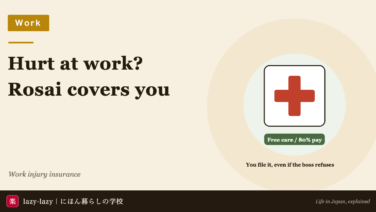
Japan's work injury insurance (rosai) covers foreign workers regardless of nationality, including students injured during part-time jobs, and the employer pays the premium. Health insurance cannot be used for a work or commuting injury: treatment at a rosai-designated hospital is free, and the full cost is refunded if you had to pay elsewhere. From the fourth day off work you receive 80% of your basic daily wage, about 5,217 yen a day on 200,000 a month. You file the claim yourself at the Labour Standards Inspection Office, even if the employer refuses to certify, never enrolled, or has closed, and even after you have left Japan. Time limits: two years for treatment and absence benefit, five for disability and survivors. The MHLW brochure is available in 13 languages.
English

Visa Renewal Denied in Japan: Why It Happens and What to Do Next

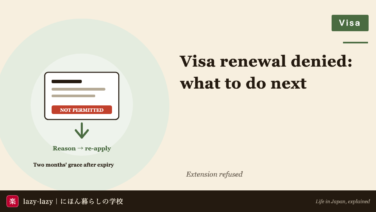
A denied visa renewal in Japan means the Minister of Justice found no reasonable grounds to extend. The Immigration Services Agency's guidelines review eight factors: the activity fits the status, landing criteria, actually doing the activity, conduct, livelihood, employment conditions, tax paid and notifications filed. Its nine published denial cases are criminal punishment (5), a false statement about the notified address (1), not carrying out the status's activity (2) and no settledness (1). If no decision arrives by your expiry date, you may stay on your current status until the decision or two months after expiry, whichever is earlier, with the application noted on the back of your residence card. After a denial: ask the counter for the reason, re-apply or change status within your period of stay, and otherwise prepare to leave, asking the counter how many days you have. No fee is charged on a denial.
English

Unemployment Benefits in Japan for Foreigners: 80% Pay From Day 4

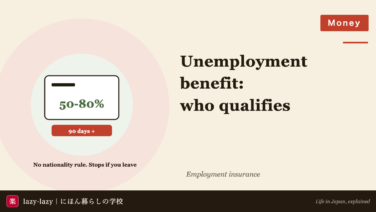
Japan's unemployment benefit (the basic allowance of employment insurance) is open to any foreign resident who was enrolled, whatever their nationality. Conditions: 12 months insured in the two years before leaving (6 months in one year after dismissal or bankruptcy) and looking for work in Japan through Hello Work. Student part-timers are excluded as daytime students. The daily amount is 50-80% of your previous daily wage, capped at 7,450 yen under age 30 as of August 2026. Voluntary leavers get 90 days with under 10 years insured; dismissed workers 90-330 days by age and years. Voluntary leavers wait 7 days plus a one-month restriction (for separations from 1 April 2025; formerly two months); dismissed workers start after 7 days. Recognition happens every four weeks in person, so leaving Japan ends the payments. The claim window is one year from the day after leaving.
English

Leaving a Job in Japan as a Foreigner: What to Do in 14 Days

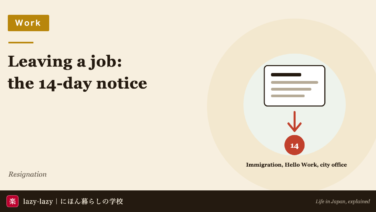
When a foreign resident leaves a job in Japan, three offices need to hear from you. Immigration: within 14 days, file the notification of the contracting or affiliated organization online, in person or by post; skipping it is a fine of up to 200,000 yen. From the employer, get the rishokuhyo and the withholding slip; if they will not issue the rishokuhyo, ask Hello Work. Health insurance ends the day after you leave, so choose voluntary continuation (20 days, double premium, up to two years), National Health Insurance (14 days) or a family member's plan. Pension: register for the National Pension within 14 days. Three months without the status's activity can mean revocation, but job-hunting is a listed good reason. Leaving Japan: employer, immigration, insurance and pension, income and resident tax, pension lump-sum, moving-out notice, departure. Appoint a tax agent before you board.
English

Hanko for Foreigners in Japan: Do You Need One, and How to Register

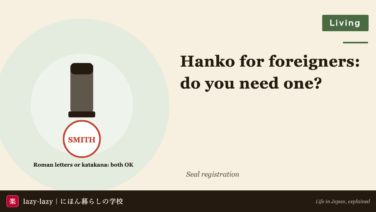
Foreign residents aged 15 or over with a resident record can register a seal (jitsuin) in roman letters, kanji or katakana, but only a name that is on the resident record. For katakana, first have the katakana reading added to the record; for kanji, have it added to the residence card first. Mixed names, initials only and rubber or self-inking stamps are refused, and the impression must be larger than 8 mm and within 25 mm square. You need a registered seal only when someone asks for the seal certificate: registering a car, buying property, a loan. National procedures dropped ordinary seals almost entirely, so few people need one right away. Bring the seal and your residence card, usually same day; certificates are about 300 yen. Moving to another municipality cancels the registration.
English

Kakutei Shinkoku 2026: Who Must File a Tax Return in Japan

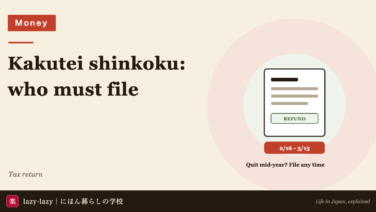
You must file a Japanese tax return (kakutei shinkoku) if you have two or more employers with unadjusted pay plus other income over 200,000 yen, side income over 200,000 yen, or a salary over 20 million yen. One employer with a year-end adjustment and other income of 200,000 or less means no return. If you quit mid-year with no adjustment there is no duty, but a refund return brings the over-withheld tax back and can be filed any time for five years. The window is 16 February to 15 March; late filing carries a penalty of 5% if voluntary and 15% or more after an audit, with no penalty if you file within a month and pay in full. Leaving Japan before filing means appointing a tax agent. Bring your withholding slip and My Number Card; a Special Residence Card counts.
English

Visa Cancelled in Japan: What Really Triggers It and What Happens Next

Japan revoked 1,446 statuses of residence in 2025, a record; 67% were technical intern trainees and 24% students. Nine in ten were for doing nothing: three months or more without the status's activity (69%) or doing something else instead (24%). Every one of those grounds says except where there is good reason, so job-hunting records, a leave-of-absence form or a medical certificate protect you. You are always heard before a revocation and may state your case, submit evidence and see the file. Even after revocation, everyone except those who entered by deceit gets up to 30 days to leave voluntarily; failing to leave in that period means deportation and criminal penalties.
English

My Number Card in Japan: It Expires With Your Period of Stay

A foreign resident's My Number Card does not last ten years. It expires on the day your period of stay expires. Only Permanent Residents, Highly Skilled Professional (ii) and Special Permanent Residents get the tenth-birthday rule. Extending your stay is only half the job: you must also extend the card at your city office, or it lapses, and if the new residence card is late you can phone the city office for a special extension. Since 14 June 2026 the residence card and My Number Card can be one Special Residence Card, but you cannot apply for it on its own, there is no online route, it takes at least two weeks, and your electronic certificates lapse about a week before you collect it.
English

Residence Tax in Japan: It Starts in Year Two, Even After You Leave

Residence tax is charged on last year's income by the municipality where you had your address on 1 January. Nothing is charged in the year you arrive; it starts in June of your second year, as twelve payroll deductions from June to May or four bills in June, August, October and January. The rate is 10% of taxable income plus a flat 5,000 yen (4,000 yen per-capita and 1,000 yen forest environment tax). Low income last year means exemption: in Tokyo's 23 wards with no dependants, total income of 450,000 yen or less, roughly a salary of 1.1 million yen. Leaving Japan does not cancel it: have your employer deduct the balance, appoint a tax agent, or pay before you go. No address in Japan on 1 January means no tax for the following year.
English

Lost Residence Card in Japan: Police, Then Immigration Within 14 Days

Losing your residence card does not lose you your status of residence. Two steps: report it to the police and get the receipt number, then apply for a reissue at your regional immigration office within 14 days of noticing. There is no fee and the new card is normally issued the same day. Bring the form, one photo, the statement with the police number, your passport and any part-time work permit slip. Lost it abroad? Special re-entry permission does not require the card, so you can still come back; apply within 14 days of landing. Special Residence Card holders get an ordinary card first and should suspend the My Number function. Never applying is an offence: up to a year's imprisonment or a 200,000 yen fine.
English

Nenmatsu Chosei 2026: Japan’s Year-End Tax Adjustment Explained

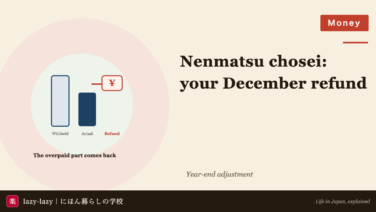
Nenmatsu chosei is the December procedure in which your employer settles the difference between the income tax withheld from your pay all year and the tax you actually owe, usually as a refund. You are covered if you filed the dependants declaration and are employed in December; you hand in three forms. From the December 2026 adjustment the basic deduction rises from 580,000 to 1,040,000 yen for income of 1.32 million or less and the minimum employment-income deduction from 650,000 to 740,000, so salary-only earners pay no income tax up to 1.78 million yen. Withholding through November is unchanged. Quit mid-year and you usually file your own return; leaving Japan is adjusted at departure. Family abroad needs relationship and remittance documents, with a 380,000-yen remittance rule for relatives aged 30 to 69.
English

Re-Entry Permit Japan: Who Needs One, Fees, and the One-Year Trap

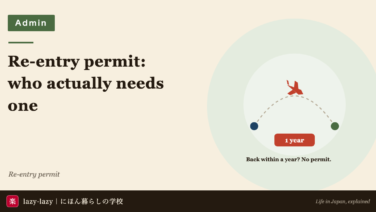
If you return within one year of leaving Japan you do not need a re-entry permit: special re-entry permission covers you, and you simply tick a box on the ED card at the airport, free. But it ends when your period of stay ends if that is sooner, and it cannot be extended from abroad (Immigration Act article 26-2 (3)). If there is any chance of being away longer, get an ordinary re-entry permit before departure - 4,000 yen single or 7,000 multiple, issued the same day - which a Japanese consulate can extend for up to a year and six years in total. Losing your residence card abroad does not stop re-entry, and a proxy in Japan can obtain a certificate of your deadline. Miss the deadline and you cannot re-enter on that status; it starts again from a visa.
English

How to Bring Your Family to Japan: Spouse and Children, Not Parents

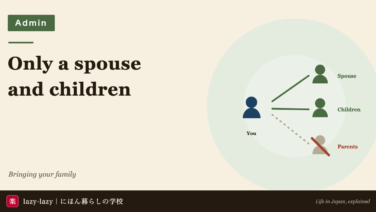
Bringing your family to Japan means getting them the Dependent status of residence, and the provision names only a spouse and children. Parents are not covered. The status you hold also decides it: Engineer/Specialist, Specified Skilled Worker (ii) and Student can bring dependents, while SSW (i) and Technical Intern Training cannot. The order is a Certificate of Eligibility in Japan, sent home, then a visa at the embassy there. A student proves support with a bank balance certificate. Nepalese family members have needed a TB clearance certificate since 23 June 2025; Sri Lanka is not covered.
English

Japan Visa Fee Increase 2026: Permanent Residence Now 200,000 Yen

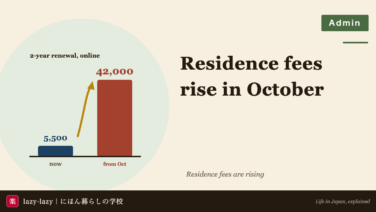
Residence permit fees change on 1 October 2026. The flat rate is replaced by amounts based on the period of stay granted.
English

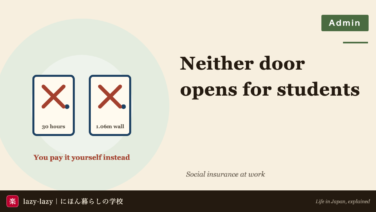
Student Part-Time Work in Japan: Why Social Insurance Does Not Apply

Student part-time workers in Japan do not join employer health insurance or the employee pension.
English

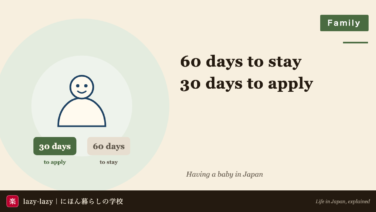
Having a Baby in Japan: The 30-Day Rule and the 500,000 Yen Grant

Japan has no birthright citizenship, so a baby born to foreign parents is a foreign national and needs a status of residence.
English

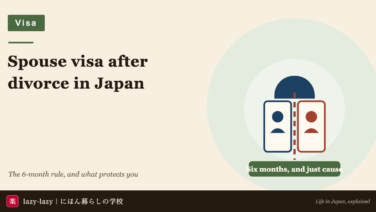
Spouse Visa Japan and Divorce: The 6-Month Rule Explained

Divorce or bereavement must be reported to immigration within 14 days, but divorce does not end your status of residence on the spot.
English

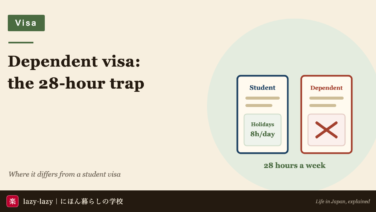
Dependent Visa Japan: Working Hours and the 28-Hour Work Permit

A dependent visa permits no work until you hold a work permit.
English

Do I Have to Carry My Residence Card in Japan? Rules, Fines, Renewal

You must carry your residence card at all times in Japan. Only people under 16 are exempt, and permanent residents are not.
English

Can Permanent Residency Be Revoked in Japan? The 2027 Rules

From April 2027 permanent residence in Japan can be revoked on three grounds: unpaid public dues, Immigration Act breaches, and certain crimes.
English

Japan National Pension for Students: 17,920 Yen and How to Defer It

Residents aged 20 and over must join the National Pension, students included, and the premium is 17,920 yen a month.
English

Visa Renewal in Japan: Timing, Documents and the 1 October Fee Rise

You can file from roughly three months before your period of stay ends. The fee is 6,000 yen, or 5,500 yen online.
English

How to Choose a Japanese Language School: Check Accreditation First

Before anything else, check whether the school is accredited.
English

Certificate of Eligibility (COE) Japan: Timeline and Why Some Fail

The COE is Japan's pre-approval before your visa. Your school files it for you, the review takes 1 to 3 months, and it stays valid for 3 months.
English

Permanent Residency in Japan 2026: Rules and the 2027 Changes

Ten years is the standard, but from April 2027 your residence card must show a 5-year period of stay, and permanent residence becomes revocable.
English

Medicine in Japan 2026: What You Cannot Bring, and the New Rules

Cold medicine with pseudoephedrine cannot enter Japan, prescription or not. Since May 2026 under 18s get one small pack and ID is checked.
English

Converting Your Foreign Driving Licence in Japan (2026)

A Nepali licence does not work in Japan even with an IDP. Sri Lankan and Indian ones do, until the three month rule cancels them.
English

Rent Increase in Japan: Why You Can Say No (Tenant Rights 2026)

Your landlord cannot raise your rent without your agreement under a standard lease.
English

Student Visa to Work Visa in Japan: 97% Are Approved, Why Some Are Not

In 2024, 96.7% of applications to change from a student visa to a work visa were approved.
English

Leaving Japan for Good: The Checklist That Saves You Money

Leaving Japan permanently? The moving-out notice unlocks your pension refund and stops your bills.
English

Seeing a Doctor in Japan 2026: Clinics, Hospitals and What You Pay

How to see a doctor in Japan: clinic or hospital, the 5 steps of a visit, Japanese phrases that work.
English

Move-Out Costs in Japan: What You Really Owe (and What You Don’t)

Move-out costs in Japan explained. Normal wear is the landlord responsibility; you pay only for damage you caused.
English

Residence Registration (Juminhyo) in Japan: The 14-Day Rule

How foreigners register their address (juminhyo) in Japan. The 14-day rule, what to bring, why you need it for a bank, SIM, insurance and jobs.
English

Health Insurance in Japan for Foreigners: Which One You Are In

Japan has two public health insurances and you are in exactly one. Company employees are enrolled by their employer in Employee Health Insurance (about 10% of salary, half paid by the employer, dependants free). Everyone else - students, the self-employed, people between jobs - joins National Health Insurance at the city office within 14 days and pays the whole premium. Both leave you paying 30% at the clinic. Private insurance is a top-up, not a substitute. This guide tells you which one you are in, then explains kokuho in full: joining, premiums, reductions, what happens if you fall behind, and the high-cost ceiling from August 2026.