Figures, prices and terms were checked against the MHLW medical fee schedule (revision effective 1 June 2026) on 23 August 2026, and the first- and repeat-visit fees again on 2 October 2026. They change — check the current terms yourself before you sign up or file anything.
Last updated: October 2026
In short
- A first visit to a clinic costs about 880 yen at the desk, and a repeat visit about 230 yen. Under the national fee schedule from June 2026, a first visit is 2,930 yen and a repeat visit 780 yen, and with insurance you pay 30% (under 70; 20% before primary school). Tests and medicine are added on top. Without your insurance card you pay 100% that day.
- Feeling sick? Go to a small local clinic first. You go to a big hospital only with a referral letter.
- A visit has 5 steps: reception, intake form, doctor, payment, pharmacy. Show your insurance card and you pay only 30 percent.
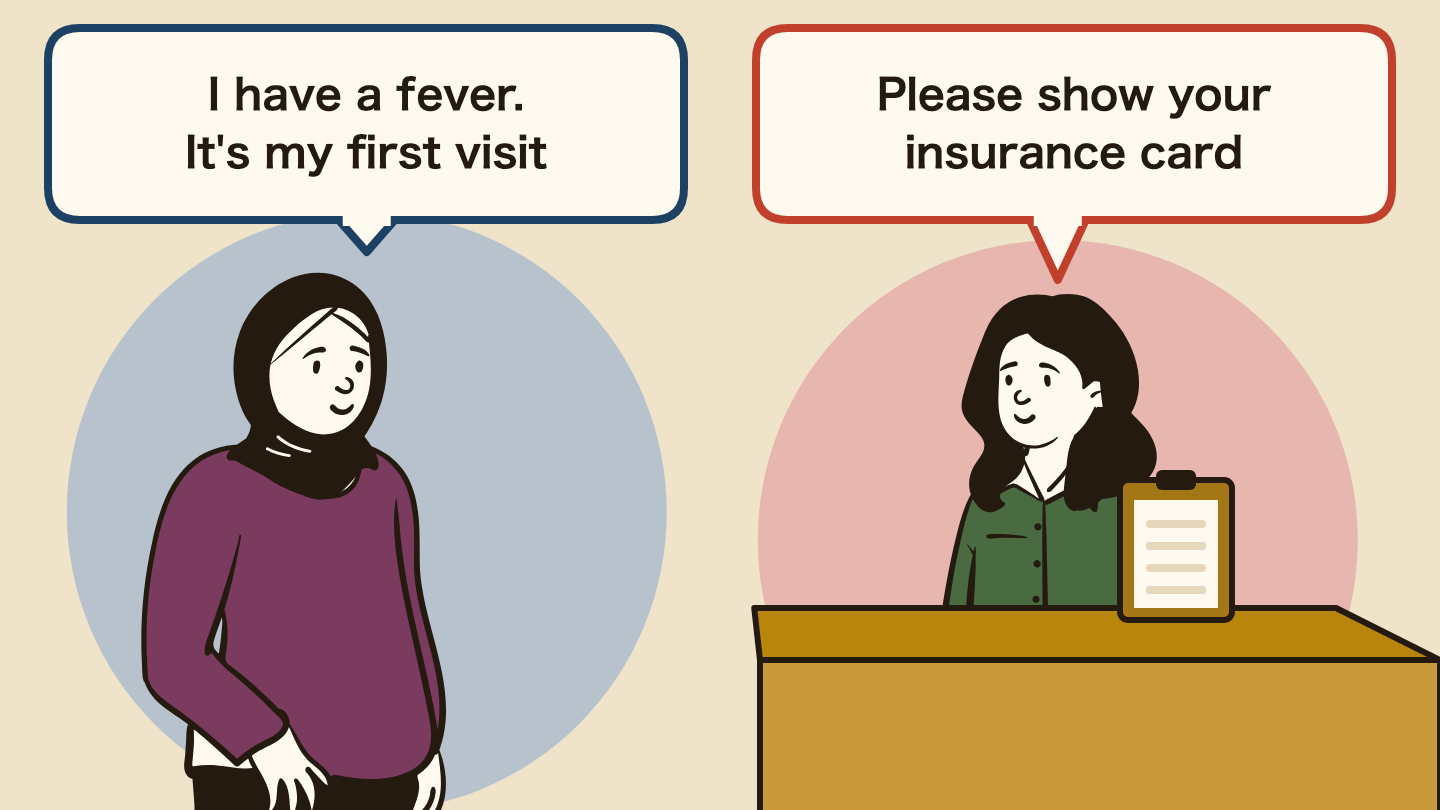
- Tell the doctor three things: since when, where, and how it feels. Simple Japanese or a translation app is fine.
- Life-threatening emergency: call 119 for an ambulance – it is free. Not sure if you need one? Call #7119 for advice.
- How insurance itself works (joining, premiums) is in our National Health Insurance guide.
Knowing this, on the night the fever starts you already know where to go in the morning and what to say at the desk.
First, the big picture. Japanese healthcare has two levels: the clinic (診療所 / shinryojo – a small doctor's office) and the hospital (病院 / byoin). The basic rule that surprises many foreigners: you do not start at the big hospital.
- Clinic or hospital – which one do I go to?
- Which department do I go to?
- How much does a hospital visit cost?
- What happens during the visit? The 5 steps
- How do I explain my symptoms in Japanese?
- What do I need to bring?
- What if you cannot pay the bill?
- Can I get an interpreter if nobody speaks my language?
- Emergency: when do I call 119, and when #7119?
- What about the cost? Insurance covers 70 percent
- Frequently asked questions
- Summary
- Related guides
Clinic or hospital – which one do I go to?
You come down with a fever and decide that, if you are going to see a doctor, it might as well be the big, well-equipped hospital. Where you come from, that may be the safest choice. In Japan, you start at a local clinic: walk into a large hospital without a referral letter and you can be charged an extra 7,000 yen or more.
Start at a clinic. It handles colds, fevers, minor injuries and allergies (an injury at work or on the commute goes through rosai insurance, not health insurance). If you need surgery, admission or big tests, the clinic writes you a referral letter to a hospital.
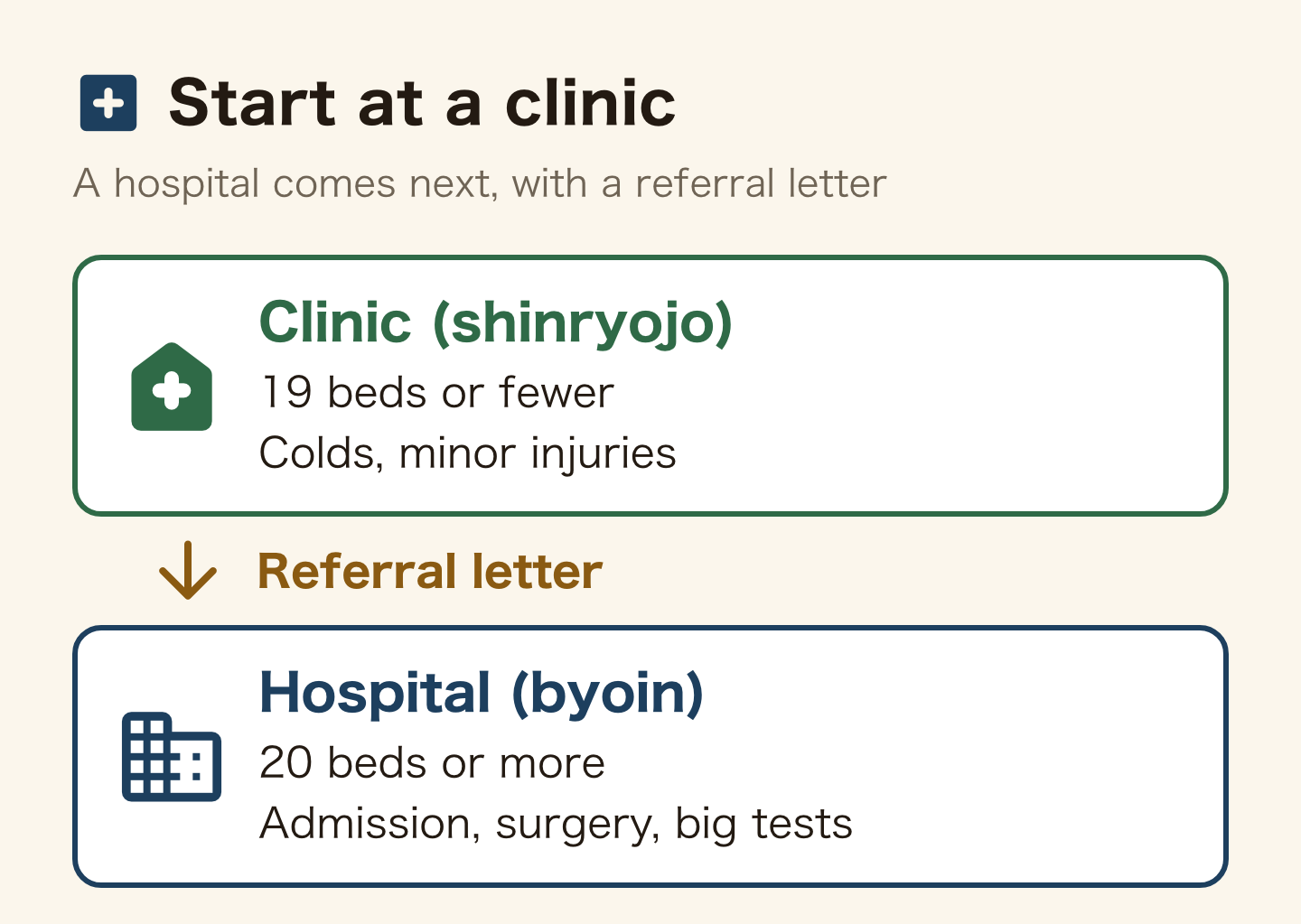
Why not go straight to a big hospital? Because without a referral letter (紹介状 / shokaijo), large hospitals charge an extra fee of 7,000 yen or more on top of your bill. Pick the right department instead: naika (内科, general medicine) for fever and stomach problems, jibika (耳鼻科) for ear, nose and throat, ganka (眼科) for eyes.
Which department do I go to?
You settle on a clinic and then stall again right here. Japanese medical departments are finely split, and the kanji on the sign gives you nothing to work with.
| Symptom | Department | Japanese |
|---|---|---|
| Fever, cough, sore throat, fatigue | Internal medicine | 内科 (naika) |
| Stomach pain, diarrhoea, nausea | Internal medicine | 内科 (naika) |
| Injury, fracture, back or joint pain | Orthopaedics | 整形外科 (seikei geka) |
| Itching, rash, skin problems | Dermatology | 皮膚科 (hifuka) |
| Eye pain, itching, blurred vision | Ophthalmology | 眼科 (ganka) |
| Ear, nose, throat, hay fever | ENT | 耳鼻咽喉科 (jibi inkoka) |
| Toothache | Dentistry | 歯科 (shika) |
| Low mood, cannot sleep | Psychosomatic medicine | 心療内科 (shinryo naika) |
| Children (up to about 15) | Paediatrics | 小児科 (shonika) |
When in doubt, internal medicine. It covers the body generally and will refer you onward if a specialist is needed. Turning up at the wrong department is not a problem. Describe the symptom at reception and they will tell you on the spot: that one is dermatology. If low mood or sleepless nights keep coming back, start with psychiatry versus psychosomatic medicine, and helplines in your language. If you wear contact lenses and your eye is red or painful, check which eye symptoms mean see a doctor now, and what the contact lens exam costs before you phone the clinic.
How much does a hospital visit cost?
With an insurance card you pay 30% of the treatment cost. On top of that, your first visit to any clinic carries a first-visit fee.
That fee is 2,910 yen. Since June 2026 a 20 yen outpatient price-adjustment fee is added, which makes 2,930 yen (Ministry of Health, Labour and Welfare, FY2026 medical fee schedule (Japanese PDF)). At 30% that is about 880 yen. A repeat visit is 780 yen, so about 230 yen. Tests and medicine are added on top of these, so the total depends on what the doctor does.
The expensive mistake is walking into a large hospital directly. Without a referral letter, a large hospital charges an extra 7,000 yen or more for a first visit, and 3,000 yen or more for a repeat visit. This applies to advanced treatment hospitals and to hospitals of 200 beds or more that hold regional support or referral-focused status. The amounts have been set at this level since October 2022.
What makes it hurt: insurance does not touch this charge. There is no 30%. You pay all of it, on top of your 30% share of the visit itself. The ministry sets only the minimum (7,000 yen including tax), and each hospital may set its own amount at or above it. Emergency patients must not be charged this fee.
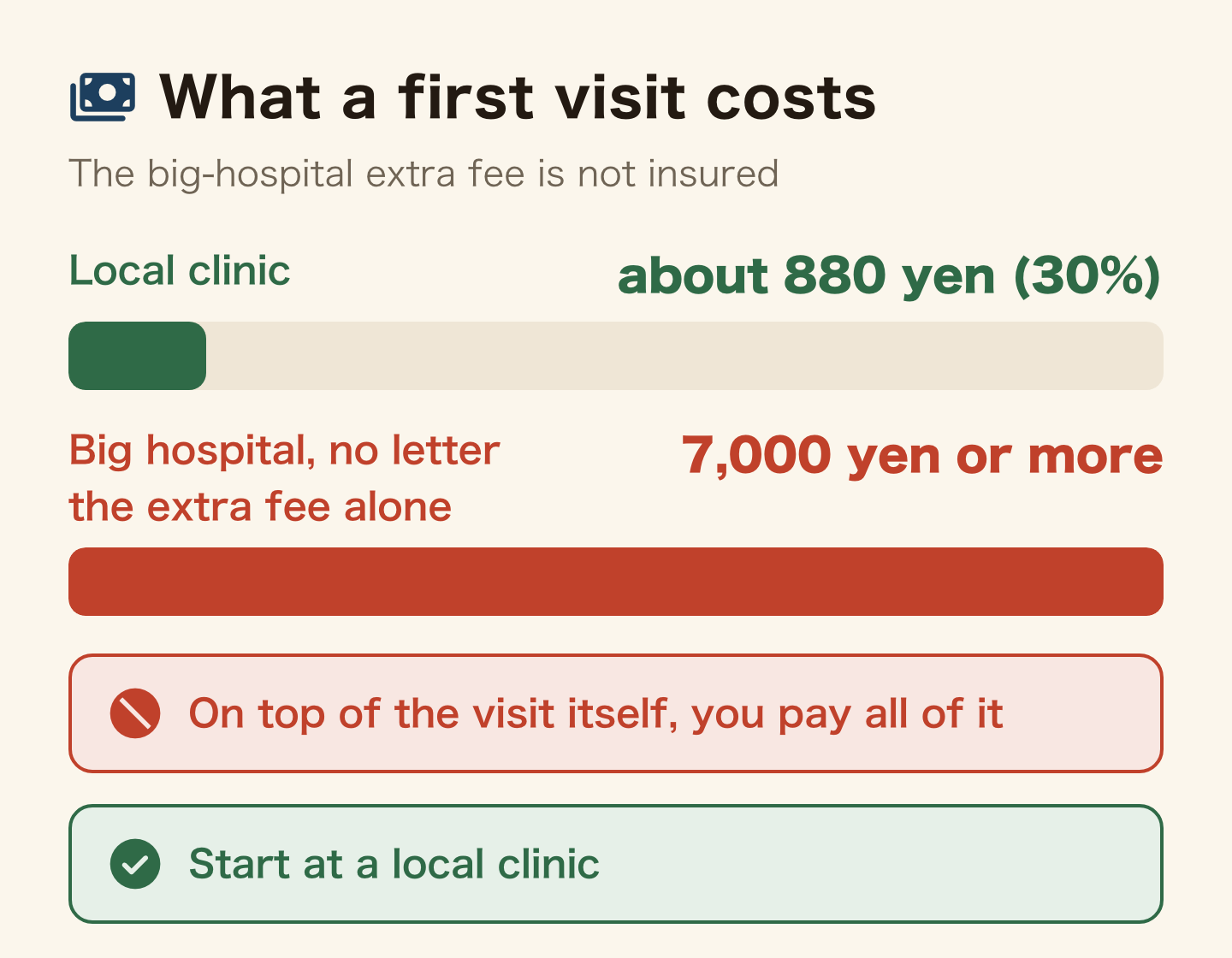
Thinking a bigger hospital is the safer choice is exactly what walks you into it. Start at a local clinic. Get a referral letter if you need one, and that 7,000 yen never appears.
What happens during the visit? The 5 steps
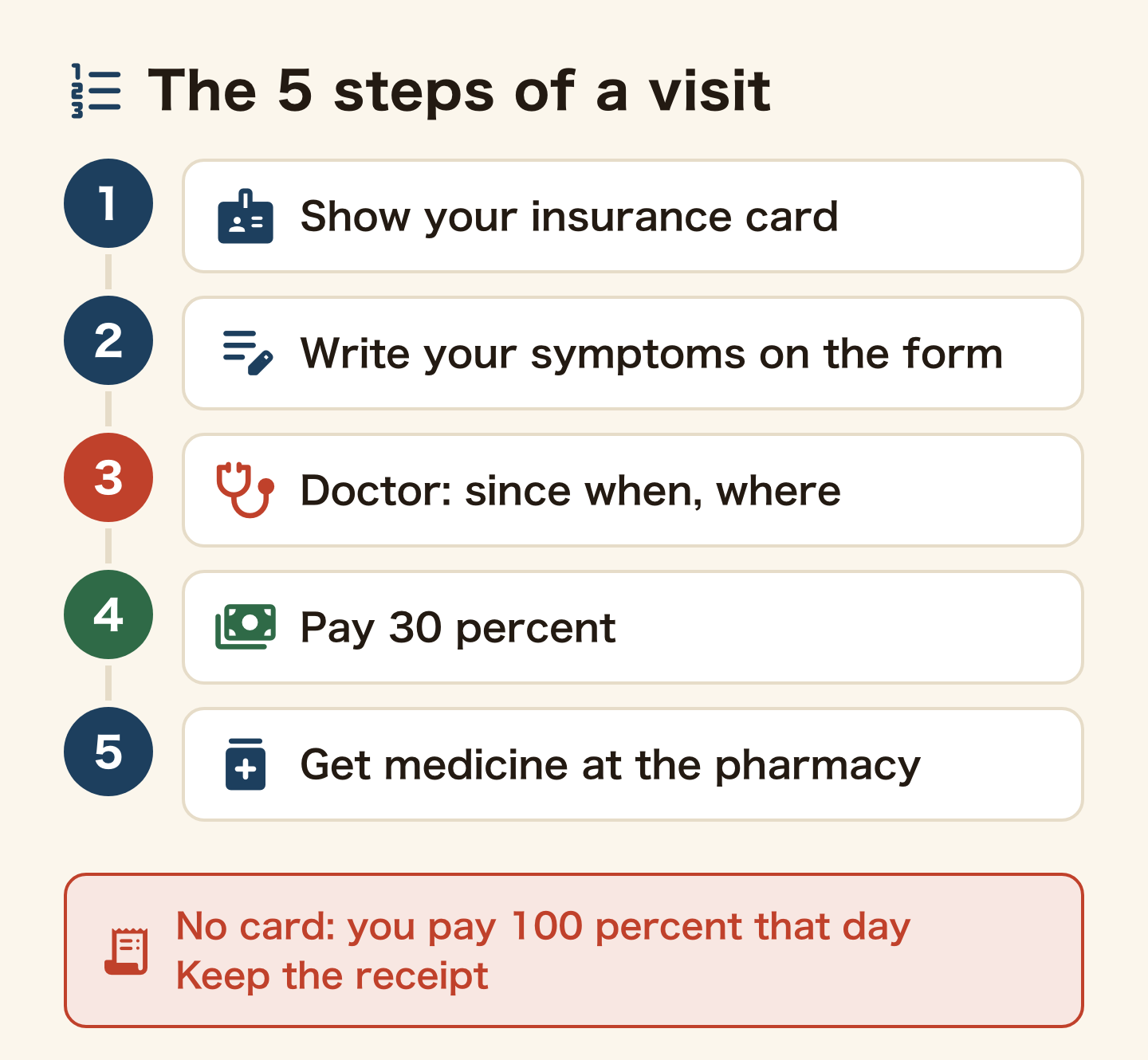
Reception, intake form, examination, payment, pharmacy – in that order. Bring your insurance card, your residence card, and cash or a card.
How do I explain my symptoms in Japanese?
Say three things: since when, where, and how it feels. These exact phrases work:
| What you want to say | Japanese phrase |
|---|---|
| Since when | Kino kara (きのうから – since yesterday) / Mikka mae kara (3日前から – since 3 days ago) |
| My head hurts | Atama ga itai desu (頭が痛いです) |
| My throat hurts | Nodo ga itai desu (のどが痛いです) |
| My stomach hurts | Onaka ga itai desu (おなかが痛いです) |
| I have a fever | Netsu ga arimasu (熱があります) |
| I have a cough | Seki ga demasu (せきが出ます) |
| I feel nauseous | Hakike ga shimasu (はき気がします) |
| Please speak slowly | Yukkuri onegaishimasu (ゆっくりお願いします) |
Nervous about speaking? Show your symptoms on a translation app – doctors are used to it. Large hospitals sometimes have medical interpreters and multilingual intake forms.
What do I need to bring?
So that reception is not where you get stuck, bring these.
- Your health insurance card (My Number health card, or a qualification confirmation document) – without it you pay the full amount that day. The old cards no longer work, so check which one you should be showing before you go
- Your residence card for identification
- Money, and cash is the safe answer. Plenty of clinics still do not take cards
- If you take any medication, your medicine notebook or the boxes themselves
- A referral letter if you have one (without it a large hospital adds 7,000 yen or more)
Forgetting your insurance card does not stop you being seen. You pay 100% at the counter that day. Some clinics refund the difference if you bring your card back later; not all do. If yours will not, apply to your health insurer (the city office for National Health Insurance) for a reimbursement called ryoyohi. If they accept that you had an unavoidable reason, you get back the insured share, which is 70% for most people. Do not throw the receipt away.
What if you cannot pay the bill?
Money runs short and bodies break down on the same days. There is an order to work through.
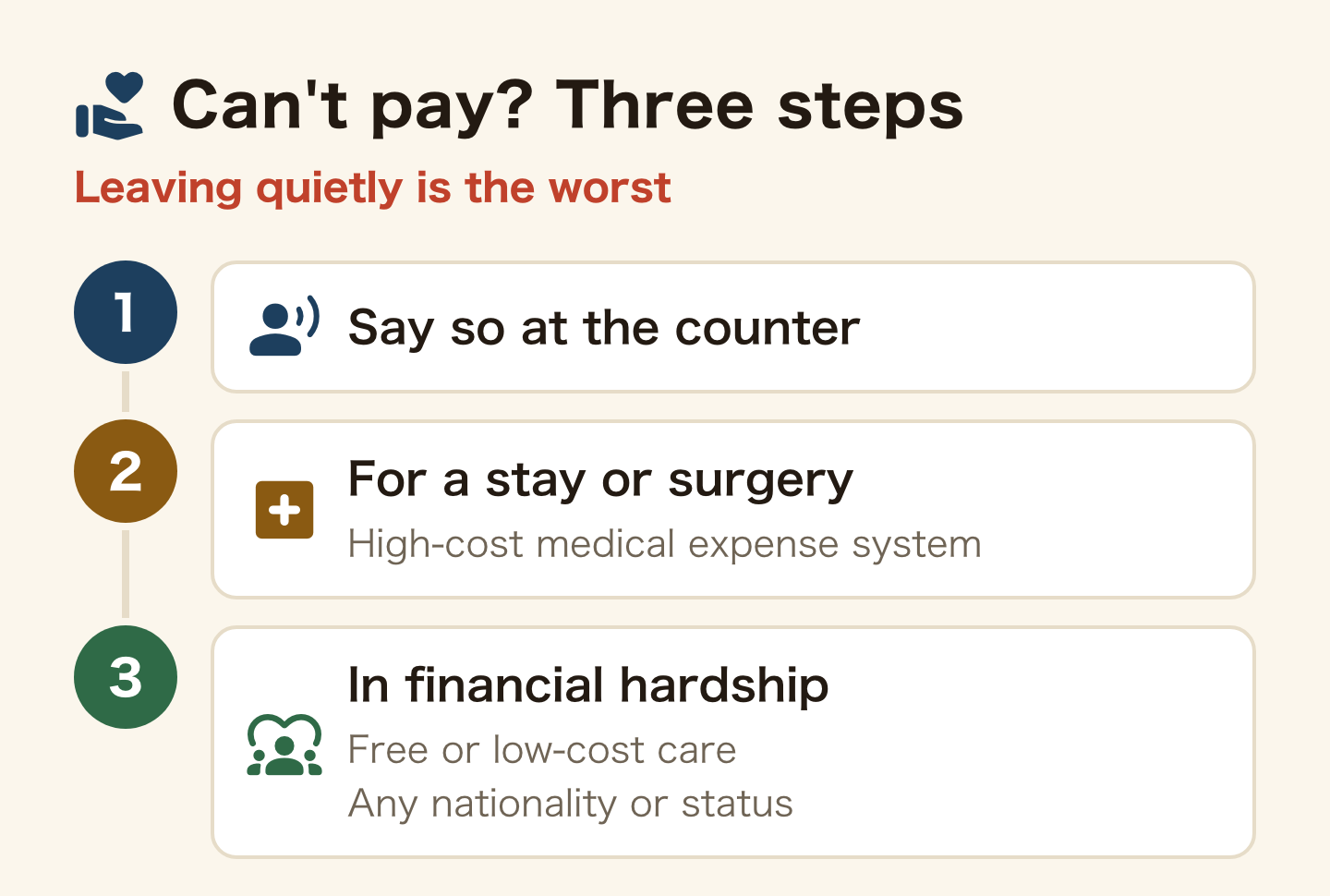
Say so at the counter. Tell them you cannot pay the full amount today and many hospitals will arrange instalments or a later date. Leaving quietly is the worst version of this.
For hospital stays or surgery, use the high-cost medical expense system. Your monthly out-of-pocket cost is capped, and if you use a My Number health card or obtain a “limit application certificate” in advance, the counter simply stops charging at that cap. The cap for your income band, and where to claim if you already paid, are in the high-cost medical expense guide.
There is also a scheme few people know about: the free or low-cost medical care service. Established under the Social Welfare Act, it lets people in financial hardship receive treatment free or at reduced cost.
The important part: it does not depend on your nationality, or on whether you hold a residence status at all. A March 2005 notice from the Ministry of Health, Labour and Welfare states that treating someone without residence status does not put the institution in breach of immigration law, and that the institution is under no obligation to report it.
Not every hospital runs it, though. Participating institutions are limited. To find one, ask your prefecture’s hospital affairs section, or an organisation that supports foreign residents. Public consultation desks are listed on our links page.
Can I get an interpreter if nobody speaks my language?
This gets misunderstood, so start with how it actually works. Medical interpreting is not something a patient books. Hospitals and prefectures hold contracts with interpreting services, and the hospital dials in an interpreter when one is needed.
Which means you cannot summon one on the day. The answer is choosing a hospital that already has interpretation, before you need it. Knowing what to ask on the phone, who pays for the interpreter, and the 13-language questionnaires for hospitals without one saves you from panicking on the day.
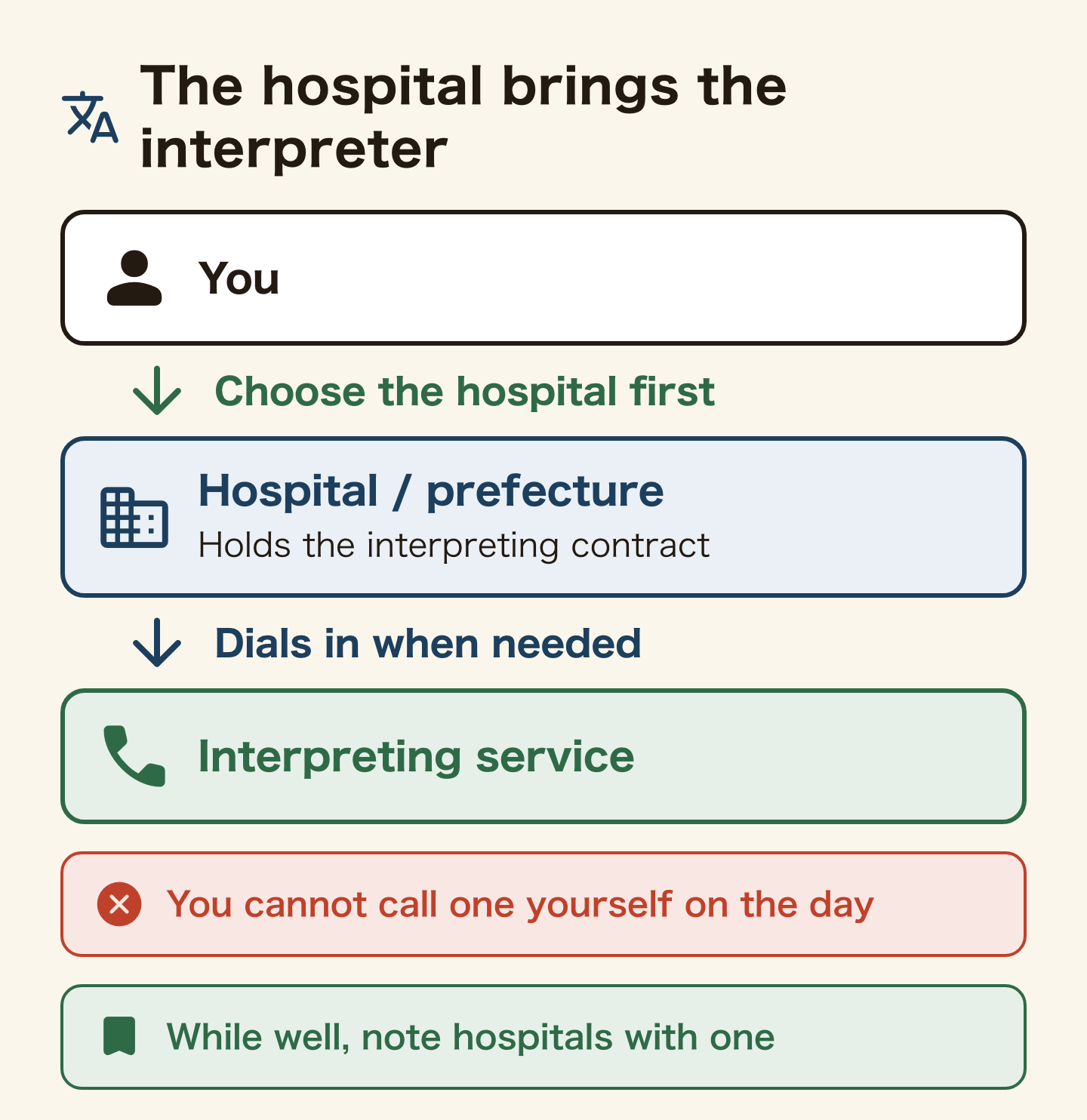
There is a place to look. The Japan National Tourism Organization runs a page that lets you search medical institutions by the languages they handle – over 20 languages, filtered by department and prefecture, including hospitals that take emergencies around the clock.
Open it once while you are well and note down what exists in your area. Searching after the fever starts means doing the hardest task at the hardest moment.
If you still need to manage on the day, three things are realistic.
- Ask at reception whether anyone speaks English. More often than people expect, somebody does
- Show a translation app. Showing them the symptom table above works just as well
- Bring someone who speaks Japanese. School staff or a colleague at work will often come along if asked
Emergency: when do I call 119, and when #7119?
A family member collapses in the middle of the night, and you reach for a taxi because an ambulance will cost too much. Where you come from, paying for an ambulance may be normal. In Japan, a 119 ambulance is free, so do not let the cost stop you from calling.
The Fire and Disaster Management Agency’s ambulance guide for visitors lists being unconscious, an injury with heavy bleeding, and sudden shortness of breath or difficulty breathing among the signs that need 119 right away. It also lists a sudden severe headache and chest pain that feels like squeezing for two to three minutes.
If it is life-threatening – unconscious, heavy bleeding, cannot breathe – call 119 now. The ambulance is free. If you are not sure whether you need one, call #7119 and a nurse helps you decide.
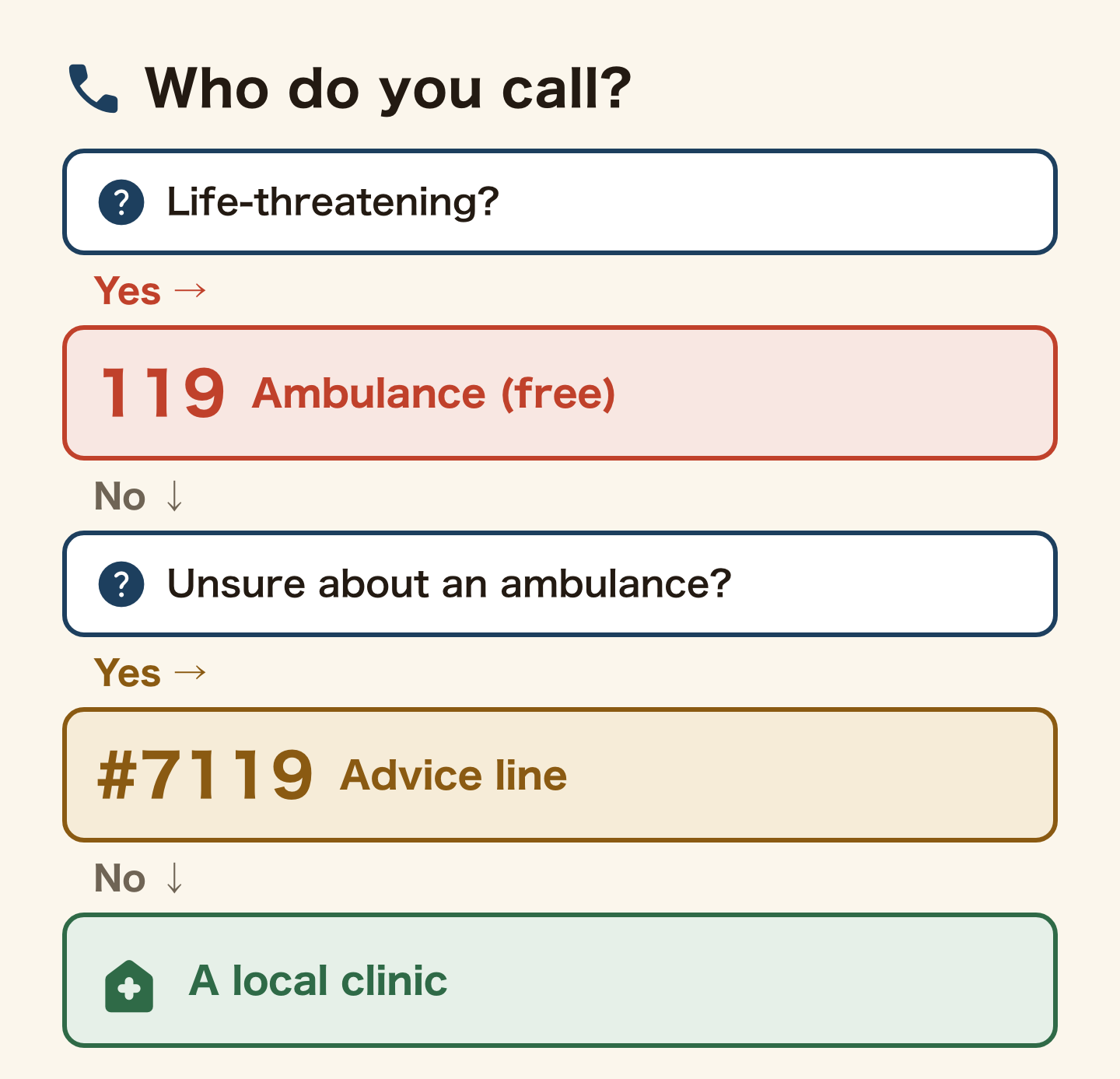
The ambulance in Japan is free. Do not hesitate because you fear the cost – hesitating is the dangerous part. On the phone, say Kyukyu desu (救急です – this is an emergency), then your address, then the symptoms. Slow, simple Japanese is fine, and most fire departments can bring in a phone interpreter on 119, with a way to give the address when you do not know it.
What about the cost? Insurance covers 70 percent
With National Health Insurance, a 10,000 yen bill becomes 3,000 yen, and there is a system that caps very large bills from surgery or admission. Joining is required if you stay over 3 months (as of July 2026) – how to join, what it costs and how the cap works are all in the National Health Insurance guide. Paying your premiums also matters for your paperwork and visa renewal.
Official sources: Ministry of Health, Labour and Welfare: the special fee without a referral letter; MHLW leaflet on the special fee (Japanese); Tokyo Metropolitan Government: reimbursement (ryoyohi); e-Gov, Social Welfare Act (Japanese); Japan National Tourism Organization: medical institution search; Fire and Disaster Management Agency: what #7119 is (Japanese); Fire and Disaster Management Agency, ambulance guide for visitors / MHLW, FY2026 medical fee schedule (Japanese PDF); MHLW, copayment rates by age (Japanese PDF) (checked 26 September 2026; fees and copay rates checked 2 October 2026; ambulance signs checked 27 September 2026)
Frequently asked questions
How much does it cost to see a doctor in Japan?
With insurance, a first visit to a clinic is 2,930 yen on the national fee schedule from June 2026, so you pay about 880 yen at 30%. A repeat visit is 780 yen, so about 230 yen. Tests and medicine are added on top. Without your insurance card you pay 100% that day, and a large hospital without a referral letter adds 7,000 yen or more that insurance does not cover.
I forgot my insurance card. Do I pay the full price?
That day, yes – you pay 100 percent. Some clinics refund the difference when you bring the card back later, but it depends on the clinic. If not, apply to your health insurer for a reimbursement (ryoyohi). If they accept that you had an unavoidable reason, the insured share comes back. Keep the receipt.
Can I go straight to a big hospital?
You can, but without a referral letter a large hospital adds an extra 7,000 yen or more for a first visit, and insurance does not cover it. Start at a clinic and get a referral letter if you need one.
Does calling an ambulance cost money?
No. The ambulance is free in Japan. In a life-threatening emergency, call 119 without hesitating. If you are unsure, call #7119 first (#8000 for children).
Does insurance work at the dentist?
Yes. Dental treatment is covered and you pay 30 percent. Cosmetic treatment such as whitening is not covered. What a first visit actually costs, how to find and book a dentist, and what counts as self-pay are in the guide to dentist costs in Japan.
Can I see a doctor if I do not speak Japanese?
Yes. Simple Japanese or a translation app is enough at most clinics. Large hospitals may have medical interpreters and multilingual forms. Bringing a friend also helps.
Summary
- Start at a clinic – move to a hospital with a referral letter
- The visit: reception, intake form, doctor, pay 30 percent, pharmacy
- Tell the doctor since when, where, how it feels
- Life-threatening: 119, free. Unsure: #7119
- Insurance details: NHI guide
Related guides
Found this useful? Share it
Send it to a friend who lives in Japan.
WHO WROTE THIS

mori
Japanese. I read the ministries’ own notices, orders and Q&As in the original, and I start from what my Nepalese and Sri Lankan friends in Japan actually ran into. I do not write about what I have not checked or been told.
What this site can and cannot do →Looking for something else?
You may use the figures in this article, including commercially, if you credit this site with a link. How to use our figures