Checked on 1 October 2026 against the Immigration Services Agency’s pages on the fee revision, online payment and fee reductions; the Ministry of Health, Labour and Welfare’s list of October 2026 changes, its minimum wage table and its harassment page; the prefectural labour bureaus; and the Japan Pension Service pages on the childcare exemption and wider social insurance coverage. Most official pages are in Japanese.
The short answer
- Residence permit fees went up. A renewal or change of status now costs 10,000 to 75,000 yen at the counter, depending on the period granted. Permanent residence costs 200,000 yen. Applications accepted by 30 September still pay the old fee.
- The minimum wage rose in Tokyo and 14 other prefectures. Tokyo is now 1,280 yen an hour. The rest follow by 2 December.
- The 88,000-yen monthly pay test for social insurance is gone. Students are still excluded.
- Parents paying their own National Pension can have it waived until their child turns one, if they file a notification.
- Every employer must now protect staff from customer harassment.
Knowing this, you can pick out only the changes that apply to you and deal with each one today. Skip the rest.
On the morning of 1 October, the news lists “what changes from today”: fees, wages, insurance, pensions. Ask a Japanese friend whether any of it affects you, and they will probably not know. A Japanese citizen has never paid a residence permit fee in their life. Five questions below tell you which parts are yours.
- Did anything change for me on 1 October 2026? Five questions
- How much is the Japan visa fee increase from 1 October 2026?
- Did the minimum wage go up on 1 October 2026?
- Did the 1.06 million yen wall for social insurance disappear in October 2026?
- I have a baby: is there a National Pension exemption from October 2026?
- What changed about customer harassment at work in October 2026?
- Which one are you?
- FAQ
- Summary
- Related reading
Did anything change for me on 1 October 2026? Five questions
Of everything that changed in Japan on 1 October 2026, five things matter most to foreign residents. If you answer yes to a question on the left, read the section on the right.
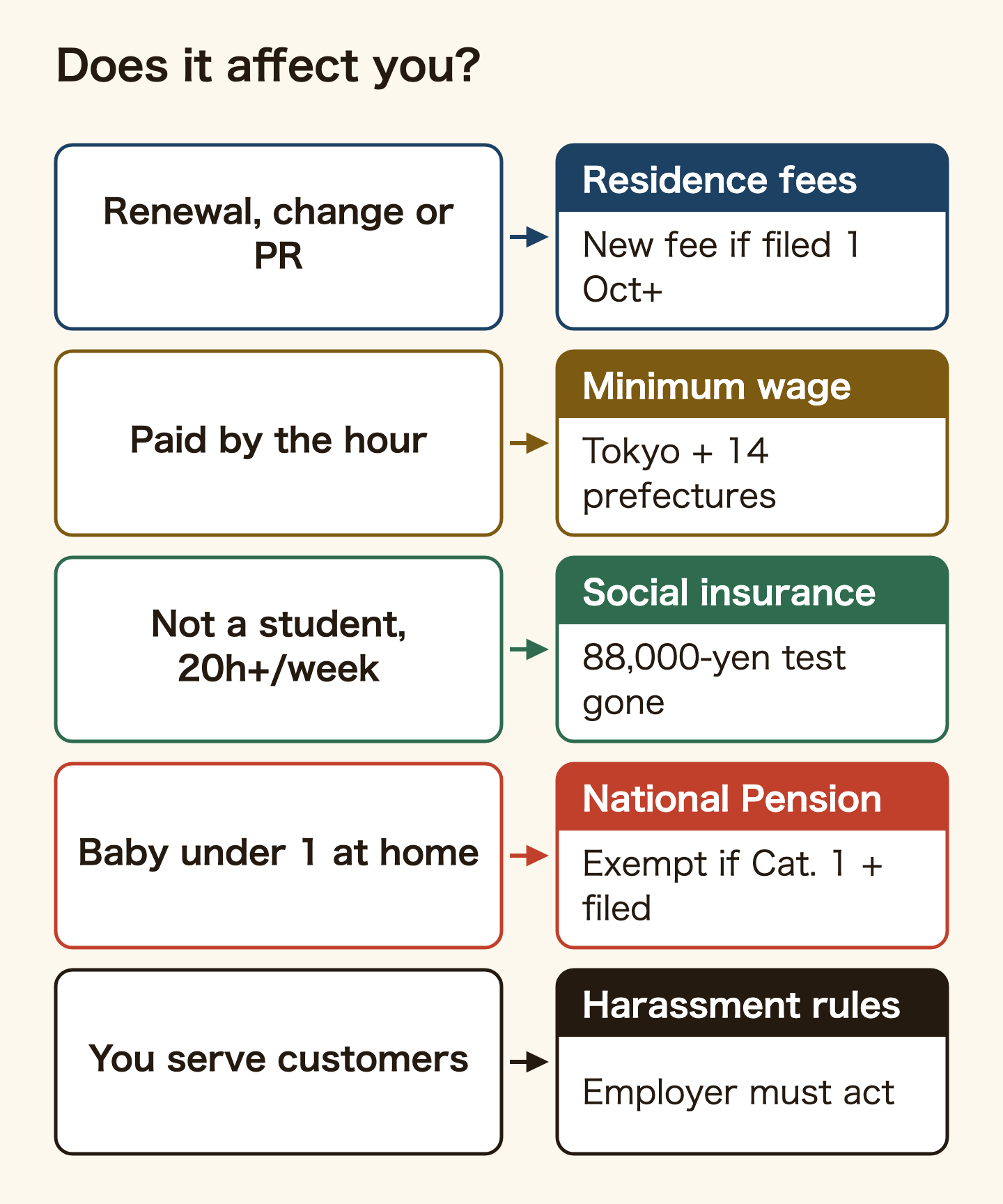
All five were announced by the Ministry of Health, Labour and Welfare or the Immigration Services Agency as changes taking effect on 1 October (MHLW, main changes in October 2026, Japanese). If none of them fits you, there is nothing you need to rush today.
How much is the Japan visa fee increase from 1 October 2026?
You buy the same revenue stamp you used last time and take it to the counter. Where you come from, that may be normal. In Japan, from 1 October 2026, the renewal and change fee depends on the period of stay you are granted.
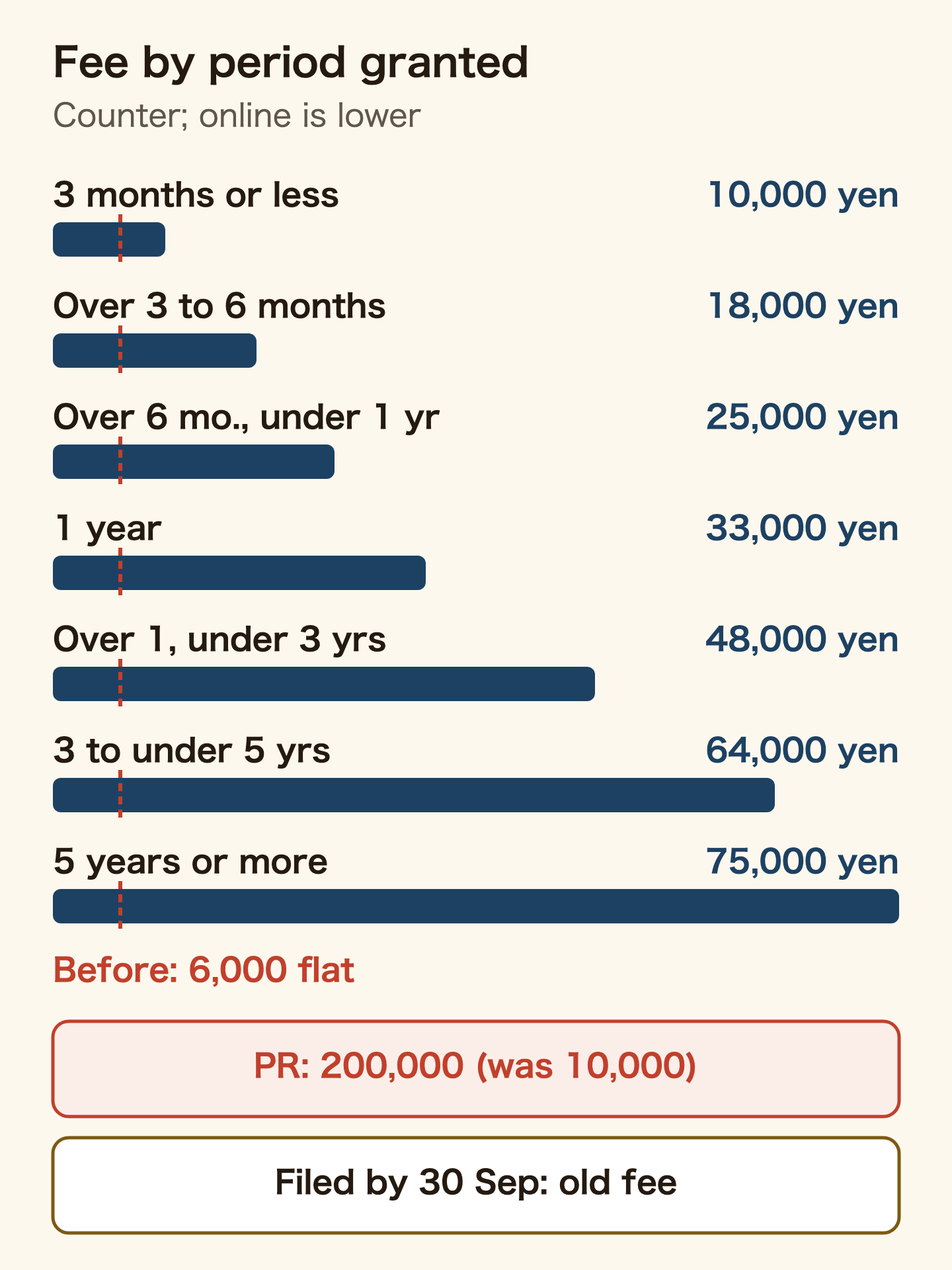
- What changed: a change of status or extension of stay used to cost a flat 6,000 yen (5,500 online). It now has seven bands: 10,000 to 75,000 yen at the counter and 10,000 to 65,000 yen online. A one-year grant costs 33,000 yen at the counter. Permanent residence went from 10,000 to 200,000 yen (Immigration Services Agency, fee revision, Japanese).
- Who it affects: anyone whose application is accepted on or after 1 October. What counts is the date your application was accepted, not the date it is granted. Applications accepted by 30 September pay the old fee (6,000 or 5,500 yen, or 10,000 yen for permanent residence) even if permission comes in October or later.
- What to do today: if you have not applied yet, think about the period you are likely to be granted and check that band. If you applied online in September, check the acceptance date in the email with your application number.
How you pay changed too. Counter applications still pay with revenue stamps, and stamps can only be bought with cash. Online applications accepted from 1 October cannot use stamps: you pay at a convenience store or by bank payment (Pay-easy). Credit cards and QR code payments are not accepted, and a payment charge of 330 or 550 yen is added (ISA, online application fees and payment, Japanese). The payment email comes from “@service-dgft.com”. Immigration warns that a request from any other address is a scam.
If you cannot pay, there is a reduction. People whose living conditions are close to those of welfare recipients, and who need humanitarian consideration, may have the renewal or change fee cut to 10,000 yen and the permanent residence fee to 20,000 yen. For permanent residence, the reduction is limited to spouses and children of Japanese nationals, permanent residents and special permanent residents, and similar cases. The reduction is not available online, so apply at the counter (ISA, fee reduction and exemption, Japanese).
You may also hear that permanent residence costs 300,000 yen. That is the ceiling written into the law; the actual fee is 200,000 yen. All seven online amounts and which stamps to buy are in our guide to the residence permit fee increase. When you can apply and what to bring are in our visa renewal guide.
Did the minimum wage go up on 1 October 2026?
- What changed: the minimum wage rose in 15 prefectures on 1 October. Tokyo went from 1,226 to 1,280 yen an hour (Tokyo Labour Bureau, Japanese).
- Who it affects: anyone paid by the hour in the 15 prefectures below. Every other prefecture rises on its own date between 2 October and 2 December. Until the day before that date, the old rate applies.
- What to do today: look up your prefecture’s new rate and start date, and check on your next payslip that hours worked from 1 October are paid at least that much.
| Rose on 1 October | New hourly rate |
|---|---|
| Tokyo | 1,280 yen |
| Kanagawa | 1,279 yen |
| Osaka | 1,231 yen |
| Saitama | 1,196 yen |
| Chiba, Aichi | 1,195 yen |
| Hyogo | 1,172 yen |
| Mie | 1,143 yen |
| Hokkaido | 1,131 yen |
| Tochigi | 1,125 yen |
| Gifu | 1,121 yen |
| Toyama | 1,119 yen |
| Niigata | 1,108 yen |
| Miyagi | 1,098 yen |
| Kagawa | 1,092 yen |
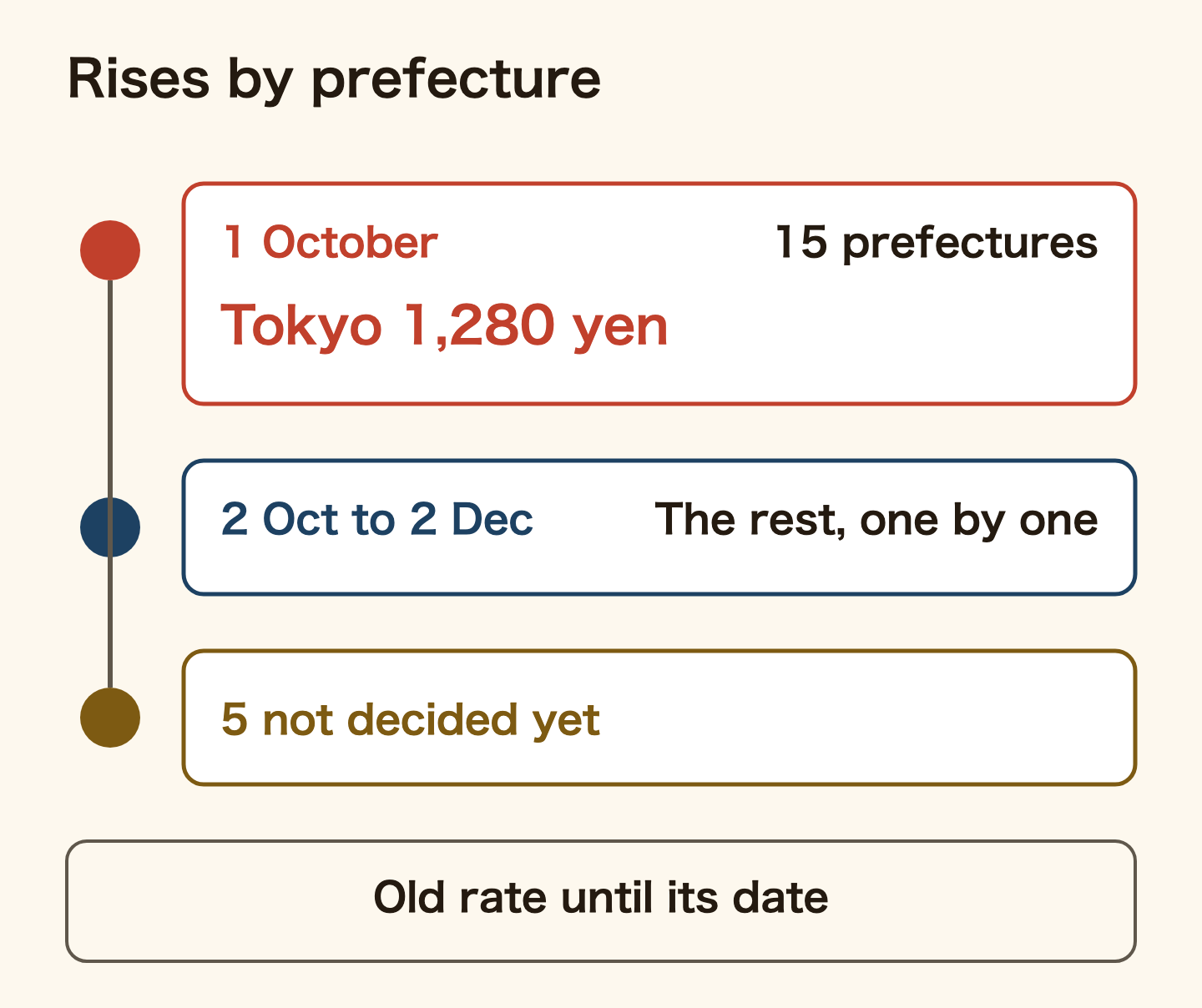
In Iwate, Yamanashi, Saga, Kumamoto and Okinawa, only the wage council’s recommendation was out as of 1 October, so their start dates are still planned dates. The “national average of 1,177 yen” in the news is the average of all 47 new rates; it is not the minimum wage anywhere (MHLW, minimum wage by prefecture, Japanese). Every prefecture’s rate and date is in our minimum wage 2026 table, and the 28-hour rule for students who work is in our part-time job guide.
Did the 1.06 million yen wall for social insurance disappear in October 2026?
- What changed: the “88,000 yen or more a month” condition for part-time workers to join their employer’s health insurance and employees’ pension is gone. Over a year it comes to about 1.06 million yen, which is why people called it the “1.06 million yen wall” (MHLW, Japanese).
- Who it affects: people who are not students, work 20 hours or more a week, and earned less than 88,000 yen a month. The rule currently covers workplaces with 51 or more employees’ pension members.
- What to do today: check whether you meet the conditions, and look at the health insurance and pension lines on your next payslip. If you are unsure, ask your employer.
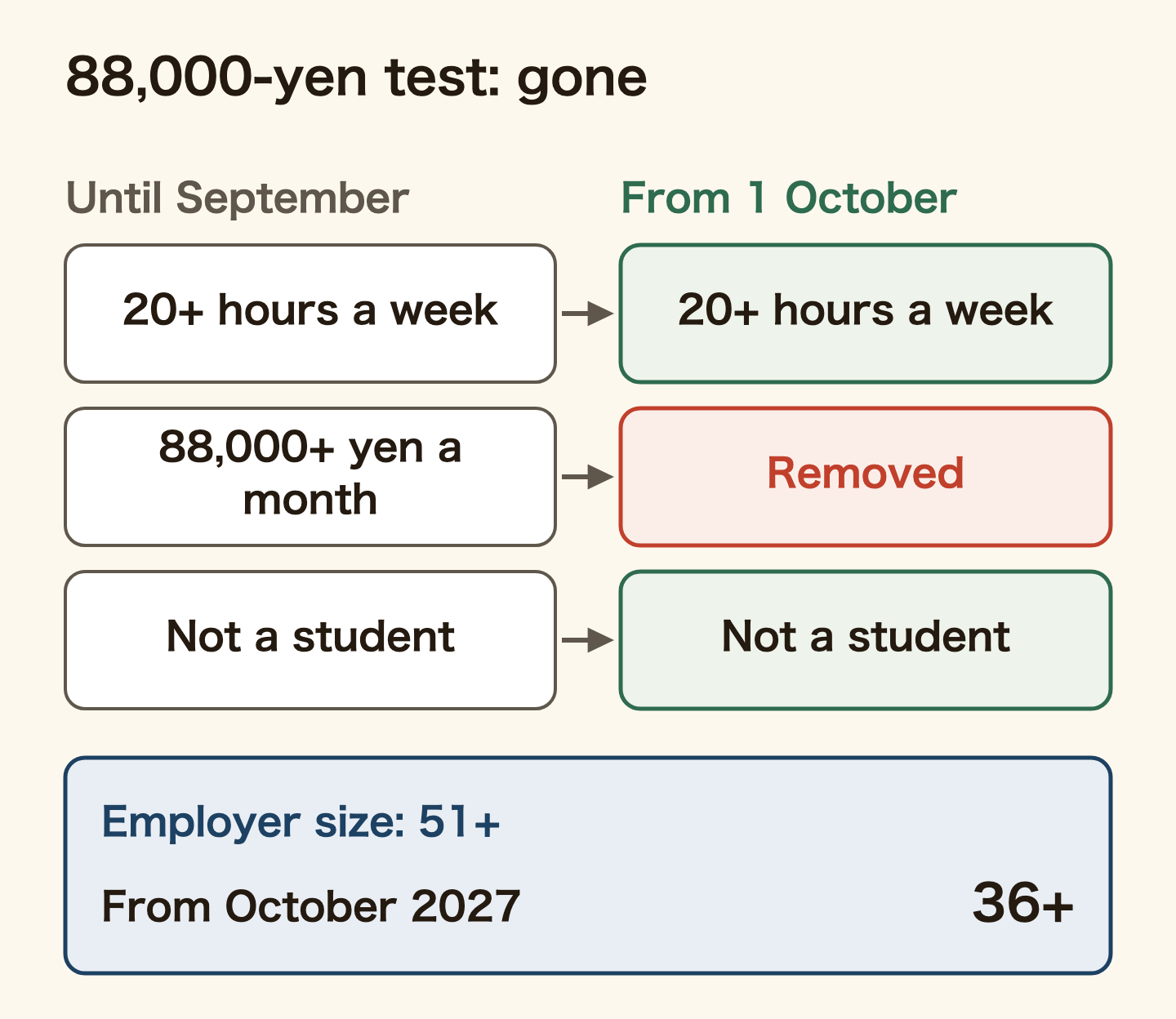
Students are still excluded; that exclusion remains in the law. Some students are covered anyway: night-school and correspondence students, people on a leave of absence, and people who will keep working for the same employer after graduating (Japan Pension Service Q&A, Japanese). The employer size threshold widens to 36 or more in October 2027, 21 or more in October 2029, 11 or more in October 2032, and to 10 or fewer in October 2035. What stays the same for student part-timers is in our guide to students and social insurance.
I have a baby: is there a National Pension exemption from October 2026?
- What changed: a new childcare exemption waives National Pension contributions until your child turns one. There is no income test. The waived months count as paid when your basic pension is calculated (Japan Pension Service, childcare exemption, Japanese).
- Who it affects: Category 1 members of the National Pension (people aged 20 to 59 such as students, the self-employed and people without work) who are the birth or adoptive parent of a child under one and live at the same address. If both parents are Category 1, both qualify. People in an employer’s pension scheme use a different exemption.
- What to do today: file the notification at your city office’s National Pension desk or through Mynaportal.
Only months from October 2026 onward are waived. Fathers and adoptive parents are covered from the month they start raising the child until the month before the first birthday, up to 12 months. Mothers who had the pre- and post-birth exemption get the following 9 months. For a child born on 1 January 2026, that means October to December 2026: three months. If the parent or child is a foreign national, you attach proof of the parent-child relationship. If a Japanese family register cannot show it, that means a certificate from your country’s public authority plus a Japanese translation naming the translator. How this compares with the other exemptions and the student deferral is in our National Pension exemption guide.
What changed about customer harassment at work in October 2026?
- What changed: every employer must now take measures to protect staff from customer harassment, meaning abusive words or behaviour from customers that go beyond what is socially acceptable (MHLW, harassment prevention, Japanese).
- Who it affects: anyone whose work means dealing with customers, business partners, or users of facilities such as stations, hospitals and schools. Phone calls and social media count too.
- What to do today: find out where your workplace’s harassment contact point is.
Employers must set a policy and tell staff about it, set up a contact point, check the facts quickly, look after the person harmed, and prevent it happening again. The ministry’s leaflet gives examples: avoid leaving a worker to deal with a customer alone where possible, and report behaviour that may be a crime to the police (MHLW leaflet, Japanese). Employers must also make clear that nobody will be treated unfavourably for asking for help. From the same day, preventing sexual harassment of job seekers and interns is also an employer duty. If your workplace does not help, free labour advice is available in English and other languages.
Which one are you?
- You are about to apply for a renewal, change of status or permanent residence: check the fee for the period you expect, then buy stamps for a counter application, or be ready to pay at a convenience store or bank for an online one.
- You are paid by the hour in one of the 15 prefectures: check on your next payslip that work from 1 October is paid at least the new minimum. Elsewhere, put your prefecture’s start date in your calendar.
- You are not a student and work 20 hours or more a week part-time: check your employer’s size and your hours, and look at the insurance lines on your next payslip. Ask your employer if unsure.
- You have a baby under one and pay your own National Pension: file the childcare exemption at your city office or on Mynaportal. If the parent or child is foreign, get the relationship certificate and translation ready first.
- You deal with customers at work: find out today where your workplace’s contact point is.
FAQ
Q. What changed for foreigners in Japan on 1 October 2026?
Five things: higher residence permit fees, a higher minimum wage in Tokyo and 14 other prefectures, the end of the 88,000-yen pay test for social insurance, a new childcare exemption from National Pension contributions, and a duty on every employer to tackle customer harassment.
Q. I applied for my visa renewal in September. Do I pay the new fee?
No. Applications accepted by 30 September pay the old fee even if permission comes on or after 1 October: 6,000 yen at the counter or 5,500 yen online for a renewal or change, and 10,000 yen for permanent residence.
Q. Is the permanent residency fee 300,000 yen?
No, the actual fee is 200,000 yen. 300,000 yen is the ceiling set in the law. Permanent residence applications accepted by 30 September pay 10,000 yen.
Q. When does the minimum wage go up?
In 15 prefectures it rose on 1 October 2026, with Tokyo at 1,280 yen. The others rise on their own dates by 2 December. For Iwate, Yamanashi, Saga, Kumamoto and Okinawa, the dates were still planned as of 1 October.
Q. Do international students have to join social insurance from October?
No. What ended was the 88,000-yen pay test; the rule that excludes students is still there. Night-school and correspondence students, people on a leave of absence, and people who will keep working for the same employer after graduating are covered even though they are students.
Q. Can foreigners use the childcare exemption?
Yes, if you are a Category 1 National Pension member and the birth or adoptive parent of a child under one living at the same address. If the parent or child is foreign, attach proof of the relationship: a certificate from your country’s public authority with a Japanese translation, if a Japanese family register cannot show it.
Summary
Five of the changes on 1 October 2026 matter most to foreign residents. Visa fees depend on when your application was accepted, and the minimum wage rises on each prefecture’s own date. Social insurance lost its 88,000-yen pay test, but students are still excluded.
Parents with a baby who pay their own National Pension can have it waived by filing a notification. And if a customer abuses you at work, you do not have to handle it alone: go to your workplace’s contact point. Read only the sections that apply to you, and do today’s step for each.
Official sources (Japanese): Immigration Services Agency, residence permit fee revision of 1 October 2026 / ISA, online application fees and payment / ISA, fee reduction and exemption / ISA, buying revenue stamps / MHLW, main changes in October 2026 / MHLW, minimum wage by prefecture / Tokyo Labour Bureau, 1,280 yen from 1 October / MHLW, pension reform outline / Japan Pension Service, wider social insurance coverage / JPS, students and coverage / JPS, National Pension childcare exemption / MHLW, preventing workplace harassment / MHLW leaflet on customer harassment. All checked on 1 October 2026. Confirm with Immigration, your city office or your employer before you act.
Related reading
Found this useful? Share it
Send it to a friend who lives in Japan.
WHO WROTE THIS

mori
Japanese. I read the ministries’ own notices, orders and Q&As in the original, and I start from what my Nepalese and Sri Lankan friends in Japan actually ran into. I do not write about what I have not checked or been told.
What this site can and cannot do →Looking for something else?