Checked on 23 September 2026 against the National Police Agency’s 2025 White Paper and lost-property pages, official pages of the Tokyo, Osaka and Hiroshima police, Government of Japan PR Online, and the law texts on e-Gov (Lost Property Act, Immigration Control Act, Police Duties Execution Act and others).
The short answer
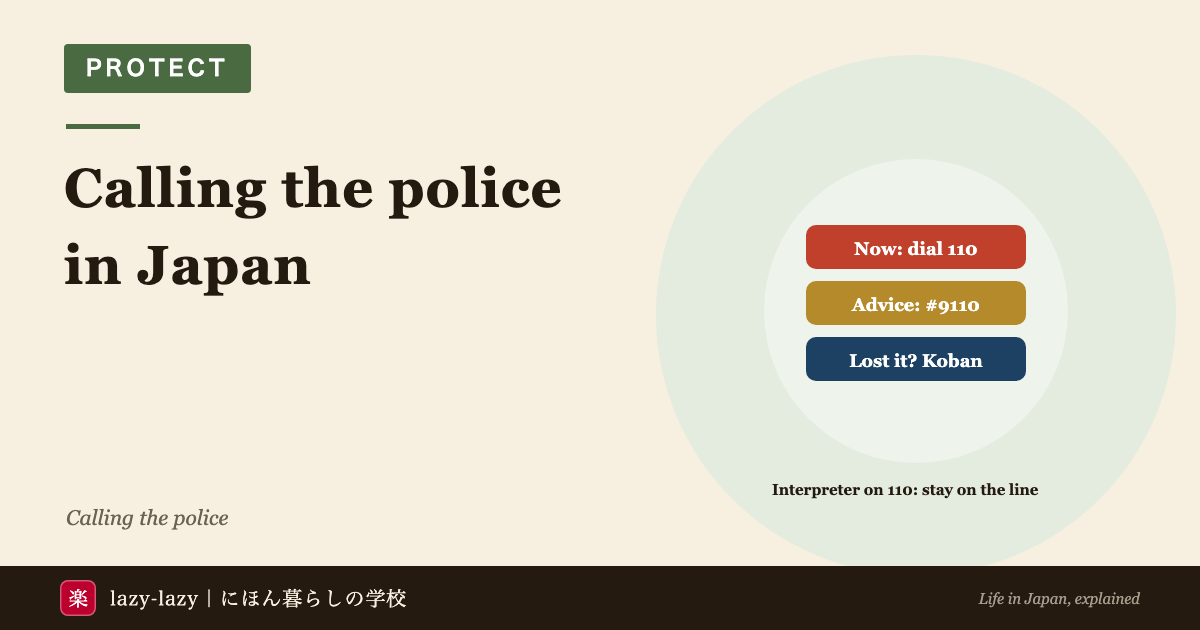
- The police emergency number in Japan is 110. The call is free. You will be asked what happened, how long ago, and where.
- You can call 110 without speaking Japanese. The police bring an interpreter into the call. Say your language and stay on the line.
- For non-urgent advice, call #9110. It is mainly weekdays 8:30 to 17:15, and you pay the call charge.
- Lost something? Any koban (police box) can take your report. Found something? Hand it in within 7 days (24 hours if you found it inside a shop or station) and you can claim a reward of 5 to 20% of its value if the owner turns up.
- If a police officer asks to see your residence card, you must show it. Refusing can bring up to one year in prison or a 200,000 yen fine.
Knowing this, you can pick the right contact — 110, #9110 or a koban — the moment something goes wrong, instead of wondering whether your Japanese is good enough.
You are cycling home from the station at night. A scooter pulls up behind you and someone grabs the bag from your basket: wallet, residence card, phone charger. Your hands are shaking and you do not know what to say on 110. You message a Japanese friend and get back “call 110 now”. They have never needed to know that 110 can bring in an interpreter, or that there is a separate number for things that are not emergencies.
- How do I call the police in Japan?
- Can I call 110 in English?
- What if I don’t know where I am?
- What is #9110? The non-urgent police number
- What is a koban, and what can I do there?
- What should I do if I lose something in Japan?
- What happens if I find a wallet in Japan?
- Do I have to show my residence card to the police?
- How do I file a police report in Japan?
- How much does it cost?
- What if I keep something I found, or refuse to show my card?
- Which one are you?
- FAQ
- Summary
- Related reading
How do I call the police in Japan?
Dial 110 from a mobile, a landline or a public phone. It is the police emergency number, and the call is free (Osaka Prefectural Police). In Japanese it is said “hyaku-tō ban”.
The person who answers will ask you questions. The Tokyo Metropolitan Police list five.
- What happened? — a theft, a traffic accident, a fight
- How long ago? — “just now”, “ten minutes ago”
- Where? — the address, a shop or building nearby, which floor
- What was taken or what you saw, and is anyone hurt?
- Do you remember the suspect? — sex, how many, age, clothes, which way they went
You do not need perfect answers. The dispatcher asks one thing at a time, so answer what you can. After the call, stay somewhere safe and wait for the police to arrive (Osaka Prefectural Police).
Japan’s police received about 10.6 million 110 calls in 2024, roughly one every three seconds (National Police Agency White Paper). About 20% of calls did not need an emergency response (Government PR Online, figures for 2023). That is why non-urgent matters have their own number, #9110.
Can I call 110 in English?
Yes. The police place officers who speak foreign languages in the 110 command centres. They also run three-way calls that bring in staff from an interpretation centre, so that people who do not speak Japanese can report (National Police Agency White Paper).
Osaka’s English page puts it simply: if they cannot understand your language, they will put you through to an interpreter, so do not hang up. The Tokyo police’s English page also says a police interpreter will come on the line. When the call connects, say the name of your language and stay on. That alone tells the dispatcher what to do next.
There is also a 110 app for people who cannot make a voice call, such as people with hearing difficulties. In a foreign language, it only works as far as the button report; the text chat screen is Japanese only (National Police Agency). If you can speak, call 110 by voice.
What if I don’t know where I am?
If you call 110 from a smartphone contracted in Japan, your location is sent to the police. Location sharing for mobile 110 calls runs in every prefecture (National Police Agency White Paper). But Osaka police note that a phone on international roaming may not be able to call 110 at all.
Indoors, or when the location fails, you will be asked for landmarks. Osaka police give these examples.
- The name of your apartment building and your room number
- A nearby shop, intersection or station
- In Osaka, the number on the blue “OPP” sticker on a traffic-sign post
Save your home address in Japanese in your phone’s notes today, so that you can read it out. The same trick helps when you call an ambulance.
Sometimes 110 will not connect — in a disaster, a power cut or a mobile network failure. The Tokyo police suggest three things: use a phone on another carrier, a landline or a public phone; go straight to a koban or police station; or stop a police officer or patrol car.
What is #9110? The non-urgent police number
“I don’t know if this is a crime, but I want to talk to the police.” That is what #9110, the police advice line, is for. From anywhere in Japan it connects to the advice desk of the police for the area you are calling from (Government PR Online).
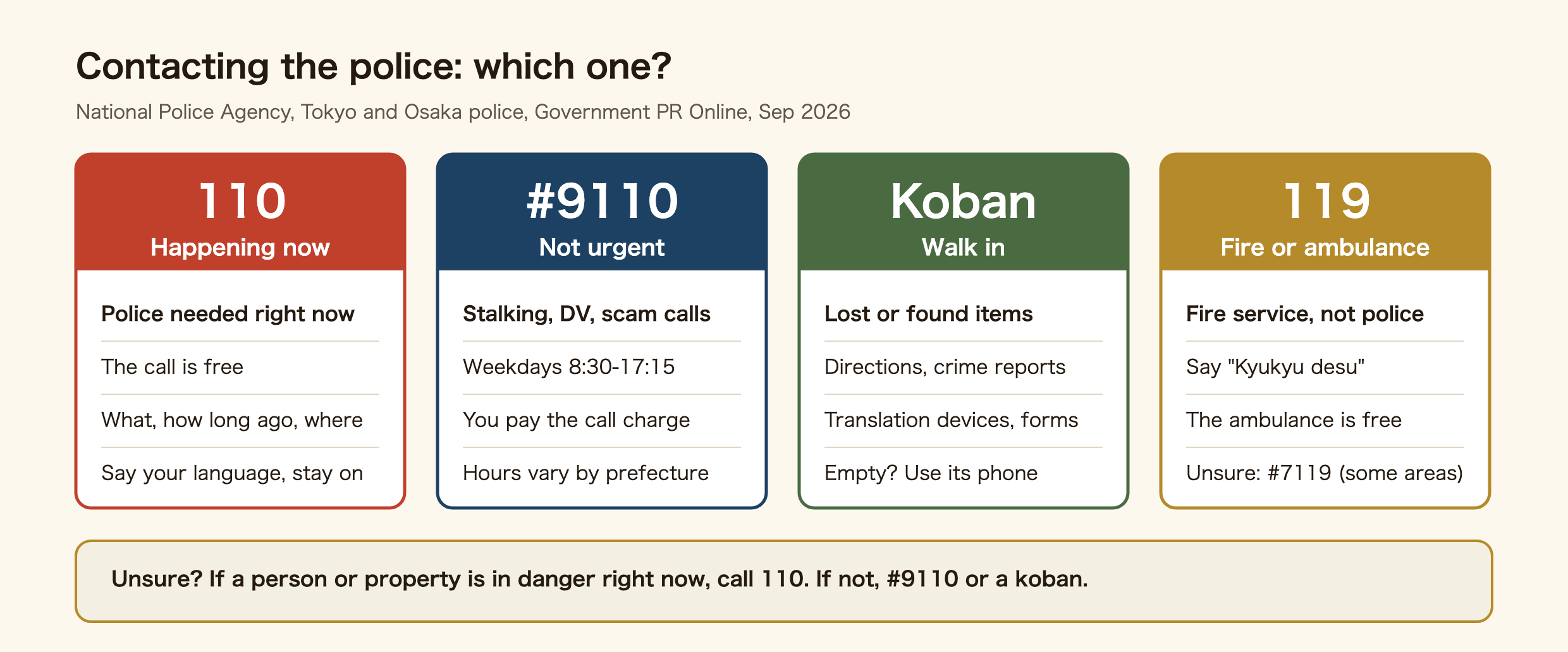
| Contact | When | Good to know |
|---|---|---|
| 110 | A crime or accident is happening and you need officers now | Free. Interpreters by three-way call |
| #9110 | Not urgent: stalking, domestic violence, a suspicious call, trouble near home | Mainly weekdays 8:30–17:15 (varies by prefecture). Nights and holidays: duty staff or a recorded message in most areas. You pay the call charge |
| Koban or police station | Lost or found property, directions, reporting a crime | Walk in. Translation devices and forms with foreign languages |
| 119 | Fire or ambulance | Goes to the fire service, not the police |
#9110 cannot be dialled from rotary phones or some IP phones. In that case, use your prefectural police’s advice number. The police can give advice, warn the other person, or investigate. If another office fits better, such as the legal aid centre (Houterasu) or a consumer centre, they pass you on (Government PR Online).
In Tokyo, the Metropolitan Police General Advisory Center answers on #9110 and on 03-3501-0110. Its English page says it handles calls in Japanese, English, Chinese and Korean. For sexual assault, the nationwide number is #8103; in Tokyo it is free and open 24 hours.
What is a koban, and what can I do there?
A koban is a small police box by a station or on a street corner. On 1 April 2025 Japan had 6,145 koban and 5,852 residential police posts (chuzaisho) (National Police Agency White Paper). The Tokyo police’s English pages simply call it “KOBAN”.
You can ask for directions, report something lost, hand in something you found, or report a crime. About 6,100 “koban counsellors” also work at koban across Japan. They are civilian staff, not police officers. They take lost and found reports, write crime reports on your behalf, and give directions (White Paper).
For people who do not speak Japanese, the police keep devices with translation functions and forms with foreign languages printed alongside Japanese, such as the lost-property report. When an interpreter is needed, officers connect one by phone from a mobile device (White Paper).
Sometimes you walk in and nobody is there, because the officers are out on patrol. If that happens, use the phone inside the koban to reach the police station. Hiroshima and Osaka police say to follow the instructions on the board beside the phone. If it is urgent, call 110 on the spot.
What should I do if I lose something in Japan?
Report it at a koban or police station. This is called an ishitsu todoke, a lost-property report. The Tokyo police say you can file it at any police station or koban, even if you lost it in another prefecture. Things lost outside Japan cannot be reported to Japanese police.
You can also report online. From the National Police Agency’s lost-property page, 42 prefectures share one online portal. In Tokyo, the Metropolitan Police’s online service takes reports when the cash lost is under 1 million yen. Online reports can take time to be accepted, so go to a koban if it is urgent (National Police Agency).
After reporting, do two more things.
- If you lost cards or a phone, call the card company or phone carrier straight away to stop them (Tokyo police)
- Search the police “lost property search”. Items handed in are listed online for three months (Tokyo police)
Lost property is handled prefecture by prefecture. You collect it from the police station where it is held, and you need ID. In Tokyo the counter is open on weekdays from 8:30 to 16:30. If you cannot go, the police can send it to you at your cost (Tokyo police).
If your residence card was in the bag, the police report is only the first step. You also need to get a new card at Immigration within 14 days of noticing the loss, and the receipt number from the police goes on that application.
What happens if I find a wallet in Japan?
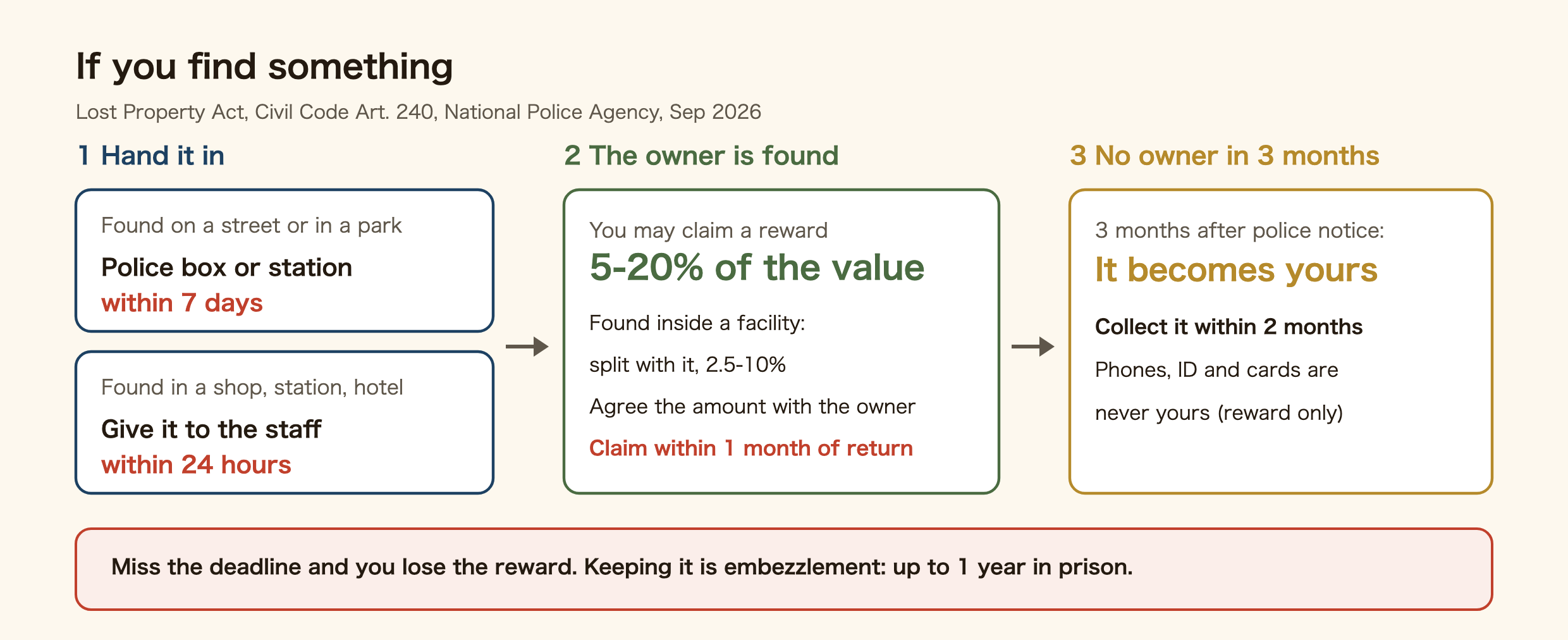
By law, you must return it to the owner or hand it in to the police promptly (Lost Property Act, Article 4). If you find it inside a building with staff — a shop, station or hotel — give it to the staff instead.
The deadline depends on where you found it.
- On a street, in a park and similar places: within 7 days of finding it, to a koban or police station
- Inside a shop, station, hotel, school or other place with staff: within 24 hours of finding it, to the staff
Miss the deadline and you lose the right to a reward and the right to keep the item (Article 34).
When the owner is found, they must pay the finder a reward (hōrōkin) of 5% to 20% of the item’s value. If it was found inside a facility, the reward is split with the facility, so you get 2.5% to 10% (Article 28). You agree the amount with the owner. If you claim it, your name and address are given to the owner (National Police Agency).
The claim expires one month after the item is returned (Article 29). You can also give up all your rights if you do not want anything.
If no owner turns up within three months of the police notice, the item becomes yours (Civil Code, Article 240). You then have two months to collect it (Lost Property Act, Article 36).
But items with personal information — phones, driving licences and other ID, cash cards, credit cards — never become the finder’s, even after three months (Article 35). You can still receive the reward if the owner is found (Tokyo police).
Do I have to show my residence card to the police?
Police questioning on the street (shokumu shitsumon) means an officer stopping and questioning someone when, judging from their behaviour and the circumstances, there are reasonable grounds to suspect a link to a crime (Police Duties Execution Act, Article 2(1)). The same law covers Japanese and foreign nationals.
For foreign residents, the Immigration Control Act adds a rule. Mid- to long-term residents must carry their residence card at all times, and must show it when a police officer asks in the course of their duties (Article 23(2) and (3)).
- Not carrying it: a fine of up to 200,000 yen (Article 75-3)
- Refusing to show it: up to one year in prison or a fine of up to 200,000 yen (Article 75-2)
- Under 16: you do not have to carry it (Article 23(5))
The residence card is not the only thing people get caught out by. Selling a bank account or riding off on a bicycle left somewhere can also lead to arrest; see seven things that can get foreign residents arrested in Japan.
There are rules for the officer too. An official who asks for your card must carry ID and show it if you ask (Article 23(4)). When officers need to show they are police, they present the ID and badge in their police notebook (Police Notebook Rules, Article 5). If someone not in uniform asks for your card, you can ask to see their police ID.
On the questioning itself, Article 2(3) of the Police Duties Execution Act says that, except under the laws on criminal procedure, a person cannot be detained, taken to a police station against their will, or forced to answer. Showing your residence card is a separate duty under the Immigration Control Act. If you do not understand, say “Tsūyaku o onegai shimasu” — “An interpreter, please.”
Someone who calls or video-calls you, says “this is the police” and asks for a photo of your residence card, your bank details or money is not a police officer. Learn the four signs of a fake-police call and where to report it.
How do I file a police report in Japan?
Something stolen, someone hit you, you were cheated. If it is happening now, call 110. If it can wait, go to a koban or police station and file a crime report (higai todoke).
The police rules on criminal investigation say a crime report must be accepted whether or not the case falls in that station’s area (Rules on Criminal Investigation, Article 61). You do not need to know how to fill in the form. If you report it verbally, the police either ask you to fill in the form or write it for you. Koban counsellors also write crime reports on people’s behalf (White Paper).
When police question a foreign national who does not understand Japanese, the rule is to do it through an interpreter (Article 233). Before you go, write down when, where and what happened; it speeds things up even through an interpreter. If you were tricked into sending money, call the receiving bank the same day as well.
How much does it cost?
| Item | Cost |
|---|---|
| 110 | Free |
| #9110 | Normal call charge |
| #8103 (sexual assault) | Free in Tokyo |
| When your lost item comes back (owner) | Reward of 5–20% of the value to the finder (split between finder and facility if found inside one) |
| Having a lost item posted to you | You pay the postage |
If you are the owner, the reward is a legal duty. Unless the finder has given it up, you agree an amount between 5% and 20%. The costs of handing in and storing the item also fall on the owner (Lost Property Act, Article 27).
What if I keep something I found, or refuse to show my card?
Using a wallet you found is embezzlement of lost property: up to one year in prison, or a fine of up to 100,000 yen or a petty fine (Penal Code, Article 254). What you lose after 7 days is the reward and similar rights. The duty to return it or hand it in (Lost Property Act, Article 4) remains, so take it to a koban as soon as you realise.
Refusing to show your residence card: up to one year in prison or a 200,000 yen fine. Leaving it at home: a fine of up to 200,000 yen (Immigration Control Act, Articles 75-2 and 75-3).
Calling 110 for things that are not urgent can delay the response to real emergencies (Government PR Online). If you are unsure, ask one question: is a person or property in danger right now? If yes, call 110.
Which one are you?
- A crime or accident is happening now — call 110. Say what happened, how long ago and where; if Japanese fails you, say your language and stay on the line. Today, save your address in Japanese in your phone.
- You lost your wallet or phone — today, file a lost-property report at a koban or online, and call your card company and phone carrier. If your residence card was in it, take the receipt number to Immigration within 14 days.
- You found a wallet or phone — street: to a koban within 7 days; shop or station: to the staff within 24 hours. Hand it in today and the deadline stops mattering.
- You want police advice, but it is not urgent — call #9110 during weekday hours. For stalking or a suspicious call, keep the messages and call history, then call today.
FAQ
Q. Can I call 110 in English in Japan?
Yes. The police have foreign-language officers in the 110 centres and use three-way calls with interpreters. When it connects, say your language and do not hang up.
Q. What is the difference between 110 and #9110?
110 is the free emergency number for crimes and accidents that need officers now. #9110 is the non-urgent police advice line, mainly weekdays 8:30 to 17:15, and you pay the call charge.
Q. Can I report a lost item at any police box?
Yes, a lost-property report can be filed at any police station or koban (Tokyo police). Most prefectures also take reports online. Things lost outside Japan cannot be reported to Japanese police.
Q. Do I get a reward for handing in a lost wallet in Japan?
If the owner is found, you can claim 5% to 20% of the item’s value. If you found it inside a shop or station, it is split with the facility, so 2.5% to 10%. You must hand it in within 7 days (24 hours inside a facility) to keep this right.
Q. Can I keep something I found if no owner turns up?
If no owner is found within three months, it becomes yours, and you must collect it within two months. Phones, ID, cards and other items with personal information never become yours.
Q. What happens if I refuse to show my residence card to the police?
Refusing when an officer asks in the course of duty can bring up to one year in prison or a fine of up to 200,000 yen. Not carrying it at all can bring a fine of up to 200,000 yen. Under-16s do not have to carry it.
Summary
Contacting the police comes down to three choices. Danger now: 110, free, with an interpreter if you need one. Not urgent: #9110. Lost or found property, directions and crime reports: a koban, and if nobody is there, the phone inside reaches the station.
Lost it or found it, go to a koban. If you found it, hand it in within 7 days (24 hours inside a facility) to keep your right to a 5–20% reward. And carry your residence card everywhere and show it when an officer asks. Refusing to show it is punished more heavily than not carrying it.
Official sources: National Police Agency White Paper 2025, responding to incidents (Japanese) / same, koban activities (Japanese) / NPA, lost-property reports and search (Japanese) / NPA, finders’ rights (Japanese) / Tokyo Metropolitan Police, “How do I contact the police?” / Tokyo Metropolitan Police, 110 (Japanese) / Osaka Prefectural Police, “110 Emergency Calls” / Government of Japan PR Online on #9110 (Japanese) / e-Gov law texts (Lost Property Act, Civil Code, Penal Code, Immigration Control Act, Police Duties Execution Act, Police Notebook Rules, Rules on Criminal Investigation; Japanese). Checked on 23 September 2026. Hours and languages differ by prefecture, so also check your own prefectural police’s website.
Related reading
Found this useful? Share it
Send it to a friend who lives in Japan.
WHO WROTE THIS

mori
Japanese. I read the ministries’ own notices, orders and Q&As in the original, and I start from what my Nepalese and Sri Lankan friends in Japan actually ran into. I do not write about what I have not checked or been told.
What this site can and cannot do →Looking for something else?