Last updated: 2 October 2026
In short
- Check one thing before anything else: is the school accredited? Japan started a new accreditation system in April 2024, and schools have until April 2029 to qualify.
- A school advertising to you today is not necessarily accredited. The Ministry of Education publishes the list. Search for the school’s name on it.
- Accreditation is not a formality. In one recent round, 100 institutions applied and 32 were accredited; most of the rest withdrew while under review.
- After that, four numbers decide the school: class size, where graduates went, the mix of nationalities, and the total cost for one year.
- The nationality mix is the one nobody warns you about. If half your class speaks your language, you will speak it, and you will leave with less Japanese than you paid for.
Knowing this, one look at the Ministry’s list keeps a year of tuition out of a school that is not accredited.
Every Japanese language school says it is the best one. Their websites are marketing, and so are most of the “top 10 schools” pages you will find – many are written by agents who are paid when you enrol. This guide does not name a best school. It gives you the checks that let you judge one yourself.
First: is the school accredited?
In April 2024 Japan changed how language schools are approved. The new status is nintei nihongo kyoiku kikan (認定日本語教育機関), an accredited Japanese language institution (Ministry of Education, outline of the Japanese Language Education Institution Accreditation Act (PDF, Japanese)). Schools that existed under the old system have five years – until April 2029 – to become accredited. (Immigration Services Agency, notice on Japanese language institutions under the old notification system (Japanese))
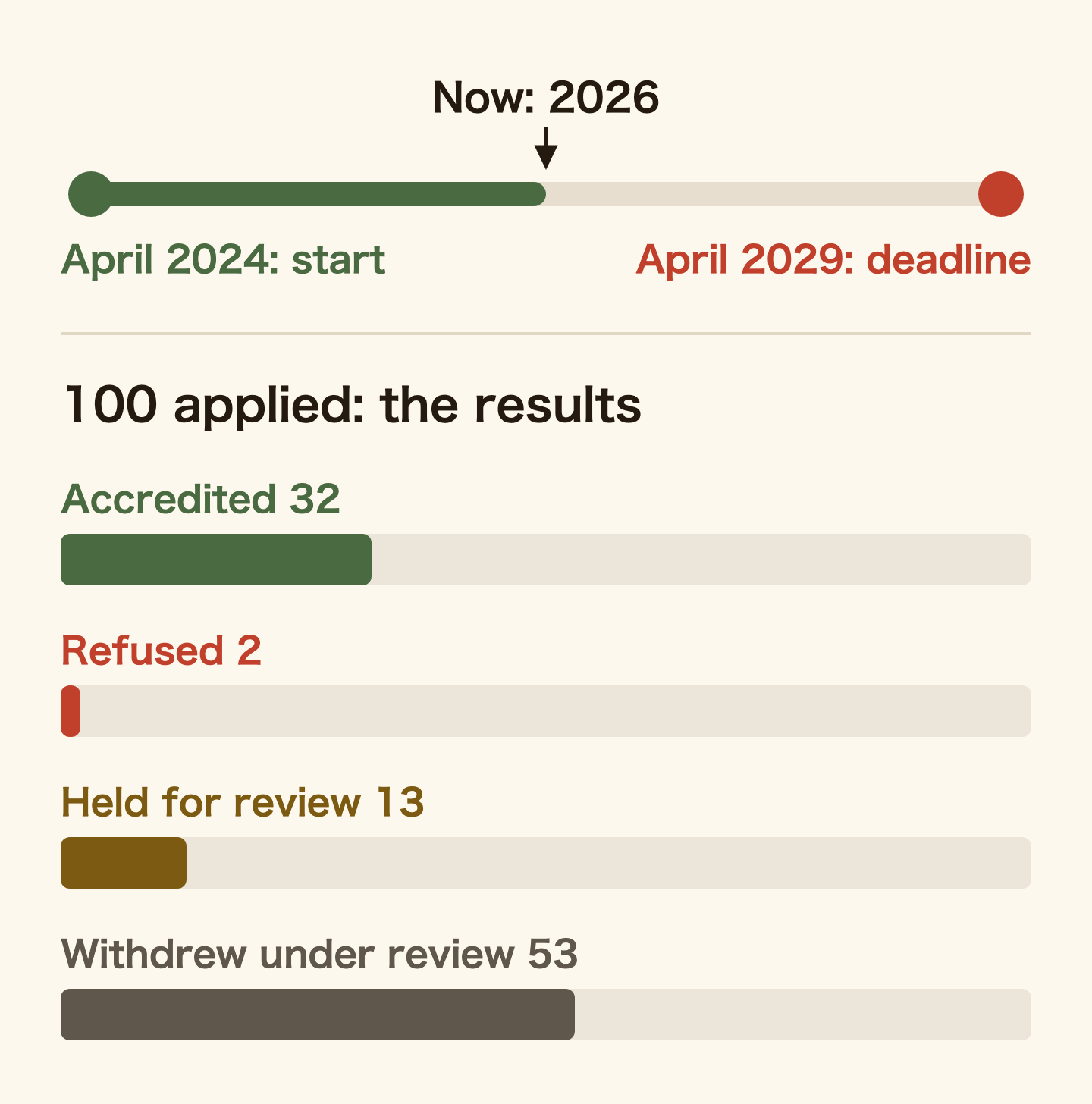
We are in the middle of that transition right now. A school can advertise, take your application and take your money while still not being accredited. If it does not qualify before the deadline, it cannot accept foreign students – and you may be enrolled when that happens.
This is not a rubber stamp. In one recent round of decisions, 100 institutions applied, 32 were accredited, 2 were refused, 13 were held for further review, and 53 withdrew their applications while under review. Read that last number again. Most applicants pulled out before the result came (Ministry of Education, accreditation results, in Japanese).
What to do: the Ministry of Education publishes the results (Ministry of Education, accreditation results for Japanese language institutions (Japanese)). Open the list, search for the school’s name in Japanese, and if it is not there, ask the school directly when they expect to be accredited. A school that cannot answer that question clearly has told you something.
Then: four numbers on the school’s own website
Once a school is accredited, the differences that matter are ordinary and measurable. Every one of these should be findable on the school’s site or by one email. If it is not, that is your answer.
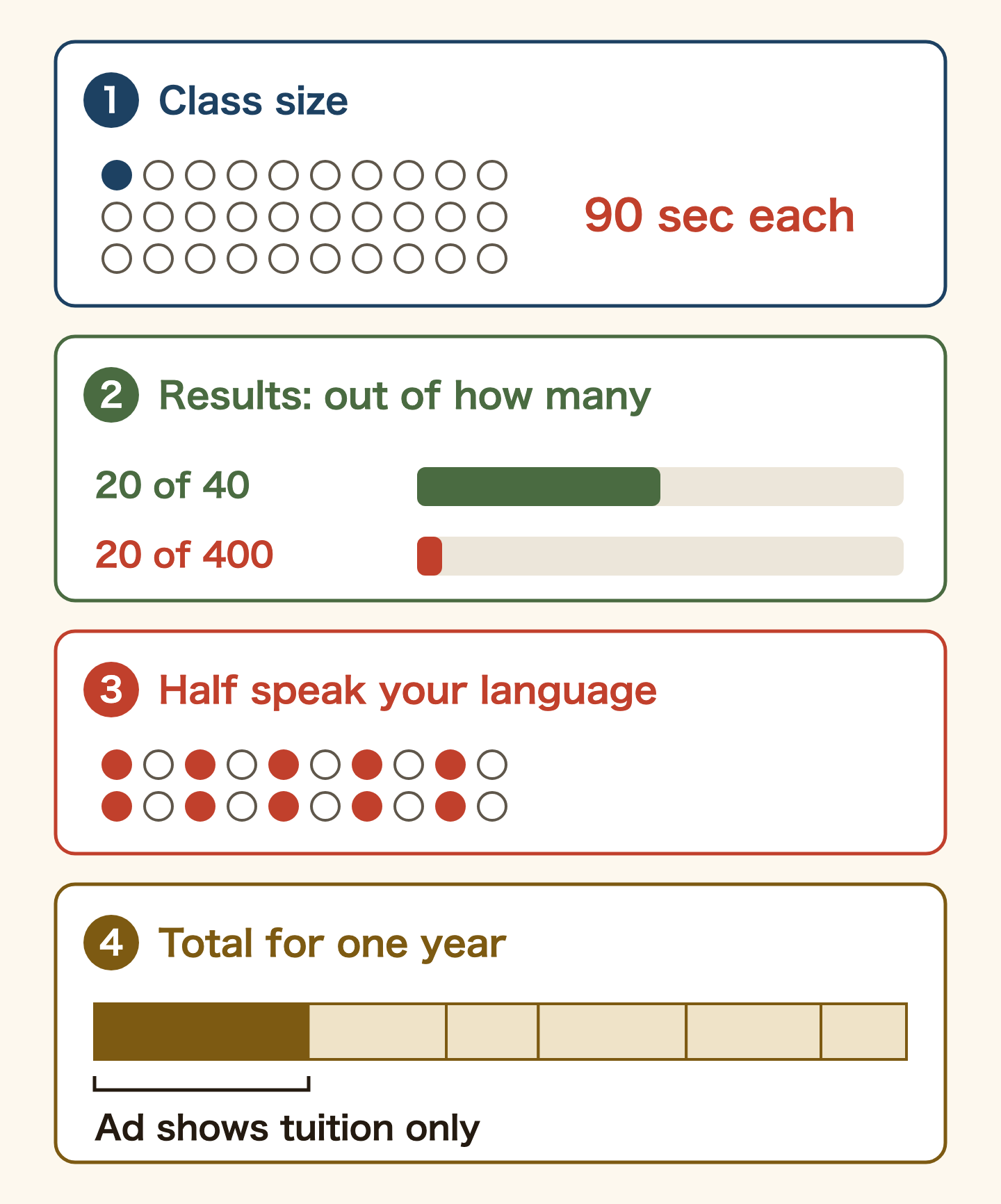
Class size: it decides how much you speak
A class of 15 and a class of 30 cost about the same and are not the same product. In a 45-minute lesson, thirty students means roughly ninety seconds of speaking each. You are paying for the minutes your mouth is open, not the minutes you are in the room.
Where graduates went: ask “out of how many”
Schools publish lists of universities their students entered. The list is meaningless without the denominator. Twenty students into good universities is excellent out of a class of forty and poor out of four hundred. Ask: how many students graduated last year, and how many went where?
The mix of nationalities: the one nobody warns you about
If a large share of your class speaks your language, you will speak your language. Not because you are weak, but because that is what people do. Two years later you leave with the Japanese of someone who spent two years talking to friends from home.
This is the single most common way students waste a year of tuition, and no school will raise it with you. Ask for the nationality breakdown. A school with a genuinely mixed intake will tell you happily.
The total for one year, not the tuition
Tuition is the number in the advertisement. The number you pay includes the entrance fee, materials, facilities fee, insurance and often a dormitory. Ask for the full first-year total in writing before you compare two schools – we cover the realistic totals in what a language school actually costs.
Do you get your money back? Read the refund policy before you pay
After the total, read the conditions for getting that money back. Your Certificate of Eligibility is refused. Your visa is not issued and you cannot come. You arrive and decide to leave. Any of these can happen, and how much you get back differs from school to school.
JASSO, the government-backed Study in Japan service, lists this among its keys to finding a school: “Is the refund policy explained in detail on the website or application requirements?” Accredited schools must set rules on “collecting and refunding tuition, entrance fees and other costs” in their school regulations (Ministry of Education accreditation guide, June 2026 edition (Japanese)), and the Ministry publishes information on accredited schools in several languages on its accreditation portal.
When you read it, look for what comes back, how much, and how to claim it in these three cases:
- Your Certificate of Eligibility is not issued
- The certificate is issued, but your visa is refused and you cannot come
- You decide to leave, before or after the course starts
If you cannot find the policy, or the school will not answer in writing, stop there – before you send any money.
Where the school is: Tokyo is not automatically better
Tokyo has the most schools, the most part-time work and the highest rent. Osaka, Fukuoka and Nagoya have fewer schools but noticeably lower living costs, and your part-time hours are capped at 28 a week wherever you live (Immigration Services Agency, permission for part-time work on a Student status (Japanese)) – so a cheaper city keeps more of what you earn.
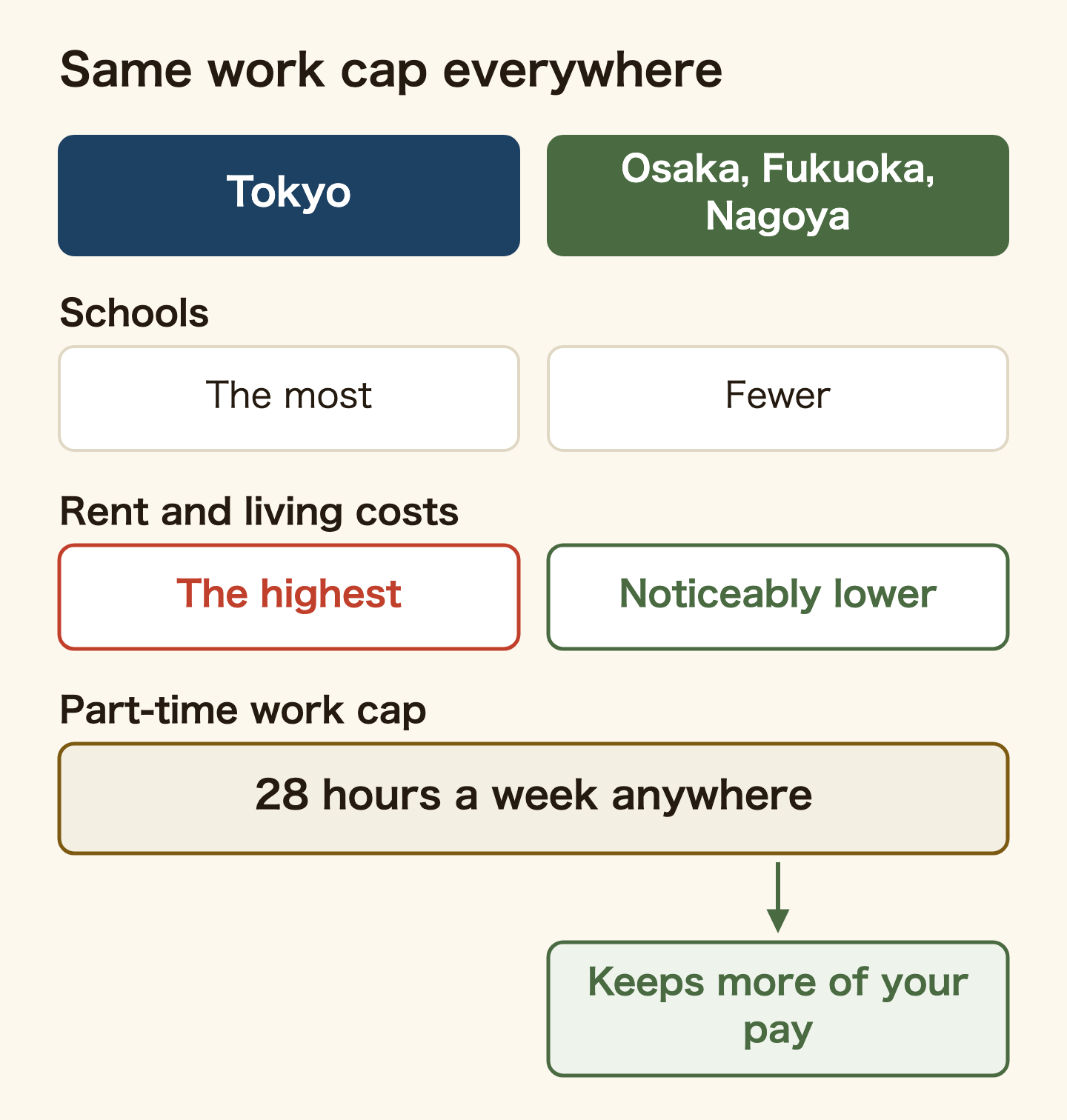
The honest trade-off: big cities have more of everything, including more people who speak your language. If your goal is Japanese rather than a community from home, a smaller city can work in your favour.
Should you use an agent?
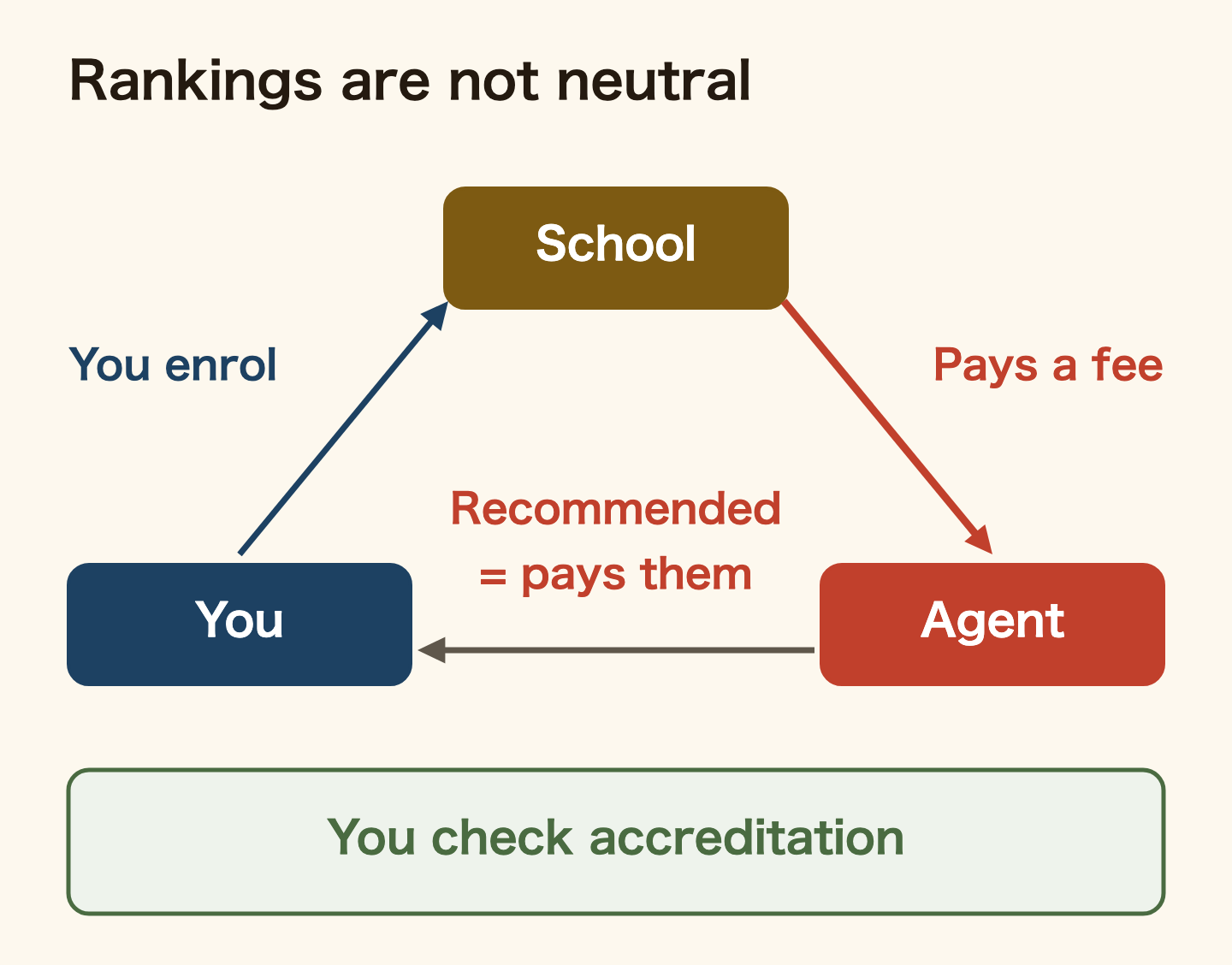
An agent is not automatically bad, but understand how they are paid: by the school, when you enrol. That means their list of “recommended” schools is the list of schools that pay them. It does not make their advice wrong. It does mean their ranking is not neutral.
Use an agent for what they are genuinely good at – paperwork, translation, chasing deadlines. Do the accreditation check yourself. It takes five minutes and nobody else has a reason to do it for you.
Before you apply
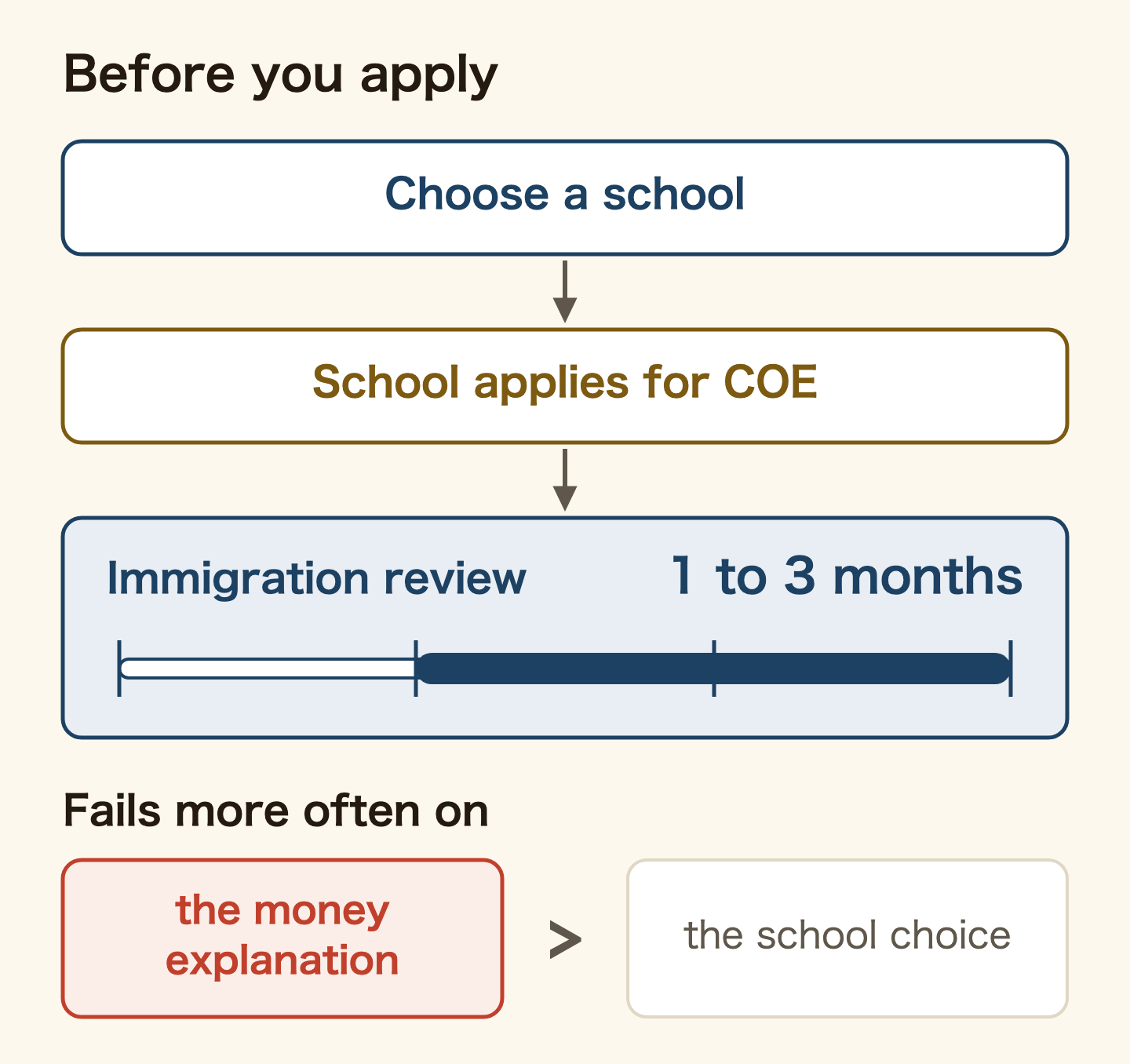
Once you have chosen, the school applies for your Certificate of Eligibility on your behalf, and the review takes one to three months. Applications fail more often on the money explanation than on the school choice, so read that part early.
Accreditation dates and figures were checked on 20 August 2026. This article explains the system in general terms and does not recommend a specific school. Official sources: Ministry of Education: results of accreditation for Japanese language institutions / Ministry of Education, outline of the Japanese Language Education Institution Accreditation Act (PDF, Japanese) / Immigration Services Agency, notice on Japanese language institutions under the old notification system (Japanese) / Immigration Services Agency, permission for part-time work on a Student status (Japanese) / JASSO Study in Japan, Japanese language institutions / Ministry of Education, accreditation application guide (Japanese) / Ministry of Education accreditation portal (checked 26 September 2026; refund section and accreditation results checked 2 October 2026)
Frequently asked questions
How do I check whether a school is accredited?
The Ministry of Education publishes the accreditation results, including a list of institutions. Search for the school’s Japanese name on that list. If it is not there, ask the school when they expect accreditation – schools have until April 2029.
Is a more expensive school better?
Not reliably. Price mostly reflects location and facilities. What changes your Japanese is class size, the mix of nationalities and how much you speak, and none of those move with the price.
Is Tokyo the best place to study Japanese?
It has the most schools and the most part-time work, and also the highest rent and the largest communities of every language. If your priority is speaking Japanese daily, a smaller city can suit you better.
Should I go through an agent?
Agents are paid by schools when you enrol, so their recommendations are not neutral. They are genuinely useful for paperwork and deadlines. Check accreditation yourself either way.
If my visa is refused, do I get my tuition back?
It depends on the school. Accredited schools must set refund rules in their regulations, and JASSO advises checking that the refund policy is explained in detail on the website or in the application requirements. Before you pay, read how much comes back if your Certificate of Eligibility is refused, if your visa is refused, and if you leave on your own.
What if my school loses accreditation while I am studying?
This is exactly why the check matters before you apply. A school that cannot accept foreign students cannot sponsor your status, and you would need to transfer to another school, with two notifications to Immigration within 14 days. Choosing an already-accredited school removes the risk.
Summary
- Accreditation first. The system began in April 2024 and the deadline is April 2029
- A school advertising today may not be accredited. Check the MEXT list yourself
- In one recent round, 53 of 100 applicants withdrew while under review
- Then judge on class size, graduate destinations out of how many, nationality mix, and the one-year total
- Too many speakers of your language is how a year of tuition gets wasted
Related guides
Found this useful? Share it
Send it to a friend who lives in Japan.
Of the things to prepare before school starts, the laptop is the one not to buy at home.
Buying a Laptop in Japan →READ THIS NEXT
Japanese Language School Cost →One year at a Japanese language school costs about 2,000,000 yen once living costs are added.WHO WROTE THIS

mori
Japanese. I read the ministries’ own notices, orders and Q&As in the original, and I start from what my Nepalese and Sri Lankan friends in Japan actually ran into. I do not write about what I have not checked or been told.
What this site can and cannot do →Looking for something else?
You may use the figures in this article, including commercially, if you credit this site with a link. How to use our figures