Checked on 24 September 2026 against the Immigration Services Agency’s document lists for “Spouse or Child of Japanese National” (for spouses, and for children and special adoptees), its pages on the Certificate of Eligibility and on change of status, the official questionnaire form, its notice on the fee revision, and the Immigration Control Act (e-Gov).
The short answer
- “Spouse visa” is the everyday name for the status of residence “Spouse or Child of Japanese National”. It covers the husband or wife of a Japanese national, a child born to a Japanese national, and a Japanese national’s special adoptee.
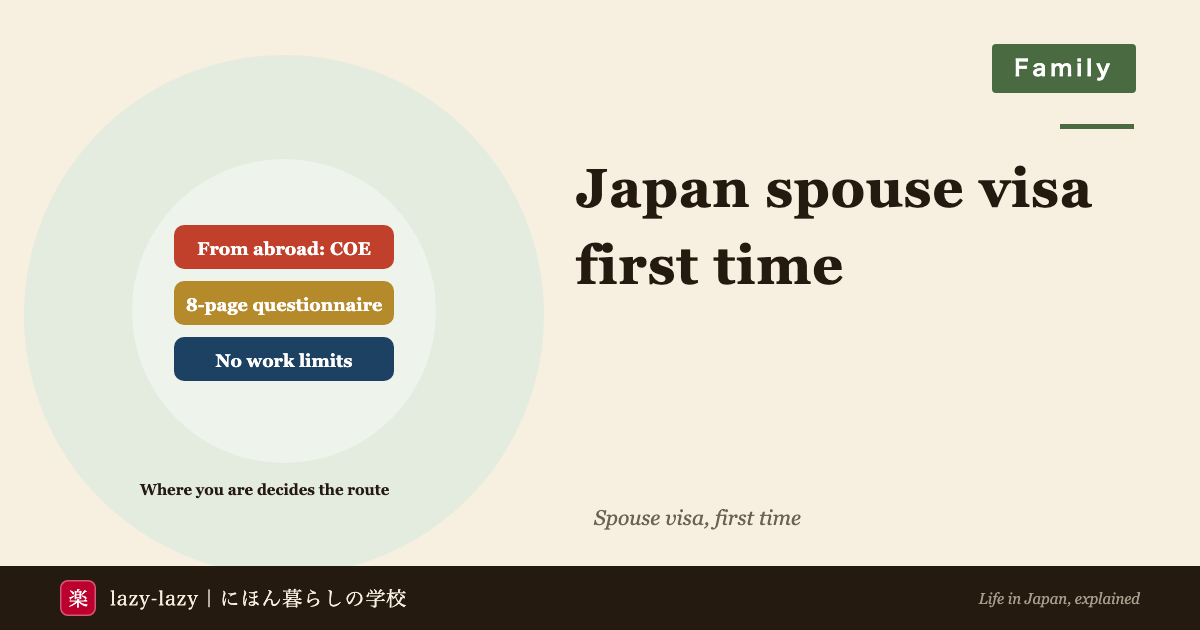
- Where you are decides the route. From abroad, you need a Certificate of Eligibility (COE). Already in Japan, you apply for a change of status. A change from a tourist (short-term) stay is not granted as a rule.
- For a spouse, the documents include a family register extract, a marriage certificate from your home country, local tax certificates, a letter of guarantee, a residence record, the questionnaire and two or three photos of you together. The questionnaire runs to eight pages and is signed by the Japanese spouse. Children do not need one.
- Standard processing time: one to three months for a COE, one to two months for a change of status. A COE is free. A change is paid for only when granted, and for applications received from 1 October 2026 it costs 18,000 to 75,000 yen, depending on the period granted.
- Once granted, there is no limit on the work you can do. A marriage with no real married life behind it is a crime, and the status will be cancelled.
Knowing this, you can work out today whether you file a COE or a change of status, and who fetches which paper from which office. You can also count back from your expiry date, or the day you want to arrive, to see when you need to file.
The day your marriage registration is accepted, your husband is delighted: “So now you have a spouse visa.” Then you open the immigration website. There are close to ten documents, and an eight-page “questionnaire”. When did you first meet? Who introduced you? What language do you speak at home? Which relatives know about the marriage? You ask him how to fill it in. He has no idea. Neither do your Japanese friends. None of them has ever had to apply for a status of residence.
- What is the spouse visa (Spouse or Child of Japanese National)?
- How do you get a spouse visa in Japan? COE from abroad, change of status inside Japan
- Spouse visa Japan requirements: the documents on the official list
- Who fills in the spouse visa questionnaire? The Japanese spouse signs all eight pages
- Documents for a Japanese national’s child or special adoptee
- How long does a spouse visa take in Japan? One to three months for a COE, one to two for a change
- How much does a Japan spouse visa cost? A COE is free; a change is paid when granted
- Can you work on a spouse visa in Japan? Yes, with no limits
- What if you are running out of time or missing a document?
- What happens with a sham marriage?
- Which one are you?
- FAQ
- Summary
- Related reading
What is the spouse visa (Spouse or Child of Japanese National)?
The spouse visa is the status of residence “Spouse or Child of Japanese National” under the Immigration Control Act. Appended Table II of the Act defines it as a spouse or special adoptee of a Japanese national, or a person born as the child of a Japanese national.
In plain terms, three groups qualify:
- The husband or wife of a Japanese national, in a legal marriage
- A child born to a Japanese national
- A Japanese national’s special adoptee (a child whose adoption was decided by a Japanese family court; in principle under 15 at the time)
Special adoption is the only kind of adoption this status names. An ordinary adoption is not listed. If your partner is a permanent resident rather than a Japanese national, the status is a different one: Spouse or Child of Permanent Resident.
The period granted is five years, three years, one year or six months. After that, you extend it through spouse visa renewal, which has no questionnaire and a shorter list.
How do you get a spouse visa in Japan? COE from abroad, change of status inside Japan
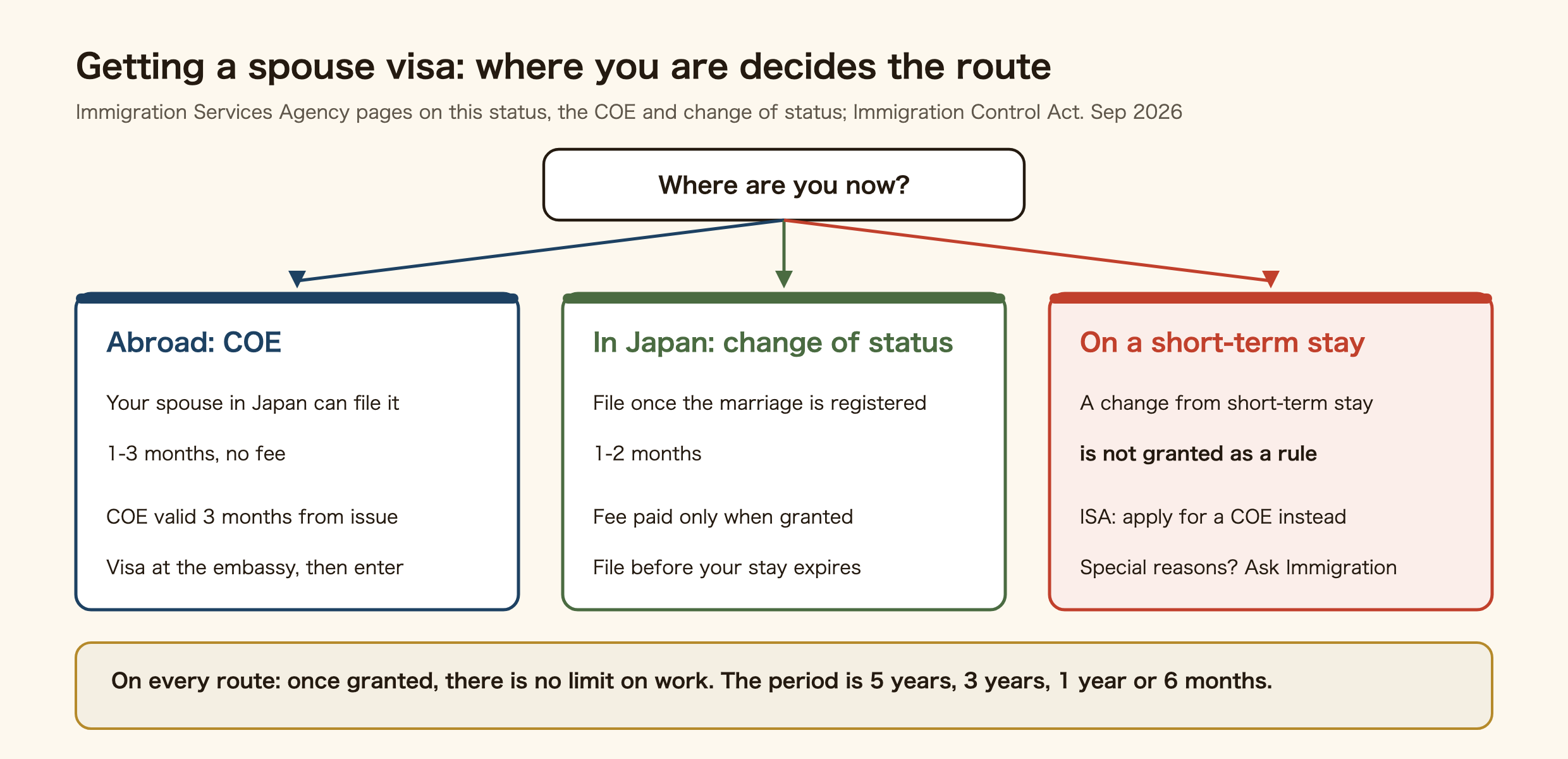
There are two ways to get this status for the first time. Which one applies depends not on who you married, but on where you are right now.
Bringing someone from abroad: the Certificate of Eligibility (COE)
To bring a husband, wife or child who lives abroad, you apply to immigration in Japan for a Certificate of Eligibility. Besides the applicant, a relative of theirs who lives in Japan may file it (Enforcement Regulation, Appended Table IV). In practice, the Japanese spouse files it from Japan. Applications by mail are not accepted, so you go to the immigration office or apply online.
Once the COE is issued, send it to your partner. They apply for a visa at the Japanese embassy or consulate in their country, then fly in. A COE expires three months after the date it is issued. Plan the arrival inside that window. The whole COE process is laid out in our Certificate of Eligibility guide.
Nationals of the Philippines, Nepal and Vietnam also need a TB clearance certificate for the COE. It comes from a designated clinic in the home country after a chest X-ray, and is valid for 180 days in principle.
Switching inside Japan: application for change of status
If you live in Japan on a student or work status and marry a Japanese national, you apply for a change of status. You can file from the moment the reason for the change arises until your current period of stay expires. That means after the marriage registration is accepted.
Some people do not need to hurry. The immigration Q&A says that someone who keeps doing the same job may stay on their work status after marrying. Others do. If you quit your job or graduate, immigration asks you to apply promptly. Staying in Japan without doing the activity of your old status can make it liable to cancellation.
Came as a tourist? A change is not granted as a rule
If you married while on a short-term stay (tourism, visiting family), a change to the spouse visa is not granted unless there are “unavoidable special circumstances” (Immigration Control Act, Article 20(3)). The immigration Q&A tells people who want to live in Japan longer to apply for a COE instead. The usual route is to go home and wait for the COE there. If you have special circumstances, talk to immigration first.
Spouse visa Japan requirements: the documents on the official list
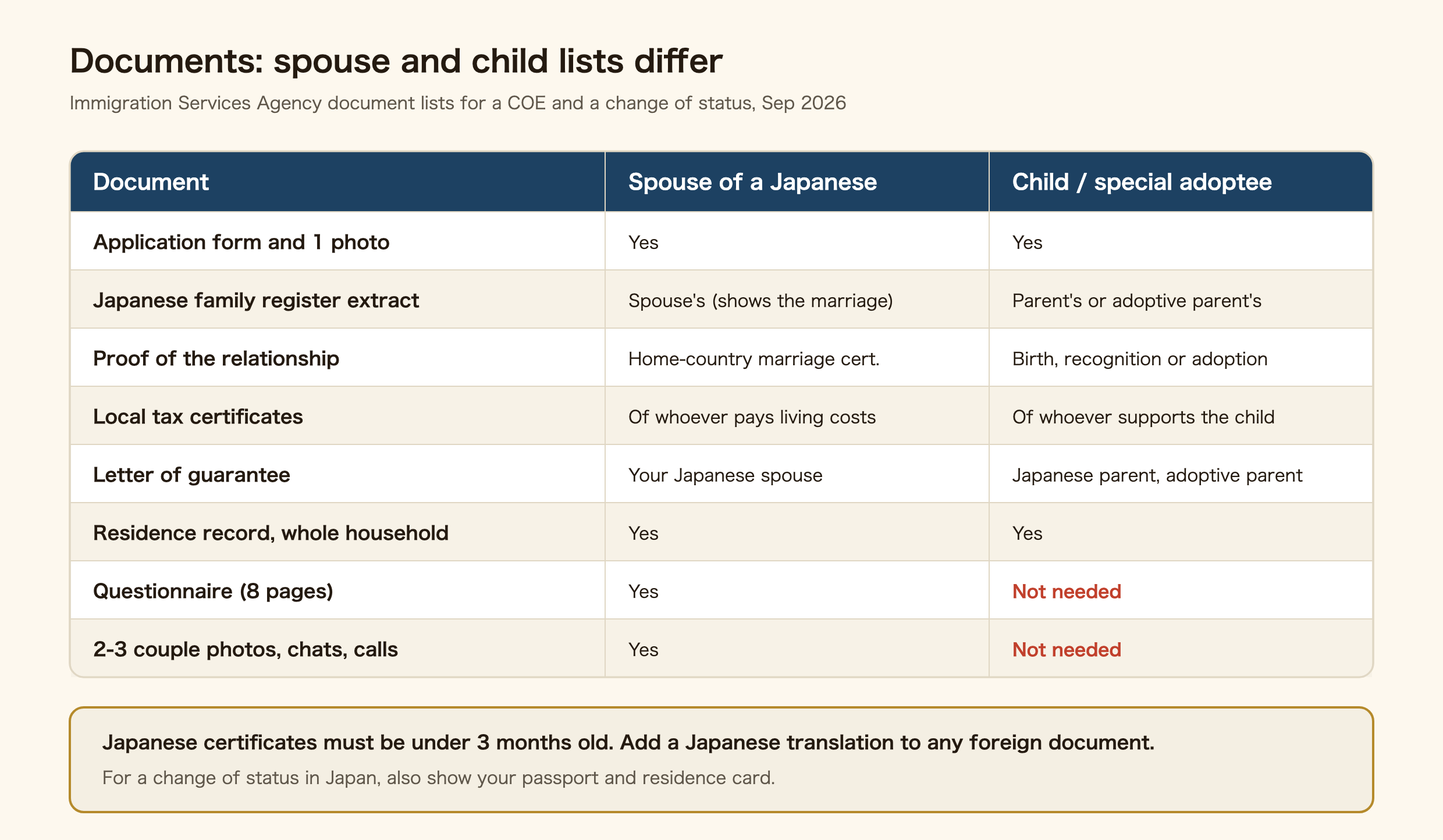
For the spouse of a Japanese national, the immigration agency lists the following. The COE and the change of status use almost the same set.
| Document | Where it comes from | Notes |
|---|---|---|
| Application form (COE or change) and one photo | Immigration website | Official filled-in samples are available |
| Family register extract (koseki tohon) of the Japanese spouse | City office of the spouse’s registered domicile | Must show the marriage. If it does not yet, add the certificate of acceptance of the marriage registration |
| Marriage certificate | An authority of your home country | Nationals of countries with a family register, such as Korea, may submit that register showing the marriage |
| Local tax certificates (taxation or non-taxation, and tax payment) for the last year | City office where the payer lived on 1 January | Of whoever covers your living costs. Just arrived? A bank book copy or a job offer letter instead |
| Letter of guarantee | Written by the Japanese spouse | Official form, English version available |
| Residence record (juminhyo) of the spouse’s whole household | Local city office | Leave out the My Number, nothing else |
| Questionnaire | Immigration website | Japanese plus versions in 10 languages, English included |
| Proof of your relationship | Your own | Two or three photos of you together (no app-edited photos), social media or call records |
| Passport and residence card | — | Shown at the counter for a change of status. A COE application needs a return envelope |
Every certificate issued in Japan must be less than three months old. Foreign-language documents need a Japanese translation. The agency also warns that it may ask for papers that are not on this list during the review.
The document that most often gets stuck is the home-country marriage certificate. If you registered the marriage in Japan first, some countries do not issue one straight away. The immigration Q&A says that in that case you should explain in a written statement why you cannot submit it. You do not have to stop and wait. How the marriage registration itself works, and which embassy papers you need for it, is in getting married in Japan as a foreigner.
The photo rule changed in 2026 too. For a change of status in Japan, residence cards issued from 14 June need a photo for anyone aged one or over. Before that, under-16s were exempt. If a small child living in Japan is part of the application, bring a photo once they turn one.
Who fills in the spouse visa questionnaire? The Japanese spouse signs all eight pages
The questionnaire is the “for COE and change” form, eight pages long. The person who fills it in and signs it is the spouse, meaning the Japanese partner in Japan. The first page makes the split clear: the “applicant (your partner)” and the “spouse (you)”.
It asks about:
- Both partners’ details, and the spouse’s home and workplace
- How you came to marry: when and where you first met, and everything up to the marriage registration, with dates and in as much detail as possible
- Whether someone introduced you (for a marriage agency, its name)
- The language you speak together, how well each of you understands the other’s language, and how you communicate when words fail
- The two witnesses on the registration, if you married in Japan, and the wedding date and guests, if you held one
- Previous marriages, the applicant’s past visits to Japan, and the spouse’s trips to the applicant’s country
- Whether the applicant has ever been deported from Japan
- Both families, and which relatives know about the marriage
There is no official model answer. The form only carries a warning: if an entry is found to be untrue, the application can be treated unfavourably, or you can face criminal charges. If the lines run out, you may continue on a separate sheet, and you may attach photos, letters or records of international calls. Check dates against the stamps in your passports and your message history before you write them down.
Documents for a Japanese national’s child or special adoptee
If the applicant is a Japanese national’s child, a separate list applies. There is no questionnaire and no couple photos. Instead, you prove the parent-child link:
- The Japanese parent’s (or adoptive parent’s) family register extract, or the closed register
- Born in Japan: certificate of acceptance of the birth notification, or of the recognition of paternity
- Born abroad: a birth certificate from that country, or a certificate of recognition
- Special adoptee: certificate of acceptance of the special adoption, or the family court decision with its certificate of finality
- Local tax certificates of whoever supports the child (if two people do, the one with the higher income)
- A letter of guarantee from a Japanese parent or adoptive parent living in Japan, and a residence record
For a minor’s COE, the residence record is the supporting parent’s. For an adult, it is that of the person they will live with in Japan.
How long does a spouse visa take in Japan? One to three months for a COE, one to two for a change
The immigration agency’s standard processing time is one to three months for a COE and one to two months for a change of status. It warns that incomplete applications can be delayed a lot. After a COE comes the embassy visa step, so arrival takes longer than the review alone.
Two things to count correctly:
- The COE’s three months run from the day it is issued. They are the window for using it, not the waiting time
- For a change of status, what must happen before your expiry date is the application, not the decision. If the result comes late, you may stay until the decision or two months after expiry, whichever is earlier (Article 20(6); not for periods of stay of 30 days or less)
That grace period only works if your application has been accepted. To avoid being one paper short on the last day, file well before the deadline. Certificates must be under three months old, so collect them just before you file.
How much does a Japan spouse visa cost? A COE is free; a change is paid when granted
There is no immigration fee for a COE. The embassy visa fee depends on nationality and the mission, so check with the Japanese embassy in your partner’s country.
For a change of status, you pay when it is granted, not when you apply. If it is refused, you pay nothing. The amount depends on the date your application was received.
| Period granted | At the counter | Online |
|---|---|---|
| (Received by 30 September 2026, flat rate) | 6,000 yen | 5,500 yen |
| 6 months | 18,000 yen | 15,000 yen |
| 1 year | 33,000 yen | 27,000 yen |
| 3 years | 64,000 yen | 56,000 yen |
| 5 years | 75,000 yen | 65,000 yen |
For applications received from 1 October 2026, the longer the period, the higher the fee. You will not know the period until it is granted. At the counter it ranges from 18,000 yen for six months to 75,000 yen for five years, so look at the row you are likely to get. Online payments add a small processing charge. The full table and the reduction rules are in Japan’s visa fee increase.
The city office certificates (family register, residence record, tax certificates) each carry a small local fee as well.
Can you work on a spouse visa in Japan? Yes, with no limits
Yes. Article 19 of the Immigration Control Act restricts activities only for the statuses in Appended Table I, such as Student and the work statuses. Spouse or Child of Japanese National is in Table II, so there is no limit on the type of job or the hours. The immigration Q&A says the same: after a change to this status, the limit on work (and on the kind of job) disappears.
The 28-hour weekly cap you had as a student, and the job-type limits of a status like Engineer/Specialist in Humanities/International Services, end on the day it is granted. You do not need a work permit for students either. This freedom rests on the marriage continuing, though. After a divorce or a spouse’s death, six months or more without living as a spouse can lead to cancellation. What to do then is in spouse visa and divorce in Japan.
What if you are running out of time or missing a document?
- Your home country will not issue a marriage certificate: submit a written statement of the reason with the other papers (immigration Q&A)
- Your period of stay is about to expire: at least get the change of status filed before the expiry date, so the grace period covers you
- You are not sure what to submit: the Immigration Services Agency’s information centre (0570-013904) answers questions about documents
- Your COE was refused: there is no appeal procedure for a COE (agency page). Ask immigration what was missing before you apply again
The worst outcome is staying past your expiry date without having applied. That is a breach of the Immigration Control Act (Article 70(1)(v)), and the spouse visa is no longer the issue.
What happens with a sham marriage?
Registering a marriage only for a visa, with no intention of living as a married couple, is a crime. Having a false entry made in the family register falls under Penal Code Article 157. Obtaining permission to stay by deception falls under Immigration Control Act Article 70: up to three years’ imprisonment, a fine of up to 3 million yen, or both. Permission obtained by fraud is cancelled (Article 22-4), and the person faces deportation.
Even for a real couple, writing something untrue on the questionnaire can bring unfavourable treatment or charges, as the form itself warns. If you do not remember an exact date, write “around” rather than dressing it up.
Which one are you?
- Your partner is abroad — this week, the Japanese spouse collects the family register extract, residence record and tax certificates, and your partner requests the home-country marriage certificate. Filipino, Nepali or Vietnamese? Book the TB check today.
- You are in Japan and keeping your job or studies — no rush. Check the expiry date on your residence card, and put the month you will file the change in your calendar, before that date.
- You are in Japan and have quit (or are quitting) your job or school — apply promptly. Today, decide the day you will fetch the certificate of acceptance of the marriage registration and your residence record.
- You came as a tourist and married — a change is not granted as a rule. Before you fly home, agree with your spouse who prepares which COE papers, and call immigration today to ask about your case.
FAQ
Q. Is the spouse visa the same as “Spouse or Child of Japanese National”?
Yes. “Spouse visa” is the everyday name; the official status of residence under the Immigration Control Act is “Spouse or Child of Japanese National”. Besides husbands and wives, it covers a Japanese national’s children and special adoptees.
Q. What documents do I need for a spouse visa in Japan?
For the spouse of a Japanese national: the application form and a photo, the Japanese spouse’s family register extract, a marriage certificate from your home country, local tax certificates, a letter of guarantee, a residence record for the household, the questionnaire and two or three photos of you together. Japanese certificates must be under three months old, and foreign documents need a Japanese translation.
Q. How long does a spouse visa take in Japan?
The standard processing time is one to three months for a Certificate of Eligibility (COE) from abroad, and one to two months for a change of status in Japan. A COE expires three months after it is issued.
Q. Who fills in the spouse visa questionnaire?
The Japanese spouse living in Japan fills it in and signs it. It is eight pages long and asks how you met and came to marry, the language you use, visits to each other’s countries and your families. Untrue entries can lead to unfavourable treatment or criminal charges.
Q. I married while visiting Japan as a tourist. Can I switch to a spouse visa?
As a rule, no. The Immigration Control Act says a change from a short-term stay is not granted without unavoidable special circumstances. Immigration tells people to apply for a Certificate of Eligibility (COE) instead.
Q. Can I work on a spouse visa in Japan?
Yes. Spouse or Child of Japanese National has no work restrictions: any job, any hours, with no separate work permit.
Summary
The spouse visa (Spouse or Child of Japanese National) is for the husband or wife, child or special adoptee of a Japanese national. From abroad you get it through a COE; in Japan, through a change of status; and a change from a tourist stay is not granted as a rule. Processing takes one to three months for a COE and one to two months for a change.
A spouse’s application needs the eight-page questionnaire, signed by the Japanese partner, and photos of you together. A change of status is paid for when granted; for applications received from 1 October 2026 it costs 18,000 to 75,000 yen depending on the period. Once granted, your work is no longer limited.
Sources (official): Immigration Services Agency, “Spouse or Child of Japanese National” / the same, for spouses / the same, for children and special adoptees / Certificate of Eligibility / Change of status of residence / Questionnaire (English) / Immigration Q&A (Japanese) / Fee revision from 1 October 2026 / Pre-entry TB screening / Immigration Control and Refugee Recognition Act (e-Gov). Checked on 24 September 2026. Lists can change, so check the agency’s current page before you apply.
Related reading
Found this useful? Share it
Send it to a friend who lives in Japan.
WHO WROTE THIS

mori
Japanese. I read the ministries’ own notices, orders and Q&As in the original, and I start from what my Nepalese and Sri Lankan friends in Japan actually ran into. I do not write about what I have not checked or been told.
What this site can and cannot do →Looking for something else?