Checked on 30 September 2026 against the National Police Agency and Tokyo Metropolitan Police pages on parking-space certificates, the Ministry of Land, Infrastructure, Transport and Tourism (MLIT) pages on car registration, jibaiseki insurance and vehicle inspection, the Light Motor Vehicle Inspection Organization, the tax pages of the Tokyo Metropolitan Government, the Ministry of Internal Affairs and Yokohama City, and the laws on e-Gov.
The short answer
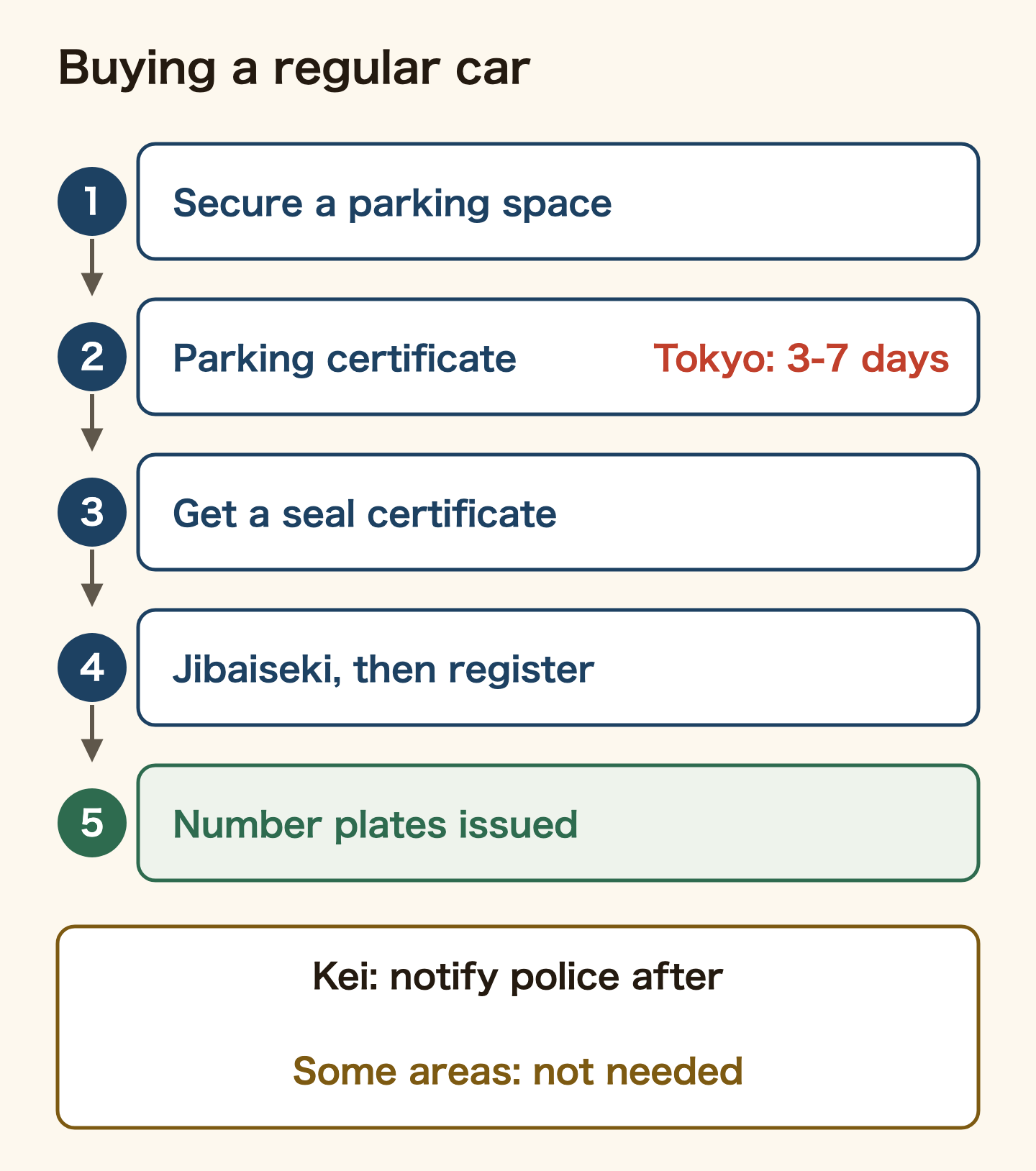
- Yes, a foreigner can buy a car in Japan. The order is: rent a parking space, get a parking certificate from the police, then register the car. The parking certificate (shako shomeisho) is police proof that you have an off-road space within 2 km of where the car is based, usually your home.
- To put a regular car in your name you need a seal registration certificate issued within the last 3 months. Your residence card is what you show at city hall to register the seal. If you cannot get a seal certificate, an embassy signature certificate can stand in for it.
- Jibaiseki insurance is compulsory, but it only pays for injury or death caused to other people. Other people’s cars, your own car and your own injuries need voluntary insurance.
- Car tax goes to whoever owns the car on 1 April and is billed in May. In Tokyo the deadline is 31 May. Shaken inspection is due 3 years after a new car is registered, then every 2 years.
- A kei car keeps the paperwork light. No parking certificate, and the police notice is needed only in some cities. A juminhyo copy works as proof of address, and the tax is 10,800 yen a year (standard rate, private passenger kei first inspected from April 2015).
Knowing this, you can line up the parking space and the papers before you visit a dealer, so delivery is not held up by a missing document. You will also know what leaves your account every May and in each shaken year.
You have the job. There is no train to the workplace. A used kei car looks affordable. Then the dealer asks, “Parking certificate? Seal certificate?” and you have no answer. Your Japanese colleague shrugs: the shop did all of it for them. The parts the shop cannot do for you are exactly where foreign buyers get stuck.
- Can a foreigner buy a car in Japan? Yes — parking space, then certificate, then registration
- What is a parking certificate in Japan, and how do you get one?
- What documents does a foreigner need to buy a car? A seal certificate, not your residence card
- Jibaiseki vs voluntary insurance: what is the difference?
- When is car tax due in Japan, and how much is it?
- What is shaken, and how often is it due?
- Kei cars: what is different?
- How much does it cost to own a car in Japan?
- What if you break the rules?
- Can’t pay, or missed a deadline?
- Which one are you?
- FAQ
- Summary
- Related reading
Can a foreigner buy a car in Japan? Yes — parking space, then certificate, then registration
Yes. MLIT’s page on new registration (in Japanese) even spells out what a foreign owner submits when they cannot provide a seal certificate.
The order matters. For a regular car, the police will not issue a parking certificate until you have a space. Without the certificate, the Transport Bureau will not register the car. At registration you also show the jibaiseki insurance certificate.
Registration itself can be done by an agent if you sign a letter of attorney. Still, only you can sign the parking contract and get the seal certificate. If you do not have a Japanese licence yet, start there: convert your foreign licence if your country allows it, or get a Japanese licence from scratch.
What is a parking certificate in Japan, and how do you get one?
You plan to leave the car on the street outside your flat. Where you come from, that may be normal. In Japan, using the road as your garage is against the law (Act on Securing Parking Spaces, Article 11, in Japanese). That is why the parking space comes first.
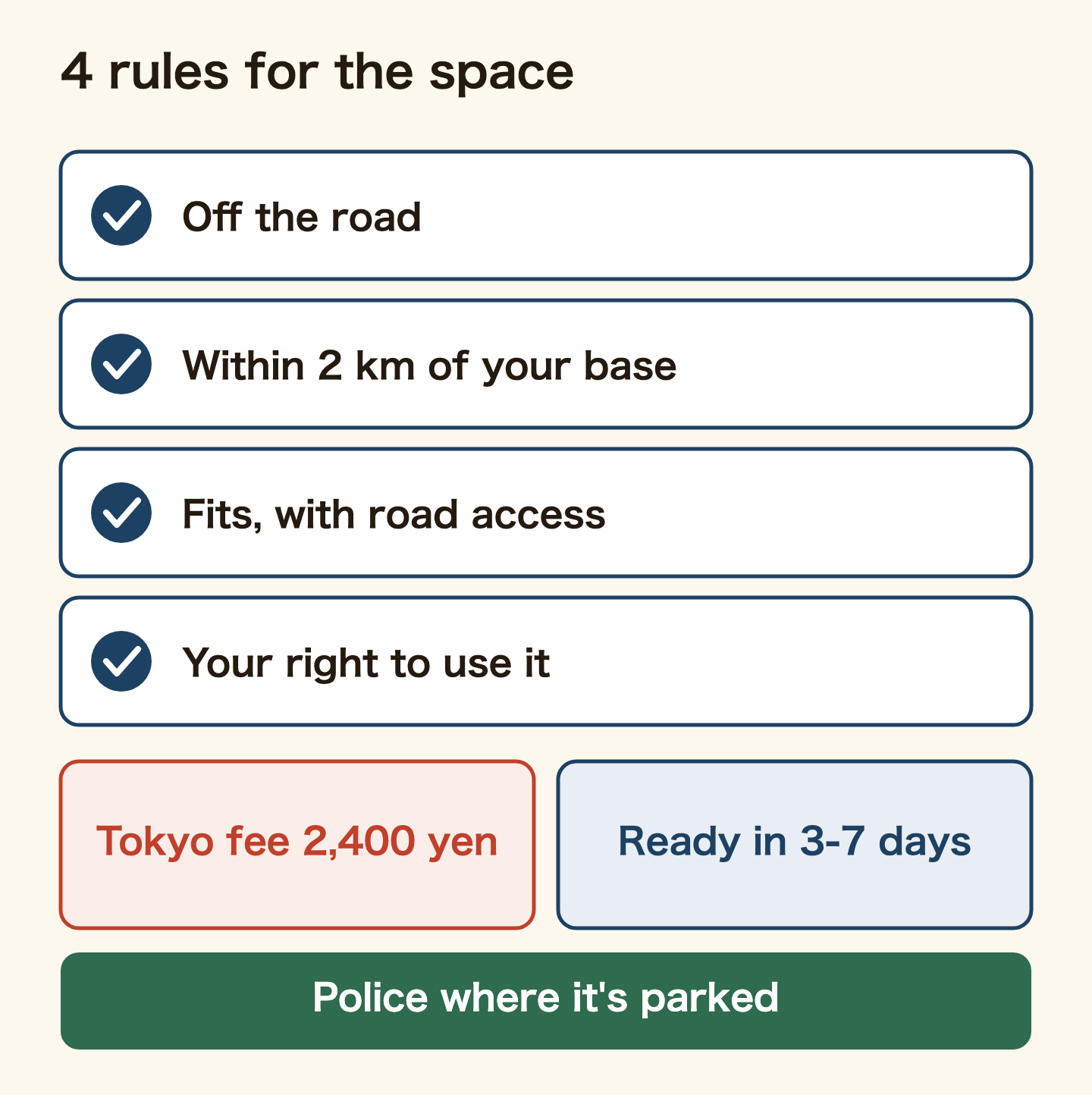
The official name is the “automobile storage place certificate” (jidosha hokan basho shomeisho). According to the National Police Agency (in Japanese), the space must meet four conditions:
- it is not on the road
- it is no more than 2 km from the car’s base of use (normally your home)
- the car can get in and out from the road without trouble, and the whole car fits
- you have the right to use it as a parking space
You apply at the police station that covers the parking space. There are three documents: the application form, a location map and layout of the space, and proof of your right to use it. For a rented monthly space, the owner or manager fills in a “consent certificate for use of the parking space” — you cannot write it yourself. If your apartment comes with parking and the lease says so, a copy of the lease is enough (Tokyo Metropolitan Police, in Japanese).
The fee depends on the prefecture. In Tokyo it is 2,400 yen at the counter or 2,300 yen online. The certificate takes 3 to 7 days, and it should reach the Transport Bureau within about a month of its date (Tokyo Metropolitan Police procedure page). The same page offers the forms in English.
What documents does a foreigner need to buy a car? A seal certificate, not your residence card
Many people expect to show their residence card and be done. The residence card is not on MLIT’s list of registration documents. For a regular car, the owner needs a seal registration certificate from the city office, issued within the last 3 months (MLIT: documents for a change of ownership, in Japanese).
The residence card comes in one step earlier. You can register a seal at the city office where you are on the resident register, from age 15. In Nerima City, Tokyo, you can register the same day if you go in person with your residence card (Nerima City, in Japanese). The rules for a seal in romaji or katakana are in our guide to hanko and seal registration for foreigners.
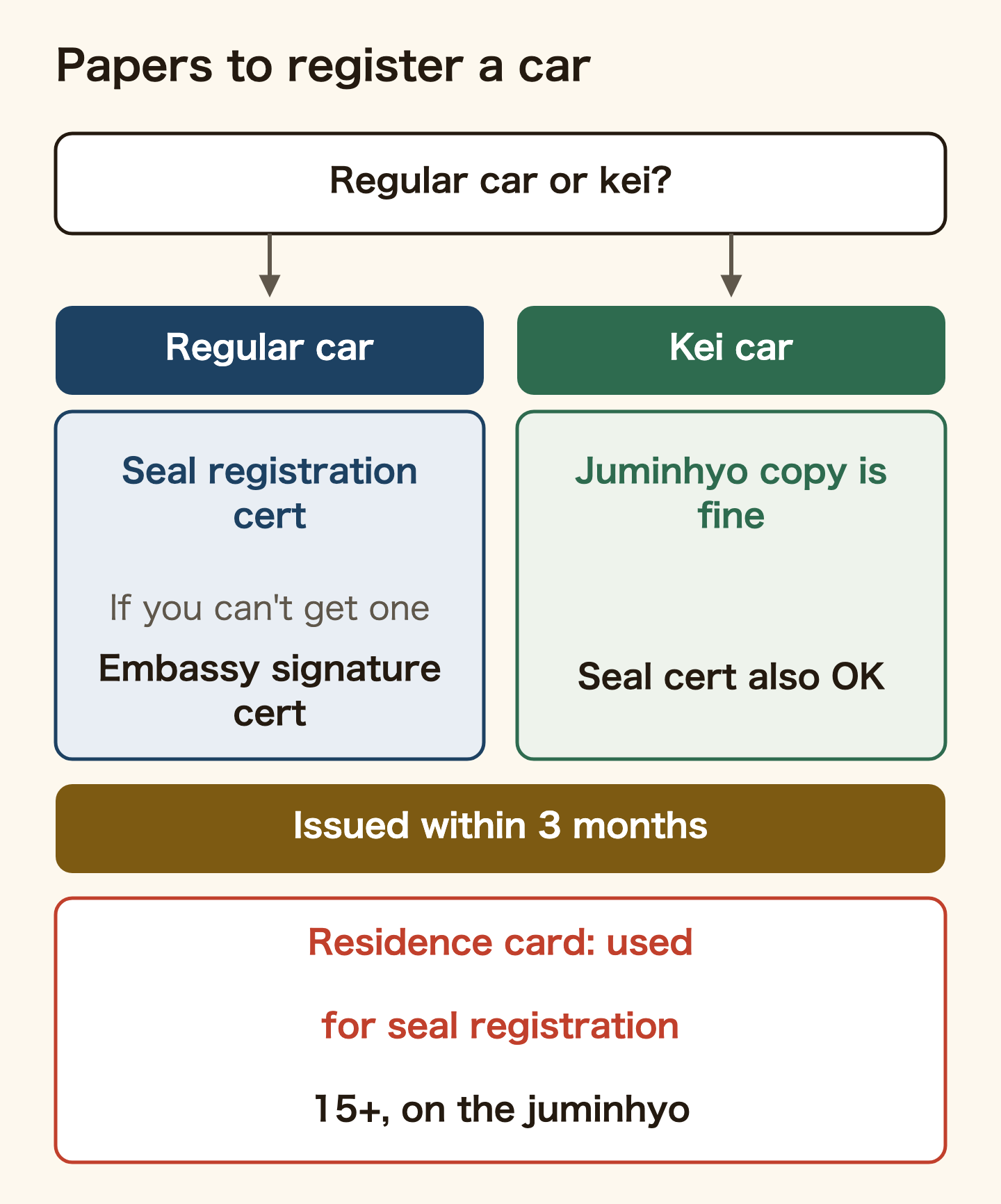
If you cannot provide a seal certificate, there is another route. MLIT treats a “signature certificate” issued by an embassy, consulate or public office, showing your name and address, as equivalent to a seal certificate. Ask your own embassy whether it issues one.
Proof of the user’s address can be a juminhyo, a seal certificate or that signature certificate (issued within 3 months). If the owner and the user are the same person, this extra document is not needed.
Jibaiseki vs voluntary insurance: what is the difference?
Jibaiseki (compulsory automobile liability insurance) is required for every motor vehicle, mopeds included. MLIT describes its purpose as securing “minimum” compensation for injury to people. It pays only for personal injury; damage to cars and other property is not covered (MLIT jibaiseki FAQ, in Japanese).
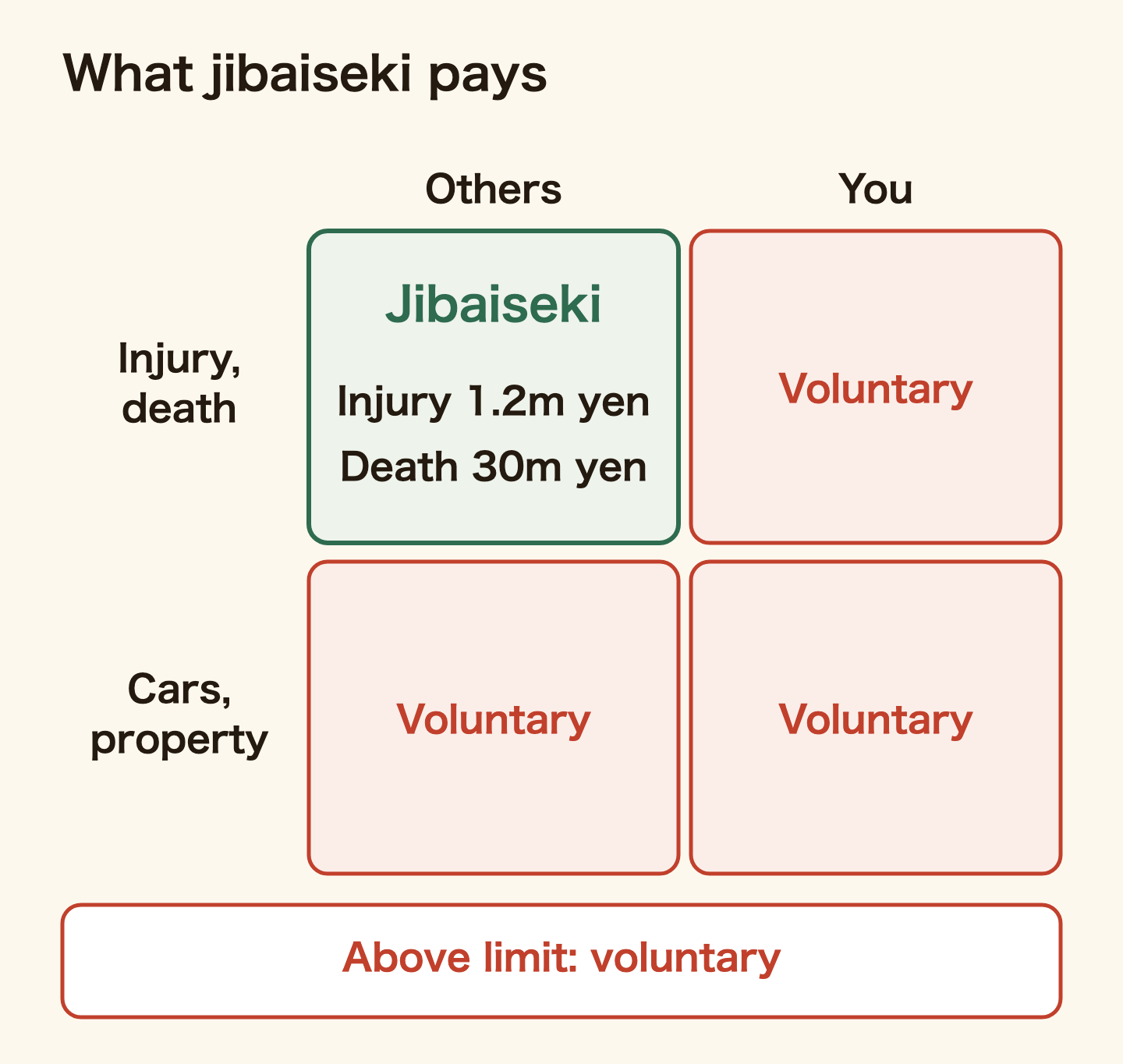
There are limits, too. Per victim: 1.2 million yen for injury, 30 million yen for death, and up to 40 million yen for permanent disability (MLIT: limits and cover). Anything above that, repairs to the other car, your own car and your own injuries come from voluntary insurance or from your own pocket.
“Voluntary” is the name, not a real choice about driving without it. Premiums and cover differ by company and policy. What to do at the scene of a crash, and the papers you need to claim, are in our car accident guide.
When is car tax due in Japan, and how much is it?
Car tax is a prefectural tax charged to whoever is registered as the owner on the vehicle inspection certificate on 1 April. In Tokyo, the tax notice arrives in early May and the deadline is 31 May (Tokyo Bureau of Taxation, in Japanese). If the dealer or lender keeps ownership until a loan is paid off, the person registered as the user pays.
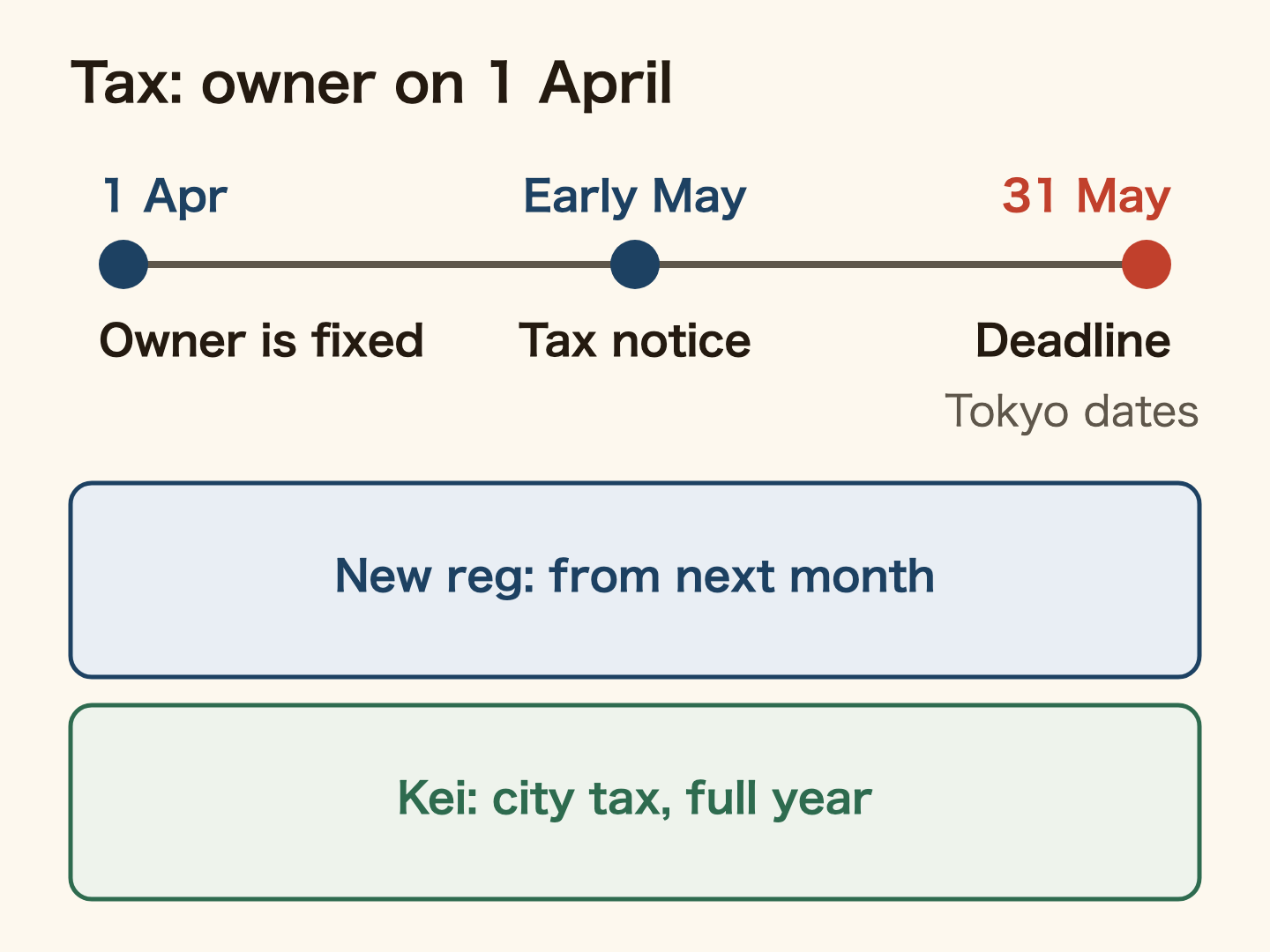
Count carefully. A regular car newly registered during the year pays by month, from the month after registration to March. If you only take over a used car’s registration after 2 April, that year’s tax falls in full on whoever owned it on 1 April. Whether “buying in May costs more” depends on which of these applies.
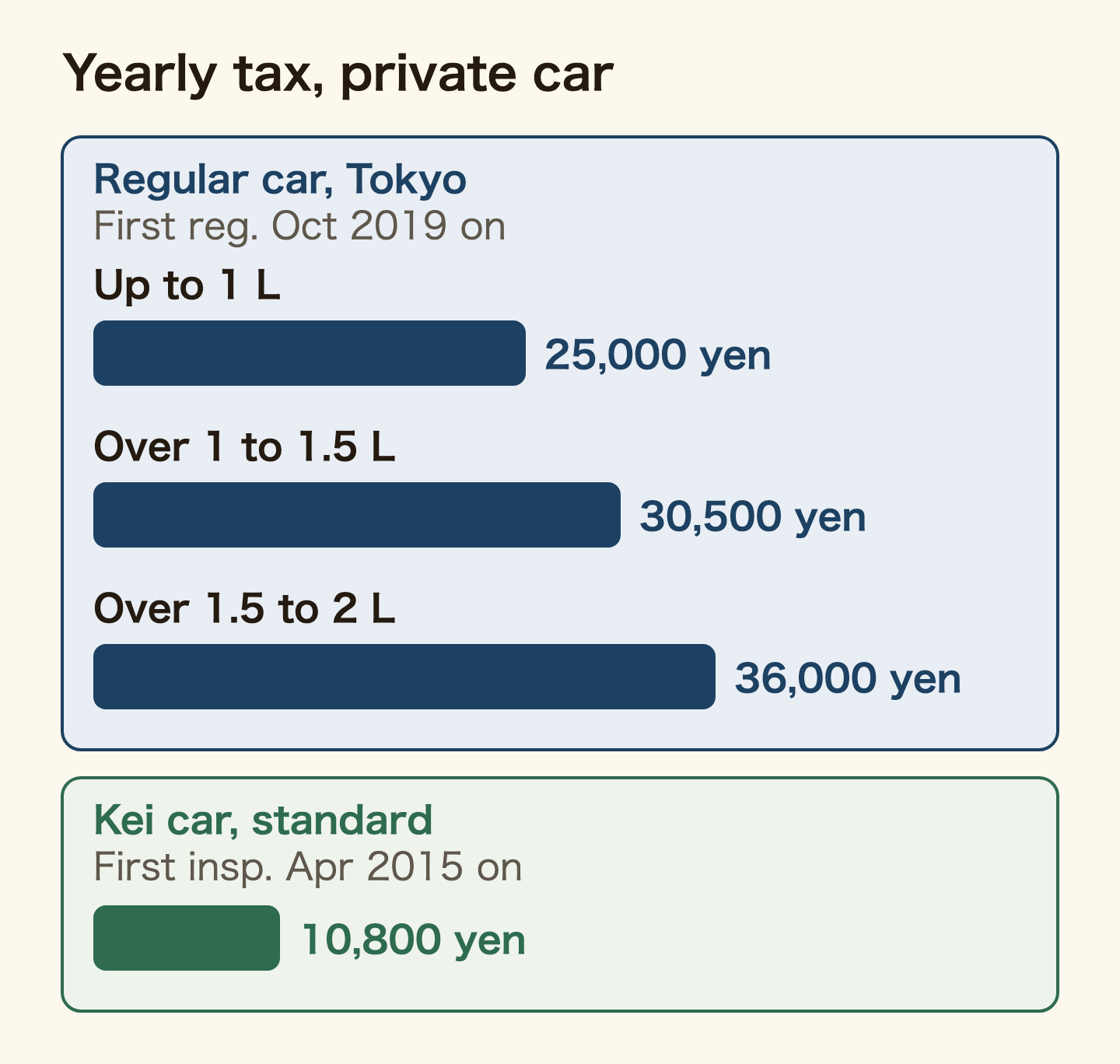
The amount follows engine size. For a private passenger car in Tokyo first registered on or after 1 October 2019, it is 25,000 yen a year up to 1 litre, 30,500 yen up to 1.5 litres and 36,000 yen up to 2 litres. Kei car tax is a municipal tax, with a standard rate of 10,800 yen for a private passenger kei (Ministry of Internal Affairs and Communications, in Japanese). In Yokohama’s table, 10,800 yen applies to kei cars first inspected from April 2015; older ones pay 7,200 yen, and cars more than 13 years past their first inspection pay 12,900 yen. Regular cars also have a heavier rate for older vehicles.
Older guides use two names you may still see. According to the Tokyo Bureau of Taxation, “automobile tax, type-based” was renamed simply “automobile tax” on 1 April 2026, and the “environmental performance” tax paid when buying a car was abolished on 31 March 2026 (Tokyo Bureau of Taxation).
What is shaken, and how often is it due?
Shaken is the government inspection that checks a vehicle meets safety and environmental standards. A car without a valid inspection certificate must not be driven on public roads (Road Transport Vehicle Act, Article 58, in Japanese).
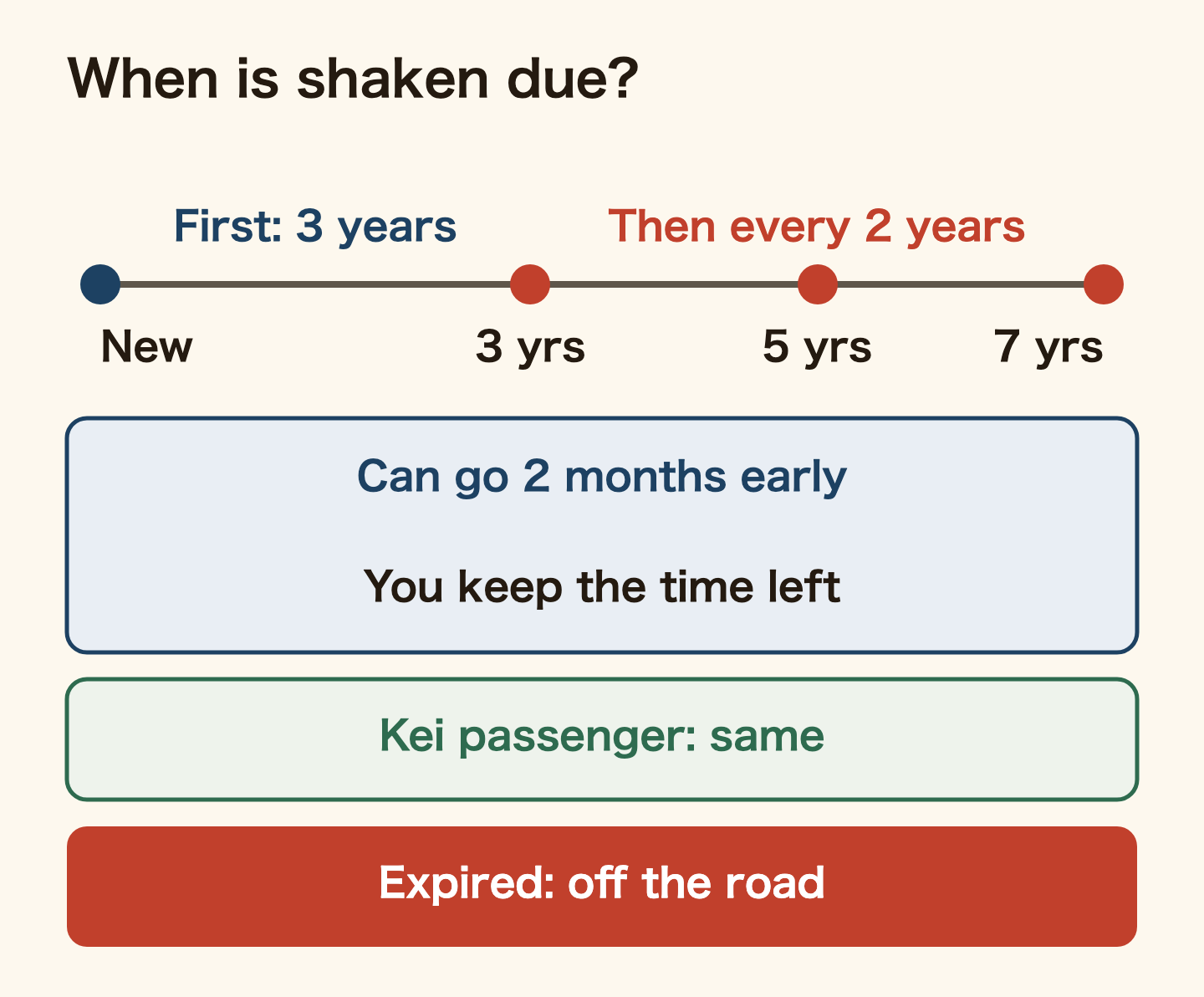
A new private passenger car has 3 years until its first shaken, then 2 years each time. Passenger kei cars are the same; kei vans and trucks are 2 years from the start (MLIT: validity of the inspection certificate). With a used car, check how many months of shaken are left before you agree a price.
Since 1 April 2025 you can take the inspection from 2 months before expiry without losing the remaining time. Before that it was 1 month (MLIT press release). The ministry asks drivers to avoid the end-of-March rush. At each shaken you also renew jibaiseki to cover the next period and pay the motor vehicle weight tax.
Kei cars: what is different?
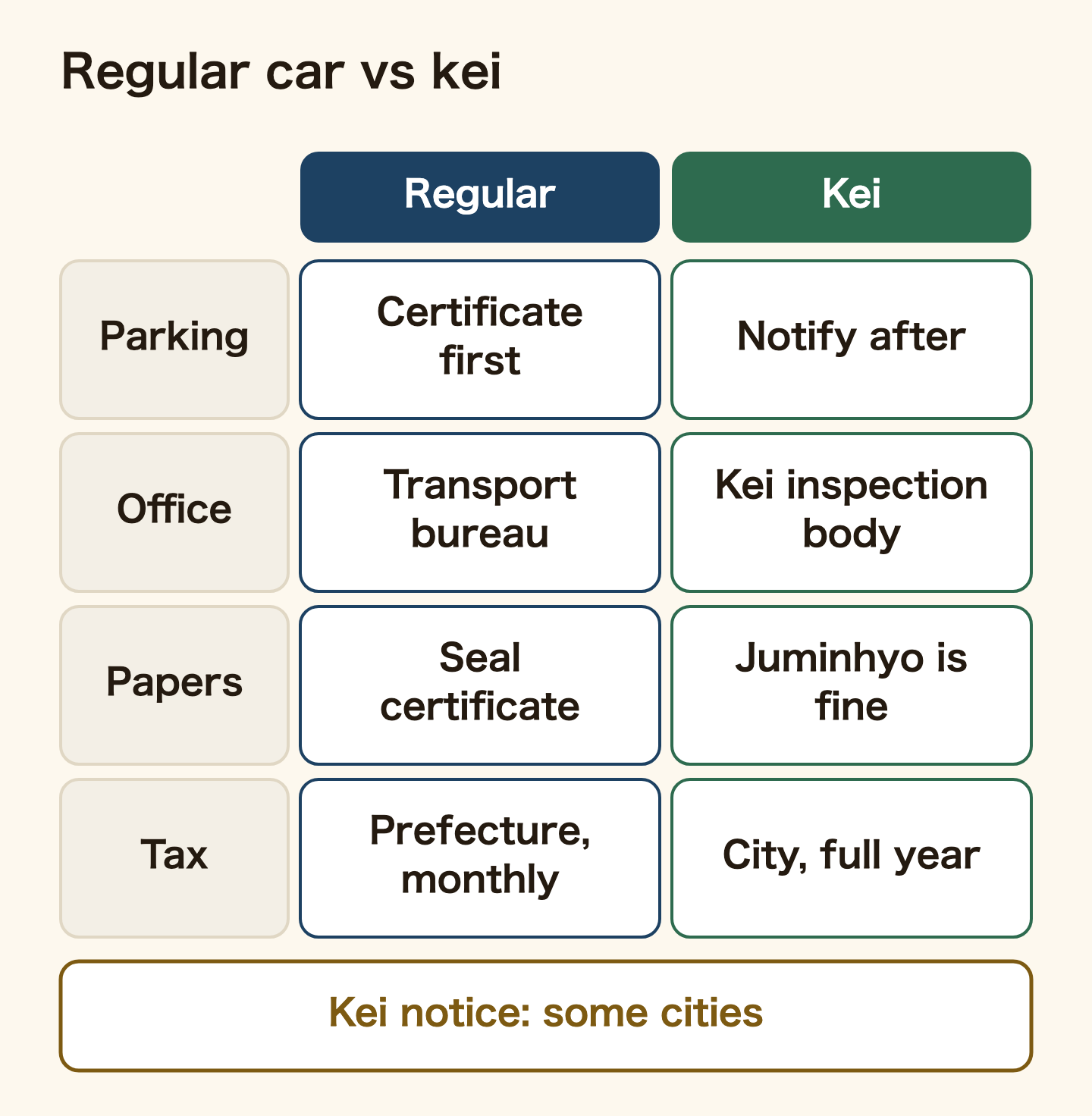
A kei car does not need a parking certificate. Instead, you file a parking-space notice with the police when you start using the car, free of charge (National Police Agency, in Japanese). Even that notice is required only in Tokyo’s 23 wards and the cities listed by government order. Ask the police station whether your city is one of them.
The ban on using the road as a garage and the 2 km rule apply to kei cars too. The paperwork gets lighter; the need for a parking space does not go away.
Registration is handled by the Light Motor Vehicle Inspection Organization instead of the Transport Bureau. Proof of address is either a juminhyo copy (without your My Number on it) or a seal certificate, and a photocopy is accepted (Light Motor Vehicle Inspection Organization, in Japanese). So you can go ahead with a juminhyo even if you have not registered a seal.
The tax counts differently as well. Kei car tax is charged in full to the owner on 1 April, with no monthly proration. In Yokohama the payment period is 1 to 31 May (Yokohama City, in Japanese).
How much does it cost to own a car in Japan?
| What | How much | When |
|---|---|---|
| Parking certificate (regular car) | 2,400 yen at a Tokyo counter (varies by prefecture) | Once, before buying |
| Jibaiseki (24 months) | 17,650 yen private passenger car / 17,540 yen kei | Every shaken |
| Car tax | 25,000 yen a year up to 1 litre in Tokyo (first registered from Oct 2019) / 10,800 yen standard for kei (first inspected from Apr 2015) | Every May |
| Motor vehicle weight tax | Set by weight and age | Every shaken |
| Voluntary insurance | Depends on company and policy | Every year |
| Parking space | Depends on the area | Every month |
The jibaiseki figures come from the premium table MLIT publishes, for policies starting on or after 1 April 2023; remote islands and Okinawa have different rates (MLIT: data). The parking space is charged every month, so check that price before you set a budget for the car.
What if you break the rules?
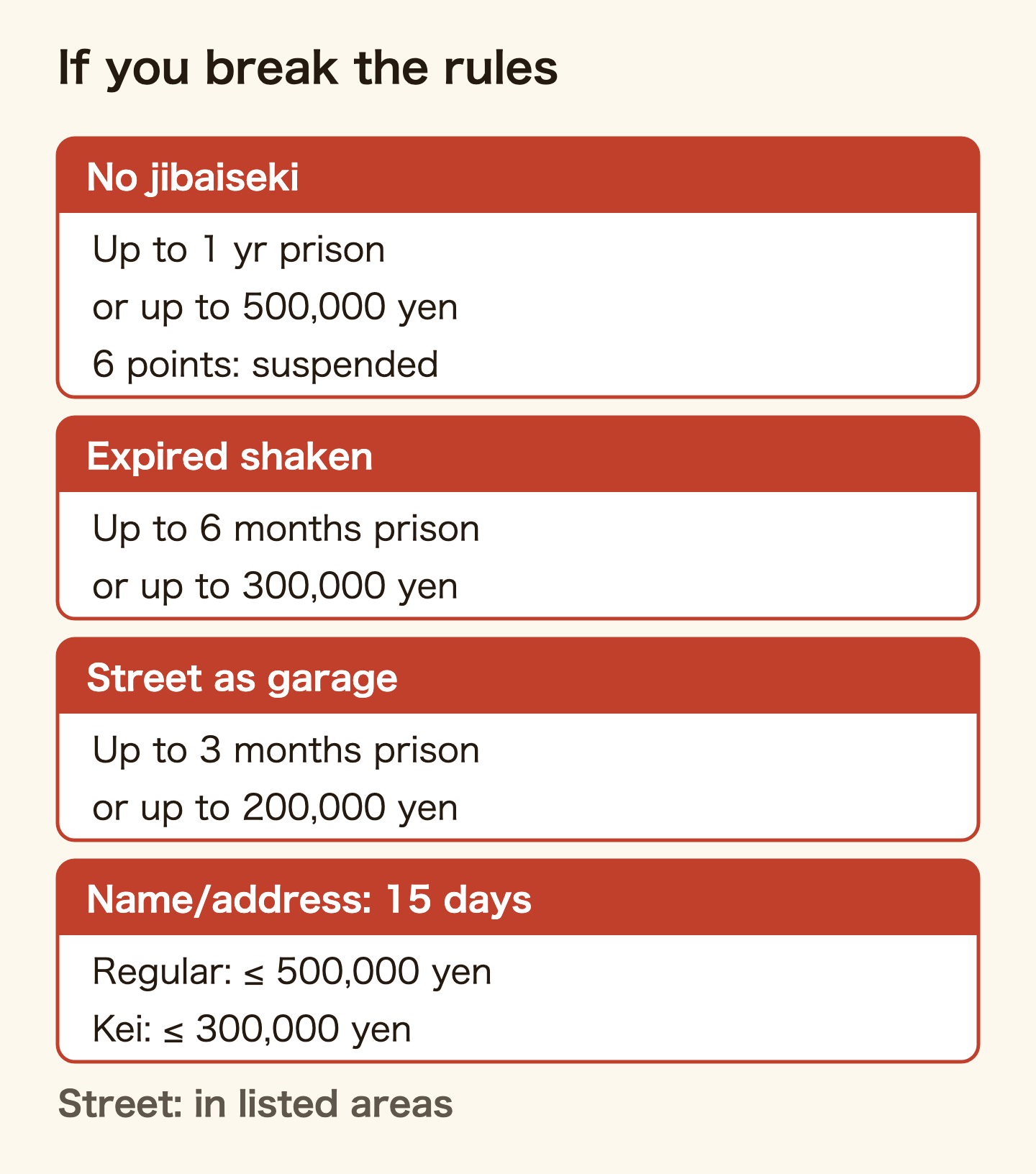
Driving with lapsed jibaiseki, even without an accident, carries up to 1 year in prison or a fine of up to 500,000 yen. It also adds 6 points, which means an immediate licence suspension. Just not carrying the certificate can bring a fine of up to 300,000 yen (MLIT). Driving with an expired shaken carries up to 6 months in prison or a fine of up to 300,000 yen.
Moving house has a deadline too. For a regular car, the address change must be registered at the Transport Bureau within 15 days. When you take over a used car, the new owner has 15 days to transfer the registration. Missing these can bring a fine of up to 500,000 yen for a regular car or up to 300,000 yen for a kei car. Changing your juminhyo address does not change the address on the inspection certificate. Tokyo warns that without a transfer, the previous owner may keep being taxed.
Using the road as your garage carries up to 3 months in prison or a fine of up to 200,000 yen. Parking in the same spot on the road for 12 hours or more (8 hours or more at night) can bring a fine of up to 200,000 yen. Both apply in the areas the law covers: Tokyo’s 23 wards, every city and town, and some villages.
Can’t pay, or missed a deadline?
If your shaken has already expired, you cannot even drive the car to the Transport Bureau. You borrow temporary plates through a temporary operation permit, issued by the city or town office among others. In the Kinki region, the permit lasts only the days needed, 5 at most, costs 750 yen, and needs a jibaiseki certificate valid for that period. A residence card is accepted as ID (Kinki District Transport Bureau, in Japanese).
If you cannot pay car tax by the end of May, contact the office named on the tax notice rather than ignoring it. Tokyo says that if you miss the deadline you receive a demand notice, and if it still goes unpaid you may face seizure of assets (Tokyo Bureau of Taxation: paying tax, in Japanese). Late-payment charges are added by the day. The same local-tax process, and how to ask about paying in parts, is laid out in our guide to unpaid residence tax.
If the 15 days for a transfer or an address change have passed, do it on the day you notice. Leaving it lets other problems stack up, such as tax notices going to the old address or the previous owner still being charged.
Which one are you?
- No Japanese licence yet — sort out the licence before the car: convert your foreign licence if you can, otherwise price up driving school. Today, check which route your licence falls under.
- Buying a regular car — rent a space and apply for the parking certificate at the police station. At the same time, register a seal at city hall and get the certificate. Today, look for a parking space within 2 km of home.
- Buying a kei car — no parking certificate needed. Get a juminhyo copy without your My Number and ask the police whether your city needs the notice. Today, pick the day you will get the juminhyo.
- Already own a car — find the shaken expiry date on the inspection certificate and put the date 2 months before it in your calendar. Today, check the jibaiseki certificate is in the car.
FAQ
Q. Can a foreigner buy a car in Japan?
Yes. For a regular car you rent a parking space, get a parking certificate from the police, and register the car at the Transport Bureau with the owner’s seal registration certificate. A foreign owner who cannot provide a seal certificate can use a signature certificate from an embassy or similar office showing name and address.
Q. Do I need my residence card to buy a car in Japan?
The residence card is not on MLIT’s list of registration documents. What you need is a seal registration certificate (regular car) or a juminhyo copy (kei car). You use the residence card at city hall when you register your seal.
Q. What is a parking certificate (shako shomeisho)?
It is police proof that you have an off-road parking space within 2 km of where the car is based, usually your home. You apply at the police station covering the space. In Tokyo the counter fee is 2,400 yen and it takes 3 to 7 days.
Q. Does a kei car need a parking certificate?
No. Instead, in Tokyo’s 23 wards and cities listed by government order, you file a free parking-space notice with the police when you start using the car. The obligation to have a parking space is the same as for a regular car.
Q. What is the difference between jibaiseki and voluntary insurance?
Jibaiseki is compulsory for every car and pays only for injury or death caused to other people, up to 1.2 million yen for injury and 30 million yen for death per victim. Other people’s cars and property, your own car, your own injuries and anything above the limits need voluntary insurance.
Q. What happens if I do not pay car tax in May?
After the deadline you receive a demand notice, and if it stays unpaid you may face seizure of assets. As soon as you know you cannot pay, contact the office named on the tax notice. In Tokyo the deadline is 31 May.
Summary
A foreigner can buy a car in Japan. For a regular car the order is: rent a parking space, get the police parking certificate, register a seal at city hall and get the seal certificate, take out jibaiseki, then register. The residence card is not a registration document; it is what you show when registering your seal.
After that, car tax arrives every May, and shaken and jibaiseki come round every 2 years. Jibaiseki covers only injury or death to others, so voluntary insurance is a separate step. A kei car needs no parking certificate, can be registered with a juminhyo, and is taxed 10,800 yen a year at the standard rate for cars first inspected from April 2015. Either way, you still need a parking space.
Sources (official, in Japanese unless stated): National Police Agency: parking-space certificate / National Police Agency: parking-space notice / Tokyo Metropolitan Police: applying at the counter / Tokyo Metropolitan Police: fees / e-Gov: Act on Securing Parking Spaces / MLIT: new registration / MLIT: documents for a change of ownership / Nerima City: seal registration for foreign residents / Light Motor Vehicle Inspection Organization: change of owner / MLIT: jibaiseki FAQ / MLIT: jibaiseki limits / MLIT: driving without jibaiseki / Tokyo Bureau of Taxation: automobile tax / Tokyo Bureau of Taxation: paying tax / MIC: automobile tax and kei car tax / Yokohama City: kei car tax / MLIT: inspection validity / e-Gov: Road Transport Vehicle Act / Kinki District Transport Bureau: temporary operation permit (all checked 30 September 2026). Fees and tax dates differ by prefecture and city, so confirm with your local police station and city office.
Related reading
Found this useful? Share it
Send it to a friend who lives in Japan.
READ THIS NEXT
Social Media for Foreigners in Japan →Social media arrives fast; a blog gets found later by search. Use both.WHO WROTE THIS

mori
Japanese. I read the ministries’ own notices, orders and Q&As in the original, and I start from what my Nepalese and Sri Lankan friends in Japan actually ran into. I do not write about what I have not checked or been told.
What this site can and cannot do →Looking for something else?