Checked on 30 September 2026 against the official pages and 2026 brochures of Japan Educational Exchanges and Services (JEES) for Gakkensai, its liability add-on, the plan for international students and the Ryuhosho housing scheme, the University Co-op insurance service, the Ministry of Land, Infrastructure, Transport and Tourism, and the official guidance of the University of Tokyo, Tohoku, Osaka, Tsukuba and Kanazawa.
The short answer
- Gakkensai is accident insurance for university students: it pays when you are injured in class, at school events or on your way to school. With the commuting rider it costs 1,000 yen for one year or 3,300 yen for four. Illness is not covered.
- Gakkensai only pays for your own injuries. If your bicycle hurts someone, that is the job of the liability add-on (futai-baiseki), which costs 340 yen a year for course A.
- The add-on only covers accidents in class, at school events and on the way there and back. A bike accident on the way to your part-time job or the supermarket needs separate 24-hour liability cover.
- The 24-hour options through a university are JEES’s Inbound Futai-gakuso (from 11,500 yen a year) and the University Co-op’s student liability insurance (from 1,800 yen a year).
- Language schools and vocational schools cannot join Gakkensai. If your school takes part in Ryuhosho (4,000 yen a year), use that. Otherwise, use the personal liability rider on your fire insurance.
Knowing this, you will not throw away the insurance form in your enrolment pack unread. And you will know, before anything happens, which of your policies pays if your bicycle knocks someone down.
There was a sheet in your enrolment pack that said “Gakkensai”. You already joined National Health Insurance, and now there is another one. You ask a Japanese friend. “It’s the university insurance. I think I’m in it.” That is all they know. They do not know how many years they paid for, or whether bike accidents count, because their parents did the paperwork. You have to read it and decide yourself.
- What is Gakkensai?
- What does Gakkensai not cover?
- What is the Gakkensai liability add-on (futai-baiseki)?
- If your bicycle hurts someone, which insurance pays?
- What 24-hour insurance can international students get?
- What if you study at a language school or vocational school?
- How much does Gakkensai cost?
- How do you join through your school?
- What if you have an accident?
- Missed the deadline to join, or short of money?
- Which one are you?
- FAQ
- Summary
- Related reading
What is Gakkensai?
Gakkensai is short for gakusei kyoiku kenkyu saigai shogai hoken, “Personal Accident Insurance for Students Pursuing Education and Research”. It is run by Japan Educational Exchanges and Services (JEES). When a student at a university, junior college or technical college (kosen) is injured in class, at a school event, on campus or during club activities, it pays out. According to JEES, 85% of university and technical college students in Japan (as of 2024) are enrolled.
Injuries on your way to school are covered only if you have the commuting rider (tsugaku tokuyaku). “Commuting” means travelling between home and school, by a normal route, to attend classes, events or club activities.
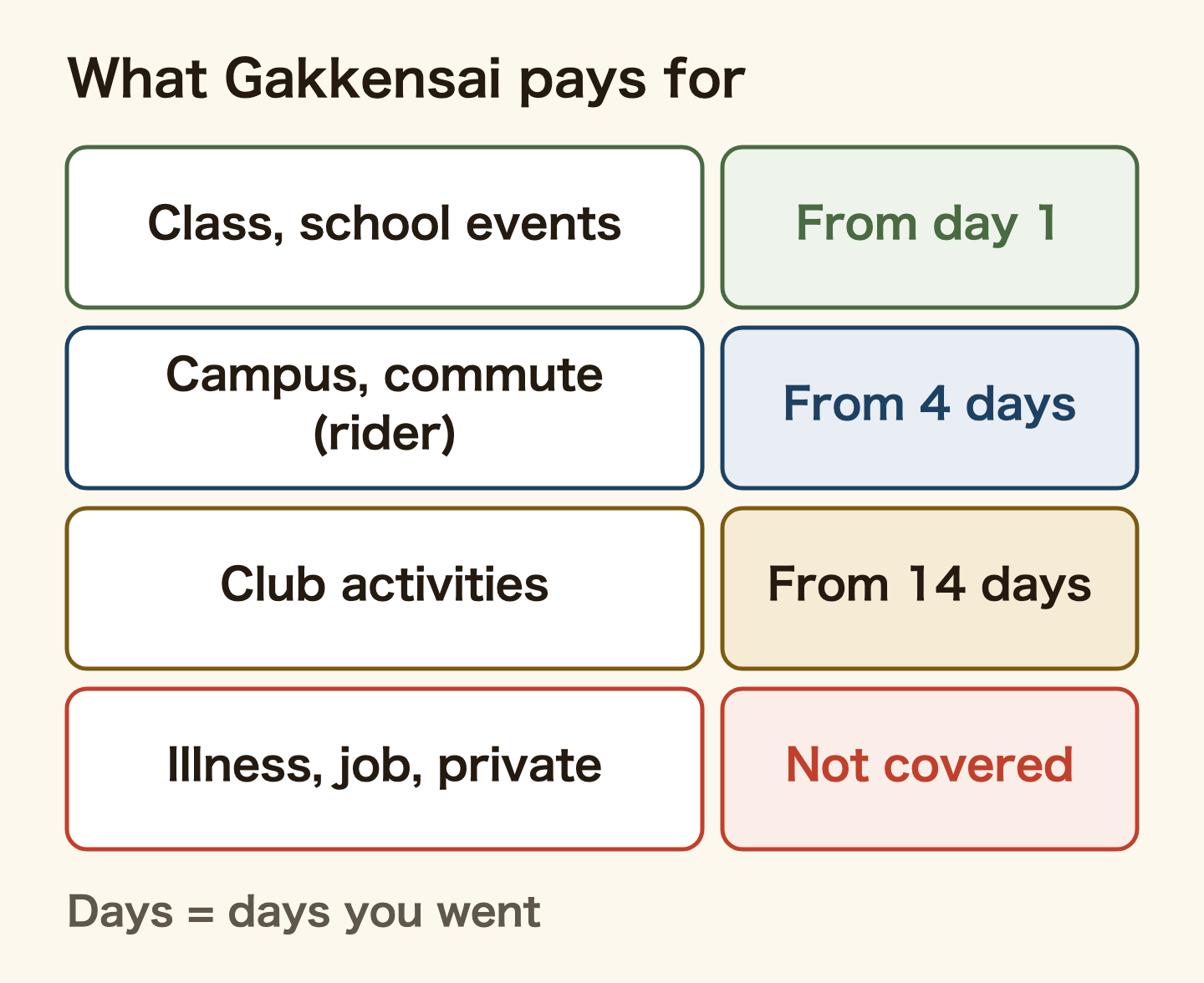
The amount depends on how many days you received treatment (JEES Gakkensai brochure, 2026 English edition).
- In class or at a school event: from day 1 of treatment, 3,000 to 300,000 yen
- Elsewhere on campus, or commuting with the rider: from 4 days of treatment, 6,000 to 300,000 yen
- Club activities: from 14 days of treatment, 30,000 to 300,000 yen
- If you are admitted to hospital: in every case, 4,000 yen a day from the first day (up to 180 days)
“Days of treatment” are not all the days until you recover. They are the days you actually visited a hospital or stayed in one. Two hospitals on the same day still count as one day.
Gakkensai pays regardless of your health insurance. National Health Insurance cuts your hospital bill to 30%, and Gakkensai’s payment comes on top of that. How to join the health insurance itself is in our National Health Insurance guide.
What does Gakkensai not cover?
The gaps are clear. The University of Tokyo states that Gakkensai does not cover liability to others, illness, or injuries in private activities.
- Illness such as a cold or flu (heatstroke and sudden poisoning are included)
- Injuries at your part-time job or on the way there (commuting means between home and school only)
- Injuries on a day off, travelling or shopping
- Paying for someone else’s injury or property that you caused
The last one can be by far the biggest bill. That is what the liability add-on is for.
What is the Gakkensai liability add-on (futai-baiseki)?
Futai-baiseki is the “Liability Insurance Coupled with Gakkensai”. If you injure someone or damage their property in class, at a school event, or on the way there and back, and you are legally liable, it pays (JEES liability add-on page). Course A is also called gakkenbai.
There are four courses. Most undergraduates are on course A. Course B covers only internships and teaching practice, C is for medical departments, and L is for law school. Every course pays up to 100 million yen per accident, with no deductible.
The example JEES gives is a student cycling to class whose handlebar catches a pedestrian’s bag, so the pedestrian falls and is hurt. Course A pays for that. Accidents with cars, motorbikes and mopeds are not covered.
Only students enrolled in Gakkensai can join; you cannot buy the add-on on its own. Its “extracurricular activities” also mean only internship or volunteer activities by groups the school has approved for that purpose. If you hurt someone during ordinary club activities, the add-on does not pay.
If your bicycle hurts someone, which insurance pays?
You ride to class and to work on a bike with no insurance. Where you come from, that may be normal. In Japan, according to the Ministry of Land, Infrastructure, Transport and Tourism, 34 prefectures required cyclists to carry liability insurance by local ordinance as of 1 April 2024, and 10 more asked cyclists to make the effort. Courts have ordered cyclists to pay tens of millions of yen in damages.
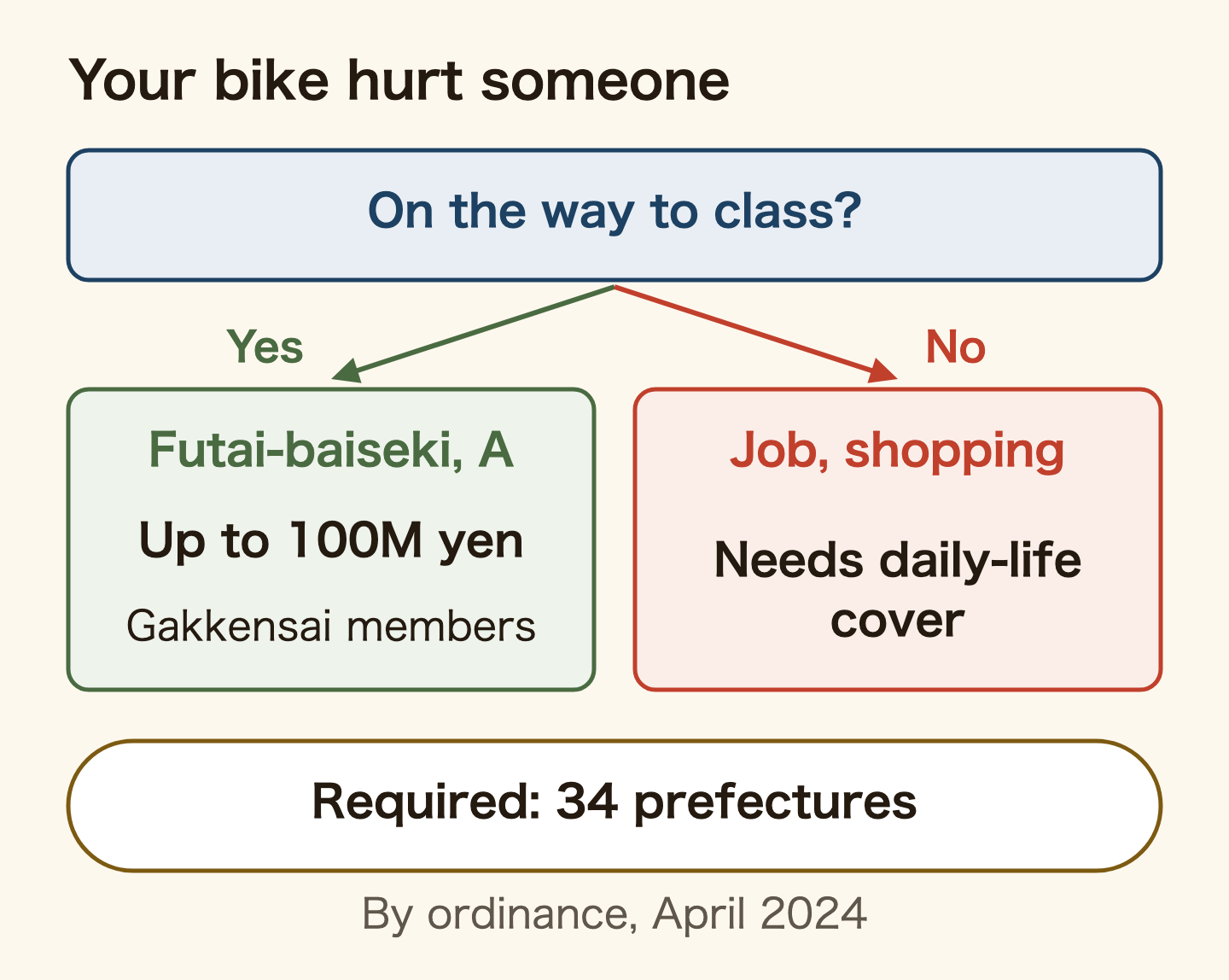
This is where the add-on’s limits matter. It pays only on the way to and from classes and school events. If you hit someone on the way to your part-time job or the supermarket, the add-on does not pay. Those hours need daily-life liability insurance.
Daily-life liability cover comes from the 24-hour plans below, or from the personal liability rider (kojin baisho sekinin) on your apartment’s fire insurance. To check whether your current policy has it, read your certificate alongside our renters insurance guide. The traffic rules and fines for cyclists are in Japan’s bicycle rules.
What 24-hour insurance can international students get?
Gakkensai and its add-on cover school time only. If you want your part-time job, days off and illness covered as well, there are 24-hour plans. Two can be joined through a university.
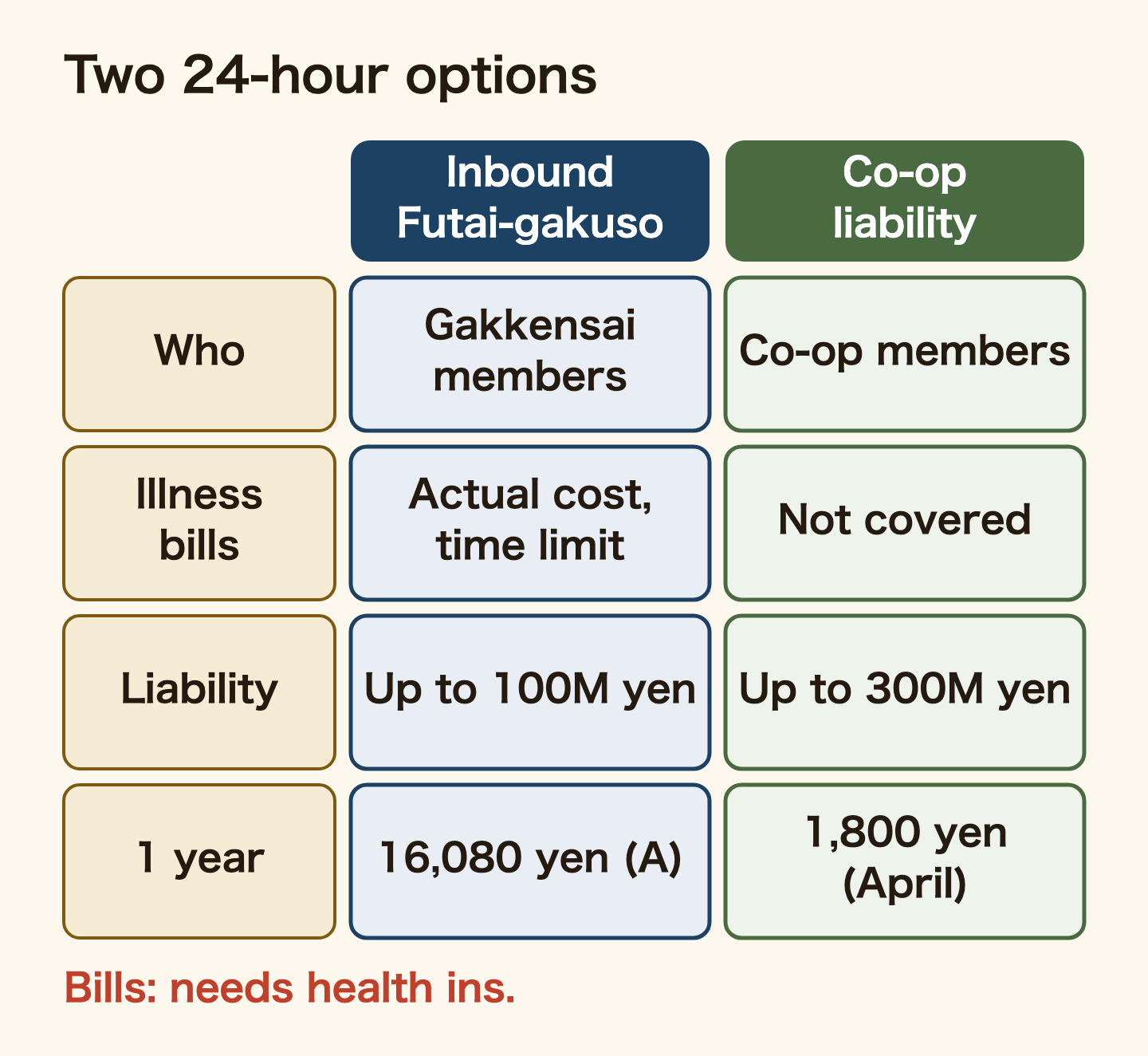
The first is JEES’s “Comprehensive Insurance for Students Lives Coupled with Gakkensai for International Students”, known as Inbound Futai-gakuso. JEES describes it as 24-hour cover for everyday injuries and illness bills, liability to others, and costs such as family flying in. It is open to international students at the 1,072 schools that use Gakkensai, but only if you are enrolled there and in Gakkensai.
- Liability: up to 100 million yen per accident, in Japan and abroad, including at your part-time job. For accidents in Japan, the insurer negotiates the settlement
- Treatment costs: it pays your health insurance co-pay, from the first visit or admission until the end of the month in which 60 days have passed. Dental treatment and conditions from before you joined are excluded
- Type A, for students living alone, also covers damage to your rented room from fire or water leaks that you owe the landlord (10 million yen) and your belongings (1 million yen)
- Types A and B are only for people in health insurance. If you stay three months or less without health insurance, choose type C or D
The second is the University Co-op’s student liability insurance (gakusei baisho sekinin hoken). The co-op’s insurance service says it pays up to 300 million yen per accident for liability in daily life, part-time work and internships, and one of its examples is injuring a pedestrian while cycling. You need to be a student member of a university co-op, so your university must have one. Between April 2024 and March 2025 it handled 3,311 accidents, and 795 of them were bicycle accidents. It does not pay for illness or for treating your own injuries.
What if you study at a language school or vocational school?
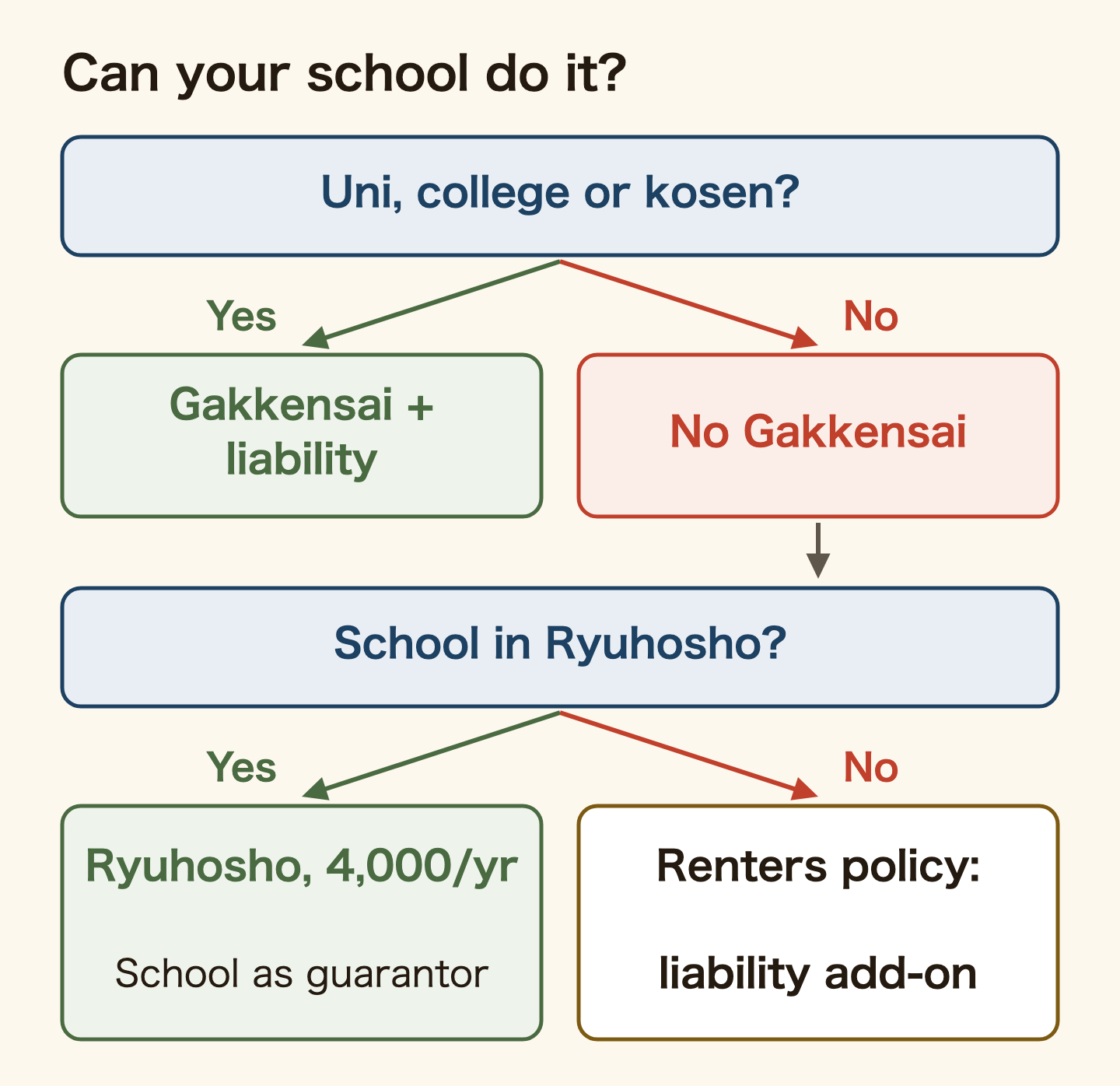
Gakkensai and the add-on are limited to students at graduate schools, universities, junior colleges and technical colleges that are JEES supporting members. Language school and vocational school students are not covered. Inbound Futai-gakuso requires Gakkensai, so the same applies.
What may work for them is JEES’s Comprehensive Renters Insurance for Foreign Students, called Ryuhosho. JEES says it is open to students, in principle on a Student visa, at participating universities, junior colleges, technical colleges, vocational schools and Japanese language institutions.
- Liability to your landlord or others for a fire in your room, water leaking to the flat below and similar: up to 50 million yen per accident
- Money your joint guarantor paid for unpaid rent and similar: up to 300,000 yen (rent up to three months, restoration up to 100,000 yen)
- Cost: 4,000 yen for one year (2,500 yen premium plus 1,500 yen fee), 8,000 yen for two years
There is one condition. Your joint guarantor for the lease is, in principle, your school or a staff member such as the head of the international student centre. How to rent without a private guarantor is in our guide to renting without a guarantor. If your school does not take part, get daily-life liability through the personal liability rider on your fire insurance.
How much does Gakkensai cost?
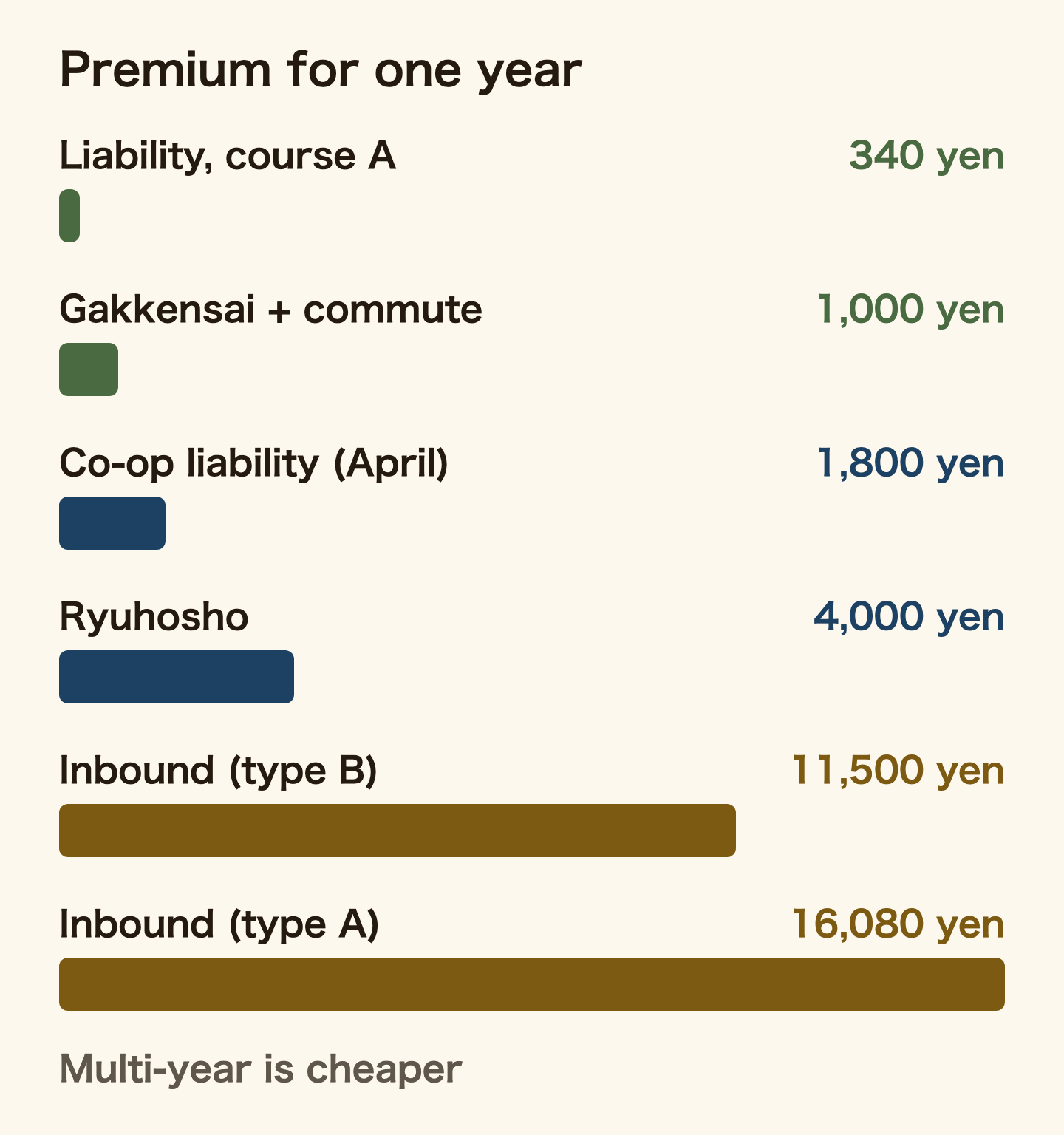
| Insurance | 1 year | 4 years |
|---|---|---|
| Gakkensai (with commuting rider, daytime course) | 1,000 yen | 3,300 yen |
| Liability add-on, course A | 340 yen | 1,360 yen |
| Inbound Futai-gakuso A (living alone) | 16,080 yen | 52,280 yen |
| Inbound Futai-gakuso B (living at home) | 11,500 yen | 37,410 yen |
| Co-op student liability (no living-alone rider) | 1,800 yen (paid by 29 April) | — |
| Ryuhosho | 4,000 yen | 8,000 yen for 2 years |
The Gakkensai and add-on figures match on Tohoku University’s page and in the JEES brochures. Gakkensai is charged by the full year even if you join mid-year. Inbound Futai-gakuso is paid in one lump sum up to graduation.
Your school may pay for you. The University of Tokyo pays the premium and enrols every student in Gakkensai with the commuting rider. Tohoku enrols everyone who started in or after April 2026 in Gakkensai and its liability add-on at the university’s expense. Check your school’s guidance before you pay anything.
How do you join through your school?
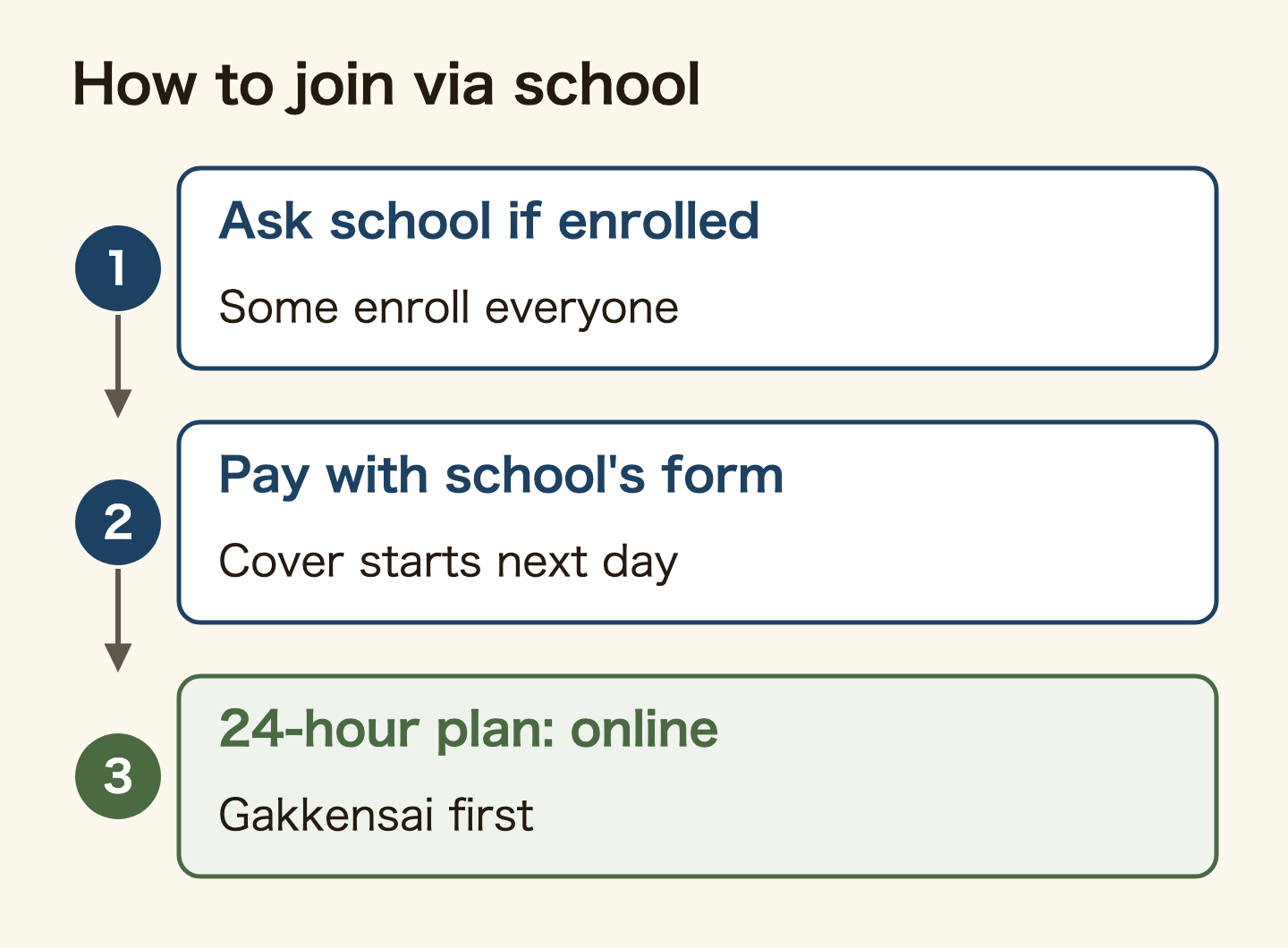
- Check whether you are in: at schools that enrol everyone, the premium may already have been paid with your enrolment fees. Ask the student affairs office or health centre, or look on the student portal
- If not, pay: use the payment slip your school hands out and pay for the years up to graduation, usually at a post office (Osaka, Kanazawa and others). If you join yourself, cover starts at midnight the day after you pay
- The liability add-on is also joined through the school (the University of Tokyo, Tsukuba and others). Which courses are offered depends on the school
- For Inbound Futai-gakuso, scan the QR code on the pamphlet, pre-register online (you need an email address) and pay at a convenience store. If you cannot apply online, apply at a post office
Some schools make it compulsory. Kanazawa University requires international students to join Gakkensai and Inbound Futai-gakuso. If an internship host asks for proof of insurance, apply at your school. Kanazawa issues a certificate in Japanese and English within a few days.
What if you have an accident?
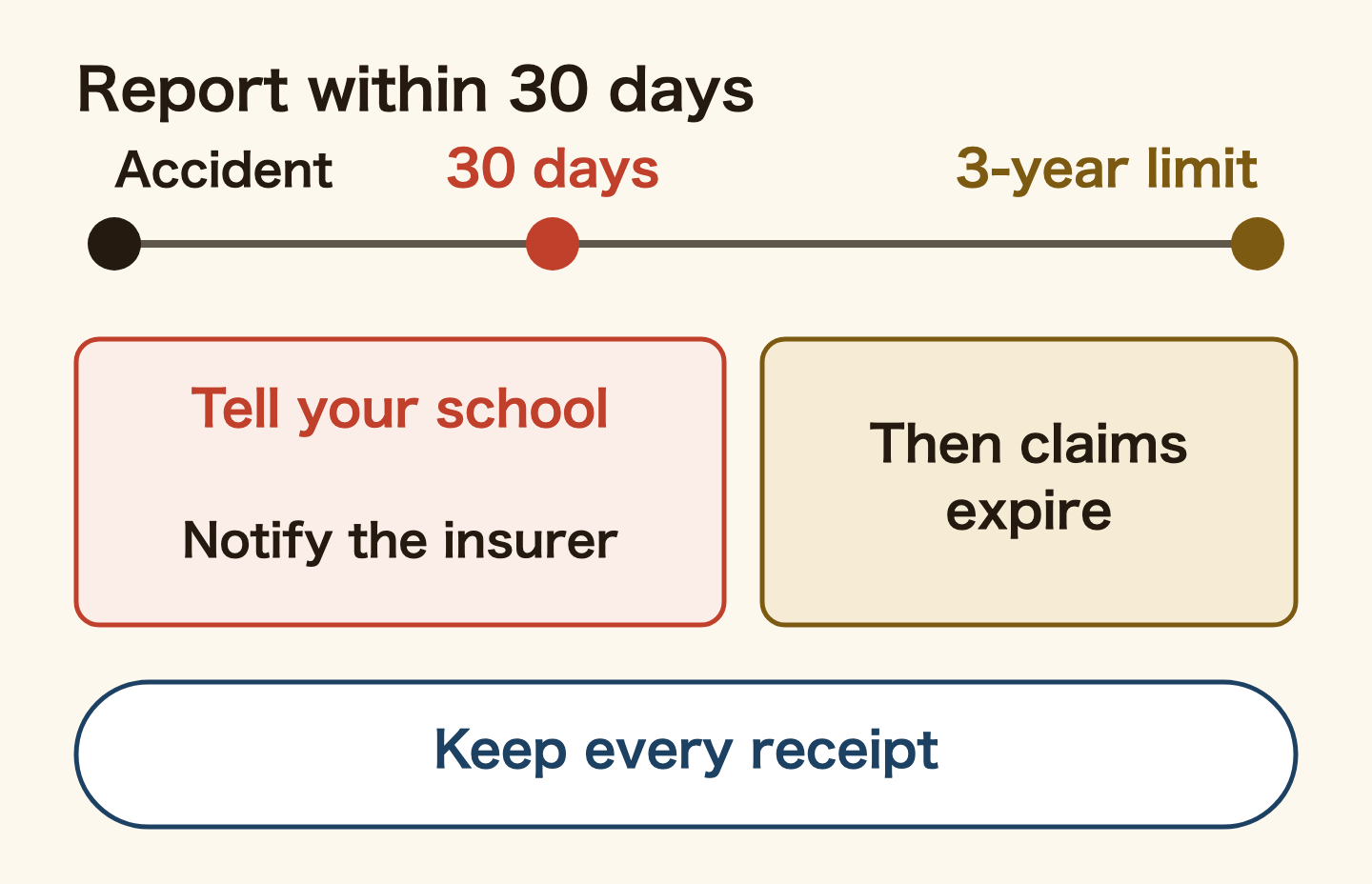
If you are injured in a way Gakkensai covers, tell your school’s office the date, place, what happened and how badly you were hurt within 30 days of the accident. Then notify Tokio Marine & Nichido through the online accident system, a postcard or fax (JEES accident page). Reporting through the online system does not inform your school automatically, so report to the school as well.
The right to claim expires after three years. At the University of Tokyo, the claim form needs the university’s certification, and claims over 300,000 yen also need a doctor’s certificate.
If you injured someone, always write down their name and contact details. The Inbound Futai-gakuso pamphlet says to consult the insurer before you agree to pay anything; if you agree without asking, the payment may be reduced. Accident reports for Inbound Futai-gakuso can be emailed in English or Japanese.
Missed the deadline to join, or short of money?
If you did not pay at enrolment, you can still join later. But cover starts the day after you pay, so an accident before that is not covered. The add-on and Inbound Futai-gakuso both require Gakkensai, so Gakkensai comes first.
If money is tight, start with Gakkensai and add-on course A only, 1,340 yen for one year together. Then check whether your current fire insurance has a personal liability rider. If it does, daily-life bike accidents are covered there.
If you take a leave of absence, tell your school as well: Gakkensai requires you to notify the school if your leave adds up to a year or more during the policy period. What a leave of absence does to your visa is in our leave of absence guide.
Which one are you?
- University student, not sure if you are in Gakkensai — check your status today at the student office or on the portal. If you are not in, pay up to graduation with the school’s payment slip.
- University student who also cycles to work or the shops — on top of Gakkensai and the add-on, check whether you have 24-hour liability cover. If not, choose this week between Inbound Futai-gakuso, the co-op’s student liability insurance, or the liability rider on your fire insurance.
- Language school or vocational school student — you cannot join Gakkensai, so ask your school today: “Do you take part in Ryuhosho?” If not, check your fire insurance certificate for a personal liability rider.
- You were injured, or you injured someone — report to your school’s office and notify the insurer within 30 days of the accident. Put the receipts and the other person’s contact details together today.
FAQ
Q. What is Gakkensai?
It is accident insurance for students at universities, junior colleges and technical colleges that pays when you are injured in class, at school events, on campus, during club activities, or while commuting if you have the rider. It is run by Japan Educational Exchanges and Services (JEES) and does not cover illness.
Q. How much does Gakkensai cost?
With the commuting rider (daytime course), 1,000 yen for one year or 3,300 yen for four years. The liability add-on course A is 340 yen for one year or 1,360 yen for four. Some universities pay the premium for you.
Q. Can international students join Gakkensai?
Yes, if you study at a university, junior college or technical college that is a JEES supporting member, whatever your nationality. Language school and vocational school students cannot.
Q. If my bicycle injures someone, does Gakkensai pay?
No. Gakkensai covers your own injuries, not what you owe the other person. On the way to class, the liability add-on course A pays up to 100 million yen per accident. On the way to work or the shops, you need 24-hour liability insurance or the liability rider on your fire insurance.
Q. I have National Health Insurance. Do I still need Gakkensai?
They do different jobs. National Health Insurance cuts your hospital bill to 30%. Gakkensai pays a separate amount based on your days of treatment, regardless of your health insurance.
Q. How soon must I report a Gakkensai accident?
Within 30 days of the accident, report to your school’s office and notify the insurer. The right to claim expires after three years.
Summary
Gakkensai pays for your own injuries during school time, and with the commuting rider it costs 1,000 yen a year. Paying for someone you injure is the liability add-on’s job, but only in class, at school events and on the way there and back. A bike accident on the way to work or the shops is only covered by 24-hour liability insurance.
At university, check you are in Gakkensai and the add-on, then arrange daily-life liability through Inbound Futai-gakuso, the co-op’s student liability insurance or a fire insurance rider. At a language or vocational school, you cannot join Gakkensai, so look at Ryuhosho or a fire insurance rider. If you are injured, tell your school within 30 days.
Sources (official): JEES, Gakkensai / Gakkensai brochure, type A, 2026 (English) / Liability add-on / Inbound Futai-gakuso and its 2026 pamphlet / Ryuhosho / JEES accident page / University Co-op student liability insurance / MLIT, bicycle liability insurance / University of Tokyo / Tohoku University / Kanazawa University (all checked 30 September 2026). Premiums and the plans offered differ by school, so check your own school’s guidance before you join.
Related reading
Found this useful? Share it
Send it to a friend who lives in Japan.
WHO WROTE THIS

mori
Japanese. I read the ministries’ own notices, orders and Q&As in the original, and I start from what my Nepalese and Sri Lankan friends in Japan actually ran into. I do not write about what I have not checked or been told.
What this site can and cannot do →Looking for something else?