Checked on 30 September 2026 against the Ministry of Health, Labour and Welfare’s contact lens pages and notice, its FY2026 medical fee schedule and personal import page, the Consumer Affairs Agency’s warning, the PMDA (Japan’s medical device agency), the Japan Ophthalmologists Association, the treatment-glasses pages of Minato City and Kyokai Kenpo, the Immigration Services Agency’s living and working guidebook, and the Tokyo Metropolitan Government.
The short answer
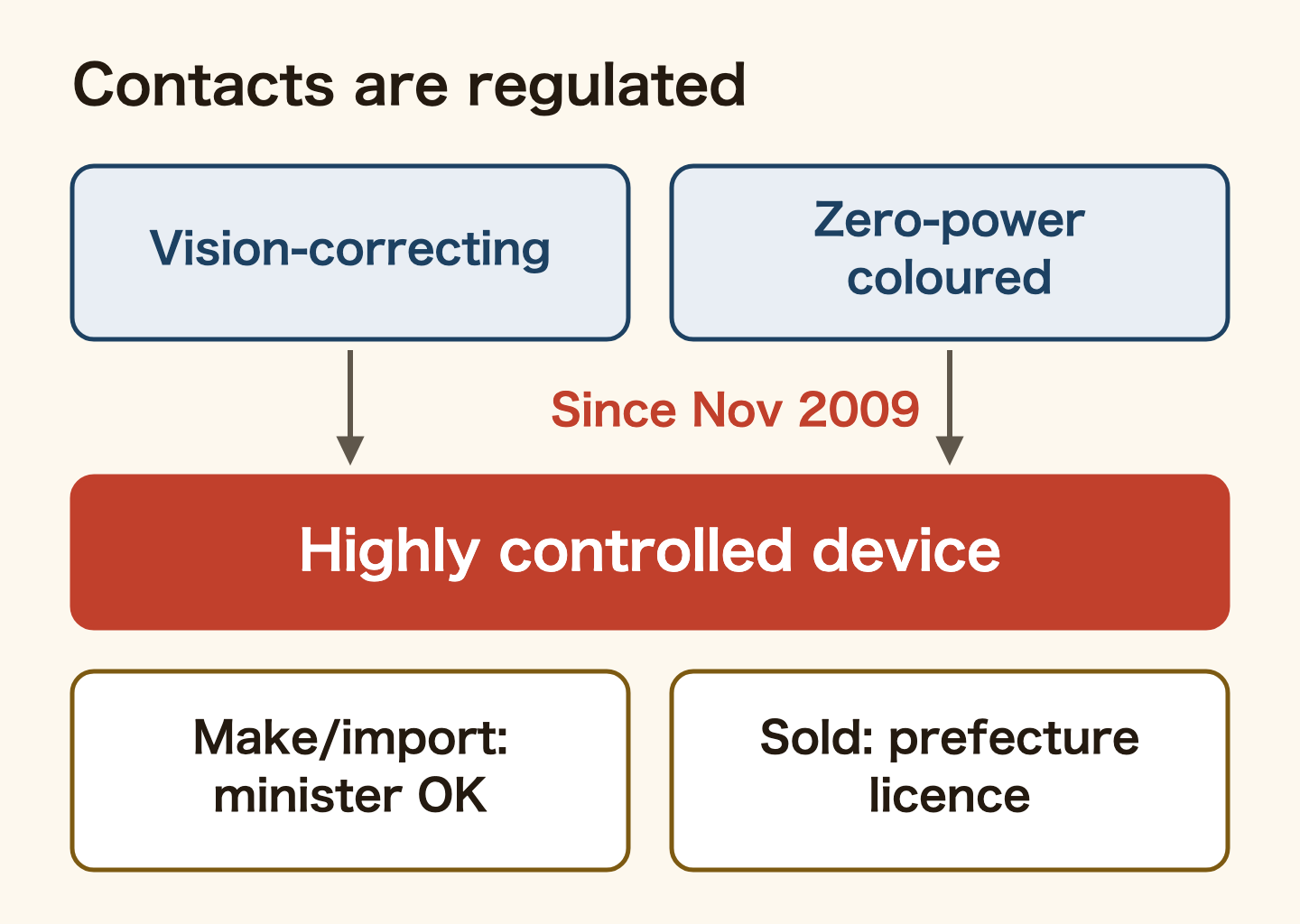
- In Japan, contact lenses are “highly controlled medical devices”. Zero-power coloured lenses have been in the same category since November 2009.
- The eye exam for contacts is covered by health insurance. At a clinic you have not used before, you pay about 1,030 to 1,480 yen at 30% for the basic part, depending on the clinic’s category and any add-ons. The lenses themselves are extra.
- Shops, online ones included, are supposed to check that you have seen an eye doctor and sell to the doctor’s instructions. The health ministry calls “no prescription needed” selling improper.
- If your eye turns red, hurts, feels gritty, is sensitive to light or itches, take the lens out and see an eye doctor. If it still hurts with the lens out, or your vision has changed, go straight away.
- Ordinary glasses are not covered by health insurance. The exception is treatment glasses for children under 9 with amblyopia, a squint, or correction after congenital cataract surgery, where part of the cost comes back.
Knowing this, you can go to an eye doctor first, knowing roughly what the exam costs, before a cheap “no prescription” online shop tempts you. And on the day your eye feels wrong, you will know whether to wait or to go today.
The lenses you brought from home are down to the last two boxes. You search for the same ones online in Japan and the cheapest shops say “no prescription needed”. The shop by the station has an “eye clinic inside” sign. A Japanese friend says, “You get your eyes checked at the ganka first, then buy them.” How much is that check? Does insurance pay? What actually goes wrong if you buy from the no-prescription shop? Your friend does not know that part.
- What are contact lenses in Japan? “Highly controlled medical devices”
- How much is an eye exam for contacts in Japan? 30%, about 1,030 to 1,480 yen the first time
- Can I buy contact lenses in Japan without a prescription? Shops must check you have seen a doctor
- Can I import lenses from abroad, or sell my spare ones? There are rules
- Which eye symptoms mean you should see a doctor? Lens out, then the eye clinic
- Does Japanese health insurance cover glasses? Not ordinary glasses
- How do I find an English-speaking eye doctor in Japan? Choose “ophthalmology” and your language on Navii
- Which one are you?
- FAQ
- Summary
- Related reading
What are contact lenses in Japan? “Highly controlled medical devices”
A contact lens is a medical device that sits directly on your eye (MHLW leaflet on using contact lenses correctly, in Japanese). Under Japan’s law on medicines and medical devices, it falls in the strictest group, kodo kanri iryo kiki, “highly controlled medical devices”.
Zero-power coloured lenses for fashion (colored contacts, circle lenses) have been in the same group since 4 November 2009 (MHLW page on fashion coloured contact lenses, in Japanese). Making or importing them for sale needs approval from the health minister, and selling them needs a licence from the prefectural governor.
You can tell a genuine medical device from the box. The device or its direct packaging carries a label such as 高度管理医療機器 and a 16-character approval or certification number (PMDA medical device Q&A, in Japanese).
How much is an eye exam for contacts in Japan? 30%, about 1,030 to 1,480 yen the first time
An eye exam for contact lenses is covered by health insurance. The national fee schedule has a separate item for it, the contact lens exam fee, and the price is the same everywhere in Japan (MHLW FY2026 fee revision, in Japanese). One point is 10 yen.
At a clinic you have not used before, the first-visit fee of 291 points and a 2-point price add-on are charged, plus the contact lens exam fee. That fee comes in four levels, 200, 180, 56 or 50 points, depending on how the clinic is registered (MHLW medical fee schedule, in Japanese). At 30%, that is about 1,030 to 1,480 yen.
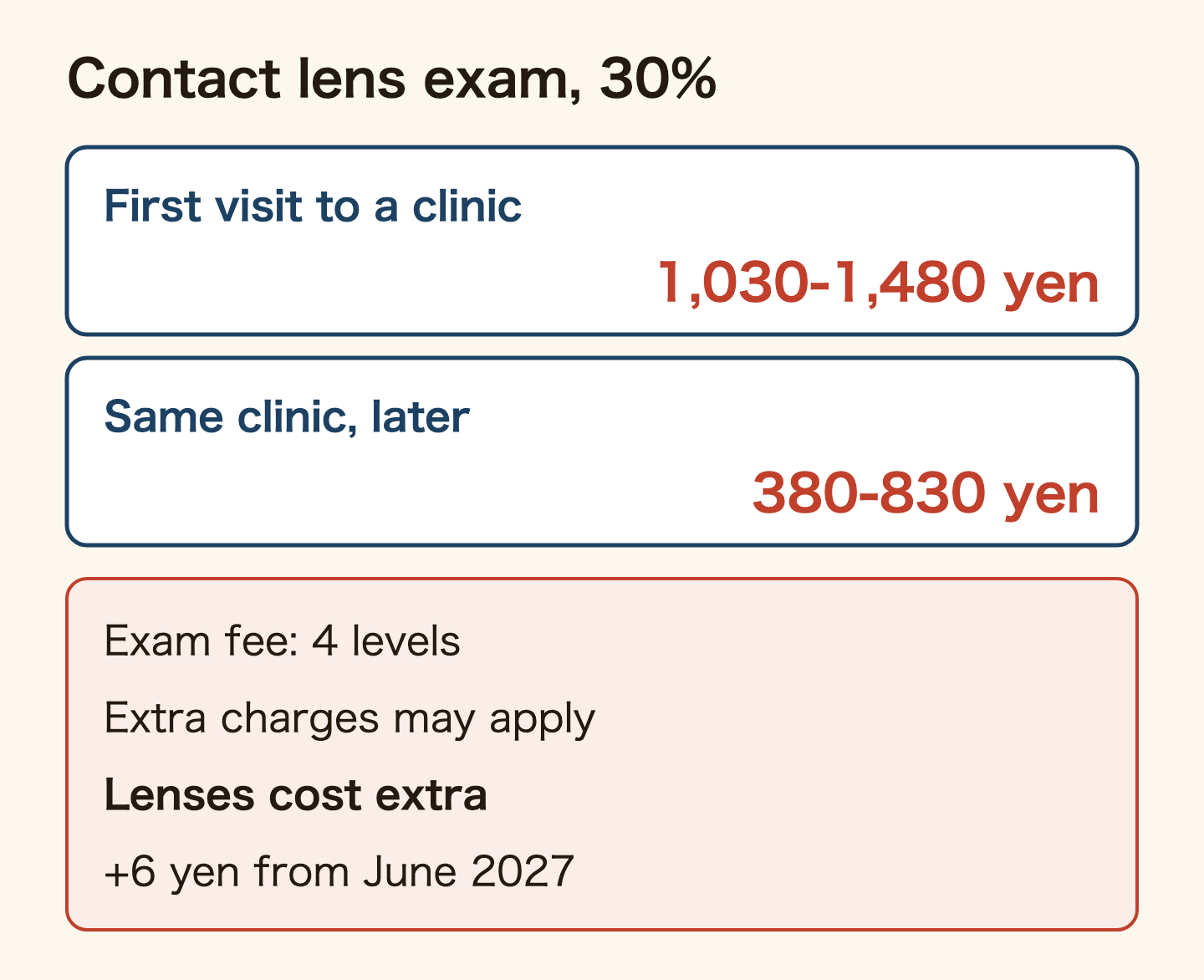
Go back to the same clinic for your contacts and the repeat-visit fee of 76 points applies instead, about 380 to 830 yen at 30%. That is the basic part. It changes in these cases:
- Add-ons may apply at night, on holidays, or for things the clinic has registered for
- Children under 6 pay 20% at the desk; people aged 70 to 74 pay 20% (30% with an income like a working person’s) (MHLW co-payment rates, in Japanese)
- The price add-on doubles from June 2027, which is only 6 yen more at 30%
The lenses themselves are not part of this bill. You buy them after the exam, from a licensed seller. If you do not show your My Number health insurance card or equivalent, you pay the full exam fee that day (Immigration Services Agency living and working guidebook). If your registration is not done yet and you have no eligibility certificate either, you pay in full and claim back everything except your share later. How that works is in our guide to the My Number insurance card and the eligibility certificate.
Can I buy contact lenses in Japan without a prescription? Shops must check you have seen a doctor
Buying zero-power coloured lenses like any accessory, from a shop or an ad on social media. Where you come from, that may be normal. In Japan, coloured lenses are the same class of medical device as prescription lenses, and the sellers have a set procedure to follow.
A health ministry notice asks every retailer, online and mail-order shops included, to do the following (MHLW notice of 26 September 2017, in Japanese):
- At the sale, check whether you have seen a doctor. If you have, sell according to the doctor’s instructions
- If you have not, explain the risk of eye damage and urge you to see a doctor
- Selling in a way that suggests you need no doctor, such as “no prescription needed” or “no exam needed”, is improper
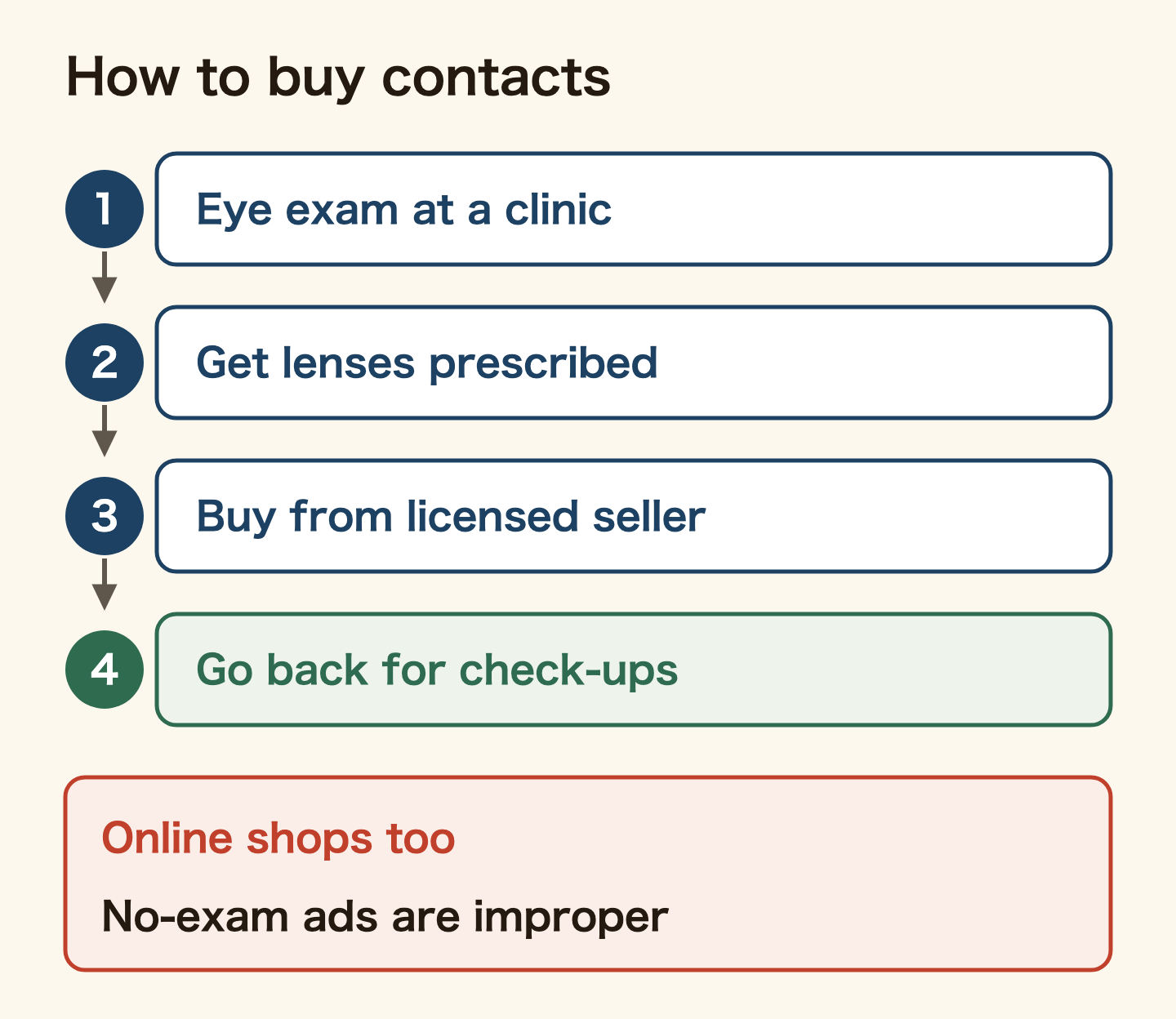
The notice also cites research finding more eye damage among people who bought online or by mail order. The Consumer Affairs Agency puts it plainly. Even for coloured lenses, see an eye doctor before you buy and have lenses prescribed for you. Ask the doctor then how often to come back for check-ups. A lens that does not fit the curve and size of your cornea can slip and scratch it.
Once you have a prescription, you can buy from any licensed seller, online or in a shop. Count the replacement period from the day you open the pack, not from the days you actually wore the lenses (MHLW). Even with days off in between, replace them when the set period is up.
Can I import lenses from abroad, or sell my spare ones? There are rules
Some of you will order your usual lenses from a shop back home. The Consumer Affairs Agency’s report says lenses you import yourself, including ones bought on a trip and carried back, have not been checked under Japanese law for quality, effectiveness or safety. The packaging is made for another market, contacting the maker is hard if something goes wrong, and nothing guarantees you anything if your eyes are harmed.
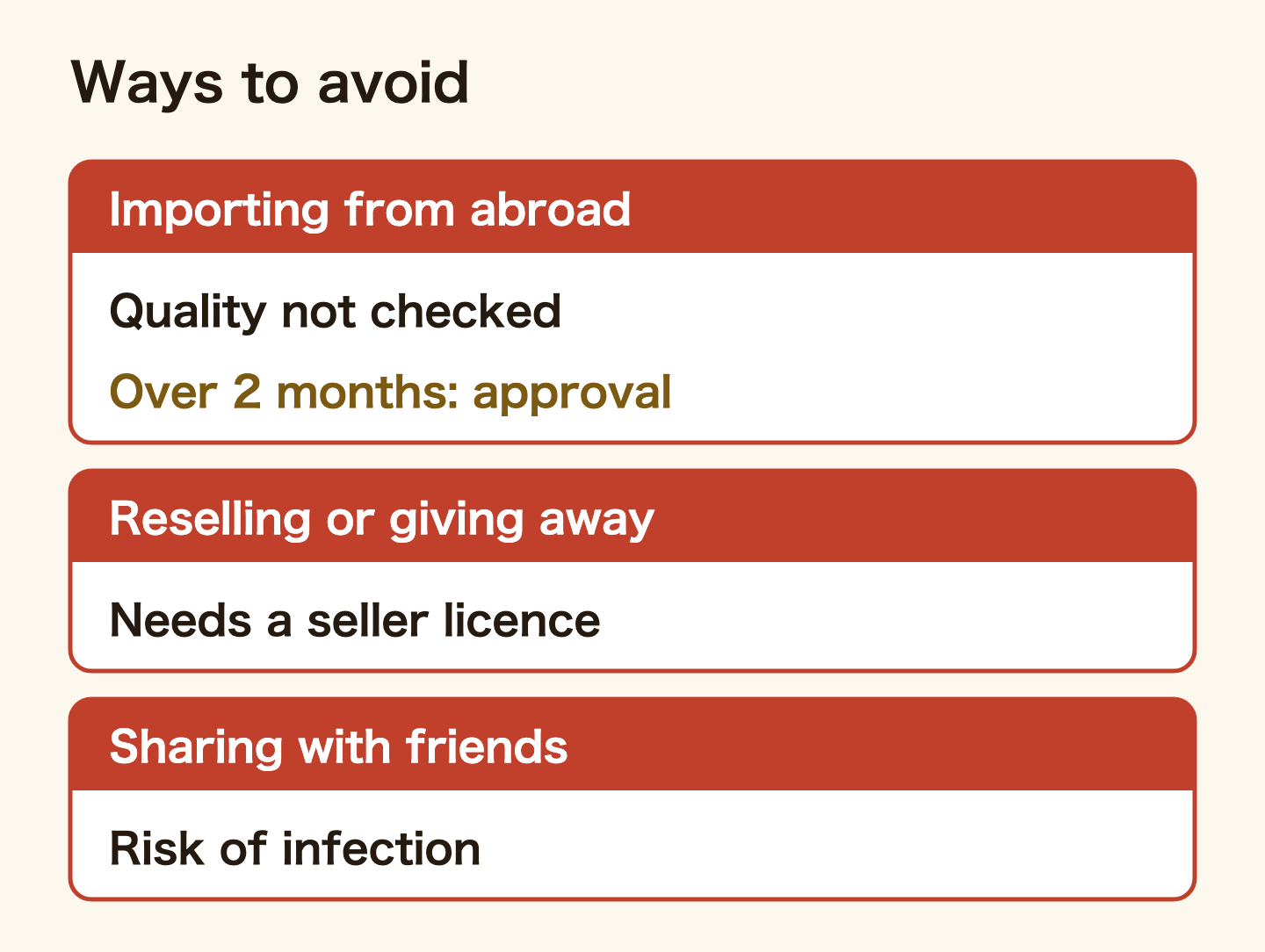
There is a quantity limit too. For your own use you may import up to two months’ supply of disposable contact lenses; above that you need to apply for an import approval (MHLW page on personal import, in Japanese). For two-day disposables, for example, that is 30 pairs.
Selling your spares has rules as well. The PMDA says that selling or giving away spare contact lenses or coloured lenses, on flea-market sites or elsewhere, needs a seller licence or notification. Handing your leftovers to a friend before you leave Japan counts as giving them away. Sharing lenses with friends can pass an eye infection through the lens, the Japan Ophthalmologists Association warns.
Which eye symptoms mean you should see a doctor? Lens out, then the eye clinic
With soft lenses, the lens covers a scratch on the cornea, so a small injury is easy to miss, the Consumer Affairs Agency notes. That is why you act at the “something feels off” stage. These are the symptoms official sources tell you to see an eye doctor about:
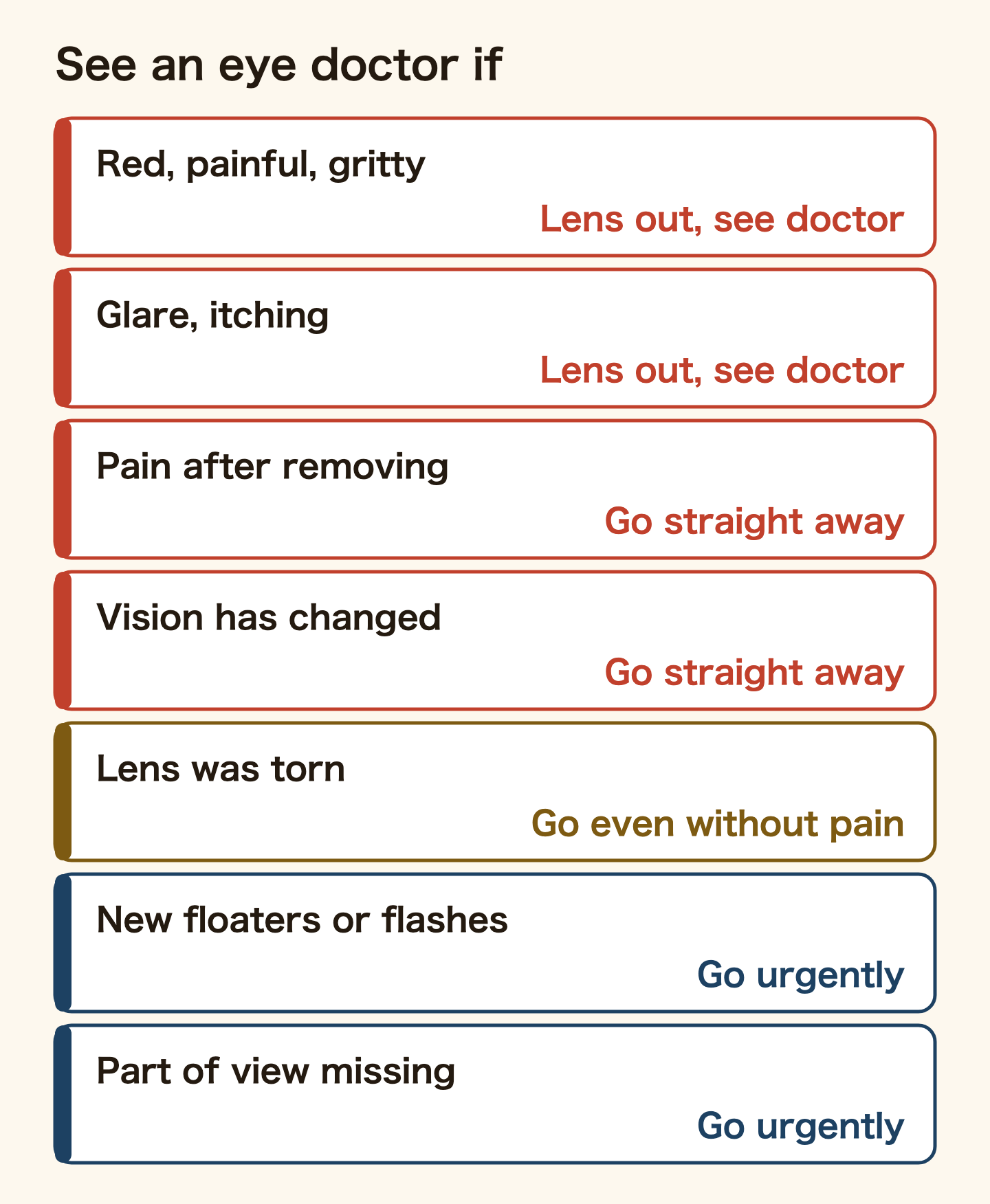
- Redness, a gritty feeling, pain, sensitivity to light or itching: take the lens out at once and see an eye doctor straight away (Consumer Affairs Agency). Bring a spare of the same lens if you have one
- Pain that continues after the lens is out, or vision that is affected: see an eye doctor straight away (Japan Ophthalmologists Association on contact lens complications, in Japanese)
- The lens you took out is torn or has a piece missing: always see an eye doctor, even without pain. A fragment may still be in your eye
- Tears that will not stop, or blurred vision: leave the lenses out and see an eye doctor early (PMDA)
- New floating specks, flashes of light at the edge of your vision, or part of your view missing: see an eye doctor urgently, as this can mean retinal detachment (Japan Ophthalmologists Association on floaters and retinal detachment, in Japanese). This applies whether or not you wear contacts
A retina check may use drops that widen your pupils, leaving you dazzled and unable to focus for a few hours. You cannot drive after the exam, so go by some other way (Japan Ophthalmologists Association). If your eye starts hurting at night or on a holiday, use our guide to night and holiday clinics to find one that is open.
You may be tempted to try drugstore eye drops first. The Japan Ophthalmologists Association says drops are basically meant to go in with your lenses out. If you use them over soft lenses, choose preservative-free drops or drops with a preservative other than benzalkonium chloride. But if any symptom above has appeared, the eye doctor comes before the eye drops. The words to use at the drugstore counter and how to ask the pharmacist are in our guide to medicine in Japan.
Does Japanese health insurance cover glasses? Not ordinary glasses
You lost your glasses, or they no longer suit your eyes, and you wonder whether insurance will help. A health ministry paper lists glasses as an example of what health insurance does not reimburse, treating them as things you need for daily life or work.
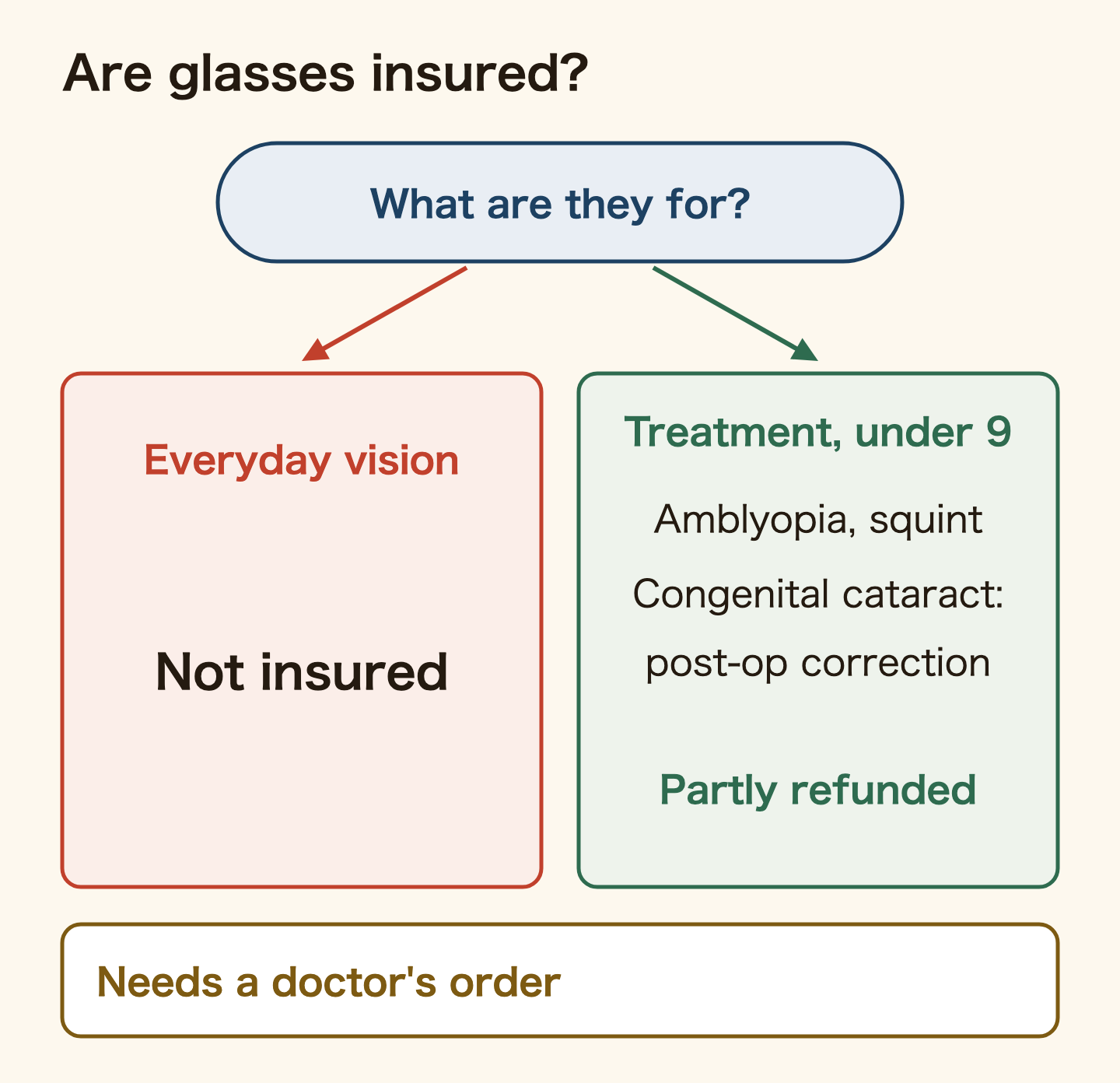
The exception is treatment for children. Glasses and contact lenses made on a doctor’s instructions to treat amblyopia, a squint, or to correct vision after congenital cataract surgery in a child under 9 can be partly refunded as ryoyohi when you apply afterwards (Minato City on treatment glasses for children, in Japanese).
- What you submit: the receipt, a copy of the doctor’s glasses prescription (the order to make them), and the test results
- What comes back: what you paid times your insurance’s benefit rate, up to a national cap
- Replacing them: under 5, after at least a year of wearing the previous pair; 5 and over, after at least two years
On a company plan (Kyokai Kenpo), you likewise apply with a copy of the doctor’s order for the treatment glasses (Japan Health Insurance Association, in Japanese). What you still pay after the refund may be covered by your city’s children’s medical expense subsidy. For glasses too, the Japan Ophthalmologists Association advises having an eye specialist prescribe a pair that suits your eyes.
How do I find an English-speaking eye doctor in Japan? Choose “ophthalmology” and your language on Navii
The health ministry’s medical information site, Navii, lets you narrow clinics down by department and by the foreign languages they handle (MHLW guide to Navii, in Japanese). Choose ophthalmology (眼科, ganka) and your language, then search near home or work.
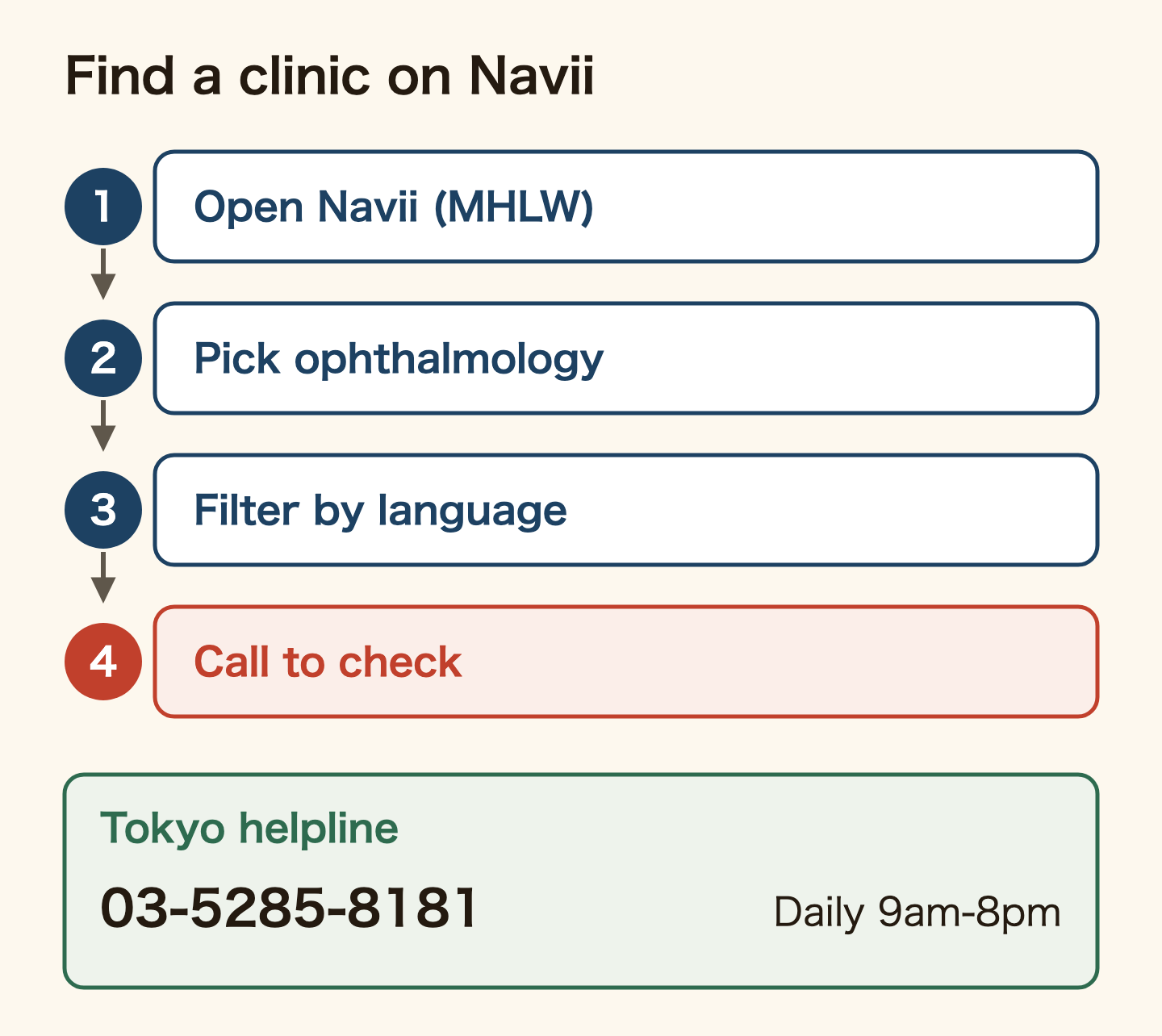
In Tokyo, the medical information service for foreign patients (03-5285-8181) will point you to clinics that handle your language. It runs in English, Chinese, Korean, Thai and Spanish, daily from 9am to 8pm.
When you phone to book, “Kontakuto no kensa o onegai shimasu. Hajimete desu” (a contact lens exam, please; it is my first visit) will get you through. How reception works and the Japanese for describing symptoms are in our guide to seeing a doctor in Japan. Bring the box of the lenses you use now, or a spare lens, so you can show what you wear.
Which one are you?
- The lenses you brought from home are running out: this week, find a nearby eye clinic on Navii and phone it. Take your current lens box, get a prescription, then buy from a licensed seller.
- You want to try coloured lenses for the first time: have an eye exam even for zero-power lenses. Do not buy from a “no prescription needed” shop. Ask on the day how often to come back.
- Your eye is red, hurts or feels gritty right now: take the lens out now and phone an eye clinic today. Bring a spare of the same lens if you have one.
- An eye doctor has found amblyopia or a squint in your child: when you order the treatment glasses, get the doctor’s written order and keep it with the receipt. Apply to your insurer for ryoyohi.
FAQ
Q. Do I need a prescription to buy contact lenses in Japan?
Shops, online ones included, are supposed to check whether you have seen an eye doctor and sell according to the doctor’s instructions. If you have not, they should urge you to go. The health ministry calls “no prescription needed” selling improper.
Q. Does health insurance cover the eye exam for contacts?
Yes. There is a contact lens exam fee in the national fee schedule, and you pay 30%. At a clinic you have not used before, that comes to about 1,030 to 1,480 yen for the basic part, including the first-visit fee. The lenses are extra.
Q. Do I need to see an eye doctor for coloured contacts?
Zero-power coloured lenses have been highly controlled medical devices since November 2009, the same as prescription lenses. The Consumer Affairs Agency asks you to see an eye doctor and have them prescribed before you buy, even for coloured ones.
Q. Can I order contact lenses from abroad?
You can import them for your own use, but they have not been checked for quality or safety under Japanese law. Disposables are limited to two months’ supply; more than that needs an import approval.
Q. Which eye symptoms mean I should see a doctor?
Redness, pain, a gritty feeling, sensitivity to light or itching: take the lens out and see an eye doctor. Go straight away if it still hurts with the lens out, if your vision has changed, or if you start seeing floaters or flashes. If the lens was torn, go even without pain.
Q. Does Japanese health insurance cover glasses?
Not glasses for everyday vision correction. Treatment glasses and contact lenses for children under 9 with amblyopia, a squint, or correction after congenital cataract surgery are partly refunded as ryoyohi when a doctor has ordered them.
Summary
In Japan, contact lenses, coloured ones included, are highly controlled medical devices. The eye exam before you buy is covered by insurance, and at a new clinic you pay about 1,030 to 1,480 yen at 30% for the basic part. Shops, online ones too, are supposed to check that you have seen a doctor and sell to the doctor’s instructions, and “no prescription needed” selling is called improper.
Personally imported lenses have not been quality-checked in Japan, and selling or giving away spares needs a licence. If your eye turns red, hurts or your vision changes, take the lens out and see an eye doctor straight away. Ordinary glasses are not covered by insurance; only treatment glasses for children under 9 are partly refunded.
This article explains the rules and is not medical advice. See an eye doctor about any eye symptoms. Official sources: MHLW: fashion coloured contact lenses / MHLW: using contact lenses correctly / MHLW notice of 26 September 2017 / MHLW FY2026 medical fee schedule / MHLW: personal import / MHLW: treatment devices and ryoyohi / Consumer Affairs Agency: eye damage from contact lenses / PMDA medical device Q&A / Japan Ophthalmologists Association: contact lens complications / same: floaters and retinal detachment / Minato City: treatment glasses for children / Japan Health Insurance Association: treatment devices and glasses / Immigration Services Agency: living and working guidebook (all checked 30 September 2026). Exam costs vary with the clinic’s category and add-ons, so check with the clinic you go to.
Related reading
Found this useful? Share it
Send it to a friend who lives in Japan.
WHO WROTE THIS

mori
Japanese. I read the ministries’ own notices, orders and Q&As in the original, and I start from what my Nepalese and Sri Lankan friends in Japan actually ran into. I do not write about what I have not checked or been told.
What this site can and cannot do →Looking for something else?