Checked on 23 September 2026 against the Immigration Services Agency’s pages on Long-Term Resident status, the Long-Term Resident Notice, the permanent residence guidelines, the published cases of changes from spouse status to Long-Term Resident, and the Immigration Control Act on e-Gov.
The short answer
- Long-Term Resident (teijusha) is a status the Minister of Justice grants for a special reason, with a set period of stay. Third-generation Nikkei, stepchildren of foreigners married to Japanese nationals, and people who changed status after a divorce from a Japanese spouse all hold it.
- There is no limit on work. Any job, any hours, no work permit needed.
- Periods of stay are 5 years, 3 years, 1 year or 6 months, or another period up to 5 years. For permanent residency, 5 years as a Long-Term Resident is enough instead of the usual 10.
- There are two ways in. Positions listed in an official Notice (Nikkei, stepchildren and others), and situations that are not listed (such as after divorce or a spouse’s death). After divorce there are no published requirements; each case is judged on its own.
- From 1 October 2026, renewal and change fees depend on the period granted: 33,000 yen for 1 year and 75,000 yen for 5 years at the counter.
Knowing this, you can tell whether your status comes from the Notice or not, and plan the right renewal documents — or what to prepare after a divorce — before the deadline arrives.
Your residence card says 定住者 in the status box. Someone at your new job asks what kind of visa that is, and whether it is the same as permanent residency. You are not sure. Or your marriage to a Japanese partner is ending, and every search result repeats the same line: “after divorce, change to Long-Term Resident”. Your Japanese friends cannot help. They have never held a status of residence in their lives.
- What is a Long-Term Resident visa in Japan?
- Long-Term Resident visa requirements: listed in the Notice, or not
- Can I work on a Long-Term Resident visa?
- Long-Term Resident vs Permanent Resident: what is the difference?
- How long is a Long-Term Resident period of stay?
- Long-Term Resident visa after divorce: case by case, and 13 published cases
- Long-Term Resident visa renewal requirements: documents and where to get them
- When can I renew, and how much does it cost?
- What if I miss the deadline or forget a notification?
- What if I cannot get everything ready, or I might be refused?
- Which one are you?
- Frequently asked questions
- Summary
- Related reading
What is a Long-Term Resident visa in Japan?
The official name is the status of residence “Long-Term Resident” (teijusha). The Immigration Control Act lists it in Appended Table II as a person “whom the Minister of Justice permits to reside in Japan, designating a certain period of stay, in consideration of special reasons”.
Appended Table II also holds Permanent Resident, Spouse or Child of Japanese National, and Spouse or Child of Permanent Resident. These are statuses based on who you are, not on a job or a school.
The Immigration Services Agency gives three examples: resettled refugees, third-generation Nikkei (people of Japanese descent), and Japanese people left behind in China after the war, with their families. In practice the group is wider. Stepchildren of foreigners married to Japanese nationals, and people who changed status after divorce, live on it too.
Long-Term Resident visa requirements: listed in the Notice, or not
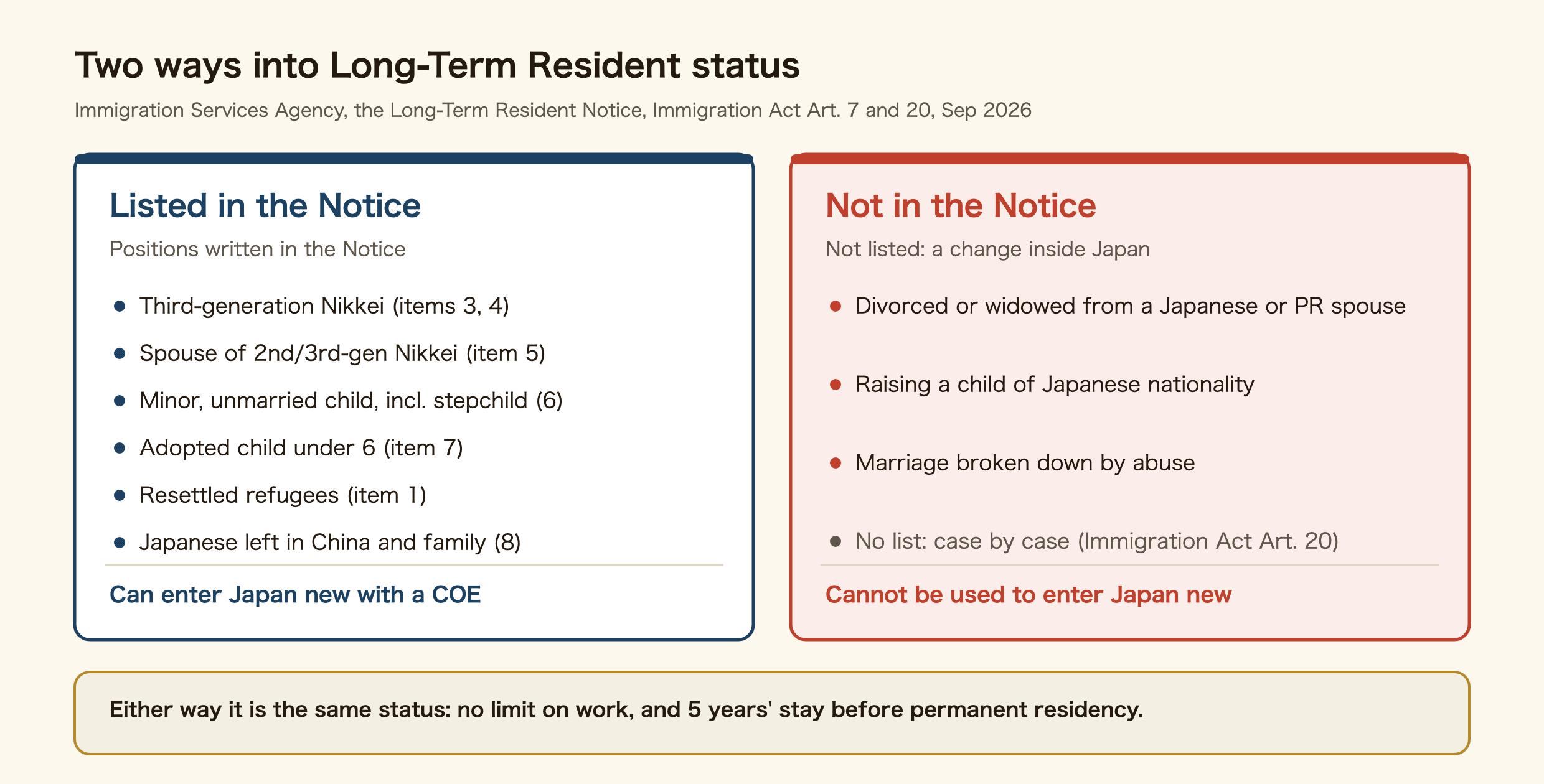
There is no single list of requirements. Instead, the Minister of Justice has published a list of positions in advance, called the Long-Term Resident Notice. Status granted under a listed position is often called kokuji teiju (listed). Status granted for reasons outside the list is kokuji-gai teiju (not listed).
Listed in the Notice — you can come from abroad
The main positions in the Notice (Ministry of Justice Notice No. 132 of 1990):
- Third-generation Nikkei (items 3 and 4), who must also be of good conduct
- Spouses of second- or third-generation Nikkei, or of a Long-Term Resident with a period of 1 year or more (item 5)
- Minor, unmarried biological children supported by a Japanese national, permanent resident, special permanent resident or Long-Term Resident with 1 year or more (item 6)
- Minor, unmarried biological children of a foreigner married to a Japanese national or permanent resident, supported by that parent (item 6-ni) — in other words, stepchildren
- Adopted children under 6 supported by a Japanese national, permanent resident and others (item 7)
- Resettled refugees (item 1), and Japanese left behind in China and their families (item 8)
Since 1 April 2022, “minor” in item 6 means under 18. The agency tells children with a Certificate of Eligibility (COE) to enter Japan by the day before they turn 18. A stepchild who is already 18 cannot come under this item. If you are planning to bring family to Japan, count back from your child’s birthday.
Not in the Notice — only a change inside Japan
Article 7 of the Immigration Act says that, for someone entering Japan, the Long-Term Resident position must be one set out in the Notice. A Long-Term Resident status for reasons outside the Notice can only come from changing status while you are already in Japan.
The typical case is someone who lived in Japan as the spouse of a Japanese national or permanent resident, and whose marriage ended in divorce or death. Article 20 allows a change of status only where there are “reasonable grounds”. No list of requirements exists. The section on divorce below uses the agency’s published cases instead.
Can I work on a Long-Term Resident visa?
Yes, without limits. Article 19 of the Immigration Act — the rule against paid work outside your status — applies only to Appended Table I statuses such as Student or Engineer/Specialist in Humanities/International Services. Long-Term Resident is in Table II, so it does not apply.
The agency’s Q&A tells employers directly that people with Spouse of Japanese National, Spouse of Permanent Resident, Long-Term Resident or Permanent Resident status can be hired. Full-time, part-time or self-employed — all are fine. There is no 28-hour cap and no permission for activity outside your status to apply for.
Your status does have an expiry date, though, and employers check it on your residence card. Miss a renewal and the question is no longer whether you can work, but whether you can stay.
Long-Term Resident vs Permanent Resident: what is the difference?
| Long-Term Resident | Permanent Resident | |
|---|---|---|
| Work limits | None | None |
| Period of stay | 5 years, 3 years, 1 year, 6 months, or set (up to 5 years) | Unlimited |
| Renewal of stay | Required | Not required (the card itself is renewed) |
| Permission fee | At every renewal, by period granted | Once, when permanent residency is granted |
Working life is the same. The big difference is that a Long-Term Resident has an expiry date and a review at every renewal.
The Guidelines for Permanent Residence (revised 24 February 2026) normally require 10 years in Japan. One of the exceptions is 5 or more years of continuous stay on Long-Term Resident status.
Other conditions still apply. You must hold the longest period of stay available for your status — 5 years for Long-Term Resident, although until 31 March 2027 a 3-year period is treated as the longest. Taxes, pension and health insurance contributions must have been paid on time. Spouses and children of Japanese nationals and permanent residents are exempt from the “good conduct” and “independent livelihood” requirements, but Long-Term Residents are not. The full picture is in permanent residency in Japan.
How long is a Long-Term Resident period of stay?
The agency lists 5 years, 3 years, 1 year, 6 months, or a period the Minister sets individually, up to 5 years. Which one you get is decided when you are granted permission.
Third-generation Nikkei who want a 5-year period submit proof of Japanese ability (minors excluded). The agency accepts any one of these:
- JLPT N2, or JLPT N3 with a total score of 104 or more
- BJT Business Japanese Proficiency Test score of 400 or more
- 6 months or more of study at a Japanese language institution designated by the Minister of Justice
- 1 year or more at a Japanese school such as an elementary, junior high or high school
The length matters for effort and money. A 1-year period means renewing every year. And for permanent residency, holding the longest period is one of the conditions.
Long-Term Resident visa after divorce: case by case, and 13 published cases
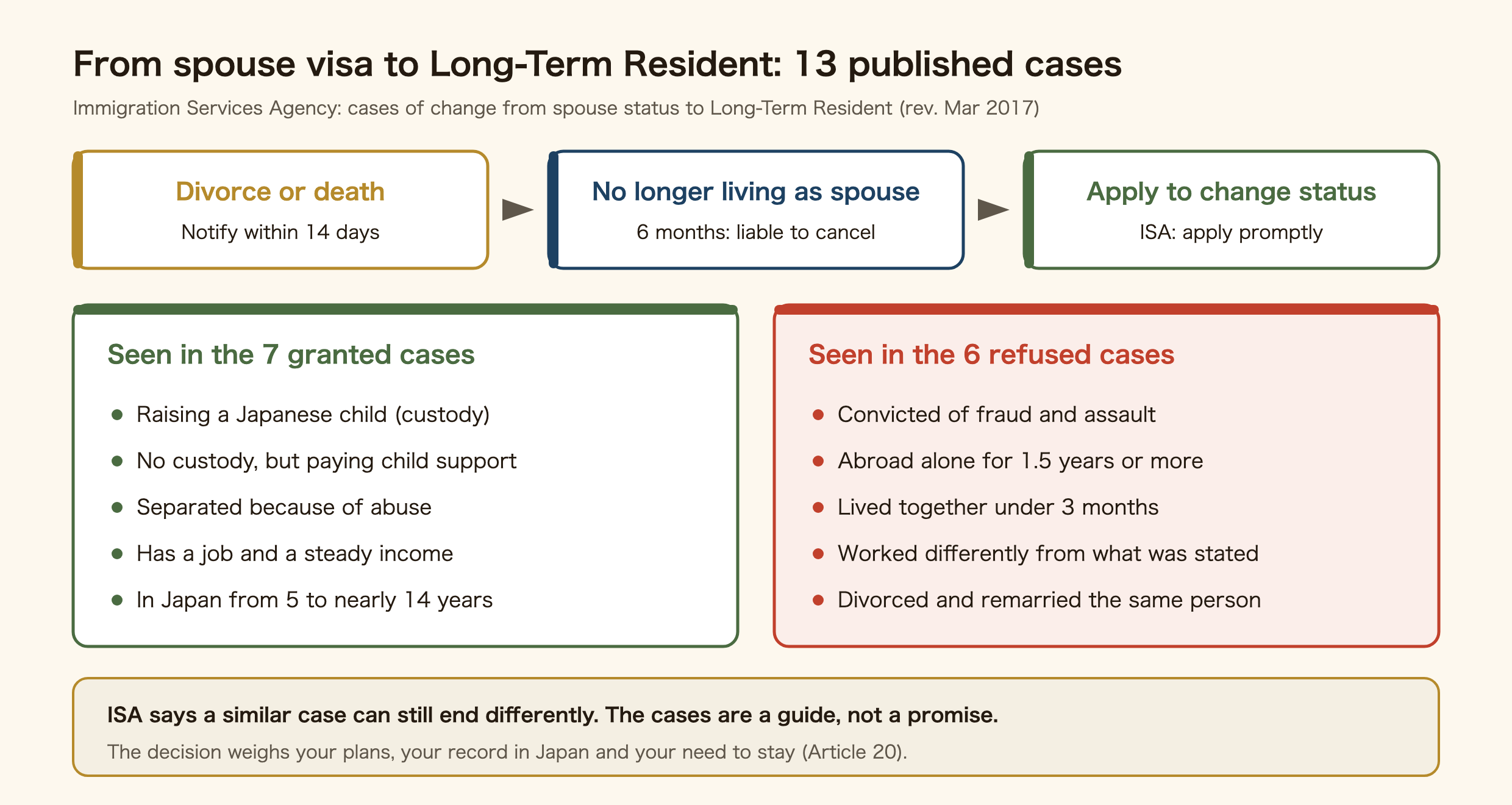
“Divorce converts to Long-Term Resident” is not accurate. “Divorce can lead to Long-Term Resident” is.
A person on Spouse of Japanese National or Spouse of Permanent Resident status must notify Immigration within 14 days of a divorce or a spouse’s death. After six months or more without living as a spouse, the status becomes liable to cancellation unless there is a justifiable reason. How the six months are counted, and the four official examples of a justifiable reason, are in spouse visa and divorce in Japan.
The agency’s application page tells people whose family status has changed to “apply promptly”. There is no reason to wait out the six months. And if Immigration moves to cancel, the law requires it to consider giving you the chance to apply for a change of status or permanent residency (Article 22-5).
The 7 cases that were granted, and the 6 that were not
For changes after divorce, the agency publishes cases, not requirements (first published July 2012, revised March 2017). The 7 granted cases include these circumstances:
- Having custody of a Japanese child and actually raising them (2 cases)
- No custody, but paying 30,000 yen a month in child support to a Japanese child without a break
- Separated because of the spouse’s violence, with the marriage broken down in fact, even before a divorce was filed (3 cases)
- After the spouse’s death, needing to keep running one’s own business
- A steady income from work, mentioned in 4 of the 7
The 6 refused cases mention a conviction for fraud and assault, living abroad alone for about a year and a half or more, living together for under three months, and working in a way that did not match the stated reason for living apart.
In the same document, the agency says the decision weighs “the activities the person intends to engage in, their status of stay, the necessity of their stay” and more, and that a case similar to a published one can still reach a different result. Treat the cases as a guide to what you need to explain, not as a checklist.
Another agency document adds that even after six months without living as a spouse, a change to another status may be granted where, for example, the person is taking care of and raising a child of Japanese nationality. If that is you, start there.
Long-Term Resident visa renewal requirements: documents and where to get them
If your status comes from the Notice, open the agency’s Long-Term Resident page and choose your category (third-generation Nikkei, spouse of a second-generation Nikkei, spouse of a third-generation Nikkei, minor unmarried child being supported, adopted child under 6). Each one lists documents for change and renewal, with a checklist.
The lists differ, but these documents come up often:
| Document | Where to get it |
|---|---|
| Application form (change or renewal), letter of guarantee | Download from the agency’s page, or at a regional immigration bureau |
| Residence certificate (juminhyo) for the whole household, My Number omitted | Your city or ward office |
| Resident tax certificate (taxable or non-taxable) and tax payment certificate | The city office where you lived on 1 January |
| Family register (koseki) extracts, certificates of accepted notifications | The Japanese family’s registered city office (for Japanese family or Nikkei) |
| Certificate of employment | Your employer (self-employed: copy of your tax return) |
| Birth, marriage and criminal record certificates | Authorities in your home country, with a Japanese translation |
| Photo, passport, residence card | Your own, shown at the counter |
Certificates issued in Japan must be less than 3 months old. Documents in a foreign language need a Japanese translation.
For a status outside the Notice, such as after divorce, there is no official document list. The agency directs questions about documents to the Immigration Services Agency Information Center (0570-013904). Before you apply, check with them what to bring: a written statement of your circumstances, and papers that show how you are raising a child, your income, or why you live apart.
When can I renew, and how much does it cost?
Apply before your period of stay ends. If your period is 6 months or longer, you can apply from 3 months before the expiry date. The full renewal process is in visa renewal in Japan.
You pay the fee when permission is granted. From 1 October 2026, the amount depends on the period of stay you are granted. For Long-Term Resident periods, the counter fees are:
| Period granted | Counter fee |
|---|---|
| (before the change, flat) | 6,000 yen |
| 6 months | 18,000 yen |
| 1 year | 33,000 yen |
| 3 years | 64,000 yen |
| 5 years | 75,000 yen |
| Permanent residency | 200,000 yen (was 10,000 yen) |
Applications accepted by 30 September 2026 pay the old amount, even if permission comes in October or later. For individually set periods and online fees, see the Japan visa fee increase.
What if I miss the deadline or forget a notification?
The “three months without activity” rule for students and the “six months” rule for spouses do not apply to Long-Term Residents. In Article 22-4, those items cover only Table I statuses and spouses.
You can still lose the status in other ways:
- Staying past your period of stay is overstaying. Article 70 sets up to 3 years’ imprisonment, a fine of up to 3 million yen, or both, and it is also grounds for deportation
- When you move, report your new address to the new city office within 14 days. If you do not report a new address within 90 days of leaving the old one, your status can be cancelled unless there is a justifiable reason
- Permission obtained with false documents can be cancelled
Reporting your move through residence registration at the city office also counts as the report to Immigration.
What if I cannot get everything ready, or I might be refused?
File before the expiry date, even if some documents are missing. If you apply in time, you can stay until the decision, or until 2 months after the expiry date, whichever comes first (Article 20(6), applied to renewals by Article 21(4)). During that time you are still a Long-Term Resident and can keep working.
Tell the counter which documents will follow, and ask how to submit them. If a refusal notice arrives, the next steps are in visa renewal denied in Japan.
If you cannot pay the fee, a reduction and exemption system starts on 1 October 2026. Who qualifies is set by Cabinet Order and the agency’s guidelines. Check the agency’s dedicated page to see whether you are covered.
Which one are you?
- You are a third-generation Nikkei or a stepchild, on a listed status — open your category on the agency’s Long-Term Resident page and save the renewal checklist. Put the date 3 months before your expiry in your calendar today.
- You were the spouse of a Japanese national or permanent resident, and the marriage ended — file the 14-day notification. Do not wait six months: gather papers on childcare, income and why you live apart, and set a date to ask about a change.
- You are raising a child of Japanese nationality — collect proof of custody and care (school or nursery papers, child support transfer records). Call the Information Center to confirm what to submit.
- You have been a Long-Term Resident for nearly 5 years and want permanent residency — check on your residence card that your period is 5 years (or 3 years until 31 March 2027). Request your tax, pension and insurance payment records and look for late payments.
Frequently asked questions
Q. What is a Long-Term Resident visa in Japan?
It is a status of residence the Minister of Justice grants for special reasons, with a set period of stay. It is in Appended Table II of the Immigration Control Act. Third-generation Nikkei, stepchildren of foreigners married to Japanese nationals, resettled refugees, Japanese left in China and their families, and people who changed status after a divorce from a Japanese spouse hold it.
Q. Can I work on a Long-Term Resident visa?
Yes, with no limits. The work restrictions in Article 19 apply only to Appended Table I statuses, and Long-Term Resident is in Table II. The agency’s Q&A says employers can hire Long-Term Residents. No permission for outside activities is needed.
Q. What is the difference between Long-Term Resident and Permanent Resident?
A Long-Term Resident has a period of stay and must renew it. A Permanent Resident has no time limit. Both can work without restrictions.
Q. How many years before a Long-Term Resident can apply for permanent residency?
Five years of continuous stay on Long-Term Resident status is an exception in the permanent residence guidelines. You also need the longest period of stay (3 years also counts until 31 March 2027), good conduct, an independent livelihood, and taxes and contributions paid on time.
Q. Can I change to Long-Term Resident after divorcing a Japanese spouse?
It can be granted, but there are no fixed requirements and each case is judged on its own. In the agency’s published cases, changes were granted where the person was raising a Japanese child, the marriage had broken down because of violence, or the person had work and income. They were refused where the couple lived together for under three months, the person lived abroad alone for a long time, or there was a criminal conviction.
Q. Where do I get the documents for a Long-Term Resident renewal?
Application forms and the letter of guarantee come from the agency’s website or a regional immigration bureau, the residence certificate and tax certificates from your city office, and the certificate of employment from your employer. The list for each category is on the agency’s Long-Term Resident page. Certificates issued in Japan must be less than 3 months old.
Summary
Long-Term Resident status lets you work without limits and shortens the road to permanent residency to 5 years. In exchange, it has an expiry date and a review at every renewal. If your status comes from the Notice, the agency’s category pages list everything you need.
After a divorce or a spouse’s death, Long-Term Resident sits outside the Notice. There are no published requirements, only published cases. Raising a child, income, years in Japan, the reason you live apart: work out which of these you can show, and ask before the six months run out.
Official sources: Immigration Services Agency, “Long-Term Resident” (Japanese) / Long-Term Resident Notice (MOJ Notice No. 132 of 1990) / Guidelines for Permanent Residence / Cases of permission granted or not granted to change from spouse status to Long-Term Resident (English PDF) / Guidelines on change of status and extension of period of stay / Fee revision from 1 October 2026 / Immigration Control and Refugee Recognition Act (e-Gov). Checked on 23 September 2026. For your own case, confirm with your regional immigration bureau or the Immigration Services Agency Information Center.
Related reading
Found this useful? Share it
Send it to a friend who lives in Japan.
WHO WROTE THIS

mori
Japanese. I read the ministries’ own notices, orders and Q&As in the original, and I start from what my Nepalese and Sri Lankan friends in Japan actually ran into. I do not write about what I have not checked or been told.
What this site can and cannot do →Looking for something else?