Checked on 17 September 2026 against Hello Work’s pages on the basic allowance, benefit days and procedures, the MHLW paper on the reform effective April 2025, and the Employment Insurance Act (e-Gov). The daily caps are the figures as of 1 August 2026; they change every August.
In short
- “Unemployment insurance” is the basic allowance of employment insurance, and foreign residents who were enrolled can claim it. There is no nationality condition. Student part-timers are not enrolled, so they cannot.
- Two conditions: 12 months insured in the two years before leaving, and looking for work in Japan. After dismissal or bankruptcy, 6 months in one year is enough.
- The amount is 50-80% of your previous daily wage, capped at 7,450 yen a day under age 30. Voluntary leavers get 90 days; dismissed workers 90-330 days by age and years insured.
- Voluntary leavers wait 7 days plus a one-month restriction. It was two months until April 2025. Dismissed workers start after the 7 days.
- Leave Japan and the payments stop. You must appear at Hello Work every four weeks. The claim window is one year from the day after leaving.
You left the job. Nothing lined up yet. A Japanese colleague says “you can get unemployment.” Can a foreigner? What about the visa? What if I go home? Hello Work’s pages are in small-print Japanese. This article clears the three things that trip up foreign residents – status of residence, student part-time work, and leaving Japan – and then gives the conditions and the money.
- Can a foreign resident claim it? Yes, if you were enrolled
- Two conditions: 12 months, and looking for work
- How much, and for how long?
- When does it start? Seven days plus a month if you quit; seven days if dismissed
- The procedure and what to bring
- Leaving Japan: claim first, or fly first?
- The decision: do you qualify?
- FAQ
- Summary
Can a foreign resident claim it? Yes, if you were enrolled
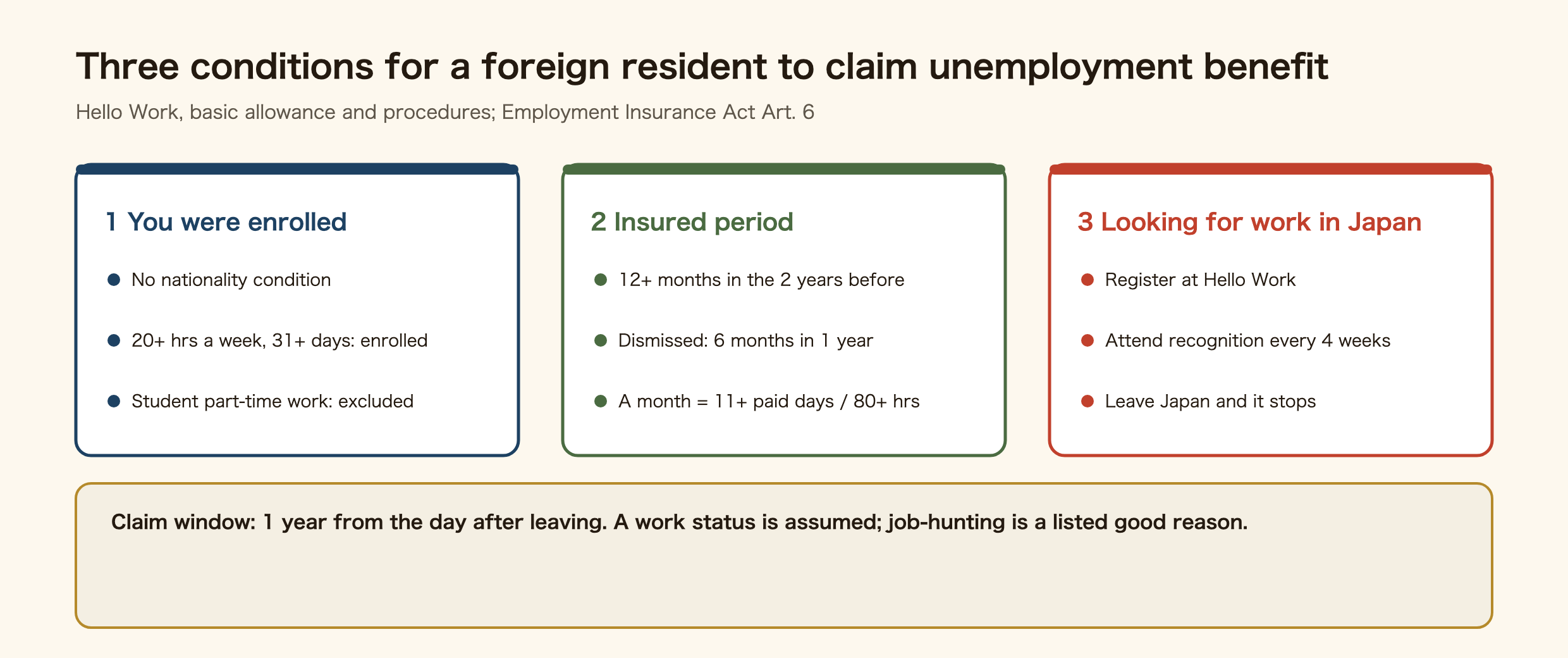
What people call unemployment insurance is formally the “basic allowance” (kihon teate) of employment insurance: money paid to someone who has lost a job, to live on while looking for the next one (Hello Work, “Basic allowance”). Who gets it is set by the Employment Insurance Act, and that Act has no nationality condition. With 20 or more scheduled hours a week and a prospect of 31 or more days of employment, a foreign worker is enrolled exactly like a Japanese one (none of the Art. 6 exclusions apply). If your payslip shows an employment-insurance deduction, you were in.
Three things trip up foreign residents.
- Student part-time work does not count. Art. 6 excludes students under the School Education Act (daytime students). A 28-hour-a-week job under a permission for activities outside status was never enrolled. Same reason as the “not enrolled” answer in the student social-insurance article.
- You need a status that lets you work in Japan. The allowance goes to people “able to take a job at any time” who cannot find one. That logic points to work statuses (Engineer/Humanities, Specified Skilled Worker, Permanent Resident, Spouse of Japanese National and so on) or a permission for activities outside status that allows work. A job search on a work status is one of the listed “good reasons” against status revocation.
- Leave Japan and it stops. Unemployment is “recognised” every four weeks in person at the Hello Work for your address. No presence, no recognition, no payment. Whether to claim first or fly first is at the end of this article.
Two conditions: 12 months, and looking for work
Hello Work’s eligibility test has exactly two parts.
- Being unemployed – registered as a job seeker at Hello Work, willing and able to work, yet unable to find a job. Someone who cannot start work because of illness or childcare, or who plans to rest for a while, is not “unemployed” in this sense.
- An insured period of 12 months or more in the two years before leaving – a month counts when 11 or more days, or 80 or more hours, were paid. “Specified qualified recipients” (dismissal, bankruptcy) and “specified-reason leavers” (contract not renewed, and similar) need only 6 months in the year before leaving.
So someone who worked a year and quit qualifies; someone who quit after ten months does not. Someone whose contract was ended after ten months qualifies under the six-month rule. The “reason for separation” on your rishokuhyo decides this, so if the reason your employer wrote looks wrong, say so at Hello Work; it investigates and decides.
How much, and for how long?
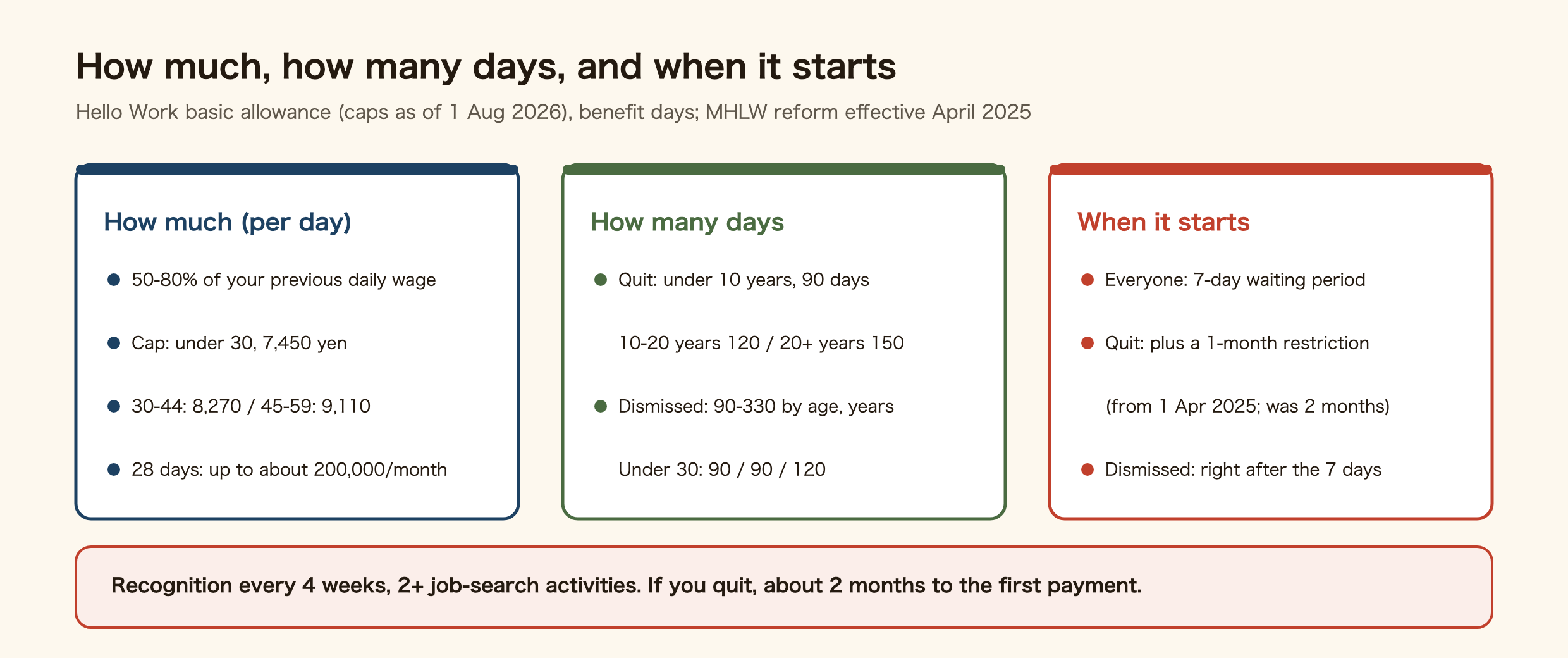
The daily amount is roughly 50-80% of a “daily wage” calculated from your last six months’ pay. Lower earners get the higher rate. There is a cap: as of 1 August 2026, 7,450 yen under age 30, 8,270 at 30-44, 9,110 at 45-59, 7,830 at 60-64. Counting 28 days a month, someone under 30 gets at most about 200,000 yen a month.
The number of days depends on how you left and how many years you were insured.
- Voluntary leavers: 90 days with under 10 years insured, 120 for 10-20 years, 150 for 20 or more. Age does not matter.
- Specified qualified recipients (dismissal, bankruptcy): 90-330 days by age and years. Under 30: 90 days with under 1 year, 90 for 1-5 years, 120 for 5-10. Age 30-34: 90, 120, 180.
Most foreign readers are around 30 with one to five years in the job. That means 90 days if you quit, 90-120 if you were dismissed. Think of it as three to four months.
When does it start? Seven days plus a month if you quit; seven days if dismissed
From the day you register as a job seeker, the first seven days of unemployment are a “waiting period” with no payment. That applies to everyone.
If you left voluntarily, a “benefit restriction” follows the waiting period, and for separations on or after 1 April 2025 it is one month as a rule (MHLW, reform effective April 2025; two months before that). Three or more voluntary separations in five years make it three months. The restriction is lifted if you take education or training on your own after leaving (or within a year before). Dismissed and bankruptcy leavers have no restriction: payment starts after the seven days.
Money actually arrives after each “recognition day”, every four weeks, when you go to Hello Work and report at least two job-search activities for the period (applications, a careers consultation at Hello Work, and so on). If you quit, expect close to two months between registering and the first payment, and budget for it.
The procedure and what to bring
- Receive the rishokuhyo (-1 and -2) from your employer. It arrives about ten days to two weeks after you leave. If it does not, go to Hello Work.
- At the Hello Work for your address, register as a job seeker and have your eligibility decided. Bring the rishokuhyo, your My Number Card (or notification card plus photo ID), photos and a bank book in your name. Your residence card serves as photo ID. The reason for separation is judged here too.
- Attend the first recipients’ briefing. You receive your recipient’s certificate and the recognition report form, and are told your first recognition day.
- Every four weeks, go to Hello Work on the recognition day. Fill in your job-search record and hand it in. The recognised days are paid a few days later.
What not to do: leave out days you worked, or claim job-search activities you did not do. Fraud stops every further payment and brings penalties. A day of part-time work, once reported, simply reduces or defers that day’s allowance.
Leaving Japan: claim first, or fly first?
The claim window is one year from the day after you leave the job. Your allotted days must be used inside that year. Once you leave Japan you cannot attend recognition, so the remaining days are lost the day you go.
That leaves two options if you have decided to go home.
- Stay, look for work and claim. You need time left on your period of stay and a status that lets you work. If you quit, the first payment is about two months away and then 90 days follow. If your period of stay is close to expiry, weigh whether a renewal would pass.
- Go without claiming. The employment-insurance premiums you paid are not refunded. Pension is different: part comes back as the lump-sum withdrawal. The whole departure sequence is in the leaving-Japan checklist.
The decision: do you qualify?
Worked a year or more, quit or were dismissed, hold a work status, and are looking for the next job in Japan: yes. Take the rishokuhyo to Hello Work. About two months to the first payment if you quit, under a month if dismissed.
A student who left a part-time job: no. You were never enrolled. For money, see the living-cost article and the scholarship article.
Leaving Japan right away: no. The rishokuhyo is no use abroad, so make sure of the pension lump-sum and the income-tax refund instead.
FAQ
Q. Can foreigners get unemployment benefit in Japan?
Anyone who was enrolled in employment insurance can, regardless of nationality. Conditions: 12 months insured in the two years before leaving (6 months in one year after dismissal or bankruptcy), and looking for work in Japan.
Q. I was a student with a part-time job. Can I claim?
No. Daytime students are excluded from employment insurance, so you were never enrolled.
Q. How much, and for how many days?
50-80% of your previous daily wage, capped at 7,450 yen a day under age 30 (as of August 2026). 90 days if you quit with under 10 years insured; 90-330 days after dismissal, by age and years.
Q. I quit. When does payment start?
After a 7-day waiting period and a one-month restriction (for separations on or after 1 April 2025). Expect about two months to the first payment.
Q. Can I keep receiving it after I leave Japan?
No. Recognition happens every four weeks in person at Hello Work, so the remaining days are lost when you leave.
Q. Can I do part-time work while claiming?
Yes, if you report it on the recognition day; that day’s allowance is reduced or deferred. Not reporting it is fraud and stops all further payment.
Summary
Japan’s unemployment benefit (the basic allowance) is open to any foreign resident who was enrolled in employment insurance, whatever their nationality. Twelve months in two years (six in one after dismissal), and a job search in Japan. Student part-timers are out. Leaving Japan ends it.
50-80% of pay, capped at 7,450 yen under 30. 90 days if you quit, 90-330 if dismissed. Quitters wait seven days plus a month. Take the rishokuhyo to Hello Work – that is the first step.
Sources (official): Hello Work Internet Service, the basic allowance / benefit days / employment insurance procedures / MHLW, 2024 employment insurance reform, provisions effective 1 April 2025 / Employment Insurance Act, Art. 6 (e-Gov) / MHLW, notification of foreign workers’ employment status (all checked 17 September 2026)
Found this useful? Share it
Send it to a friend who lives in Japan.
WHO WROTE THIS

mori
Japanese. I read the ministries’ own notices, orders and Q&As in the original, and I start from what my Nepalese and Sri Lankan friends in Japan actually ran into. I do not write about what I have not checked or been told.
What this site can and cannot do →Looking for something else?