Checked on 23 September 2026 against the Immigration Services Agency’s Standards for Japanese Language Institutions, their Interpretation Guidelines (revised 1 September 2026), and the document lists for renewing Student status.
The short answer
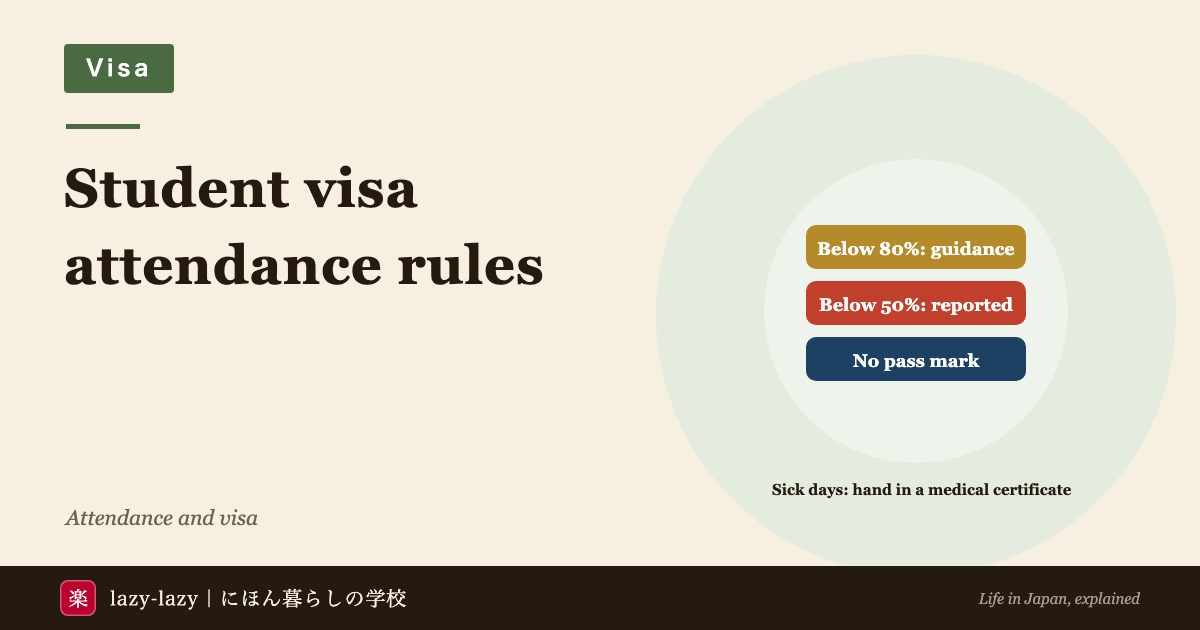
- Japanese language schools have two attendance lines set by national standards. Below 80% in a month, the school must give you improvement guidance. Below 50%, the school reports you to Immigration by the end of the next month — with the name of your part-time employer.
- 80% is a floor, not a target. Immigration’s own guidelines say so.
- Immigration does not publish an attendance rate that guarantees a visa renewal. But the renewal documents include your attendance certificate and transcript.
- Absence for illness or other unavoidable reasons can be excluded. The school decides. Always hand in a medical certificate.
- Universities and vocational schools have no published percentage. They must still track attendance, and renewals look at grades and credits too.
Knowing this, you can stop asking “how much can I miss?” and cut your shifts in any month you are heading below 80%. If you were ill, a medical certificate protects your rate.
Last month you took more shifts. You were late for morning class twice and missed three days. At the end of the month the school office calls you in: “Your attendance is 77%.” One friend says 80% is safe. Another says anything under 90% puts your visa at risk. Your Japanese friends cannot help. For a Japanese student, attendance has nothing to do with a visa.
- What attendance rate do international students in Japan need?
- How is the attendance rate calculated?
- Can low attendance stop my visa renewal?
- What if I was ill?
- Does it count during a leave of absence or a trip home?
- What about universities and vocational schools?
- What does it cost?
- My attendance is dropping. What now?
- Which one are you?
- FAQ
- Summary
- Related reading
What attendance rate do international students in Japan need?
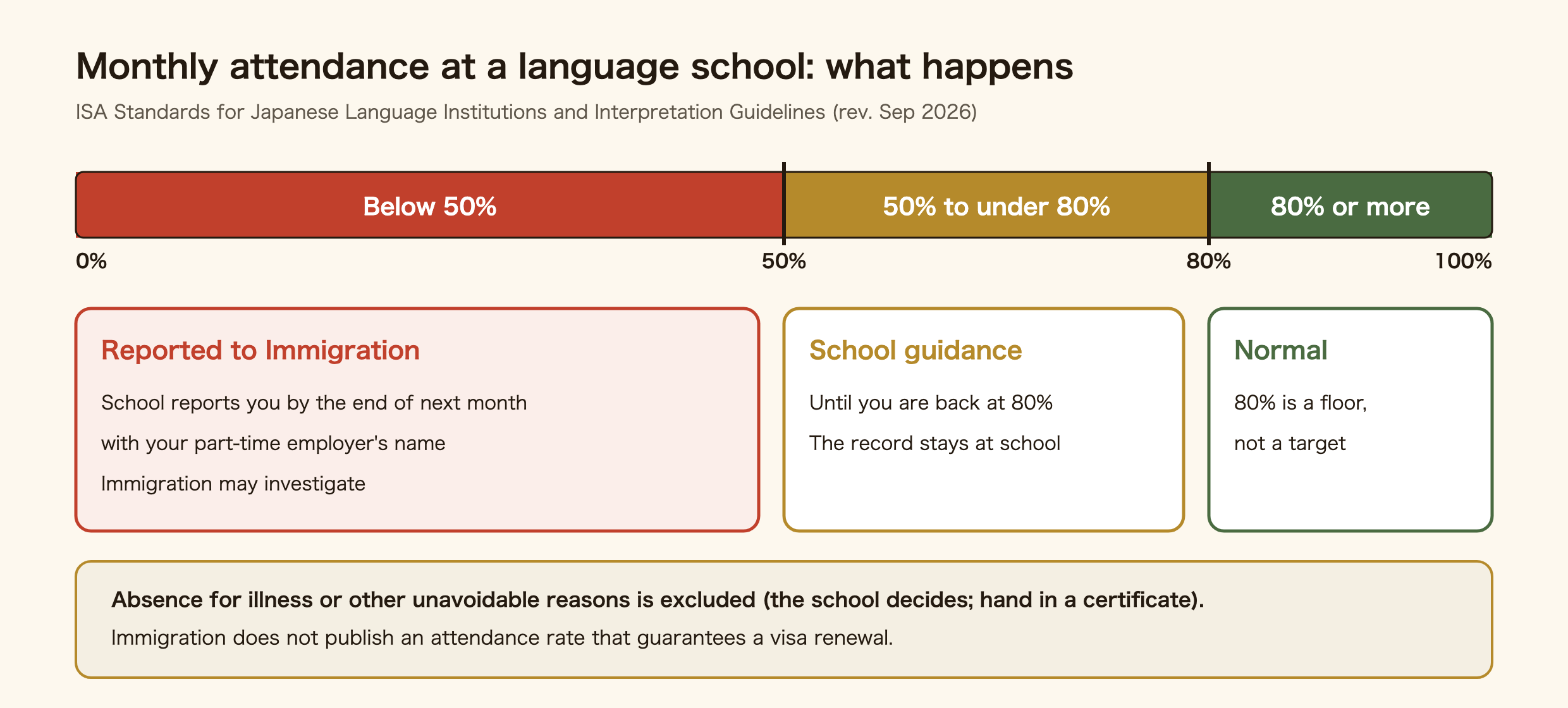
The numbers exist for Japanese language schools. The Immigration Services Agency’s Standards for Japanese Language Institutions require schools to do the following.
- Students below 80% in a month — the school gives improvement guidance until they are back at 80% or more, and keeps a record of it
- Students below 50% in a month — the school reports them to the regional immigration bureau by the end of the next month, together with the name of the place they work if they hold a work permit
- Every student’s six-month rate — reported twice a year, for April to September and October to March, within three months of each period
The guidelines are blunt about the 50% report. People below 50% are likely to include some whose real purpose in Japan is not study, so Immigration takes the report and investigates where needed.
About 80%, the guidelines say it is “not meant as a target”. It is the point at which the school must act. Planning your absences to land at exactly 80% is not what the standard has in mind.
These standards apply to language schools approved under the Ministry of Justice notice. Those schools must move to certification by the education minister (certified Japanese language institutions) by 31 March 2029, and the transition is under way. Ask your school which kind it is and how its own rules define attendance.
How is the attendance rate calculated?
The standards define the monthly rate as class hours attended ÷ class hours you should have attended in that month. A class hour is one teaching period.
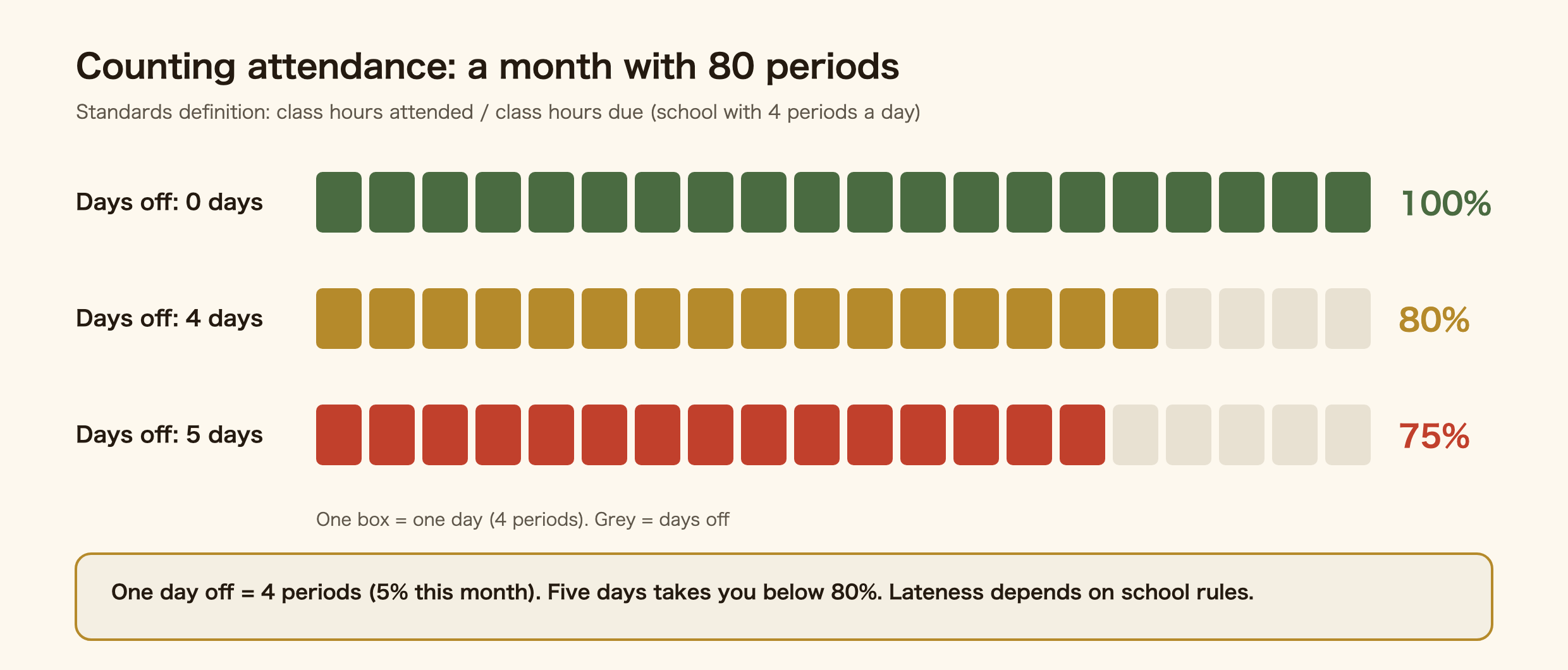
If a month has 80 periods and you attend 64, that is 64 ÷ 80 = 80%. At a school with four periods a day, one full day off costs you four periods. In a short month, “only three days off” can drop you a long way.
Schools must record attendance period by period and keep the record for at least a year after you leave. How lateness and leaving early are counted is not in the national standard; it is in your school’s rules, so check your enrolment documents or ask the office.
Can low attendance stop my visa renewal?
Immigration does not publish the rate you need to be renewed. “80% is safe” and “you need 90%” are not official numbers.
What is official is that attendance is part of the evidence. The renewal document lists for Student status include “attendance certificate, transcript and graduation certificate” for language schools, vocational schools and universities alike (for universities and vocational schools, “if the school can issue one”). That covers every school you have attended since your last application. Immigration can also ask for documents that are not on the list.
University guidance points the same way. Kyoto University warns that poor grades, very few credits or unpaid fees can mean a renewal is refused. The University of Tokyo asks students with poor credits or who repeated a year to submit a statement of reasons and a supervisor’s recommendation with their renewal.
Attendance also follows you later. When you change to a work visa, your record as a student is looked at. The job-hunting visa after graduation for language school graduates with an overseas degree requires about 90% attendance. And three months without going to school at all makes your status liable to cancellation.
What if I was ill?
Both the 80% guidance and the 50% report exclude absence for illness or other unavoidable reasons. The school decides what counts, but the guidelines give examples.
- An infectious disease, for the period a doctor told you to stay away
- A disaster that makes getting to school very difficult
- A family wedding or funeral
- Representing the school at an event or competition it specially approves
- A late arrival in Japan that was not your fault
The school does not know your reason unless you tell it. When you see a doctor, get a medical certificate and hand it in for the days you missed. The guidelines also say that if a student is suspected of working while off sick, the school may ask for a certificate and question the student. Do not work on days you are off sick.
Does it count during a leave of absence or a trip home?
Yes. For the 50% report, the guidelines say that students on leave of absence or temporarily back home are still covered as long as they hold Student status (including while abroad on a re-entry permit), unless the absence is for illness or a similar reason.
Before a long trip home or a leave, sort out your status itself first. Read what a leave of absence does to a student visa.
What about universities and vocational schools?
The 80% and 50% lines are language school standards. No equivalent percentage has been published for universities or vocational schools.
But since the 2024 review, every school that takes international students must have a system to properly track attendance, part-time work and study (a landing requirement for Student status). A school that loses track of attendance and ends up with many students who are not really studying is judged not to have that system. So at a vocational school or university your attendance is still recorded, and renewals look at an attendance certificate (where one can be issued) and your transcript.
What does it cost?
Your school issues attendance certificates and transcripts. The fee depends on the school, so ask the office. Certificates for an application must be issued within the last three months.
The renewal fee itself changes on 1 October 2026 to a system based on the length of stay granted. Check the amount for your case in the residence permit fee increase.
My attendance is dropping. What now?
A typical pattern: you take more shifts and stop making morning classes. Immigration states that working beyond your permitted hours can lead to deportation or a refused renewal. Falling attendance is the warning before that.
- A month heading below 80% — cut shifts. Even inside the 28-hour limit, do not keep a schedule that stops you getting to class
- Off sick — hand in a medical certificate. Do not work those days
- Already below 80% — take the school’s guidance and get back above 80% next month. The record stays with the school
- Renewal coming up — go over the reasons for any low months with your teacher, and look at your own attendance certificate first
Which one are you?
- Language school, 80% or more every month — keep going as you are. Check your attendance certificate before renewal.
- Language school, heading below 80% this month — cut this week’s shifts and stop being late. If it was illness, hand in a certificate.
- Language school, a month below 50% — assume Immigration has been told. Meet the school, get the reason and your plan on record, and cut your hours today if work is the cause.
- University or vocational school — no percentage, but attendance and credits count at renewal. If you failed credits, talk to your supervisor before you apply.
FAQ
Q. What attendance rate does a student visa in Japan require?
Under the national standards for Japanese language schools, below 80% in a month triggers guidance from the school and below 50% is reported to Immigration. 80% is a floor, not a target. Immigration does not publish a rate that guarantees renewal.
Q. How is attendance calculated?
Class hours attended in the month divided by class hours you should have attended. 64 out of 80 periods is 80%. How lateness is counted depends on your school’s rules.
Q. Can low attendance get my renewal refused?
There is no published cut-off, but attendance is part of the evidence. Renewal documents include an attendance certificate and transcript, and universities warn that poor grades or few credits can lead to refusal.
Q. Do sick days count against my attendance?
Absence for illness or other unavoidable reasons is excluded from the 80% guidance and the 50% report. The school decides, so hand in a medical certificate.
Q. What happens below 50% attendance?
The school reports you to Immigration by the end of the next month, with your part-time employer’s name. Immigration may investigate.
Q. Do universities and vocational schools have an attendance requirement?
No percentage like 80% or 50% has been published for them. Schools must still track attendance properly, and renewals look at an attendance certificate (where available) and your transcript.
Summary
Japanese language schools work to two national lines: 80% a month (the school steps in) and 50% (Immigration is told). 80% is a floor, not a target, and no renewal pass mark is published. So instead of counting how much you can miss, change how you work in any month you are heading below 80%.
Sick days can be excluded with a medical certificate. Leave and trips home still count while you hold Student status. Universities and vocational schools have no percentage, but attendance and grades are in your renewal file.
Official sources: Immigration Services Agency, reports under the Standards for Japanese Language Institutions (with the Standards and Interpretation Guidelines, Japanese) / ISA, Student status and renewal document lists (Japanese) / ISA, measures on enrolment management of international students (Japanese) / Kyoto University, status procedures (Japanese). Checked on 23 September 2026. Always check how your own school counts attendance.
Related reading
Found this useful? Share it
Send it to a friend who lives in Japan.
WHO WROTE THIS

mori
Japanese. I read the ministries’ own notices, orders and Q&As in the original, and I start from what my Nepalese and Sri Lankan friends in Japan actually ran into. I do not write about what I have not checked or been told.
What this site can and cannot do →Looking for something else?