Checked on 23 September 2026 against the texts of the Immigration Control Act, the Penal Code, the Act on Prevention of Transfer of Criminal Proceeds, the Mobile Phone Improper Use Prevention Act and the Firearms and Swords Act (e-Gov), and pages from the National Police Agency, Government of Japan PR Online and the Ministry of Health, Labour and Welfare.
The short answer
- You must carry your residence card at all times. Not carrying it: a fine of up to 200,000 yen. Refusing to show it to the police: up to one year in prison or a 200,000 yen fine. Permanent residents too.
- Selling or giving away a bank account or cash card is a crime. Penalties rose on 10 July 2026 to up to three years in prison or a 5,000,000 yen fine. Close your account before you leave Japan.
- Handing your phone or SIM to anyone outside your family needs the carrier’s consent first.
- Cannabis — gummies and vape liquids included — means up to seven years in prison just for having or using it. For a foreign national, a conviction alone is a ground for deportation.
- Also: riding off on someone else’s bicycle, carrying a blade over 6 cm without a reason, and working without permission. “I didn’t know” is not a defence.
Knowing this, you can spot the everyday things that are normal back home but crimes here, and take simple steps today — keep your residence card in your wallet, close your bank account before you go home. You will also see how one fine can follow you into a visa renewal or a permanent residency application.
A senior student going home says, “I don’t need my bank account any more. You can have it. Someone even offered 30,000 yen for one.” The same bicycle has sat outside the station for weeks. You left your residence card in your room because you were only going to the convenience store. Ask a Japanese friend about any of this and you may get a shrug. Japanese people do not carry residence cards, and few of them have ever thought about selling a bank account.
- What are the things that are illegal in Japan for foreign residents?
- What happens if I don’t carry my residence card?
- Can I give my bank account to a friend when I leave Japan?
- Can I pass my phone or SIM on to a friend?
- Can I ride a bicycle that has been left somewhere?
- Is weed legal in Japan? What about gummies and CBD?
- Can I carry a knife in Japan?
- What about working without permission?
- Will a fine affect my visa or permanent residency?
- What does it cost?
- Which one are you?
- FAQ
- Summary
- Related reading
What are the things that are illegal in Japan for foreign residents?
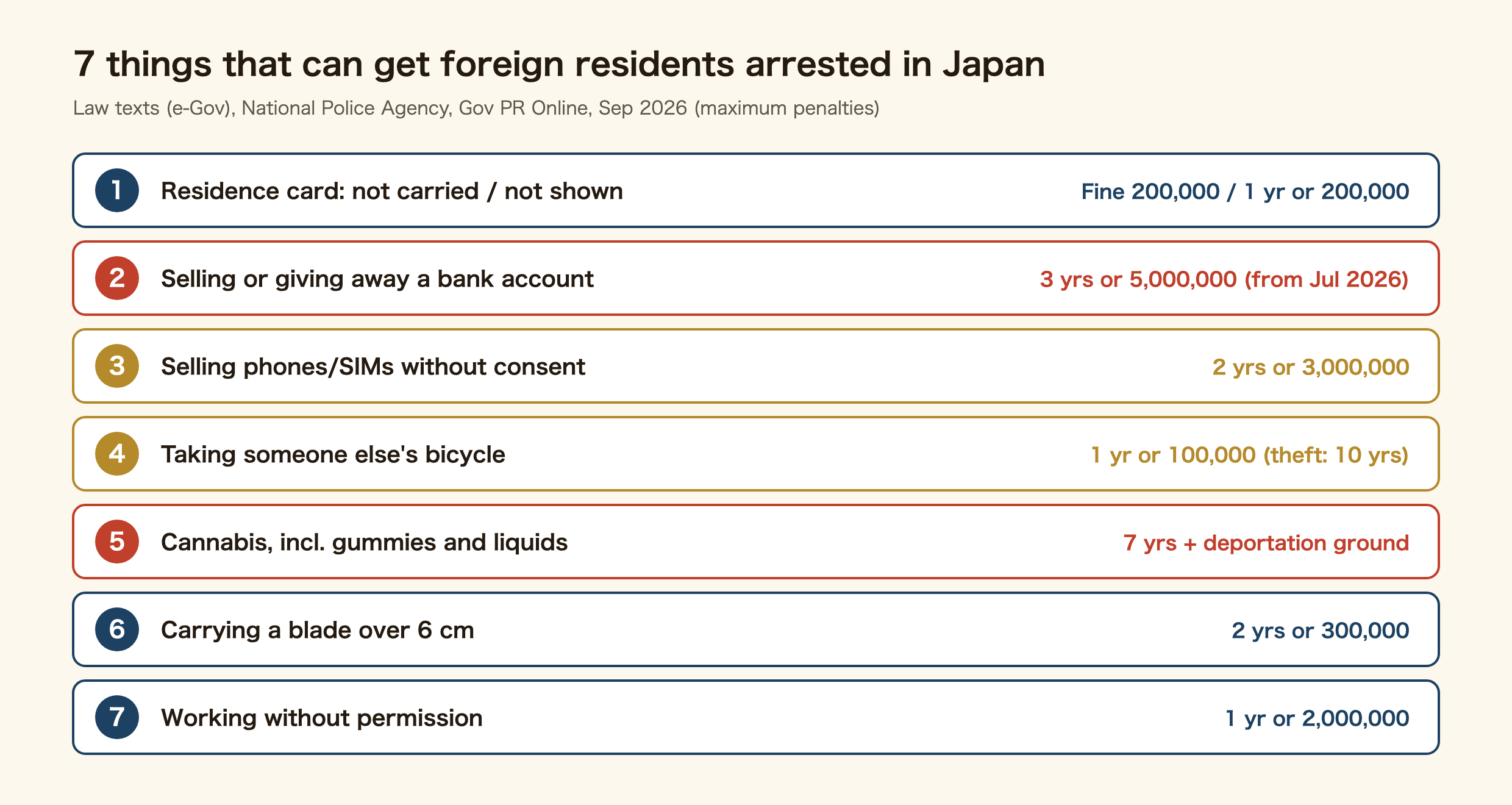
This article covers seven things people living in Japan can run into in daily life.
| What not to do | Law | Penalty |
|---|---|---|
| Not carrying your residence card | Immigration Control Act | Fine up to 200,000 yen |
| Refusing to show your residence card | Immigration Control Act | Up to 1 year in prison or 200,000 yen |
| Selling or giving away a bank account or cash card | Act on Prevention of Transfer of Criminal Proceeds | Up to 3 years or 5,000,000 yen |
| Selling phones or SIMs as a business without consent | Mobile Phone Improper Use Prevention Act | Up to 2 years or 3,000,000 yen |
| Taking someone else’s bicycle as your own | Penal Code | Up to 1 year or 100,000 yen (theft is heavier) |
| Having or using cannabis | Narcotics and Psychotropics Control Act | Up to 7 years in prison |
| Carrying a blade over 6 cm without a reason | Firearms and Swords Act | Up to 2 years or 300,000 yen |
| Working without permission | Immigration Control Act | Up to 1 year or 2,000,000 yen |
These are maximums. For foreign nationals there is a second layer on top: immigration review. That comes in the last section.
What happens if I don’t carry my residence card?
Mid- to long-term residents must carry their residence card at all times (Immigration Control Act, Article 23(2)) — a quick trip to the convenience store included. Not carrying it can bring a fine of up to 200,000 yen (Article 75-3).
If a police officer or other official asks to see it in the course of their duties, you must show it (Article 23(3)). Refusing is heavier: up to one year in prison or a fine of up to 200,000 yen (Article 75-2).
Permanent residents are mid- to long-term residents, so this applies to them too. If you carry your residence card, you do not also need to carry your passport. Keep the card in your wallet or phone case. If you lose it, you must apply for a new one within 14 days; the steps are in what to do if you lose your residence card.
Can I give my bank account to a friend when I leave Japan?
No. The National Police Agency warns foreign residents, in posters in six foreign languages, that transferring a bank account is a crime whether or not you are paid. Accounts handed over like this end up being used for fraud.
Penalties rose on 10 July 2026. Handing over an account knowing it will be misused, or handing it over for money without a legitimate reason, can bring up to three years in prison or a fine of up to 5,000,000 yen, or both. As a business: up to five years or 10,000,000 yen. It covers not just the bankbook but the cash card and online-banking IDs and passwords too.
From the same date, a new offence covers paid money-transfer jobs: “Money will arrive in your account — just send it on to this account and keep 50,000 yen.” Taking on such a job for payment can mean up to two years in prison or a 3,000,000 yen fine (National Police Agency). If you see these offers on social media, do not reply. If you are on the other side, the one tricked into paying, how to report a scam in Japan and try to get your money back covers who to call.
Close your account before you go home. The police also ask you to tell your bank when your address or status changes. The order of everything before departure is in the leaving-Japan checklist.
Can I pass my phone or SIM on to a friend?
To hand over a phone or SIM contracted in your name to anyone other than family or people who share your household, you need the carrier’s consent first (Mobile Phone Improper Use Prevention Act, Article 7). The carrier checks the new user’s identity before agreeing.
Selling them for money as a business without consent can mean up to two years in prison or a 3,000,000 yen fine (Article 20). Handing on a phone that is not contracted in your name can mean a fine of up to 500,000 yen (Article 21). When you leave Japan, cancel the contract instead of passing it on.
Can I ride a bicycle that has been left somewhere?
A bicycle left for weeks, a bicycle with no lock. It may look abandoned, but it can still have an owner. Taking lost or left property that belongs to someone else as your own is embezzlement of lost property: up to one year in prison or a fine of up to 100,000 yen (Penal Code, Article 254). Taking a bicycle the owner is still using is theft: up to ten years or a fine of up to 500,000 yen (Article 235).
If you need a bicycle, buy one or use a bike-share. How you ride now carries fines too: see Japan’s bicycle blue tickets from April 2026.
Is weed legal in Japan? What about gummies and CBD?
No. Since 12 December 2024, cannabis has been controlled under the Narcotics and Psychotropics Control Act, and using it is now a crime too. Having, giving, receiving or using it can each mean up to seven years in prison (Government of Japan PR Online).
It comes in many forms: dried leaf, vape liquids, gummies, chocolate, cookies. The government advises watching for products marked “Cannabis” or with a cannabis leaf. On social media, sellers use slang such as “yasai” (vegetables), “kusa” (grass) and “liquid”. Legal at home does not mean legal here, and bringing it into Japan is a crime.
CBD products are sold in Japan, but there are limits on the THC they may contain (10 ppm for oils and powders, 0.10 ppm for water-based liquids, 1 ppm for other forms; Ministry of Health, Labour and Welfare). Overseas products with unknown contents are safest left alone.
The heavier consequence for foreign nationals comes after. Under the Immigration Control Act, a foreign national convicted under the drug laws is subject to deportation regardless of the sentence (Article 24(4)(chi)). A suspended sentence does not change that.
Can I carry a knife in Japan?
You may not carry a blade longer than 6 cm without a legitimate reason such as work (Firearms and Swords Act, Article 22). The penalty is up to two years in prison or a fine of up to 300,000 yen. Some scissors and folding knives with blades of 8 cm or less are exempt by government ordinance.
What counts as a legitimate reason depends on the situation. It is safest not to carry blades except when taking them to where you will use them.
What about working without permission?
Paid work that your status does not allow can mean up to one year in prison or a fine of up to 2,000,000 yen (Immigration Control Act, Article 73). If it is clearly your main activity, it is also a ground for deportation (Article 24(4)(i)). Students may work up to 28 hours a week with permission.
Will a fine affect my visa or permanent residency?
A criminal penalty does not end with the court or the fine. Foreign nationals also face immigration review.
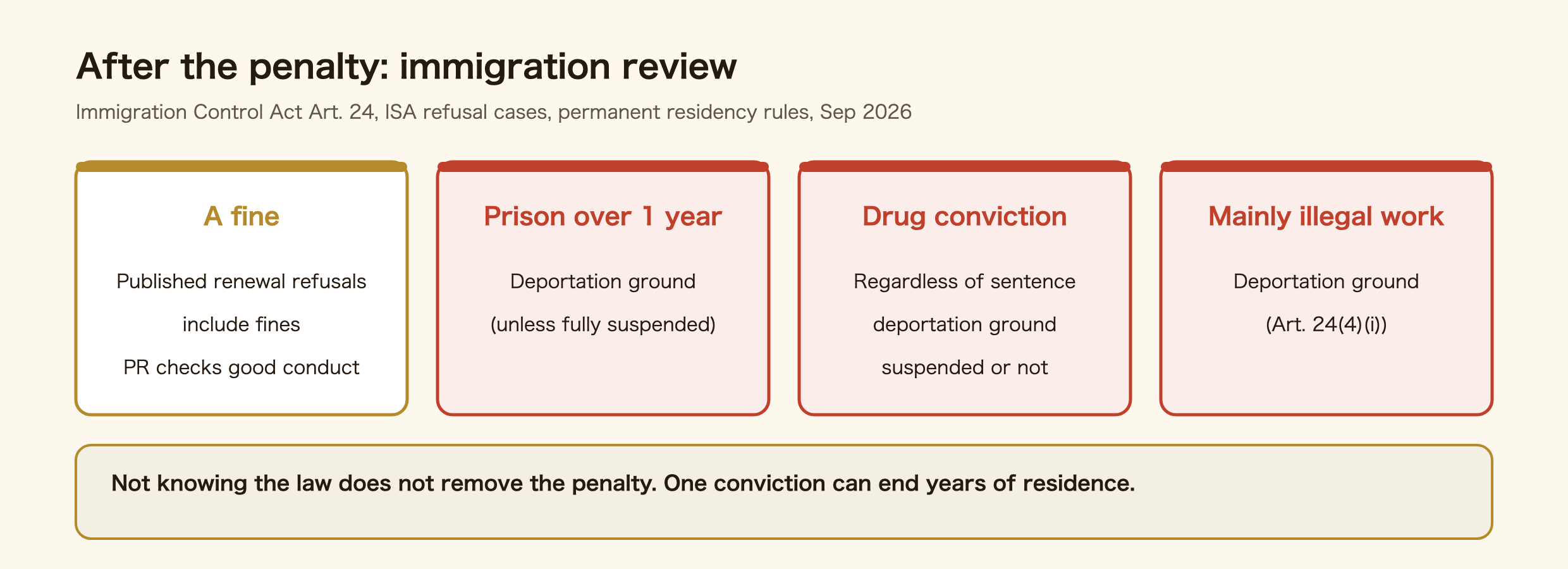
- A drug conviction — a deportation ground regardless of the sentence (Article 24(4)(chi))
- A prison sentence of more than one year (unless fully suspended) — a deportation ground (Article 24(4)(ri))
- A fine — the Immigration Services Agency’s published renewal refusal cases include refusals after a fine
- Permanent residency — good conduct is a requirement
Not knowing the law does not remove the penalty. And a single conviction can end a stay that took years to build.
What does it cost?
Maximum fines run from 200,000 yen for not carrying your residence card to 5,000,000 yen for selling a bank account. The bigger cost is losing your status. Deportation ends your studies, your flat, your job and your life in Japan at once. Set against a few tens of thousands of yen for an account, it is not a trade worth making.
Which one are you?
- Everyday life — put your residence card in your wallet. From today, do not leave home without it.
- Leaving Japan soon — close your bank account and phone contract. Do not hand them to anyone, and ignore “someone wants to buy it” offers.
- You saw a “just forward the money” job on social media — do not reply. Block the account.
- Cannabis was legal where you come from — bring none of it to Japan, gummies and liquids included. Say no if someone offers.
- You need a bicycle — do not take one that is left somewhere. Buy one or use a bike-share.
FAQ
Q. What happens if I don’t carry my residence card in Japan?
Not carrying it can bring a fine of up to 200,000 yen. Refusing to show it to the police or other officials can bring up to one year in prison or a 200,000 yen fine. This applies to permanent residents too.
Q. Can I give my bank account to a friend when I leave Japan?
No. The National Police Agency says transferring an account is a crime whether or not you are paid. From 10 July 2026 the penalty is up to three years in prison or a 5,000,000 yen fine. Close it before you leave.
Q. Is weed legal in Japan? What about CBD gummies?
Cannabis is illegal, including gummies and liquids: having or using it can mean up to seven years in prison. CBD products are allowed only within THC limits. A drug conviction is a deportation ground for foreign nationals regardless of the sentence.
Q. Can I sell my phone to a friend in Japan?
Passing it to anyone outside your family or household needs the carrier’s consent first. Selling phones as a business without consent can mean up to two years in prison or a 3,000,000 yen fine.
Q. Is it a crime to ride an abandoned bicycle in Japan?
Taking a bicycle that belongs to someone as your own can be embezzlement of lost property (up to one year or 100,000 yen) or theft. Even if it looks abandoned, do not ride off on it.
Q. If I just pay a fine, is my visa safe?
Not necessarily. Published renewal refusal cases include refusals after a fine, and permanent residency looks at good conduct. A drug conviction is a deportation ground.
Summary
The things foreign residents in Japan can run into in daily life: not carrying the residence card, handing over bank accounts or phones, other people’s bicycles, cannabis, knives and unauthorised work. Each penalty can be followed by immigration review. A drug conviction alone is a deportation ground.
Residence card in your wallet. Bank account and phone closed before you leave. Cannabis refused, whatever form it comes in. Those three cover most of this article.
Official sources: e-Gov law texts (Immigration Control Act, Penal Code, Act on Prevention of Transfer of Criminal Proceeds, Mobile Phone Improper Use Prevention Act, Firearms and Swords Act; Japanese) / National Police Agency, transferring bankbooks and cash cards is a crime (Japanese, multilingual poster) / NPA, 2026 amendment of the Act on Prevention of Transfer of Criminal Proceeds (Japanese) / Government of Japan PR Online on cannabis (Japanese). Checked on 23 September 2026.
Related reading
Found this useful? Share it
Send it to a friend who lives in Japan.
WHO WROTE THIS

mori
Japanese. I read the ministries’ own notices, orders and Q&As in the original, and I start from what my Nepalese and Sri Lankan friends in Japan actually ran into. I do not write about what I have not checked or been told.
What this site can and cannot do →Looking for something else?