Checked on 23 September 2026 against the Japan Pension Service’s pages on exemption and deferral, application periods, enforcement, late charges and the lump-sum withdrawal payment, the National Pension Act (e-Gov), and the Immigration Services Agency’s guidelines for status renewal and permanent residence.
The short answer
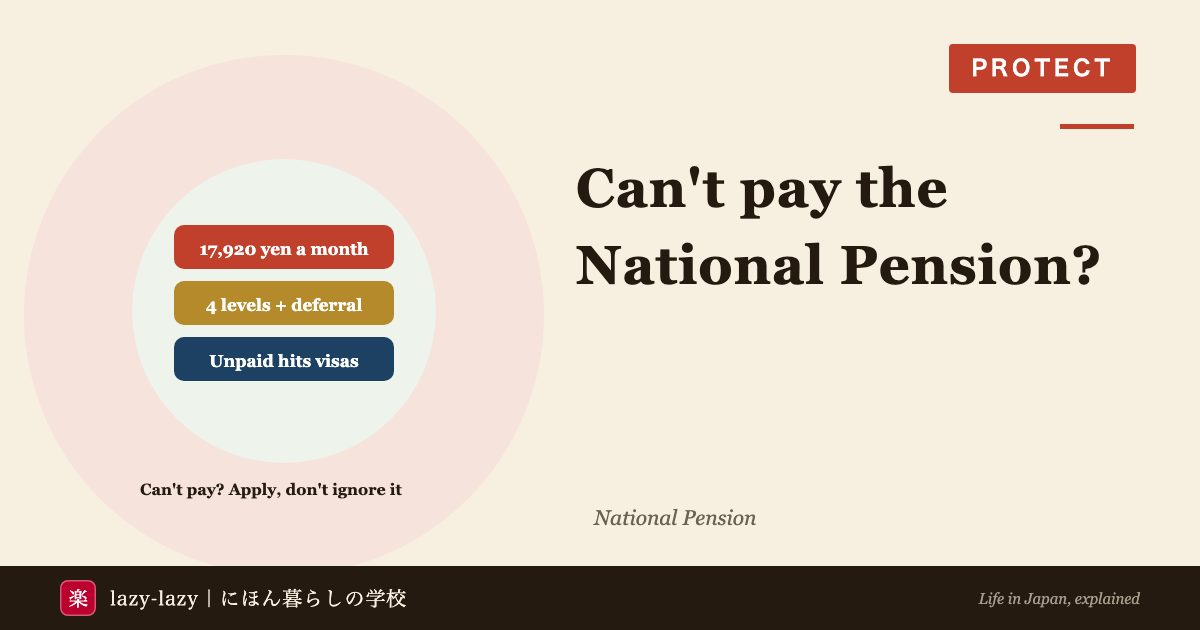
- Everyone aged 20 to 59 who lives in Japan is covered by the National Pension, whatever their nationality. If you are not in a company’s Employees’ Pension, you pay it yourself: 17,920 yen a month in FY2026.
- If you cannot pay, apply for an exemption. There are four levels — full, three-quarters, half and one-quarter — plus a payment deferral for people under 50. All of them depend on last year’s income.
- If you lost your job, a special rule ignores last year’s income. Attach a copy of your separation notice (rishokuhyo).
- You can apply for months up to two years and one month back, at your city office, a pension office, by post, or online through Mynaportal.
- Doing nothing is the most expensive option. Unpaid months lead to demand letters, late charges and seizure, can cost you a disability pension, and are looked at in visa renewals and permanent residence applications.
Knowing this, you can decide today whether to pay, apply for an exemption or deferral, and avoid leaving the kind of unpaid record that follows you into a visa renewal.
A month after you left your job, a National Pension payment slip arrives: 17,920 yen. Your unemployment benefit has not come through yet. You ask a Japanese friend what happens if you just don’t pay it, and they are not sure. If they work for a company, the pension comes out of their salary, and they may never have paid one of these slips themselves.
This guide is for foreign residents who are not students: people between jobs, people on low income from part-time or freelance work, people living with family. If you are a student, read the student pension deferral guide instead — it is a different system.
- Is the National Pension mandatory for foreigners in Japan?
- How much is the National Pension in 2026?
- What is a National Pension exemption? Four levels and a deferral
- Who qualifies? The income lines
- Lost your job? The special exemption that ignores last year’s income
- How to apply, and how far back you can go
- What happens if you leave it unpaid?
- Does unpaid pension affect a visa renewal or permanent residence?
- The downside of an exemption: a smaller pension and refund
- Which one are you?
- FAQ
- Summary
- Related reading
Is the National Pension mandatory for foreigners in Japan?
Yes. The Japan Pension Service says that everyone living in Japan aged 20 to 59 who is not in the Employees’ Pension becomes a category 1 or category 3 insured person. Its English guidance puts it directly: all residents of Japan between 20 and 59, “regardless of nationality”, must be covered. The National Pension Act’s definition of who is covered (Article 7) says nothing about nationality.
Category 1 is the group that pays on its own. That includes:
- People who left a job and have not started the next one
- Freelancers and the self-employed, and part-timers whose hours do not put them into company social insurance
- People whose spouse is not a company employee (self-employed, not working), or who are not their spouse’s dependant
If you are in the Employees’ Pension at work, the National Pension part is already inside what comes out of your pay, so no slip arrives (how the Employees’ Pension works). A dependent spouse of a company employee is category 3 and pays nothing directly. People from a country with a social security agreement may be exempt from joining.
After leaving a job, you switch to the National Pension at your city office within 14 days of the day after your last day. The whole checklist is in leaving a job in Japan as a foreigner.
How much is the National Pension in 2026?
From April 2026 to March 2027 the premium is 17,920 yen a month. Each month is due at the end of the following month — April’s premium by the end of May. You can pay at a bank, post office or convenience store, by direct debit, by credit card or through a smartphone app. You cannot pay at the city office counter.
A year comes to 215,040 yen. With a partial exemption, you pay this much instead:
| Level | You pay per month (FY2026) |
|---|---|
| No exemption | 17,920 yen |
| One-quarter exemption | 13,440 yen |
| Half exemption | 8,960 yen |
| Three-quarters exemption | 4,480 yen |
| Full exemption or deferral | 0 yen |
A partial exemption only counts if you pay the reduced amount. If you don’t, that month is simply unpaid. Which level you get depends on last year’s income.
What is a National Pension exemption? Four levels and a deferral
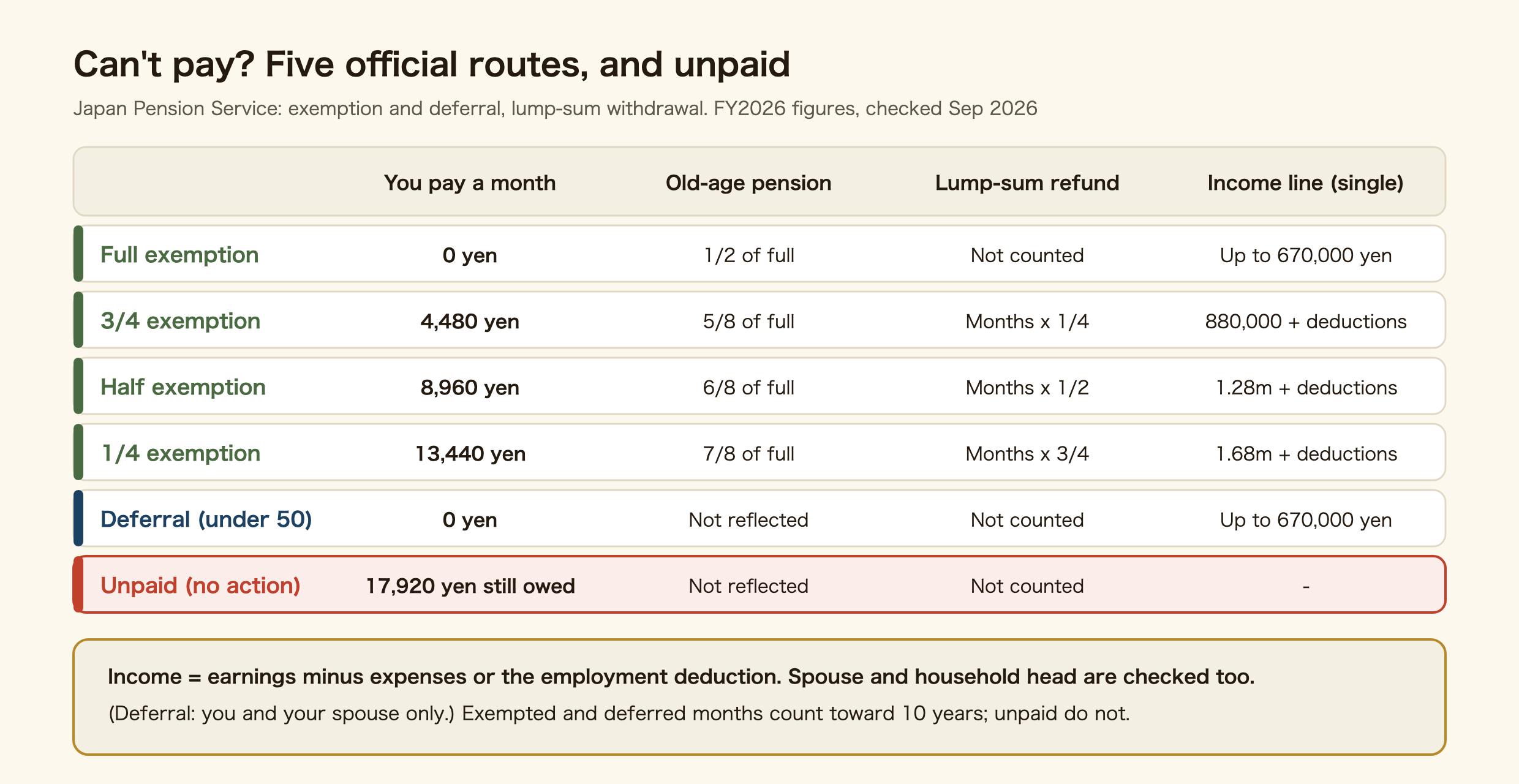
There are five official routes for people who cannot pay. Each one works only after you apply and it is approved.
An exemption — full, three-quarters, half or one-quarter — still adds something to your future pension for the part you did not pay, because half of the basic pension is funded from taxes. Even a fully exempted month is worth half of a paid month.
The deferral is only for people aged 20 to 49. It means “pay later”: the month does not raise your pension unless you pay it afterwards. In exchange, only your own and your spouse’s income is checked, not the household head’s. If a household head’s income blocks your exemption, a deferral may still go through.
Both exempted and deferred months count toward the ten years you need to receive a pension at all. Unpaid months do not, and that is the biggest reason to apply rather than ignore the slip.
If you have a baby, a new scheme starts in October 2026. A category 1 parent of a child under one can file a notification and be exempted regardless of income, and those months count as paid (the childcare exemption).
Who qualifies? The income lines
The check is on last year’s income of you, your spouse and your household head. “Income” here means earnings minus expenses or the employment-income deduction, not your gross pay. The lines are:
- Full exemption and deferral: (number of dependants + 1) × 350,000 yen + 320,000 yen
- Three-quarters: 880,000 yen + deductions for dependants + social insurance deductions, etc.
- Half: 1,280,000 yen + the same deductions
- One-quarter: 1,680,000 yen + the same deductions
Living alone with no dependants, the full-exemption line is 670,000 yen of income. With one dependant it is 1,020,000 yen. If your only income was a salary, the 2025 employment-income deduction is 650,000 yen for pay up to 1.9 million yen, so 670,000 yen of income is roughly 1.32 million yen of pay (National Tax Agency).
Three things people count wrong:
- An exemption “year” runs from July to the following June. The months from July 2026 to June 2027 are judged on your 2025 income
- A spouse or household head with a higher income can block the exemption even if your own income is zero
- If you did not file a tax return in Japan for last year, file a resident-tax declaration at the city office first, even with zero income (the same reason the health insurance reduction needs one)
If you lived abroad on 1 January of the year that is checked, write the country and the date you moved to Japan in the “special notes” box of the form.
Lost your job? The special exemption that ignores last year’s income
For people who lost their job, there is a special exemption for unemployment. If the fact that you are out of work can be confirmed on paper, you can get an exemption or deferral regardless of last year’s income.
If you were in employment insurance, attach a copy of one of these:
- The separation notice from your employer (koyo hoken hihokensha rishokuhyo)
- The eligibility card or eligibility notice from Hello Work (koyo hoken jukyu shikakusha sho / jukyu shikaku tsuchi)
The exemption can start from the month before you became unemployed. Your unemployment date is the day after your last day of work.
Two catches. If you have a spouse or a household head, they must also meet the income line or fall under the same special rule. And the special exemption has to be applied for again the next year; it does not roll over automatically the way a full exemption or deferral can.
You can use it while receiving unemployment benefit. Check when the first unemployment payment arrives, and keep the pension from eating into the gap.
How to apply, and how far back you can go
Any of these four is fine:
- The National Pension counter at your city or ward office
- Your nearest pension office (nenkin jimusho)
- By post, with the documents
- Online through Mynaportal (you need a My Number Card)
Bring the application form for exemption or deferral and either your Basic Pension Number Notice or your My Number Card. Without the card, bring something showing your My Number plus ID such as your residence card. For the unemployment rule, add the copy of your separation papers. Proof of income is normally not needed.
You can apply for any month whose payment deadline was less than two years ago — in practice, up to two years and one month before the day you apply. After two years, a month is time-barred and can no longer be exempted. The longer you wait, the more months drop off the back end.
If language is the problem, the Japan Pension Service’s National Pension line is 0570-003-004, with free interpreters in English, Chinese, Korean, Portuguese, Spanish, Tagalog, Vietnamese, Indonesian, Thai, Nepali and Burmese. Say your language first. From a phone number starting with 050, call 03-6630-2525.
What happens if you leave it unpaid?
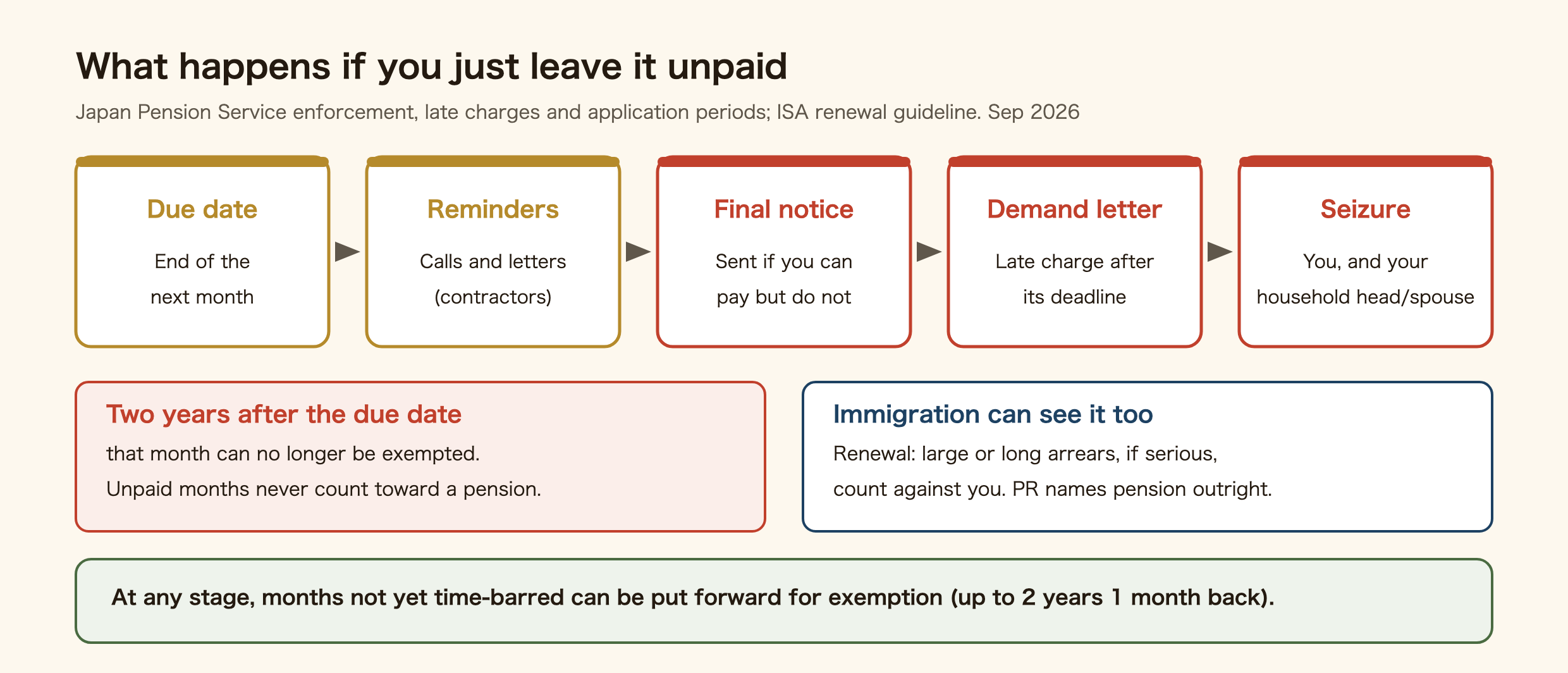
First come reminder calls and letters; the Japan Pension Service uses private contractors for these. If you can pay but keep not paying, a final notice arrives, and then a formal demand letter.
If the demand letter’s deadline passes, your assets can be seized. It is not only you. By law, the household head and your spouse are jointly liable for your premiums, so they receive demand letters too and their assets can be seized as well.
Paying after the demand letter’s deadline adds a late charge, counted from the day after the original due date. For 2026 the rate is 2.8% a year for the first three months and 9.1% after that. In the Japan Pension Service’s own example, April 2026’s premium paid on 1 October carries a 250 yen charge.
The heavier cost is not money. If an illness or accident leaves you disabled and there are unpaid months in the year up to two months before your first doctor’s visit, you may not get the disability basic pension. Applying for an exemption after the accident does not fix that.
Does unpaid pension affect a visa renewal or permanent residence?
It can. The Immigration Services Agency’s guideline for changes of status and renewals (revised June 2026) says that large or long-running arrears of payments required by law, “such as National Health Insurance premiums”, are treated as a negative factor where they are serious. The same revision added a note that Immigration may decide using payment information it receives from other agencies.
The permanent residence guideline is more direct. It lists “payment of public pension and public medical insurance premiums” among the public duties, and says that paying late, even if everything is paid by the time you apply, is in principle viewed negatively. A Japan Pension Service leaflet for foreign residents also warns that skipping the procedure can affect status renewals.
Is an exemption safe, then? No Immigration document says “an exemption is fine”. What is certain is that the pension record treats exempted and deferred months as a separate category from unpaid ones. For the permanent residence revocation system starting in April 2027, the draft guideline lists being on instalments or a deferral as a case that does not qualify. Public comment closed on 4 September, and as of 23 September no final version had been published (when permanent residency can be revoked).
The downside of an exemption: a smaller pension and refund
An exemption beats unpaid, but it is not the same as paying. Forty years fully paid gives an old-age basic pension of 847,300 yen a year; forty years fully exempted gives 423,650 yen (FY2026 guide figures).
You can close the gap with catch-up payments (tsuino). Exempted or deferred months can be paid within ten years. One year of catch-up raises the future pension by about 10,000 yen a year for fully exempted months, or about 20,000 yen for deferred months. From the third fiscal year after approval, a surcharge is added.
If you may leave Japan, look at the lump-sum withdrawal payment as well. It counts paid months and partially exempted months only (a one-quarter exemption counts as three-quarters of a month, half as a half, three-quarters as a quarter). Fully exempted and deferred months are not counted at all, and neither are unpaid ones.
If your last premium was paid in FY2026, the refund is 53,760 yen for every six months, up to 537,600 yen for 60 months. You need at least six countable months and must claim within two years of no longer having an address in Japan.
Which one are you?
- You left your job and have nothing lined up — switch to the National Pension at the city office within 14 days of the day after your last day, and apply for the unemployment exemption at the same counter. Today: make a copy of your separation notice.
- Your income is low and 17,920 yen a month is too much — check last year’s income on your withholding slip or resident-tax notice and see which line you fall under. If you never declared it, start with the resident-tax declaration. Today: pick up the form at the city office’s pension counter, or open Mynaportal.
- You already have unpaid months — anything within two years and one month can still be put forward for exemption. If a demand letter has arrived, contact the pension office before its deadline. Today: call 0570-003-004 and ask which months are unpaid.
- You expect to go home within a few years — months you pay, or partially pay under a partial exemption, count toward the lump-sum refund; fully exempted and deferred months do not. Today: write down your planned leaving date and how many months you have paid.
FAQ
Q. Do foreigners have to pay the National Pension in Japan?
Yes. Everyone living in Japan aged 20 to 59 is covered regardless of nationality. If you are not in a company’s Employees’ Pension, you pay 17,920 yen a month yourself in FY2026. If you cannot, you can apply for an exemption or a deferral.
Q. What income do I need to be under for a National Pension exemption?
It depends on last year’s income of you, your spouse and your household head. For a full exemption the line is (dependants + 1) × 350,000 yen + 320,000 yen, which is 670,000 yen of income for a single person with no dependants. The three-quarters, half and one-quarter lines are 880,000, 1.28 million and 1.68 million yen plus deductions.
Q. Can I get a National Pension exemption after losing my job?
Yes, there is a special exemption that ignores last year’s income. Apply with a copy of your separation notice or your Hello Work eligibility card. A spouse or household head must also meet the income line or the same special rule, and you need to reapply each year.
Q. How far back can I apply for a National Pension exemption?
Up to two years and one month before the day you apply. Months more than two years past their due date are time-barred. You can apply at the city office, a pension office, by post or through Mynaportal.
Q. Will unpaid National Pension affect my visa renewal?
It can. Immigration’s renewal guideline treats serious, large or long-running arrears of legally required payments as a negative factor, and the permanent residence guideline names public pension premiums as a public duty that must be met on time.
Q. Does an exemption reduce my lump-sum withdrawal payment?
Yes. Only paid months and partially exempted months count; fully exempted and deferred months do not. If you make catch-up payments within ten years, those months count as paid.
Summary
If you live in Japan, are between 20 and 59 and are not in a company’s Employees’ Pension, you pay the National Pension yourself: 17,920 yen a month in FY2026. If you cannot, apply for one of the four exemption levels or the deferral based on last year’s income — or, if you lost your job, the unemployment exemption. You can go back two years and one month.
The one thing to avoid is doing nothing. Unpaid months bring demand letters and late charges, seizure that can reach your spouse and household head, the risk of losing a disability pension, and a record Immigration can look at. An exemption costs you part of your pension and refund, but leaving it unpaid costs more, and that cost cannot be undone later.
Official sources: Japan Pension Service, exemption and deferral of National Pension premiums (Japanese) / JPS, periods you can apply for (Japanese) / JPS, entering Japan (English) / JPS, enforced collection (Japanese) / JPS, late charges (Japanese) / JPS, lump-sum withdrawal payment (Japanese) / JPS, consultations in multiple languages / Immigration Services Agency, guideline on change of status and renewal (Japanese) / ISA, permanent residence guideline (Japanese). Checked on 23 September 2026. Confirm with your city office or pension office before you apply.
Related reading
Found this useful? Share it
Send it to a friend who lives in Japan.
WHO WROTE THIS

mori
Japanese. I read the ministries’ own notices, orders and Q&As in the original, and I start from what my Nepalese and Sri Lankan friends in Japan actually ran into. I do not write about what I have not checked or been told.
What this site can and cannot do →Looking for something else?