This article was checked on 13 October 2026 against pages from the Japan Meteorological Agency (JMA), the Cabinet Office and the Prime Minister’s Office. JMA changed the names of its warnings on 29 May 2026, so older English guides may not match.
The rain starts on a Friday evening. Your phone buzzes with a message in Japanese you cannot read. The news shows a map with a purple area and the words 避難指示. Your flatmate says “it’s fine, it’s just a typhoon”.
This article gives you the one table you need for that moment.
The short answer
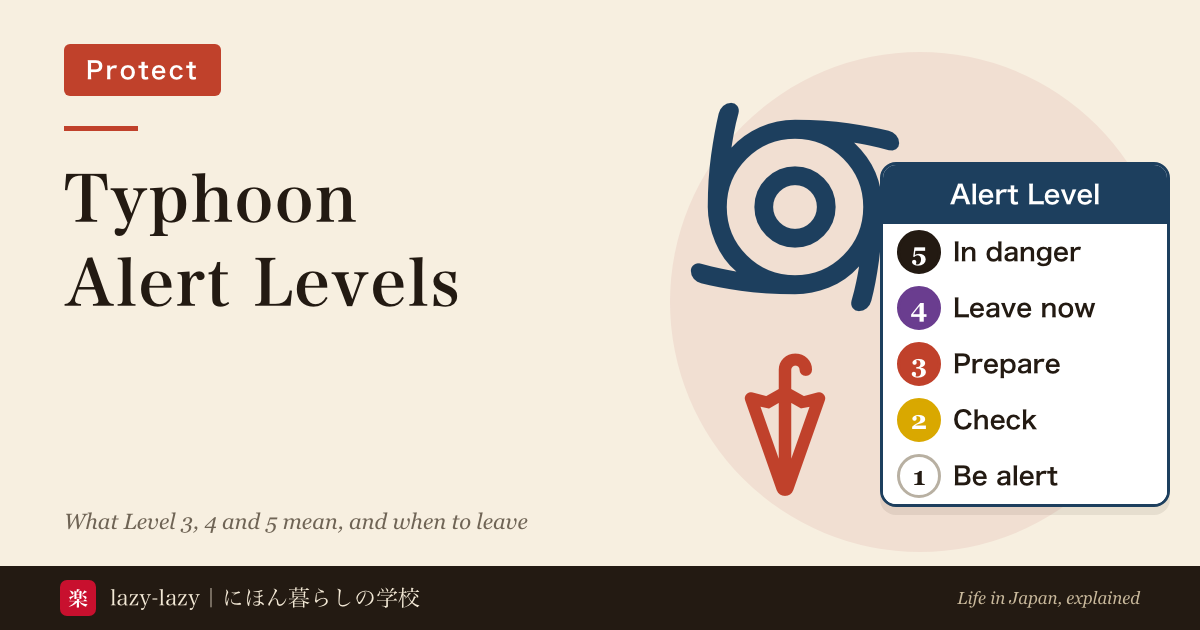
- Japan uses five Alert Levels, and Level 4 (避難指示, Evacuation Instruction) means everyone in the danger area leaves. Do not wait for Level 5.
- Level 5 means the disaster has probably already happened. It is not always issued.
- JMA warnings usually come before the city order. You can decide for yourself from Level 3.
- Since 29 May 2026, JMA warnings carry the level number in their names, such as Level 4 Urgent Warning (Landslide). Most English guides still use the old names.
- Install one multilingual app before the season: Safety tips (15 languages) or NHK WORLD-JAPAN (11 languages).
Once you see this, you can read a Japanese weather screen and know in a few seconds whether to stay, prepare or leave. The order is: learn the five rows, pick your tool, then check your own home on the hazard map.
What are Alert Levels 1 to 5 in Japan?
The Alert Levels are a five-step scale that links what the weather agency says with what the city tells you to do. A bigger number means more danger and less time. The table gives the city order, the new JMA name, the colour on the live risk map and what you do.
| Level | City order (Japanese / English poster) | JMA warning, from 29 May 2026 | Kikikuru colour | What you do |
|---|---|---|---|---|
| 5 | 緊急安全確保 / Emergency Safety Measures | Level 5 Emergency Warning (レベル5特別警報) | Black: 災害切迫 / Emergency | The disaster has probably already happened. Protect your life where you are, right now. This level is not always issued, so never wait for it. |
| 4 | 避難指示 / Evacuation Instruction | Level 4 Urgent Warning (レベル4危険警報) | Purple: 危険 / High Risk | Everyone in the danger area leaves. Go to a shelter, or to a sturdy building nearby. |
| 3 | 高齢者等避難 / Evacuation of the Elderly, Etc. | Level 3 Warning (レベル3警報) | Red: 警戒 / Warning | People who need time to move (the elderly, people with disabilities, young children and their carers) leave. Everyone else stops normal activity and gets ready. |
| 2 | (no city order) | Level 2 Advisory (注意報) | Yellow: 注意 / Advisory | Check the hazard map, your shelter and the route to it. |
| 1 | (no city order) | Early Advisory (早期注意情報) | White | Raise your guard. Watch the latest information. |
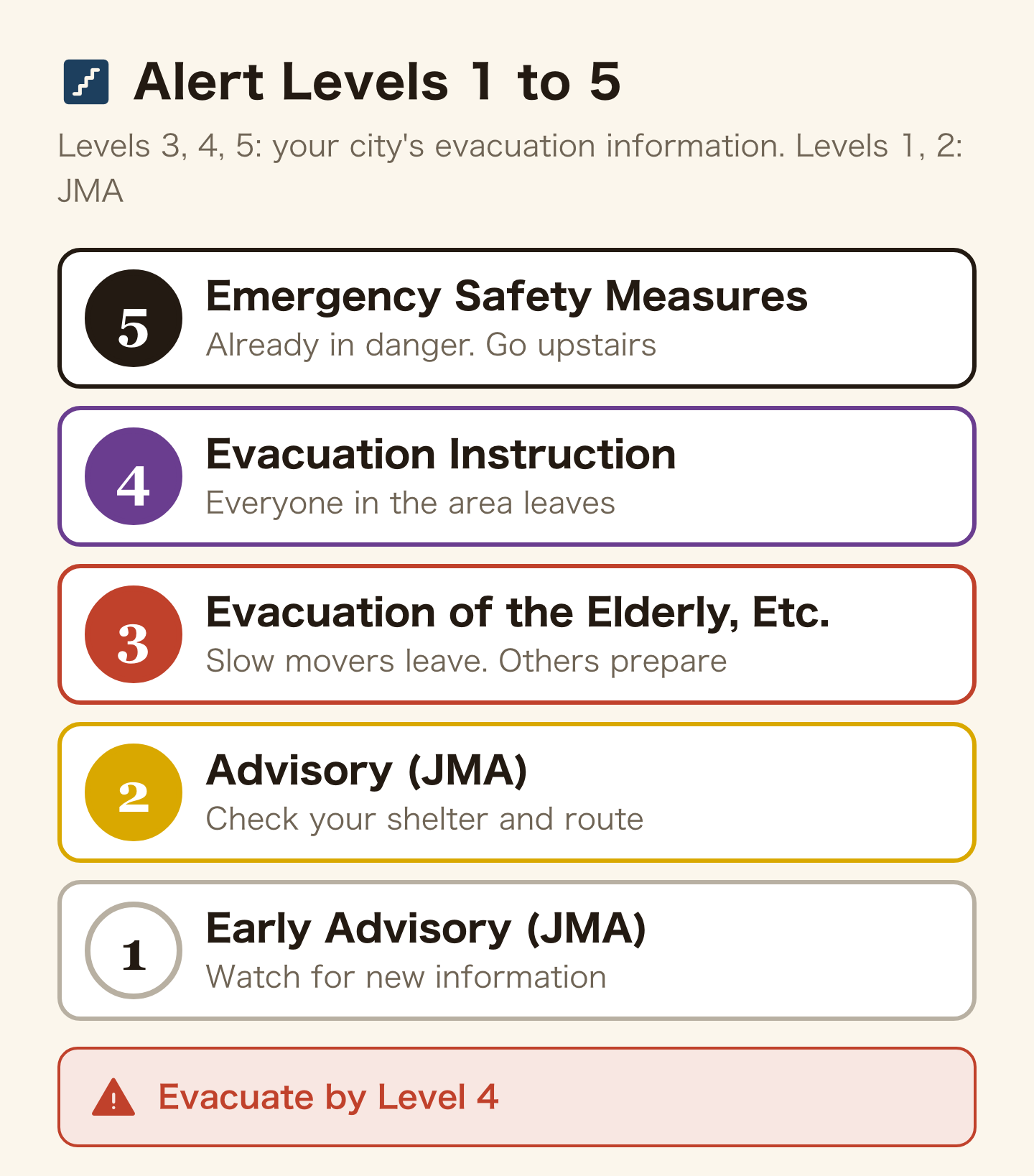
The English words in the second column come from the Cabinet Office poster. The poster was translated with the Nagasaki International Student Support Centre, so the wording is aimed at people like you.
When should I leave: at Level 3, 4 or 5?
Leave by Level 4 at the latest. In some countries people wait for a final order before they move. In Japan, Level 5 is not a step you wait for, because by then the disaster has probably already happened.
Three facts make this easier to act on.
- JMA information usually comes before the city order. At the Level 3 or Level 4 stage of the JMA warnings, you can decide for yourself.
- The levels do not always come in order. A warning can jump from Level 2 to Level 4.
- You do not have to go to the designated shelter. A sturdy building nearby, on an upper floor, is also acceptable.
The difference between a shelter and an evacuation site, and how to find yours on the hazard map, is explained in our earthquake preparedness guide. The map for floods and landslides is a different map from the one for earthquakes, so check both.
What changed in the names on 29 May 2026?
JMA now puts the level number inside the name of each warning. There are four hazards: heavy rain, flood, landslide and storm surge. The English pattern is “Level N Emergency Warning / Urgent Warning / Warning / Advisory (hazard)”.
| Old name (most guides still use it) | New name (since 29 May 2026) |
|---|---|
| 大雨特別警報 | Level 5 Emergency Warning (Heavy rain) |
| 土砂災害警戒情報 | Level 4 Urgent Warning (Landslide) |
| 氾濫危険情報 | Level 4 Urgent Warning (Flood), 氾濫危険警報 |
| 洪水警報 | No longer operated. It is folded into heavy rain, with a new Level 4 Urgent Warning (Heavy rain). |
| (did not exist) | Level 5 Emergency Warning (Flood) |
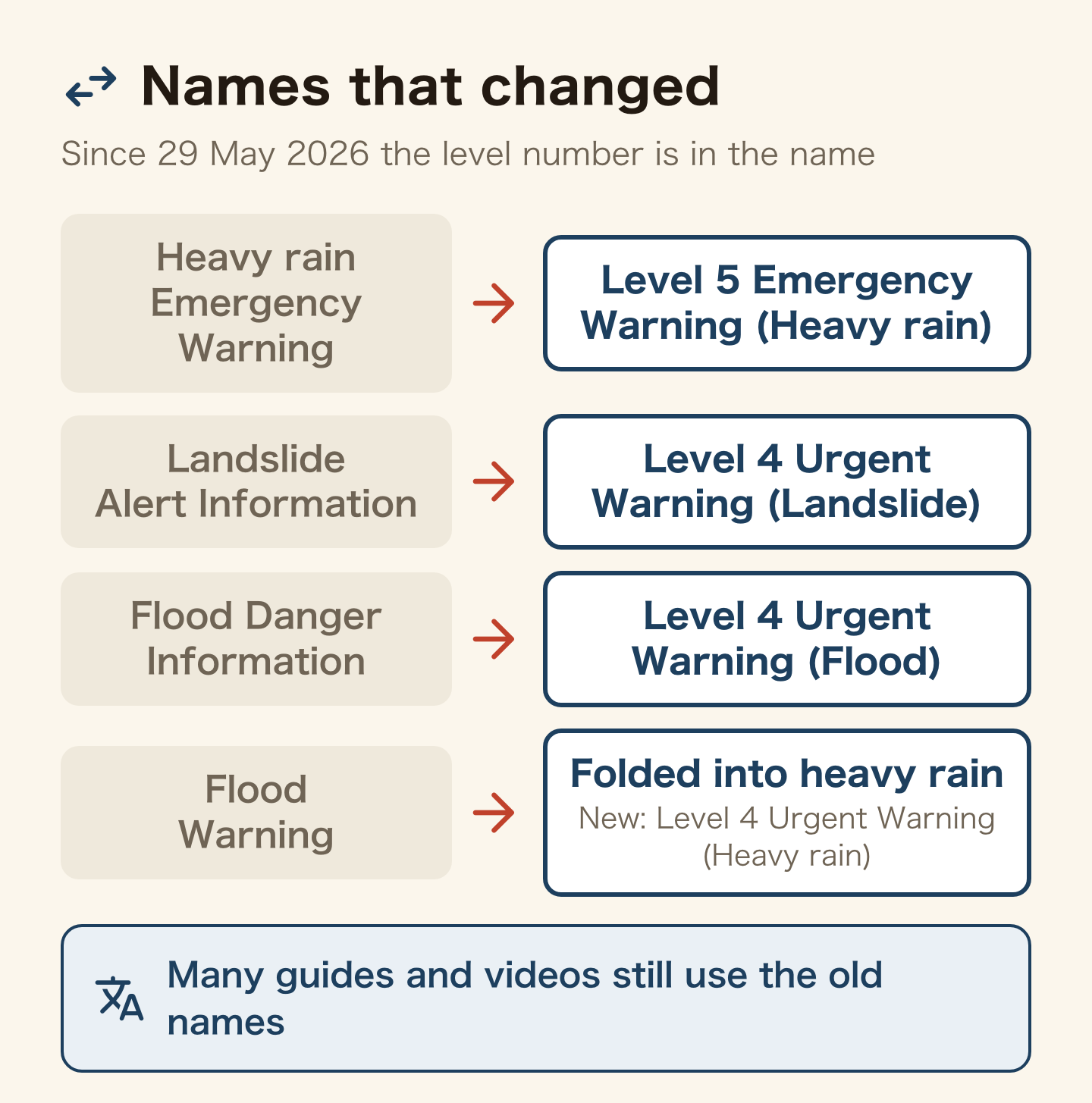
Other warnings, such as wind, waves and snow, are not part of the Alert Levels. Their English names have not changed. For example, the high-waves warning is still “High waves Emergency Warning” at the top level.
How strong is strong? Wind, rain and typhoon size in numbers
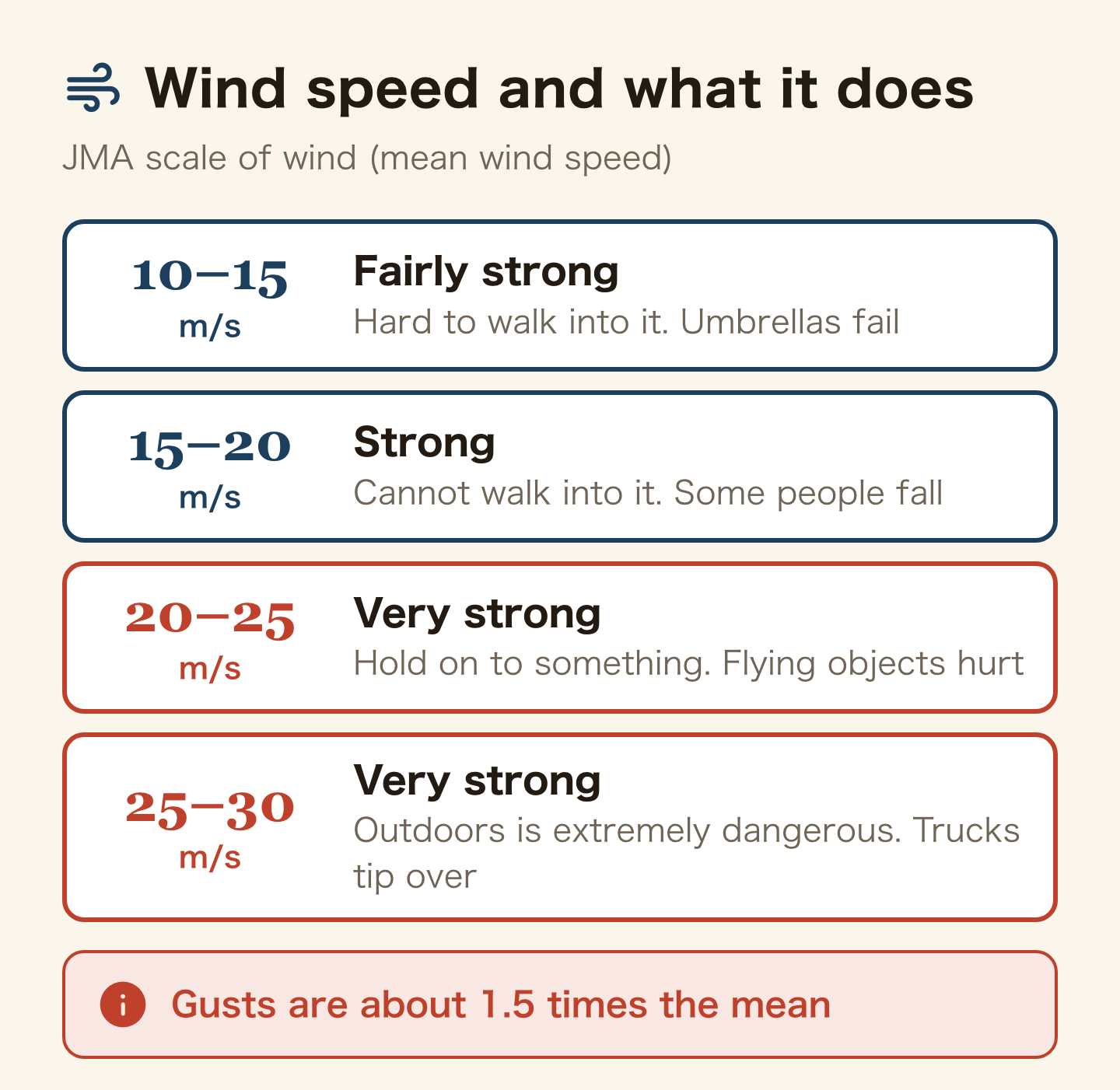
Words like “very strong” are defined by numbers. The wind table uses the 10-minute average wind. Gusts are about 1.5 times stronger, and can reach 3 times or more when the air is unstable. Wind at your street can also differ from the wind at the weather station.
| Wind (10-minute average) | JMA term | What it does to you |
|---|---|---|
| 10 to under 15 m/s | やや強い風 | Hard to walk against the wind. Umbrellas stop working. |
| 15 to under 20 m/s | 強い風 | You cannot walk against the wind. Some people fall. |
| 20 to under 25 m/s | 非常に強い風 | Hold on to something. Flying objects injure people. |
| 25 to under 30 m/s | 非常に強い風 | Being outdoors is extremely dangerous. Trucks overturn. |
| 30 m/s and over | 猛烈な風 | Worse than the row above. |
| Rain (mm per hour) | JMA term | What it feels like |
|---|---|---|
| 20 to under 30 | 強い雨 | Pouring. You get wet even with an umbrella. |
| 30 to under 50 | 激しい雨 | Roads look like rivers. Cars can hydroplane. |
| 50 to under 80 | 非常に激しい雨 | Like a waterfall. Umbrellas are useless, visibility is poor, driving is dangerous. |
| 80 and over | 猛烈な雨 | Oppressive and frightening. |
JMA also names typhoons by strength and size. These are my translations, because I could not confirm an official English wording.
- Strength: 強い (strong) 33 to under 44 m/s; 非常に強い (very strong) 44 to under 54; 猛烈な (violent) 54 and over.
- Size: 大型 (large) means the area with winds of 15 m/s or more has a radius of 500 to under 800 km; 超大型 (very large) is 800 km or more.
- If the radius is under 500 km, the size is not stated. If the maximum wind is under 33 m/s, the strength is not stated.
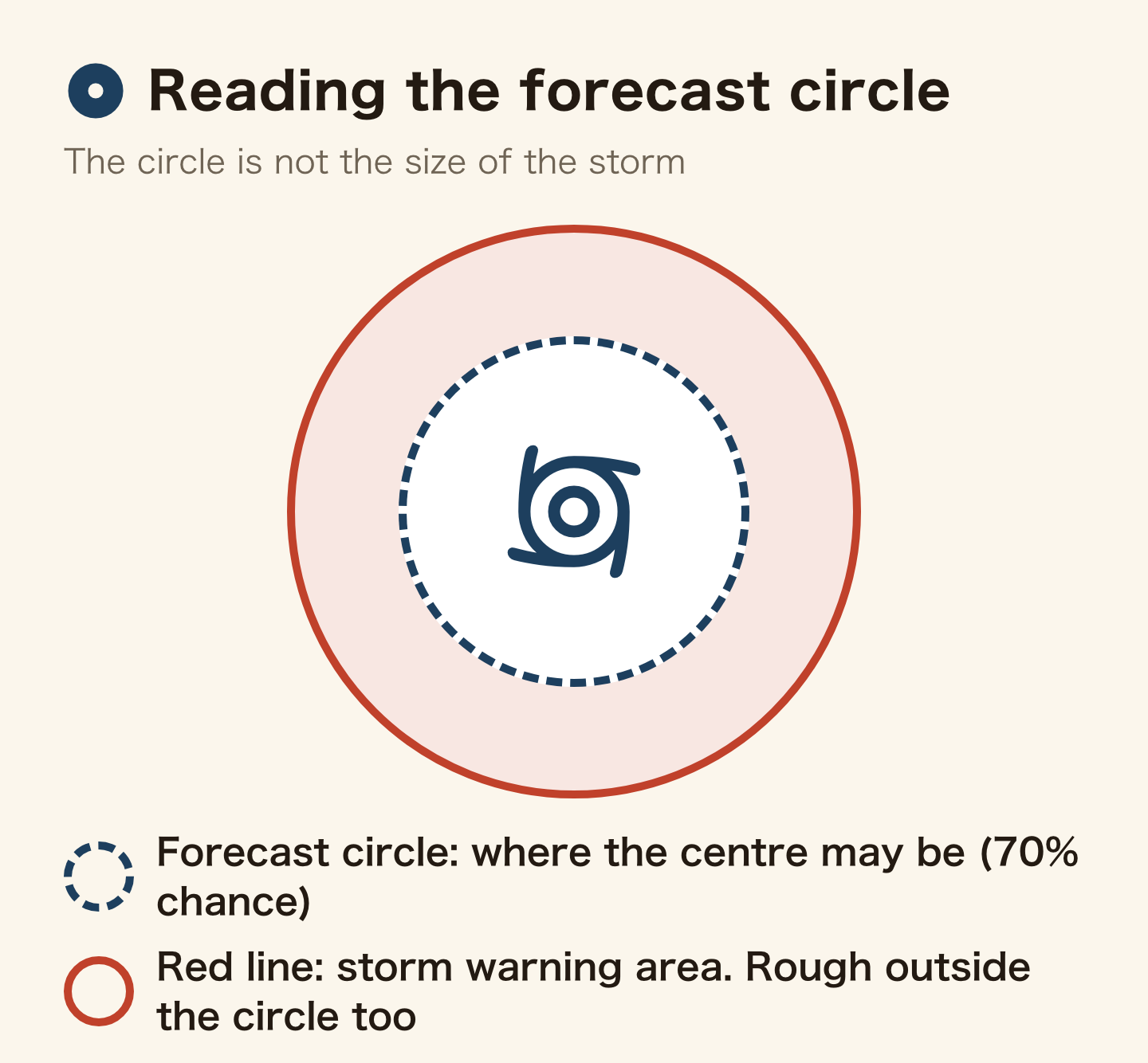
On the forecast map, the circle (予報円) shows where the centre of the typhoon may be, with 70% probability. It is not the size of the storm. The red line outside the circle is the area where violent wind is likely (暴風警戒域). JMA announces the actual position every 3 hours.
Typhoons are most frequent from July to October. In the 1991 to 2020 average, about 25 typhoons form each year, about 12 come within 300 km of Japan, and about 3 make landfall. Heavy rain also causes landslides, which account for a large share of natural-disaster deaths other than earthquakes and tsunami.
What should I do before the typhoon arrives?
Do these while the sky is still calm. The list follows the Prime Minister’s Office guidance.
- Check your emergency bag and the route to your shelter.
- Reinforce the house: secure or bring in things from the balcony.
- Check the hazard map for flood and landslide risk at your address.
- When you leave, put out any fire, carry minimal luggage on your back and keep both hands free.
- Never go back for something you forgot.
- Avoid underpasses and flooded roads. Do not go to look at rivers or rice fields.
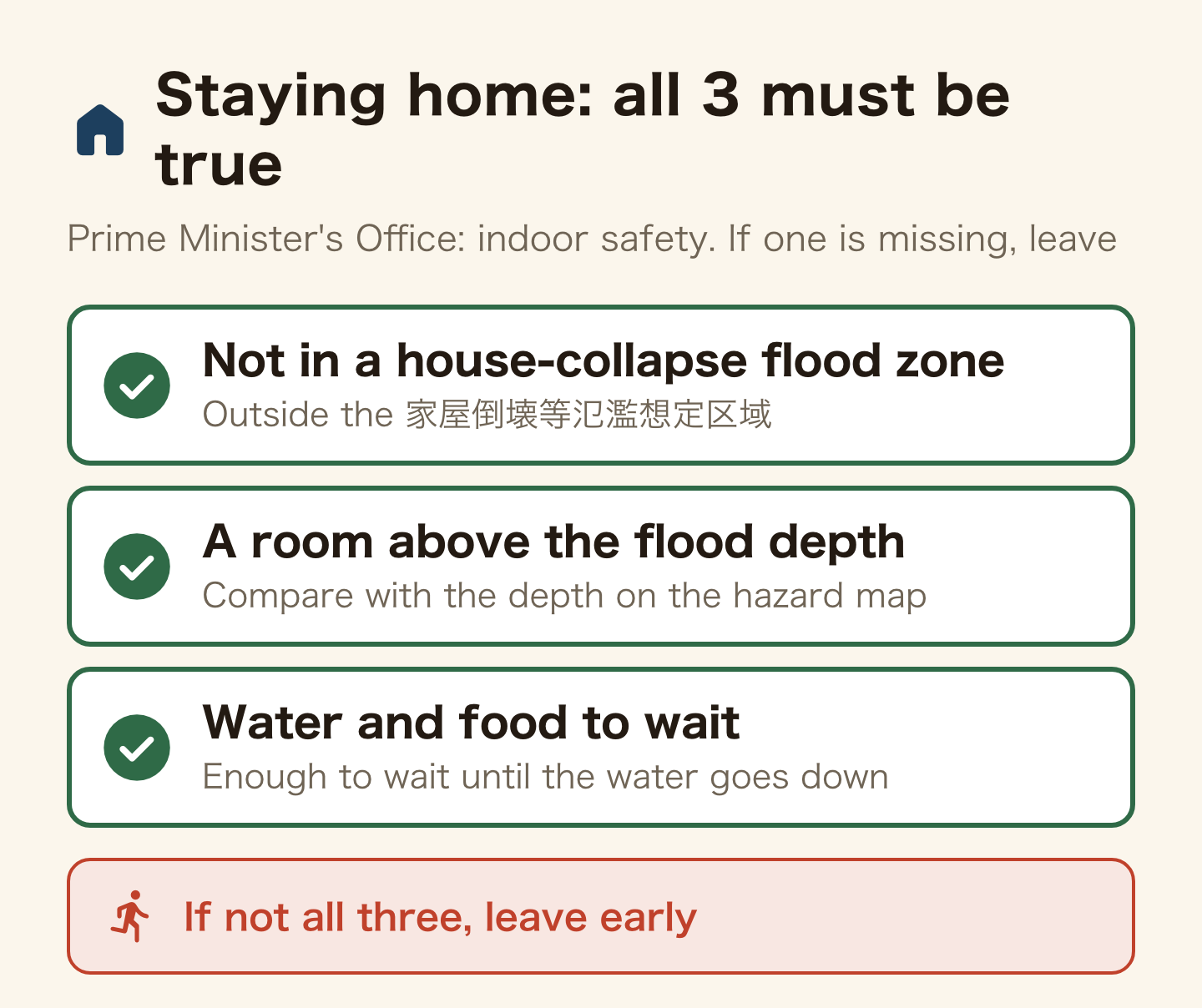
Staying at home is possible, but only if all three of these are true. The official name is 屋内安全確保.
- Your home is outside a house-collapse flood zone (家屋倒壊等氾濫想定区域).
- You have a room above the expected flood depth.
- You have water and food to wait with.
Flood damage to your belongings is a question for your own renters policy. Our guide to renters insurance renewal fees shows where to look. If you are still choosing a flat, check the hazard map before you sign.
Where can I get alerts in my language?
City information arrives by emergency area mail on your phone, by the city loudspeakers (防災行政無線) and by public-address cars. These are in Japanese. Whether your city adds other languages is not the same everywhere, so ask your city office.
| Tool | What it gives you | Languages |
|---|---|---|
| JMA multilingual pages | Official explanations of warnings, typhoons and rain | 15, including Japanese and Nepali |
| Safety tips (JNTO app) | Pushes earthquake early warnings, tsunami and weather warnings; has an evacuation flowchart and phrases | 15 |
| NHK WORLD-JAPAN app | Notifications for earthquakes, tsunami and weather emergency warnings | 11 |
| Cabinet Office evacuation-information poster | Explains Levels 1 to 5 in one page | 14, including English and Nepali |
| Kikikuru (JMA Risk Maps) | Colour map of landslide, flood and river risk, updated live | English screen available |
JMA lists its pages in 15 languages including Nepali. I found no tool that supports Sinhala, so I do not claim it. If your language is missing, the poster and the leaflets are the next best step.
A glossary for the words that appear on the screen.
| Japanese | Reading | Meaning |
|---|---|---|
| 避難指示 | hinan shiji | Evacuation Instruction (Level 4) |
| 警報 / 注意報 | keihō / chūihō | Warning / Advisory |
| 特別警報 | tokubetsu keihō | Emergency Warning |
| 大雨 / 暴風 | ōame / bōfū | Heavy rain / Violent wind |
| 土砂災害 | doshasaigai | Landslide |
| 高潮 | takashio | Storm surge |
| 氾濫 | hanran | River flooding |
| 浸水 | shinsui | Water getting into buildings |
| 線状降水帯 | senjō kōsuitai | Line-shaped band of heavy rain |
Which one are you?
- You live in a flat near a river, or on a slope. Open Kikikuru today and look at your address. Decide your route at Level 3, not at Level 4.
- You live on an upper floor away from rivers. Check the three staying-home conditions above. Keep water and food for several days.
- You are alone and do not read Japanese. Install Safety tips or the NHK WORLD-JAPAN app now. Tell one neighbour or friend your plan.
- Someone is hurt. The evacuation decision is not a 119 matter. For an injury, see how to call an ambulance in Japan.
FAQ
Q. What does Level 4 mean in Japan?
Level 4 is the city order 避難指示 (Evacuation Instruction). Everyone in the danger area is expected to leave. Leave by Level 4 at the latest.
Q. Do I have to wait for the city to order evacuation?
No. JMA warnings usually come before the city order. If you see a Level 3 or Level 4 warning, you can decide for yourself using Kikikuru and the river levels.
Q. Do I have to go to the designated shelter?
No. A sturdy building nearby, on an upper floor, is also acceptable. Check the route in daylight beforehand.
Q. When can I stay at home?
Only if you are outside a house-collapse flood zone, your room is above the expected flood depth, and you have water and food to wait. This is called 屋内安全確保.
Q. Are the warning names different this year?
Yes. Since 29 May 2026, JMA warnings carry the level number, such as Level 4 Urgent Warning (Landslide).
Q. Which app is best for typhoon alerts in English?
Safety tips from JNTO covers 15 languages and pushes weather warnings. The NHK WORLD-JAPAN app covers 11 languages. Install one before the season.
Summary
Japan uses five Alert Levels. Level 4, Evacuation Instruction, means everyone in the danger area leaves. Level 5 is too late to wait for. JMA warnings now carry the level number, and they usually arrive before the city order. Install one multilingual app, check your address on the hazard map, and decide your route before the rain starts.
Sources (official): JMA, New disaster-prevention weather information (from 29 May 2026) / JMA, Alert Levels / JMA, Risk Maps / JMA, multilingual pages / JMA, typhoon strength and size / JMA, typhoon forecast map / JMA, wind scale / JMA, rain scale / Cabinet Office, evacuation-information guideline and poster / Prime Minister’s Office, evacuation / Prime Minister’s Office, typhoons and heavy rain / JNTO, Safety tips / NHK WORLD-JAPAN app. Checked on 13 October 2026.
Read next
Found this useful? Share it
Send it to a friend who lives in Japan.
WHO WROTE THIS

mori
Japanese. I read the ministries’ own notices, orders and Q&As in the original, and I start from what my Nepalese and Sri Lankan friends in Japan actually ran into. I do not write about what I have not checked or been told.
What this site can and cannot do →Looking for something else?
You may use the figures in this article, including commercially, if you credit this site with a link. How to use our figures