English

English

Japan Tax on Foreign Income 2026: Non-Permanent Resident 5-Year Rule

A non-permanent resident is a non-Japanese person with 5 years or less in Japan in total over the past 10 years. Interest and dividends from home are taxed in Japan only on the part paid in or sent to Japan, and money sent counts as that year's foreign income first: send 500,000 yen in a year with 100,000 yen of interest and 100,000 yen is taxable. Gains on foreign shares bought while non-permanent are taxed anyway. After 5 years, worldwide income is taxed. Also: the 200,000 yen filing line and bank reports on transfers over 1 million yen. Checked October 2026.
English

Japan DC Pension Plan After You Quit or Leave Japan 2026: 6 Months

A corporate DC plan does not become cash when you quit. Within six months from the month after you lose membership, move it to a new DC plan or iDeCo, or claim the lump sum. Left alone it is auto-transferred: no investing, 4,348 yen plus 98 yen a month. Foreigners going home with 5 years or less, or 250,000 yen or less, can withdraw it from abroad. Checked October 2026.
English

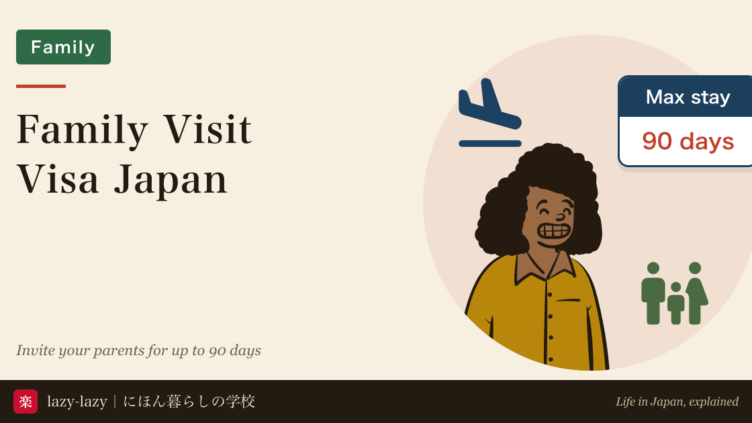
Family Visit Visa Japan 2026: Requirements, Invitation Letter, 90 Days

Parents and relatives visit Japan on a short-term stay: no paid work, 90, 30 or 15 days. Visa-exempt nationalities (74 countries and regions) need no visa; others apply at the Japanese embassy at home (about 15,000 yen for a single entry). You write the invitation letter and itinerary, plus a letter of guarantee, income proof and juminhyo if you pay. Extensions only for reasons like medical treatment, and no National Health Insurance. Checked October 2026.
English

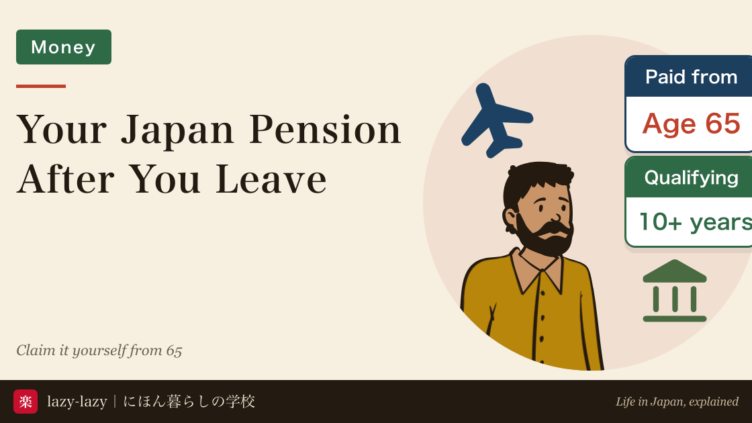
Japan Pension After Leaving Japan 2026: 10 Years, Then Claim From 65

With 10 years, your Japanese pension can be paid in your home country. No claim form is sent abroad: from the day before you turn 65, send Form 101 yourself. A foreign bank works with its SWIFT code. File a status report every birth month. If your country's tax treaty covers pensions, a form waives Japan's 20.42% tax. Checked October 2026.
English

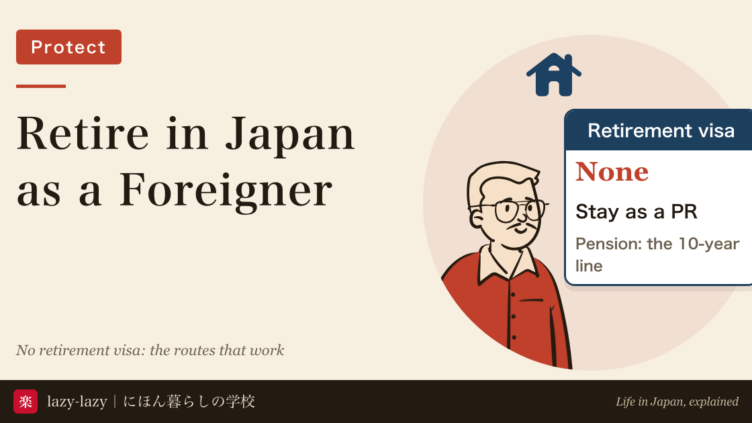
Retire in Japan as a Foreigner 2026: No Retirement Visa, 3 Routes

Japan has no retirement visa. Permanent residents, spouses and long-term residents can stay after work. Long Stay needs 30M yen and lasts one year. Checked October 2026.
English

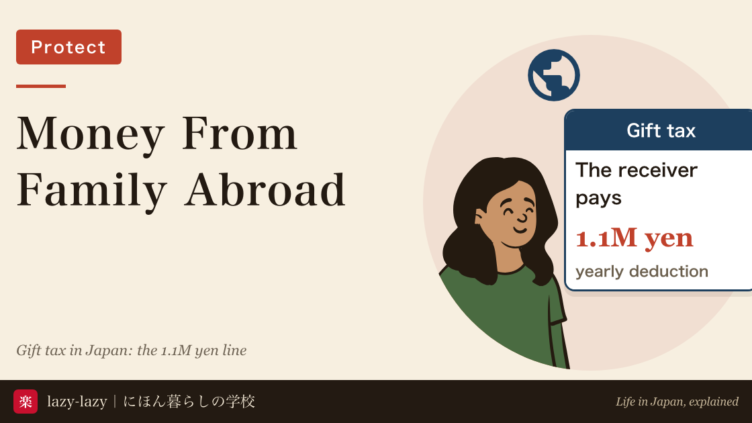
Money From Parents Abroad: Gift Tax in Japan, the ¥1.1M Line

Gift tax on money from your parents abroad: the receiver pays, 1,100,000 yen a year is deducted, and living and tuition money is exempt. Checked October 2026.
English

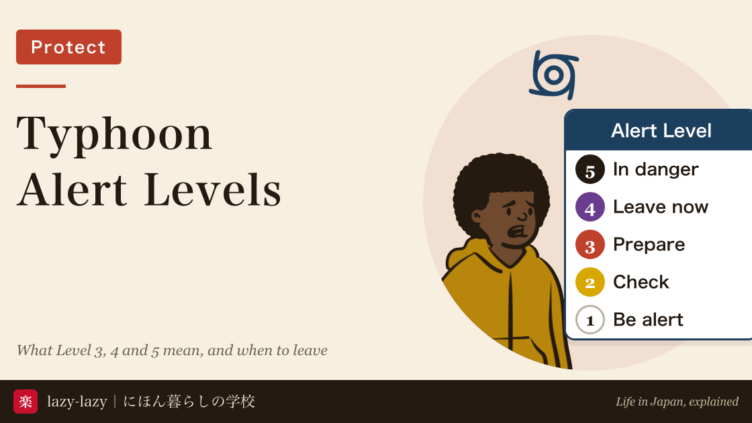
Typhoon Alert Levels in Japan 2026: What Level 4 Means, When to Leave

Japan's typhoon and heavy-rain Alert Levels 1 to 5 for foreign residents. Level 4 (Evacuation Instruction) means everyone in the danger area leaves; do not wait for Level 5. JMA put level numbers into its warning names on 29 May 2026. Tables for wind and rain numbers, the forecast circle, the three conditions for staying home, and apps in 11 to 15 languages. Checked against official pages in October 2026.
Earn

The Four Quadrants in Japan 2026: Your Visa Limits Which You Can Pick

The four quadrants are Kiyosaki's way of sorting how money comes in, not evidence about Japan. In Japan your residence status sets your activities first. This guide does not claim which status allows which type; it shows the order for checking the scope of your permission.
English

The Richest Man in Babylon, 7 Lessons for Japan 2026 (5 Skills)

The Richest Man in Babylon is a parable set in ancient Babylon, not evidence about Japan. Its seven lessons map onto Save, Grow, Protect and Earn. Book claims and official Japanese facts are kept apart, with an article to read for each lesson.
English

Interview Questions in Japan 2026: 3 Common Ones, 14 Sensitive Items

Write each ES answer as conclusion, specifics, then how it helps at work, filling 90 to 100% of the limit (JASSO). Interviews run two or more times; students are often asked why they came to Japan, how long they want to work and what other selections they have. Residence status is not among the 14 items.
English

Jobs Foreigners Do in Japan 2026: 2.57M Workers by Visa and Industry

Of 2,571,037 foreign workers in Japan, manufacturing is the largest industry at 24.7%, then other services 15.2%, wholesale and retail 13.3% and hotels and restaurants 12.4% (MHLW, end of October 2025). The order differs by visa: interns in manufacturing 44.5% and construction 24.0%, Specified Skilled Workers in manufacturing 35.0%, students in hotels and restaurants 34.8%, Engineer/Specialist holders spread out. Industry is the employer's business, not your job; the Specified Skilled Worker count can run low; 13.6% work in industries not listed; students are capped at 28 hours a week.
English

Buying a House in Japan as a Foreigner 2026: Mortgage, PR, 4 Taxes

Yes, foreigners can buy property in Japan (Civil Code, Article 3). Mortgages split on permanent residency: Flat 35, MUFG and Mizuho require PR. On top of the price come four taxes (registration, acquisition, stamp duty, fixed asset tax), and the agent's fee is capped at 1,056,000 yen on a home priced at 30 million yen before tax. The mortgage tax credit has no nationality rule, but a 2026 new build gets nothing below the energy standard. Plus the 5 October 2026 nationality rule for registration, the 2 October proposal, and keep, sell or let if you leave.
English

Long-Term Care Insurance Japan 2026: Foreigners Pay From 40, No Refund

Long-term care insurance (kaigo hoken) is the premium everyone aged 40-64 in Japan pays with their health insurance, foreigners included, if they have a resident record and employee or National Health Insurance. It starts with the month of the day before your 40th birthday. Kyokai Kenpo's rate is 1.62% from March 2026, split with your employer: 1,944 yen a month on 240,000 yen in Tokyo. On National Health Insurance your city adds a care part (Shinjuku: 17,800 yen + 2.43%). Before 65 it covers only 16 specified diseases, and premiums are not refunded when you leave Japan.
English

Life Insurance for Foreigners in Japan 2026: 3 Public Benefits First

Whether a foreigner in Japan needs life insurance depends on whether anyone here lives on your income. Count three public benefits first: medical bills are capped each month (92,940 yen on a 1,000,000 yen bill for income of about 3.7-7.7 million yen); employee health insurance pays sick pay of two-thirds of daily pay from day 4 for up to 1 year 6 months, but National Health Insurance may not; and a spouse with a child gets a survivors' pension of 847,300 yen a year plus a child addition. Plus insurers' published conditions for foreigners, and what to do when you leave.
English

Injury and Sickness Allowance Japan 2026: Get 2/3 of Pay From Day 4

Japan's injury and sickness allowance pays people in employee health insurance who cannot work because of an illness or injury outside work. There is no nationality condition. After 3 days off in a row, from day 4 it pays two-thirds of your 12-month average standard monthly pay divided by 30, for up to 1 year 6 months (3,780 yen a day on a 170,000 yen average). National Health Insurance pays it only if your city does. Plus eligibility after leaving a job (a year of cover, no work on your last day), payment within 10 working days, unemployment benefit, and what to check before leaving Japan.
English

Should Foreigners Invest in Japan? 2026: 5 Reasons Savings Shrink

Yes, foreigners can invest in Japan, and the reason to care is simple: prices rose 1.9% in August 2026 while ordinary savings paid 0.322% (Bank of Japan, September). Real wages fell four years running (2022-2025), the employees' pension takes 18.3% split with your employer, the lump-sum refund stops at 60 months, and the pension replacement rate is projected to fall from 61.2%. What differs for foreigners, and how the years until you leave decide your first step.
English

What Changed in Japan on 1 October 2026: Visa Fee Increase and 4 More

Five changes on 1 October 2026 matter to foreigners in Japan. Renewal and change-of-status fees now depend on the period granted, 10,000 to 75,000 yen at the counter; permanent residence is 200,000 yen, and applications accepted by 30 September pay the old fee. The minimum wage rose in 15 prefectures, Tokyo to 1,280 yen. The 88,000-yen social insurance test is gone, students still excluded. A National Pension childcare exemption and a customer harassment duty for employers also began.
English

How to Pay in Japan Without a Credit Card 2026: Konbini, Debit, COD

You can run most of daily life in Japan without a credit card. ahamo and Rakuten Mobile take direct debit, and povo takes Paidy, payable by direct debit or at a konbini. UQ WiMAX and SoftBank Air take direct debit, with the router paid cash on delivery. Debit cards can be refused for phone bills and utilities. Amazon konbini payment is due by 23:59 three days after the number is issued, and the ETC Personal Card costs 1,257 yen a year. Fees and the five-year rule on unpaid bills included.
English

Gakkensai Student Insurance Japan 2026: Injuries and Bike Accidents

Gakkensai is accident insurance for university, junior college and kosen students in Japan: it pays for injuries in class, at school events and, with the rider, while commuting, for 1,000 yen a year or 3,300 yen for four. It does not cover illness or what you owe others. If your bike hurts someone on the way to class, the liability add-on (340 yen a year, up to 100 million yen) pays; on the way to work or the shops, you need 24-hour cover. Language and vocational schools cannot join.
English

Tenant Rights in Japan 2026: Who Pays If the AC or Water Heater Breaks

In a rented flat in Japan, the landlord must repair equipment that breaks from age, such as the AC or water heater (Civil Code Art. 606). You pay if you broke it or lost your key. Tell the management company first; for a leak, close the stop valve. If they won't fix it, you may repair it and claim the cost (Arts. 607-2, 608), and since April 2020 rent is reduced for what you can't use (Art. 611).
English

Cheap Furniture in Japan 2026: Second-Hand Appliances, Recycling Fees

Three cheap ways to furnish a flat in Japan: second-hand shops with an antique-dealer licence, your city's reuse furniture, and people giving things away. Sagamihara's reuse furniture costs 350, 650 or 1,300 yen by size (residents of junior-high age or older, one item a month, lottery). Check the PSE mark on used electronics. Fridges, washing machines, TVs and air conditioners cannot go out as oversized rubbish: you pay a recycling fee (Sharp example: fridge over 170 L 4,730 yen, washer 2,530 yen) plus a collection fee. Avoid unlicensed free-pickup trucks.
English

Passport Renewal or Lost Passport in Japan 2026: Your Residence Card

You renew your passport at your own country's embassy or consulate. A new passport does not change your residence card, which has no passport number, so there is nothing to tell Immigration unless your name, date of birth, sex or nationality changed (then within 14 days, no fee). Keep the old passport: carrying both covers any re-entry permit stamp. Lost it in Japan? File a report at a police box, then go to your embassy, and replace a lost residence card within 14 days.
English

Winter Electricity Bills in Japan 2026: How to Stay Warm and Pay Less

Winter electricity bills in Japan jump because heating raises your usage and, on stepped plans, each kWh costs more. On TEPCO's Meter-Rate Lighting B from November 2026, the first 120 kWh cost 29.85 yen and anything over 300 kWh 40.54 yen. The bill is basic charge + energy charge (with the fuel cost adjustment) + renewable surcharge of 4.18 yen/kWh; the average model comes to 9,561 yen for November. The government guideline is 20°C, and turning an air-con from 21°C to 20°C saves about 1,650 yen a year under set conditions. Turn kerosene heaters off before refuelling and ventilate. No bill discount had been announced for October onwards as of 30 September.
English

Halal Food in Japan 2026: Read Labels for Pork, Alcohol and Allergens

Japan has no central halal certification body, so you check food yourself. On packaged food, read 原材料名: pork appears as 豚肉, ポーク or 豚脂, alcohol as 酒精, 洋酒 or みりん. Only 9 allergens must be labelled; pork and gelatin are among the 20 recommended ones, so they can be present even when the allergen note is silent. Restaurants and in-store food carry no label, so ask with JNTO's bilingual sheet. For school lunch, religion or allergy, talk to the class teacher.
English

Contact Lenses in Japan 2026: Eye Exam at 30%, Prescriptions, Online

In Japan, contact lenses are highly controlled medical devices, and zero-power coloured lenses have been too since November 2009. The eye exam for contacts is covered by health insurance: about 1,030 to 1,480 yen at 30% at a new clinic, lenses extra. Shops, online included, must check you have seen a doctor, and "no prescription needed" selling is called improper. Plus the two-month import limit, symptoms that mean see a doctor now, and why glasses are not insured except treatment glasses for children under 9.
English

Japanese Wedding and Funeral Money 2026: Amounts, Envelopes, New Bills

No law sets wedding or funeral money in Japan. In surveys by the All Japan Kankonsosai Mutual Aid Association, the most common gift for a coworker's wedding reception was 30,000 yen (average 31,696, FY2023) and koden for a coworker's family funeral was 5,000 yen (average 5,336, FY2021). Avoid 4, 9 and even amounts; use crisp new notes for weddings but not for funerals. How to write the envelopes, hand them over, and post money by cash registered mail.
English

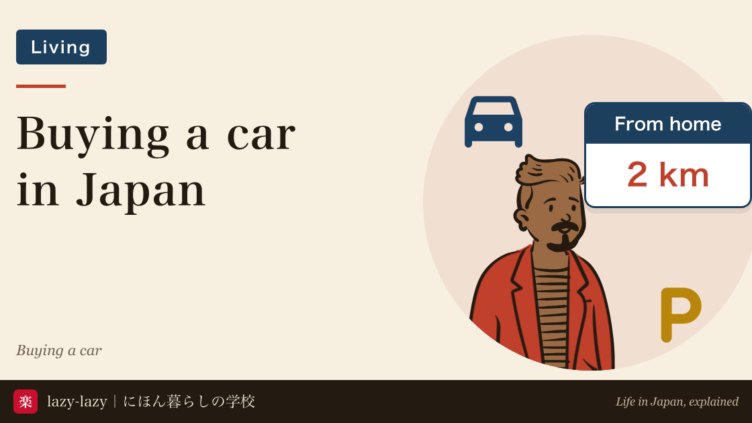
Buying a Car in Japan as a Foreigner 2026: Parking Certificate & Tax

Yes, a foreigner can buy a car in Japan. For a regular car, rent a parking space within 2 km of home, get the police parking certificate (2,400 yen and 3 to 7 days in Tokyo), and register with a seal certificate issued within 3 months; the residence card is used at city hall to register the seal. Jibaiseki covers only injury or death to others. Car tax goes to the 1 April owner in May, and shaken is due after 3 years, then every 2. Kei cars need no parking certificate and accept a juminhyo.
English

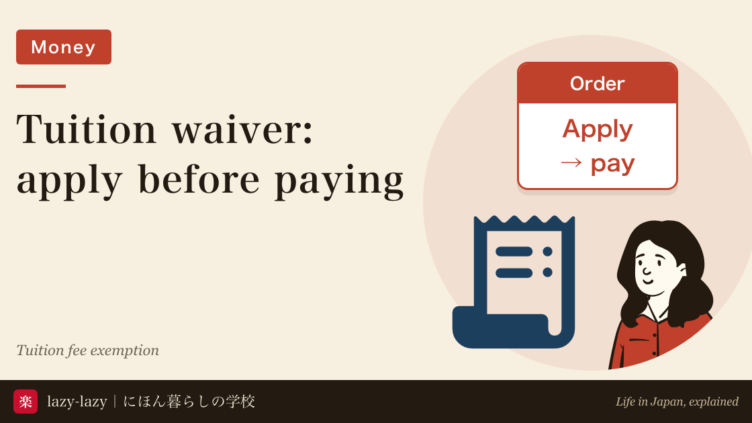
Tuition Fee Exemption in Japan 2026: Full or Half, Apply Before Paying

With Student status you cannot use Japan's national higher education support scheme, but schools run their own tuition waivers. UTokyo and Osaka let international students apply for a full or half waiver, among others; Kobe limits financial-reason waivers to graduate students. Waseda cuts 50% of annual tuition and APU selects only before enrolment. Autumn 2026 deadlines: Tokyo 6 October (postmark), Osaka 5 October. At some universities, paying first means you can no longer apply.
English

NHK Fee for Foreigners 2026: 1,100 Yen, Student Exemption, Cancelling

Foreigners in Japan pay the NHK fee on the same rules as everyone: if you set up a TV-type device or start NHK ONE, the Broadcasting Act requires a contract. Owning a smartphone alone does not. It costs 1,100 yen a month, or 1,950 yen with BS. Students living alone can be fully exempt with income of 1.87 million yen or less or a pension deferral, from the month they apply. Leaving Japan? Cancel on 0120-222000 from the month before.
English

Japan Post, Yamato, Sagawa Redelivery in English 2026: 7-8 Day Hold

A missed delivery notice (fuzaihyo) means a parcel came while you were out. Find the number first: 6 or 11-13 digits for Japan Post, 12 for Yamato, an office and tracking number for Sagawa. Request redelivery by phone, online or LINE; in English call Japan Post on 0570-046-111 or Yamato on 0120-67-9625 (daily 8:00-21:00), or use Sagawa's multilingual chat. Items are held 7 days (Japan Post, Yamato) or 8 (Sagawa). A residence card sent by post and the My Number letter come by registered mail.
English

Noise Complaints in Japan 2026: Lease Rules, Eviction, Where to Call

In a Japanese apartment block sound travels next door and up and down, and the government tells foreign residents to take care especially from late at night to early morning. Japan's model lease bans high-volume TV, stereos and piano playing; adding a live-in person needs notice and subletting needs written consent. One complaint does not end a lease: termination comes after a warning with a deadline, if the problem is not fixed and the lease becomes hard to continue. Ignoring an official's order to stop and staying extremely loud is a minor offence (detention or a 1,000 to under 10,000 yen fine). Where to go: management company, city pollution complaints desk (free), #9110, 188.
English

How to Write a Japanese Address 2026: 6 Parts, in English and Japanese

A Japanese address runs largest first in six parts: 7-digit postal code, prefecture, city, town and chome, ban and go (or banchi), building and room. 1-chome 15-ban 1-go is written 1-15-1. For mail, a correct postal code lets you drop the prefecture and city. In English, reverse the order and end with the postal code and JAPAN. On bank and post office forms, copy the address on your residence card, and report a move within 14 days.
English

Suica and PASMO for Foreigners 2026: Deposit, Refunds, Commuter Passes

Foreigners can buy Suica or PASMO at any station machine; if you live in Japan, register it. Every card holds a 500-yen deposit you get back on return (phone cards have none). Student commuter passes are only for JR-designated schools: a Japanese language school must be a licensed senshu or kakushu gakko with a designated course. Refunds are at the issuer's stations: balance minus 220 yen plus 500. Leaving Japan? Refund Mobile Suica before closing your bank account.
English

PayPay for Foreigners in Japan 2026: Phone Number, ID Check and Limits

Foreigners can use PayPay, but you need a Japanese mobile number; overseas numbers cannot register. For the identity check, use a residence card with at least 90 days left when you apply (age 16 or over) or a My Number card. Residence cards issued on or after 14 June 2026 are not accepted for now. After the check, paying from your balance rises from 500,000 to 1,000,000 yen in any 24 hours and sending from 100,000 to 300,000 yen, and you can link and withdraw to a bank. Cash top-ups at Seven Bank and Lawson Bank ATMs work even before it.
English

Dentist in Japan Cost 2026: You Pay 30%, First-Visit Fee 830 Yen

Japanese health insurance covers the dentist for foreign residents too: you pay 30%. Under the fee schedule from June 2026, the first-visit fee is 2,750 yen, about 830 yen at 30%, and a repeat visit is 180 yen, with tests and treatment added. Implants are self-pay as a rule and whitening is not covered. How to find a dentist on Navii, book by phone, use the 13-language dental questionnaire, and the one-month rule.
English

Mental Health Help in Japan 2026: Hotlines, Therapy Costs and 10% Aid

Where foreigners in Japan can get help when their mental health suffers. Call Yorisoi Hotline on 0120-279-338 and press 2: daily 10:00 to 22:00, 10 languages, free. TELL takes English calls. Psychiatric clinics take health insurance (you pay 30%), and jiritsu shien iryo cuts ongoing outpatient care to 10% with a monthly cap. Plus university counselling and when to call 119, checked against MHLW, Tokyo and Osaka pages.
Earn

Japanese Phrases for Work 2026: 35 Lines for Your Part-Time Job

35 Japanese phrases for a part-time job, from the application call to the till. Say otsukaresama desu to your manager, never gokurousama (government keigo guidelines); 77.1% use otsukaresama to seniors after work. To call in sick, contact the shop yourself before your shift: name, reason, sorede, apology. Changing a fixed shift needs the shop's agreement. And swap ryokai desu for kashikomarimashita.
Earn

Japanese Job Interview Phrases 2026: Onsha vs Kisha, Email Templates

Job-hunting Japanese is a small set of fixed phrases. Say onsha and write kisha for "your company", and call yourself watashi, never boku or ore. In a December 2025 employer survey, 87.7% of companies interview international students entirely in Japanese. Doubled keigo and how to fix it, templates for scheduling and thank-you emails, how to phone a company, and how to decline an offer (by phone, without naming your new employer), checked against JASSO's job hunting guide and the government Guidelines on Keigo.
English

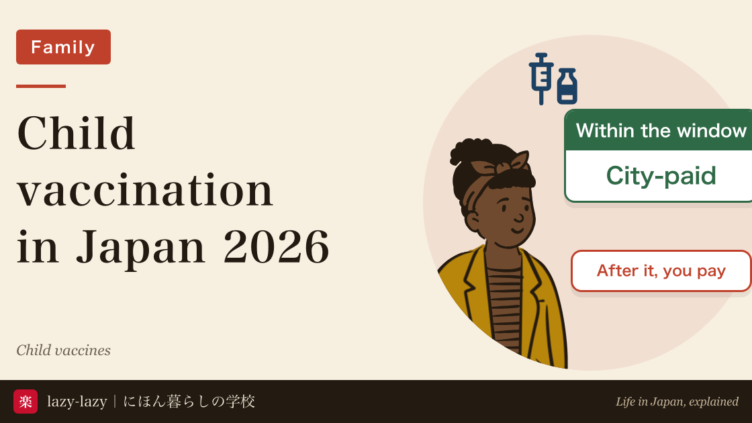
Child Vaccination in Japan 2026: City-Paid by Age, Then You Pay

Routine child vaccinations in Japan are given by the city you live in under the Immunization Act, and foreign children are included. Each is publicly funded only within its age window (free in Yokohama and Osaka); BCG must be given by the day before the first birthday, and after a window closes you pay. Forms come from the city where you are registered, so go to the health centre after arriving or moving. Shots from home can count if the doctor agrees. Plus booking, what to bring and the two-year illness exception.
English

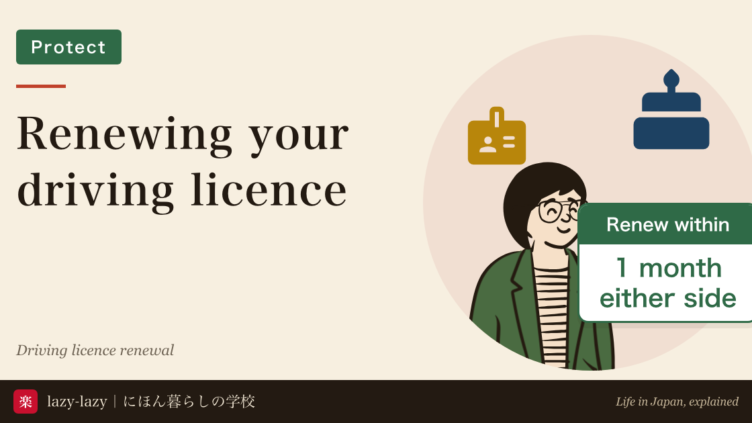
Japan Driving License Renewal 2026: Dates, Fees, and If It Expired

You renew a Japanese driving licence in the month either side of your birthday. Since 1 October 2025, foreign nationals cannot apply without showing a residence card or equivalent. The reminder postcard goes to the address on your licence, so report a move to the police. Lectures run 30 minutes to 2 hours; in Tokyo you pay 3,350 to 4,250 yen. Plus early renewal before a trip abroad, getting a lapsed licence back within 6 months, and the penalty for driving on it.
English

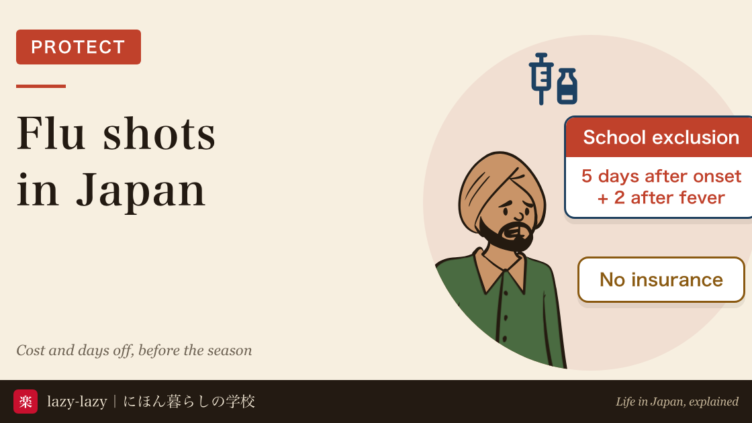
Flu Shot in Japan 2026: Cost, No Insurance, and the 5-Day School Rule

A flu shot is not a treatment, so health insurance in Japan does not cover it and each clinic sets the price. The routine shot is only for 65 and over (and some 60-64): 1,500 yen in Nagoya, free in Shinagawa in FY2026. Some cities pay for children: 2,000 yen off in Shinagawa, free to high school in Chiyoda. Under 13 needs two doses, ideally by mid-December. If you catch it: school exclusion for 5 days after onset and 2 after the fever, language-school attendance, and paid leave or sickness allowance at work.
English

Car Accident in Japan 2026: What to Do, Police Report and Insurance

After a traffic accident in Japan, every driver must stop, help the injured, prevent danger and report to the police (Road Traffic Act Article 72) — cyclists too. Not reporting can mean up to three months or a 50,000 yen fine, and no traffic accident certificate (1,000 yen). Jibaiseki pays only for injuries to others, up to 1.2 million yen. Health insurance still works, with a third-party notification. Bicycle insurance is mandatory in 34 prefectures. Plus free help, including Houterasu's multilingual line.
English

Urgent Care in Japan 2026: Night and Holiday Clinics, What You Pay

Sick at night or on a holiday in Japan but it is not an ambulance case? Go to a holiday and night emergency clinic or the duty doctor. Find one open now with the health ministry's Navii search (in English), #7119 in 41 areas, #8000 for children, or Tokyo and Osaka phone lines. Night and holiday visits add 85, 250 or 480 points: 255, 750 or 1,440 yen at 30%. Walking into a big hospital when it is not urgent can cost 7,000 yen or more.
English

Job Change Notification to Japan Immigration 2026: 14 Days, Online

When you quit or join a company in Japan on a work or study status, you must tell the Immigration Services Agency yourself within 14 days (Immigration Control Act, Article 19-16). Engineer/Humanities and Specified Skilled Workers file the notification of the contracting organization; Business Managers and Students file for the organization of affiliation; permanent residents and spouses of Japanese nationals do not file. The 14 days run from the day you quit and the day you join, and you cannot file early. Online filing is open 24 hours with no documents. Your employer's Hello Work report does not replace it, and not filing can mean a fine of up to 200,000 yen.
English

Japan Job-Hunting Visa After Graduation 2026: 1 Year, 28 Hours a Week

International students in Japan with no job offer by graduation can change to Designated Activities (continued job hunting): six months, renewable once, up to one year, plus one more year if a local government job-support programme covers them. It is open to graduates of universities, junior colleges, graduate schools and technical colleges, and to vocational graduates with the senmonshi title in a course related to a work status. Japanese language school graduates without a degree are not eligible; the only exception is an overseas degree holder who graduates from an approved language school with about 90% attendance. You need your school's recommendation letter and proof that you were job hunting before graduating. Part-time work up to 28 hours a week with permission. With an offer, a separate Designated Activities status lets you wait until you start, if hired within one year of the offer and 18 months of graduating. From 1 October 2026, a six-month grant costs 18,000 yen at the counter or 15,000 online.
English

Student Visa Leave of Absence in Japan 2026: 3-Month Rule, No Work

A leave of absence does not end your Student status in Japan on the day you take it, but three months or more without studying makes the status liable to cancellation under Article 22-4 of the Immigration Control Act. The exception Immigration gives as a justifiable reason is long hospital treatment with the intention to return after discharge. You cannot do part-time work during a leave, even with a work permit, according to the University of Tokyo, Kyoto, Osaka and Kobe. If you go home, universities tell you to hand in your residence card at the airport, and your school applies for a new Certificate of Eligibility (COE) when you return. COE review takes one to three months, so contact your school at least four months ahead. Nationals of Nepal, the Philippines and Vietnam also need a TB clearance certificate.
English

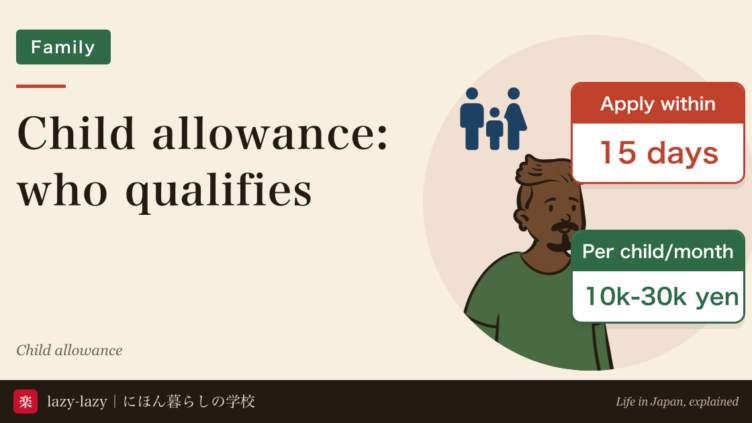
Child Allowance Japan for Foreigners 2026: Who Qualifies, 15-Day Rule

Japan's child allowance (jido teate) is paid to anyone raising a child up to the end of the school year they turn 18, and foreigners receive it on the same terms; visa type and nationality do not matter, only that parent and child are registered residents. 15,000 yen a month under age 3, 10,000 yen from 3 to the end of high school, 30,000 yen for a third or later child, with no income limit since October 2024: about 2.34 million yen per child. Paid in even months, two months at a time. Apply at your city office within 15 days of the birth or of moving in and it starts from the month after; missed months are not back-paid. A child living abroad is not covered (only exception: study abroad within 3 years). A moving-out notice ends it; a trip home with the record kept continues; if the recipient leaves, the spouse re-applies.
English

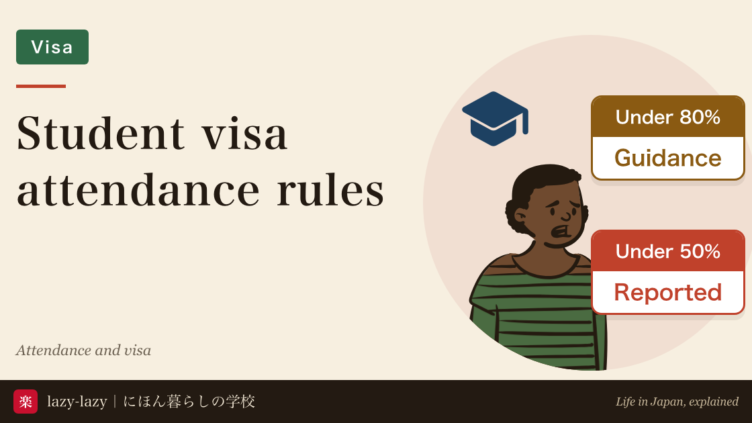
Japan Student Visa Attendance Requirements 2026: The 80% and 50% Lines

Japanese language schools work to two national attendance lines. If your monthly rate (class hours attended divided by class hours due) falls below 80%, the school must give you improvement guidance; below 50%, it reports you to Immigration by the end of the next month, with your part-time employer's name. Immigration's guidelines call 80% a floor, not a target. No attendance rate that guarantees a visa renewal is published, but renewal documents include your attendance certificate and transcript. Absence for illness or other unavoidable reasons is excluded, so hand in a medical certificate. Leave and trips home still count while you hold Student status. Universities and vocational schools have no published percentage but must track attendance.
English

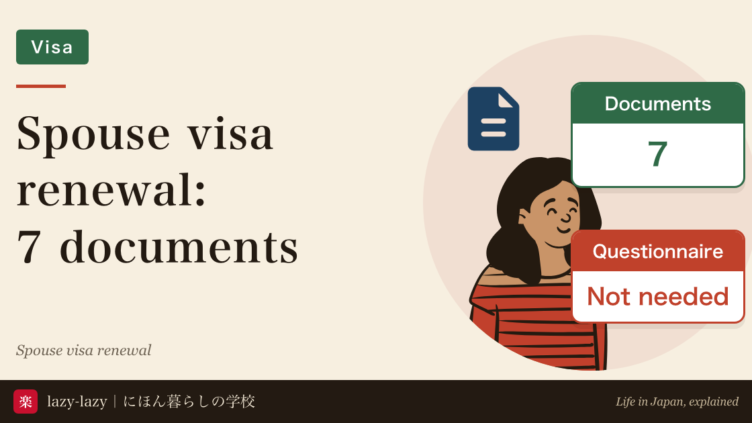
Spouse Visa Renewal Japan 2026: 7 Documents, No Questionnaire, Fees

Renewing a Japan spouse visa (Spouse or Child of Japanese National) is an application for extension of period of stay, filed from about three months before expiry. Seven documents: the form, a photo, your spouse's family register, residence tax certificates, the spouse's letter of guarantee, the household residence record, plus passport and residence card to show. The questionnaire and couple photos from when you married are not required. Since 1 October 2026 the fee depends on the years granted: 64,000 yen at the counter or 56,000 yen online for three years; applications accepted by 30 September 2026 still pay the old 6,000 yen (5,500 online). Periods are 5 years, 3, 1 or 6 months with unpublished criteria; of the eight published factors, only tax and premium arrears, long absences and notifications are in your hands. You can apply while living apart, with a written explanation.
English

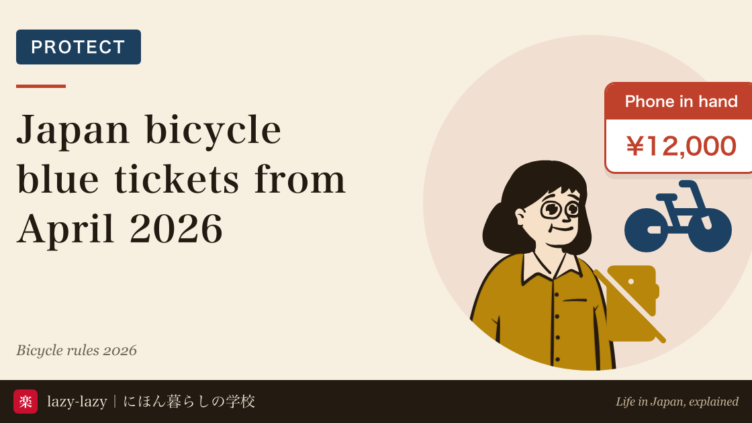
Japan Bicycle Rules 2026: Blue Tickets and Fines From April

Since 1 April 2026, cyclists aged 16 and over in Japan, foreign or Japanese, can be given a blue ticket (traffic infraction notice). Fines include 12,000 yen for holding a phone while riding, 7,000 yen for entering a closing level crossing, 6,000 yen for a red light or riding on the right, 5,000 yen for a missed stop sign, no light, an umbrella or earphones that block sound, and 3,000 yen for a passenger or riding side by side (National Police Agency Bicycle Rulebook). Police warn first and ticket dangerous riding or ignored warnings. Pay within seven days from the day after and the case ends with no trial and no criminal record. Drink-cycling is a red-ticket criminal case. Ride on the left of the road; pavements only in limited cases.
English

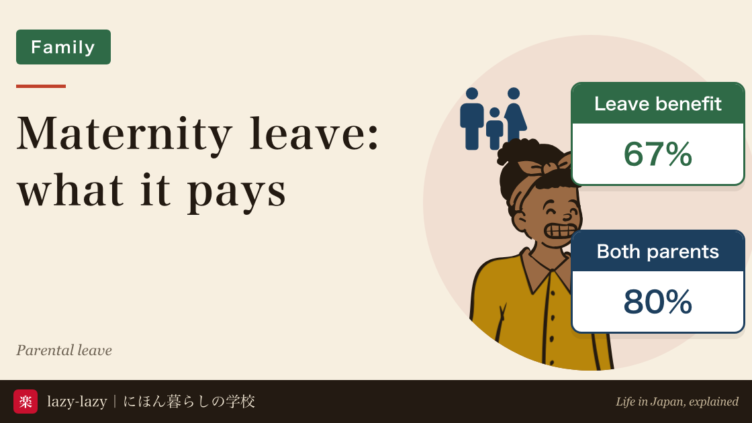
Maternity Leave Japan for Foreigners 2026: Pay, Conditions, 80% Rule

Foreigners have the same maternity and childcare leave rights as anyone in Japan: six weeks before the birth and eight after under the Labour Standards Act, and childcare leave until the child turns one (up to two if no nursery place). While off, salary is replaced by benefits: the maternity allowance (two-thirds of pay, employer health-insurance members only) and the childcare leave benefit (67% for 180 days, then 50%). Since April 2025, if both parents take 14 or more days, the first 28 days pay 80%, tax-free with premiums waived. Conditions: 12 months in employment insurance, and for fixed-term contracts no clear end before the child is 18 months; student part-time jobs are excluded. If you go home, go without resigning: the benefit stops the day you quit. Fathers can take up to 28 days of post-birth leave.
English

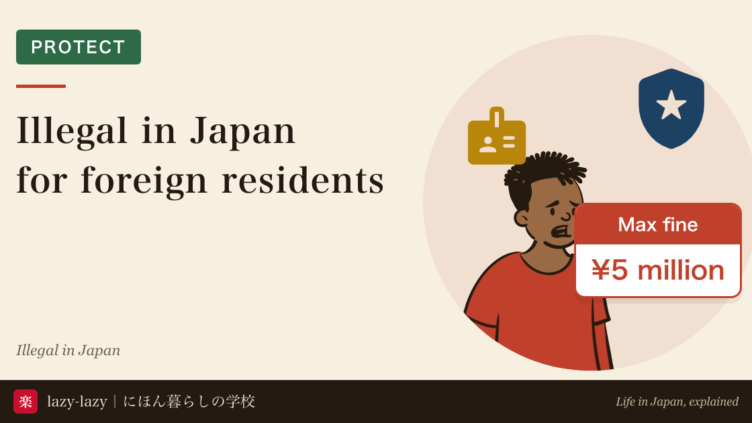
Things That Are Illegal in Japan for Foreign Residents: 7 Laws (2026)

Foreign residents in Japan must carry their residence card at all times: not carrying it can mean a fine of up to 200,000 yen, and refusing to show it up to one year in prison. Selling or giving away a bank account or cash card is a crime whether or not you are paid, with penalties raised on 10 July 2026 to up to three years or 5,000,000 yen. Passing a phone or SIM outside your family needs the carrier's consent. Taking someone else's bicycle can be embezzlement or theft. Cannabis, including gummies and liquids, means up to seven years for having or using it, and a conviction alone is a deportation ground. Carrying a blade over 6 cm and unauthorised work are also crimes, and even a fine is looked at in immigration review.
English

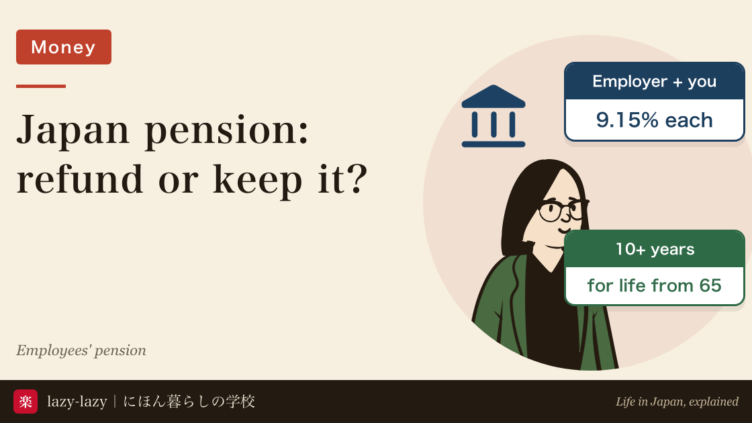
Japan Pension for Foreigners 2026: 9.15% Split, 10 Years to a Pension

Japan's Employees' Pension (kosei nenkin) covers foreign workers regardless of nationality; part-timers at 20 or more hours a week are enrolled too, students excepted (the 88,000 yen condition ended in October 2026). The premium is 18.3% of pay split half and half with the employer, so 9.15% from you. With a qualifying period of 10 years or more you receive a pension for life from 65, paid to a bank abroad after you leave, and 20 of the 24 social security agreement countries let you add home-country years. Leaving before 10 years, the lump-sum withdrawal returns up to 5 years' worth within 2 years of leaving, but it erases those years; if you might return or seek permanent residence, keeping the record leaves more open. The fork is how long you will be in Japan.
Earn

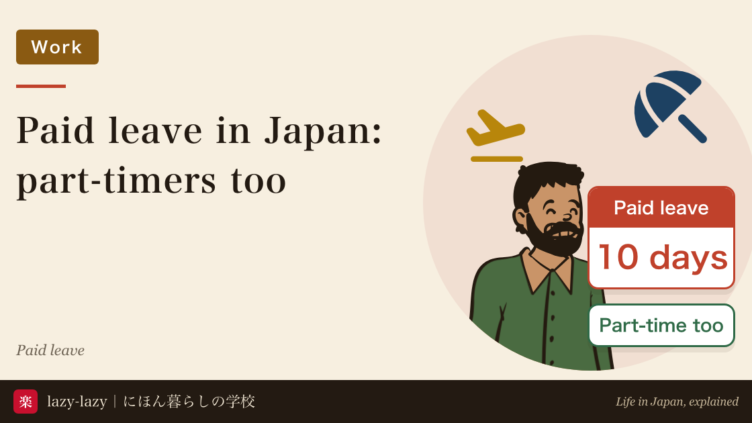
Paid Leave in Japan 2026: 10 Days After 6 Months, Part-Timers Too

Paid leave (yukyu) in Japan arises by law after six months of continuous work and 80% attendance, whatever your nationality and even if you are part-time. You start with 10 days and reach 20 after six and a half years; part-timers on 4 days a week or fewer and under 30 hours start with 7, 5, 3 or 1 day. You choose the day, constant understaffing is no reason to refuse, days last two years, employers must make you take 5 if you get 10 or more, and leave before quitting cannot be moved. Free help lines in English included.
English

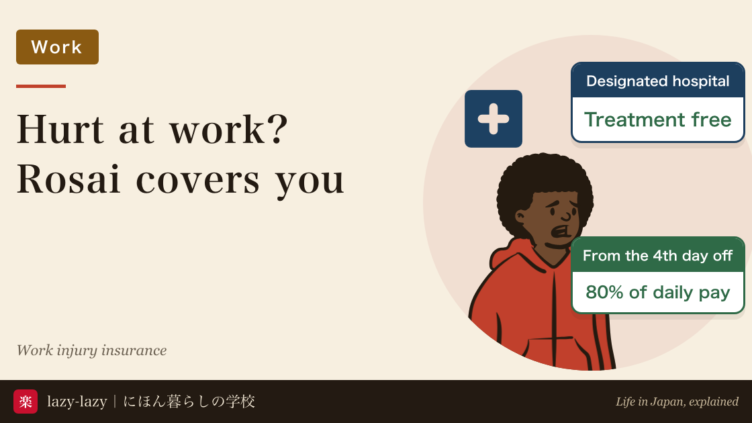
Work Injury in Japan 2026: Rosai Insurance Covers Foreign Workers Too

Japan's work injury insurance (rosai) covers foreign workers regardless of nationality, including students injured during part-time jobs, and the employer pays the premium. Health insurance cannot be used for a work or commuting injury: treatment at a rosai-designated hospital is free, and the full cost is refunded if you had to pay elsewhere. From the fourth day off work you receive 80% of your basic daily wage, about 5,217 yen a day on 200,000 a month. You file the claim yourself at the Labour Standards Inspection Office, even if the employer refuses to certify, never enrolled, or has closed, and even after you have left Japan. Time limits: two years for treatment and absence benefit, five for disability and survivors. The MHLW brochure is available in 13 languages.
English

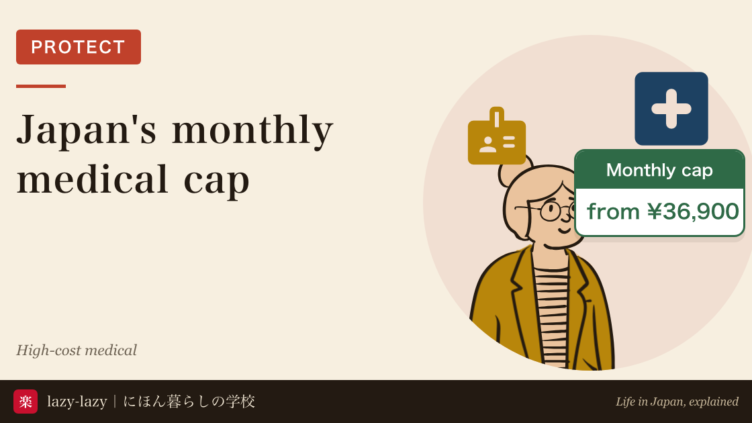
High Cost Medical Expense Benefit Japan 2026: Caps From 36,900 Yen

The high-cost medical expense benefit works the same for foreign residents. For under-70s the monthly cap has five income bands: from August 2026, 36,900 yen if you are exempt from resident tax and 61,500 yen up to about 3.7 million yen a year. What a 1-million-yen month costs in each band, why a My Number health card makes the limit certificate unnecessary, why undeclared income puts you in band A, household totals over 21,000 yen, where to claim and the two-year deadline.
English

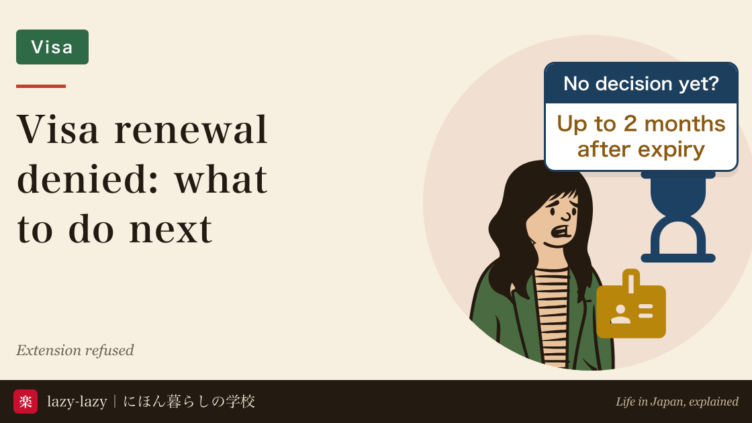
Visa Renewal Denied in Japan: Why It Happens and What to Do Next

A denied visa renewal in Japan means the Minister of Justice found no reasonable grounds to extend. The Immigration Services Agency's guidelines review eight factors: the activity fits the status, landing criteria, actually doing the activity, conduct, livelihood, employment conditions, tax paid and notifications filed. Its nine published denial cases are criminal punishment (5), a false statement about the notified address (1), not carrying out the status's activity (2) and no settledness (1). If no decision arrives by your expiry date, you may stay on your current status until the decision or two months after expiry, whichever is earlier, with the application noted on the back of your residence card. After a denial: ask the counter for the reason, re-apply or change status within your period of stay, and otherwise prepare to leave, asking the counter how many days you have. No fee is charged on a denial.
English

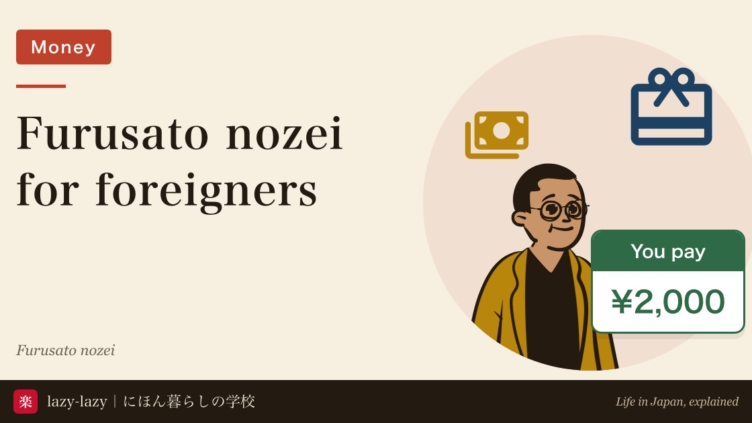
Furusato Nozei for Foreigners 2026: 2,000 Yen, the Limit and One-Stop

Furusato nozei is open to any nationality, as long as you pay the income-based part of resident tax. Within your limit it costs 2,000 yen a year, and the limit is 20% of your income levy. The one-stop exception needs 5 municipalities or fewer and forms arriving by 10 January. Leave Japan before 1 January, or pay no resident tax as a student, and you pay the donation yourself. Points were banned from October 2025.
English

Leaving Japan on a Student Visa 2026: Going Home and the 1-Year Rule

Yes, you can leave Japan on a student visa and come back: tick the re-entry ED card at the airport and special re-entry permission is free. But you must return within one year, or by your card's expiry date if sooner, and neither can be extended abroad. Renew from three months before expiry, before you fly. Term-time trips count as absences, language schools report under-50% months even while you are home, and vacation work is 8 hours a day. Keep your resident record and insurance and the 17,920-yen pension keep running.
Earn

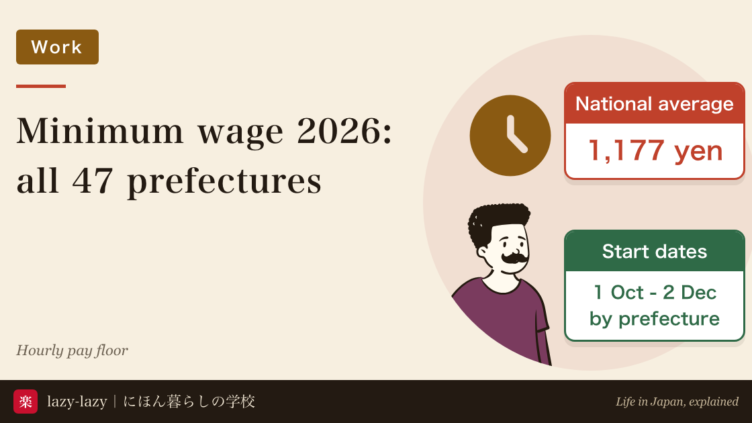
Japan Minimum Wage 2026: All 47 Prefectures and Start Dates

Japan's regional minimum wages for fiscal 2026 were answered by all 47 prefectural councils on 3 September: a national weighted average of the new amounts of 1,177 yen an hour, up 56 yen. Tokyo 1,280, Kanagawa 1,279, Osaka 1,231; the lowest is Miyazaki at 1,085. Start dates run from 1 October to 2 December by prefecture; 15 prefectures, including Tokyo, Kanagawa, Aichi and Osaka, moved on 1 October, and Kyoto follows on 16 November; Iwate, Yamanashi, Saga, Kumamoto and Okinawa are not yet decided (Okinawa planned for 2 December). Until the start date the previous amount applies. The Minimum Wage Act has no nationality limit, so student part-timers, technical interns and Specified Skilled Workers get the same amount. Monthly-paid workers strip out commuting allowance and bonuses and divide by scheduled hours to compare. A contract below the minimum is void for that part and you can claim the difference; the employer faces a fine of up to 500,000 yen. Full table of all 47 prefectures included.
English

Unemployment Benefits in Japan for Foreigners: Up to 80% of Pay, After a 7-Day Wait

Japan's unemployment benefit (the basic allowance of employment insurance) is open to any foreign resident who was enrolled, whatever their nationality. Conditions: 12 months insured in the two years before leaving (6 months in one year after dismissal or bankruptcy) and looking for work in Japan through Hello Work. Student part-timers are excluded as daytime students. The daily amount is 50-80% of your previous daily wage, capped at 7,450 yen under age 30 as of August 2026. Voluntary leavers get 90 days with under 10 years insured; dismissed workers 90-330 days by age and years. Voluntary leavers wait 7 days plus a one-month restriction (for separations from 1 April 2025; formerly two months); dismissed workers start after 7 days. Recognition happens every four weeks in person, so leaving Japan ends the payments. The claim window is one year from the day after leaving.
Earn

JLPT 2026 Registration in Japan: December Closed, Fee, Pass Marks

Registration in Japan for the 6 December 2026 JLPT closed on 3 September, with N1 and N2 full by noon on 31 August. The fee is 7,500 yen via MyJLPT. Pass marks are 100 for N1 and 90 for N2, plus a minimum in every section. Results come in late January 2027, the certificate costs 1,000 yen, and Immigration names N4 for Specified Skilled Worker and N1 for 15 Highly Skilled points.
English

Leaving a Job in Japan as a Foreigner: What to Do in 14 Days

When a foreign resident leaves a job in Japan, three offices need to hear from you. Immigration: within 14 days, file the notification of the contracting or affiliated organization online, in person or by post; skipping it is a fine of up to 200,000 yen. From the employer, get the rishokuhyo and the withholding slip; if they will not issue the rishokuhyo, ask Hello Work. Health insurance ends the day after you leave, so choose voluntary continuation (20 days, double premium, up to two years), National Health Insurance (14 days) or a family member's plan. Pension: register for the National Pension within 14 days. Three months without the status's activity can mean revocation, but job-hunting is a listed good reason. Leaving Japan: employer, immigration, insurance and pension, income and resident tax, pension lump-sum, moving-out notice, departure. Appoint a tax agent before you board.
English

My Number Card as Health Insurance in Japan 2026: 3 Ways to Register

Old health insurance cards in Japan stopped being issued on 2 December 2024, all expired on 1 December 2025, and clinics stopped accepting expired cards on 31 July 2026. You now show your My Number Card registered for insurance, or a Health Insurance Eligibility Certificate, which your insurer sends free and without an application if you have no card. It works the same for National Health Insurance and company insurance. Register at a clinic's card reader, in Mynaportal or at a Seven Bank ATM. For foreign residents the card expires with the period of stay, so extend it at the city office after every renewal.
English

Hanko for Foreigners in Japan: Do You Need One, and How to Register

Foreign residents aged 15 or over with a resident record can register a seal (jitsuin) in roman letters, kanji or katakana, but only a name that is on the resident record. For katakana, first have the katakana reading added to the record; for kanji, have it added to the residence card first. Mixed names, initials only and rubber or self-inking stamps are refused, and the impression must be larger than 8 mm and within 25 mm square. You need a registered seal only when someone asks for the seal certificate: registering a car, buying property, a loan. National procedures dropped ordinary seals almost entirely, so few people need one right away. Bring the seal and your residence card, usually same day; certificates are about 300 yen. Moving to another municipality cancels the registration.
English

Japanese Citizenship (Naturalization) 2026: 10-Year Rule, No Fee

Naturalization makes you a Japanese citizen with the Minister of Justice's permission. The law sets six conditions, including five years' residence, but since 1 April 2026 applicants are expected in principle to have lived in Japan for 10 years or more. Spouses of Japanese nationals have shorter periods. You apply at the Legal Affairs Bureau by appointment, there is no fee, and a decision takes about 18 months at the shortest. You normally give up your old nationality.
English

Kakutei Shinkoku 2026: Who Must File a Tax Return in Japan

You must file a Japanese tax return (kakutei shinkoku) if you have two or more employers with unadjusted pay plus other income over 200,000 yen, side income over 200,000 yen, or a salary over 20 million yen. One employer with a year-end adjustment and other income of 200,000 or less means no return. If you quit mid-year with no adjustment there is no duty, but a refund return brings the over-withheld tax back and can be filed any time for five years. The window is 16 February to 15 March; late filing carries a penalty of 5% if voluntary and 15% or more after an audit, with no penalty if you file within a month and pay in full. Leaving Japan before filing means appointing a tax agent. Bring your withholding slip and My Number Card; a Special Residence Card counts.
English

Japan National Pension Exemption 2026: Can’t Pay 17,920 Yen a Month?

Everyone aged 20 to 59 living in Japan is covered by the National Pension regardless of nationality, and if you are not in a company's Employees' Pension you pay 17,920 yen a month in FY2026. If you cannot, apply for one of four exemption levels or the under-50 deferral based on last year's income, or the unemployment exemption if you lost your job. You can go back two years and one month. Leaving it unpaid leads to demand letters, late charges, seizure, a lost disability pension and a record Immigration can see.
English

Visa Cancelled in Japan: What Really Triggers It and What Happens Next

Japan revoked 1,446 statuses of residence in 2025, a record; 67% were technical intern trainees and 24% students. Nine in ten were for doing nothing: three months or more without the status's activity (69%) or doing something else instead (24%). Every one of those grounds says except where there is good reason, and Immigration gives concrete job-hunting and a hospital-forced leave of absence as examples that may not lead to revocation. You are always heard before a revocation and may state your case, submit evidence and see the file. Even after revocation, everyone except those who entered by deceit gets up to 30 days to leave voluntarily; failing to leave in that period means deportation and criminal penalties.
English

How to Call an Ambulance in Japan 2026: 119 in English, Free, #7119

Dial 119 and say "Kyukyu desu". You are then asked for the address, what happened, the patient's age and your number. 673 of Japan's 720 fire departments connect a phone interpreter, all covering English, Chinese and Korean. The ambulance is free whatever your nationality, but the hospital bill is separate, and places like Ibaraki add about 7,700 yen for non-urgent calls. Plus landmarks when you don't know the address, #7119 (41 areas), #8000 and the Q-suke app.
Earn

Rirekisho: The Japanese Resume Template Is Free From the Ministry

The rirekisho template is free. The Ministry of Health, Labour and Welfare publishes it as Excel and PDF, with no sign-up and no payment. There is no official standard form any more: the JIS form was withdrawn in July 2020. On the ministry's form the gender field is optional and may be left blank, and the spouse, dependants, duty-to-support and commuting-time fields were deleted. No photo size is specified. Being asked for your residence card is not discrimination, because the employer must check your status of residence and report the hire or face a fine of up to 300,000 yen. But your registered domicile, birthplace and family must not be asked in selection.
Earn

Hello Work for Foreigners: The Four Free Centres With Interpreters

An Employment Service Center for Foreigners is a Hello Work office built for foreign job seekers, with interpreters on site. There are only four in Japan: Tokyo, Nagoya, Osaka and Fukuoka. Counselling, job introductions and interpreting are all free. The languages differ by centre: Nagoya lists 10 including Nepali and Burmese, Osaka lists 7 on fixed days, and Tokyo and Fukuoka publish no list. The Tokyo centre's own English page says it serves students seeking full-time employment, not part-time work. Bring your residence card and Hello Work registration slip, plus your passport if your status is Designated Activities. If none of the four is near you, ordinary Hello Work offices with interpreters exist in 32 prefectures.
English

My Number Card Japan 2026: For Foreigners It Expires With Your Stay

A foreign resident's My Number Card does not last ten years. It expires on the day your period of stay expires. Only Permanent Residents, Highly Skilled Professional (ii) and Special Permanent Residents get the tenth-birthday rule. Extending your stay is only half the job: you must also extend the card at your city office, or it lapses, and if the new residence card is late you can phone the city office for a special extension. Since 14 June 2026 the residence card and My Number Card can be one Special Residence Card, but you cannot apply for it on its own, there is no online route, it takes at least two weeks, and your electronic certificates lapse about a week before you collect it.
English

Earthquake in Japan: What to Do, Which Apps, and a 3-Day Kit (2026)

What to do in an earthquake in Japan as a foreign resident: protect your head when the alert sounds, deal with fire when it stops, and know the difference between an evacuation site and a shelter (foreign residents can use both). Covers Safety tips in 15 languages, 9 litres of water per person, 171 and web171 for family abroad, and the 14-day rule for a lost residence card.
English

Scams in Japan 2026: Fake Police and Immigration Calls, How to Report

How to spot the scams that target foreign residents in Japan, and who to call if you are caught. Special fraud and social-media investment and romance scams hit 43,000 cases and 325.7 billion yen in 2025. Real police never contact you on LINE or send warrant photos; Immigration asks for no money beyond the fee for an application you made. Call #9110, 188 or 110, and if you paid by bank transfer, call the receiving bank the same day: the Furikome Sagi Relief Act may return money still in the account.
English

Residence Tax in Japan 2026: Starts in Year Two, Even After You Leave

Residence tax is charged on last year's income by the municipality where you had your address on 1 January. Nothing is charged in the year you arrive; it starts in June of your second year, as twelve payroll deductions from June to May or four bills in June, August, October and January. The rate is 10% of taxable income plus a flat 5,000 yen (4,000 yen per-capita and 1,000 yen forest environment tax). Low income last year means exemption: in Tokyo's 23 wards with no dependants, total income of 450,000 yen or less, roughly a salary of 1.1 million yen. Leaving Japan does not cancel it: have your employer deduct the balance, appoint a tax agent, or pay before you go. No address in Japan on 1 January means no tax for the following year.
Earn

Specified Skilled Worker Visa 2026: How to Change Jobs, 14-Day Rule

You can change jobs on a Specified Skilled Worker visa, within the same job category or between categories whose skills are recognised as shared. If the company changes you must apply for a change of status of residence, which takes one to two months, and you cannot work for the new company until it is granted. The end of a contract and the signing of a new one are each notified to Immigration within 14 days. Losing your job does not mean leaving Japan: if you are job-hunting you may stay within your period of stay and unemployment insurance applies. But three months or more without SSW work and without good reason makes the status revocable. If the termination was not your fault the employer must support your job change, and if you have not yet passed the SSW tests, you can sign with the next employer and switch to Designated Activities for continued employment support.
English

Cooling-Off Period in Japan 2026: Cancel in 8 Days, but Not Online

Japan's cooling-off rule lets you cancel some contracts unconditionally: 8 days for door-to-door and phone sales, 20 for MLM, counted from the day you receive the document, and a postcard or email sent on day 8 is in time. Online shopping, shop purchases and leases have no cooling-off. Phone and fibre contracts get an 8-day initial cancellation even if signed in a shop. Adults from 18, and help on 188.
English

Lost Residence Card in Japan: Police, Then Immigration Within 14 Days

Losing your residence card does not lose you your status of residence. Two steps: report it to the police and get the receipt number, then apply for a reissue at your regional immigration office within 14 days of noticing. There is no fee and the new card is normally issued the same day. Bring the form, one photo, the statement with the police number, your passport and any part-time work permit slip. Lost it abroad? Special re-entry permission does not require the card, so you can still come back; apply within 14 days of landing. Special Residence Card holders get an ordinary card first and should suspend the My Number function. Never applying is an offence: up to a year's imprisonment or a 200,000 yen fine.
Earn

Employment Contract in Japan 2026: 6 Terms You Must Get in Writing

In Japan the law does not require a signed employment contract. It requires a written statement of working conditions from your employer, covering six terms: contract period, place and duties, hours, days off, wages and leaving the job, plus the scope of change and renewal limits since April 2024. Part-time students get one too, with extra items for part-timers. No statement can mean a fine of up to 300,000 yen, and if the job is different you may end the contract at once. Model notices in 13 languages and a free English hotline.
English

Nenmatsu Chosei 2026: Japan’s Year-End Tax Adjustment Explained

Nenmatsu chosei is the December procedure in which your employer settles the difference between the income tax withheld from your pay all year and the tax you actually owe, usually as a refund. You are covered if you filed the dependants declaration and are employed in December; you hand in three forms. From the December 2026 adjustment the basic deduction becomes 1,040,000 yen for income of 4.89 million or less (950,000 in 2025 for income of 1.32 million or less) and the minimum employment-income deduction from 650,000 to 740,000, so salary-only earners pay no income tax up to 1.78 million yen. Withholding through November is unchanged. Quit mid-year and you usually file your own return; leaving Japan is adjusted at departure. Family abroad needs relationship and remittance documents, with a 380,000-yen remittance rule for relatives aged 30 to 69.
Earn

Overtime Pay in Japan 2026: 25% Extra After 8 Hours, Part-Timers Too

Overtime pay in Japan is owed for hours beyond 8 a day or 40 a week, for 10pm to 5am, and for the statutory day off, whatever your nationality and even on a part-time job. The rates are 25%, 50% beyond 60 hours a month, 25% at night and 35% on the day off, so at 1,200 yen an hour an overtime hour pays 1,500 yen and 1,800 yen after 10pm. Overtime needs a 36 Agreement and is normally capped at 45 hours a month and 360 a year. Hours count by the minute, fixed overtime covers only its set hours, and unpaid overtime can be claimed back three years. Free help lines in English included.
English

Re-Entry Permit Japan 2026: Who Needs One, Fees, and the One-Year Trap

If you return within one year of leaving Japan you do not need a re-entry permit: special re-entry permission covers you, and you simply tick a box on the ED card at the airport, free. But it ends when your period of stay ends if that is sooner, and it cannot be extended from abroad (Immigration Act article 26-2 (3)). If there is any chance of being away longer, get an ordinary re-entry permit before departure - 4,000 yen single or 7,000 multiple, issued the same day - which a Japanese consulate can extend for up to a year and six years in total. Losing your residence card abroad does not stop re-entry, and a proxy in Japan can obtain a certificate of your deadline. Miss the deadline and you cannot re-enter on that status; it starts again from a visa.
English

Fired in Japan as a Foreigner 2026: 30 Days’ Notice and Your Visa

Employers in Japan cannot fire you at will: a dismissal without a reasonable cause is void. Even with one, you are owed 30 days' notice or your average wage for the missing days, about 245,000 yen if you earn 250,000 a month and are fired on the spot, and part-timers are covered. You can demand the reason in writing, fixed-term workers renewed three times or employed over a year get 30 days' notice, and nobody can be dismissed during work-injury or maternity leave. On a work visa, notify Immigration within 14 days; a job search counts against the three-month rule. Free help lines in English.
English

How to Bring Your Family to Japan: Spouse and Children, Not Parents

Bringing your family to Japan means getting them the Dependent status of residence, and the provision names only a spouse and children. Parents are not covered. The status you hold also decides it: Engineer/Specialist, Specified Skilled Worker (ii) and Student can bring dependents, while SSW (i) and Technical Intern Training cannot. The order is a Certificate of Eligibility in Japan, sent home, then a visa at the embassy there. A student proves support with a bank balance certificate. Nepalese family members have needed a TB clearance certificate since 23 June 2025; Sri Lanka is not covered.
English

Power Harassment in Japan 2026: Where to Report It, Free in English

Where to report power harassment, unpaid wages or discrimination at work in Japan. Start at one of 378 General Labour Consultation Corners: free, no appointment, many languages. Breaches of the Labor Standards Act go to the Labour Standards Inspection Office. Employers must prevent power harassment, and the ministry lists insults about being a foreigner as an example. Free hotline in English (0120-531-401) on evenings and weekends, a paid line on weekdays, free conciliation, a ban on firing you for reporting, and a three-year limit on wage claims.
Earn

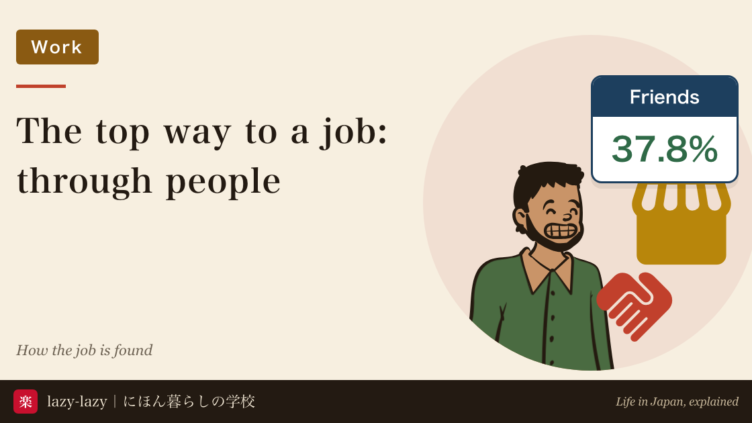
How Foreigners Actually Find Jobs in Japan: 37.8% Through Friends

Japan's labour ministry survey (31 Aug 2026): 37.8% of foreign residents found their job through friends, 19.1% through job ads, 5.8% through school.
English

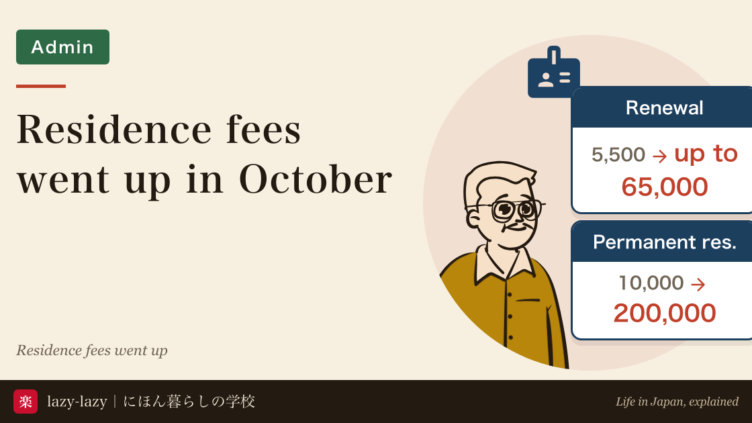
Japan Visa Fee Increase 2026: Permanent Residence Now 200,000 Yen

Residence permit fees changed on 1 October 2026. The flat rate was replaced by amounts based on the period of stay granted; applications accepted by 30 September 2026 still pay the old fee.
Earn

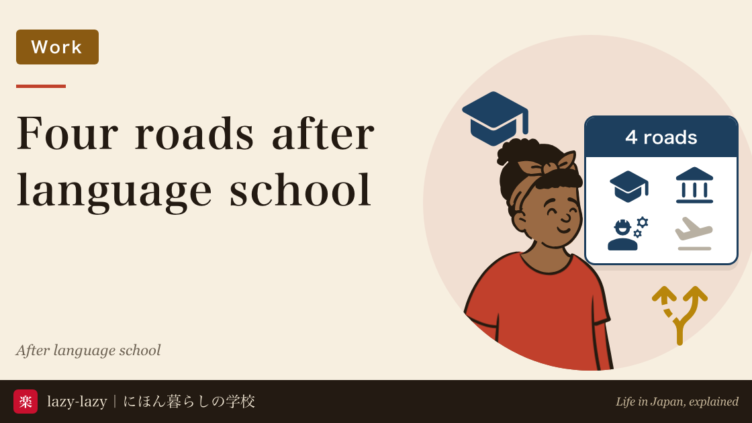
After Japanese Language School: 4 Roads and What Each Needs (2026)

A language school has no job pipeline, and that is not because you are behind.
Earn

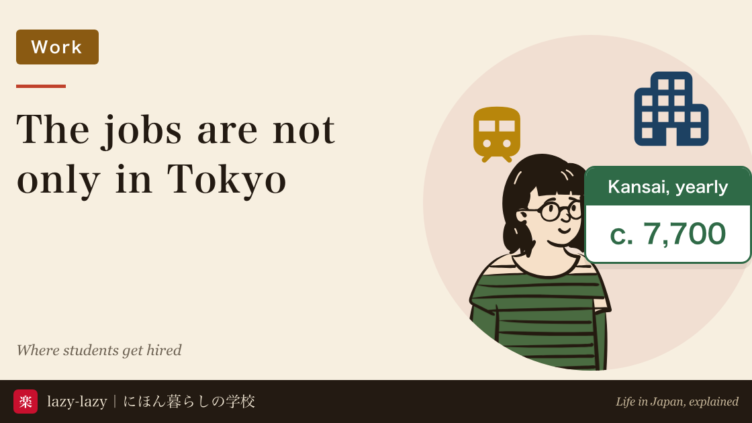
Where International Students Actually Get Hired in Japan (2026 Data)

Last year 39,766 students changed from student status to a working one, including 3,909 Nepalese, at a 96.7 percent approval rate.
English

Student Part-Time Work in Japan: Why Social Insurance Does Not Apply

Student part-time workers in Japan do not join employer health insurance or the employee pension.
English

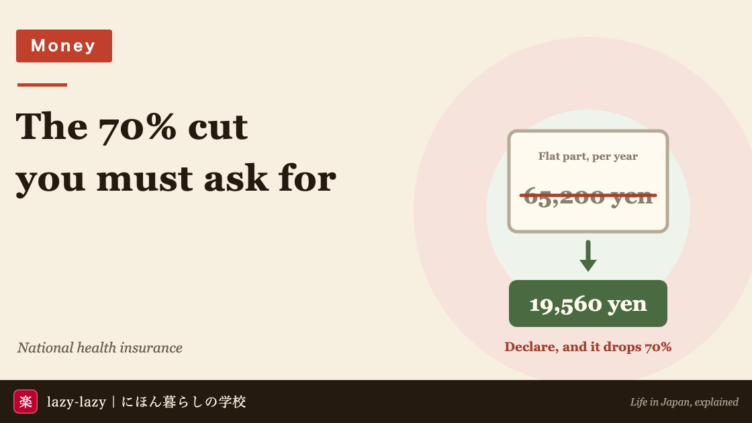
National Health Insurance Japan: The 70% Reduction You Must Ask For

Japan cuts the flat part of your National Health Insurance bill by 70, 50 or 20 percent when household income was low.
English

iDeCo for Foreigners in Japan: Locked Until 60, and the Exit

Foreign nationals can join iDeCo - the condition is public pension enrolment, not nationality - but assets are locked until age 60.
English

Daycare in Japan for Foreigners 2026: Free From Age 3, Apply in Autumn

Foreign children can use daycare and kindergarten in Japan; nationality is not a condition. Daycare checks that both parents have a reason they cannot care for the child at home, such as work or study. The 3-to-5 classes are free; for ages 0 to 2 the fee follows residence tax (0 to 70,600 yen a month in Osaka, 0 to 77,500 in Yokohama). April entry is applied for the autumn before: 1 to 28 October 2026 in Yokohama. Plus kindergarten and the new universal nursery program (up to 10 hours a month).
Earn

Work Visa Japan 2026: Salary Data by Visa Type and the Equal-Pay Rule

Official data shows every work status in Japan pays more than the 137,312 yen a month a student can earn on 28 hours a week.
English

JASSO Scholarship 2026: 30,000 Yen a Month, Language Schools Included

Before you take on more shifts: the Monbukagakusho Honors Scholarship pays 30,000 yen a month at a Japanese language school and 48,000 yen at university.
English

Having a Baby in Japan 2026: Apply Within 30 Days, Get 500,000 Yen

Japan has no birthright citizenship, so a baby born to foreign parents is a foreign national and needs a status of residence.
English

Spouse Visa and Divorce Japan 2026: Within 14 Days, Stay 6 Months

Divorce or bereavement must be reported to immigration within 14 days, but divorce does not end your status of residence on the spot.
English

Is School Free in Japan for Foreigners? Public School Enrollment 2026

Foreign children have no legal duty to attend school in Japan, but public elementary and junior high schools take them free of tuition if you apply to the board of education. For April entry some cities want the form the autumn before (Osaka: 30 September). Grades follow age, from 2 April to 1 April births. Lunch and school expenses average about 110,000 yen a year at elementary and 186,000 yen at junior high, with assistance for families who struggle. From April 2026, high school tuition support depends on status of residence.
English

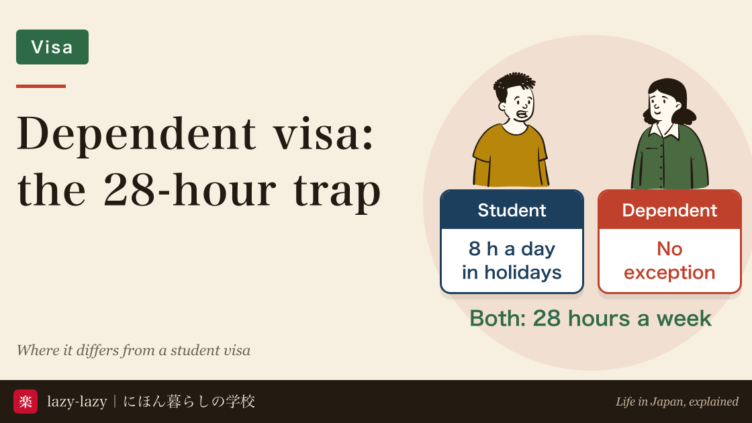
Dependent Visa Japan 2026: You Cannot Work Until the 28-Hour Permit

A dependent visa permits no work until you hold a work permit.