Checked on 23 September 2026 against the Immigration Services Agency’s pages on the Certificate of Authorized Employment, online application fees, the notification regarding your contracting organisation, its official Q&A and its Specified Skilled Worker Q&A, and Articles 19-2 and 19-16 of the Immigration Control Act (e-Gov).
The short answer
- The Certificate of Authorized Employment is a document in which Immigration confirms that the work at your new employer is work your current status allows (Immigration Control Act, Article 19-2).
- It is optional. You can work without it, and an employer may not treat you unfairly because you do not show one.
- The reason to get one after changing jobs: it removes, in advance, the risk of being told at your next renewal that the new job does not fit your status.
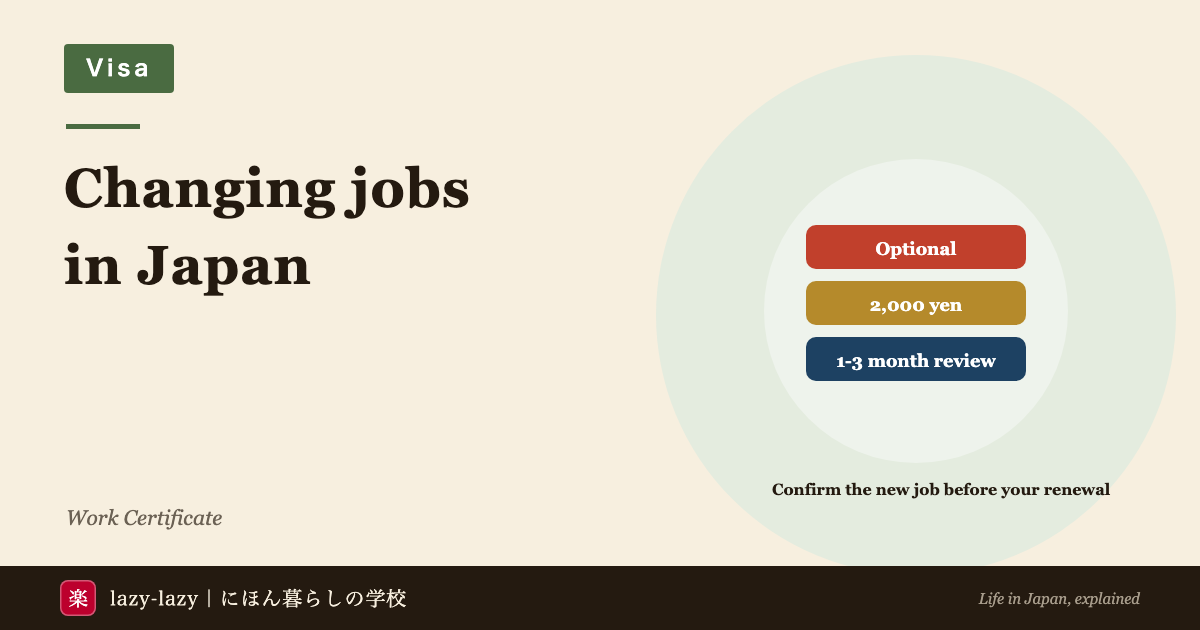
- The fee is 2,000 yen at the counter or 1,600 yen online. Online applications filed from 1 October 2026 add a 220-yen payment fee, so 1,820 yen. After a job change, the review takes one to three months.
- The 14-day notification to Immigration is a separate duty. Specified Skilled Workers who change company need a change of status, not this certificate.
Knowing this, you can pick which of the three procedures you need right after a job change, instead of learning about a problem at the renewal two years later.
You have a new job. At the old company you translated. At the new one, half of your day is sales and half is interpreting. There are two years left on your residence card. You ask a Japanese colleague whether your visa still covers this. “If the company says it’s fine, it’s probably fine.” Japanese people never deal with Immigration when they change jobs, so nobody around you can really answer.
Only Immigration can. The document for that is the Certificate of Authorized Employment.
- What is the Certificate of Authorized Employment in Japan?
- Do I need it when changing jobs in Japan on a work visa?
- How is it different from the 14-day notification?
- Changing jobs on a Specified Skilled Worker visa: the certificate is not enough
- What documents do I need?
- Where do I apply?
- How much is the Certificate of Authorized Employment fee?
- How long does it take?
- What if the new job is outside my status?
- Which one are you?
- FAQ
- Summary
- Related reading
What is the Certificate of Authorized Employment in Japan?
The Certificate of Authorized Employment (shuro shikaku shomeisho) is a document in which the Immigration Services Agency certifies what work you are allowed to do in Japan. It is issued when you apply, under Article 19-2 of the Immigration Control Act.
Your residence card only shows the name of your status, such as “Engineer/Specialist in Humanities/International Services”. It cannot tell you whether a specific job at a specific company falls inside that name. The certificate gets you Immigration’s view on that specific job.
The application form has a box for “desired activity to be certified”. Immigration’s sample fills it in as translation and interpreting work for overseas trade at a named company. You describe the company and the actual work, and Immigration looks at whether your status covers it.
People with a work status are not the only ones who can apply. Students with permission to work part-time, and permanent residents and long-term residents with no work restrictions, can apply too. But the most common use is after changing companies on the same status.
Do I need it when changing jobs in Japan on a work visa?
You do not. Immigration’s Q&A says the certificate is issued when a foreign national wants one, and that not having it does not stop you from working. Article 19-2(2) of the Act also forbids anyone from treating you unfavourably, when hiring you, because you do not show or submit one.
The reason to get one anyway is your next renewal. Immigration’s guidelines for renewals and changes of status list what is considered. Item 1 is that the activity you intend to do fits the status. The guidelines call this a requirement for granting permission, not one factor to be weighed against others.
If you change jobs on the same status, the only thing you must file is the 14-day notification, and it needs no supporting documents. Whether the new job fits your status is examined for a permission at your next renewal. If Immigration decides at a renewal two years later that the job does not fit, you will have spent those two years working outside your status. Those two years cannot be undone afterwards.
The certificate is a way to get that decision at the time you change jobs. Immigration’s Q&A (Q36) answers exactly this case: someone whose permit runs for two more years has changed jobs and wants to confirm the new work falls within “Engineer/Specialist in Humanities/International Services”. The answer is to apply for this certificate.
The form also asks for the “period of work” and the “purpose of use”, so giving it to a new employer is one of the expected uses. Whether your company asks for it or you simply want certainty, it is the same document.
How is it different from the 14-day notification?
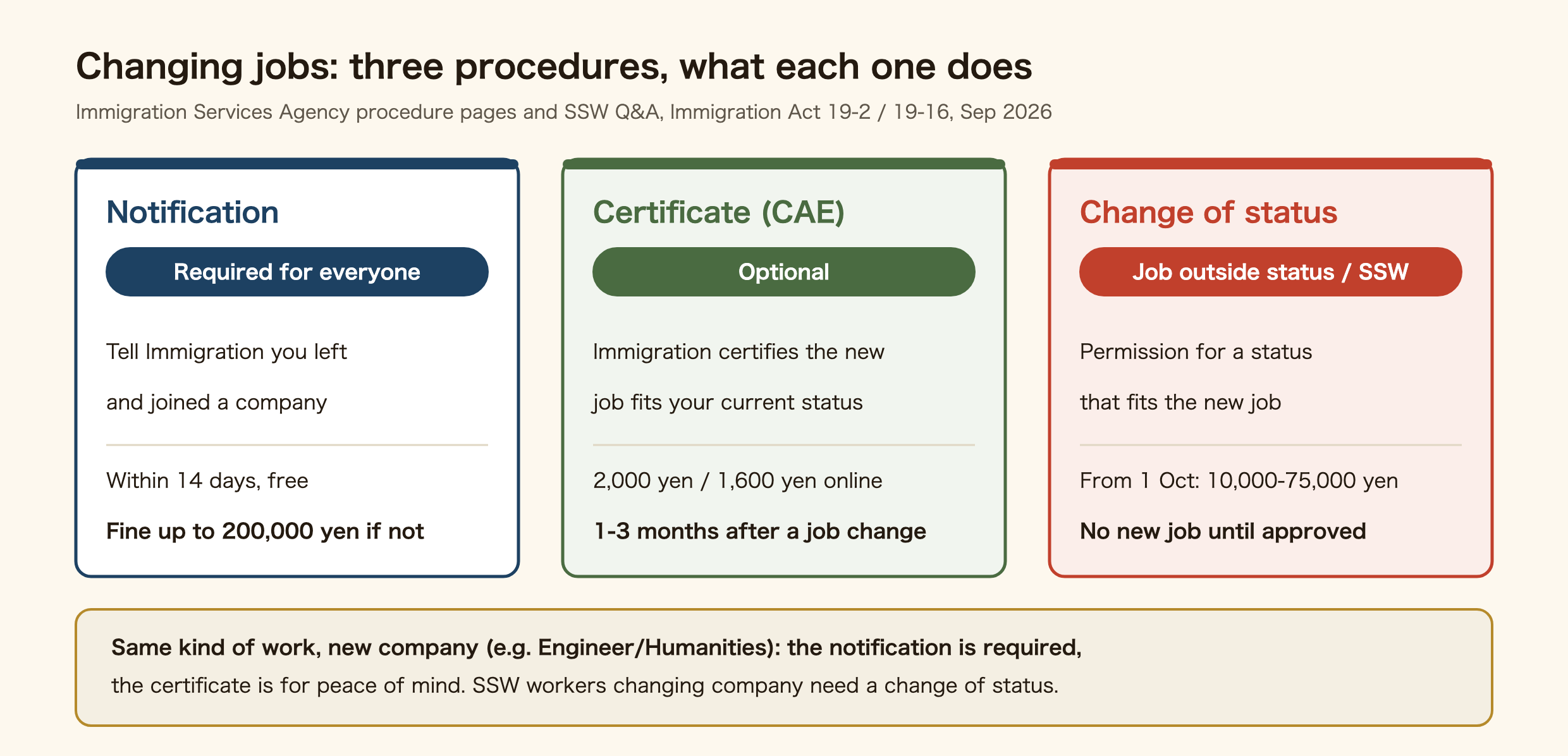
Three Immigration procedures can come up when you change jobs. They are easy to mix up, so separate them by what each one is for.
- The notification — tells Immigration your contract with the old company ended and you signed with a new one. Required.
- The Certificate of Authorized Employment — Immigration confirms the new job fits your current status. Optional.
- A change of status — moves you to a status that fits the new job. Needed before you start if the job is outside your status.
People on Engineer/Humanities, Skilled Labor, Specified Skilled Worker, Nursing Care, Researcher and similar statuses file the notification within 14 days of the contract ending and within 14 days of the new contract (Article 19-16). The online notification system works 24 hours a day and needs no supporting documents. Registering for it, and the postal address if you file on paper, are in how to file the job change notification. Applying for the certificate does not count as filing the notification. Do both.
Not filing can mean a fine of up to 200,000 yen (Article 71-5), and the renewal guidelines list meeting your notification duties as item 8. How to file after leaving a job, form by form, is in the guide to leaving a job in Japan.
Changing jobs on a Specified Skilled Worker visa: the certificate is not enough
Specified Skilled Workers are different. Immigration’s SSW Q&A says that when a job change means a new receiving organisation (company) or a new field, you must apply for a change of status.
The certificate confirms whether you can do a job on the status you already have. On Specified Skilled Worker, the status itself is tied to the employer designated for you, so you cannot work at a new company on it. That is why the certificate cannot replace the change. The standard processing time for the change is one to two months, and you cannot start at the new company until it is granted.
For job categories and how the three months are counted if you lose your job, see how to change jobs as a Specified Skilled Worker, which puts the steps in order.
What documents do I need?
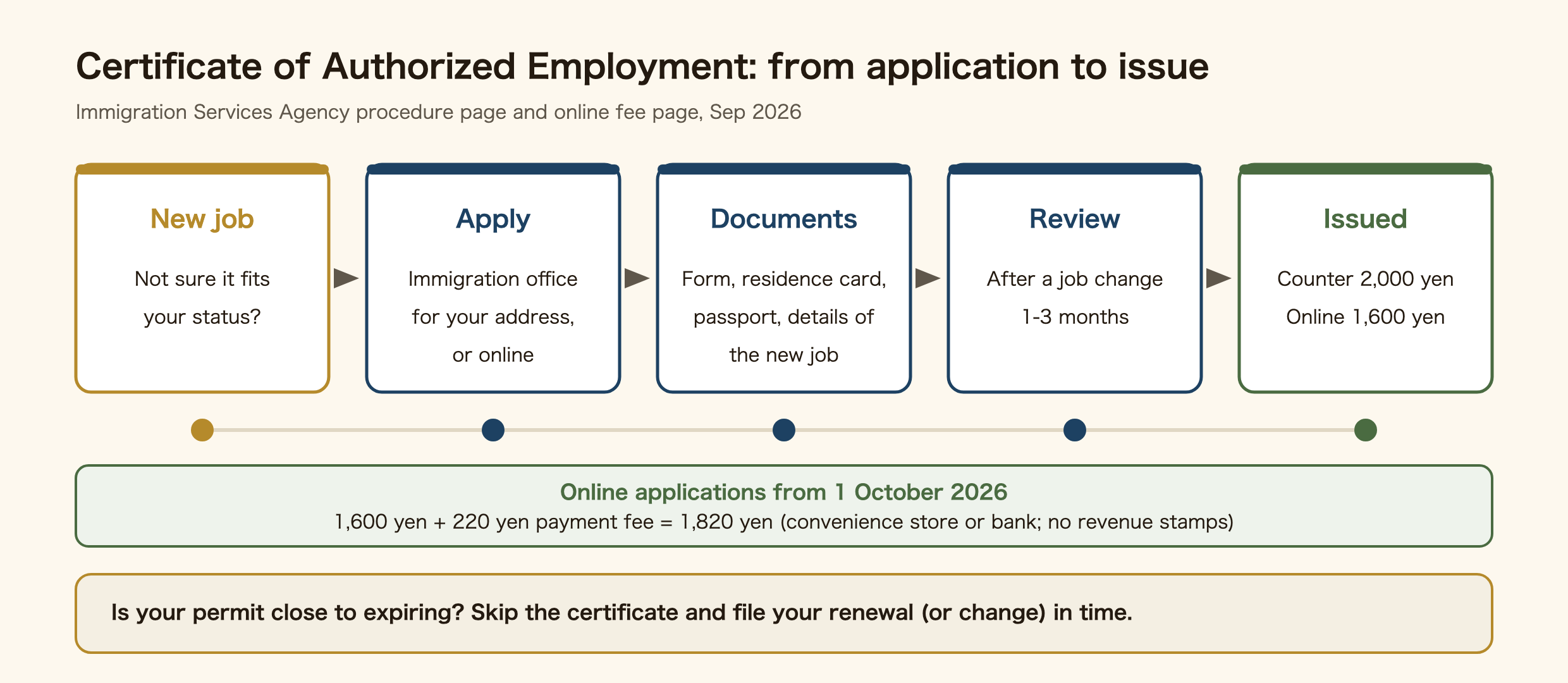
For people whose workplace or work is changing (or has changed), Immigration lists seven items.
- The application form (PDF and Excel on the Immigration website; print on A4)
- Your permission to engage in activity other than that permitted (only if you have one), shown
- Your residence card, shown
- Your passport (or certificate of status of residence), shown
- If you cannot show your passport, a written statement of the reason
- Identification of the person submitting (only if an authorised agent files for you)
- Documents showing the details of the new workplace and the work
Item 7 is the one added after a job change. Immigration does not name specific documents for it. What it wants is something that shows the new company and the actual work, so you will need your new employer’s HR team to help. If you are unsure what to bring, ask your regional immigration office or the Immigration Services Agency information centre (0570-013904) before applying.
The boxes people get stuck on are 9 to 11: “desired activity to be certified”, “period of work” and “purpose of use”. In Immigration’s sample, box 9 names the company and the work, and box 11 says the certificate is needed to submit to that company.
If neither your workplace nor your work has changed, you apply with the first six items.
Where do I apply?
Apply at the regional immigration office that covers the place you live. Immigration’s Q&A (Q37) says you cannot apply at the office that covers your workplace. It is the office for your address, not the one near your job. Counters take applications on weekdays, 9:00 to 12:00 and 13:00 to 16:00.
You can also apply online through the residence application online system. Besides you, a legal representative, an approved staff member of your employer, or a registered lawyer or administrative scrivener can file for you.
How much is the Certificate of Authorized Employment fee?
| How you apply | Fee | How you pay |
|---|---|---|
| At the counter | 2,000 yen | Revenue stamps |
| Online, received by 30 September 2026 | 1,600 yen | Revenue stamps |
| Online, received from 1 October 2026 | 1,600 yen + 220 yen payment fee = 1,820 yen | Convenience store or bank payment |
You pay when the certificate is issued. The big increase on 1 October 2026 is for changes of status, renewals and permanent residence. The fee for this certificate does not change. What changes is how you pay online.
From 1 October, online applications can no longer be paid with revenue stamps, and credit cards and QR-code payments are not accepted either. When the review is done, a payment email arrives. Immigration says those emails come only from addresses ending in “@service-dgft.com”. An email from any other address asking you to pay the fee is a scam. Do not open its links.
A change of status, whether for Specified Skilled Workers or for moving to work outside your status, costs more. For applications received from 1 October, it is 10,000 to 75,000 yen at the counter depending on the period of stay granted. The fee for each period is in the October fee rise.
How long does it take?
Immigration’s standard processing time is “the same day (one to three months if you have changed workplace, for example)”. If nothing has changed, you may get it the day you apply. After a job change, Immigration has to look at the new work, so it takes longer.
Immigration describes the applicants as people whose workplace or work “is changing (or has changed)”. That covers the time before the change as well as after. Once the new contract is settled, you can apply without waiting to start.
Be careful if your permit expires soon. Immigration’s Q&A (Q35) tells someone about to change jobs with an expiry date near to file a renewal if the kind of work stays the same, or a change of status if it does not, either way before the expiry date. The renewal review looks at the new job too, so there is no need to wait one to three months for a certificate. Timing and documents for renewals are in the visa renewal guide.
What if the new job is outside my status?
Being paid for work that is not part of your status is prohibited by Article 19(1) of the Act. Breaking it can be punished with up to one year’s imprisonment or a fine of up to 2 million yen (Article 73). Doing a different activity instead of your status’s activity is also one of the grounds for cancelling a status (Article 22-4(1)(v)).
“I didn’t know” does not help. Even if your company says it is fine, the decision belongs to Immigration. If the renewal finds the job does not fit your status, it will not be granted. When a renewal is denied, you are left choosing between reapplying and leaving Japan.
If the certificate process or talks with the company show the job is outside your status, apply for a change of status before starting the new work. Immigration’s Q&A (Q67) says the same: if the work does not fit the status, change to a status that fits or get permission for activity outside your status.
Which one are you?
- Same kind of work, new company (Engineer/Humanities and similar) — today, file “contract ended” and “new contract” through the online notification system. If you have any doubt about the work, ask HR at the new company for a document describing it and apply for the certificate at the immigration office for your address.
- The work itself is changing a lot — before you start, ask the new company today for a written description of the work. Get Immigration’s answer: the certificate if you are unsure whether it fits, a change of status if you know it does not.
- Specified Skilled Worker changing company — you need a change of status, not the certificate. Start preparing the application with the new company today, and do not work there until it is granted.
- Your permit expires within three months — skip the certificate. Start gathering your renewal (or change of status, if the work changes) documents today and file before the expiry date.
FAQ
Q. What is the Certificate of Authorized Employment in Japan?
It is a document in which the Immigration Services Agency certifies what work you can do on your current status. It is issued on your application under Article 19-2 of the Immigration Control Act. People who change jobs often use it to confirm the new work fits their status.
Q. Do I have to get one when I change jobs in Japan?
No, it is optional. Immigration says not having one does not stop you from working. But at your next renewal, the job fitting your status is a requirement, so there is value in confirming it when you change jobs.
Q. How much does the Certificate of Authorized Employment cost?
2,000 yen at the counter (revenue stamps) or 1,600 yen online. Online applications received from 1 October 2026 add a 220-yen payment fee, 1,820 yen in total, paid at a convenience store or bank.
Q. Where do I apply for the certificate?
At the regional immigration office that covers your address, or online. You cannot apply at the office that covers your workplace.
Q. How long does it take to get the certificate?
One to three months if you have changed workplace, for example. If nothing has changed, you may get it the same day. If your permit expires soon, file a renewal or change of status before the expiry date instead.
Q. Can a Specified Skilled Worker change jobs with this certificate?
No. A Specified Skilled Worker who changes company (receiving organisation) or field must apply for a change of status, and cannot work at the new company until it is granted.
Summary
The Certificate of Authorized Employment is Immigration’s confirmation that a new job fits your current status. It is optional, and you can work without it. But at your next renewal, the job fitting your status is a requirement. Getting Immigration’s answer when you change jobs means you do not find out about a problem two years later.
The fee is 2,000 yen at the counter or 1,600 yen online, and 1,820 yen for online applications from 1 October. You apply at the office for your address, and after a job change the review takes one to three months. The 14-day notification is still required on top of it. Specified Skilled Workers changing company need a change of status instead.
Official sources: Immigration Services Agency, Application for Certificate of Authorized Employment (Japanese) / ISA, online application fees and payment from 1 October 2026 (Japanese) / ISA, residence permit fee revision of 1 October 2026 (Japanese) / ISA, notification regarding the contracting organisation (Japanese) / ISA immigration and residence Q&A (Japanese) / ISA guidelines for change of status and extension of stay (Japanese) / ISA Specified Skilled Worker Q&A (Japanese) / Immigration Control and Refugee Recognition Act, e-Gov (Japanese). Checked on 23 September 2026. Confirm the latest guidance with your regional immigration office before applying.
Related reading
Found this useful? Share it
Send it to a friend who lives in Japan.
WHO WROTE THIS

mori
Japanese. I read the ministries’ own notices, orders and Q&As in the original, and I start from what my Nepalese and Sri Lankan friends in Japan actually ran into. I do not write about what I have not checked or been told.
What this site can and cannot do →Looking for something else?