Checked on 17 September 2026 against the National Tax Agency’s Tax Answers No. 2020, 1900, 2030, 2024 and 1923 and its list of identity documents. The filing window for 2026 income is 16 February to 15 March 2027.
In short
- If your employer does the year-end adjustment, you do not file a tax return. One employer, other income of 200,000 yen or less.
- You must file in three cases: two or more employers with unadjusted pay plus other income over 200,000 yen; side income over 200,000 yen; salary over 20 million yen.
- Left a job mid-year with no adjustment? No duty to file, but a “refund return” gets your tax back. You can file it any time within five years.
- The window is 16 February to 15 March. Late filing carries a penalty (5% if voluntary, 15%+ after an audit) – with an escape if you file within a month.
- Leaving Japan before filing? Appoint a tax agent at the tax office. Bring your withholding slip and My Number Card (or notification card plus passport).
Every February the words “kakutei shinkoku” appear on television and station posters. Do I have to do this? What happens if I do not? Ask a Japanese colleague and you hear “company employees don’t need to” – which is true for that colleague. For someone who left a job mid-year, holds two jobs, or is going home, the answer is different.
What is kakutei shinkoku?
Kakutei shinkoku is the tax return: the procedure in which you calculate your own income for 1 January to 31 December and the income tax due on it, and submit that to the tax office (NTA No. 2020). If tax was withheld from your pay, the return settles any over- or under-payment.
Most employees never file, because the year-end adjustment settles everything through the company. The tax return appears when there is income or a circumstance the adjustment cannot capture.
Who must file? Three cases
For salaried people, NTA No. 1900 lists those who must file:
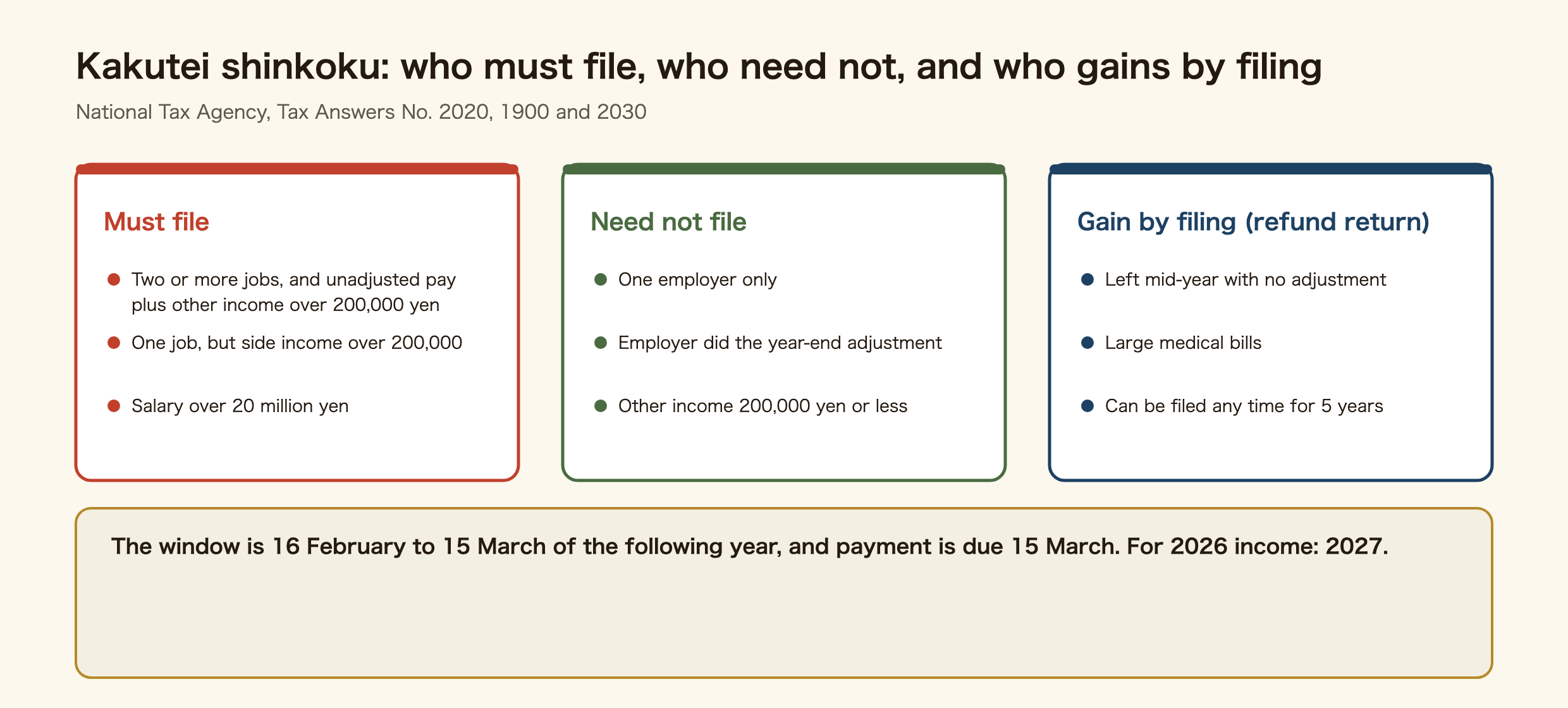
- Two or more employers, where the pay that was not year-end-adjusted plus any other income exceeds 200,000 yen – a student with two part-time jobs, where the second job’s pay was not adjusted, is the typical case
- One employer, but other income over 200,000 yen – a side business, video revenue, freelance fees
- Salary over 20 million yen a year
You need not file if you have one employer, all your pay was withheld at source, the employer did the year-end adjustment, and other income is 200,000 yen or less (No. 2020). Most employees, and students with a single part-time job, are here.
No duty, but a gain: the refund return
Even with no duty to file, if more income tax was withheld from your pay than you actually owe, filing gets the difference back. This is a refund return (kanpu shinkoku, No. 2030).
The most common case among foreign residents: you left a job or part-time work during the year and were not with an employer in December. No year-end adjustment was done, so the over-withheld tax is still sitting there. Years with heavy medical bills, or losses from disaster or theft, also qualify.
A refund return can be filed any time for five years from 1 January of the following year. It is not tied to the February-March window. If you quit last year and did nothing, it is not too late. But if the withheld amount was zero, there is nothing to refund – check the “withheld tax” box on your withholding slip.
When and how do you file?
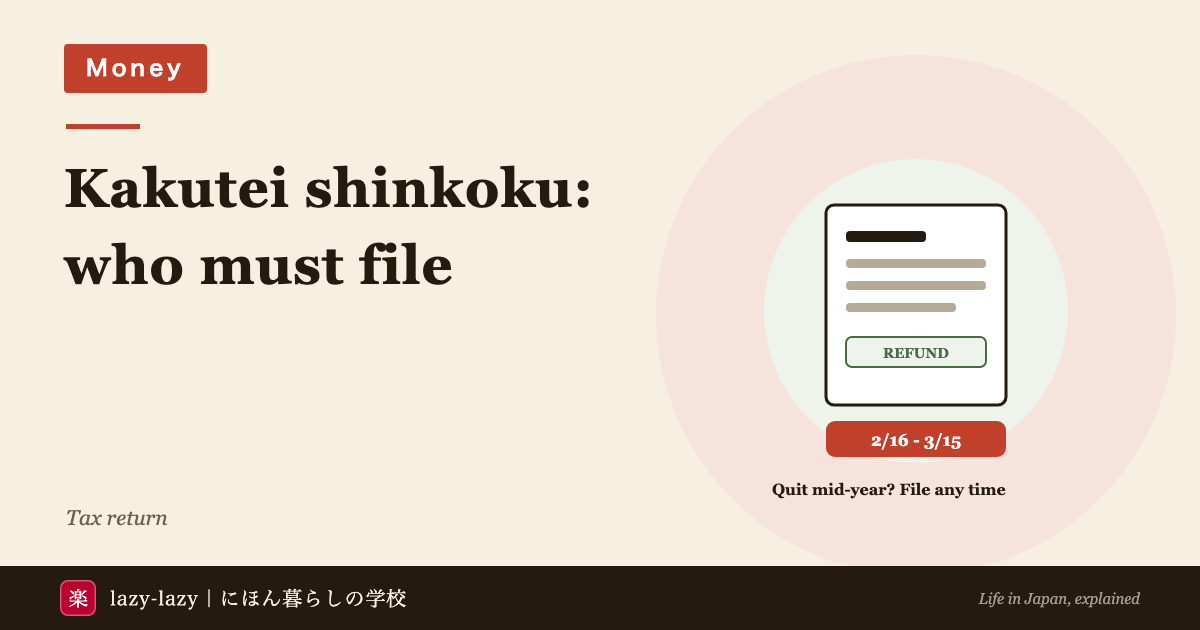
The window is 16 February to 15 March of the following year, and payment is also due 15 March (No. 2020). For 2026 income: 16 February to 15 March 2027.
The easiest route is the NTA’s online filing corner (kakutei shinkokusho-to sakusei corner). Type in the figures from your withholding slip, the tax is calculated automatically, and you submit through e-Tax or print and post it. With a My Number Card (or Special Residence Card) and a smartphone, it is done without leaving home.
What to have ready:
- Withholding slip (gensen choshu hyo) – you can request one from a former employer; they must issue it
- Identity documents – a My Number Card alone is enough. Without one, you need a number document (notification card, or resident record showing the number) plus a photo ID such as a passport. The NTA’s list states that the Special Residence Card counts as a My Number Card
- Proof of deductions – National Health Insurance and pension payment certificates, life-insurance certificates, medical receipts, remittance and relationship documents for family abroad
- A Japanese bank account to receive the refund
What if you miss 15 March?
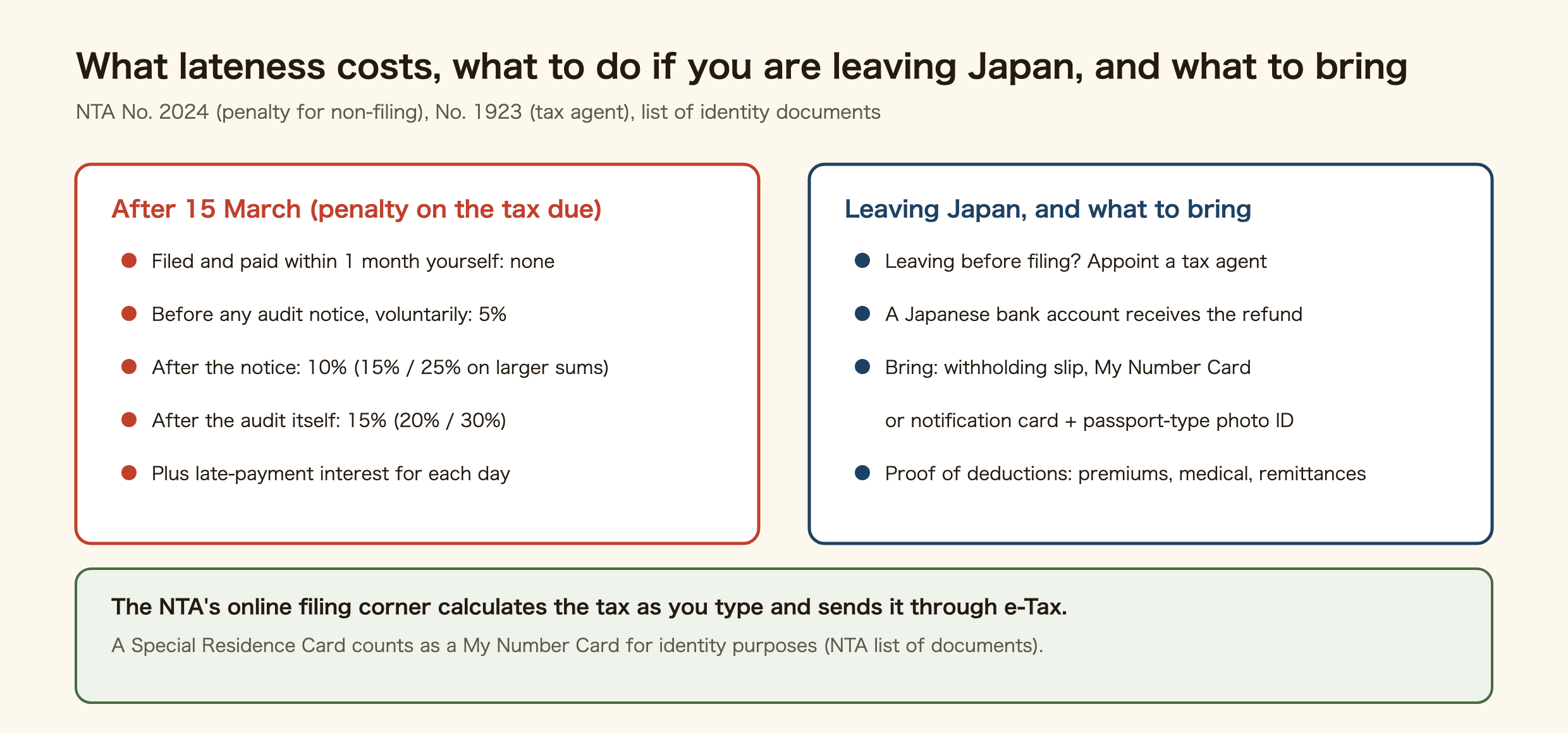
You can still file – a “late return”. But if tax is due, a penalty for non-filing is added on top (No. 2024).
- Filed voluntarily before any audit notice from the tax office: 5% of the tax due
- After a notice, before the audit decides: 10%; 15% on the part over 500,000 yen; 25% on the part over 3 million
- After the audit itself: 15%; 20% over 500,000; 30% over 3 million
- Plus late-payment interest for every day of delay
There is one escape. If you file voluntarily within one month of the deadline, pay the tax in full by the due date, and have had no penalties in the previous five years, no non-filing penalty applies. Realise on 20 March that you forgot, and 15 April is the date that matters.
None of this touches refund returns. No tax is due, so there is no penalty; file any time within five years and the money comes back.
What if you are leaving Japan?
Leave Japan mid-year and give up your address, and you become a non-resident for income-tax purposes. If a return or refund is still needed for that year, appoint a “tax agent” (nozei kanrinin) before departure and file the notification at the tax office (No. 1923). The agent can be a friend staying in Japan, your company, an individual or a corporation. They receive documents, submit the return and collect the refund on your behalf.
If you are an employee and the company runs the year-end adjustment at departure, a return may not be needed at all. Telling your employer early that you are leaving comes first. It is on the leaving-Japan checklist.
Which one are you?
One employer, year-end adjustment done: nothing to do. You can close this page.
Left mid-year, or holding two jobs: gather every withholding slip and open the filing corner. Leavers are filing a refund return, so there is no deadline pressure. Two-job holders over the 200,000-yen line have until 15 March.
Leaving Japan: tell your employer, check whether the departure adjustment covers you, and if not, file the tax-agent notification. In that order.
Frequently asked questions
Q. Do company employees need to file a tax return in Japan?
Not with one employer, a year-end adjustment, and other income of 200,000 yen or less. Two or more employers, side income over 200,000 yen, or salary over 20 million yen means you must.
Q. When is the deadline?
16 February to 15 March of the following year; payment is also due 15 March. For 2026 income, 16 February to 15 March 2027.
Q. I quit mid-year. Do I have to file?
There is no duty, but a refund return gets the over-withheld tax back. It can be filed any time for five years from 1 January of the following year.
Q. Is my residence card accepted as identification?
A My Number Card alone is enough. Without one, combine a notification card or a resident record showing your number with a photo ID such as a passport. A Special Residence Card is treated as a My Number Card.
Q. I missed 15 March.
File now, voluntarily. Before an audit notice the penalty is 5%, and filing within a month with the tax paid in full can mean no penalty at all. Wait for an audit and it is 15% or more.
Q. I am leaving Japan. How do I get my refund?
Appoint a tax agent at the tax office before you go. They file on your behalf and receive the refund into a Japanese account.
Summary
You must file if you have two jobs, side income over 200,000 yen, or salary over 20 million. An employer’s year-end adjustment covers everyone else. Quit mid-year? No duty, but a refund return brings the tax back – any time within five years.
The window is 16 February to 15 March, with an escape if you are less than a month late. Leaving Japan means a tax agent. Bring the withholding slip and My Number Card. Type the numbers into the filing corner and the rest is automatic.
Sources (official): National Tax Agency, Tax Answer No. 2020, the tax return / No. 1900, salaried people who must file / No. 2030, refund returns / No. 2024, if you forgot to file / No. 1923, working abroad and the tax agent / List of identity documents (all checked 17 September 2026)
Found this useful? Share it
Send it to a friend who lives in Japan.
WHO WROTE THIS

mori
Japanese. I read the ministries’ own notices, orders and Q&As in the original, and I start from what my Nepalese and Sri Lankan friends in Japan actually ran into. I do not write about what I have not checked or been told.
What this site can and cannot do →Looking for something else?