Checked on 17 September 2026 against the Immigration Services Agency’s explanation of the system, its press release, and the text of article 22-4 of the Immigration Act on e-Gov. The figures are final numbers for 2025.
In short
- Japan revoked 1,446 statuses of residence in 2025 – a record. 67% were technical intern trainees, 24% students.
- Nine in ten were for “doing nothing”: three months or more without the status’s activity (69%), or doing something else instead (24%).
- Every one of those grounds says “except where there is good reason.” Job-hunting, a leave of absence, a medical certificate – a record of activity is a reason.
- You are always heard before a revocation. You may state your case, submit evidence and see the file.
- Even after revocation, most people get up to 30 days to leave voluntarily. Only entry by deceit means immediate deportation.
You left school. You lost your job and nothing has come up. Plenty of people lie awake wondering whether their visa is about to be cancelled. Far fewer know what the grounds are, how the decision is made, or what they can do first. The agency’s own numbers show that nine in ten revocations were for standing still. Which means moving is what protects you.
- What is revocation of a status of residence?
- What actually gets people revoked? Three idle months, and doing something else
- How are the three months counted? With good reason, passing them does not mean revocation
- What happens before a revocation? You are always heard
- What happens after a revocation? Usually up to 30 days to leave
- What do you do when the notice arrives?
- Who should worry, and who should not
- Frequently asked questions
- Summary
What is revocation of a status of residence?
Revocation is the system under which the Minister of Justice cancels a person’s status of residence when it was obtained by deceit, or when the person has not carried out the activity the status is for over a set period (Immigration Act article 22-4). In everyday English, “my visa got cancelled”.
The law lists ten grounds. They fall into three groups.
- Deceit at entry – (1)(2) permission obtained by fraud, (3) false documents submitted (no intent required), (4) special permission to stay obtained by fraud
- Not doing what the status is for – (5) not engaging in the status’s activity and doing something else; (6) not engaging in it continuously for three months or more; (7) a spouse-status holder not living as a spouse for six months or more
- Address notifications – (8) no address filed within 90 days of landing or a status change; (9) no new address filed within 90 days of moving; (10) a false address filed
Grounds (5) to (9) all carry the words “except where there is good reason.” Those are the most important words in the system.
What actually gets people revoked? Three idle months, and doing something else
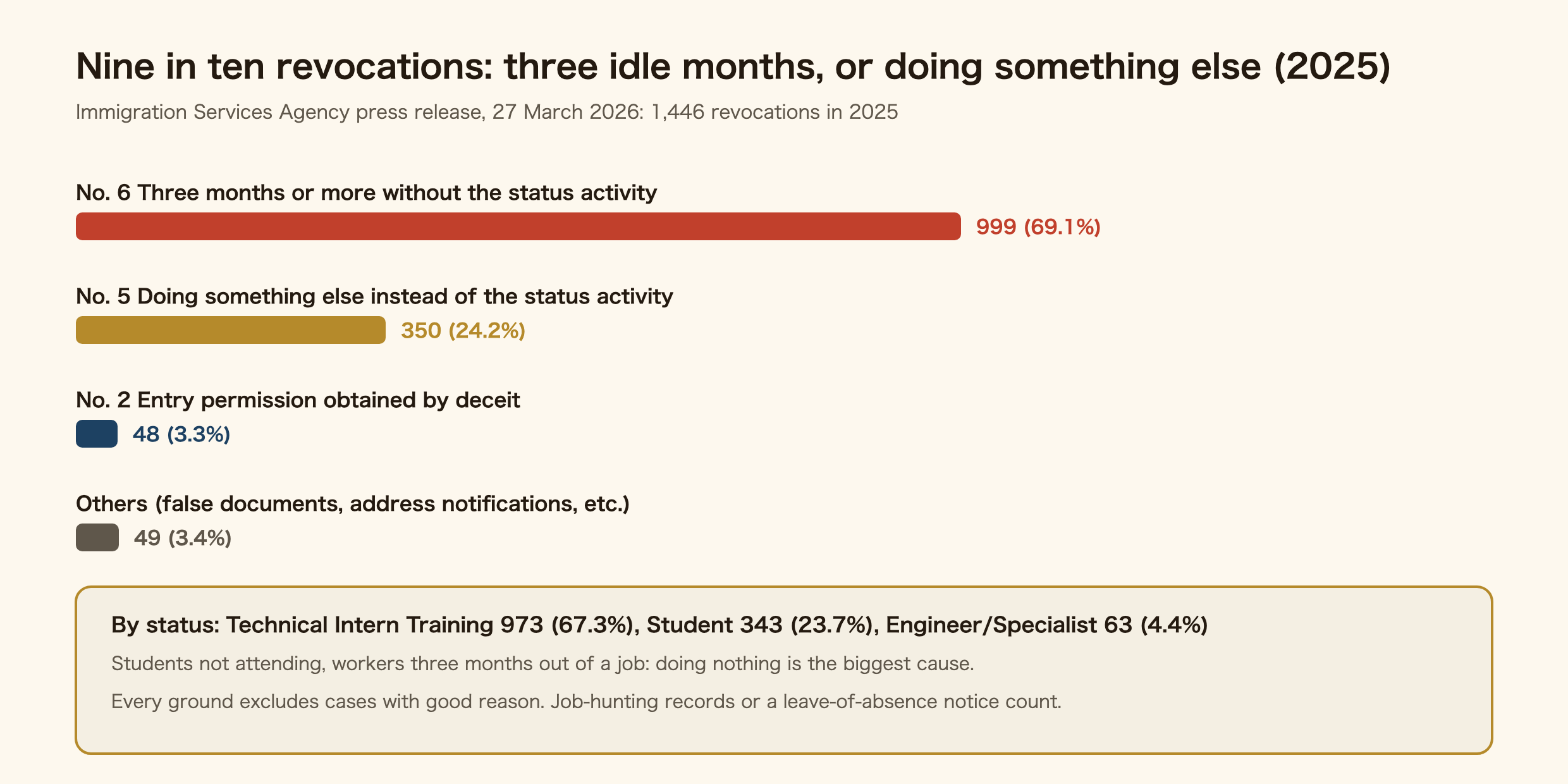
The agency published the 2025 figures on 27 March 2026.
- 1,446 revocations – 262 more (+22.1%) than 2024, the highest ever
- By ground: (6) three months or more idle, 999 (69.1%); (5) doing something else, 350 (24.2%); (2) entry by deceit, 48 (3.3%)
- By status: Technical Intern Training 973 (67.3%), Student 343 (23.7%), Engineer/Specialist in Humanities/International Services 63 (4.4%)
- By nationality: Vietnam 947 (65.5%), Indonesia 94, Sri Lanka 91
So most revocations are not of people who lied. They are students who stopped attending, trainees who left their placement, and workers who lost a job and did nothing for three months. The 343 student cases read, in the main, as people who were no longer enrolled or attending.
How are the three months counted? With good reason, passing them does not mean revocation
Ground (6) reads: not engaging in the status’s activity continuously for three months or more (except where there is good reason).
Two things matter.
- “Continuously” – three months without a break. Resume the activity and the count restarts
- “Except where there is good reason” – with a reason, passing three months does not make you a target. The agency even publishes examples of cases it does not revoke
Good reason can be, for instance, losing your job through the employer’s fault and searching for a new one, a leave of absence for illness or injury (with a medical certificate), or a school’s long vacation. What they have in common is a record. A Hello Work registration slip, application emails, interview dates, a copy of the leave-of-absence form, a doctor’s certificate. Three months with nothing and three months with a paper trail are, in law, completely different things.
For students: the moment you leave school, the “Student” activity stops. Within three months, set one of these in motion – a new school, a change to a work status, or going home.
What happens before a revocation? You are always heard
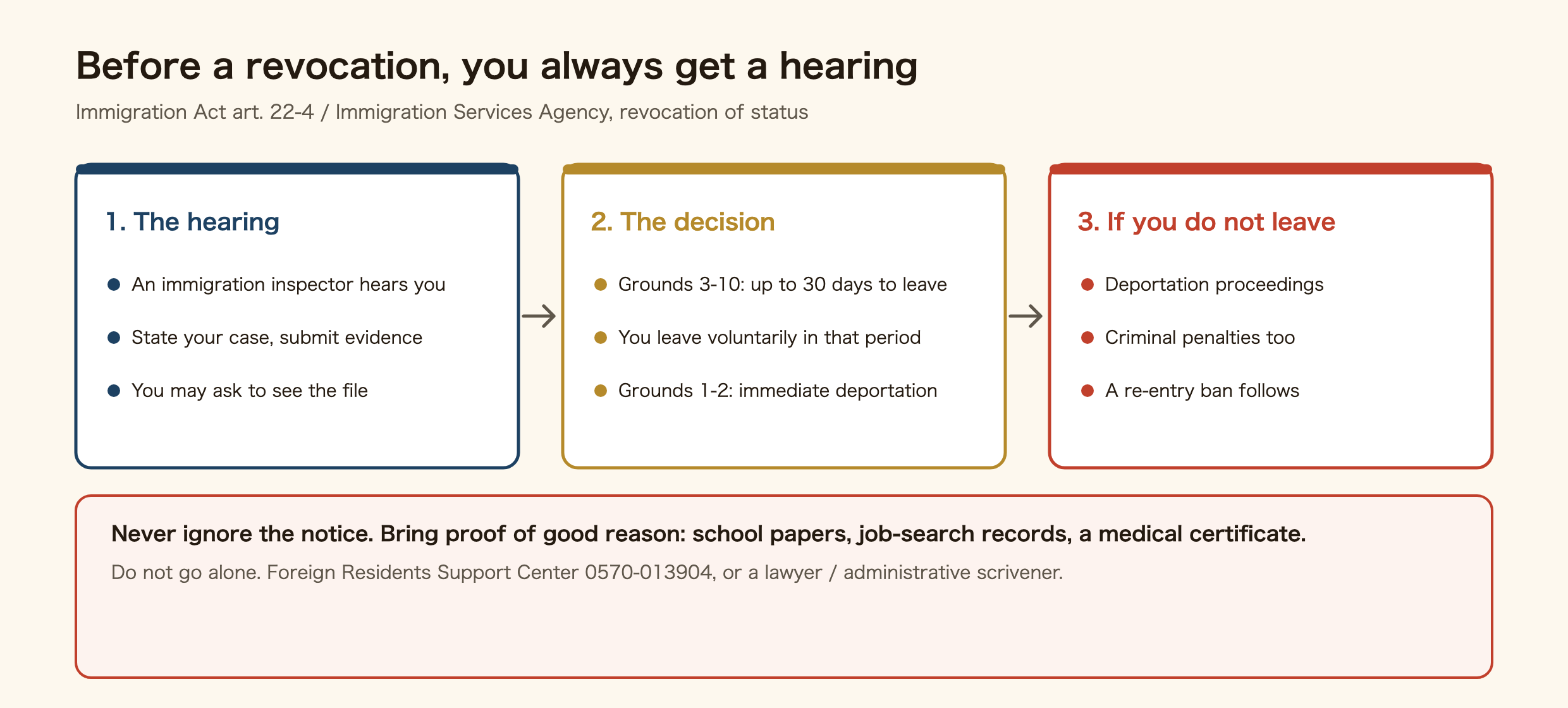
The agency’s page is explicit. When a revocation is intended, an immigration inspector hears the person concerned, who may state opinions, submit evidence and request to inspect the file.
So your card does not simply go dead one morning. A notice arrives, a hearing is held, and you can bring evidence. Not attending, or attending empty-handed, is the single costliest mistake.
What happens after a revocation? Usually up to 30 days to leave
- Grounds (1)(2), entry by deceit: immediate deportation proceedings
- Grounds (3) to (10): a period of up to 30 days is set as the time needed to leave, and you depart voluntarily within it. Under (5), if there are reasonable grounds to suspect you will abscond, deportation is immediate
- If you do not leave within the set period: deportation proceedings, and criminal penalties
Voluntary departure and deportation lead to different futures. Deportation brings a landing ban that closes the door to Japan for years. If you are revoked, leaving within the period is the only way to keep a return possible.
What do you do when the notice arrives?
- Do not ignore it. Attend the hearing. If you do not, your side of the story is never recorded.
- Gather proof of good reason. Enrolment certificate, leave-of-absence form, attendance record, Hello Work slip, application and interview records, medical certificate, notice of dismissal or the company’s bankruptcy.
- Do not go alone. The Foreign Residents Support Center (0570-013904) can advise. A lawyer or administrative scrivener can attend the hearing with you.
- Start moving now. Job-hunting begun after the notice is still job-hunting. The dates go on record.
Who should worry, and who should not
If you attend school or work, and your address is filed, you do not need to worry. Revocation is a system for people who are not doing what their status is for.
If you left school, or have been out of work for two months, act today. The three-month line is close. A new school, a job search, a change of status, a flight home – any of them, so long as it leaves a record.
If you moved and never filed your new address, go to the city office this week. Ground (9)’s 90 days is a revocation ground on its own. The move-in notification doubles as the notification to Immigration.
Frequently asked questions
Q. When can a Japanese visa be cancelled?
For deceit at entry, or for not carrying out the status’s activity. Of 1,446 revocations in 2025, 69% were for three months or more without the activity and 24% for doing something else instead.
Q. Is my status revoked automatically three months after I lose my job?
No. The law says “except where there is good reason”, and job-search records count. A hearing always comes before a revocation.
Q. I left school. What happens to my Student status?
The Student activity stopped when you left. Within three months, set in motion a new school, a change to a work status, or a return home. Do nothing for three months and you become a target.
Q. If my status is revoked, am I deported at once?
Only for entry by deceit. Otherwise a period of up to 30 days is set and you leave voluntarily. Fail to leave in that period and deportation and criminal penalties follow.
Q. What should I bring to the hearing?
Proof of good reason. Enrolment certificate, leave-of-absence form, attendance record, Hello Work slip, application and interview records, medical certificate, dismissal or bankruptcy notice. Bring a lawyer or administrative scrivener if you can.
Q. I forgot to file my address. Will I be revoked?
Failing to file within 90 days of landing or a status change, or within 90 days of moving, is a ground. File the move-in notification at the city office now, and explain the reason for the delay if you have one.
Summary
1,446 revocations in 2025, a record, and nine in ten were for three idle months or doing something else. It is a system aimed at people who stopped moving, not at liars.
Every ground allows good reason, and a hearing always comes first. Keep records, attend when the notice comes, and do not go alone. Even if revoked, leaving within the period keeps a way back open.
Sources (official): Immigration Services Agency, revocation of status of residence (Immigration Act art. 22-4) / the same, revocations in 2025 (press release, 27 March 2026) / Immigration Control and Refugee Recognition Act (e-Gov), article 22-4 (all checked 17 September 2026)
Found this useful? Share it
Send it to a friend who lives in Japan.
WHO WROTE THIS

mori
Japanese. I read the ministries’ own notices, orders and Q&As in the original, and I start from what my Nepalese and Sri Lankan friends in Japan actually ran into. I do not write about what I have not checked or been told.
What this site can and cannot do →Looking for something else?