Checked on 24 September 2026: every number, opening time and language below comes from the official pages of the Immigration Services Agency (information centre, FRESC, the list of local consultation desks), the Ministry of Justice, the Ministry of Health, Labour and Welfare, Houterasu, the Consumer Affairs Agency and the Japan National Tourism Organization.
The short answer
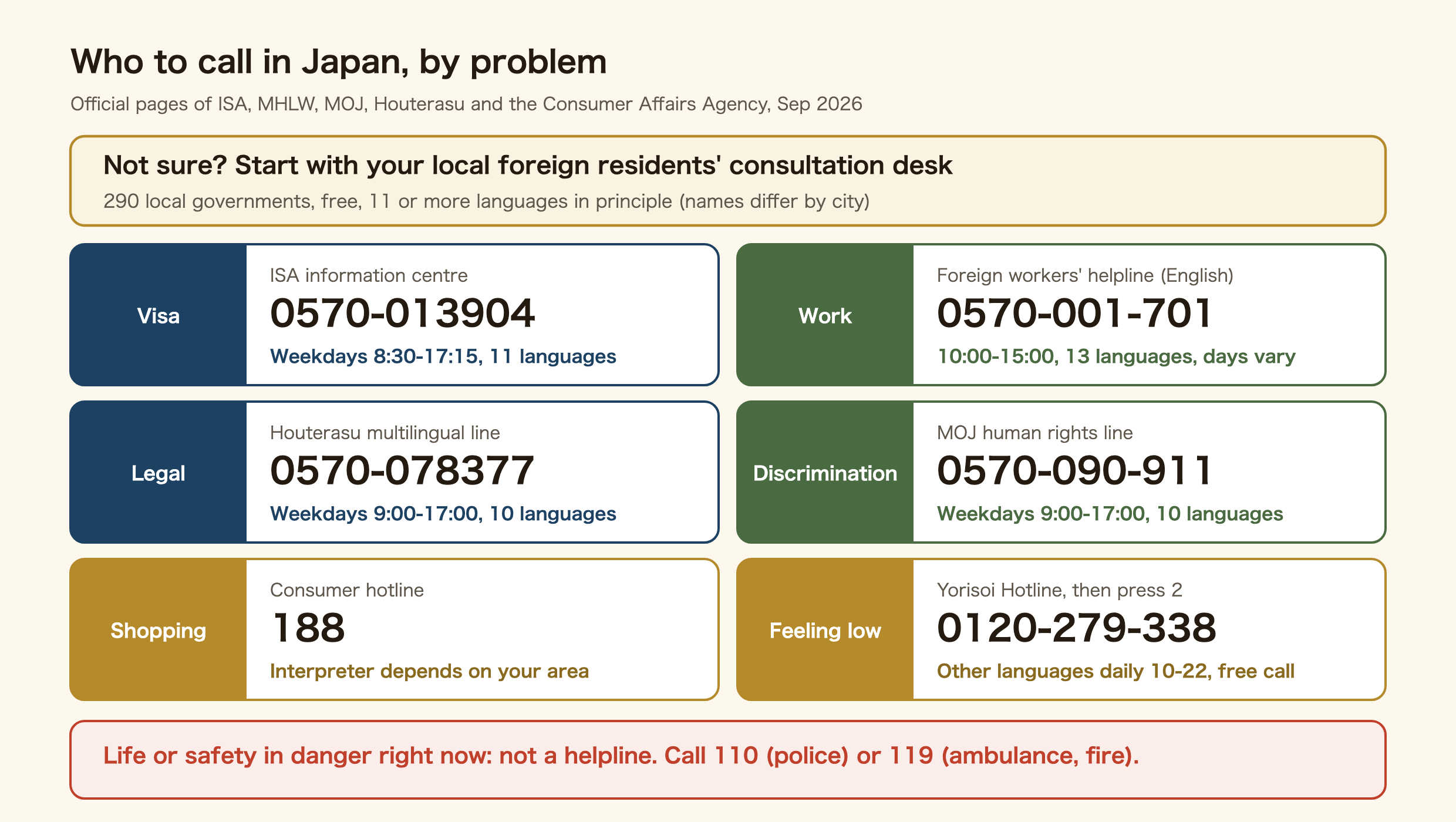
- Not sure where to start? Call your city’s or prefecture’s consultation desk for foreign residents. 290 local governments run one. It is free, and to receive national funding it must work in 11 or more languages in principle.
- Visa and residence card questions: the Immigration Services Agency’s information centre, 0570-013904. Weekdays 8:30 to 17:15, in 11 languages including Sinhala and Burmese.
- Work: the foreign workers’ helpline (English 0570-001-701, 13 languages). Legal trouble: Houterasu, 0570-078377. Discrimination or bullying: the Ministry of Justice, 0570-090-911. All free to consult.
- Shopping and contracts: 188. Feeling low: Yorisoi Hotline, 0120-279-338, then press 2 (other languages daily 10:00 to 22:00, free call).
- If life or safety is at risk right now, skip the helplines and call 110 (police) or 119 (ambulance, fire).
Knowing this, you can make the first call on the day the problem starts, to a line that speaks your language. And if one office sends you elsewhere, you already know where the next call goes.
A letter from your letting agent you cannot read. A payslip that looks short. A residence card about to expire and no idea what to submit. You ask a Japanese friend where people go with this, and the answer is “city hall, maybe?” They are not being unhelpful. The help desks for foreign residents simply never come up in a Japanese person’s life. They exist. There is just a different number, and a different set of languages, for each kind of problem.
- Where can foreigners get help in Japan? Helplines by problem
- What is a local consultation desk for foreign residents?
- What is FRESC, the Foreign Residents Support Center?
- Is there an immigration helpline in English? The information centre
- Where do foreign workers get help? The foreign workers’ helpline
- Can foreigners get free legal advice in Japan? Houterasu’s multilingual line
- Where do I report discrimination? The foreign-language human rights line
- How do I find a doctor who speaks my language?
- Shopping or contract trouble? Consumer hotline 188
- Is there a mental health hotline in English? Yorisoi Hotline
- Which helpline speaks my language?
- How much does it cost to call?
- What should I have ready before I call?
- Which deadlines keep running while I look for help?
- What if nobody answers, or it is after hours?
- Will what I say be kept confidential?
- Which one are you?
- FAQ
- Summary
- Related reading
Where can foreigners get help in Japan? Helplines by problem
These are the public help lines foreign residents can use, sorted by problem. Numbers, hours and languages were checked on each organization’s official page on 24 September 2026.
| Problem | Who to call | Hours | Languages |
|---|---|---|---|
| Anything / don’t know where to ask | Your local consultation desk for foreign residents | Varies | 11+ in principle |
| Visa, residence card, residence procedures | ISA information centre 0570-013904 | Weekdays 8:30-17:15 | 11 |
| Several government desks in one place (Tokyo) | FRESC 0570-011000 | Weekdays 9:00-17:00 | Japanese / English menu |
| Work: pay, dismissal, harassment | Foreign workers’ helpline (English 0570-001-701) | 10:00-15:00, lunch break | 13, days vary |
| Legal problems: debt, divorce, accidents | Houterasu multilingual line 0570-078377 | Weekdays 9:00-17:00 | 10 + easy Japanese |
| Discrimination, bullying | MOJ foreign-language human rights line 0570-090-911 | Weekdays 9:00-17:00 | 10 |
| Finding a doctor | JNTO medical search / prefectural desks | Search any time | By clinic or desk |
| Shopping, contracts, pushy sellers | Consumer hotline 188 | Local office hours | Interpreter depends on area |
| Feeling low, need to talk | Yorisoi Hotline 0120-279-338, press 2 | Other languages daily 10:00-22:00 | 10 |
| Mental health (in Japanese) | Mental health line 0570-064-556 | Set by prefecture | Japanese |
When someone’s life or body is in danger now, none of these apply: call 110 or 119. What to say on a 119 call, how the interpreter joins, and the number for “should I call an ambulance?” are in how to call an ambulance in Japan.
What is a local consultation desk for foreign residents?
A one-stop consultation desk (ichigenteki sodan madoguchi) is a help desk run by a prefecture or city that answers foreign residents’ questions about daily life in several languages: residence procedures, work, medical care, welfare, pregnancy and childcare, and children’s schooling. The Immigration Services Agency funds them through a grant.
Each one has its own name, usually something like “foreign residents consultation centre” or “multilingual consultation” in Japanese (外国人相談センター, 多言語相談).
At the end of March 2026, 290 local governments were running one, including all 47 prefectures. If your town has none, call the prefecture’s desk: a prefecture that takes the grant must also accept calls from areas without a desk of their own.
The grant comes with other conditions that matter to you. From the agency’s rules:
- Free consultation all year round (open five days a week or more, in principle)
- At least 11 languages in principle: Japanese, English, Chinese, Korean, Vietnamese, Nepali, Indonesian, Filipino, Thai, Portuguese and Spanish. An area may swap in languages it needs more, such as Khmer or Burmese, and may use phone interpreters or translation devices
- Keep what you say confidential
- Do not use the consultation to sell you paid advice or paid paperwork services
Because of the last rule, if a free desk nudges you toward a paid agent, you do not have to decide on the spot.
To find yours, open the agency’s spreadsheet of one-stop desks (the “current status” list on its grant page). It gives each desk’s name, address, phone number and opening days by prefecture. Tokyo’s is the metropolitan government’s multilingual consultation line, TMC Navi (東京都多言語相談ナビ, 0120-142-142, weekdays 10:00 to 16:00). Osaka Prefecture’s is the information corner for foreign residents run by its international exchange foundation, OFIX (大阪府外国人情報コーナー, 06-6941-2297, weekdays 9:30 to 17:30, with some extra hours). Languages differ by desk, so check the city’s own page before you call.
What is FRESC, the Foreign Residents Support Center?
The Foreign Residents Support Center (FRESC) is an Immigration Services Agency facility where several government desks for foreign residents share one floor: the 13th floor of Yotsuya Tower in Tokyo. There are no branches elsewhere.
The main number is 0570-011000 (weekdays 9:00 to 17:00). Choose Japanese or English, then press the number of the office you want: 1 for the Tokyo Regional Immigration Services Bureau’s residence consultation, 2 for the Tokyo Labour Bureau, 3 for the Tokyo Employment Service Center for Foreigners, 4 for the Legal Affairs Bureau’s human rights desk, 6 for Houterasu.
Face-to-face residence consultations need a booking (reservation line 03-5363-3025, or online). One limit to know: you cannot do residence card procedures or hand in notifications at FRESC. Renewals and changes of status are filed at your regional immigration office or through the online residence application system.
If you live outside Tokyo and want to ask about your visa by phone, the next number is the one to call.
Is there an immigration helpline in English? The information centre
Questions about your status, extending your period of stay, the residence card or re-entry go to the Immigration Services Agency’s information centre (Gaikokujin Zairyu Sogo Information Center), 0570-013904. You can call it from anywhere in Japan.
- Hours: weekdays 8:30 to 17:15 (closed weekends, holidays, 29 December to 3 January)
- Languages: Japanese, English, Chinese, Korean, Spanish, Portuguese, Vietnamese, Nepali, Thai, Burmese, Sinhala
- From an IP phone or from abroad: 03-5796-7112
- Email: through the agency’s form, Japanese and English only
It answers general questions about procedures, the kind of information that is on the agency’s website. It cannot tell you when your own application will be decided, or whether it is likely to be approved. The agency says the section handling your case cannot answer that either.
Where do foreign workers get help? The foreign workers’ helpline
Unpaid wages, sudden dismissal, power harassment. The labour ministry’s helpline for foreign workers takes calls in 13 languages, 10:00 to 15:00 (not 12:00 to 13:00). English is 0570-001-701, Monday to Friday; each other language has its own number and days. On weekday evenings and weekends there is the free Working Conditions Hotline (English 0120-531-401).
The number and days for every language, which office can actually make your employer act, and what to write down before you report are in where to report power harassment and unpaid wages. If you are still job-hunting, the Hello Work centres for foreigners have interpreters.
Can foreigners get free legal advice in Japan? Houterasu’s multilingual line
Debt, divorce, a traffic accident, a deposit that never came back. For anything with a legal side, call the multilingual information service of Houterasu, the Japan Legal Support Center, on 0570-078377.
- Hours: weekdays 9:00 to 17:00
- Languages: English, Chinese, Korean, Spanish, Portuguese, Vietnamese, Tagalog, Nepali, Thai, Indonesian, plus easy Japanese
- From an IP phone or prepaid mobile: 050-3754-5430
- A three-way call with an interpreter; the information is free, the call is charged at normal rates
What you get is which legal system applies and where to take it. To see a lawyer for free, there is Civil Legal Aid, open to foreign nationals living in Japan lawfully. It is means-tested: for a single person, monthly income up to about 182,000 yen (200,200 yen in large cities such as Tokyo and Osaka) and assets up to 1.8 million yen. Criminal cases are not covered.
Where do I report discrimination? The foreign-language human rights line
A landlord refused you because you are foreign. Your child is being bullied at school. Human rights problems like these go to the Ministry of Justice’s foreign-language human rights line, 0570-090-911.
It runs on weekdays 9:00 to 17:00 (closed over New Year) in 10 languages: English, Chinese, Korean, Filipino, Portuguese, Vietnamese, Nepali, Spanish, Indonesian and Thai. The call goes through an interpreting company to the Legal Affairs Bureau for your area. The ministry also takes online consultations in the same 10 languages.
How do I find a doctor who speaks my language?
The Japan National Tourism Organization runs a medical institution search. It was built for travellers, but anyone can open it without signing up. You filter by prefecture, language and department, and hospitals chosen by the prefecture as core facilities for foreign patients are marked.
To ask which hospital to go to in your own language, use your prefecture’s desk; the health ministry keeps a list of these by prefecture, with languages. Once you have a hospital, know that the hospital books the interpreter, and cannot charge you for one without your signed consent. How a visit works and what to say at reception are in seeing a doctor in Japan.
Shopping or contract trouble? Consumer hotline 188
You signed with a salesperson at your door. A parcel you never ordered turned up. The move-out bill is far too high. Money and contract problems go to the consumer hotline, 188. Enter your postcode and you are put through to the nearest consumer affairs centre.
Foreign-language support depends on where you live. According to the Consumer Affairs Agency, as of 1 April 2022, 31 prefectures and 460 municipalities had arrangements such as interpreters in place. When someone answers, ask first whether an interpreter is available. If not, call back with someone who speaks Japanese, or go to your local consultation desk for foreign residents first.
A contract signed with a door-to-door seller may be cancellable within the 8-day cooling-off period. And if a caller claiming to be the police or immigration asks for money, suspect a scam before anything else.
Is there a mental health hotline in English? Yorisoi Hotline
You cannot sleep. There is no one to talk to. You find yourself wishing you could disappear. Call Yorisoi Hotline on 0120-279-338 and press 2 when the recorded message plays. That puts you through to the foreign-language line.
The foreign-language line is open every day from 10:00 to 22:00 and covers 10 languages; which languages are available on which day is posted monthly on its official page. It is a freephone number, so the call itself is free (from an IP phone starting 050, use 050-3655-0279).
If you can talk in Japanese, there is also the national mental health line, 0570-064-556, which connects you to the public counselling service of the prefecture you are calling from. Days and hours are set by each prefecture, and it cannot be reached from 050 IP phones.
Which helpline speaks my language?
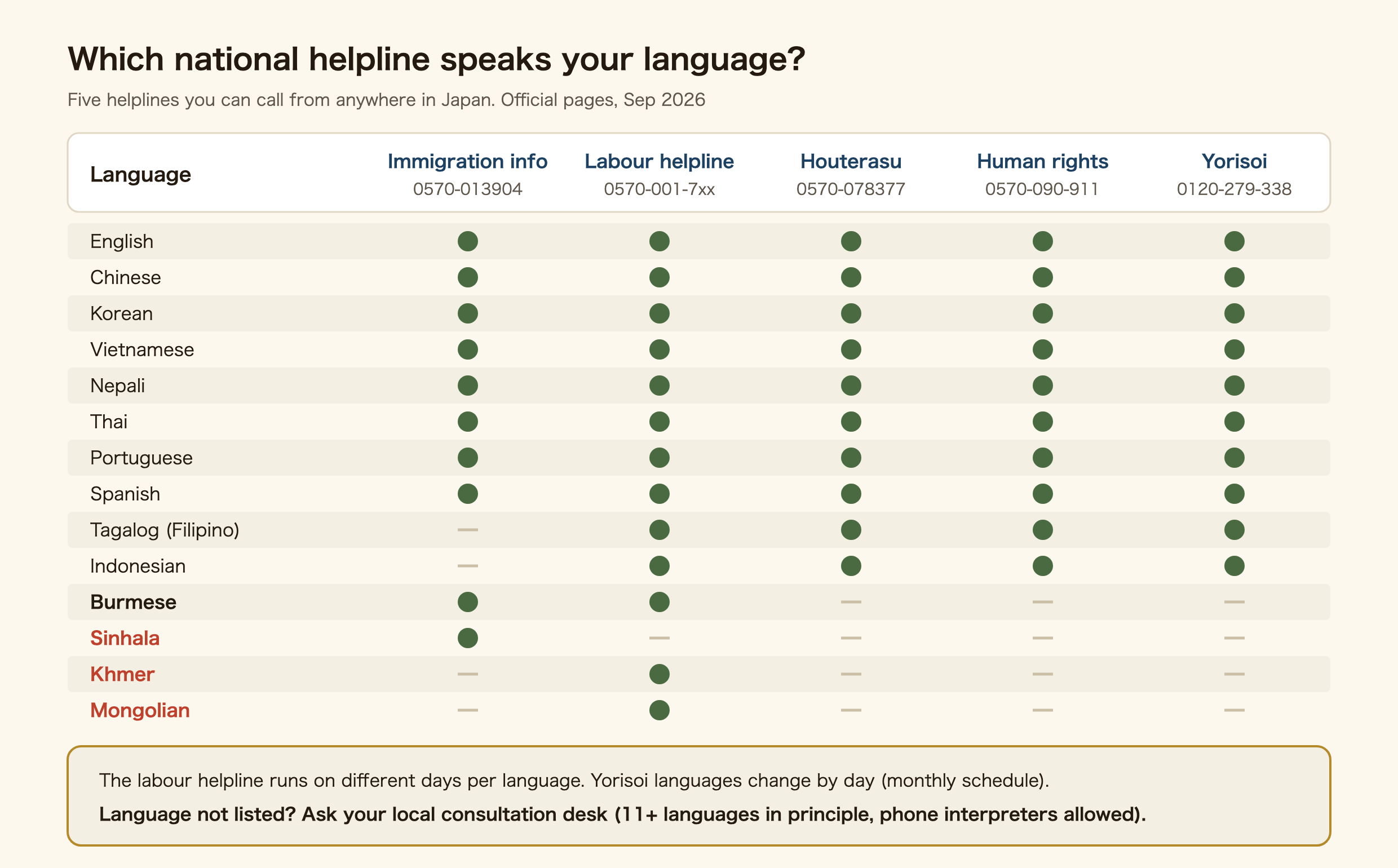
Put the five nationwide lines side by side and the gaps show. Sinhala is only spoken at the immigration information centre. Khmer and Mongolian are only on the labour helpline. And Tagalog (Filipino) and Indonesian are not available at the immigration information centre at all.
If your language is not in the table, ask your local consultation desk whether it can use a phone interpreter or a translation device. The grant rules explicitly allow both.
How much does it cost to call?
Every service in this article is free to consult. What you pay for is the phone call. Numbers starting 0120 (Yorisoi Hotline, the Working Conditions Hotline) are free to call. Numbers starting 0570 (Navi Dial) and 188 are charged, and your mobile plan’s unlimited calls do not cover them, as the health ministry and the Consumer Affairs Agency both point out.
Each service states the charge differently. For 188 and the foreign workers’ helpline it is 11 yen per 20 seconds from a mobile and 9.35 yen per 180 seconds from a landline. Ten minutes on a mobile is 30 blocks of 20 seconds: 330 yen. For a long call, a landline or a service with an 0120 number costs less.
What should I have ready before I call?
There is no standard list of documents. For 188 you enter your postcode, not your phone area code; the wrong one sends you to the wrong area. FRESC’s face-to-face residence consultations need a booking. Beyond that, have a note of when, who and what happened, and the papers in front of you: the contract, the payslip, the letter you received.
Which deadlines keep running while I look for help?
Legal deadlines do not wait while you search for the right office. These are the ones most easily missed.
- Cooling-off on a door-to-door sale: 8 days, counted from the day you received the contract document (Act on Specified Commercial Transactions, Article 9)
- Claiming unpaid wages: 3 years before the claim expires (Labor Standards Act, Articles 115 and 143)
- Registering your new address after moving: within 14 days (Immigration Control Act, Article 19-9)
- Telling Immigration you left or changed your employer or school: within 14 days (Immigration Control Act, Article 19-16)
Even before you know who to ask, act on anything with a deadline. A cooling-off notice can be posted without waiting for advice.
What if nobody answers, or it is after hours?
Most national lines only work on weekday daytimes. Here is the next step for each case.
- 188 is engaged: the National Consumer Affairs Center’s backup line, 03-3446-0999 (weekdays 10:00 to 16:00)
- Work problem in the evening or at the weekend: the Working Conditions Hotline (weekdays 17:00 to 22:00, weekends and holidays 9:00 to 21:00, free)
- A bad night: Yorisoi Hotline (other languages until 22:00 every day; Japanese 24 hours)
- The immigration information centre is busy: avoid the first working day after a holiday and 11:00 to 12:00. In English or Japanese, the email form is another route
For the police when it is not an emergency, the non-emergency number is #9110. It takes calls on weekdays 8:30 to 17:15, though hours differ by prefectural police.
Will what I say be kept confidential?
Local one-stop desks must keep your consultation confidential as a condition of their grant. Houterasu’s multilingual line and Yorisoi Hotline also say they keep what you tell them confidential. At the same time, calls to the immigration information centre and to Houterasu are recorded to improve the service. If that matters to you, ask at the start whether the call is recorded.
Which one are you?
- You are not even sure what the problem is — save your local consultation desk’s number in your phone today, and check which days it speaks your language.
- You are stuck on a visa or residence card procedure — call 0570-013904 on a weekday, early or in the afternoon. Write your question in one line before you dial.
- You are in a dispute over work, money or a contract — check the deadlines first (8 days, 3 years, 14 days), then call one of the labour helpline, 188 or Houterasu today.
- You are struggling and have no one to talk to — before 22:00 tonight, call 0120-279-338 and press 2. The call is free.
FAQ
Q. Where can foreigners get help in Japan?
If you do not know where to start, call your city’s or prefecture’s consultation desk for foreign residents. 290 local governments run one and it is free. Visa questions go to the Immigration Services Agency’s information centre on 0570-013904.
Q. What is FRESC?
The Foreign Residents Support Center, an Immigration Services Agency facility in Yotsuya, Tokyo, where several government desks for foreign residents share one floor. The main number is 0570-011000 (weekdays 9:00 to 17:00). You cannot do residence card procedures there.
Q. Is there an immigration helpline in English?
Yes. The Immigration Services Agency’s information centre, 0570-013904, answers in Japanese, English, Chinese, Korean, Spanish, Portuguese, Vietnamese, Nepali, Thai, Burmese and Sinhala, weekdays 8:30 to 17:15. Its email form is Japanese and English only.
Q. Where is the list of local consultation desks?
On the Immigration Services Agency’s page about its grant for accepting foreign nationals, as a spreadsheet and PDF of the current one-stop desks. It lists each desk’s name, address, phone number and opening days.
Q. Can foreigners get free legal advice in Japan?
Houterasu’s multilingual line, 0570-078377 (weekdays 9:00 to 17:00), gives free information on legal options and where to go; the call is charged. Free consultations with a lawyer are open to foreign nationals living in Japan lawfully, subject to income and asset limits.
Q. Is there any helpline in English at night or at weekends?
Yorisoi Hotline’s foreign-language line (0120-279-338, then press 2) is open daily 10:00 to 22:00. For work problems, the Working Conditions Hotline runs weekday evenings 17:00 to 22:00 and weekends 9:00 to 21:00 (English 0120-531-401). Both are free to call.
Summary
Help for foreigners in Japan is split by problem. Visa: 0570-013904. Work: the foreign workers’ helpline. Legal: Houterasu. Discrimination: 0570-090-911. Contracts: 188. Feeling low: 0120-279-338, then 2. When you do not know where to start, start with your local consultation desk for foreign residents.
The national lines mostly run on weekday daytimes, and the languages differ from line to line. Look for numbers only once you are in trouble and the whole day goes on it. Save two numbers that speak your language while things are calm.
Official sources: Immigration Services Agency, information centre (Japanese) / ISA, FRESC contacts (Japanese) / ISA, grant for one-stop consultation desks, desk list and rules (Japanese) / MHLW, counseling services and hotlines in foreign languages / Houterasu, For Foreign Nationals / Ministry of Justice, human rights counseling for foreign nationals / JNTO, guide for when you are feeling ill / MHLW, prefectural consultation desks (English) / Consumer Affairs Agency, consumer hotline 188 (Japanese) / MHLW, phone counselling (Japanese) / Yorisoi Hotline, helpline for foreign people. Checked on 24 September 2026. Numbers, hours and languages can change, so check the official page before you call.
Related reading
Found this useful? Share it
Send it to a friend who lives in Japan.
WHO WROTE THIS

mori
Japanese. I read the ministries’ own notices, orders and Q&As in the original, and I start from what my Nepalese and Sri Lankan friends in Japan actually ran into. I do not write about what I have not checked or been told.
What this site can and cannot do →Looking for something else?