Checked on 23 September 2026 against the Ministry of Health, Labour and Welfare’s pages on the General Labour Consultation Corners, foreign-language help lines, individual labour dispute resolution and workplace harassment, the Labor Standards Act and the Comprehensive Labour Policy Promotion Act (e-Gov), and the foreign-language services of the Ministry of Justice and Houterasu.
The short answer
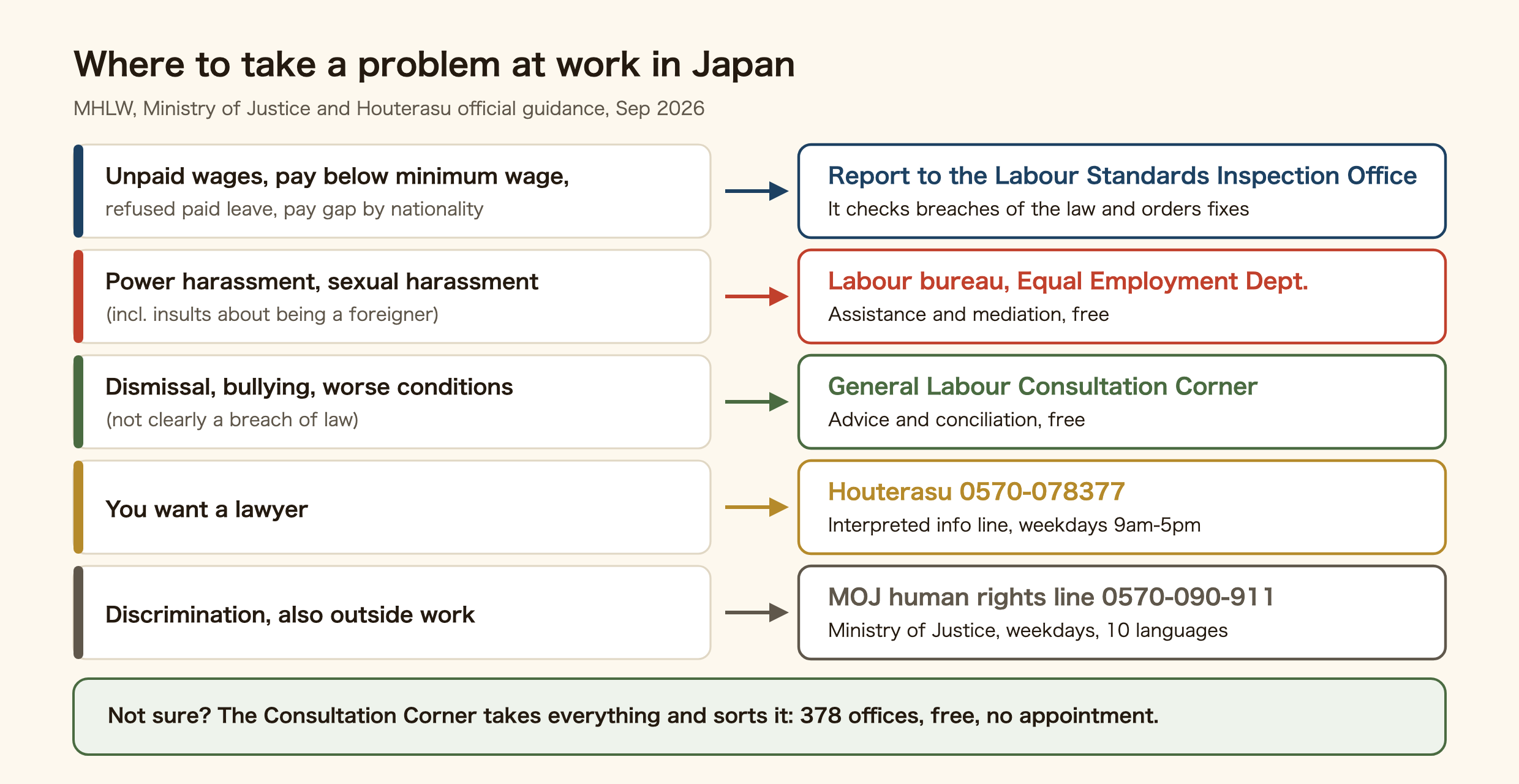
- Not sure where to go? Start at a General Labour Consultation Corner. There are 378 across Japan, run by the national labour bureaus. Free, no appointment, and open to foreign workers in many languages.
- Unpaid wages, pay below the minimum wage, refused paid leave — breaches of the Labor Standards Act can be reported to the Labour Standards Inspection Office. An inspector checks the company and orders it to fix what is wrong.
- Power harassment is something your employer is legally required to prevent. The ministry lists contemptuous remarks about being a foreigner as an example of it.
- You can call in your language. A free hotline (English 0120-531-401, weekday evenings and weekends) and a paid line on weekday daytimes. Days differ by language.
- Firing or punishing you for reporting or asking for help is illegal. Before you go, note the date, place, words used, who said them and who saw it.
Knowing this, you know which office to go to and what to bring from the first call, so you are not passed around and can start a free process that actually moves.
Your manager at the convenience store shouts at you in front of everyone on every night shift. “You don’t get it because you’re a foreigner.” You quit, and your last month’s pay never arrives. A Japanese friend says, “Just go to the rodo kijun” — the labour inspection office. But does that office deal with harassment? Will your employer be told your name? Your friend does not know. Someone who has never had to fight an employer has never needed these offices.
- Where can foreign workers report power harassment or unpaid wages in Japan?
- Is there a labour help line in English? Numbers and days by language
- What can the Labour Standards Inspection Office do, and what can it not?
- Will my employer find out if I go to the labour inspection office?
- What is power harassment in Japan? The legal definition and six types
- What does Japan’s Power Harassment Prevention Act require of employers?
- Where do I report sexual harassment or discrimination at work?
- How do I settle it with my employer? Free advice, conciliation and mediation
- Can a union or Houterasu help?
- What should I record before I report?
- How much does it cost?
- How long can I claim unpaid wages?
- What if I am fired for complaining?
- Which one are you?
- FAQ
- Q. Where can foreign workers report problems at work in Japan?
- Q. Can I report power harassment to the Labour Standards Inspection Office?
- Q. Will my employer know I reported them?
- Q. Is there a labour help line in English in Japan?
- Q. Can I be fired for reporting?
- Q. How long can I claim unpaid wages in Japan?
- Summary
- Related reading
Where can foreign workers report power harassment or unpaid wages in Japan?
If you are not sure where to start, go to a General Labour Consultation Corner (sogo rodo sodan corner). There are 378 of them, in the prefectural labour bureaus and inside labour standards inspection offices around the country.
The ministry says they cover “labour problems of every kind”: dismissal, non-renewal of contracts, transfers, pay cuts, bullying and harassment, power harassment and more. They take questions from students, and consultations from foreign workers in many languages.
- Free, no appointment, in person or by phone
- Closed on weekends, public holidays and 29 December to 3 January
- The ministry’s harassment page says you can consult anonymously
Counsellors are sometimes out, so call before you go. If your problem is a breach of the law, the Corner passes it to the inspection office. You do not need to know which law applies before you go; they sort it out for you.
Is there a labour help line in English? Numbers and days by language
The ministry runs two phone lines for working conditions — pay, hours, leave — in foreign languages.
- Telephone Consultation Service for Foreign Workers — weekdays 10am to 3pm, closed noon to 1pm. Call charges apply: 9.35 yen per 180 seconds from a landline, 11 yen per 20 seconds from a mobile.
- Working Conditions Consultation Hotline — weekdays 5pm to 10pm, weekends and holidays 9am to 9pm. Free.
| Language | Consultation Service (weekday daytime, paid) | Hotline (evenings and weekends, free) |
|---|---|---|
| English | 0570-001-701 (Mon–Fri) | 0120-531-401 (every day) |
| Chinese | 0570-001-702 (Mon–Fri) | 0120-531-402 (every day) |
| Portuguese | 0570-001-703 (Mon–Fri) | 0120-531-403 (Mon–Sat) |
| Spanish | 0570-001-704 (Mon–Fri) | 0120-531-404 (Thu, Fri, Sat) |
| Tagalog | 0570-001-705 (Mon–Fri) | 0120-531-405 (Tue, Wed, Sat) |
| Vietnamese | 0570-001-706 (Mon–Fri) | 0120-531-406 (Tue, Wed, Fri, Sat, Sun) |
| Burmese | 0570-001-707 (Tue, Wed, Fri) | 0120-531-407 (Wed, Sun) |
| Nepali | 0570-001-708 (Mon–Fri) | 0120-531-408 (Wed, Sun) |
| Korean | 0570-001-709 (Tue–Fri) | 0120-613-801 (Thu, Sun) |
| Thai | 0570-001-712 (Tue, Thu) | 0120-613-802 (Thu, Sun) |
| Indonesian | 0570-001-715 (Tue, Thu) | 0120-613-803 (Thu, Sun) |
| Khmer | 0570-001-716 (Wed) | 0120-613-804 (Mon, Sat) |
| Mongolian | 0570-001-718 (Fri) | 0120-613-805 (Mon, Sat) |
| Japanese | — | 0120-811-610 (every day) |
Both close over New Year. The table is the ministry’s list “as of August 2026”, and days or hours can change temporarily. For a face-to-face consultation in your language, some labour bureaus and inspection offices have a Foreign Workers Consultation Corner; the same ministry page lists them by prefecture.
What can the Labour Standards Inspection Office do, and what can it not?
The Labour Standards Inspection Office (rodo kijun kantokusho) makes employers obey the Labor Standards Act and related laws. The ministry says it is the place for “breaches of the law on wages, working hours, dismissal and so on”.
Telling an inspector about a breach and asking for action is called a “report” (shinkoku, Article 104). The office visits the workplace or calls in the employer to check the facts, and orders the breach to be fixed. Serious, malicious cases can be sent to prosecutors.
- Your pay is not paid, not paid in full, or not paid on a fixed day each month (Article 24)
- You are paid less or given different hours because of your nationality (Article 3)
- Your hourly pay is below your prefecture’s minimum wage
- You qualify but are refused paid leave
Changes to your conditions or a dismissal that do not directly break a law belong to the Consultation Corner. Power harassment falls under a different law, the Comprehensive Labour Policy Promotion Act, so it goes to the labour bureau. Because Consultation Corners sit inside many inspection offices, you may walk into the same building either way; the desk depends on what you came for.
Will my employer find out if I go to the labour inspection office?
According to the Yamanashi Labour Bureau, when the office investigates a report it normally tells the company that a report was made. But it asks you first whether it may do so. If you do not want your name used, say so when you report.
If you only want advice, the Consultation Corner accepts anonymous consultations. You can ask anonymously first, learn what your problem counts as, and then decide whether to report.
What is power harassment in Japan? The legal definition and six types
Under the ministry’s definition, workplace power harassment meets all three of these: (1) conduct backed by a position the victim cannot easily resist, such as a boss’s; (2) conduct that goes beyond what the work needs; and (3) conduct that harms the working environment. Firm instructions that the work genuinely needs are not harassment. Conduct that causes severe distress can count even once. Part-timers and contract staff are covered too.
The six typical types:
- Physical attacks — hitting, kicking, throwing things
- Mental attacks — threats, attacks on your character in front of others, abusive language
- Isolation — taking you off work, separating you, group silent treatment
- Excessive demands — forcing plainly pointless or impossible work on you
- Too little work — only trivial tasks for no reason, or no work at all
- Intrusion into private life — watching you outside work, spreading your medical or other private information
The ministry’s harassment pamphlet, updated in July 2026, adds a note to its example of attacking someone’s character: it includes contemptuous remarks about being a foreigner, coming from a particular country or region, or having roots there. “That’s foreigners for you” is not just rudeness.
What does Japan’s Power Harassment Prevention Act require of employers?
“Power Harassment Prevention Act” is the popular name. The law is the Comprehensive Labour Policy Promotion Act. Preventing power harassment became a legal duty for employers on 1 June 2020, and for small and medium-sized companies on 1 April 2022.
The employer must set and announce a policy against harassment and set up a place to consult. When someone consults, it must check the facts, protect the victim, deal with the person responsible and prevent a repeat. If your company has no such desk, does nothing, or you are afraid to speak up inside, use the outside offices. Employers that ignore the duty can be advised, instructed and recommended to act by the state, and named publicly if they ignore the recommendation.
One more change matters if you serve customers. From 1 October 2026, employers must also take measures against customer harassment — serious abuse from customers (MHLW).
Where do I report sexual harassment or discrimination at work?
Employers also have a legal duty to prevent sexual harassment (Equal Employment Opportunity Act, Article 11). Men and women can both be victims. It covers conduct from the same sex and from customers or business partners. Go to a Consultation Corner or the labour bureau’s Employment Environment and Equal Employment Department.
Different pay or hours because of your nationality breaks Article 3 of the Labor Standards Act, and you can report it to the inspection office. The penalty is up to six months’ imprisonment or a fine of up to 300,000 yen (Article 119). For discrimination outside work as well, the Ministry of Justice runs a foreign-language human rights line: 0570-090-911, weekdays 9am to 5pm, in 10 languages including English, Chinese, Vietnamese and Nepali.
How do I settle it with my employer? Free advice, conciliation and mediation
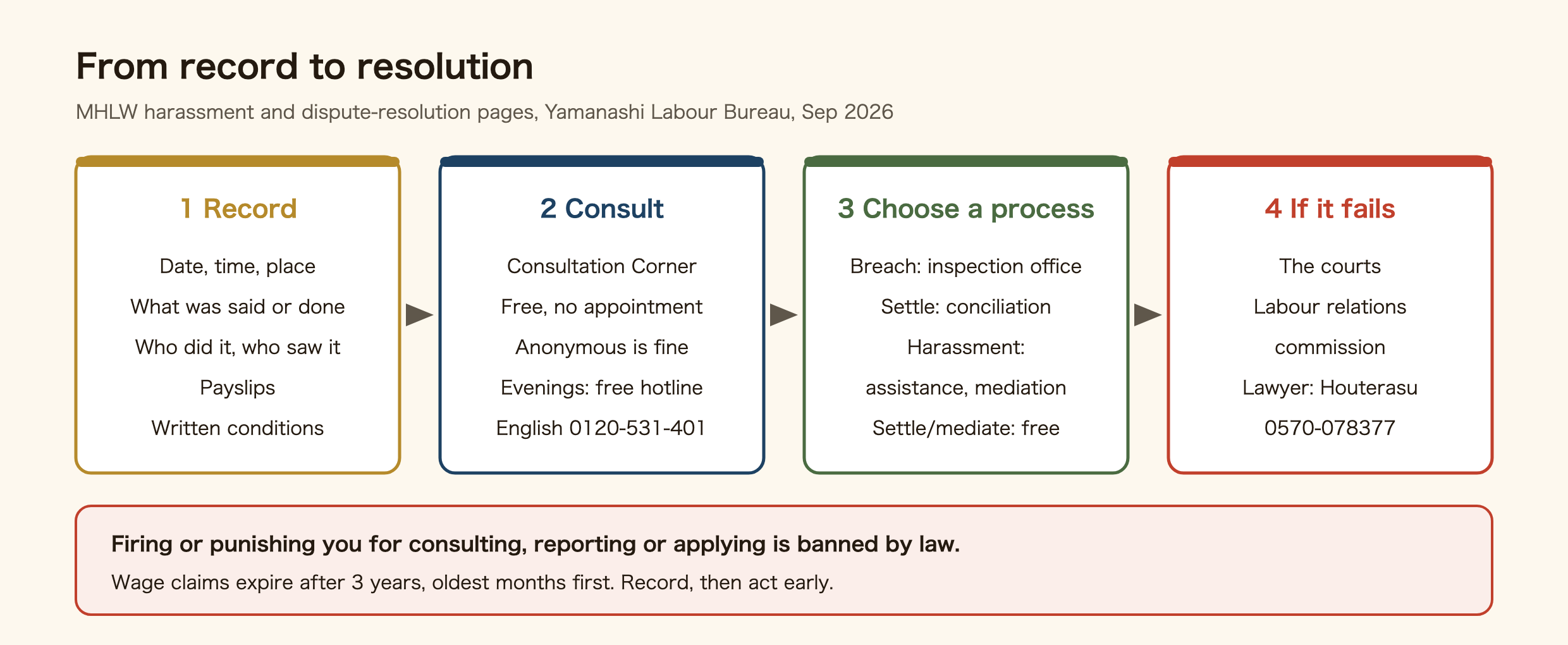
You want an apology. You want your workplace changed. You want money for being pushed out. For that kind of settlement, the labour bureau offers free procedures, and you apply at a Consultation Corner.
- Advice and guidance — the bureau director points out the problem and the direction for solving it
- Conciliation (assen) — a lawyer, professor or labour and social security attorney sits between you and the employer. It is private, and as a rule the two sides wait in separate rooms and never meet
- Mediation (chotei) — disputes over harassment-prevention duties go through a separate law: help from the bureau director, or mediation
In one case published by the ministry, a worker who left after hurtful remarks by the company president applied for conciliation, and the two sides agreed on 600,000 yen. But if the employer does not take part, the process ends, and nobody is forced to accept a proposal. If it fails, you are referred to the courts or the labour relations commission.
Can a union or Houterasu help?
Even if your company has no union, there are unions individuals can join — community unions and general unions — according to the Tokyo government’s “Pocket Labour Law”. As a member, the union negotiates with your employer. The employer cannot refuse to negotiate without good reason, and cannot fire you for joining (Trade Union Act, Article 7).
For a lawyer, go to Houterasu, the Japan Legal Support Center. Its Multilingual Information Service (0570-078377, weekdays 9am to 5pm) explains the legal system and where to get help, free, on a three-way call with an interpreter. You pay the call charge. It covers 10 languages, including English, Chinese, Vietnamese and Nepali, plus easy Japanese. If your income and savings are below a limit, you can also get free legal consultations with a lawyer. Foreign nationals living lawfully in Japan qualify. The income guide for a single person is 182,000 yen a month (200,200 yen in big cities).
What should I record before I report?
The ministry suggests bringing these to a harassment consultation.
- The date and time of each incident
- Where it happened
- What was said to you, or what you were forced to do
- Who said or did it
- Who was there and saw it
For unpaid wages, bring your employment contract or written working conditions, your payslips, and any emails with the employer (Yamanashi Labour Bureau). You will be asked your start and end dates, daily hours, and the pay cut-off and pay day. Keep LINE messages and emails with the company. If the stress of harassment leads to depression or a similar illness, it can qualify for work injury insurance (rosai) if the conditions are met. If you see a doctor, get a medical certificate.
How much does it cost?
| Office or process | Cost |
|---|---|
| General Labour Consultation Corner | Free |
| Advice, conciliation, harassment mediation | Free |
| Working Conditions Consultation Hotline | Free |
| Telephone Consultation Service for Foreign Workers | Call charges (9.35 yen per 180 sec landline, 11 yen per 20 sec mobile) |
| Houterasu Multilingual Information Service | Information free, call charges apply |
| Lawyer consultation through Houterasu | Free if income and savings are below the limit |
How long can I claim unpaid wages?
For now, the right to claim wages expires after three years (Labor Standards Act, Articles 115 and 143). Retirement allowances last five years. Each month’s pay is counted separately, from the day it should have been paid. You can report after you have left the job, but the oldest months drop away first. If several months are unpaid, get help this month.
What if I am fired for complaining?
Reporting to the inspection office, asking the labour bureau for advice or conciliation, consulting about power or sexual harassment or applying for mediation, joining a union: for each, the law bans dismissal or other punishment because you did it. Punishing someone for a report to the inspection office carries up to six months’ imprisonment or a fine of up to 300,000 yen (Articles 104 and 119).
If you are pushed out anyway, report that too. If you hold a work visa, you must notify Immigration within 14 days of leaving. The steps are in what to do when you leave a job.
Which one are you?
- Unpaid, or paid below the minimum wage — put your payslips, working conditions and bank records in one folder. Call the inspection office for the area where your employer is and set a day to go and report.
- Being harassed — start writing today: date, place, words, who, who saw. Call a Consultation Corner anonymously and ask which process fits.
- Worried about speaking Japanese — check the table for your language’s days. If it is a weekday evening or weekend, call the free hotline today.
- You want an apology or money — get the conciliation form (mediation for harassment) at a Consultation Corner. To ask a lawyer too, call Houterasu on 0570-078377.
FAQ
Q. Where can foreign workers report problems at work in Japan?
Start at a General Labour Consultation Corner. There are 378, free, with no appointment, and they take consultations in many languages. By phone, the Working Conditions Consultation Hotline is free (English 0120-531-401).
Q. Can I report power harassment to the Labour Standards Inspection Office?
Power harassment goes to the labour bureau — a Consultation Corner or the Employment Environment and Equal Employment Department. Consultation Corners sit inside many inspection offices, so it may be the same building. If there is also a breach of the Labor Standards Act, such as unpaid wages, you can report that part to the inspection office.
Q. Will my employer know I reported them?
The inspection office normally tells the company a report was made, but asks you first whether it may (Yamanashi Labour Bureau). The Consultation Corner accepts anonymous consultations.
Q. Is there a labour help line in English in Japan?
Yes. On weekday evenings and weekends, the free hotline (English 0120-531-401, every day). On weekday daytimes, the Telephone Consultation Service for Foreign Workers (English 0570-001-701, call charges apply). Other languages run on set days.
Q. Can I be fired for reporting?
No. Dismissal or other punishment because you reported, asked for advice or conciliation, or consulted about harassment is banned by law. If it happens, report that too.
Q. How long can I claim unpaid wages in Japan?
Three years from the day each payment was due (five years for retirement allowances). You can report after leaving, but the oldest months drop away first, so act early.
Summary
Where you go depends on the problem. Breaches of the Labor Standards Act — wages, paid leave — are reported to the inspection office. Power and sexual harassment go to the labour bureau’s assistance and mediation. If you cannot tell, the 378 Consultation Corners sort it for free. Remarks about being a foreigner are on the ministry’s list of power harassment.
For your language: the free hotline on evenings and weekends, the paid line on weekday daytimes. Firing you for complaining is illegal, and wage claims expire after three years. Start your record today, and make one call this week.
Official sources: MHLW, General Labour Consultation Corners (Japanese) / MHLW, counselling services and hotlines in foreign languages / MHLW, individual labour dispute resolution (Japanese) / MHLW, workplace harassment information for foreign workers / MHLW harassment pamphlet, July 2026 (Japanese) / Yamanashi Labour Bureau, reporting unpaid wages (Japanese) / Labor Standards Act (e-Gov, Japanese) / Ministry of Justice, human rights counselling for foreign nationals / Houterasu, For Foreign Nationals. Checked on 23 September 2026. Phone days and hours can change, so check the ministry’s page before you call.
Related reading
Found this useful? Share it
Send it to a friend who lives in Japan.
WHO WROTE THIS

mori
Japanese. I read the ministries’ own notices, orders and Q&As in the original, and I start from what my Nepalese and Sri Lankan friends in Japan actually ran into. I do not write about what I have not checked or been told.
What this site can and cannot do →Looking for something else?