Checked on 30 September 2026 against Japan Post’s pages on writing addresses, shortening addresses and mail forwarding, the address-numbering pages of Suginami City, Fukuoka City and Okayama City, the Immigration Services Agency’s page on reporting a new address, and the Immigration Control Act, the Basic Resident Registration Act and the ordinance under the Act on Prevention of Transfer of Criminal Proceeds on e-Gov.
The short answer
- In Japanese, an address goes from the largest unit to the smallest: postal code, prefecture, city, town and chome, ban and go, then building and room number.
- “1-chome 15-ban 1-go” is usually shortened to “1-15-1”. Some areas use a land number (“187-banchi 6”) instead. Your residence record shows which one you have.
- In English (romaji), reverse the order. Name, building and room, number and town, city and prefecture, then postal code and JAPAN, from top to bottom.
- Family sending mail from abroad should use that English order, with JAPAN in capitals on the last line.
- On bank and post office forms, write the address exactly as it appears on the back of your residence card and on your residence record. After moving, report the new address within 14 days first, so it is printed on your card.
Knowing this, you can fill in any address box in Japan without guessing, and give your family an address that actually reaches you. You also avoid having a bank application sent back because your form and your card do not match.
The bank clerk slides an account form across the counter. There is one line for your address. The note on your phone says “1-15-1”. The back of your residence card says “一丁目15番1号”. Which one goes on the form? Do they need the building name? You ask the Japanese friend who came with you, and they say it does not matter, the mail arrives either way. They have written their own address the same way since childhood and have never had to think about it. When your mother asks for the address in English, they cannot tell you the order either.
- How do you write a Japanese address? Six parts, largest first
- What do chome, ban, go and banchi mean?
- How to write a Japanese address with hyphens: 1-15-1
- Can you shorten an address if you write the postal code?
- How to write a Japanese address in English (romaji)
- How to write a Japanese address on an envelope or postcard
- How should family abroad address mail to you in Japan?
- Which address goes on bank and post office forms?
- What if you do not report a new address in time?
- Does any of this cost money?
- Which one are you?
- FAQ
- Summary
- Related reading
How do you write a Japanese address? Six parts, largest first
Where you come from, you may start with the house number and work outwards to the city and the country. That may be normal. In Japan, an address written in Japanese starts from the largest unit, the prefecture, and ends with your room.
- Postal code, 7 digits, after the 〒 mark (e.g. 166-0004)
- Prefecture (e.g. 東京都, Tokyo)
- City, ward, town or village (e.g. 杉並区, Suginami-ku)
- Town name and chome (e.g. 阿佐谷南一丁目, Asagayaminami 1-chome)
- Ban and go, or a banchi number (e.g. 15番1号)
- Building name and room number, if you live in an apartment block (e.g. Sakura Heights 101)
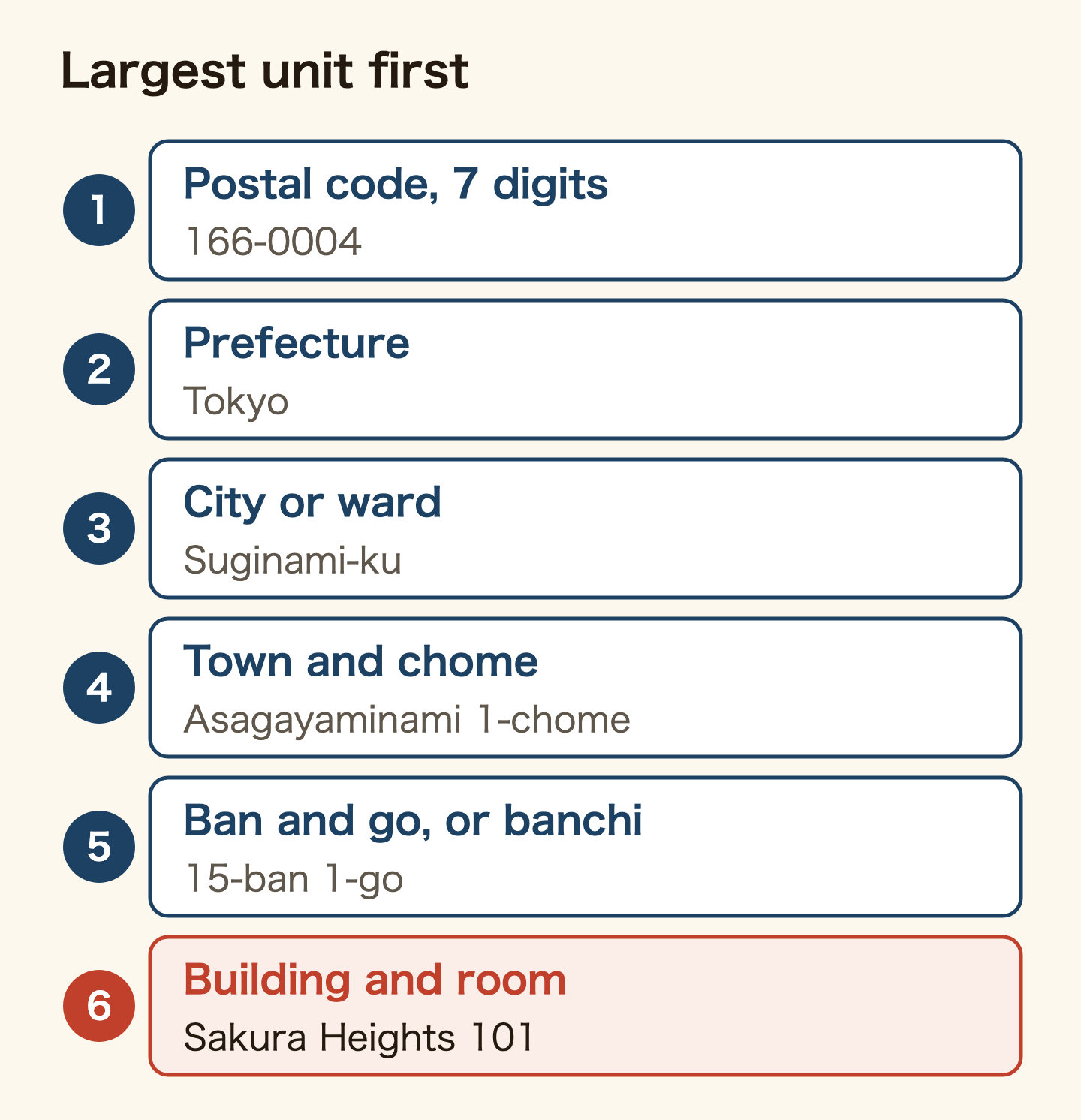
The example address, “Suginami-ku Asagayaminami 1-chome 15-ban 1-go”, is the one Suginami City uses to explain its address numbers. The postal code 166-0004 is the code Japan Post’s postal code search returns for Asagayaminami.
The part people drop most is the last one. Even Japan Post’s page for children says to write the room number for a flat or apartment. A building can have dozens of rooms, and a letter without a room number has no mailbox to go to. Always write the building name and room number, on every form.
What do chome, ban, go and banchi mean?
Japanese addresses use one of two numbering systems. Which one depends on the area you live in, not on you.
The first is the residential address system (jukyo hyoji). Suginami City describes it as town name, block number and building number:
- Chome: a numbered district inside a town. “Asagayaminami 1-chome” is the full town name
- Ban: the number of a block, an area enclosed by roads or waterways
- Go: a number showing where a building’s entrance sits along that block
The go number does not identify a single building. Suginami says you need the go number plus a nameplate to tell buildings apart. Several buildings can share one go number, which is another reason the building name and room number matter.
The second system is the land number (chiban). According to Okayama City, addresses have used land numbers since the early Meiji era. When an area switches to the residential system, “XXX-banchi X” becomes “X-ban X-go”. Some cities, such as Fukuoka, have both kinds of area.
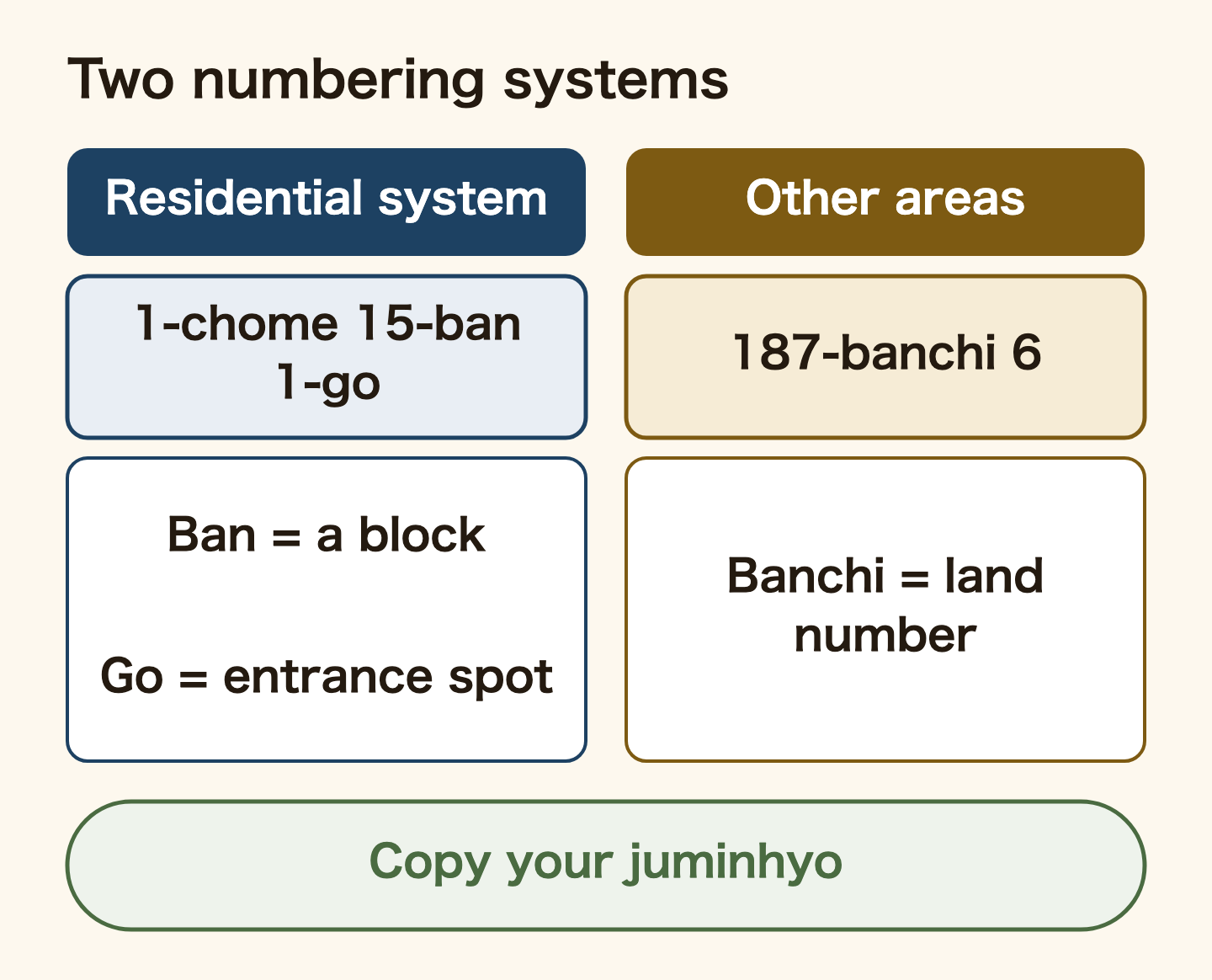
You do not need to work out which one you have. Whatever is written on your residence record (juminhyo) and on the back of your residence card is your address.
How to write a Japanese address with hyphens: 1-15-1
When a box is short, drop the words chome, ban and go and join the numbers with hyphens. Japan Post’s own example writes “霞が関1丁目3-2“, joining ban and go with a hyphen.
- 1-chome 15-ban 1-go → 1-15-1
- Room 101 at 15-ban 1-go → 15-1-101 (Suginami’s example writes it as 15番1-101号)
- 187-banchi 6 → 187-6
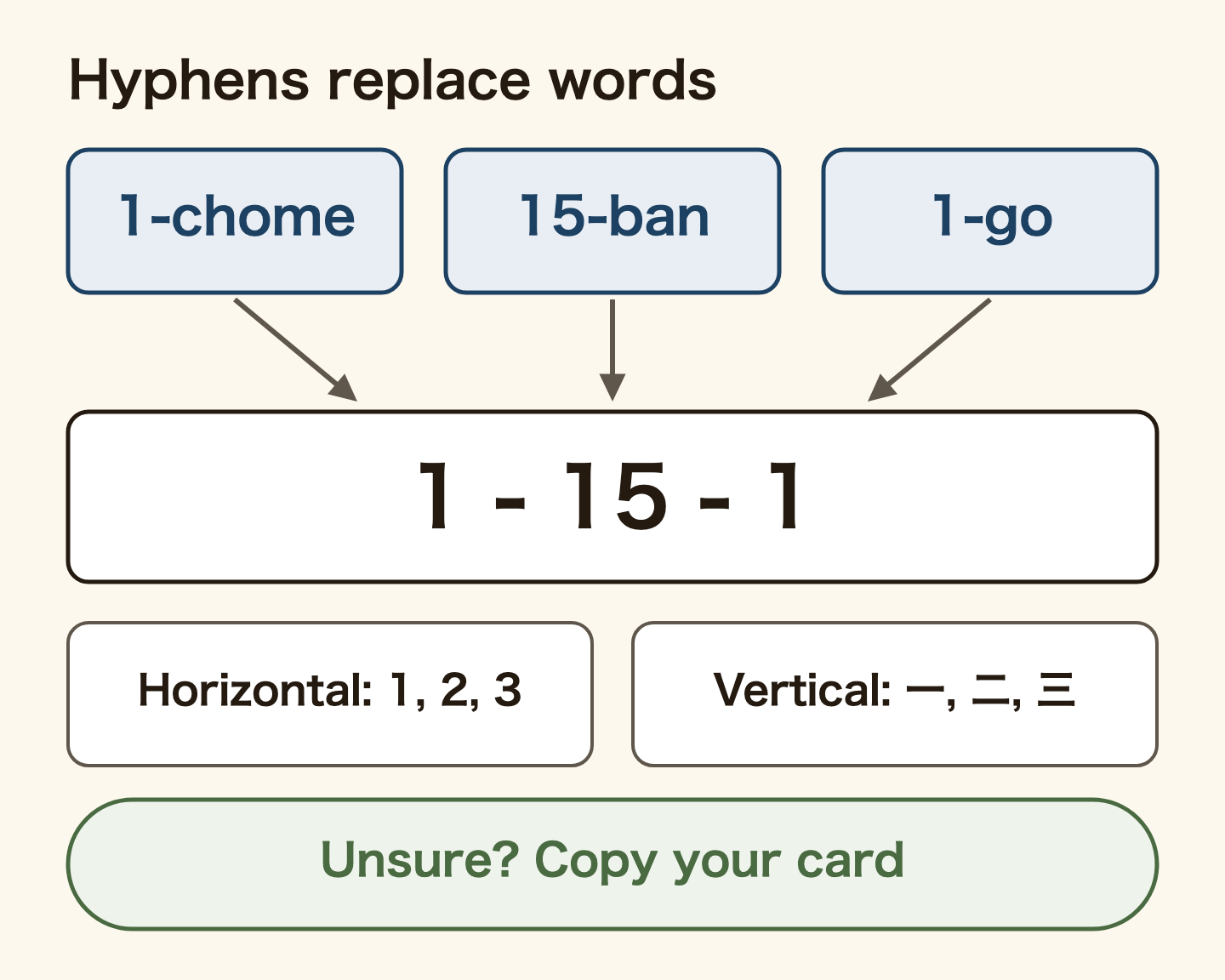
Japan Post’s print service guide says to use Arabic numerals (1, 2, 3) in horizontal writing and kanji numerals (一, 二, 三) in vertical writing. If your card says 一丁目 in kanji, 1丁目 on a horizontal form is the same address.
Which form a bank or city office wants varies from form to form. Follow the sample if there is one. If there is none, copying your residence card exactly is the safest choice.
Can you shorten an address if you write the postal code?
For mail, yes. Japan Post’s FAQ says that with a correct 7-digit postal code you may leave out the prefecture and the city (or ward). “100-0013 東京都千代田区霞が関1丁目3-2” can be written “100-0013 霞が関1丁目3-2”.
There are two conditions. The 7-digit code must be correct. And everything from the town name down must stay. For addresses with 大字 (oaza) or 字 (aza), you may drop the text up to and including 大字 or 字, but a 字 that follows an oaza town name cannot be dropped.
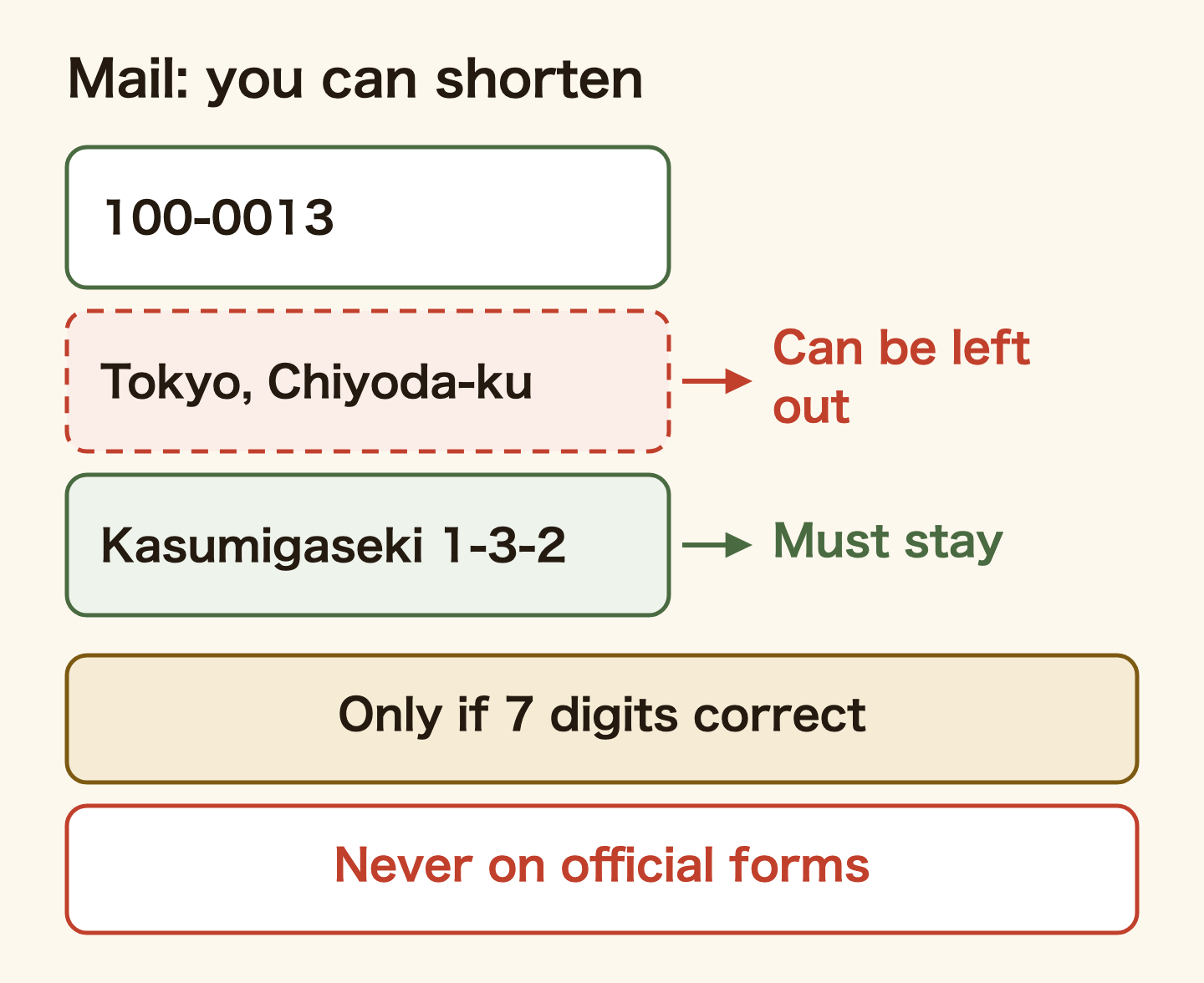
This is about delivering mail. On city office and bank forms, write the full address from the prefecture. In letters such as New Year cards, writing the prefecture in full is also considered the proper manner (Japan Post print service).
How to write a Japanese address in English (romaji)
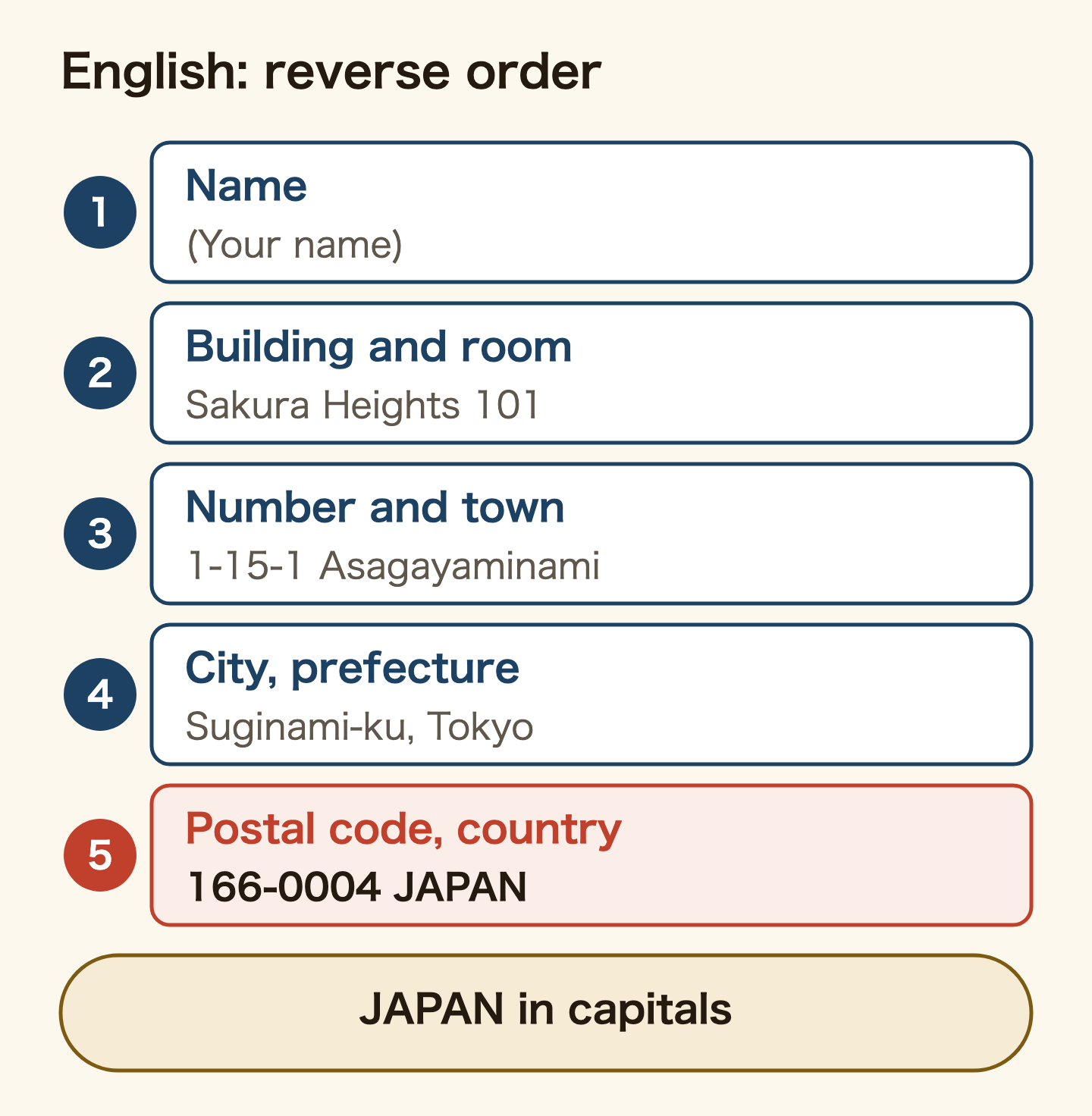
In English, the order flips. Japan Post’s “How to Write the Address and Name” sets out a Japanese address for international mail in five rows, in the Roman alphabet and Arabic numerals as a general rule:
- Name
- Building name and room number (if any)
- House number, street, town or village
- City, prefecture
- Postal code, country
Its FAQ puts it in one line: name first, then the address “in inverse order of the Japanese way”. Applied to the example address:
(Your name)
Sakura Heights 101
1-15-1 Asagayaminami
Suginami-ku, Tokyo
166-0004 JAPAN
“Sakura Heights” is a made-up building name for the example. If you are not sure how your town name is read, enter your postal code in Japan Post’s postal code search. It shows the reading in katakana (Asagayaminami appears as アサガヤミナミ). Japan Post also publishes its postal code data in Hepburn romaji (romaji postal code data).
Online forms in Japan usually split the address into separate fields: postal code, prefecture, city, street number, building. Fill each field with its own part and the form handles the order.
How to write a Japanese address on an envelope or postcard
For mail inside Japan, use the Japanese order. Japan Post’s guidance comes down to this:
- Write the recipient’s postal code as its 7 digits (Japan Post kids’ site)
- Write their address, down to the building and room number
- Write their name in the middle, a little larger, followed by 様 (sama)
- Add your own address, name and postal code. On a horizontal envelope, keep them in the bottom third of the back (envelope guide)
- Put the stamp where it would be top left if the envelope were held upright
For a company department where you do not know a person’s name, write 御中 (onchu) after the department. If you know the name, use 様. Writing both together is treated as a mistake.
To post wedding or funeral money, use cash registered mail, not an ordinary envelope. Check how to write the gift envelope and post it inside a cash envelope first.
How should family abroad address mail to you in Japan?
Give them your address in the English order above. In Japan Post’s layout for international mail, the sender’s address goes top left and the recipient’s address bottom right, and the country name is always in capitals (Japan Post addressing guide).
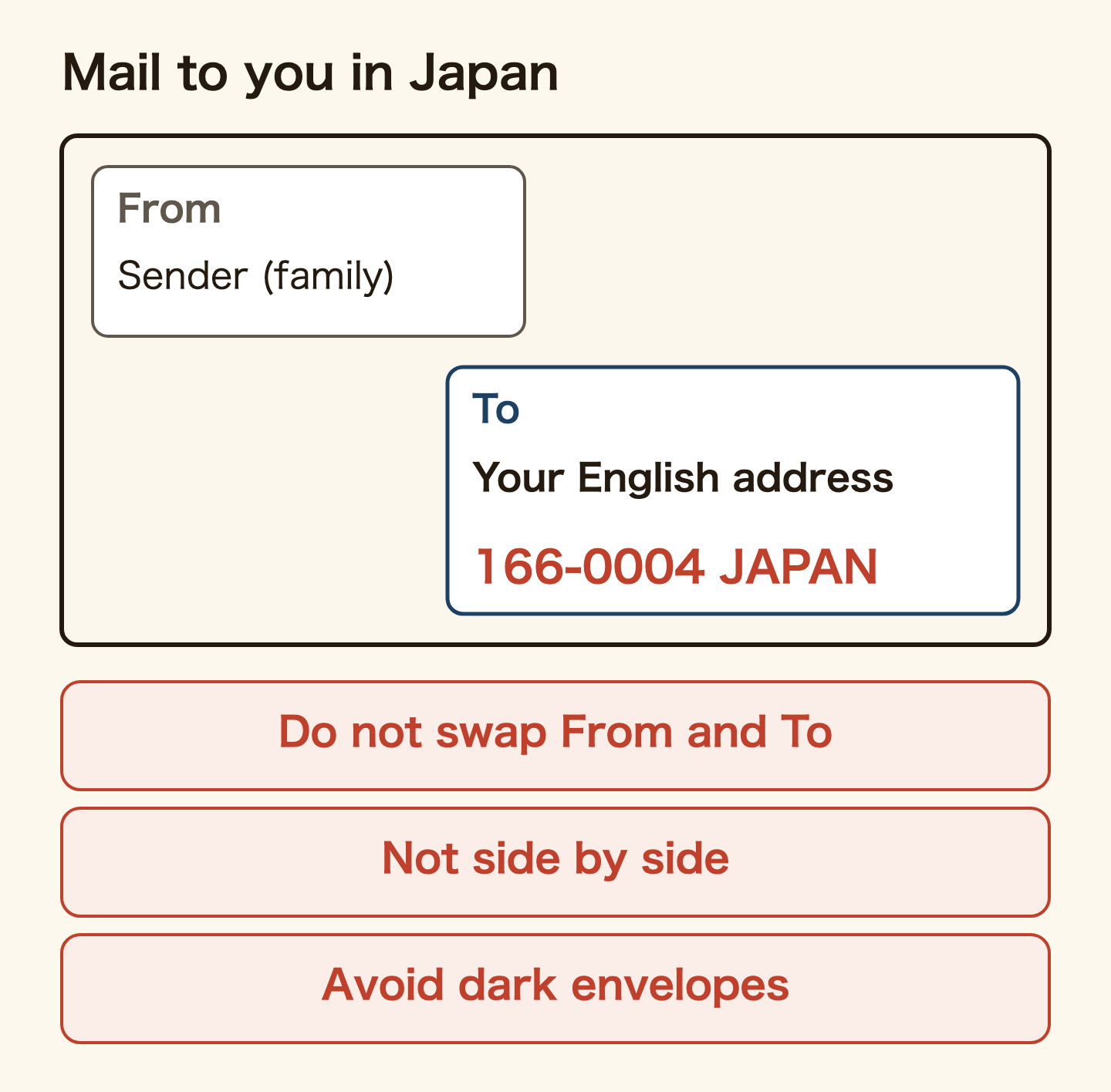
Japan Post warns that if the sender and recipient are swapped or written side by side, the letter may be returned or delayed. The same goes for a dark envelope that makes the address hard to read (How to Write the Address and Name).
Send your family the five typed lines to copy, rather than reading the address out to them. Japan Post notes that Western-style addresses are easy to get wrong, and that a wrong country or region name is fatal.
The post office in the sending country has its own rules as well. Ask your family to check with their local post office before they send anything.
Which address goes on bank and post office forms?
Banks, post offices, phone shops, schools, part-time jobs: in Japan you write your address and show your residence card again and again. Write the address exactly as it is on the back of your residence card and on your residence record.
When a bank opens an account, the Act on Prevention of Transfer of Criminal Proceeds requires it to confirm your name, residence and date of birth with an identity document, and the residence card is one of those documents. Under the ordinance for that Act, if your document does not show your current residence, the bank must check it with another document that does: a utility bill receipt, a tax or social insurance receipt and similar, issued or stamped within the last six months.
The post office works the same way. Japan Post’s guide for international students says to bring ID showing your current address when you collect a parcel at the counter, and ID showing your old address when you file a change of address for mail forwarding.
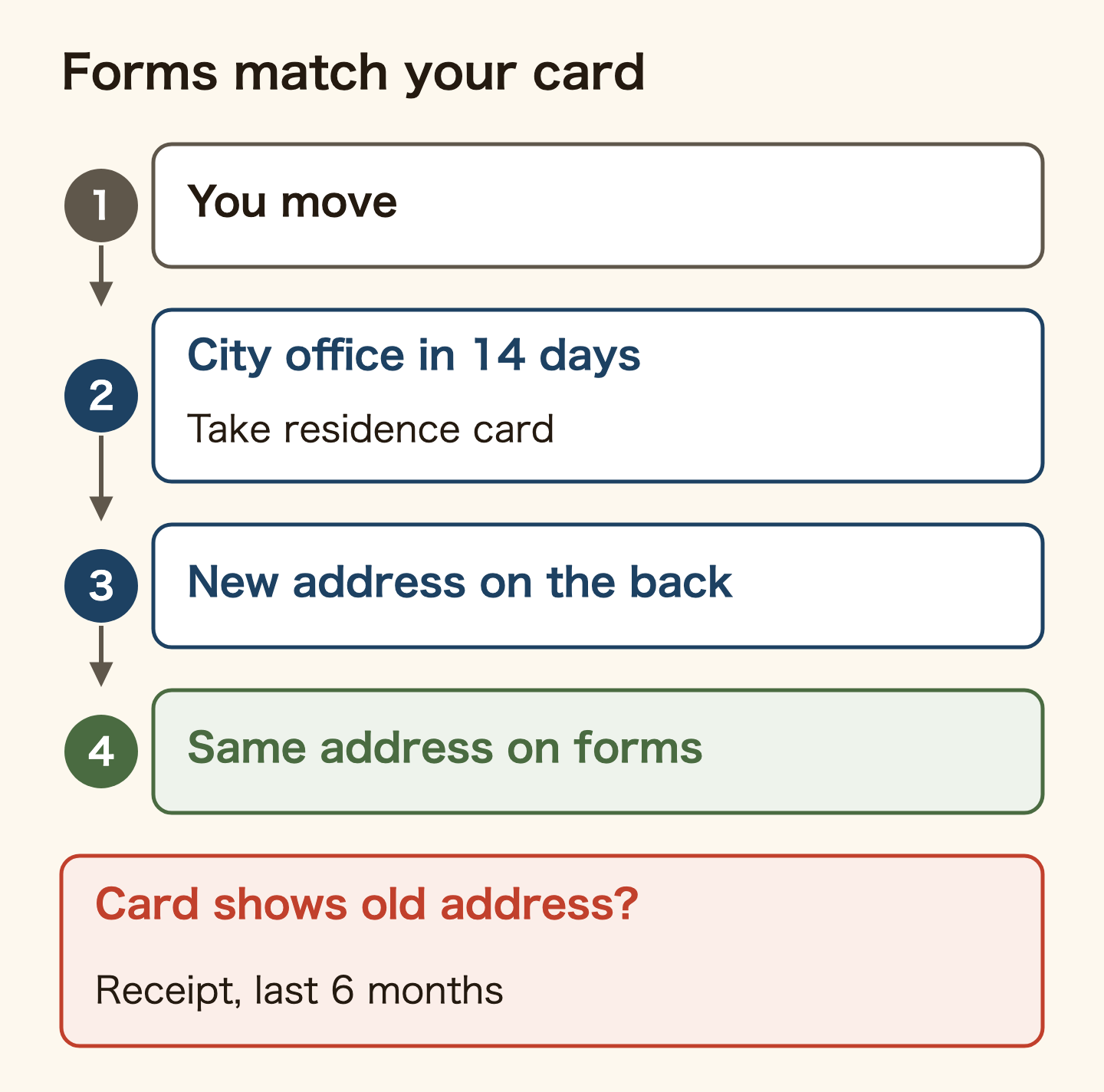
So the order matters. After you move, go to the city office for your new address within 14 days and report it with your residence card. According to the Immigration Services Agency, reporting at the city office also counts as reporting your new address to Immigration. You do not get a new card: the new address is written on the back of the one you have.
If you file the move without your residence card, it does not count as the report to Immigration, and you have to report again (ISA Q&A). Always take the card. After that, update your bank, card company and school. What each bank asks for is in our guide to opening a bank account.
What if you do not report a new address in time?
A typo on a form is fixed by writing it again. The serious problems are not reporting a new address, and reporting a false one.
- Not reporting a new address within 14 days: a fine of up to 200,000 yen under the Immigration Control Act (Article 71-5), and a non-criminal fine of up to 50,000 yen under the Basic Resident Registration Act (Article 52(2)) if you have no good reason
- Not reporting a new address within 90 days of leaving the old one: your status of residence can be cancelled, unless you have a justifiable reason
- Reporting a false address: your status can be cancelled, and a false report carries up to 1 year’s imprisonment or a fine of up to 200,000 yen
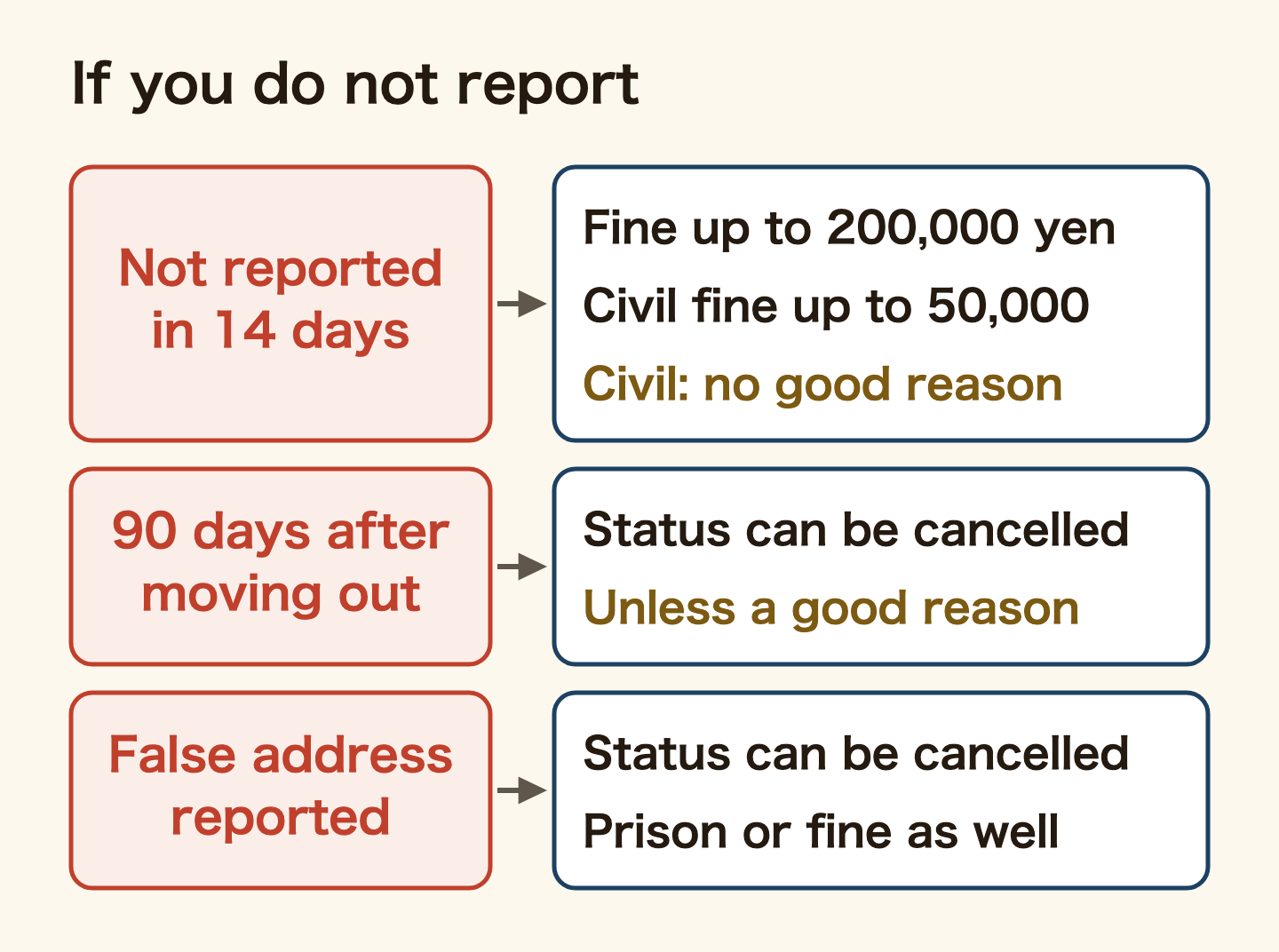
The grounds for cancellation are listed on the Immigration Services Agency’s cancellation of status page. If you have already passed 14 days, not going at all is the worst choice. Go to the city office with your residence card on the day you notice, and if they ask why you are late, explain honestly.
Does any of this cost money?
Writing an address costs nothing. If you file a change of address with Japan Post, it forwards mail sent to your old address to the new one free of charge for one year (Japan Post mail forwarding). The year counts from the day you file, and registration takes 3 to 7 business days, so file before you move.
A copy of your residence record costs a fee. The amount differs by city, so check at the counter or on your city’s website.
Which one are you?
- You just arrived and have not registered an address yet — go to the city office with your residence card within 14 days of settling in. Today, look up the office and its opening hours.
- You are filling in a bank or phone form — copy the back of your residence card, building and room number included. Today, take a photo of the back of your card.
- Your family wants to send you a parcel — type the five English lines (name, building and room, number and town, city and prefecture, postal code and JAPAN) and send them today.
- You have moved or are about to — report at the city office within 14 days, file a change of address with Japan Post, then update your bank, school and employer. Today, put the reporting date in your calendar.
FAQ
Q. What order is a Japanese address written in?
Largest first: postal code, prefecture, city, town and chome, ban and go (or banchi), then building name and room number.
Q. Is “1-chome 15-ban 1-go” the same as “1-15-1”?
Yes, it is the same address with the words dropped and the numbers joined by hyphens. Follow the sample on a form if there is one. Otherwise, copy your residence card.
Q. What is the difference between ban and banchi?
Banchi is a land number. Ban and go belong to the residential address system, where ban is a block enclosed by roads and go shows the position of a building’s entrance in that block. Your residence record shows which one you have.
Q. How do I write a Japanese address in English?
Reverse the Japanese order. Japan Post’s guide goes, from the top: name, building and room, number and town, city and prefecture, postal code and country. Write JAPAN in capitals.
Q. Can I leave out part of the address if I write the postal code?
For mail, a correct 7-digit postal code lets you leave out the prefecture and city. Everything from the town name down must stay. Do not shorten official or bank forms.
Q. Which address should I write on a bank application?
Your current address as shown on the back of your residence card and on your residence record. Banks check your residence against your ID, and if the ID does not show your current address, they ask for another document from the last six months, such as a utility bill receipt. After moving, report the new address first.
Summary
A Japanese address runs from the postal code down to the room number, largest unit first, in six parts. Chome, ban and go mark the district, the block and the entrance, and some areas use a banchi land number instead. In English the order reverses, and the last line is the postal code and JAPAN.
Whatever the format, the reference is the back of your residence card and your residence record. After moving, take your card to the city office within 14 days so the new address is on it, and only then fill in bank and post office forms. Late or missing reports can lead to fines or cancellation of your status, so if you are late, go on the day you notice.
Official sources: Japan Post, How to Write the Address and Name / Japan Post FAQ, writing an address in English / Japan Post, addressing greeting cards abroad (Japanese) / Japan Post FAQ, shortening an address (Japanese) / Japan Post kids’ site, addressing (Japanese) / Japan Post envelope guide (Japanese) / Japan Post romaji postal code data (Japanese) / Japan Post mail forwarding (Japanese) / Japan Post, Practical Guide for International Students / Suginami City, residential addresses (Japanese) / Fukuoka City (Japanese) / Okayama City (Japanese) / Immigration Services Agency, reporting a new address (Japanese) / e-Gov: Immigration Control Act, Basic Resident Registration Act, Ordinance for Enforcement of the Act on Prevention of Transfer of Criminal Proceeds (all checked 30 September 2026). For any specific form, check the sample the office or bank provides.
Related reading
Found this useful? Share it
Send it to a friend who lives in Japan.
WHO WROTE THIS

mori
Japanese. I read the ministries’ own notices, orders and Q&As in the original, and I start from what my Nepalese and Sri Lankan friends in Japan actually ran into. I do not write about what I have not checked or been told.
What this site can and cannot do →Looking for something else?