Checked on 23 September 2026 against the Nationality Act (e-Gov), the Ministry of Justice’s Nationality Q&A and naturalization procedure page, the Justice Minister’s press conference of 27 March 2026, and naturalization guidance from the Tokyo, Mito and Maebashi Legal Affairs Bureaus.
The short answer
- Naturalization is how a foreign national becomes a Japanese citizen, with the permission of the Minister of Justice. The Nationality Act sets six conditions, starting with five years of continuous residence.
- Since 1 April 2026, applicants are in principle expected to have lived in Japan for 10 years or more. This is a change in how applications are judged; the five years in the law were not rewritten. Tax and social insurance payments are also checked further back.
- Spouses of Japanese nationals and some others have shorter periods written into the law (Articles 6 to 8). How the 10-year rule applies to them is something to ask at your consultation.
- You apply at the Legal Affairs Bureau for your area, by appointment, and there is no fee. Bureaus say it takes about 18 months at the shortest from the first consultation to a decision.
- You normally give up your old nationality. Compared with permanent residence, the differences are nationality, the vote and the passport.
Knowing this, you can decide today whether you are ready to book a consultation or should aim for permanent residence first, by looking at your years in Japan and your tax record. You will also know what the 18 months between the first visit and the decision involve.
Your ninth year in Japan. You ask a Japanese colleague whether permanent residence or citizenship makes more sense. They think for a moment and say they have never had to consider either. Someone born Japanese never has to choose a nationality. And in spring 2026 the way naturalization is judged changed, while much of what you find online still says “five years is enough”.
- What is the difference between permanent residency and Japanese citizenship?
- What are the requirements for Japanese citizenship?
- Did the naturalization requirements change in 2026? The 10-year rule
- Japanese citizenship by marriage: shorter periods for spouses
- Where do I apply for naturalization in Japan?
- What documents do I need?
- How much does naturalization cost?
- How long does it take to get Japanese citizenship?
- How the years are counted
- Does Japan allow dual citizenship after naturalization?
- What happens after naturalization is approved?
- What if my application is refused?
- Which one are you?
- FAQ
- Summary
- Related reading
What is the difference between permanent residency and Japanese citizenship?
Naturalization (kika) is the system by which a foreign national asks for, and receives, Japanese nationality with the permission of the Minister of Justice (Nationality Act, Article 4). Permission is announced in the Official Gazette, and you become Japanese on the day of that notice (Article 10).
Permanent residence is a residence status. It lets you stay without a time limit, but you keep your original nationality. Every other difference follows from that.
| Naturalization | Permanent residence | |
|---|---|---|
| Nationality | Japanese; you normally lose the old one | Unchanged |
| Right to vote | Yes (18 and over) | No |
| Passport | Japanese | Your home country’s |
| Residence card | Returned within 14 days | Kept |
| Years in Japan, in principle | 10+ (from April 2026) | 10+ |
| Government fee | 0 yen | 200,000 yen (from 1 October 2026) |
The vote comes from the Public Offices Election Act, which gives it to “Japanese nationals aged 18 or over” (Article 9). A Japanese passport application needs a family register (koseki) (Passport Act, Article 3), and naturalization creates one for you (Nationality Q&A). To compare with the other route, see permanent residency and the 2027 changes.
What are the requirements for Japanese citizenship?
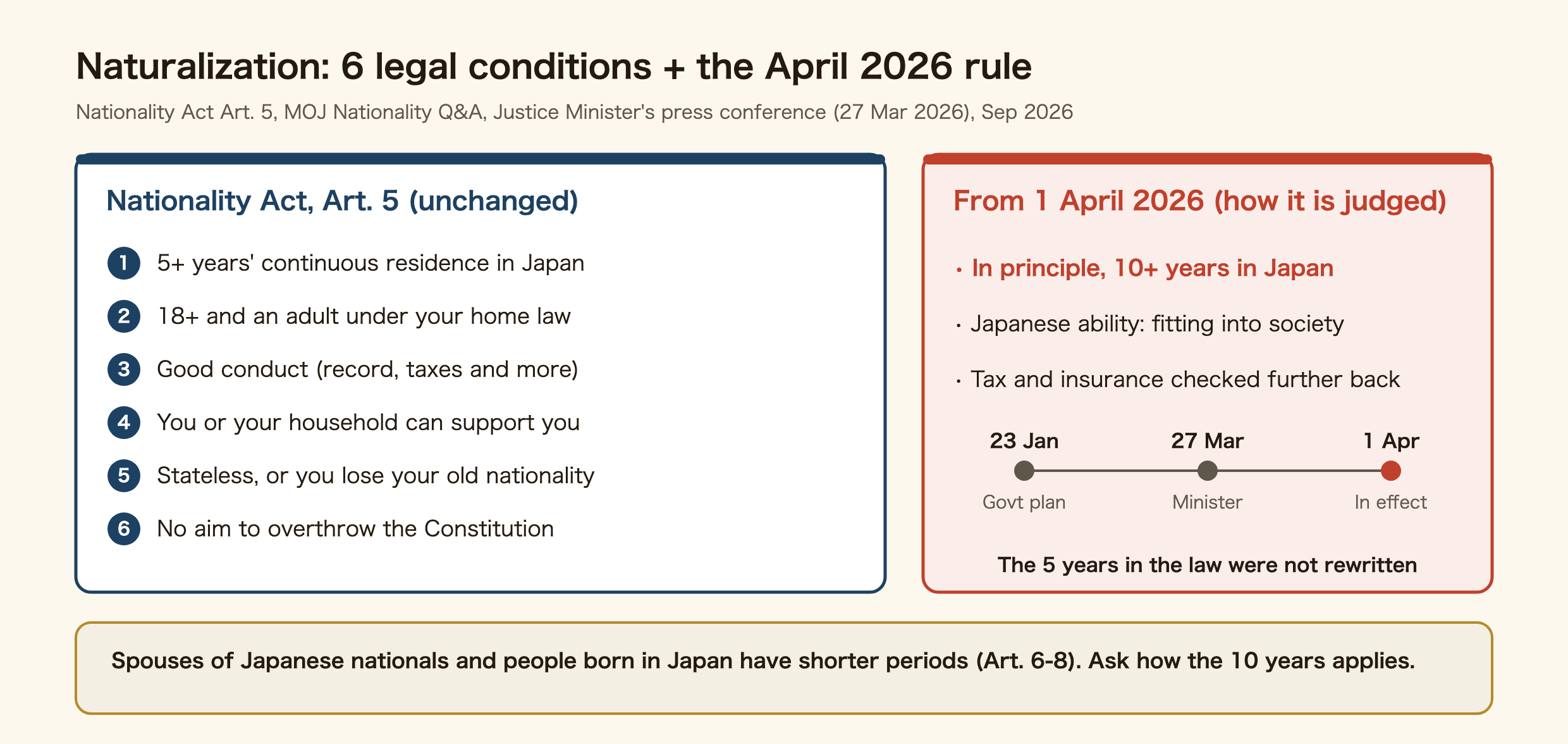
Article 5 of the Nationality Act says the Minister may not grant naturalization unless you meet these conditions.
- Residence: you have had your address in Japan continuously for five years or more up to the application, on a valid residence status
- Capacity: you are 18 or over and an adult under the law of your home country
- Conduct: your conduct is good, judged on criminal record, tax payment, trouble to others and so on
- Livelihood: you can support yourself through your own assets or skills, or those of a spouse or relative you share a household with
- No dual nationality: you are stateless, or you will lose your nationality by becoming Japanese
- The Constitution: you have never planned or advocated overthrowing the government by violence, or joined a group that does
The Ministry of Justice calls these “minimum conditions” and says meeting them does not guarantee permission. It adds that you must fit into Japanese society, for example by having enough Japanese for daily life (speaking, reading and writing) and by having lived here for 10 years or more.
Livelihood is judged per household. If your own income is low but you live securely on your spouse’s income, the condition is met. No income figure is published. Nor do the official pages name a citizenship test or a required JLPT level; the Tokyo bureau simply asks you to bring the results of any Japanese test you have taken.
Did the naturalization requirements change in 2026? The 10-year rule
Yes, but it was the practice that changed, not the law. The steps were:
- 23 January 2026: a ministerial council adopted the government’s comprehensive policy on accepting foreign nationals, which included tightening naturalization
- 27 March 2026: the Minister of Justice announced the change at a press conference
- 1 April 2026: applications began to be judged under the new practice
The Minister named two changes. When judging whether an applicant fits into Japanese society, 10 or more years in Japan are now required in principle. And when judging conduct and livelihood, tax and social insurance payments are checked over a longer period. The stated reason is consistency with permanent residence, which already needed 10 years while naturalization needed five.
The five years in Article 5 are still there. The Minister described the change as requiring a set period of stay within his discretion, on the premise that the five-year condition is met. In practice that means you can still file after five years, but without 10 years in Japan approval is unlikely in principle.
If you read that the law “changed from five years to ten”, that source has mixed up the stages. The statute did not change.
Japanese citizenship by marriage: shorter periods for spouses
Articles 6 to 8 relax the conditions for people with a special connection to Japan. The residence condition in Article 5 changes like this.
| Who | Residence condition | Also relaxed |
|---|---|---|
| Spouse of a Japanese national (Art. 7) | Address or residence in Japan for 3+ continuous years and an address here now; or 3 years since the marriage and an address in Japan for 1+ continuous year | Age |
| Born in Japan (Art. 6) | Address or residence in Japan for 3+ continuous years, or a parent born in Japan | — |
| Child of a former Japanese national (Art. 6) | Address or residence in Japan for 3+ continuous years | — |
| Residence in Japan for 10+ continuous years (Art. 6) | The five-year address condition does not apply | — |
| Child of a Japanese national, not adopted (Art. 8) | An address in Japan is enough | Age, livelihood |
So someone married to a Japanese national for four years, who has lived in Japan for 18 months, fits the second half of Article 7. If you married by filing a marriage registration at a Japanese city office, your marriage date is the day it was accepted. What the official pages do not say is how the April 2026 “10 years in principle” applies to these groups. If you think you qualify, say “I think Article 7 applies to me” at your first consultation and ask about your prospects. If you are on a spouse visa, keep renewing your spouse visa while you apply; your status stays the same until a decision.
Where do I apply for naturalization in Japan?
At the Legal Affairs Bureau (homukyoku) or District Legal Affairs Bureau that covers your address. Some branch offices do not handle nationality. The Ministry of Justice’s list of nationality consultation desks gives a phone number and area for each prefecture. Call before you go: consultations are by appointment.
You must go to the bureau in person and apply in writing. For a child under 15, a parent or other legal representative applies. You cannot apply by post or through an agent alone. The bureaus describe the process like this.
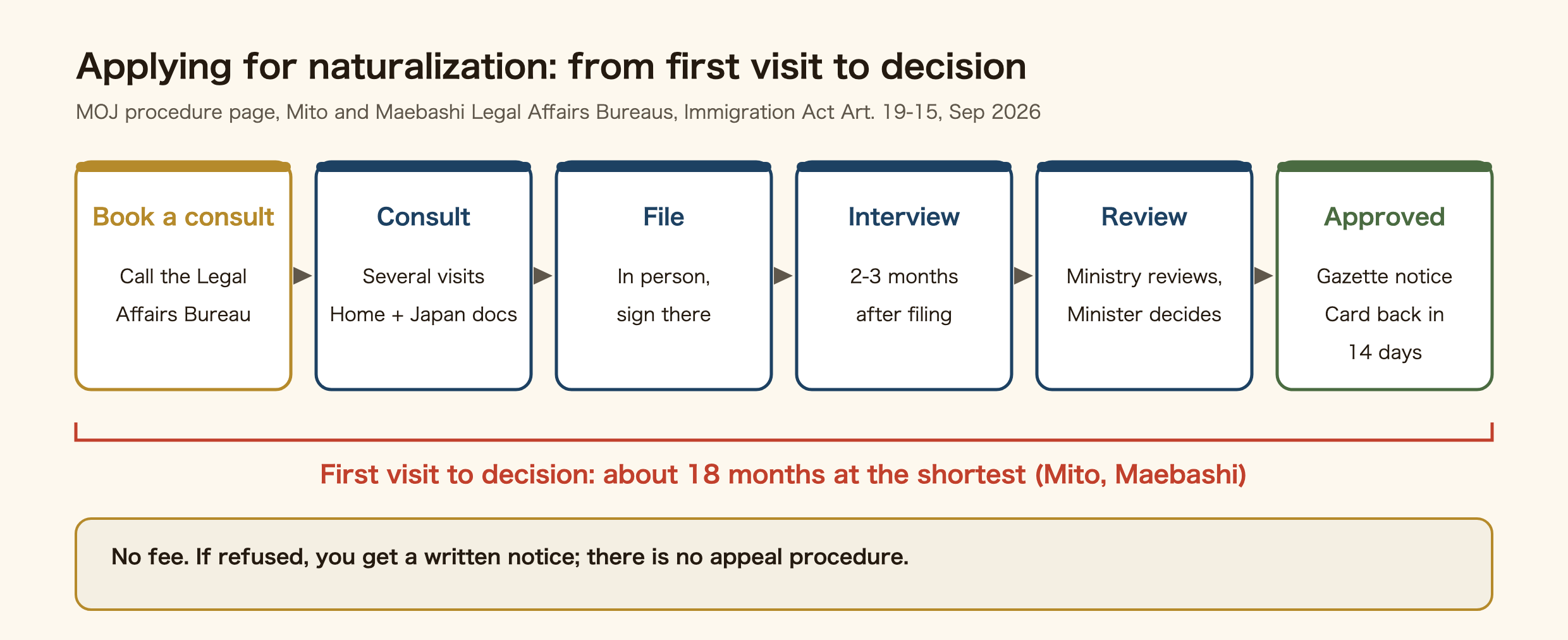
- Consultations, more than one (two at Mito and three at Maebashi, as examples). You are told which home-country documents to get, then which Japanese ones
- Filing, once everything is ready. You sign in front of the officer
- An interview about two to three months after filing (Mito), or about three months (Maebashi), for you and your spouse or family
- If your home country’s law lets you give up its nationality before naturalizing, you are guided through that
- The Ministry reviews the file and the Minister decides
- If approved, a Gazette notice and an identity certificate. If refused, a written notice
The Gazette notice shows your address (to the city or ward), your name before naturalization and your date of birth (Ministry of Justice).
What documents do I need?
The Ministry lists 11 main items: the application with photos, a summary of relatives, a statement of your reasons for naturalizing, a personal history, a summary of your livelihood, a summary of any business, your residence record, proof of nationality, proof of family relationships, proof of tax payment and proof of income. What you need varies with nationality, family and work, so the Ministry tells you to consult the bureau.
The Tokyo bureau’s list (updated 4 September 2026) shows the periods involved.
- Residence tax certificates of assessment and of payment: the latest five years
- Proof you paid residence tax on time (bank book copies or dated receipts): five years, unless it is deducted from your salary
- Proof of pension and health insurance payments: the latest two years
- Driving record certificate: five years
- Every passport you have held, including expired ones, with all used pages copied
- Results of any Japanese test you have taken
It is not only whether you paid. The bureau asks for proof that you paid at the proper time, and a late payment shows up in the dates in your bank book. For how these are billed, see residence tax in Japan and health insurance for foreigners.
Home-country documents (nationality certificate, birth and marriage certificates and so on) should in principle be issued by your government. Anything not in Japanese needs a Japanese translation. Anyone who can translate accurately may do it, including you, and the translator adds their address, name and the date (Tokyo bureau). The Ministry’s leaflet also says you must pledge to obey Japanese law.
How much does naturalization cost?
| Item | Cost |
|---|---|
| Application fee at the Legal Affairs Bureau | 0 yen |
| Residence record and tax certificates | Your city office’s fee per copy |
| Home-country certificates and postage | Depends on the country |
| Translation | 0 yen if you do it yourself |
| A licensed administrative scrivener (gyoseishoshi) | Optional; you can apply without one |
People search for a “naturalization fee increase”, but the Ministry’s procedure page still says there is no fee. The increase was in immigration fees: permanent residence costs 200,000 yen from 1 October 2026 (the October fee rise). Naturalization is handled by the Legal Affairs Bureau, not by Immigration, so it is a separate matter.
How long does it take to get Japanese citizenship?
The Ministry’s procedure page lists the standard processing period as “none”, so there is no official promise. The Mito bureau says it takes “about a year and a half at the shortest” from the first consultation to the decision; Maebashi says “at least about one year and six months”. Both say “at the shortest”.
The clock starts at your first consultation, not the filing date. If collecting documents drags on, everything moves back. How long your home government takes to send certificates depends on the country.
More people are applying. In 2025, 14,103 people applied, 9,258 were granted naturalization and 666 were refused (Ministry of Justice). After China and Korea, those granted included 695 from Nepal, 409 from Brazil, 357 from Vietnam, 352 from the Philippines, 273 from Myanmar, 248 from Sri Lanka and 229 from Bangladesh.
How the years are counted
- The five years in the law: years you have “continuously” had your address in Japan up to the application, on a valid status
- The 10 years in practice: years you have stayed in Japan, the principle since April 2026. No breakdown (such as years on a work visa) has been published
- Five years of residence tax and two of social insurance: the payment records the Tokyo bureau asks for, counted back from the application
No official standard says how long absences abroad break “continuous” residence. The bureau asks for every passport so it can see your travel record. If you have spent long periods abroad, mention it at the start of your consultation.
Does Japan allow dual citizenship after naturalization?
No. Article 5 requires that you are stateless or will lose your nationality by becoming Japanese. Japan does not expect naturalized citizens to keep a second nationality.
There is one exception: when you cannot lose your nationality by your own will. Then permission may still be granted if there are special circumstances in your family ties to Japanese nationals or your situation (Article 5, paragraph 2). If your home country allows you to renounce before naturalizing, the bureau will guide you through that (Mito bureau).
Once you are Japanese, taking a foreign nationality by your own choice means losing Japanese nationality (Article 11). So you cannot quietly take your old passport back later. Before applying, check with your home government whether property, inheritance or family matters depend on your nationality there.
What happens after naturalization is approved?
As a Japanese national, you are no longer a mid- to long-term resident under the Immigration Act. Your residence card loses its validity (Article 19-14), and you must return it within 14 days (Article 19-15). The duty to carry your residence card ends there too.
With a family register, you can apply for a Japanese passport. From 18, you can vote in national elections. For local elections, you must have lived in that municipality for three months or more (Public Offices Election Act, Article 9).
What if my application is refused?
The Ministry’s procedure page lists the way to appeal as “none”. A refusal notice cannot be challenged through an appeal procedure. The official pages also do not say how long you must wait before applying again.
So the preparation happens before you apply. If you are short of 10 years, consult now and spend the time getting your records in order. If there are months you cannot pay tax or insurance, do not leave it unpaid; ask the office about instalments or a deferral. A late record cannot be erased later.
While your application is pending, your residence status does not change, and you still need to renew it on time. The residence condition assumes a valid status, so letting it expire breaks the condition itself.
Which one are you?
- Ten years or more in Japan, with taxes and insurance paid on time — call the Legal Affairs Bureau for your area and book your first consultation. Today, find out which home-country documents take longest to get.
- Married to a Japanese national, but short of 10 years — check whether Article 7 fits you, and say “spouse of a Japanese national” when you book. Put your spouse visa renewal date in your calendar too.
- Between five and 10 years, and not married to a Japanese national — do not rush to file. Set up automatic bank payment for residence tax and insurance today, and pay on time for the next few years. Decide first whether you are aiming for permanent residence or citizenship.
- Not sure about giving up your nationality — ask your home government whether property, inheritance or family matters depend on it. Until you decide, check the permanent residence requirements and prepare for that route.
FAQ
Q. Did Japan’s naturalization requirements change in 2026?
The way applications are judged changed on 1 April 2026. In principle, 10 or more years in Japan are now required, and tax and social insurance payments are checked over a longer period. The Nationality Act’s condition of five years’ continuous residence has not been rewritten.
Q. How much does it cost to apply for Japanese citizenship?
There is no application fee. You pay only for certificates from your city office and home country, and postage. Hiring an administrative scrivener is optional.
Q. How long does it take to get Japanese citizenship?
The Ministry of Justice sets no standard processing period. The Mito and Maebashi Legal Affairs Bureaus say it takes about a year and a half at the shortest from the first consultation to the decision.
Q. Is it easier to get Japanese citizenship by marriage?
Article 7 of the Nationality Act shortens the residence and age conditions for spouses of Japanese nationals. Three continuous years of address or residence in Japan, or three years of marriage plus one continuous year of address in Japan, replace the five-year condition. Ask the Legal Affairs Bureau how the April 2026 10-year practice applies to you.
Q. Can I keep dual citizenship if I naturalize in Japan?
No. The Nationality Act requires you to lose your old nationality by becoming Japanese. The only exception is when you cannot lose it by your own will.
Q. What is the difference between permanent residency and citizenship in Japan?
Permanent residence is a residence status, and you keep your nationality. Naturalization makes you a Japanese national, with the vote and a Japanese passport. In exchange you normally lose your old nationality and return your residence card.
Summary
Naturalization gives you Japanese nationality with the Minister of Justice’s permission. The law sets six conditions, including five years’ residence, but since 1 April 2026 applications are judged against 10 or more years in Japan in principle, with tax and insurance records checked further back. The law itself still says five years, so “you can file after five years” and “you will be approved after five years” are not the same thing.
You apply at the Legal Affairs Bureau for your area, by appointment, for no fee, and a decision takes about 18 months at the shortest. If approved, you gain the vote and a Japanese passport, and give up your old nationality and your residence card. Whichever route you choose, the preparation you can start today is the same: pay residence tax and insurance on time, every time.
Official sources: Nationality Act (e-Gov, Japanese) / Ministry of Justice, Nationality Q&A (Japanese) / MOJ, application for naturalization (Japanese) / MOJ, nationality consultation desks by prefecture (Japanese) / Justice Minister’s press conference, 27 March 2026 (Japanese) / Tokyo Legal Affairs Bureau, documents to attach (Japanese) / Mito District Legal Affairs Bureau, the naturalization process (Japanese) / MOJ, naturalization statistics (Japanese). Checked on 23 September 2026. Always confirm your documents and prospects at a consultation with the Legal Affairs Bureau for your area.
Related reading
Found this useful? Share it
Send it to a friend who lives in Japan.
WHO WROTE THIS

mori
Japanese. I read the ministries’ own notices, orders and Q&As in the original, and I start from what my Nepalese and Sri Lankan friends in Japan actually ran into. I do not write about what I have not checked or been told.
What this site can and cannot do →Looking for something else?