Checked on 16 September 2026 against the Immigration Services Agency’s procedure pages and the text of articles 26 and 26-2 of the Immigration Act on e-Gov. Fees are those for applications received from 1 April 2025.
In short
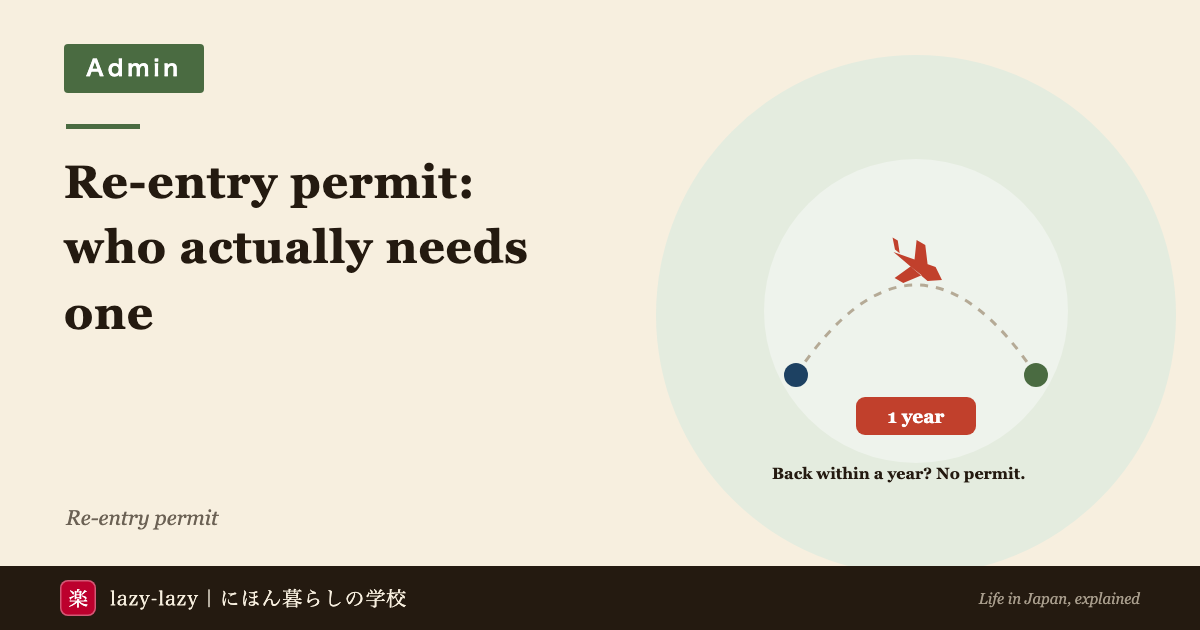
- If you will be back within a year, you do not need a re-entry permit. “Special re-entry permission” covers you: tick a box on the ED card at the airport. Free.
- But it ends when your period of stay ends, if that is sooner. Leave in October with a stay expiring in March and March is your deadline, not a year.
- Special re-entry cannot be extended from abroad (article 26-2 (3)).
- Might you be away more than a year? Get an ordinary permit before you go – 4,000 yen single or 7,000 multiple, issued the same day. That one can be extended at a consulate.
- Miss the deadline and you cannot re-enter on that status. It starts again from a visa.
Home for the summer. A long trip before starting a job. Months at a parent’s bedside. Most people look up what happens to their Japanese status the night before they fly. The answer is that there are two systems, and which one you use decides the outcome. Get it wrong and you are stopped at the airport on the way back.
- What is a re-entry permit?
- Special re-entry permission versus an ordinary permit: what is the difference?
- Are there traps in the “one year”?
- What do you do at the airport?
- Lost your passport or residence card while abroad?
- What if you might be away longer than a year?
- Which one should you choose?
- Frequently asked questions
- Summary
What is a re-entry permit?
A re-entry permit is permission granted before departure to a foreign resident who leaves Japan temporarily and intends to come back, so that re-entry does not require the full landing procedure (Immigration Act article 26). With it, you do not need a new visa to return.
And since 2012, most people do not need to apply for one at all. That is special re-entry permission (minashi sainyukoku kyoka, article 26-2).
Special re-entry permission versus an ordinary permit: what is the difference?
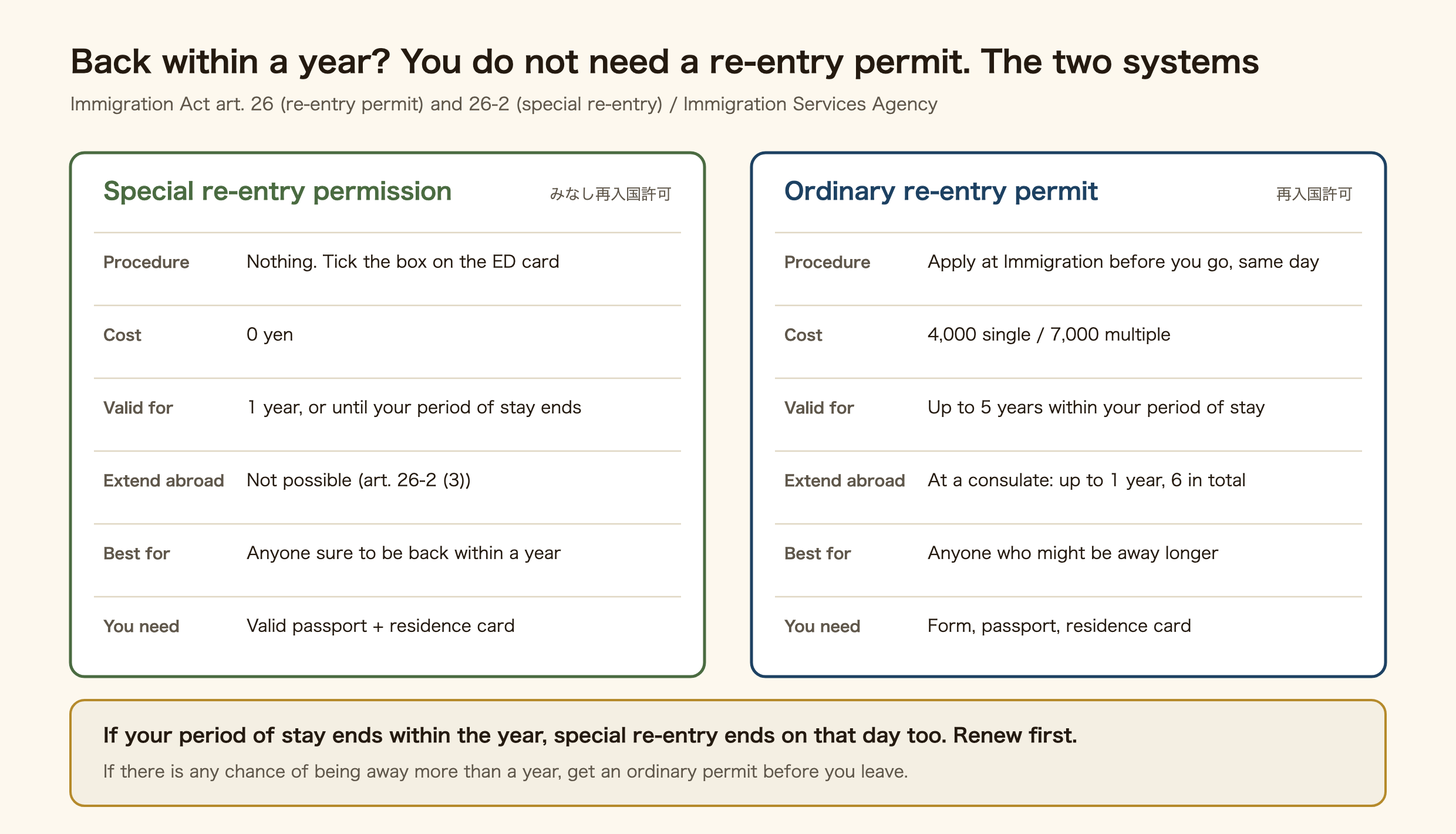
Special re-entry permission: if you hold a status of residence, a valid passport and your residence card, and you come back within one year of leaving, no procedure is required. People with a period of stay of 3 months or less, and Temporary Visitors, are excluded. At the airport you tick the box on the re-entry ED card that says you are leaving temporarily and intend to return, and tell the immigration officer so. No fee.
An ordinary re-entry permit is applied for at the regional immigration office for your address before departure. Single-use is 4,000 yen, multiple-use 7,000 yen (revenue stamps). Standard processing is “same day”. It is valid within your period of stay, for up to five years.
The biggest difference is extension from abroad. An ordinary permit can be extended at a Japanese consulate, for up to one year and not beyond six years in total, where there is good reason you cannot return in time (article 26 (5)). That provision does not apply to special re-entry permission (article 26-2 (3)). Once abroad, deciding you want three more months gets you nothing.
Are there traps in the “one year”?
Two.
First: your period of stay may end sooner. The law says one year from departure, or until your period of stay expires if that comes first. Leave in October with a stay expiring next March, and you must be back by March. Not in a year. If you are going for long, renew your period of stay before you go.
Second: some people are excluded. Anyone under status-revocation proceedings, subject to a departure-confirmation hold, under a detention order, or on Designated Activities as a refugee applicant cannot use special re-entry and must obtain an ordinary permit.
What do you do at the airport?
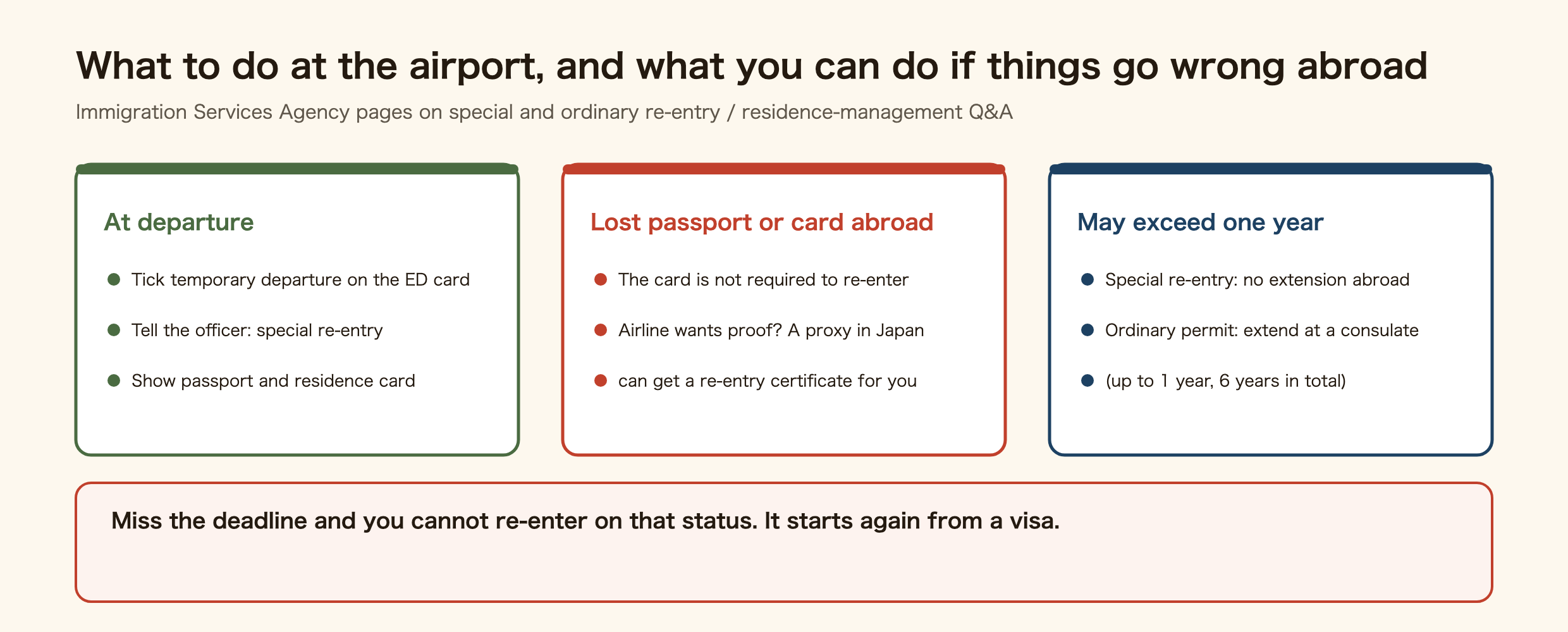
At departure control you fill in the re-entry ED card. Tick the box for a temporary departure with intent to return, and tell the officer “I am leaving under special re-entry permission.” Show your passport and residence card. That is all.
Forget the tick and your departure is not under special re-entry. The agency’s page states that you must express the intention at departure. Check the card yourself before you hand it over.
Lost your passport or residence card while abroad?
Possession of the residence card is not a requirement for re-entering under special re-entry permission – the agency’s Q&A says so. Losing it does not stop you coming back. Once home, apply for a reissue within 14 days.
The problem is check-in. Airlines sometimes want proof that you can enter Japan. In that case a proxy in Japan – a relative living with you, or anyone holding your power of attorney – can file a “re-entry permit deadline certificate request” at the regional immigration office for your address and obtain the certificate. The procedure page says a faxed power of attorney is acceptable.
What if you might be away longer than a year?
On special re-entry permission there is no remedy. You must be back by the deadline, because the law excludes extension from abroad.
On an ordinary permit you can apply for an extension at a Japanese consulate – where there is good reason, for up to one year and not beyond six years from when the permit took effect. So if there is even a small chance of exceeding a year, paying 4,000 yen for an ordinary permit before you leave is the cheapest insurance there is.
Miss the deadline and you cannot re-enter on that status. You would need a new visa and a fresh entry, and the history of residence you have built up is broken at that point.
Which one should you choose?
Sure to be back within a year, with more than a year left on your stay: special re-entry is fine. Just do not forget the tick on the ED card.
Period of stay expiring within the year: renew first, or get an ordinary permit. Special re-entry ends when the stay does.
A visit home that might run long, a sick parent, an extended posting: ordinary permit, multiple-use, 7,000 yen. It keeps the door to a consular extension open. It is on the leaving-Japan checklist too.
Frequently asked questions
Q. Do I need a re-entry permit to visit home?
Not if you are back within a year. Special re-entry permission covers you – tick the box on the re-entry ED card at the airport. If your period of stay ends sooner, that is your deadline.
Q. How much does a re-entry permit cost?
4,000 yen single-use, 7,000 yen multiple-use (revenue stamps). Online it is 3,500 / 6,500, but online applications are only possible together with a change, extension or acquisition of status.
Q. Where do I apply, and how long does it take?
At the regional immigration office for your address; standard processing is the same day. Counters open weekdays 9-12 and 13-16.
Q. Can special re-entry permission be extended from abroad?
No. Article 26-2 (3) excludes the extension provision. If you might exceed a year, get an ordinary permit before you leave.
Q. I lost my residence card abroad. Can I come back?
Yes. The card is not a requirement for re-entering on special re-entry permission. If the airline needs proof, a proxy in Japan can obtain a certificate of your re-entry deadline at Immigration.
Q. Do permanent residents need a re-entry permit?
The same rules apply. Within a year, special re-entry; longer, an ordinary permit (up to 5 years). Since permanent residence has no expiry, the special re-entry deadline is simply one year from departure.
Summary
Back within a year? No permit needed – tick the ED card, free. But it ends with your period of stay if that comes first, and it cannot be extended abroad.
Any chance of more than a year? Get an ordinary permit before you go (4,000 / 7,000 yen, same day) so a consulate can extend it. Miss the deadline and it is back to a visa.
Sources (official): Immigration Services Agency, special re-entry permission (Immigration Act art. 26-2) / the same, re-entry permit application / the same, Q&A on the residence management system / Immigration Control and Refugee Recognition Act (e-Gov), articles 26 and 26-2 (all checked 16 September 2026)
Found this useful? Share it
Send it to a friend who lives in Japan.
WHO WROTE THIS

mori
Japanese. I read the ministries’ own notices, orders and Q&As in the original, and I start from what my Nepalese and Sri Lankan friends in Japan actually ran into. I do not write about what I have not checked or been told.
What this site can and cannot do →Looking for something else?