Checked on 24 September 2026 against the Industrial Safety and Health Act and its Ordinance (e-Gov), the Ministry of Health, Labour and Welfare’s guidance on workplace checkups, tokutei kenshin and cancer screening, the School Health and Safety Act, and the official pages of Osaka, Yokohama, Atsugi and Kyoto.
The short answer
- Your employer must give you a medical checkup when you are hired and then at least once a year. It is the law (Industrial Safety and Health Act), and nationality makes no difference.
- The employer pays for it (Ministry of Health, Labour and Welfare). If you work nights, it is every six months.
- Part-timers qualify when their weekly hours are at least 3/4 of full-timers’ and they are hired for a year or more. Where full-timers work 40 hours, the line is 30, so a student job capped at 28 hours does not reach it.
- No checkup at work? Use your city. On National Health Insurance at 40-74, you get a yearly tokutei kenshin (free in Osaka and Yokohama). Cancer screening is at your city from age 20 or 40. Students are checked at school every year.
- You are required to take it, too. The fine (up to 500,000 yen) is for employers who fail to provide it.
Knowing this, you know whether your checkup comes from your employer, your city or your school, and you can get one free or for a few thousand yen instead of paying close to 10,000 yen yourself. You will also know what to say if your employer does nothing.
You have been at the company for a month. A sheet in Japanese goes round: “kenko shindan”, a date, and “no food from the night before”. Do you pay? Do you go on your day off? The part-timer next to you says she has never had one. You ask a Japanese colleague, who says “it’s just something we do every year” — and that is the end of it. For people who grew up here, the checkup has come round every spring since primary school. Nobody thinks about how it works.
- Do foreigners get the company health checkup in Japan?
- Who pays for a health checkup at work in Japan?
- Do part-timers get a health checkup? The 3/4 rule
- No checkup at work? The tokutei kenshin for National Health Insurance members aged 40-74
- Can foreigners get cancer screening in Japan?
- Do international students have a health checkup?
- How much does a health checkup cost in Japan?
- How do I book, and what do I bring?
- What happens if I don’t take the health checkup?
- What if my employer doesn’t provide a checkup?
- Which one are you?
- FAQ
- Summary
- Related reading
Do foreigners get the company health checkup in Japan?
Yes. The workplace checkup does not depend on nationality.
Article 66 of the Industrial Safety and Health Act requires employers to have a doctor examine the people they employ. The details are in the Ordinance on Industrial Safety and Health.
- Checkup on hiring (Article 43) — for anyone employed on a regular basis, just before or just after they start (Ishikawa Labour Bureau)
- Periodic checkup (Article 44) — the same people, at least once every year
- Checkup for specified work (Article 45) — for people on night work and certain other jobs, when they are moved to that work and at least every six months
There are eleven items: your medical and work history, symptoms and a physical exam, height, weight, waist, eyesight and hearing, a chest X-ray, blood pressure, anaemia, liver function, blood lipids, blood sugar, urine and an ECG. In the yearly checkup, a doctor may leave out some items depending on age and other factors.
Your employer must tell you your results (Article 66-6), and must keep a record for five years (Ordinance Article 51).
Who pays for a health checkup at work in Japan?
The employer. The Ministry of Health, Labour and Welfare says that the cost of checkups the law requires employers to provide should, as a matter of course, be borne by the employer. That covers the hiring checkup, the yearly checkup and the six-monthly checkup for night workers.
Some employers ask you to take a checkup yourself before you start and bring the results. The law allows this: if you hand in results from a checkup taken within the last three months, those items need not be repeated (Article 43). Ask who pays before you go. The duty to provide the hiring checkup sits with the employer.
Pay for the time you spend there is a separate question. The Ministry says wages for the time spent on a general checkup are for employer and employee to agree, and that it is desirable for the employer to pay. Is it on a shift day or a day off? Is the time paid? You can ask both when the sheet comes round.
Do part-timers get a health checkup? The 3/4 rule
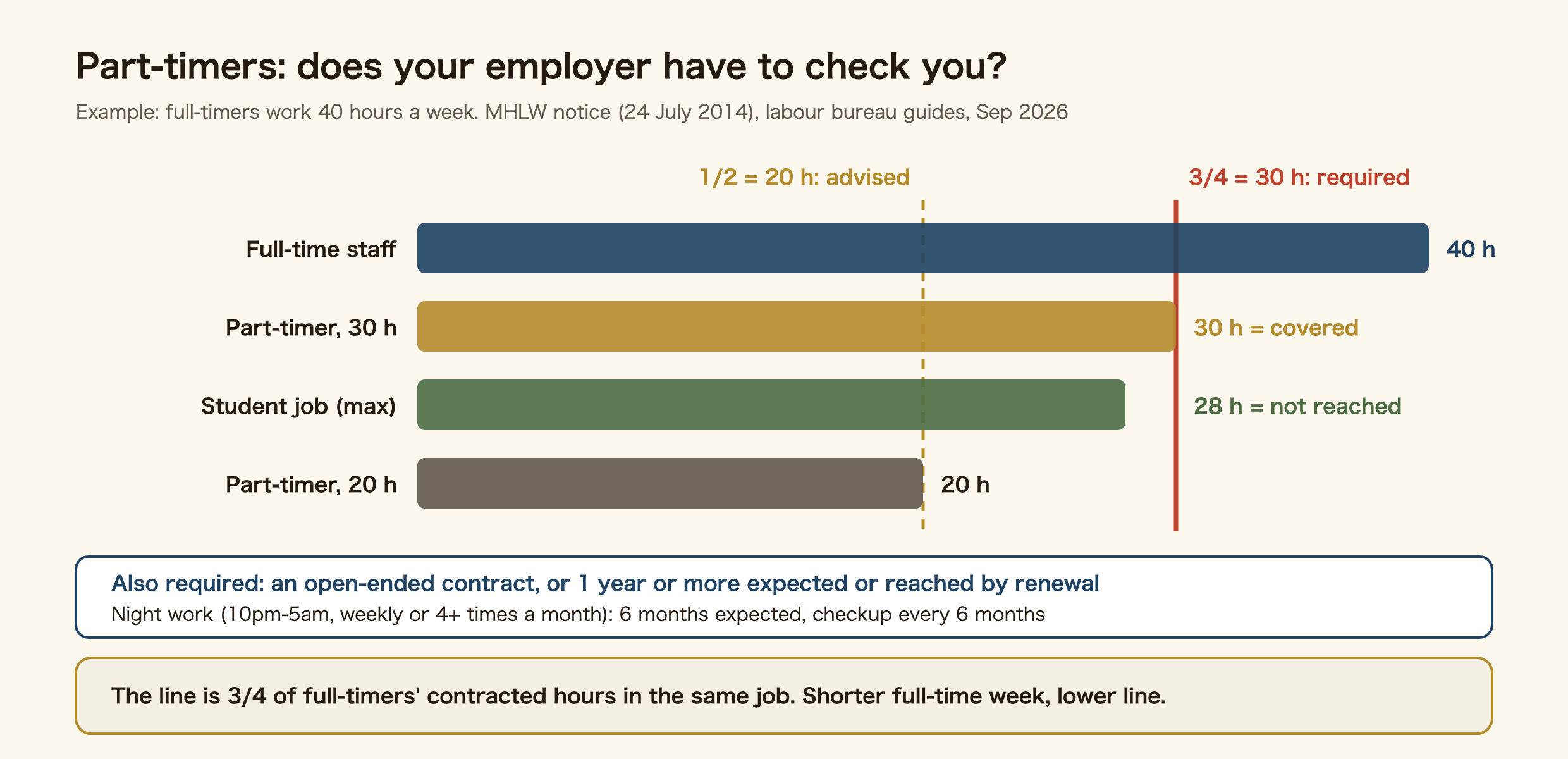
The job title “part-time” or “arubaito” does not decide it. A Ministry notice of 24 July 2014 treats a short-hours worker as employed on a regular basis, and so entitled to the checkup, when both of these are true (as quoted by the Shizuoka Labour Bureau).
- The contract has no end date — or, if it does, you are expected to work a year or more, or have been renewed to a year or more
- Your contracted weekly hours are at least three quarters of the contracted weekly hours of full-timers doing the same kind of work at the same workplace
Below three quarters, it is still considered desirable to check people working roughly half of full-time hours or more (Ishikawa Labour Bureau).
The second condition is where people get confused. It compares contracted hours, not the hours you actually worked. Where full-timers are contracted for 40 hours a week, three quarters is 30 hours and half is 20.
International students may work up to 28 hours a week on their work permission. In a workplace with a 40-hour full-time week, even the maximum does not reach 30, so the employer is not required to check you. Where the full-time week is shorter, the line drops: at 36 hours, three quarters is 27. Your weekly hours and contract length are on the written statement of working conditions you get before you start.
Night work adds a second line. If you work between 10pm and 5am at least once a week or four times a month, you count as regularly on night work, and your checkup is every six months (Ishikawa Labour Bureau). The contract condition here is six months or more. Night shifts at convenience stores and factories can fall into this.
No checkup at work? The tokutei kenshin for National Health Insurance members aged 40-74
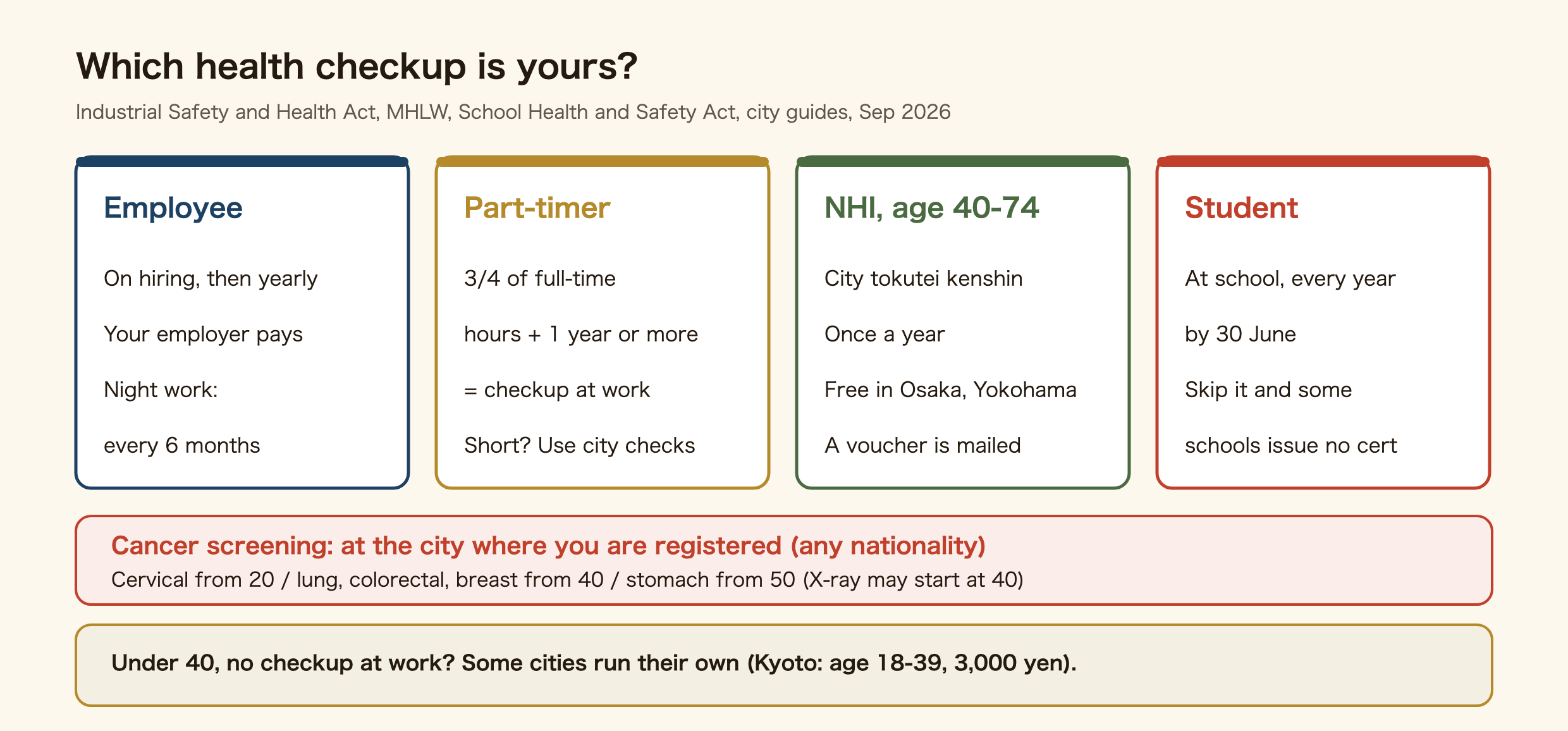
If you do not qualify at work, are self-employed or are not working, and you are on National Health Insurance at 40 to 74, your checkup is the city’s tokutei kenshin (specific health checkup).
The tokutei kenshin is a yearly checkup focused on metabolic syndrome, which health insurers must offer members aged 40 to 74 (Act on Assurance of Medical Care for Elderly People, Article 20). The Ministry tells self-employed people on National Health Insurance to ask their city, and employees to ask their employer. If you had the workplace checkup, you do not need a separate tokutei kenshin.
What you pay depends on the city.
- Osaka — free. Vouchers go out by household in late April, normally to the address on your resident record
- Yokohama — free. The questionnaire is available in other languages
- Atsugi — 1,500 yen at 40-69 (free at 40, 45 and 50), free at 70-74. Free for tax-exempt households that apply in advance
The trap is joining National Health Insurance part-way through the year. Osaka posts the voucher about two months after you join, and anyone joining from December waits for the next year. Yokohama does not post vouchers to people who joined after 1 April; you have to ask for one. That catches people who have just arrived, and people who left a job and switched to the national plan. If you have not joined yet, the 14-day enrolment comes first.
Under 40, the tokutei kenshin does not apply. Some cities run their own checkup instead. Kyoto’s young-adult checkup is for residents aged 18 to 39 who have no checkup at work or elsewhere, and costs 3,000 yen. Students are told to use their school’s checkup and employees their employer’s, so neither can use it.
Can foreigners get cancer screening in Japan?
Yes. Cities run cancer screening under the Health Promotion Act. The national guideline covers people who live in the municipality, with no nationality condition.
| Screening | Who | How often |
|---|---|---|
| Stomach | 50 and over (X-ray may start at 40) | Every 2 years (X-ray may be yearly) |
| Cervical | Women 20 and over | Every 2 years (HPV-only test: 30 and over, every 5 years) |
| Lung | 40 and over | Yearly |
| Breast | Women 40 and over | Every 2 years |
| Colorectal | 40 and over | Yearly |
The Ministry says most cities cover much of the cost with public money, so you pay only part. In Osaka, colorectal screening is 300 yen, cervical 400 yen, breast (mammography) 1,500 yen, and lung screening is free. Tax-exempt households and people on public assistance pay nothing if they show proof. Women turning 20 get a free coupon for cervical screening, and women turning 40 one for breast screening.
Osaka does exclude people who can get the same screening through their health insurance or employer. When your workplace checkup notice arrives, look first at whether cancer screening is included. The Ministry gives the same advice.
Do international students have a health checkup?
Yes, at school, every year. Article 13 of the School Health and Safety Act requires schools to check their students every academic year, by 30 June (Enforcement Regulations, Article 5). First-year university students are also checked for tuberculosis.
The same article applies to vocational schools (senmon gakko, Article 32). Accredited Japanese language institutions with a course for students on Student status must have arrangements for health checkups (accreditation standards, Article 33).
Skipping it costs you the certificate. The University of Tokyo issues no health certificate at all to students who missed its checkup, and it lists what the certificate is used for: job applications, scholarship applications, dormitories and part-time jobs. Keio also bars students who missed it from physical education classes and tells them to get checked at an outside clinic and submit the results. Missing the spring checkup in the year you apply for a scholarship for international students is an avoidable problem.
How much does a health checkup cost in Japan?
| Where | Cost |
|---|---|
| Workplace checkup (hiring, yearly, night work) | Paid by the employer |
| Tokutei kenshin (NHI, 40-74) | Free in Osaka and Yokohama; 1,500 yen in Atsugi (free at some ages) |
| Young-adult checkup (Kyoto, 18-39) | 3,000 yen |
| Cancer screening (Osaka) | Free to 1,500 yen |
| University health certificate (University of Tokyo) | 100 yen a copy |
Compare that with paying yourself. Atsugi says the same tests at a clinic cost about 9,000 yen. Kyoto describes its young-adult checkup as worth about 10,000 yen.
How do I book, and what do I bring?
For the workplace checkup, your employer sets the date and clinic and tells you. You can use a clinic of your own choice instead: Article 66(5) lets you take an equivalent checkup with another doctor and hand the results to your employer.
For the city tokutei kenshin, the steps in Osaka are:
- Your voucher arrives (if not, ask your ward office to issue one)
- Book with a participating clinic (group checkups need no booking)
- Finish eating at least 10 hours before
- Bring the voucher, your My Number health insurance card or eligibility certificate, and the personal record sheet
For Osaka’s cancer screening, you phone the clinic and say you want the Osaka City screening for the cancer in question. Bring something that shows your age and that you live in Osaka, such as your My Number card. Osaka publishes a list of clinics that can handle foreign languages. The phrases in seeing a doctor in Japan work for the checkup questionnaire too.
What happens if I don’t take the health checkup?
Article 66(5) says workers “shall undergo” the checkups their employer provides. When the notice comes, taking it is your duty as well.
The penalty clause (Article 120) lists employers’ breaches: an employer who fails to provide the checkup can be fined up to 500,000 yen. It does not list a fine for workers who do not attend. If the problem is that the employer’s clinic is far away or the date does not work, use your own doctor and hand in the results.
The city tokutei kenshin and cancer screening are not something the law requires you to take; the duty is on the side that runs them. For students, as the University of Tokyo example shows, the cost is the certificate.
What if my employer doesn’t provide a checkup?
First check that you qualify. Full-time staff do. Part-timers should check their contracted weekly hours against three quarters of full-time, and whether the contract is for a year or more.
If you qualify and a year has passed with nothing, ask: “When is the regular health checkup?” Not providing one breaks the law. If nothing happens, you can go to the Labour Standards Inspection Office for your workplace’s area. There are free labour consultation desks, some in other languages, across the country.
While you wait, you can use city checkups: the tokutei kenshin if you are 40 or over on National Health Insurance, and cancer screening at your city. Some, like Kyoto’s, are only for people with no checkup at work, so explain your situation at the counter.
Which one are you?
- Full-time, or a part-timer who qualifies — find out the checkup date and ask how that day’s shift and pay are handled. If you want your own clinic, tell your employer you will hand in the results.
- A part-timer below the 3/4 line — check your weekly hours and contract length on your working-conditions statement. At 40 or over on National Health Insurance, find your voucher; at 39 or under, search your city’s website for a young-adult checkup.
- On National Health Insurance, aged 40-74 — find the voucher envelope at home. If you joined part-way through the year, ask your city for a voucher today.
- A student — check your school’s checkup dates. If you have already missed it, contact the health centre today and ask how to get checked outside.
FAQ
Q. Do foreigners get the company health checkup in Japan?
Yes. Under Article 66 of the Industrial Safety and Health Act, employers must provide health checkups to the people they employ, regardless of nationality: on hiring, then at least once a year.
Q. Do I have to pay for the health checkup at work?
No, the employer pays. The Ministry of Health, Labour and Welfare says the cost of legally required checkups should be borne by the employer. Pay for the time spent is agreed between employer and employee, and it is desirable for the employer to pay.
Q. Do part-time workers get a health checkup in Japan?
Yes, if their contracted weekly hours are at least three quarters of full-timers’ and they are hired for a year or more (or renewed to a year or more). Where full-timers work 40 hours, the line is 30, so a student job capped at 28 hours does not reach it.
Q. Where do people on National Health Insurance get a health checkup?
At 40 to 74, through their city’s tokutei kenshin. Osaka and Yokohama offer it free and post a voucher. If you joined part-way through the year, some cities only send a voucher when you ask.
Q. Do international students have to take a health checkup?
Schools must check students every year, by 30 June (School Health and Safety Act). Some universities issue no health certificate to students who miss it, and the certificate is used for job and scholarship applications.
Q. What happens if I skip the health checkup at work?
The law says workers must take it too. The fine of up to 500,000 yen applies to employers who fail to provide it. If the employer’s clinic does not suit you, you can use your own doctor and hand in the results.
Summary
The workplace checkup comes on hiring and once a year, paid by the employer, whatever your nationality. Part-timers qualify at three quarters of full-time hours with a year or more of work ahead, and where full-timers work 40 hours, a student job capped at 28 hours does not reach that line.
If you fall outside it, go through your city: the tokutei kenshin on National Health Insurance at 40 to 74, and cancer screening where you are registered. Students use the school’s spring checkup. If none of these seems to fit, search your city’s website for “kenshin”.
Official sources: Industrial Safety and Health Act, Articles 66, 66-6 and 120 (e-Gov, Japanese) / Ordinance on Industrial Safety and Health, Articles 43-45 and 51 (e-Gov, Japanese) / MHLW FAQ on who pays (Japanese) / MHLW FAQ on wages during checkups (Japanese) / Shizuoka Labour Bureau, short-hours workers (Japanese) / Ishikawa Labour Bureau checkup FAQ (Japanese) / MHLW tokutei kenshin (Japanese) / MHLW cancer screening (Japanese) / School Health and Safety Act (e-Gov, Japanese) / Osaka City tokutei kenshin / Osaka City cancer screening / Yokohama City tokutei kenshin / Kyoto City young-adult checkup / University of Tokyo Health Service Center, student certificates. Checked on 24 September 2026. Fees and how vouchers are sent differ by city, so check your own city’s page.
Related reading
Found this useful? Share it
Send it to a friend who lives in Japan.
READ THIS NEXT
After Japanese Language School →A language school has no job pipeline, and that is not because you are behind.WHO WROTE THIS

mori
Japanese. I read the ministries’ own notices, orders and Q&As in the original, and I start from what my Nepalese and Sri Lankan friends in Japan actually ran into. I do not write about what I have not checked or been told.
What this site can and cannot do →Looking for something else?