This article was checked on 8 October 2026 against the Long-Term Care Insurance Act and Health Insurance Act (e-Gov), the Ministry of Health, Labour and Welfare’s leaflet for people turning 40 and its system overview, the Japan Health Insurance Association’s (Kyokai Kenpo) fiscal 2026 rates and premium table, the Japan Pension Service, and the official pages of Shinjuku City and Yokohama City.
The short answer
- Long-term care insurance (kaigo hoken) is Japan’s public insurance for people who come to need care, and from age 40 you pay into it with your health insurance. If you have a registered address in Japan and are in employee health insurance or National Health Insurance, foreigners pay exactly like Japanese residents.
- It starts with the month that contains the day before your 40th birthday. Employers deduct last month’s premium, so it first shows on the following month’s payslip.
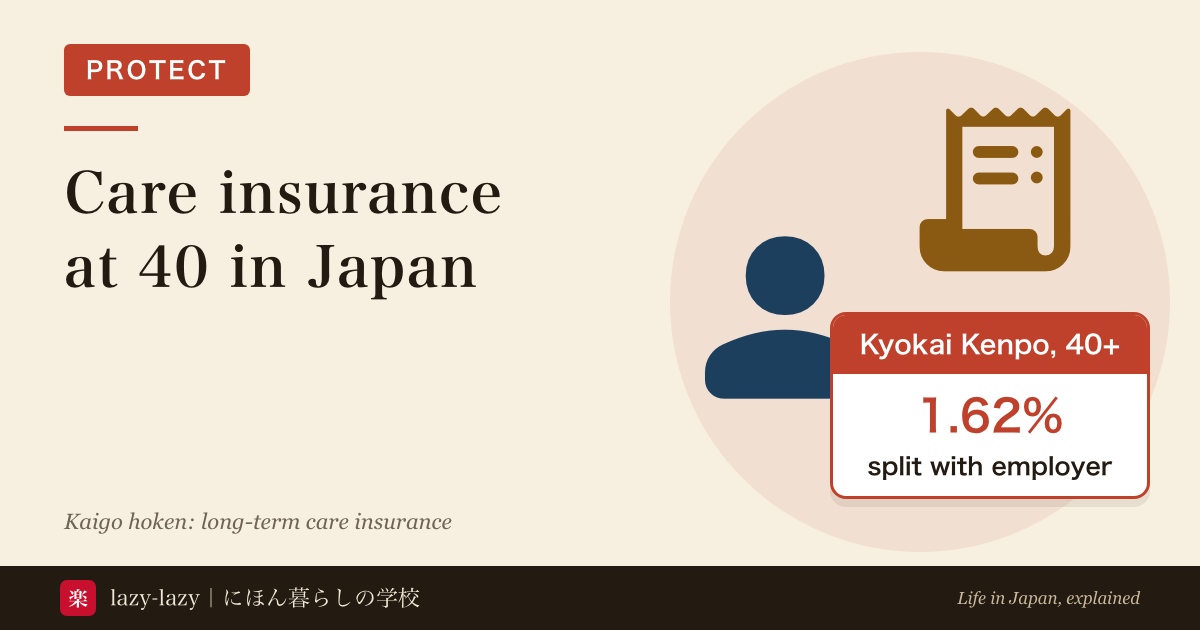
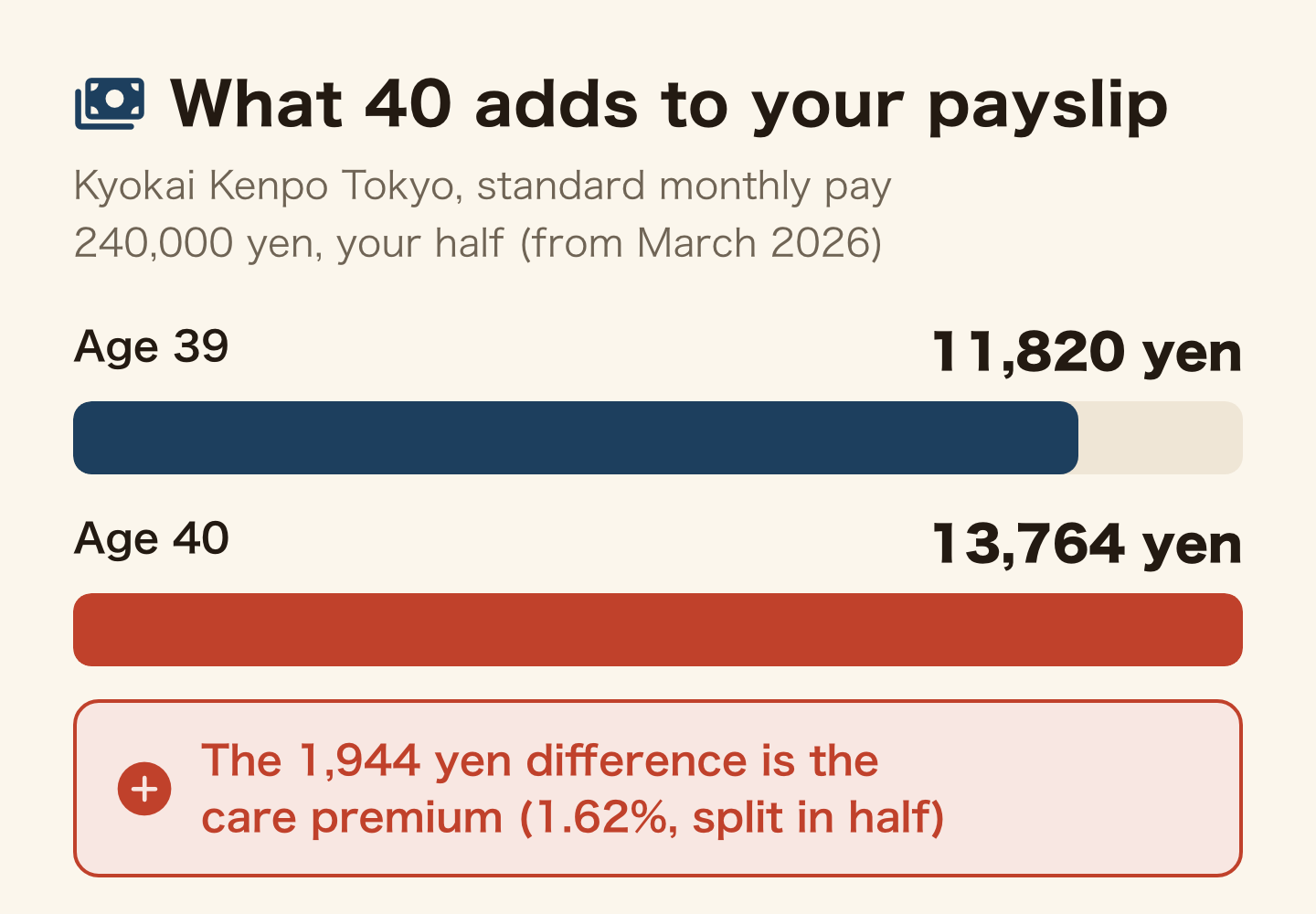
- For Kyokai Kenpo members the rate is 1.62% (from March 2026), split half and half with your employer. On standard monthly pay of 240,000 yen in Tokyo, your half is 1,944 yen a month. On National Health Insurance, your city adds a “care part” to your premium.
- Before 65 you can only use it if the cause is one of 16 specified diseases. From 65 you become Category 1 and can use it whatever the cause.
- Leaving Japan does not get you the premiums back. The lump-sum withdrawal payment is for pensions only. Premiums stop from the day after your address in Japan ends.
Knowing this, when the number on your payslip grows at 40, you can check for yourself what it is, when it started and how much it should be. You can also see what this money will do for you depending on whether you stay in Japan past 65 or go home before.
Your 40th birthday has passed. You open your payslip and the health insurance line is a little bigger than last month. There is a word you have not seen before: kaigo. You ask the Japanese colleague at the next desk. “Everyone pays it once they turn 40,” they say, and that is all. For them it is part of life their parents’ generation already went through. But you might go home one day. Will you ever receive care in Japan? What happens to this money if you leave? The next desk does not have those answers.
- What is long-term care insurance (kaigo hoken) in Japan?
- Do foreigners pay long-term care insurance in Japan?
- When does the long-term care premium start?
- How much is long-term care insurance at 40?
- How much is the care part on National Health Insurance?
- Can I use long-term care insurance before 65?
- Is it money wasted if I leave before 65?
- Do I get the long-term care premiums back when I leave Japan?
- What if I cannot pay the long-term care premium?
- Which one are you?
- FAQ
- Summary
- Related reading
What is long-term care insurance (kaigo hoken) in Japan?
Long-term care insurance is the public system that pays for care when someone needs help with daily life, funded by premiums and taxes. The person using care pays 10-30% of the cost and the insurance pays the rest.
The insured are split into two groups (Long-Term Care Insurance Act, Article 9):
- Category 1: people aged 65 or over with an address in a Japanese municipality
- Category 2: people aged 40-64 with an address in a Japanese municipality who are in a public health insurance scheme (employee health insurance, National Health Insurance and others)
At 40-64, you pay the Category 2 premium. The Ministry of Health, Labour and Welfare’s leaflet says residents “automatically qualify for this category at the age of 40”. There is nothing to file.
Why 40? The Ministry’s English leaflet for people turning 40 explains that people aged 40-64 are more likely to need care themselves because of age-related diseases, and their parents are also reaching the age when care is needed.
Do foreigners pay long-term care insurance in Japan?
Insurance is something you choose. If you do not think you will use it, you do not buy it. Where you come from, that may be normal. In Japan, long-term care insurance is set by law: you join automatically at 40, and there is no way to opt out by choice.
Nationality is not one of the conditions. Yokohama City says foreign nationals with an address in the city who are 40-64 and in a health insurance scheme are covered if all three of these apply:
- You are a foreign resident under the Basic Resident Registration Act (you have a resident record)
- Even if your first period of stay was less than three months, your purpose and way of life show you will stay three months or more
- You do not fall under an exemption
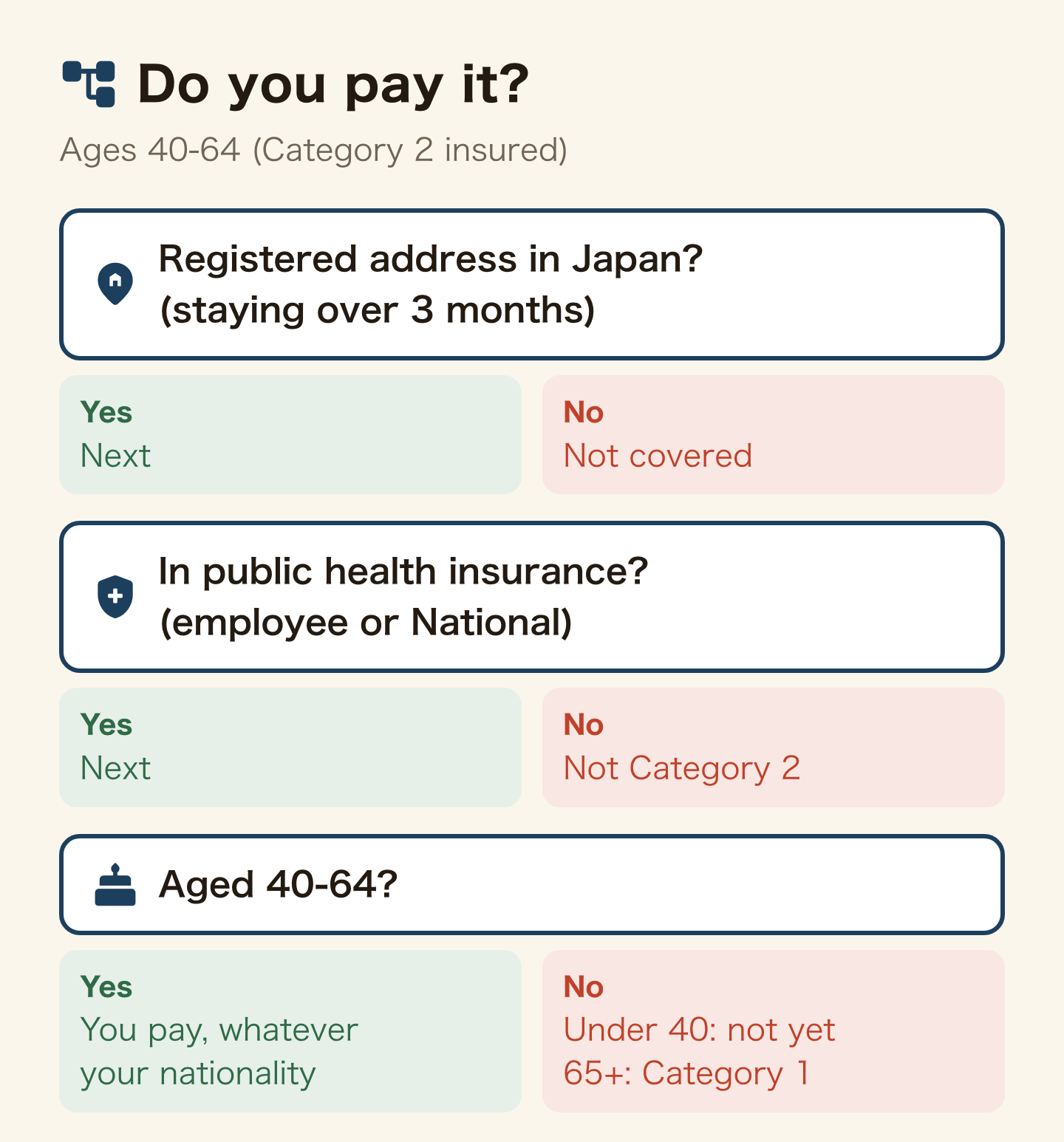
The same applies to employees. The Japan Pension Service says a foreign national whose period of stay over three months has not been granted, or an employee transferred to live abroad, files an exemption notice through the employer. Put the other way: if you live in Japan on a period of stay over three months and are in your company’s health insurance, you pay from 40.
If you have dependants on your insurance, note one point. In Kyokai Kenpo, you do not pay a separate premium for dependants aged 40-64 (Japan Pension Service Q&A). Some company health insurance societies, though, charge members under 40 for dependants aged 40 or over under their own rules. If yours is a society, ask them.
When does the long-term care premium start?
The Ministry’s leaflet says “starting from the month of the 40th birthday”. To be exact, it is the month that contains the day before your 40th birthday. Kyokai Kenpo explains that “reaching 40” means the day before the 40th birthday, with these examples:
- Born on 2 May: the day before is 1 May, so it starts with May
- Born on 1 May: the day before is 30 April, so it starts with April
If you were born on the 1st of a month, it starts a month before your birthday month. Anyone born from the 2nd to the end of a month starts with the birthday month.
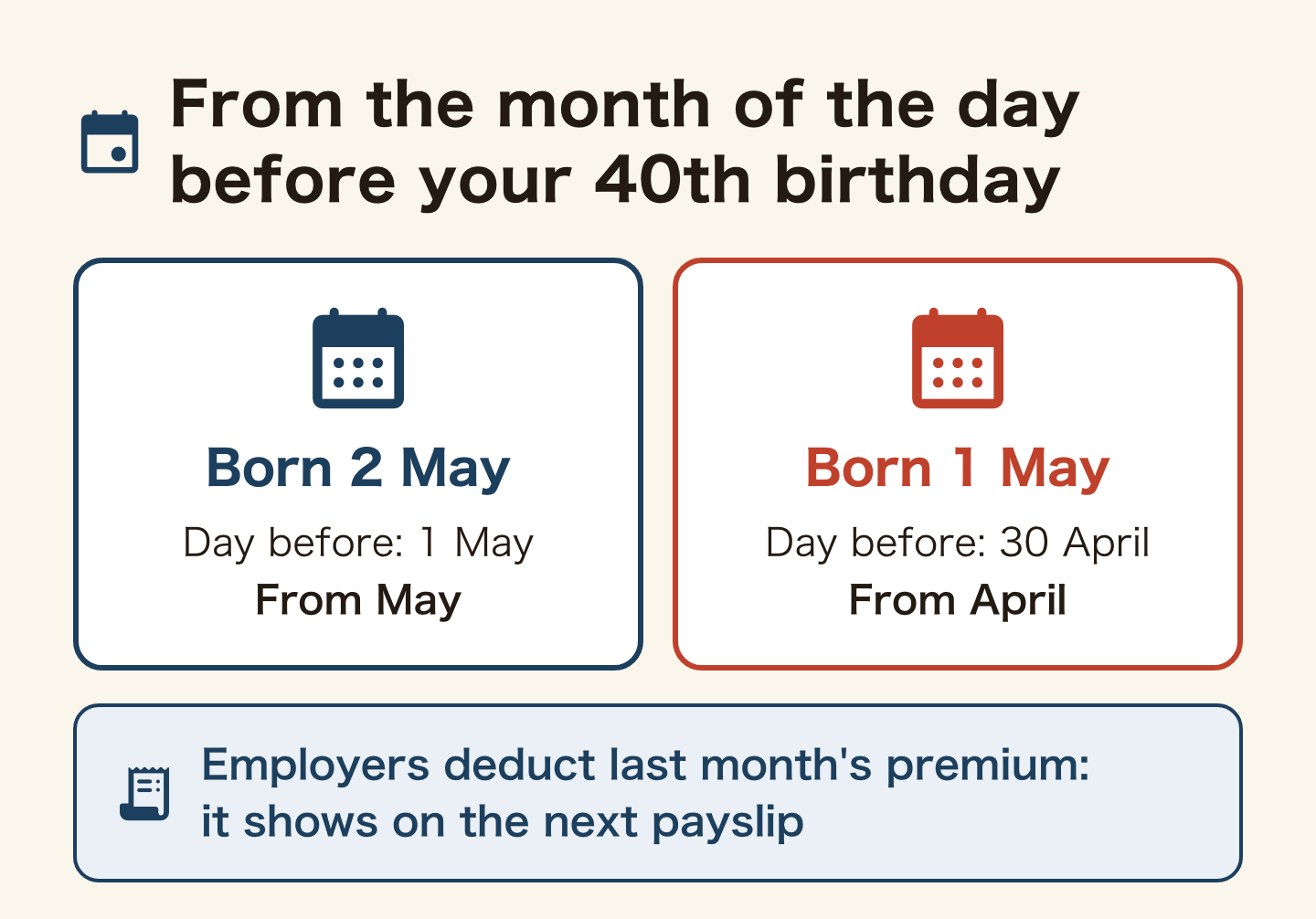
The deduction comes one month later still. Employers take the previous month’s premium out of your pay (Health Insurance Act, Article 167), and Kyokai Kenpo’s example bills May’s premium in June. If you have turned 40 and see nothing yet, look at next month’s payslip. Where to look is in how to read the five deductions on a Japanese payslip. If there is no separate care line, check whether it is inside the health insurance line.
It ends at 65. You switch to Category 1, the care premium stops coming with your health insurance, and your municipality bills you for the Category 1 premium instead.
How much is long-term care insurance at 40?
Kyokai Kenpo’s care premium rate is 1.62% from March 2026 (1.59% the year before). It is the same across Japan and is reviewed every fiscal year. The calculation:
Your share = standard monthly pay × 1.62% ÷ 2
Standard monthly pay is your monthly pay placed into a bracket. For example, pay from 230,000 yen up to under 250,000 yen counts as 240,000 yen. You and your employer each pay half (Health Insurance Act, Article 161). Kyokai Kenpo Tokyo’s premium table shows how the health line changes at 40:
| Standard monthly pay | Age 39 (your half) | From 40 (your half) | Added |
|---|---|---|---|
| 240,000 yen | 11,820 yen | 13,764 yen | 1,944 yen |
| 300,000 yen | 14,775 yen | 17,205 yen | 2,430 yen |
Bonuses are charged too: the bonus, rounded down to the nearest 1,000 yen, times the rate. If your company is in a health insurance society rather than Kyokai Kenpo, the society sets its own care rate (Health Insurance Act, Article 160). Check your payslip and the society’s notice for your rate.
The care premium you pay counts for the social insurance premium deduction in income tax, including the amount taken from your pay.
How much is the care part on National Health Insurance?
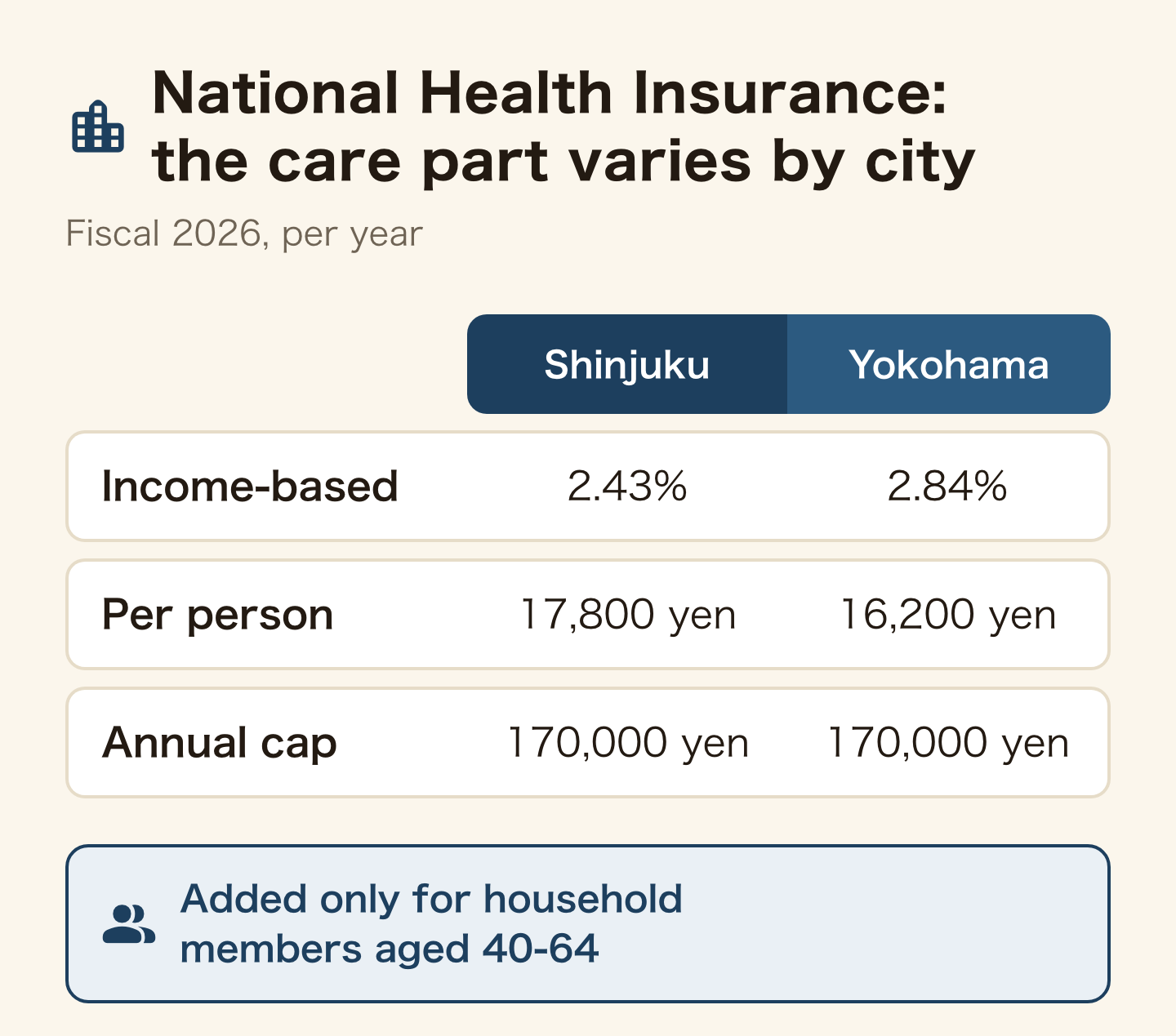
If you are on National Health Insurance and aged 40-64, a “care part” (kaigo-bun) is added to your premium. The municipality sets the numbers, so they depend on where you live. Fiscal 2026 examples:
- Shinjuku: 17,800 yen for each member aged 40-64, plus 2.43% of income; capped at 170,000 yen
- Yokohama: 16,200 yen per person plus 2.84% of income; capped at 170,000 yen
For a 40-year-old living alone in Shinjuku with income of 2,000,000 yen last year, the income base is income minus 430,000 yen:
17,800 yen + (2,000,000 − 430,000) × 2.43% = 17,800 + 38,151 = 55,951 yen a year
It arrives as one National Health Insurance bill together with the medical and other parts. Even with no job, the per-person part means it is never zero. Households with low income last year can get the per-person part reduced, and for that your income has to be declared (Itabashi City). The conditions are in the 70% reduction you must ask for. How to join and leave the scheme is in our guide to health insurance in Japan.
Can I use long-term care insurance before 65?
This is where many foreigners in their forties get stuck. Between 40 and 64 you can use the insurance only if the reason you need care is a “specified disease”, an age-related illness listed by the government (Long-Term Care Insurance Act, Article 7). The Ministry’s list of specified diseases has 16:
- Cancer (only when a doctor judges recovery is not expected)
- Rheumatoid arthritis
- Amyotrophic lateral sclerosis (ALS)
- Ossification of the posterior longitudinal ligament
- Osteoporosis with fracture
- Presenile dementia
- Progressive supranuclear palsy, corticobasal degeneration and Parkinson’s disease
- Spinocerebellar degeneration
- Spinal canal stenosis
- Progeria
- Multiple system atrophy
- Diabetic neuropathy, nephropathy and retinopathy
- Cerebrovascular disease (stroke)
- Arteriosclerosis obliterans
- Chronic obstructive pulmonary disease (COPD)
- Osteoarthritis with significant deformity of both knees or both hips
If you need care after a traffic accident before 65, long-term care insurance does not cover it. The Ministry’s leaflet sets out these steps:
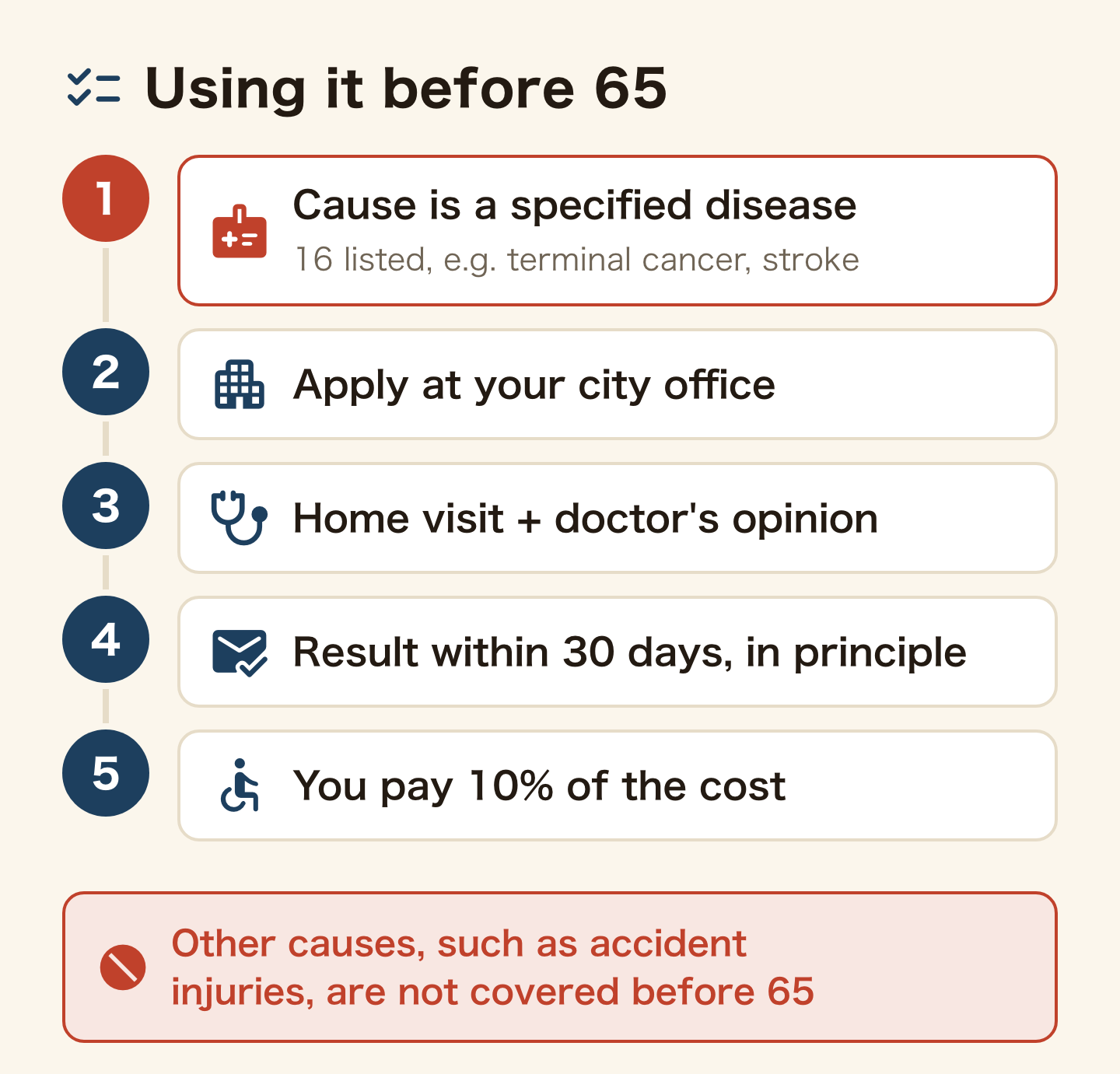
- Apply for care-need certification at your municipal office. Category 2 applicants also need their health insurance card
- A municipal assessor visits your home to ask about your body and daily life, and the city asks your doctor for a written opinion
- A certification committee decides; for Category 2 it also checks whether the cause is a specified disease
- The result arrives within 30 days of applying, in principle
- A care plan is made and you use services. Category 2 users pay 10%, whatever their income
If anything in the process is unclear, your municipality’s community general support centre (chiiki hokatsu shien center) can help; the leaflet says advice is free. For lost income while you cannot work, long-term care insurance is the wrong place to look. Health insurance sick pay is one source, and our guide to counting public cover before buying life insurance shows the rest.
Is it money wasted if I leave before 65?
Start with the numbers. In the Ministry’s system overview, there are 41.88 million Category 2 insured, and 0.13 million of them, or 0.3%, are certified as needing care or support (fiscal 2022). Few people use it themselves between 40 and 64.
After 65 the picture changes. Category 1 can use it for any cause, and the same document shows 19.0% of people 65 or over certified, and 31.3% of those 75 or over. If you will still live in Japan after 65, the premiums from 40 are part of what pays for your care then.
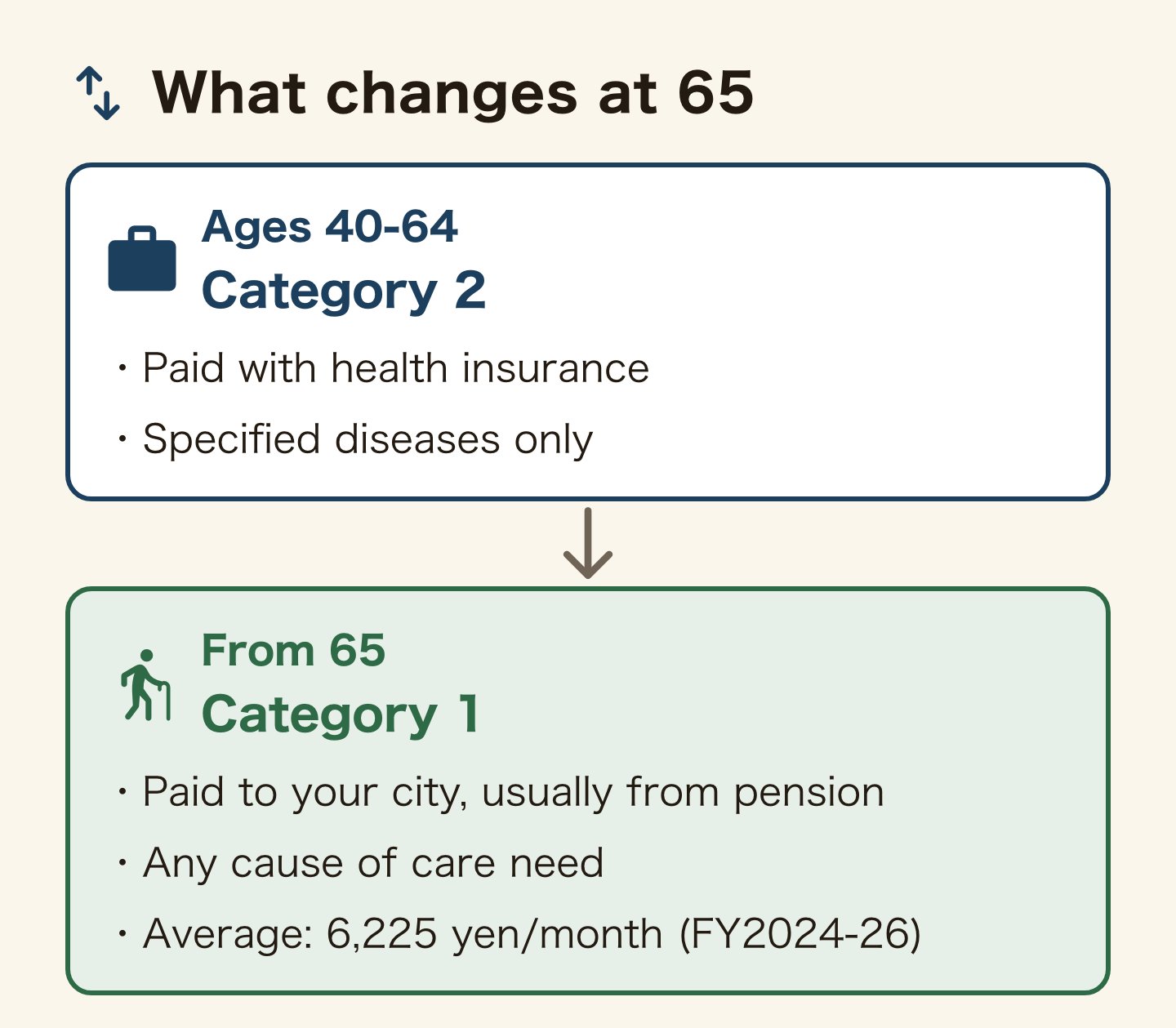
From 65 the premium no longer comes with health insurance. Your municipality sets and collects it, usually from your pension. The national average for fiscal 2024-2026 is 6,225 yen a month (same overview).
If you go home before 65, your chance of using it yourself is limited to the specified diseases. Half of the system is funded by tax and half by premiums, with 27% of the total coming from people aged 40-64. What you pay goes to the care of people receiving it in Japan now.
Do I get the long-term care premiums back when I leave Japan?
No. For pensions you can claim the lump-sum withdrawal payment after you leave. There is nothing like that for long-term care insurance.
The Japan Pension Service’s lump-sum withdrawal payment is for foreigners with six months or more of paid (or partly exempt) National Pension contributions, or six months or more in Employees’ Pension, claimed within two years of the day their address in Japan ended. It covers pensions only. Health and care premiums are not part of it. The Long-Term Care Insurance Act has no rule for returning premiums to people who leave Japan either. The only refunds it provides for are overpayments and payments made in error. How to get your pension money back is in our lump-sum withdrawal guide.
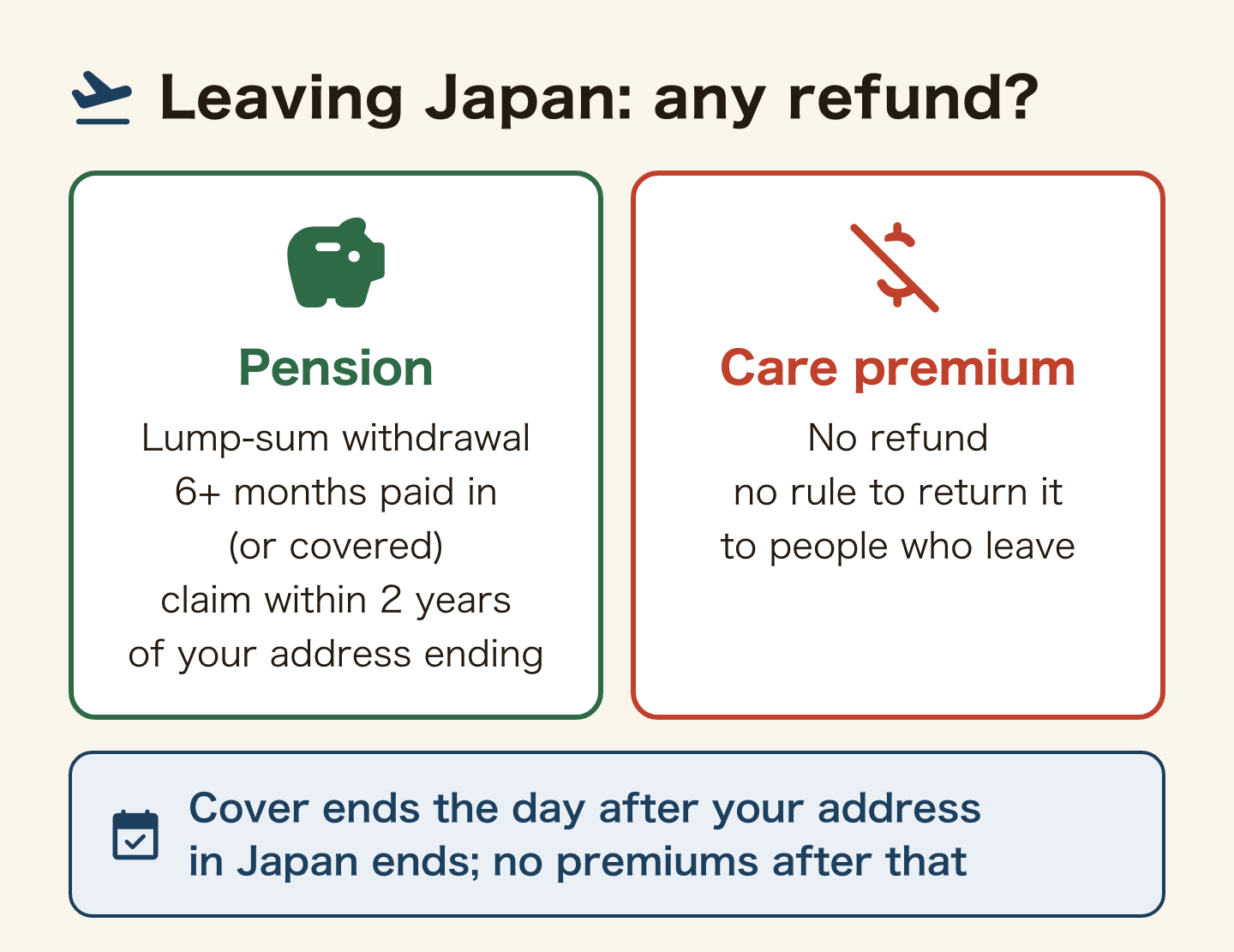
What stops it is losing the status. Under Article 11 of the Act, you lose it the day after you no longer have an address in the municipality. Category 2 members also lose it on the day they leave their health insurance. File your moving-out notice before you go, and no care premiums are charged after that. If you are leaving a job as well, what to do when you leave a job in Japan covers health insurance and pension. For the full order of things, use the leaving-Japan checklist.
If you move to an overseas office while staying on your company’s health insurance, your employer files the exemption notice with a certificate showing your removal from the resident register (Japan Pension Service).
What if I cannot pay the long-term care premium?
Employees cannot forget to pay, because it comes out of salary. National Health Insurance members are the ones to watch. Leaving the care part unpaid means unpaid National Health Insurance. How reminders turn into seizure, and how it affects visa renewal, is covered in what happens when residence tax or premiums go unpaid.
The care side has its own rule. If a Category 2 member has health insurance premiums (including National Health Insurance) unpaid past the due date, the municipality can suspend all or part of their care benefits (Long-Term Care Insurance Act, Article 68). If a specified disease ever leaves you needing care, you could find the insurance unavailable.
As soon as you know you cannot pay, go to the National Health Insurance desk at your city office. Ask whether declaring your income brings a reduction, and whether you can pay in parts. Leaving it alone is the most expensive choice.
Which one are you?
- Employee, about to turn 40 — work out the month of the day before your birthday, then check next month’s payslip for a larger health (or new care) line. If your insurer is a health insurance society, look up its care rate.
- On National Health Insurance, aged 40-64 — find this year’s care-part rates on your city’s page and run the numbers with last year’s income. If your income was low, declare it and check for a reduction.
- Planning to go home before 65 — when you set your departure date, set your moving-out notice date too so premiums stop. Note where to claim the pension lump sum and its deadline: two years from the day your address in Japan ends.
- Planning to live in Japan after 65 — your premiums from 40 cover care for any cause from 65. Ask your doctor once whether any current condition is a specified disease.
FAQ
Q. Do foreigners pay long-term care insurance in Japan?
Yes. If you are aged 40-64, have a resident record in Japan (staying more than three months) and are in employee health insurance or National Health Insurance, you are Category 2 insured whatever your nationality, and you pay the premium with your health insurance.
Q. When does the long-term care premium start?
From the month containing the day before your 40th birthday. If you were born on the 1st, that is the month before your birthday month. Employees have last month’s premium deducted, so it first appears on the following month’s payslip.
Q. How much is the long-term care premium?
Kyokai Kenpo employees pay 1.62% of standard monthly pay, split half and half with the employer (from March 2026). On 240,000 yen in Tokyo, your half is 1,944 yen a month. On National Health Insurance your city sets it; in fiscal 2026 Shinjuku charges 17,800 yen per person plus 2.43% of income.
Q. Can I use long-term care insurance before 65?
Only if the cause of your care need is one of 16 specified diseases, such as terminal cancer, stroke or rheumatoid arthritis. You need care-need certification from your municipality, and you pay 10% of the cost. Accident injuries and other causes are not covered until 65.
Q. Do I get my long-term care premiums back when I leave Japan?
No. The lump-sum withdrawal payment covers National Pension and Employees’ Pension only. Your status ends the day after your address in Japan ends, so no care premiums are charged after you move out.
Q. Do I pay the care premium for dependants aged 40 or over?
Not in Kyokai Kenpo. Some health insurance societies charge members under 40 for dependants aged 40 or over under their own rules, so check with your society.
Summary
At 40, anyone living in Japan with public health insurance becomes Category 2 insured for long-term care, foreigners included. Employees pay 1.62% split with the employer, and National Health Insurance members pay a care part set by their city, both together with health insurance. It starts with the month of the day before your 40th birthday and shows on the next payslip.
Before 65 it covers only specified diseases, and leaving Japan does not bring the premiums back. If you live in Japan past 65, it becomes insurance you can use for any cause. If you plan to go home, fix your moving-out date and your pension lump-sum deadline first.
Official sources: Long-Term Care Insurance Act (e-Gov) / Health Insurance Act (e-Gov) / Ministry of Health, Labour and Welfare, leaflets for people turning 40 (12 languages) / MHLW, Long-Term Care Insurance System (English leaflet) / MHLW, specified diseases / MHLW, overview of the long-term care insurance system (July 2025) / Kyokai Kenpo, long-term care premium rate / Kyokai Kenpo Tokyo, premium table from March 2026 / Kyokai Kenpo Ibaraki, care premiums from age 40 / Japan Pension Service, care insurance exemption notice / Japan Pension Service, lump-sum withdrawal payment / Yokohama City, foreign nationals and long-term care insurance / Shinjuku City, National Health Insurance premium calculation / National Tax Agency No.1130 (all checked 8 October 2026; Japanese pages except the MHLW English leaflet). Rates change every fiscal year, so check this year’s notice from your own health insurer and city.
Related reading
Found this useful? Share it
Send it to a friend who lives in Japan.
WHO WROTE THIS

mori
Japanese. I read the ministries’ own notices, orders and Q&As in the original, and I start from what my Nepalese and Sri Lankan friends in Japan actually ran into. I do not write about what I have not checked or been told.
What this site can and cannot do →Looking for something else?
You may use the figures in this article, including commercially, if you credit this site with a link. How to use our figures