Checked on 1 October 2026 against the Ministry of Health, Labour and Welfare’s notice of changes from October 2026 and its outline of the pension reform, the Japan Pension Service’s special page on expanded coverage and its Q&A on who counts as a student, and Article 12 of the Employees’ Pension Insurance Act as in force from 1 October 2026 (e-Gov). Re-checked: the end of the 88,000 yen pay condition, the student exclusion, and the company-size steps. They change — check the current terms yourself before you sign up or file anything.
Last updated: 1 October 2026
Summary
- “Social insurance” here means the health insurance and employee pension you join through your employer. It is a different system from National Health Insurance and the National Pension.
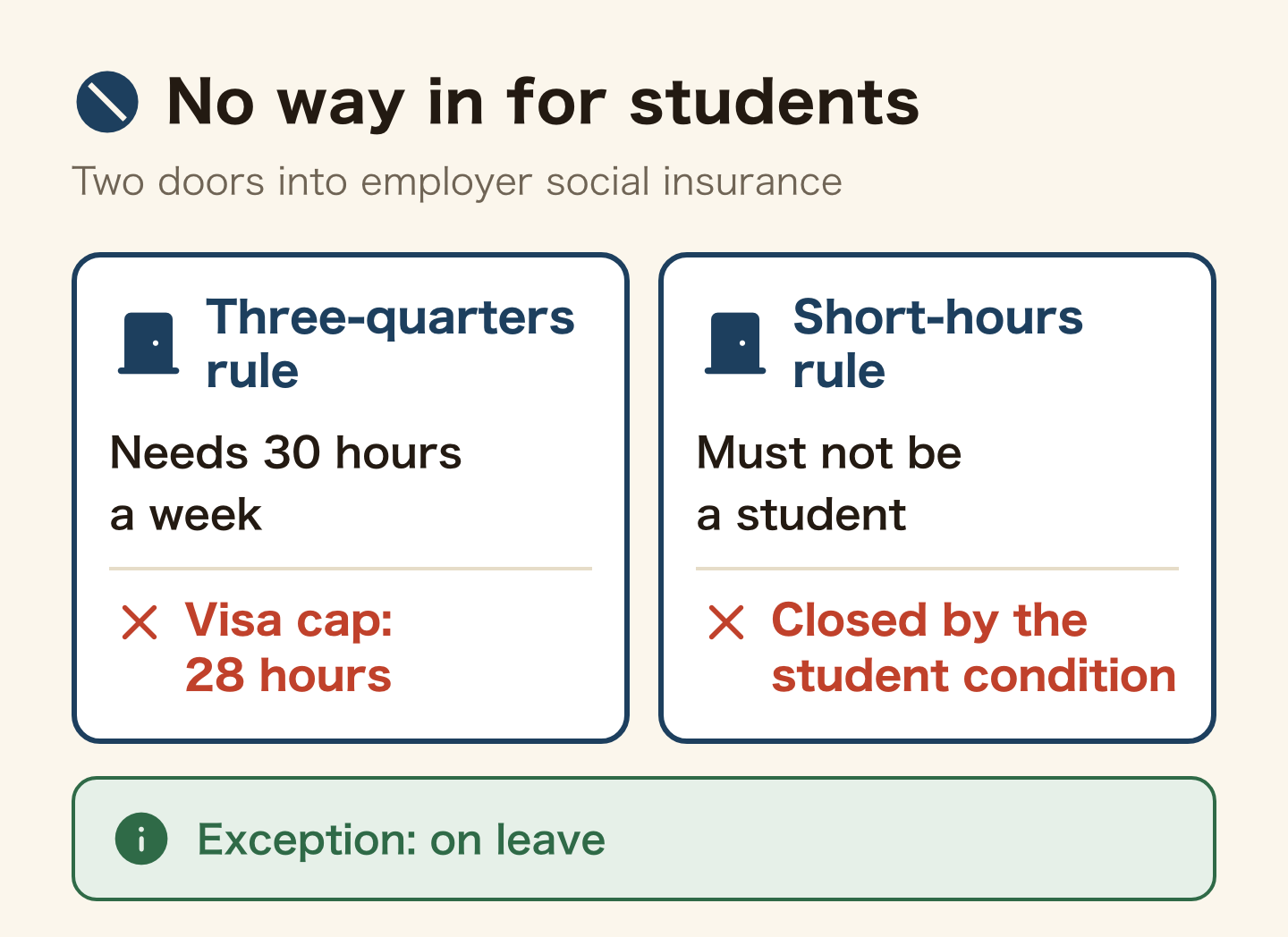
- Student part-time workers do not join it. There are two doors into the system, and students pass through neither.
- The short-hours rule behind the old “1.06 million yen wall” is one of those doors. Its pay condition was abolished on 1 October 2026; not being a student is still a condition.
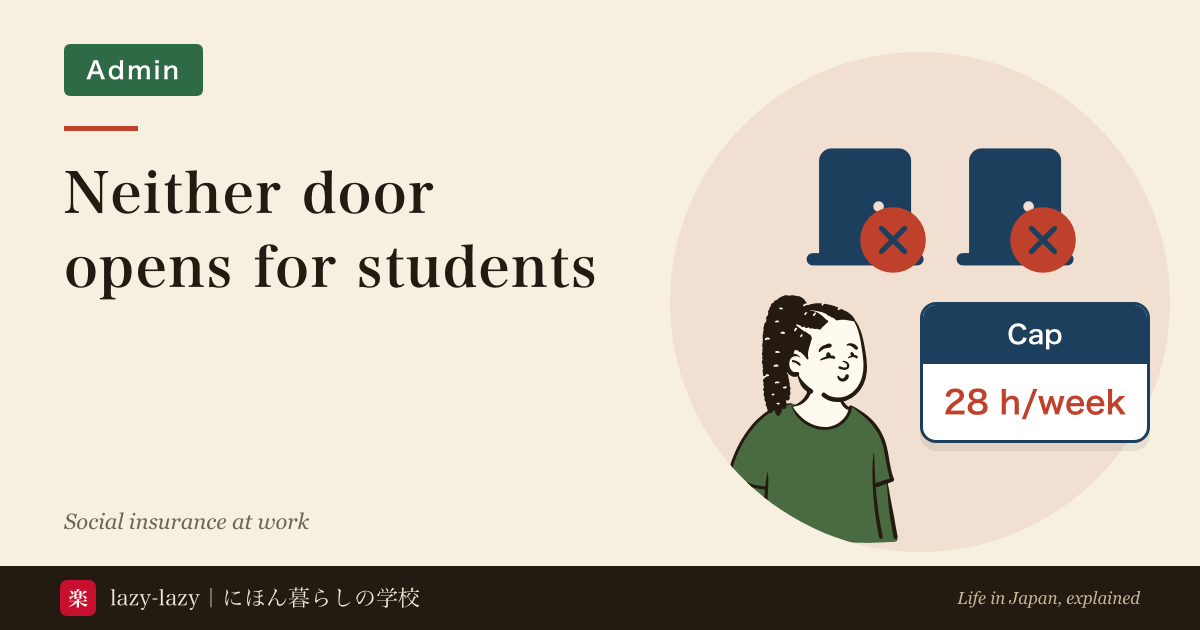
- The other door is 30 hours a week and 15 days a month. Student visas cap you at 28 hours, so you never reach it.
- Four main exceptions: on leave of absence, evening course, correspondence course, or staying with the same employer after graduation.
- Japanese language school students count as students too, because schools with a course of one year or more are included.
- Nothing is deducted, but you pay National Health Insurance and the National Pension yourself. Both have a way to bring the cost down.
October 2026 changes and students: short answers
Q. What changed in October 2026?
From 1 October 2026 the 88,000 yen a month pay condition (the “1.06 million yen wall”) for part-timers was abolished (MHLW, main changes from October 2026). The conditions now are working 20 hours a week or more, and not being a student.
Q. Do university and international students now have to join?
No. The student exclusion stays in the law (Employees’ Pension Insurance Act, Art. 12(5)). Students at universities, graduate schools, junior colleges, vocational schools, high schools and miscellaneous schools with a course of a year or more (most Japanese language schools) are outside, even at 20 hours a week or more (Japan Pension Service, who counts as a student).
Q. When does a student join anyway?
If you will stay with the same employer after graduating, are on leave of absence, or study on an evening or correspondence course, you are treated as a non-student. Working 30 hours a week and 15 days a month (the three-quarters test) also puts a student in, but a student visa caps you at 28 hours.
Q. What about small employers?
Today the rule covers employers with 51 or more insured staff. It widens to 36+ in October 2027, 21+ in October 2029, 11+ in October 2032, and all sizes in October 2035 (MHLW, outline of the reform). The student rule does not change at any step.
Q. Does a higher minimum wage change anything?
No. The pay condition is gone, so a minimum-wage rise does not change whether a student joins. The 1 October 2026 date was set after the minimum wage reached 1,016 yen or more in every prefecture (MHLW, expanding social insurance coverage).
What changes: you know student part-timers do not join it – and the ‘1.06 million yen wall’ news stops worrying you.
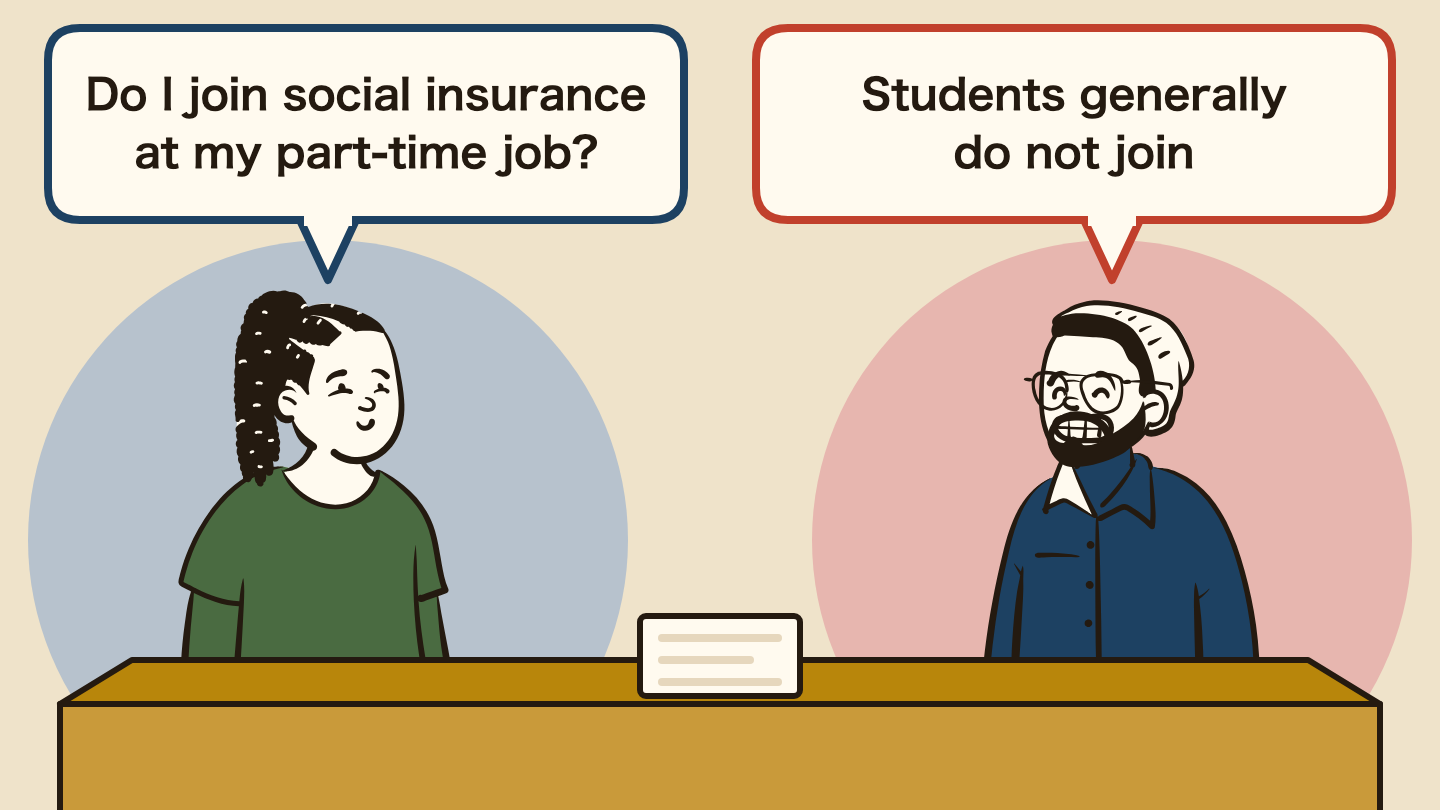
You compare payslips with a Japanese friend and the deductions do not match. Theirs shows health insurance and employee pension. Yours shows income tax and nothing else. It looks like paperwork someone forgot, and like a bill that will arrive later.
Nobody forgot. The system is built this way.
- What “social insurance” means here
- The 1.06 million yen wall is gone, and students are still outside
- The other door is 30 hours a week
- Four ways you stop counting as a student
- Language school students are students too
- What this does to your take-home pay
- What changes when you graduate and get hired
- When to stop: three checks today
- FAQ
- Summary
What “social insurance” means here
Japan runs health cover on two tracks.
- Employer health insurance and employee pension. Your company pays half and the rest comes out of your pay. That is what this article calls social insurance
- National Health Insurance and the National Pension. You pay the city office yourself. Students and self-employed people are here
You are on one track, never both. Student part-time workers are normally on the second.
There are two doors into the employer track. The Japan Pension Service publishes both, and students are outside each of them.
The 1.06 million yen wall is gone, and students are still outside
Start with the door people argue about. At companies with 51 or more employees on the employee pension, a short-hours worker joins social insurance when both of these are true (MHLW, outline of the reform).
- Scheduled working time of 20 hours a week or more
- Not being a student
There used to be a third condition: scheduled pay of 88,000 yen a month or more, about 1.06 million a year. That was the wall people talked about. It was abolished on 1 October 2026 (MHLW, main changes from October 2026). The law in force from that day keeps only the 20-hour and student conditions (Employees’ Pension Insurance Act, Art. 12(5)).
Look at the second one. The wall came down, and the student rule stayed. Work more than 20 hours and this door still does not open while you are enrolled.
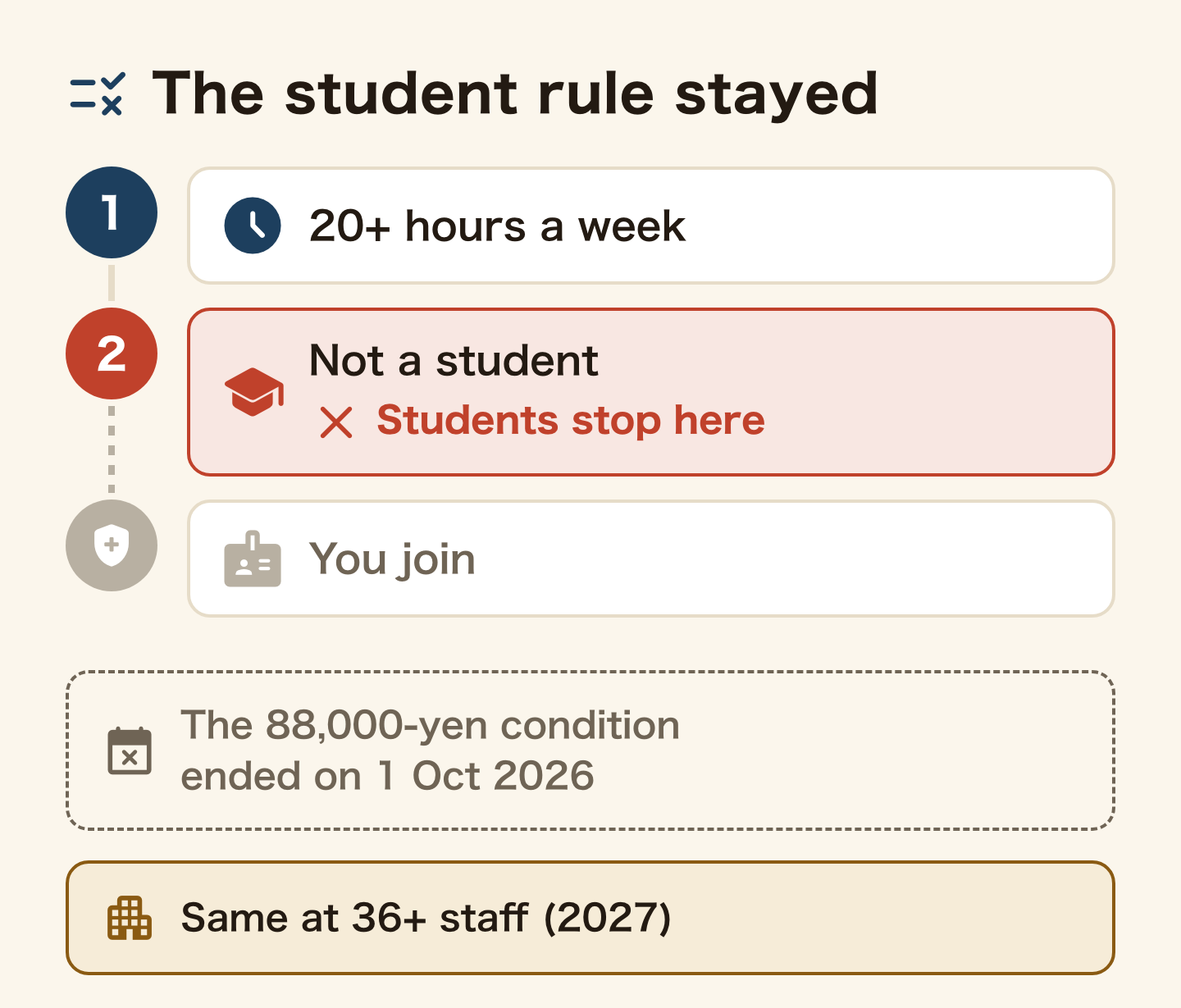
The company-size condition widens to 36 or more insured staff in October 2027, 21 or more in October 2029 and 11 or more in October 2032, and disappears in October 2035 (MHLW, outline of the reform). The treatment of students does not change at any step.
The other door is 30 hours a week
The older rule does apply to students. The Japan Pension Service puts it like this.
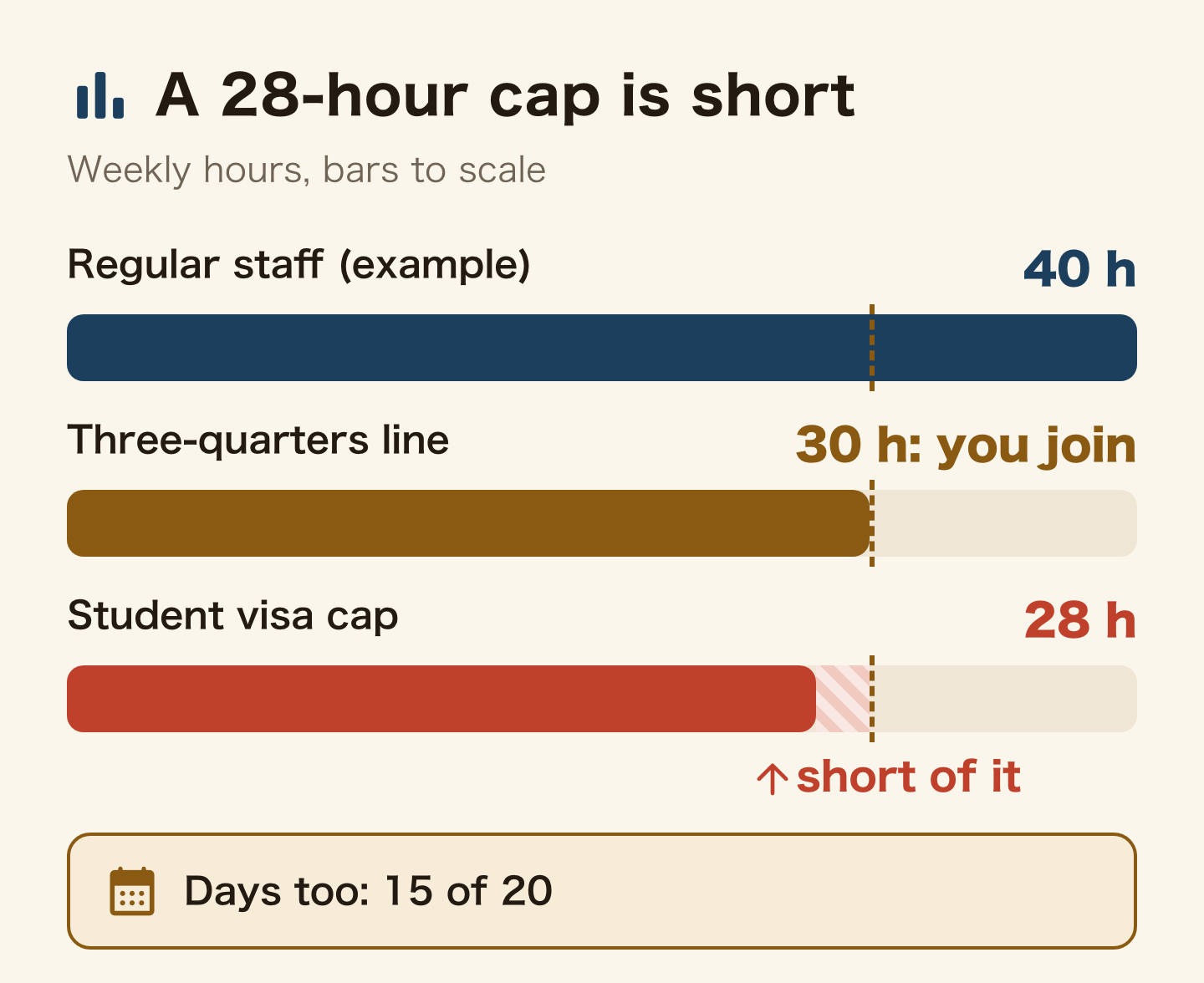
You become an insured person when both of the following are three-quarters or more of a regular employee’s: (1) scheduled working hours per week, (2) scheduled working days per month. Example: where a regular employee works 40 hours a week and 20 days a month, three-quarters is 30 hours or more a week and 15 days or more a month.
Japan Pension Service, “I work as a part-timer. Am I required to join social insurance?” (translated)
In a separate answer the same agency states that a student who meets this test does become an ordinary insured person. Being a student is not, by itself, an exemption.
But a student visa caps you at 28 hours a week. Thirty is out of reach. While that cap holds, this door stays shut as well. The limit on your work permit is doing double duty as a limit on your insurance.
Four ways you stop counting as a student
The Pension Service lists people who are treated as non-students even while enrolled.
- Those who will keep working at the same employer after graduating
- Those on leave of absence
- Those on an evening course
- Those on a correspondence course, and working adults in graduate programmes
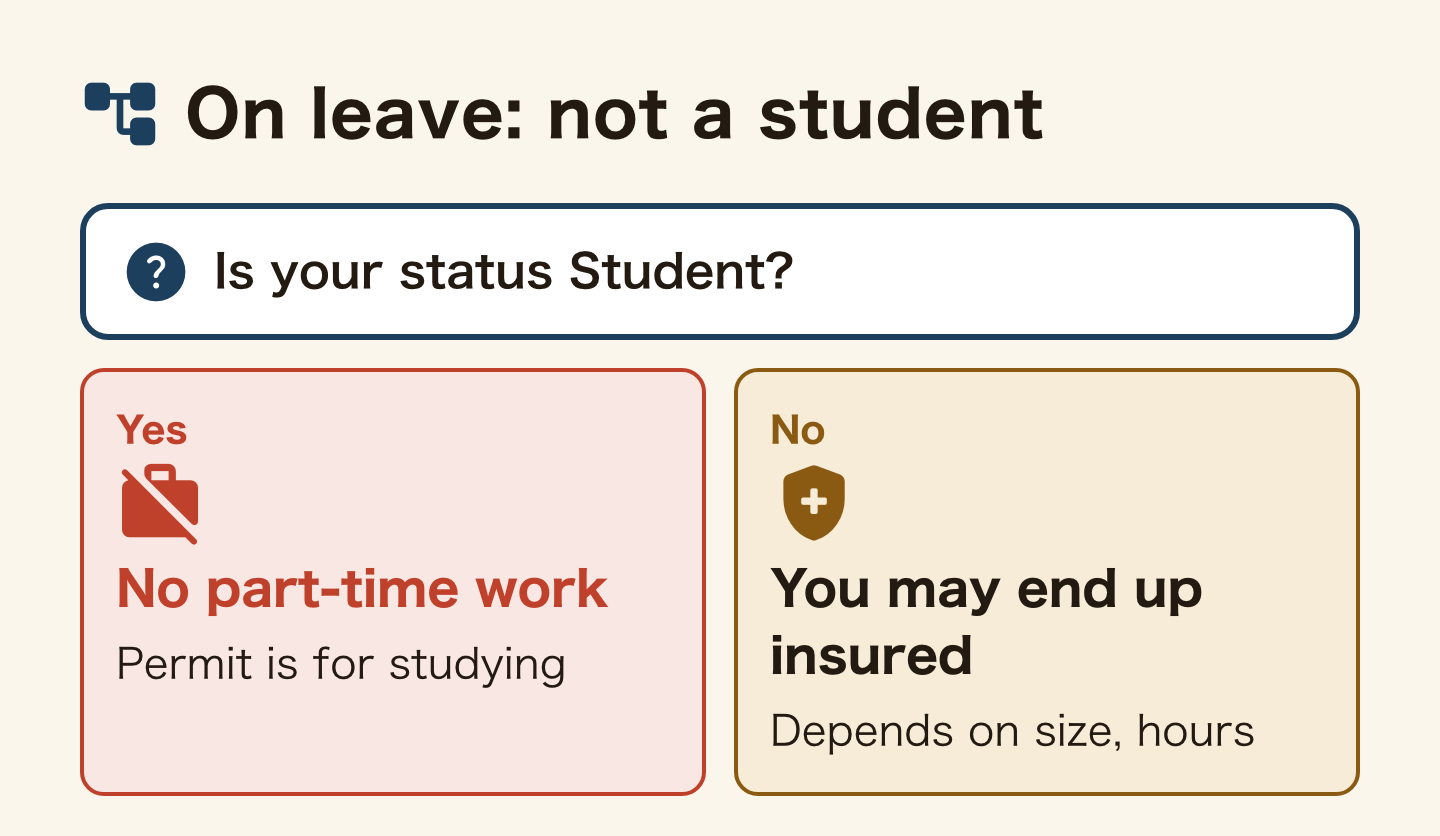
Watch out for leave of absence. Under the insurance rules, a student on leave counts as a non-student. But if you hold Student status, you cannot do part-time work at all during a leave: the work permit is for students who are studying. If you are thinking of a leave, read what a leave of absence does to your visa and work first. Someone on another status who keeps working during a leave can end up inside the system, depending on the size of the company and the hours.
The same applies if you graduate and stay on at the company where you already work part-time. From that point you are treated as a non-student.
Language school students are students too
This is where people guess wrong. The schools on the Pension Service list are high schools, secondary schools, special needs schools, universities including graduate schools, junior colleges, technical colleges, professional training colleges, and miscellaneous schools with a course of one year or more.
Most Japanese language schools are miscellaneous schools running courses of a year or more, so they are in. The agency states that the specific schools are the same ones listed for the student pension exemption, and that list has a separate table for overseas university facilities.
Which means the test is simple: if your school qualifies you for the student pension exemption, it counts here too. The school office can tell you.
What this does to your take-home pay
No health insurance and no employee pension come out of your pay. As a share of your earnings, you keep more than an employee earning the same amount.
In exchange you pay for insurance and pension yourself. That part gets missed.
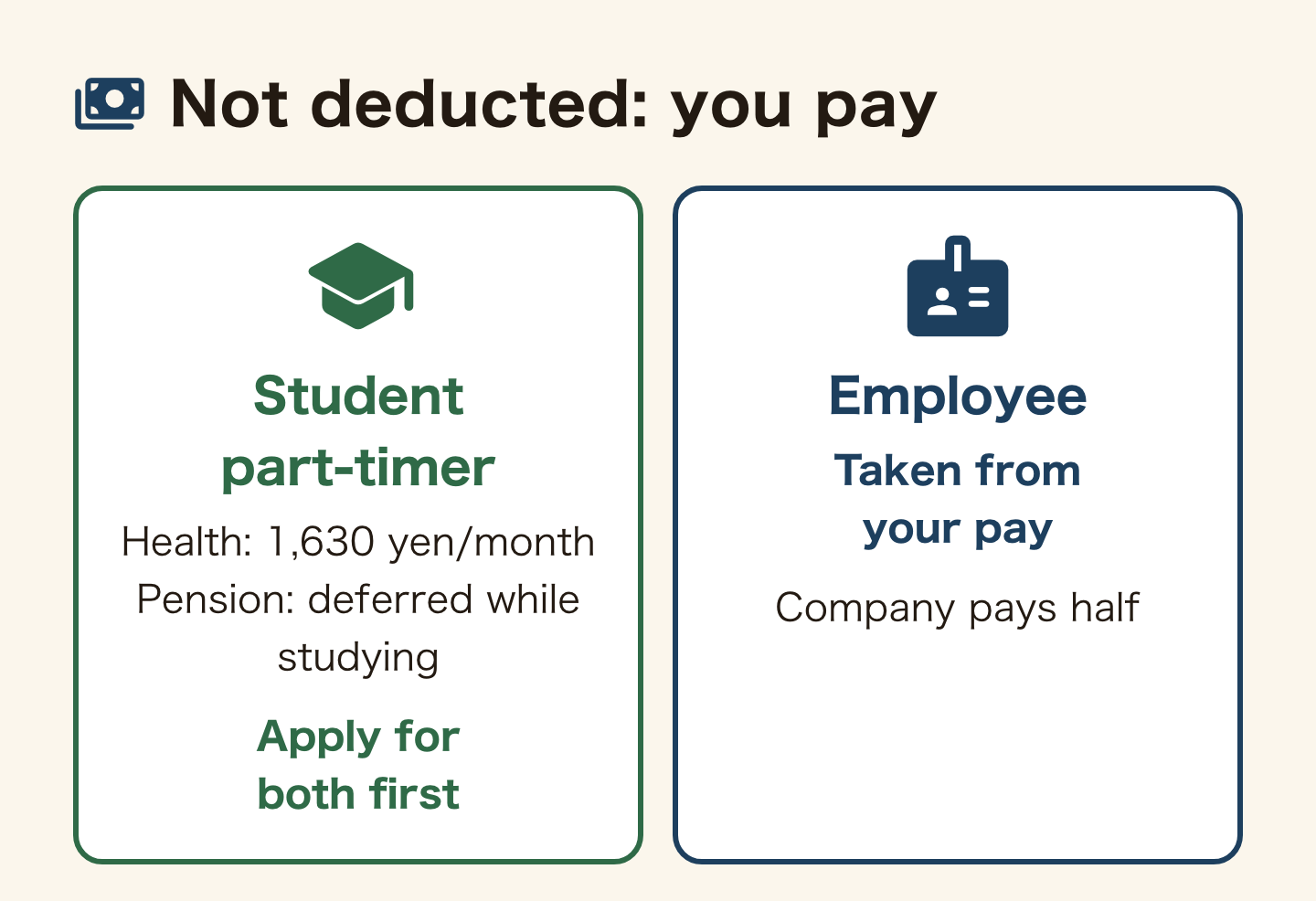
And both of those payments can be brought down.
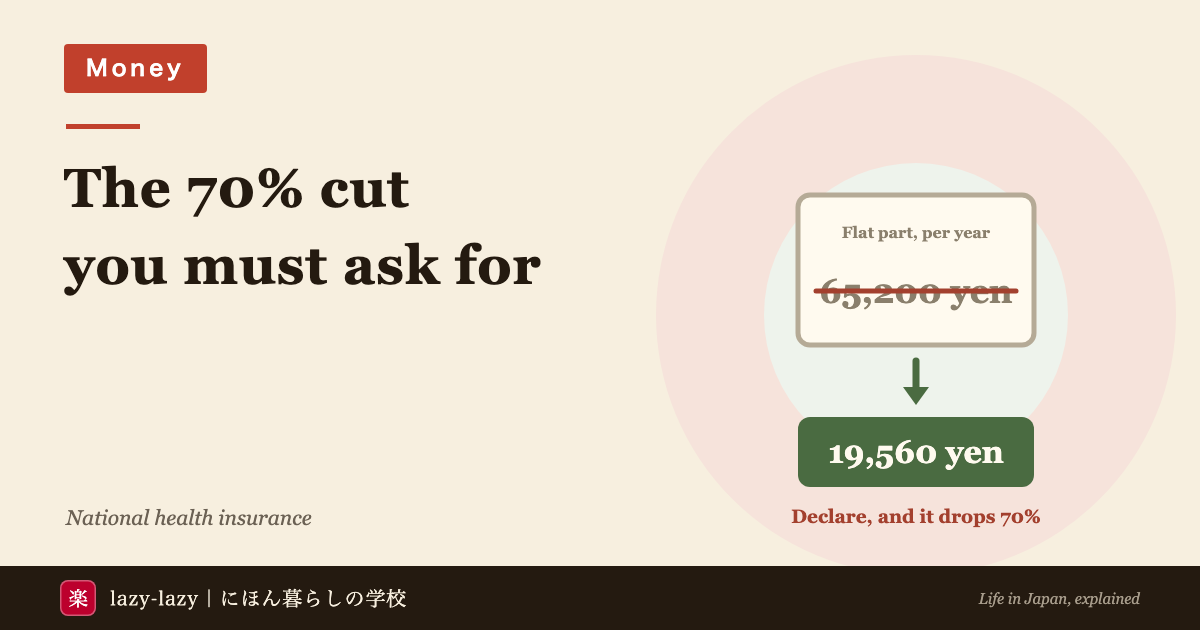
- The National Health Insurance reduction takes 70, 50 or 20 percent off the flat part when last year’s income was low. In Tokyo that is 65,200 yen a year down to 19,560
- The student pension exemption defers the 17,920 yen a month National Pension contribution while you are enrolled
Use both and the whole thing comes to 1,630 yen a month. Neither one starts until you apply. Being outside the employer system is not what makes it cheap. Filing is.
What changes when you graduate and get hired
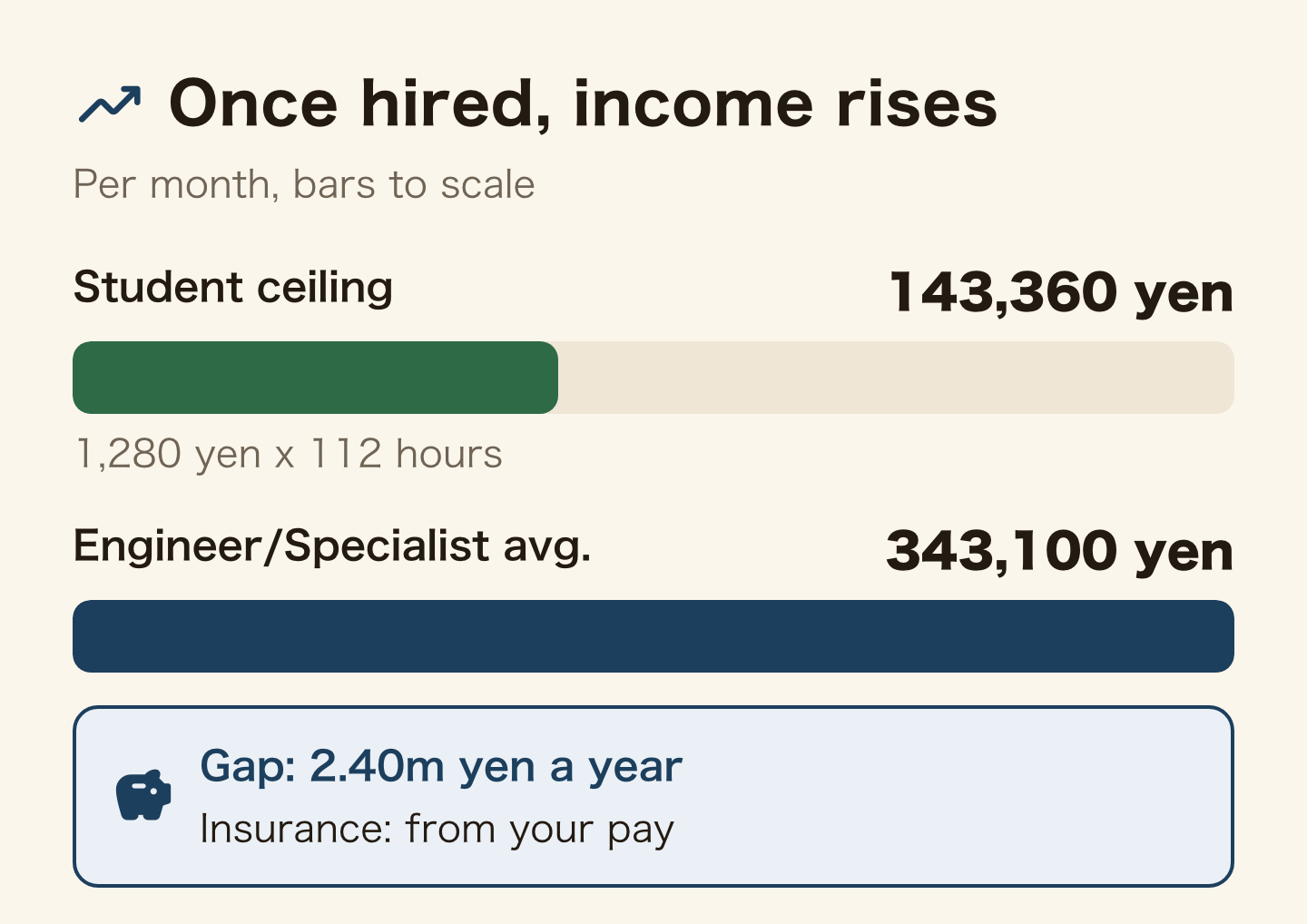
A job puts you inside the employer system. Health insurance and employee pension start coming out of your pay, so the drop from gross to net is steeper than it was as a student.
The income moves further. As the salary article shows, the average monthly wage on an engineer or specialist in humanities visa is 343,100 yen (MHLW 2025 Survey on Employment of Foreign Workers (Japanese PDF)) against the student ceiling of 143,360 yen (Tokyo’s minimum wage of 1,280 yen x 112 hours a month, Tokyo Labour Bureau), a gap of about 2.40 million yen a year ((343,100 – 143,360) x 12 = 2,396,880). More is deducted, and much more is left.
The employee pension also matters on the way out. Part of what you paid can be claimed as a lump-sum withdrawal payment.
When to stop: three checks today
- Look at your payslip. Health insurance and employee pension should not be there. Their absence is normal. Whether the income tax line is the right amount can be checked against the tax table with how to read a Japanese payslip
- If they are there, check whether you are working 30 hours a week or 15 days a month. On a student visa that already breaks the 28-hour cap
- Check that you have filed for the National Health Insurance reduction and the student pension exemption
If the first is clean and the third is done, you are finished with this. Read it again when you take leave, and when you graduate into a job.
FAQ
Q. Are international students exempt from social insurance?
Not exempt. Students sit outside the employer system by design. You join National Health Insurance and the National Pension instead and pay them yourself. The thing closest to an exemption is the student pension exemption, which defers National Pension contributions while you study.
Q. If I earn more than 1.06 million yen, do I join?
Not as a student. The 88,000 yen a month condition was abolished on 1 October 2026; the conditions now are 20 hours a week and not being a student. While you are enrolled this door stays shut, whatever you earn. The company-size condition widens in October 2027; the student rule does not change.
Q. Can a student ever end up inside the system?
Yes. The Japan Pension Service states that a student who meets the three-quarters test becomes an ordinary insured person. Where a regular employee works 40 hours a week and 20 days a month, that is 30 hours and 15 days. A student visa capped at 28 hours does not get there.
Q. Do Japanese language school students count as students?
Yes. The list covers miscellaneous schools with a course of one year or more, which most language schools are. The agency says the specific schools are the same as those on the student pension exemption list.
Q. What happens if I take a leave of absence?
For insurance you are treated as a non-student. But on Student status you cannot work part-time during a leave at all. On another status, working 20 hours a week or more at a company with 51 or more insured employees (36 or more from October 2027) puts you into health insurance and employee pension.
Q. What about employment insurance?
Separate system. Daytime students are generally not covered by employment insurance either (so no unemployment benefit; rosai work-injury insurance, on the other hand, does cover a part-time job). This article is about health insurance and employee pension.
Summary
- Social insurance here means employer health insurance and employee pension, not National Health Insurance or the National Pension
- There are two doors into it, and student part-time workers pass through neither
- The short-hours rule (20 hours a week; the 88,000 yen pay condition ended on 1 October 2026) lists “not being a student” as a condition
- The other door is 30 hours a week and 15 days a month; a student visa caps you at 28 hours
- Main exceptions: staying with the same employer after graduation, leave of absence, evening course, correspondence course
- Japanese language school students are included, as miscellaneous schools with a course of a year or more
- Nothing is deducted, but you pay the city office instead. The reduction and the exemption bring that to 1,630 yen a month
- A job starts the deductions and raises the income far more
Sources: Japan Pension Service, part-timers and the duty to join social insurance / same, students and the three-quarters test / same, what “student” means in the short-hours rule / same, special page on expanded coverage for short-hours workers / MHLW, main changes from October 2026 / MHLW, outline of the reform / MHLW, expanding social insurance coverage / Employees’ Pension Insurance Act (e-Gov) (checked 1 October 2026)
Found this useful? Share it
Send it to a friend who lives in Japan.
WHO WROTE THIS

mori
Japanese. I read the ministries’ own notices, orders and Q&As in the original, and I start from what my Nepalese and Sri Lankan friends in Japan actually ran into. I do not write about what I have not checked or been told.
What this site can and cannot do →Looking for something else?
You may use the figures in this article, including commercially, if you credit this site with a link. How to use our figures