Checked on 23 September 2026 against the Ministry of Education (MEXT) guideline on schooling for foreign children (revised 28 August 2026), its school guidebook, its surveys on Japanese-language instruction and education costs, its pages on school expense assistance and high school tuition support, the School Education Act and its regulations on e-Gov, and the school enrolment guidance of Shinjuku, Edogawa and Osaka.
The short answer
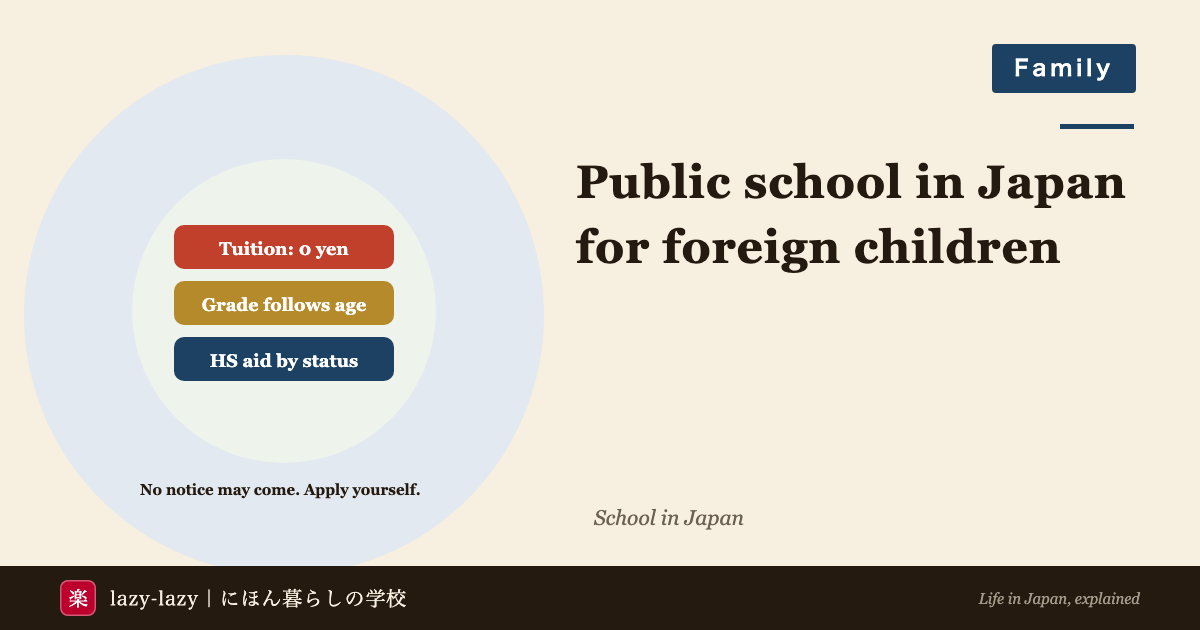
- Foreign children are not legally required to attend school in Japan, but if you want them to, public elementary and junior high schools take them free of charge, just as they take Japanese children. Tuition and textbooks cost nothing.
- You enrol through the board of education at your city or ward office, after registering your address. For a child starting first grade in April, some cities want the application the autumn before (Osaka: by 30 September).
- The grade is set by age, not by the grade your child was in at home. Children born between 2 April and 1 April of the next year are in the same grade. A lower grade is possible if Japanese is the obstacle.
- You still pay for lunch and school expenses: about 110,000 yen a year at public elementary school and about 186,000 yen at junior high (national average, FY2023). Families who struggle can apply for school expense assistance.
- From April 2026, high school tuition support depends on status of residence. For a child on a Dependent visa, one condition is having graduated from both a Japanese elementary and a Japanese junior high school.
Knowing this, you can plan the grade, the paperwork and the budget before your child even arrives. You will also see why the age at which your child joins a Japanese school can matter all the way to high school.
You are getting ready to bring your child to Japan. You ask a Japanese colleague how to get a child into elementary school, and they say the enrolment notice just arrives in the post before April. It may never arrive at your door. Japanese children are listed on a school-age register that triggers the notice. Foreign children are not on it. Your colleague has never needed to know that a foreign family has to ask.
- Can foreign children go to public school in Japan?
- What grade will my child be in? School age and grades in Japan
- How do I enrol my child in a Japanese public school?
- My child doesn’t speak Japanese. Is there support?
- Is public school free in Japan? What parents actually pay
- What if I can’t afford school costs? School expense assistance
- International school or Japanese public school?
- High school in Japan for foreigners: entrance exams and the 2026 tuition rules
- What if my child doesn’t go to school?
- Which one are you?
- FAQ
- Summary
- Related reading
Can foreign children go to public school in Japan?
Yes. In Japan, parents of Japanese children have a legal duty to send them to elementary and junior high school for nine years (School Education Act, Articles 16 and 17). MEXT’s guideline states plainly that this duty does not apply to parents of foreign children.
The same guideline tells boards of education to let foreign families know that their children can attend public schools. MEXT’s school guidebook for foreign parents goes further: public elementary and junior high schools accept foreign children free of charge if they wish to enter, and guarantee them the same education as Japanese children.
Neither document limits this by status of residence. Dependent, Long-Term Resident, Permanent Resident — the procedure is the same.
Most foreign children of school age do attend. In MEXT’s May 2025 survey, 85.0% of the 177,726 registered foreign residents of school age were at Japanese elementary or junior high schools, and 6.7% were at foreign schools.
One exception to note: if your child also holds Japanese nationality, the duty to attend school applies, and you follow the procedure for Japanese children (Shinjuku City).
What grade will my child be in? School age and grades in Japan
The Japanese school year runs from 1 April to 31 March. A child starts elementary school in the first April after turning six (School Education Act, Article 17). Before that, it is the age for daycare or kindergarten.
In practice, children born between 2 April and 1 April of the following year share a grade. For April 2027, first grade is for children born from 2 April 2020 to 1 April 2021 (Osaka City). A child born on 1 April goes into the year above. Elementary school is six years and junior high is three. There is no skipping grades.
The grade your child finished at home does not carry over as such. Placement follows age, so it may not match the grade your child was in at home.
- Not enough Japanese yet, or subjects taught in a different order — the school can place your child in a lower grade, temporarily or formally (MEXT guideline)
- Your home country’s compulsory education is shorter than nine years and your child has not completed nine — while still of school age, they can join the grade that matches their age if they want to
- Over 15 and never finished compulsory education — the local board of education may admit them to a public junior high school, and should point them to a night junior high school where one exists
How do I enrol my child in a Japanese public school?
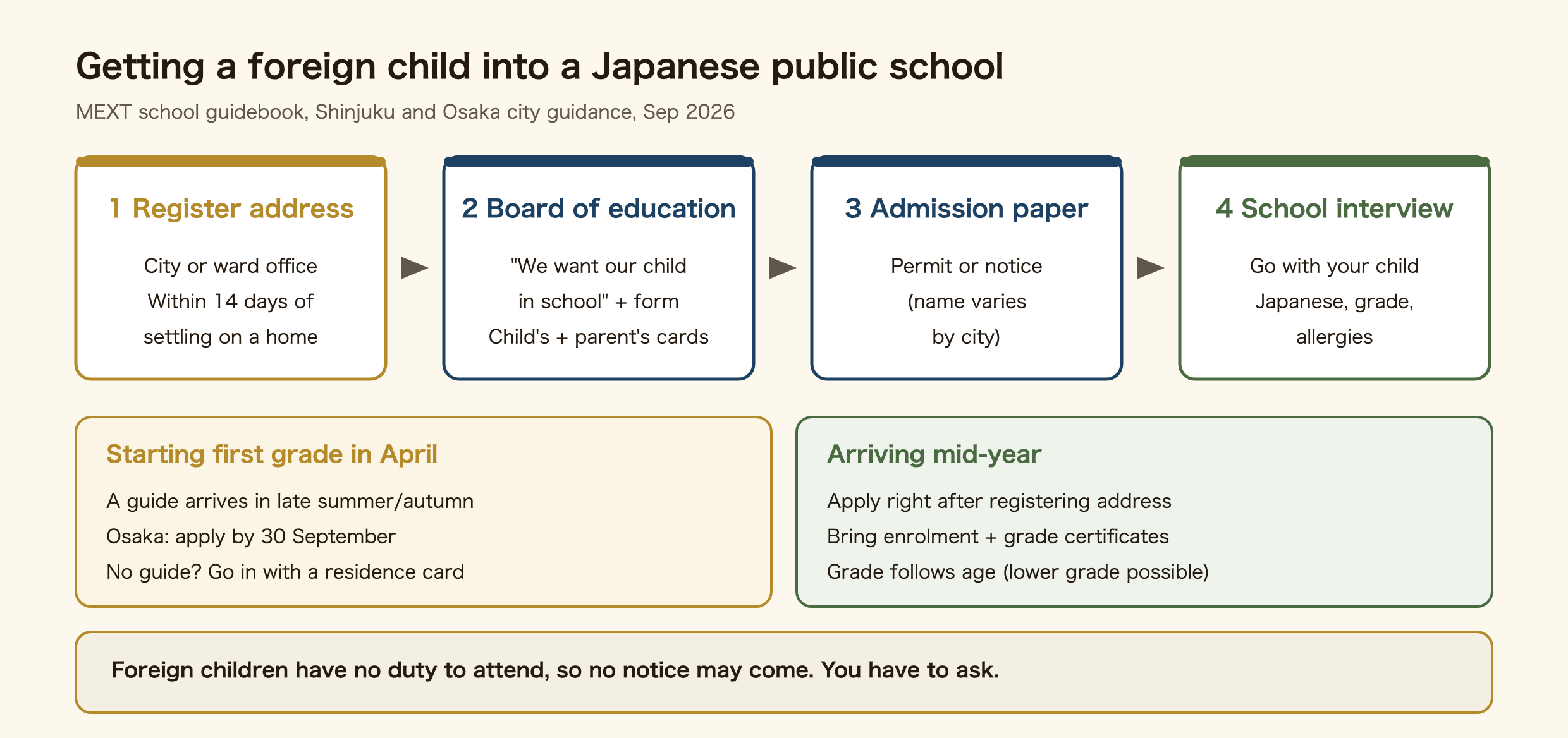
Public elementary and junior high schools are run by the municipal board of education, so that is where you go. MEXT’s guidebook describes four steps.
- Register your address at the city or ward office (within 14 days of settling on a home — the same counter as your residence registration)
- At the same office, tell the board of education you want your child to attend school, and fill in the application
- Receive the admission document (the name differs by city: admission permit, admission notice)
- Take your child to the designated school, meet the teachers, and start
Documents vary a little by city. Shinjuku asks you to apply with the residence cards (or special permanent resident certificates) of both the child and the parent, and issues the admission notice after an interview at the school. MEXT’s guidebook also tells you to bring an enrolment certificate and transcript from the school at home. At the interview you will be asked about your child’s grade at home, their experience with Japanese, and allergies.
Starting first grade in April: apply the autumn before
If your child starts elementary or junior high school next April, the application happens in late summer or autumn. Osaka sends a guide in late August and asks for the form by 30 September. Edogawa takes online applications for April 2027 until 30 September 2026 and at the counter only from October. If no guide arrives, you can still go in with a residence card or passport (Osaka).
Moving up from a Japanese elementary school to junior high can need a new application too. Osaka asks foreign children entering junior high to apply, and asks for proof of graduation from anyone who did not attend a city elementary school in the ward.
Arriving in the middle of the school year
You do not have to wait for April. Once your address is registered, you can apply at the board of education straight away (Shinjuku). If there is a reason to change the designated school, such as better Japanese-language support at another one, you can ask. MEXT’s guideline tells boards of education to be flexible about this.
If you apply and then choose a non-public school, some cities ask you to withdraw the application formally (Edogawa, Shinjuku).
My child doesn’t speak Japanese. Is there support?
Plenty of children start with no Japanese at all. Public schools had 84,759 pupils who needed Japanese-language instruction in May 2025, roughly double the number nine years earlier.
The rules allow for it. Article 56-2 of the School Education Act Enforcement Regulations lets schools run a “special curriculum” for children who do not understand Japanese, matched to each child’s level, and the same applies to junior high. Time spent learning Japanese outside the regular class counts as proper lessons. So do lessons at a Japanese class in another school.
Support is not the same everywhere. Of the children who needed it, 88.6% were getting some Japanese instruction at school. The other 11.4%, or 9,699 children, were getting none. How much help your child gets depends heavily on the city and the school.
So at the interview, ask two questions: “Is there Japanese-language instruction?” and “Is there a support worker who speaks our language?” Some cities, like Edogawa, have designated schools with Japanese classes or send Japanese-language instructors into schools. There are 7,301 native-language support workers in public schools nationwide, and they translate letters for parents as well as help children.
Is public school free in Japan? What parents actually pay
Tuition and textbooks are free for foreign children too. That does not mean school costs nothing. Lunch, materials and trips are billed, usually monthly (MEXT guidebook).
| Per child, per year | Public elementary | Public junior high |
|---|---|---|
| Tuition | 0 yen | 0 yen |
| Textbooks | 0 yen | 0 yen |
| School expenses (materials, trips, PTA fees, uniform, school bag, commuting) | about 74,000 yen | about 151,000 yen |
| School lunch | about 36,000 yen | about 36,000 yen |
| Total paid for school | about 110,000 yen | about 186,000 yen |
These are national averages from MEXT’s Survey of Children’s Learning Expenses for FY2023, as corrected in January 2026. Cram school and lessons outside school are not included.
School lunch changed in April 2026. The government now pays local authorities toward the food cost of public elementary school lunches, with a benchmark of 5,200 yen per child per month. Parents do not need to apply. Where the food costs more than that, the city can still charge the difference, so some families keep paying something. Junior high schools are not named in this scheme. Your school’s letters will tell you what you pay.
What if I can’t afford school costs? School expense assistance
Article 19 of the School Education Act requires municipalities to help parents whose children would struggle to attend school for financial reasons. This is school expense assistance (shugaku enjo). MEXT tells boards of education to include it when they explain schooling to foreign families.
It can cover a lot: school supplies, supplies for a new first-grader, school trips, outings, school lunch, club activities, PTA fees and graduation albums. Each municipality decides which items it pays and where the income line sits. About 1.17 million children received it in FY2024.
Apply through the school or the board of education. Some cities pay the new-pupil supplies money before entry, so ask when you enrol. For the wider family budget, count child allowance of 10,000 to 15,000 yen a month as well.
International school or Japanese public school?
Japanese law defines “schools” as elementary schools, junior high schools, high schools and so on (School Education Act, Article 1). According to Shinjuku City, most international and foreign schools are not among them; they are “miscellaneous schools” or unlicensed institutions. Some international schools are accredited as Article 1 schools, so check each one.
For a child with foreign nationality only, choosing a non-Article 1 school is fine, and some cities need no paperwork from you (Shinjuku). The difference shows up later.
- Finishing the junior high section of a non-Article 1 school is not, in law, graduating from junior high school
- Entering a Japanese high school requires junior high graduation or recognised equivalent ability (Enforcement Regulations, Article 95): nine years of schooling completed abroad, passing the junior high school equivalency exam, or approval by the high school itself, among others
- From April 2026, foreign schools were removed from high school tuition support (students already enrolled before April keep it under transitional rules)
The junior high school equivalency exam is open to anyone without Japanese nationality who turns 15 by the end of the school year. It is free, and a booklet with furigana reading aids is available. The 2026 exam is on 15 October and applications closed on 21 August, so the next chance is the 2027 round.
High school in Japan for foreigners: entrance exams and the 2026 tuition rules
High school is not compulsory, and getting in usually means passing an entrance exam. Public high school entrance is decided by each prefecture. For entry in FY2025, 20 prefectures set aside special places for returnee and foreign students (MEXT notice). MEXT also asks prefectures for other adjustments, such as fewer exam subjects and furigana on kanji in the questions. The rules differ by prefecture, so ask your child’s junior high teachers early.
The gap is real: 91.5% of junior high students who need Japanese-language instruction go on to high school or similar, against 98.9% of all junior high students.
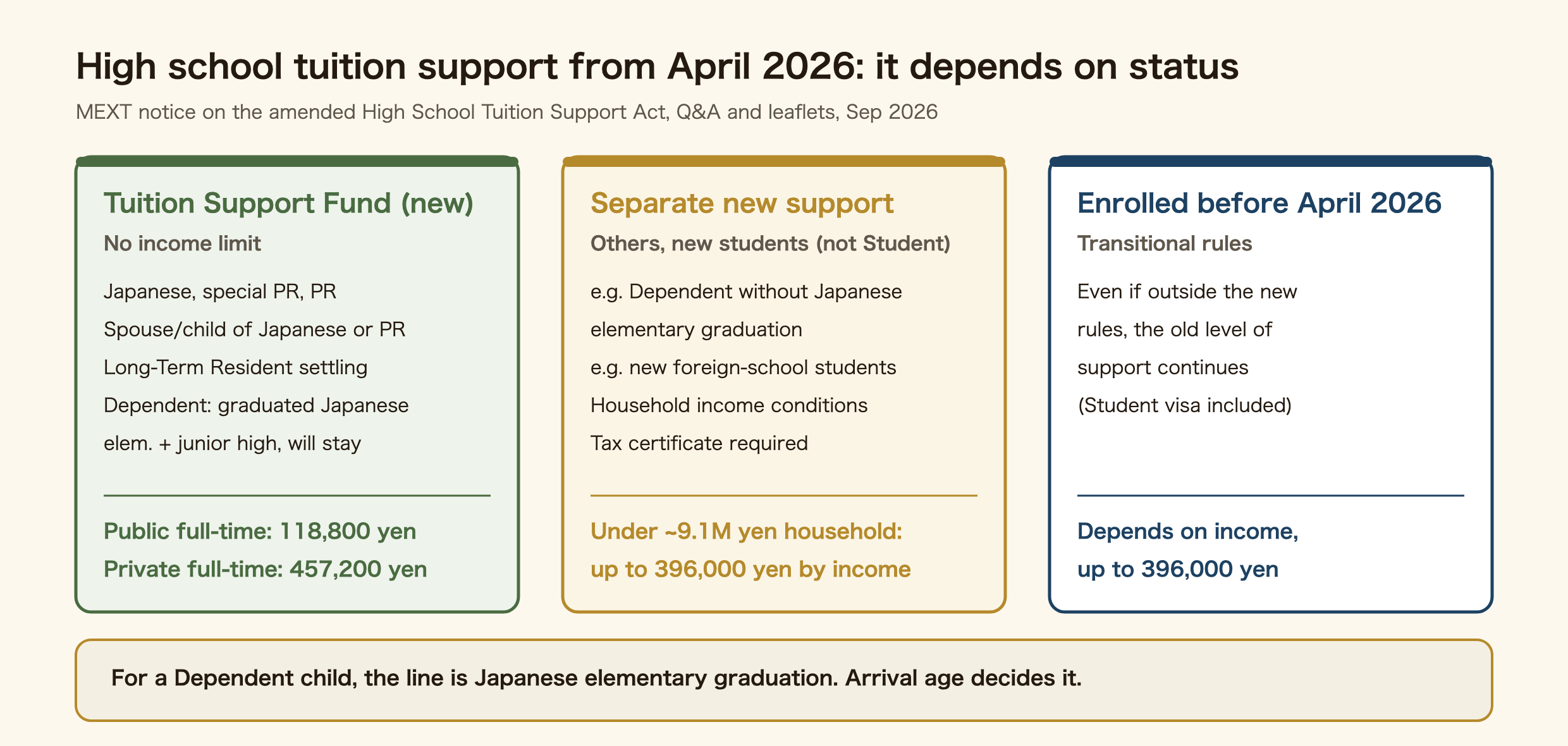
On money, 1 April 2026 brought a big change. The High School Tuition Support Fund dropped its income limit, but who can receive it is now limited by nationality and status of residence (amended High School Tuition Support Act).
- Covered: Japanese nationals, special permanent residents, permanent residents, spouses or children of Japanese nationals, spouses or children of permanent residents
- Covered: long-term residents recognised as intending to settle permanently
- Covered: Dependent visa holders who graduated from a Japanese elementary school and a Japanese junior high school, and who are recognised as intending to work and stay in Japan after high school (planning to go to university first and then work also counts)
If covered, there is no income test, and up to 118,800 yen a year goes to tuition at a full-time public high school, or up to 457,200 yen at a full-time private one. Dependent visa holders submit copies of their Japanese elementary and junior high diplomas or graduation certificates.
Falling outside does not mean nothing. New students on any status other than Student can get the separate “new support for high school students” if household income conditions are met: up to 396,000 yen a year, depending on income, for households under about 9.1 million yen. Students already enrolled before April 2026 keep the old level of support under transitional rules.
For a Dependent visa child, the dividing line is whether they also graduated from a Japanese elementary school. A child who finished elementary school at home and then attended only a Japanese junior high does not meet it. If you are deciding when to bring your family to Japan, the age at which your child joins a Japanese school is worth deciding at the same time.
What if my child doesn’t go to school?
Because foreign parents have no duty to send children to school, there is no penalty just for not doing so. It is becoming less of a private matter, though.
First, the board of education may check. MEXT’s guideline, revised on 28 August 2026, asks boards to track whether each foreign child is at some school and to follow up by phone or home visit where they cannot tell. Some cities ask families using non-public schools to report which school (Edogawa).
Second, residence decisions. The draft revision of the permanent residence guideline, put out for public comment in August 2026, adds “schooling of school-age children”: when a parent of a school-age child applies, whether the child attends elementary or junior high school is considered. This is still a draft. As of 23 September, the guideline the Immigration Services Agency publishes is the version revised on 24 February 2026, which has no such item. If adopted as drafted, it would apply to applications from 1 April 2027.
MEXT’s notice of the same date also says that taking children’s schooling into account in parents’ residence reviews “is under consideration”. That is not decided either. The direction is clear enough: if you plan a long life in Japan, a record of your child attending school will count later.
Which one are you?
- Your child is still at home and you are preparing to bring them — find your future city’s page on schooling for foreign children and check the counter and documents. Ask your child’s current school for an enrolment certificate and transcript now.
- Your child starts first grade of elementary or junior high next April — check whether an enrolment guide has arrived. If not, go to the board of education with your residence card this week. Some cities want the form by 30 September.
- Your child is on a Dependent visa and you want them to stay through high school — count whether they will graduate from both a Japanese elementary and junior high school. Ask the junior high whether your prefecture has an entrance route for foreign students, and when career guidance starts.
- Lunch and school costs are too much — ask the school or the board of education for the school expense assistance form. Do it before a month goes unpaid.
- You are considering an international or foreign school — ask the school whether it is an Article 1 school. If a Japanese high school is a possibility, check entrance eligibility and tuition support first.
FAQ
Q. Can foreign children go to public school in Japan?
Yes. Public elementary and junior high schools accept foreign children free of charge if the family wishes, the same as Japanese children. Apply through the board of education at your city or ward office.
Q. Is school required for foreign children in Japan?
No. The legal duty to send children to school does not apply to parents of foreign children. A child who also holds Japanese nationality is covered by the duty.
Q. Is school free in Japan for foreigners?
Tuition and textbooks at public elementary and junior high schools are free. Parents pay for lunch, materials and trips: about 110,000 yen a year at elementary and 186,000 yen at junior high on national averages. School expense assistance is available for families who struggle.
Q. What grade will my child be placed in?
Grades follow age. Children born between 2 April and 1 April of the next year are in the same grade. A child can be placed in a lower grade, temporarily or formally, if their Japanese or earlier schooling makes that more suitable.
Q. Can my child attend if they don’t speak Japanese?
Yes. Schools can run a special curriculum of Japanese-language instruction matched to the child’s level. How much support is available varies by city and school, so ask at the enrolment interview.
Q. Can foreign high school students get tuition support in Japan?
From April 2026 it depends on status of residence. Permanent residents, spouses or children of Japanese nationals or permanent residents, long-term residents intending to settle, and Dependent visa holders who graduated from Japanese elementary and junior high schools and intend to work in Japan are covered. Others, except Student visa holders, may get separate income-based support.
Summary
Foreign children have no legal duty to attend school in Japan, but public elementary and junior high schools will take them free of charge if you ask. You apply to the board of education yourself. The grade follows age, and a lower grade or Japanese-language instruction can bridge the gap.
Free tuition still leaves lunch and school expenses of roughly 100,000 to 200,000 yen a year, and assistance exists if that is too much. Look ahead to high school: since April 2026, tuition support depends on status of residence, and a Dependent visa child needs to have graduated from both a Japanese elementary and junior high school. When your child joins a Japanese school can shape what happens at 15.
Official sources: MEXT, notice and guideline on schooling of foreign children (28 August 2026, Japanese) / MEXT school guidebook for foreign parents (multilingual) / MEXT survey on pupils needing Japanese instruction, FY2025 (Japanese) / MEXT Survey of Children’s Learning Expenses FY2023 (Japanese) / MEXT school lunch cost relief (Japanese) / MEXT school expense assistance (Japanese) / MEXT High School Tuition Support Fund Q&A (Japanese) / MEXT junior high school equivalency exam (Japanese) / School Education Act on e-Gov (Japanese) / Shinjuku City, international schools and school attendance (Japanese) / Edogawa City, schooling for foreign residents (Japanese). Checked on 23 September 2026. Procedures differ by city, so confirm with your local board of education.
Related reading
Found this useful? Share it
Send it to a friend who lives in Japan.
WHO WROTE THIS

mori
Japanese. I read the ministries’ own notices, orders and Q&As in the original, and I start from what my Nepalese and Sri Lankan friends in Japan actually ran into. I do not write about what I have not checked or been told.
What this site can and cannot do →Looking for something else?