Checked on 23 September 2026 against the health ministry’s (MHLW) list of hospitals for foreign patients, its multilingual documents, its notice on interpreting fees and its FY2025 survey, the JNTO medical institution search, and official pages from Tokyo, Osaka, Kanagawa and Kyoto.
The short answer
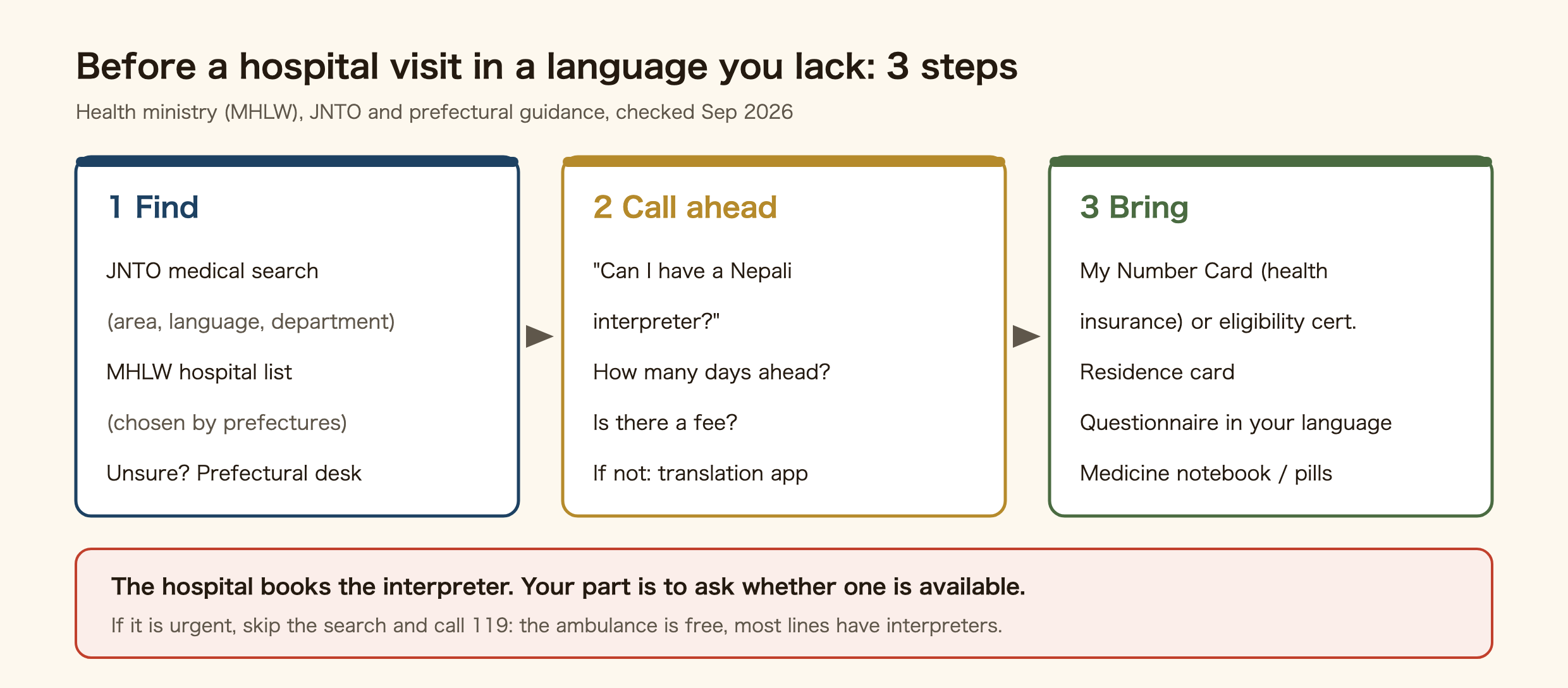
- A medical interpreter in Japan is booked by the hospital, not by you. Your part is to ask, on the phone or at reception, “Can I use a Nepali (or English, Vietnamese…) interpreter?”
- To find an English-speaking doctor, or one in your language, use the JNTO medical institution search. Filter by area, language and department. Hospitals chosen by the prefecture as core facilities for foreign patients are marked. JNTO itself asks you to call before you go.
- Interpreting fees sit outside health insurance. To charge you, a hospital must post the fee, explain it, get your signed consent and give a separate receipt. In the latest survey, 70 of 5,745 hospitals did.
- No interpreter? The health ministry’s questionnaires come in 13 languages. Every one has Japanese alongside, so you can fill it in at home and hand it over.
- Bring your My Number Card for health insurance (or eligibility certificate) and your residence card. If someone cannot breathe or is unconscious, skip the search and call 119.
Knowing this, you can settle on a clinic where your language works before you are ill, with one phone call. No surprise fee for an interpreter, and no walking out of the consulting room without having said what was wrong.
Your child’s fever has not come down in three days. You call the paediatric clinic nearby, someone asks you something in fast Japanese, and you hang up. You ask a Japanese friend where to find an English-speaking doctor. “A big hospital, probably? Someone there must speak English.” That is as far as it goes. Your friend has never had to wonder who calls the interpreter, or who pays for one. In Japanese daily life, that question never comes up.
- Do doctors in Japan speak English, and can I get an interpreter?
- How to find an English-speaking doctor in Japan (or one who speaks your language)
- What to ask when you call: interpreter, booking, fee
- Who pays for a medical interpreter in Japan?
- How much does a medical interpreter cost? There is no set rate
- No interpreter? Use the 13-language questionnaires and a translation app
- Can a friend or family member interpret for me?
- What to bring: health insurance card and residence card
- Charged for interpreting without being asked?
- In an emergency, skip the search and call 119
- Which one are you?
- FAQ
- Summary
- Related reading
Do doctors in Japan speak English, and can I get an interpreter?
Some do, and yes, you can get an interpreter. But the person you ask is the hospital, not an interpreting company.
Medical interpreting in Japan is set up on the hospital’s side. Tokyo’s emergency phone interpreting for hospitals says plainly that patients cannot request it. Osaka’s 24-hour phone interpreting and the health ministry’s service for rarer languages are also used by hospitals that have registered. Your job is to pick the hospital and to ask whether an interpreter is available.
There is no official count of doctors who speak English. What the ministry does measure is how much interpreting exists. In its FY2025 survey, 243 of Japan’s 330 secondary medical areas (the regions used to plan ordinary hospital care) had a hospital that could use a phone interpreter. Only 158 had a hospital with its own interpreter on staff. Counting translation tablets, 322 areas had some way to bridge the language.
So a hospital with an interpreter in the building is found in fewer than half of those areas. A hospital that can connect one by phone or device is found in most. That is why searching early and asking early pays off.
How to find an English-speaking doctor in Japan (or one who speaks your language)
Start with the Japan National Tourism Organization’s “Guide for when you are feeling ill”. It was built for travellers, but anyone can use it without signing up. The page itself is available in English, Japanese, Korean and Chinese (simplified and traditional).
- Choose your prefecture (or search from your current location)
- Choose a language. English, Chinese, Korean, Portuguese and Spanish are listed; everything else is under “Others”
- Choose a department. Internal medicine for fever or a cough, paediatrics for a child
- Read the language codes in the results: NE is Nepali, VI is Vietnamese, SI is Sinhala
Results carry a mark for the “base medical institutions” chosen by each prefecture. Category 1 hospitals can take foreign emergency patients who need admission, and every prefecture has at least one. Category 2 covers places that can see foreign patients, including clinics and dentists, with at least one in each secondary medical area.
The data comes from a list compiled by the health ministry and the Japan Tourism Agency. The newest version is the Excel file on the ministry’s page, published on 30 June 2026 and partly revised on 6 August. JNTO’s search is updated later, so if you cannot find a place, check your prefecture’s sheet in the Excel file. It also has columns for staff interpreters and remote interpreting.
Two cautions. JNTO asks you to contact the institution in advance whenever possible, because it may not be able to help on the day. And a hospital that is not on the list is not barred from seeing foreign patients. Calling the clinic down the road and asking is a perfectly good way to search.
Not sure whom to call? Each prefecture has a desk for foreign residents, and the health ministry keeps a list of them with their languages. In Tokyo, the metropolitan medical information service on 03-5285-8181 guides you to hospitals in English, Chinese, Korean, Thai and Spanish, every day from 9:00 to 20:00 (free apart from the call charge). For other kinds of help, see free helplines for foreigners, by problem and language.
What to ask when you call: interpreter, booking, fee
On the phone or at reception, ask three things:
- “Can I use a Nepali interpreter?” (name your language)
- “How many days ahead do I need to book the interpreter?”
- “Is there a fee for the interpreter?”
If speaking is hard, save those lines on your phone and show them. Booking can matter. Kyoto City’s interpreter dispatch asks you to tell the hospital at least five days before your visit when a language needs a reservation. Once the fever has started, those five days are gone.
At the hospital, say again at reception that you need an interpreter. Tokyo’s and Osaka’s phone services require the hospital to get your consent before using them. If staff ask whether they may use an interpreter, simply say yes.
Who pays for a medical interpreter in Japan?
This is where most people get it wrong. Hospital interpreting services bill the hospital first. And if a hospital wants to pass an interpreting fee on to you, it has to follow set steps.
A health ministry notice classes “interpreting fees for patients who do not understand Japanese” as a service not directly related to insured care. To collect one from a patient, a hospital must do all of the following:
- Post what the service is and what it costs somewhere easy to see, such as reception or the waiting room
- Explain the service and the price clearly
- Get the patient’s signature on a document stating the service and the price
- Issue a receipt that shows the fee separately from other charges
The amount must be “socially reasonable”, and vague items such as “miscellaneous” are not allowed. Translating a medical certificate for your home country’s insurer is also a separate, non-insured charge.
Few hospitals actually charge. In the ministry’s FY2025 survey, 537 of the 5,745 hospitals that answered billed foreign patients extra in insured care. Of those, 70 listed an interpreting fee.
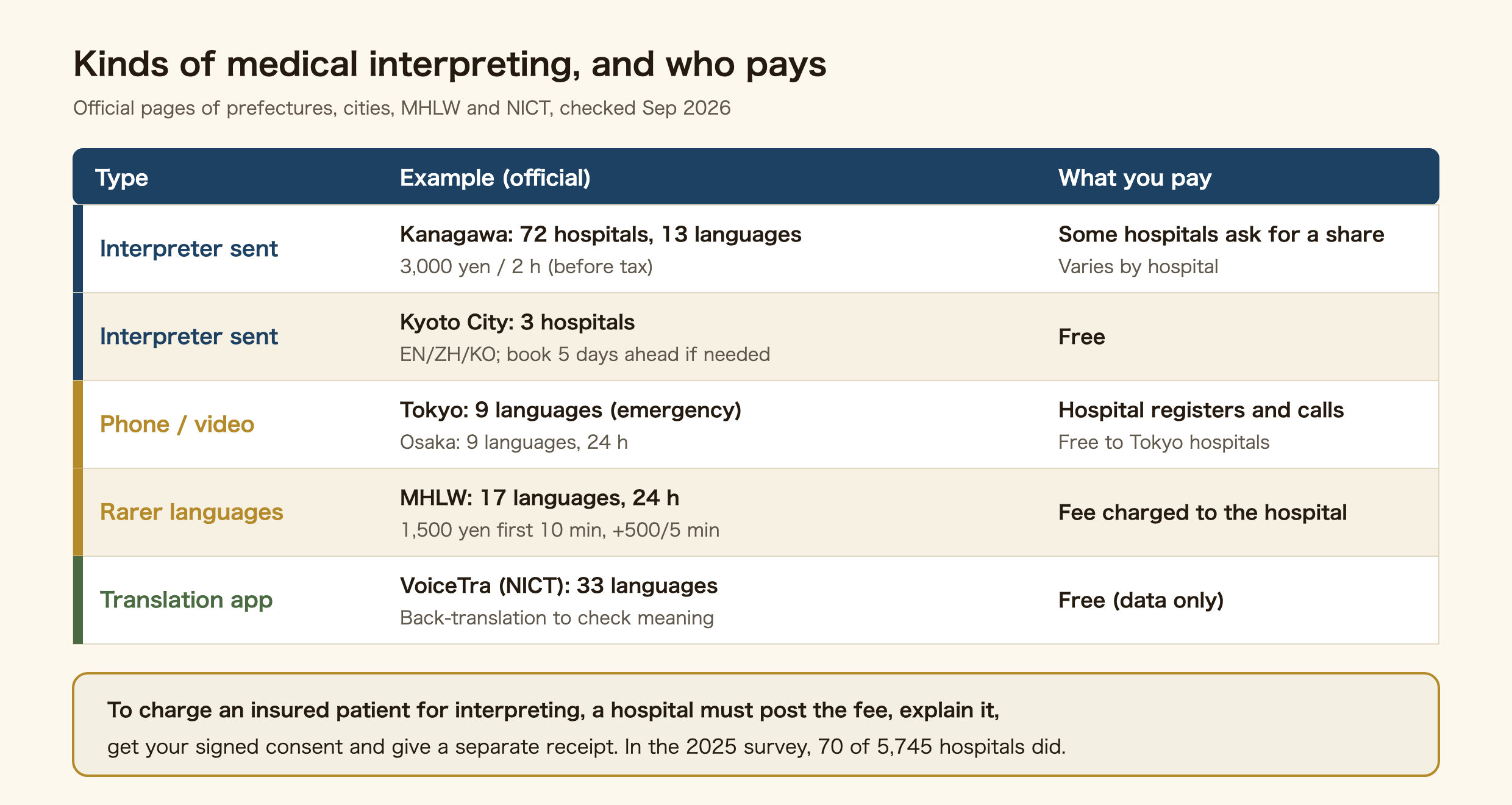
Here is how the different kinds of interpreting compare:
How much does a medical interpreter cost? There is no set rate
There is no national price for medical interpreting. The official numbers that exist are the prices of public schemes, and all of them are charged to the hospital first:
- Kanagawa’s interpreter dispatch: 3,000 yen per case of two hours, before tax. The prefecture notes that some hospitals ask patients to pay part, and that the procedure differs by hospital
- Kyoto City’s interpreter dispatch: free (English, Chinese and Korean, at three partner hospitals)
- Tokyo’s emergency phone interpreting: free to the hospital (the hospital pays the call charges)
- The health ministry’s remote interpreting for rarer languages: 1,500 yen for the first 10 minutes, then 500 yen for every further 5 minutes (Ukrainian is free)
That last one is counted by time. Twenty minutes of interpreting comes to 1,500 yen for the first ten, plus 1,000 yen for two blocks of five, so 2,500 yen. Thirty minutes is 3,500 yen. Whether a hospital asks you for any of it is up to the hospital, and if it does, your signed consent comes first.
That is why “Is there a fee for the interpreter?” belongs in your phone call. Once you know the amount, you can decide whether you need the interpreter or whether a translation app will do.
No interpreter? Use the 13-language questionnaires and a translation app
Even at a hospital with no interpreter, you have options. The first is the health ministry’s set of multilingual documents for foreign patients.
They were made for hospitals, but anyone can open the page. The 13 languages are English, Chinese, Korean, Portuguese, Spanish, Ukrainian, Hindi, Indonesian, Nepali, Tagalog, Thai, Vietnamese and Arabic. There are 53 documents in all, including medical questionnaires for 16 departments, from internal medicine and paediatrics to dermatology, obstetrics and gynaecology, and dentistry.
Print the questionnaire for the department you are visiting, in your language, and fill it in at home. Every document has Japanese alongside, so staff can read the Japanese side. Most symptoms are tick boxes, and there is a scale for how bad the pain is. The hospital decides which forms it uses, so at reception just show it and say you filled this in.
The second option is a translation app. VoiceTra, from Japan’s National Institute of Information and Communications Technology (NICT), covers 33 languages, including Nepali, Sinhala, Vietnamese and Burmese, and is free (you pay only for data). It shows a back-translation, turning the Japanese result back into your language, so you can check the meaning has not drifted.
VoiceTra is a research app intended for travellers to try out, though. The health ministry’s manual for hospitals says the best option is a trained medical interpreter in person. An app is enough for reception and simple symptoms. For surgery or how to take a medicine, ask for an interpreter. At a pharmacy you can also show the symptom words for Japanese drugstores.
Can a friend or family member interpret for me?
Nothing stops you bringing someone. A Japanese-speaking friend is a real help at reception and finding your way around.
But the health ministry’s manual lists problems with interpreting by family, friends or hospital staff. Abroad, family or friend interpreting has led to medical malpractice cases. Medical terms get lost. Patients hold back symptoms they would rather their family did not hear. The manual also says that if a hospital judges a family member unsuitable for a particular explanation, it should try to arrange another way of interpreting.
Having a child interpret for a parent is the case to avoid most. Kanagawa runs a free service that sends interpreters, including to medical institutions, to reduce the load on children who interpret for their families (young carers). Requests come through bodies such as child consultation desks and schools, so that is where to start.
What to bring: health insurance card and residence card
- Your My Number Card registered for health insurance, or an eligibility certificate. The old paper and plastic insurance cards expired on 1 December 2025
- Your residence card
- A questionnaire filled in in your language, if you have one
- Your medicine notebook (okusuri techo) or the medicine you take
- Money (JNTO notes that clinics usually expect cash)
If you are not sure which of the two you have, see what to show at a clinic now that the old insurance cards are gone. If you forget it, you pay the full cost on the day. Hand in the receipt later and most people get 70% back.
You may be asked for your residence card. In the ministry survey, 31.4% of hospitals ran an ID check on foreign residents beyond the insurance card, and 81.6% of those asked to see the residence card. The ministry’s manual also tells hospitals not to decide on ID checks by nationality, and not to refuse insured care only because a patient could not show ID.
Charged for interpreting without being asked?
Check the receipt first. An interpreting fee should be listed separately from other charges. If it appears and you never signed anything, ask at the payment desk which consent form it is based on. The notice requires consent to be confirmed by your signature on a document.
If you cannot sort it out with the hospital, you can go to a medical safety support centre. Prefectures, cities with a public health centre and Tokyo’s special wards set these up under the Medical Care Act to handle complaints and questions about medical care.
Do not stop treatment halfway over a fee dispute. Leave without understanding and you will not know how to take your medicine or when to come back. Money can be discussed after the treatment.
In an emergency, skip the search and call 119
Someone cannot breathe, is unconscious, or is bleeding heavily. Skip everything above and call 119. The ambulance is free, and 673 of Japan’s 720 fire departments connect a phone interpreter, all of them in English, Chinese and Korean. Say the name of your language first. What you will be asked, and how to give an address you do not know, are in how to call an ambulance in Japan.
Once you reach the hospital, interpreting is again arranged on the hospital’s side, and you cannot choose which hospital takes you. JNTO suggests writing down your own medical information in advance, since treatment may start without a proper interview. Keep a note of your conditions, allergies and medicines, in your language and in Japanese, in your wallet.
Which one are you?
- You are well now and have visits coming up: today, note two nearby clinics from the JNTO search and call to ask whether you can use an interpreter in your language.
- You feel ill today but can walk: call a nearby clinic and ask about an interpreter. If there is none, print the ministry questionnaire in your language, fill it in, and install a translation app before you go.
- You have an explanation coming about surgery, admission or a test: stop relying on family to translate and tell the hospital you need a medical interpreter. Ask today whether there is a fee and whether you will sign a consent form.
- Someone cannot breathe, is unconscious or will not stop bleeding: do not search. Call 119 now and say your language first.
FAQ
Q. Do doctors in Japan speak English?
Some do, but there is no official count. Use the JNTO medical institution search to find hospitals that list English or your language, and call ahead. In the health ministry’s FY2025 survey, 243 of 330 medical areas had a hospital that could use a phone interpreter.
Q. How do I get a medical interpreter at a hospital in Japan?
Ask the hospital whether you can use an interpreter in your language. Interpreting is booked on the hospital’s side, and some services, such as Tokyo’s emergency phone interpreting, cannot be requested by patients. Some hospitals need notice, so call before your visit.
Q. Who pays for a medical interpreter in Japan?
Hospital interpreting services bill the hospital first. Interpreting fees are outside health insurance, and to charge you a hospital must post the fee, explain it, get your signed consent and give a separate receipt. In the ministry’s FY2025 survey, 70 of 5,745 hospitals charged insured patients for interpreting.
Q. How do I find a hospital in Japan for foreigners?
Use the JNTO medical institution search and filter by area, language and department. It draws on a list compiled by the health ministry and the Japan Tourism Agency, whose newest version is the ministry’s Excel file. Contact the hospital before you go.
Q. What if the hospital has no interpreter?
Print the health ministry’s questionnaire in your language, fill it in and take it with you. There are 13 languages and 16 departments, all with Japanese alongside. A translation app helps at reception.
Q. What should I bring to a hospital in Japan?
Your My Number Card for health insurance (or eligibility certificate) and your residence card. Bring a filled-in questionnaire if you have one, and your medicine notebook or the medicine you take. The old insurance cards stopped working on 1 December 2025.
Summary
You can get an interpreter at a hospital in Japan, but the hospital books it. Your part is to choose the hospital and ask. Search with JNTO and the health ministry’s list, and fall back on your prefecture’s desk when unsure. The call works best when you make it before you are ill.
Interpreting fees sit outside insurance, and a hospital needs your signed consent before charging one. Where there is no interpreter, the 13-language questionnaires and a translation app fill the gap. For serious explanations like surgery or admission, use a medical interpreter rather than family. And when someone cannot breathe, search for nothing: call 119.
Official sources: MHLW, list of medical institutions accepting foreign patients (Japanese) / JNTO, Guide for when you are feeling ill / MHLW, multilingual documents for foreign patients / MHLW notice on services not directly related to insured care (Japanese) / MHLW FY2025 survey on foreign patients (Japanese) / MHLW remote interpreting for rarer languages (Japanese) / MHLW, local call centres by prefecture / Tokyo, medical information service for foreign patients (Japanese) / Osaka, 24-hour remote medical interpreting (Japanese) / Kanagawa, information in foreign languages (Japanese) / Kyoto City, medical interpreter dispatching service / NICT, VoiceTra. Checked on 23 September 2026. Interpreter availability and fees differ by hospital, so confirm with the hospital before your visit.
Related reading
Found this useful? Share it
Send it to a friend who lives in Japan.
WHO WROTE THIS

mori
Japanese. I read the ministries’ own notices, orders and Q&As in the original, and I start from what my Nepalese and Sri Lankan friends in Japan actually ran into. I do not write about what I have not checked or been told.
What this site can and cannot do →Looking for something else?