Checked on 23 September 2026 against the Immigration Services Agency’s pages on staying after graduation to look for work, on graduates’ job hunting under Designated Activities, and on Designated Activities for job-offer holders.
In short
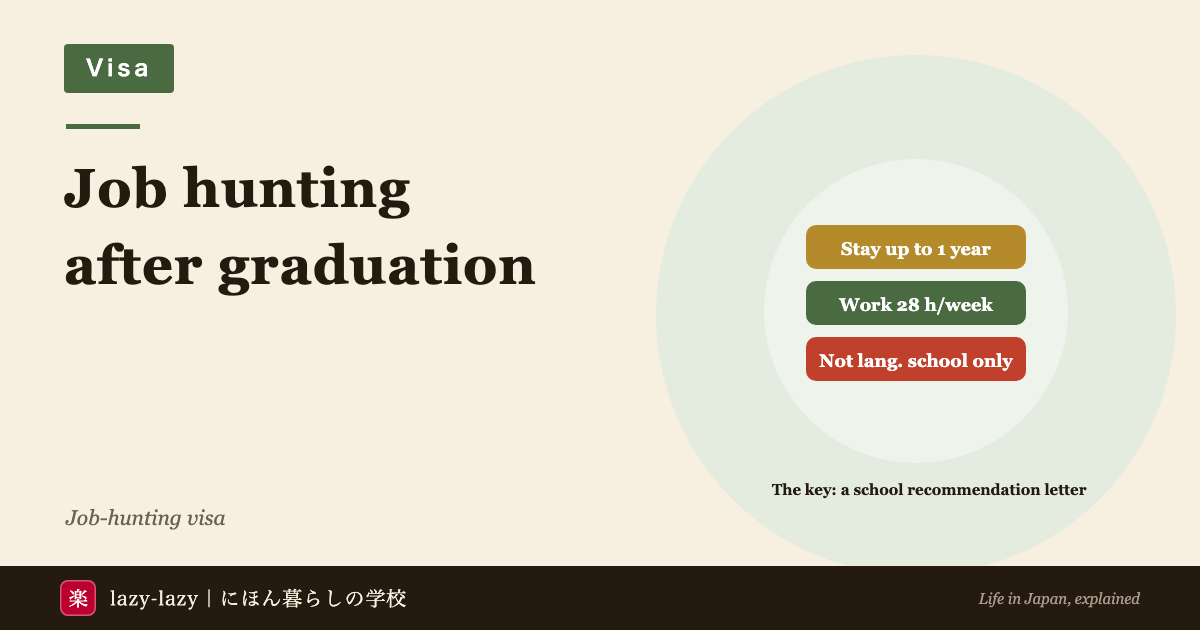
- The job-hunting visa after graduation is the “Designated Activities” status that lets an international student who has no job offer by graduation stay in Japan and keep looking. Six months, renewable once: up to one year.
- It covers graduates of universities, junior colleges, graduate schools and technical colleges, and vocational-school graduates who earned the senmonshi title. Graduating from a Japanese language school alone does not qualify – the only exception is someone who already holds a university degree from abroad and graduates from an approved language school.
- You need a recommendation letter from the school you graduated from, and your job hunting must have started before graduation. Talk to your careers office before you graduate.
- Part-time work is allowed up to 28 hours a week with permission. Once you have a job offer, you switch to a separate Designated Activities status that lets you wait until your start date (you must be hired within 18 months of graduating).
- From 1 October 2026 the fee rises: 18,000 yen at the counter (15,000 online) for a six-month grant. The renewal costs the same, so up to 36,000 yen for the year.
What changes: with graduation close and no offer, you stop assuming “I have to go home” and do the one thing that matters today – ask your school for the recommendation letter. If you are at a language school, you find out now that this route is closed to you, and choose further study or another path before you graduate.
Graduation is two months away. Your Japanese classmates all have offers. You are still going to interviews. Your residence card expires right after graduation. Ask a Japanese friend whether you have to leave and you hear, “Just job-hunt another year, like people do.” Japanese graduates can – they do not need a visa to keep looking.
- What is the job-hunting visa after graduation? Designated Activities, six months, up to a year
- Who qualifies? University and senmonshi graduates. Language school alone does not
- When do you apply, and what do you need? Ask for the recommendation letter before you graduate
- Can you work part-time meanwhile? Yes, up to 28 hours a week with permission
- What happens when you get an offer? Switch to the status for waiting until your start date
- How much does it cost? From 1 October, 18,000 yen per six months
- What if nothing comes through in a year? Go home, or change to another status
- Where do you stand?
- FAQ
- Summary
- Related guides
What is the job-hunting visa after graduation? Designated Activities, six months, up to a year
The job-hunting visa after graduation is the status of residence “Designated Activities” that lets an international student stay in Japan after graduating to keep looking for work. Immigration calls it “continued job hunting”. Your Student status ends its purpose when you graduate, so you cannot keep job hunting on it. You change to this status instead.
The period of stay is six months. It can be renewed once, for a total of one year (Immigration Services Agency).
There is a second year for some. If your local government runs a job-support programme that Immigration has approved, and you receive a certificate that you are covered by it, you can get another six months plus one renewal: one more year. Immigration does not publish a list of which municipalities qualify, so if you are thinking about a second year, ask your prefecture’s or city’s international exchange desk whether it has a job-support programme for graduated international students.
Who qualifies? University and senmonshi graduates. Language school alone does not
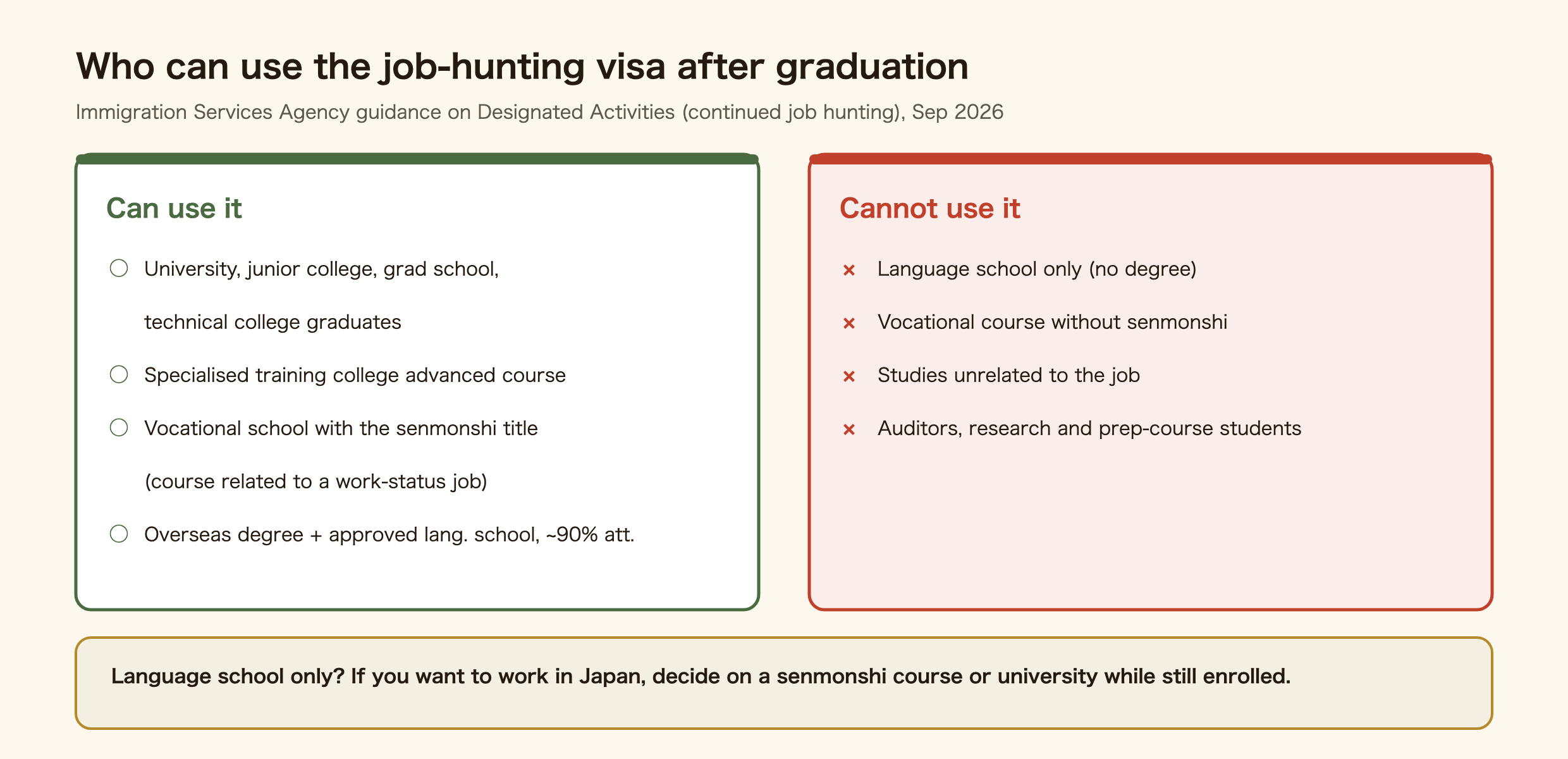
Immigration lists four groups.
- University graduates (including junior colleges, graduate schools and technical colleges). Non-degree students – auditors, credited auditors, research students and preparatory-course students – are not included
- Graduates of a specialised training college advanced course, where what you studied is related to work under a work status (such as Engineer / Specialist in Humanities / International Services)
- Vocational-school graduates who earned the senmonshi title, where what you studied is related to work under a work status
- People with a university degree from abroad who then graduate from a Japanese language school (approved schools only)
This is where language-school students divide. If you graduate from a Japanese language school alone, you cannot use this visa. It is open only to people who already hold a bachelor’s degree or higher, graduate from a language school accredited by the Minister of Education with attendance of about 90% or more, and get the school’s recommendation.
If you are at a language school without a degree and want to work in Japan, the road is a vocational school (a senmonshi course) or a university. Because you have no job-hunting year to fall back on, you need to decide on further study while you are still at the language school.
Vocational-school students need care too. A course without the senmonshi title does not qualify. And even with the title, if what you studied is not related to the job you are looking for, you may not be approved. That is why the documents include details of what you studied.
When do you apply, and what do you need? Ask for the recommendation letter before you graduate
You apply for a change of status from Student to Designated Activities. You can apply before graduating with the school’s recommendation letter and a certificate of expected graduation (you submit the diploma or graduation certificate when the change is granted).
| Document | Where / note |
|---|---|
| Change of status application form, one photo | From the Immigration website. Photo 4 cm x 3 cm |
| Passport and residence card | To show |
| Proof you can cover your living costs | Bank balance, etc. If someone else pays, their proof and how that came about |
| Diploma (copy) or graduation certificate | Certificate of expected graduation if you apply before graduating |
| Recommendation letter from your school | Immigration has a form. Ask your careers or international student office |
| Material showing you are still job hunting | Records of applications and interviews. The official wording is “as appropriate” |
| (Vocational school only) senmonshi certificate, transcript, details of what you studied | Issued by your school |
The most important item is the recommendation letter. The school issues it; you cannot produce it yourself. And the requirement is job hunting that has continued since before graduation. This is not a status for people who start looking only after they graduate. Keep records of the applications you make while still a student, and ask the careers office for the letter one or two months before graduation.
The renewal six months later needs a recommendation letter and proof of continued job hunting again.
Can you work part-time meanwhile? Yes, up to 28 hours a week with permission
Yes, but you need permission. Immigration’s guidance says people on this status can work up to 28 hours a week with permission to engage in activity outside their status. Rather than carrying on under the permission you had as a student, get the permission granted again when you change to Designated Activities.
The student rule of “8 hours a day during long school holidays” belongs to the Student status only. You have graduated, so there are no school holidays. It is 28 hours a week, all year. The hours are counted the same way as in the 28-hour rule for part-time jobs.
For an internship that is part of your job hunting, permission beyond 28 hours a week may be granted.
What happens when you get an offer? Switch to the status for waiting until your start date
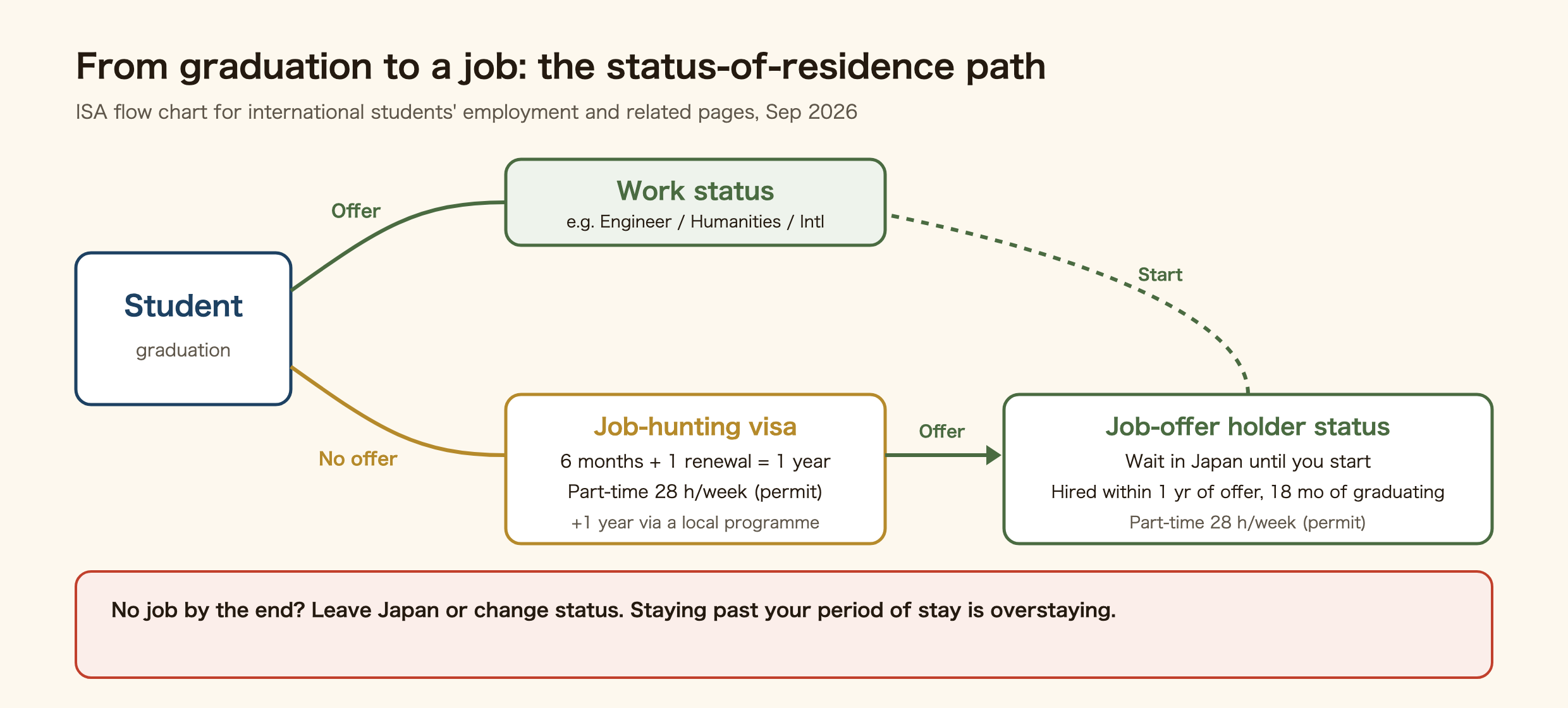
With an offer in hand, there are two paths.
- You start work straight away – apply to change to a work status (such as Engineer / Specialist in Humanities / International Services). Why some applications fail, and how to prepare, is in the student-to-work visa guide.
- Your start date is some time away – say, an offer in autumn and a start in April. Meanwhile you can change to Designated Activities for job-offer holders. The conditions: you are hired within one year of the offer and within 18 months of graduation, and the company pledges to stay in regular contact with you and to notify Immigration without delay if it withdraws the offer. During this time you can also work up to 28 hours a week with permission.
“Within 18 months of graduation” means that if you use a full job-hunting year and then get an offer, a start date more than 18 months after graduation will not work. The longer your search, the sooner you should agree a start date with the company.
How much does it cost? From 1 October, 18,000 yen per six months
Changes of status and renewals carry a fee, paid when granted. Applications accepted by 30 September 2026 pay 6,000 yen (5,500 online).
From 1 October 2026 the fee depends on the period granted. A six-month job-hunting grant falls in the “more than three months, up to six months” band: 18,000 yen at the counter, 15,000 online. Another six months on renewal costs the same, so up to 36,000 yen for the year. The full table is in the fee increase guide.
On top of that come rent and living costs for the whole period – which is why proof of living costs is part of the application. Work out whether 28 hours a week of part-time pay can carry you for a year before you commit.
What if nothing comes through in a year? Go home, or change to another status
If the job-hunting period ends (two years with a local programme) without a job, you no longer have a basis to stay. You leave Japan or change to another status, such as further study. Staying past your period of stay is overstaying.
If you go home, the pension and residence tax steps have an order. Go through the leaving-Japan checklist, including the lump-sum withdrawal that returns part of the pension you paid.
Where do you stand?
- Final year at university or a senmonshi vocational course, no offer yet – this month, ask your careers office for a recommendation letter for continued job hunting. Start keeping records of applications and interviews.
- Language-school student without a degree – this visa is closed to you. If you want to work in Japan, decide on a vocational school or university while you are still enrolled.
- Language-school student with a degree from abroad – keep attendance above 90%, and ask the school whether it is accredited and meets the job-support requirements.
- You already have an offer – check the start date. Soon: change to a work status. Months away: change to the status for job-offer holders.
FAQ
Q. Can I stay in Japan after graduation to look for a job?
Yes. Change to Designated Activities (continued job hunting): six months, renewable once, up to one year. If a local government job-support programme covers you, one more year.
Q. Does it cover Japanese language school graduates?
Not if language school is your only study in Japan. It covers only people who hold a bachelor’s degree or higher from abroad and graduate from an approved language school with attendance of about 90% or more.
Q. Can I work part-time on the job-hunting visa?
Yes, up to 28 hours a week, with permission. Get the permission granted again when you change status. The 8-hours-a-day holiday rule for students does not apply.
Q. Can vocational-school graduates use it?
Yes, if you earned the senmonshi title and what you studied is related to work under a work status. Courses without the title are not covered.
Q. What is the most important document?
The recommendation letter from your school. Immigration has a form and the school issues it. Your job hunting must have started before graduation, so keep records of applications and interviews.
Q. Can I stay in Japan between getting an offer and starting work?
Yes. Change to Designated Activities for job-offer holders. You must be hired within one year of the offer and within 18 months of graduation.
Q. How much does it cost?
From 1 October 2026, 18,000 yen at the counter or 15,000 online for a six-month grant, and the same again on renewal. Applications accepted by 30 September pay 6,000 yen (5,500 online).
Summary
No offer by graduation does not always mean going home. Graduates of universities, junior colleges, graduate schools and technical colleges, and vocational graduates with the senmonshi title, can keep job hunting on Designated Activities for six months, renewable to one year. Language-school-only graduates are not covered, so decide on further study while enrolled.
The keys are the recommendation letter you request before graduating and the job-hunting record you keep as a student. Part-time work up to 28 hours a week with permission. With an offer: a work status, or the job-offer status if your start date is months away. From 1 October, each six months costs 18,000 yen (15,000 online).
Sources (official): Immigration Services Agency, staying after graduation to look for work / ISA, graduates’ job hunting under Designated Activities / ISA, Designated Activities for job-offer holders / ISA, employment of international students. Rules and fees checked on 23 September 2026. Confirm on the official pages and with your school’s careers office before you apply.
Related guides
Found this useful? Share it
Send it to a friend who lives in Japan.
READ THIS NEXT
Student Visa to Work Visa in Japan →In 2024, 96.7% of applications to change from a student visa to a work visa were approved.WHO WROTE THIS

mori
Japanese. I read the ministries’ own notices, orders and Q&As in the original, and I start from what my Nepalese and Sri Lankan friends in Japan actually ran into. I do not write about what I have not checked or been told.
What this site can and cannot do →Looking for something else?