This article contains affiliate links.
Last updated: July 2026
Figures, prices and terms were checked against manufacturer stores and product pages (individual model prices change) on 6 August 2026. They change — check the current terms yourself before you sign up or file anything.
In short
- Decide the keyboard layout first. It is the one thing you cannot change after you buy, and it quietly narrows which shops you can use.
- Japanese laptops ship with a JIS keyboard by default. A US layout is available but only from certain sellers, sometimes at extra cost.
- You are almost certainly NOT eligible for tax-free shopping. If you live here on a student or work visa, you count as a resident, and tax-free is only for temporary visitors. Most English guides get this wrong.
- What you can use instead: point cards, direct-from-maker sales, and price comparison on Kakaku.com.
- For normal study and daily use, 50,000 to 90,000 yen buys plenty of laptop. You do not need to spend more unless you game or edit video.
Buying a laptop in Japan is cheap and easy right up until you hit two things nobody warns you about: the keyboard is laid out differently, and the tax discount you were counting on does not apply to you. This guide handles both first, then gets to what to actually buy.
Individual model prices move every week with sales and stock. The figures here are a guide checked in August 2026. Check the live price on the product page before you buy. The price bands themselves (under 50,000 / 60,000-90,000 / 100,000+) change much more slowly.
The first fork in the road: JIS or US keyboard
Laptops sold in Japan come with a JIS keyboard by default. It has extra keys, a smaller left shift and space bar, and the symbols are in different places. You can change the software language in seconds, but you cannot change the physical keys. So decide this before you shop, not after.
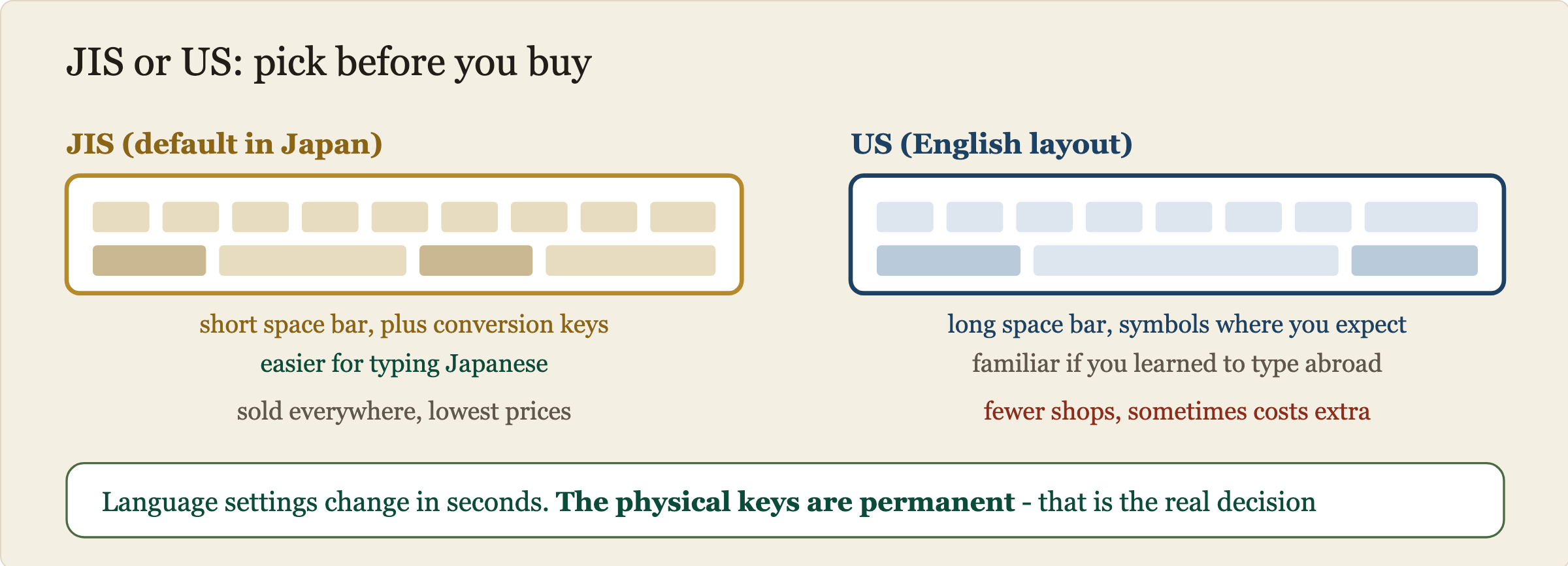
Here is the part most English guides leave out: if you are learning Japanese, the JIS keyboard is genuinely the better tool. It has dedicated conversion keys on either side of the space bar for switching between kana and kanji, which makes typing Japanese noticeably faster. Choosing JIS is not settling – for a person living in Japan long term, it is often the right call.
If you do want a US layout, these are the routes that reliably work:
- Apple Japan online store: you can select the English (US) layout when ordering, and Apple Stores in Japan commonly stock US keyboard models
- Lenovo Japan online store: offers an English keyboard option on many configure-to-order models
- Large electronics stores such as Yodobashi carry a limited set of English-layout models, often around 5,000 yen above the equivalent JIS model
- Amazon Japan: search the Japanese term “US キーボード” rather than English words, or you will miss most listings
- Akihabara specialist shops in Tokyo advertise English OS and keyboard systems, though the selection is narrow
The tax-free trap: you probably do not qualify
Tax-free shopping in Japan is for temporary visitors, not for people who live here. To qualify, a foreign national generally needs the “Temporary Visitor” residence status and less than six months in the country. If you hold a Student, Engineer, or similar residence card, you count as a resident for tax purposes and cannot buy tax-free.
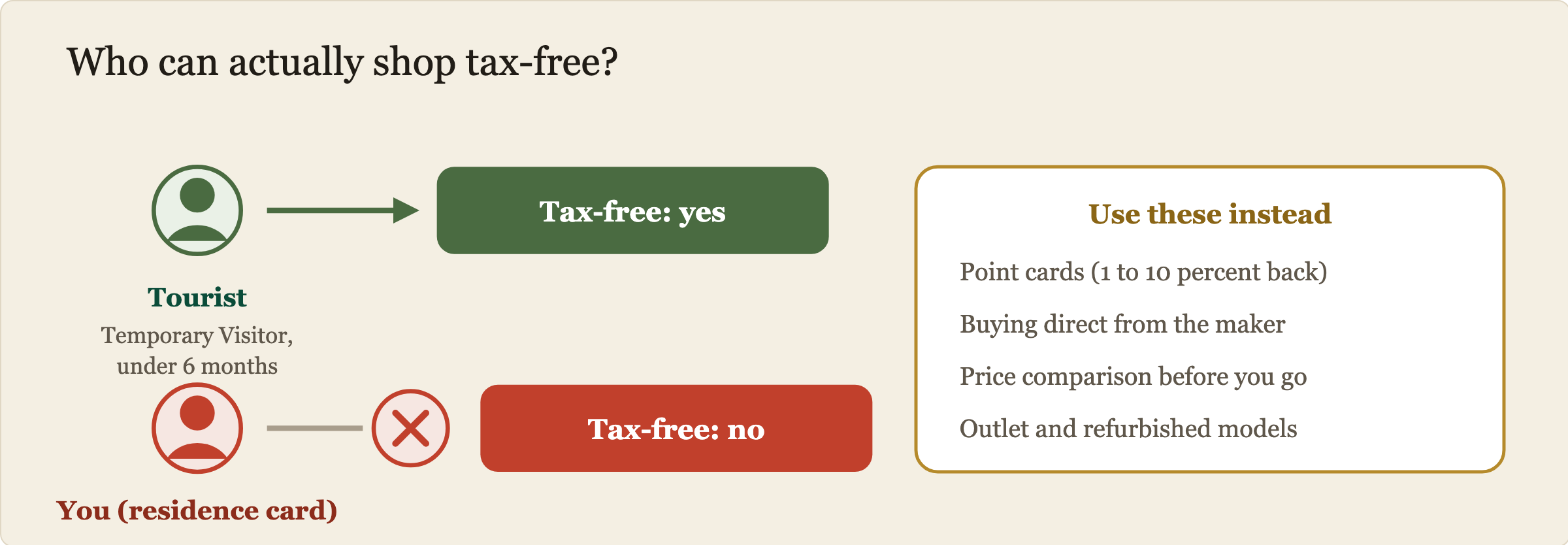
This matters because plenty of English-language advice tells foreigners in Japan to “shop tax-free at the big electronics stores.” If you show a residence card at the tax-free counter, you will simply be turned away – and if you were counting on that 10 percent, your budget is off from the start. Plan for the full price including consumption tax.
The good news is that the discounts you can use are often worth more. Big electronics chains give point card rewards of roughly 1 to 10 percent depending on the item, and those points are usable on your next purchase. Note that stores frequently do not let you stack tax-free and points anyway, so as a resident you are not losing as much as it first looks.
Where to buy, and what each option is good at
Buying direct from a manufacturer’s Japanese online store is usually the cheapest route for a new laptop, because they run direct-only sale prices that the big retail chains do not match. Physical stores are worth it when you want to type on the keyboard before committing.
| Where | Best for | Watch out for |
|---|---|---|
| Maker online stores | Lowest prices on new machines, configure-to-order | Site is usually Japanese only |
| Yodobashi, Bic Camera | Trying the keyboard, point rewards, same-day pickup | List prices run higher than direct |
| Dospara and PC specialists | Competitive pricing, staff who know specs | Fewer premium and Mac models |
| Amazon Japan | Selection, and the easiest place to find US keyboards | Check the seller, not just the price |
| Used and refurbished | Tightest budgets | Battery age, and often no warranty |
Whichever route you choose, look the model up on Kakaku.com first. It is Japan’s price comparison site, it lists both new and used prices for the same model number, and it tells you within a minute whether the deal in front of you is actually a deal.
How much do you actually need to spend?
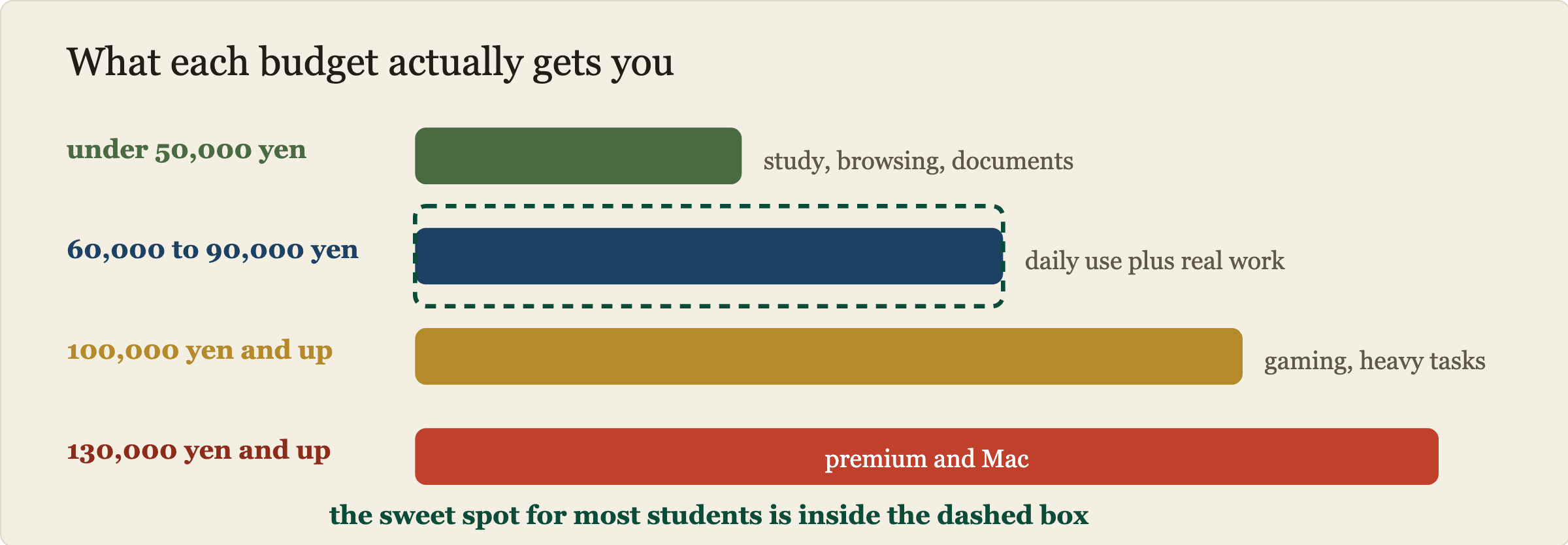
For coursework, job hunting, video calls home, and everyday use, a machine in the 60,000 to 90,000 yen range is genuinely enough. Spending more only pays off if you game, edit video, or run heavy software.
What to look for on the spec sheet, in order of how much it affects daily use:
- SSD storage, not a hard disk: this is the single biggest difference in how fast a machine feels. Any modern laptop should have it
- 8GB of memory minimum, 16GB if you can: 8GB is workable, 16GB stops the slowdowns when you keep many browser tabs open
- Core i5 or Ryzen 5 class processor: enough for everything short of gaming and video editing
- Weight, if you commute: under about 1.5kg matters a lot if you carry it to school daily
Fujitsu is a Japanese maker with frequent direct-only sales. Keyboards are JIS layout – check the product page before ordering
Acer runs some of the lowest prices for entry and mid-range machines, including gaming models
Before you pay: three things worth checking
- Payment method: maker online stores and most large retailers expect a credit card. If you do not have one yet, read how foreigners get approved for a credit card in Japan first
- Delivery address: enter your name exactly as it appears on your residence card, in the same order. A mismatch is the most common reason a delivery or an order gets held up
- Warranty length: the standard is one year. Extended warranties are usually not worth it on a budget machine, but they can be on a premium one
Also think ahead to the day you leave. A laptop you bought outright is yours to sell or take home, unlike equipment you rent – which is exactly the same logic we apply to home internet routers. Buying is the simpler position to be in when your plans change.
Reference (official): Japan Tourism Agency, consumption tax exemption program
Frequently asked questions
Q. Are laptops cheaper in Japan?
For Japanese brands sold domestically, often yes, especially direct from the maker during a sale. For international brands, prices are broadly similar to other developed markets. The bigger saving usually comes from buying direct rather than through a retail chain.
Q. Can I use tax-free shopping as an international student?
No, in almost all cases. Tax-free shopping requires Temporary Visitor status and generally under six months in Japan. Holding a Student or work residence card makes you a resident for tax purposes, which excludes you. Use point cards and direct-from-maker sales instead.
Q. Can I change a Japanese keyboard to English?
You can change the input language and software layout in a minute, and many people do. What you cannot change is the physical key arrangement, so some symbols will not match what is printed on the keys. If that would bother you daily, buy a US layout from the start.
Q. Should I buy a used laptop?
It is a reasonable way to save if your budget is tight, but check the battery condition and confirm what warranty, if any, comes with it. A used machine with a worn battery that has to stay plugged in is a poor deal at any price.
Q. Where can I find a laptop with an English keyboard?
The Apple Japan online store lets you select an English (US) layout, Lenovo Japan offers it on many configure-to-order models, Amazon Japan has listings if you search the Japanese phrase “US キーボード”, and large stores such as Yodobashi carry a limited range at around 5,000 yen extra.
Summary
- Choose the keyboard layout first – it is the only part you cannot change later
- JIS is the default and is genuinely better for typing Japanese; US layouts come from Apple, Lenovo, Amazon Japan, and a few big stores
- You do not qualify for tax-free shopping as a resident. Budget for the full price with tax
- Use point cards, direct-from-maker sales, and Kakaku.com to bring the price down instead
- 60,000 to 90,000 yen covers study and daily use. Prioritise SSD storage and memory over processor bragging rights
Related guides
Found this useful? Share it
Send it to a friend who lives in Japan.
WHO WROTE THIS

mori
Japanese. I read the ministries’ own notices, orders and Q&As in the original, and I start from what my Nepalese and Sri Lankan friends in Japan actually ran into. I do not write about what I have not checked or been told.
What this site can and cannot do →Looking for something else?