Checked on 25 September 2026 against the Road Traffic Act and related laws on e-Gov, the Ministry of Land, Infrastructure, Transport and Tourism’s compulsory insurance (CALI) portal and its list of bicycle insurance ordinances, a Ministry of Health, Labour and Welfare notice, and official pages from the Japan Safe Driving Center, Kyokai Kenpo, Yokohama City, the Tokyo Metropolitan Government, Hyogo Prefectural Police and Houterasu.
The short answer
- After a traffic accident in Japan, every driver involved must stop, help anyone injured, prevent further danger and report to the police (Road Traffic Act, Article 72). Cyclists too.
- Report it even if the other side says “no need for the police”. Not reporting is punishable, and without a police report you cannot get the traffic accident certificate that insurance claims rely on.
- Compulsory insurance (jibaiseki) only pays for injury or death caused to other people. Up to 1.2 million yen per injured person. Damage to cars and your own injuries need optional insurance, or your own money.
- You can use your health insurance for accident injuries. If you do, file a “third-party injury notification”. Injuries at work or on the way to work go to rosai instead.
- Free help exists. If Japanese is hard for you, Houterasu’s multilingual line (0570-078377) finds the right place to ask.
Knowing this, you know what to do — and what not to agree to — in the first ten minutes after a crash, so you do not end up with a claim that goes nowhere or a penalty you never saw coming. You can also decide that same day which insurance pays for your treatment.
You are stopped at a red light and the car behind hits you. The driver gets out and says, “No need to call the police. I’ll pay for the repairs.” Your neck hurts a little. You cannot find the Japanese to argue. You call a Japanese friend, but unless they have been through an accident themselves, they do not know either. Whether you say “okay” here decides who pays for your treatment later — and where you stand legally.
- What to do in a car accident in Japan: stop, help, report
- What if I do not call the police? A penalty, and no certificate
- What is a traffic accident certificate, and how do I get one?
- What happens if I cause an accident?
- Jibaiseki vs optional insurance: how car insurance works in Japan
- Bicycle accidents in Japan: the same duties, but no jibaiseki
- Can I use health insurance after a traffic accident? Yes — file the notification
- How much does it cost?
- Where can I get help after a traffic accident?
- Which one are you?
- FAQ
- Summary
- Related reading
What to do in a car accident in Japan: stop, help, report
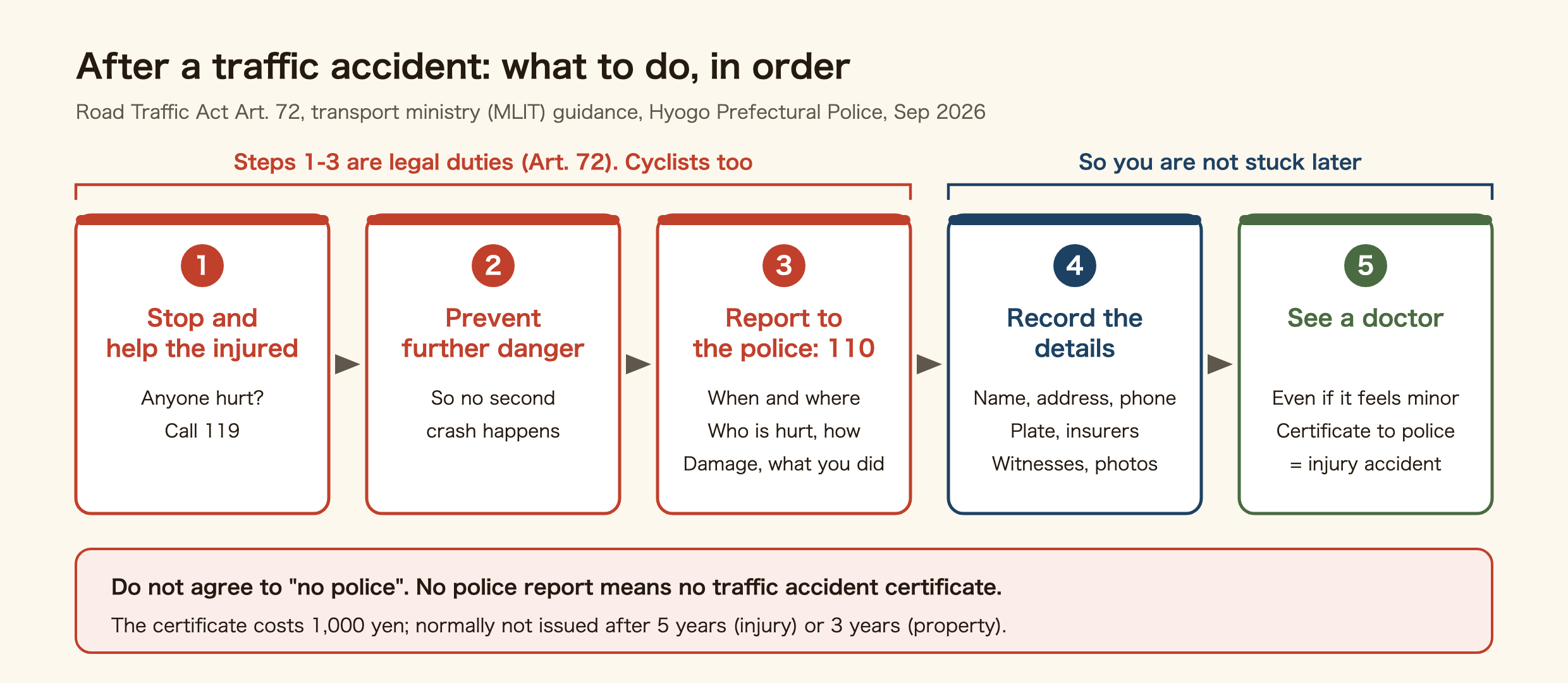
Article 72 of the Road Traffic Act gives every driver involved in an accident three duties.
- Stop at once and help anyone who is hurt. If someone is injured, call 119 for an ambulance.
- Prevent danger on the road, so that no second accident happens.
- Report to the police. If no officer is at the scene, tell the nearest police station, koban or residential police box straight away.
The law even lists what to report: the date and place, how many people were killed or injured and how badly, what was damaged and how badly, what the vehicle was carrying, and what you did about it. In practice, you call 110, say “Kotsu jiko desu” (it is a traffic accident), and the officer asks you one thing at a time. How to get an interpreter on the line is in how to call the police in Japan — worth saving on your phone before you ever need it. For the ambulance, 119 is the number, and you say “Kyukyu desu”.
While you wait for the police, Japan’s transport ministry recommends a few things. Write down the other party’s name, address and phone number, their number plate, and the names and certificate numbers of their compulsory and optional insurance. If they were driving for work, get the employer’s details too. Ask any witnesses for their name and contact. Take photos of the scene, and save the dashcam footage if you have one.
Then see a doctor. An injury that feels minor on the day can turn out to be worse. The ministry warns that if you wait too long, the link between the accident and the injury may not be accepted.
What if I do not call the police? A penalty, and no certificate
Skipping the police is itself an offence. A driver who does not make the Article 72 report faces up to three months’ imprisonment or a fine of up to 50,000 yen (Article 119). This applies even when only property was damaged.
Leaving an injured person without helping is a hit-and-run. For a car or motorbike driver, that means up to five years or a fine of up to 500,000 yen — and up to ten years or 1 million yen if your driving caused the injury (Article 117). For a cyclist, or an accident with property damage only, the maximum is one year or 100,000 yen (Article 117-5).
The money problem is worse than the penalty. If the police were never told, no traffic accident certificate can be issued. You need that certificate to claim on compulsory insurance and to use your health insurance properly. If the driver who promised to pay stops answering your calls, you have nothing that proves the accident happened.
If you were a pedestrian who got hit, the legal duty to report is not yours. Call 110 anyway. Whether a certificate exists decides who pays for your treatment.
What is a traffic accident certificate, and how do I get one?
A traffic accident certificate (kotsu jiko shomeisho) is a document from the Japan Safe Driving Center confirming that an accident reported to the police happened at a given time and place. The transport ministry calls it the only document in which a public body certifies that you were in an accident.
| How to apply | Details |
|---|---|
| Post office (Japan Post Bank) | Forms at police stations and koban. 1,000 yen per copy plus the transfer fee. Arrives by post, usually in about 10 days |
| Safe Driving Center office | 1,000 yen per copy. Usually same day if the police records have arrived |
| Online | 1,000 yen per copy plus a 143 yen payment fee. Only the people in the accident themselves. Pay within 7 days at a convenience store or bank |
The people who can apply are the parties to the accident, plus people with a legitimate interest such as a family member entitled to compensation. There is a time limit. After five years for an injury accident, or three years for a property-only accident, a certificate is normally no longer issued. The ministry notes that you may need one years later to apply for support, even if you do not need it now.
One more thing decides what the certificate says. If you were hurt but the accident was registered as property damage only, the certificate will say so. To have it treated as an injury accident, take a doctor’s certificate to the police station that covers the place of the accident. Getting treatment at a hospital does not change the record on its own (Hyogo Prefectural Police).
What happens if I cause an accident?
Injuring someone while driving a car can be the offence of negligent driving causing injury, under the law on deaths and injuries caused by driving: up to seven years’ imprisonment or a fine of up to 1 million yen. If the injury is minor, the court can waive the penalty depending on the circumstances.
Separately from the penalty, there is compensation. Under Article 3 of the Compulsory Automobile Liability Security Act, the person using a car for their own purposes is liable for injuring someone with it. That is what the insurance in the next section is for.
For foreign residents, your status is part of it too. The Immigration Control Act makes a sentence of more than one year’s imprisonment a ground for deportation, unless the whole sentence is suspended. A fine is not the end of it either: Immigration’s published examples of refused renewals include fines, and permanent residence applications look at your conduct. How each kind of penalty affects your stay is set out in things that are illegal in Japan for foreign residents.
That is why doing the three duties at the scene is your best protection. Injuring someone in a car accident carries up to seven years; driving off without helping carries up to ten.
Jibaiseki vs optional insurance: how car insurance works in Japan
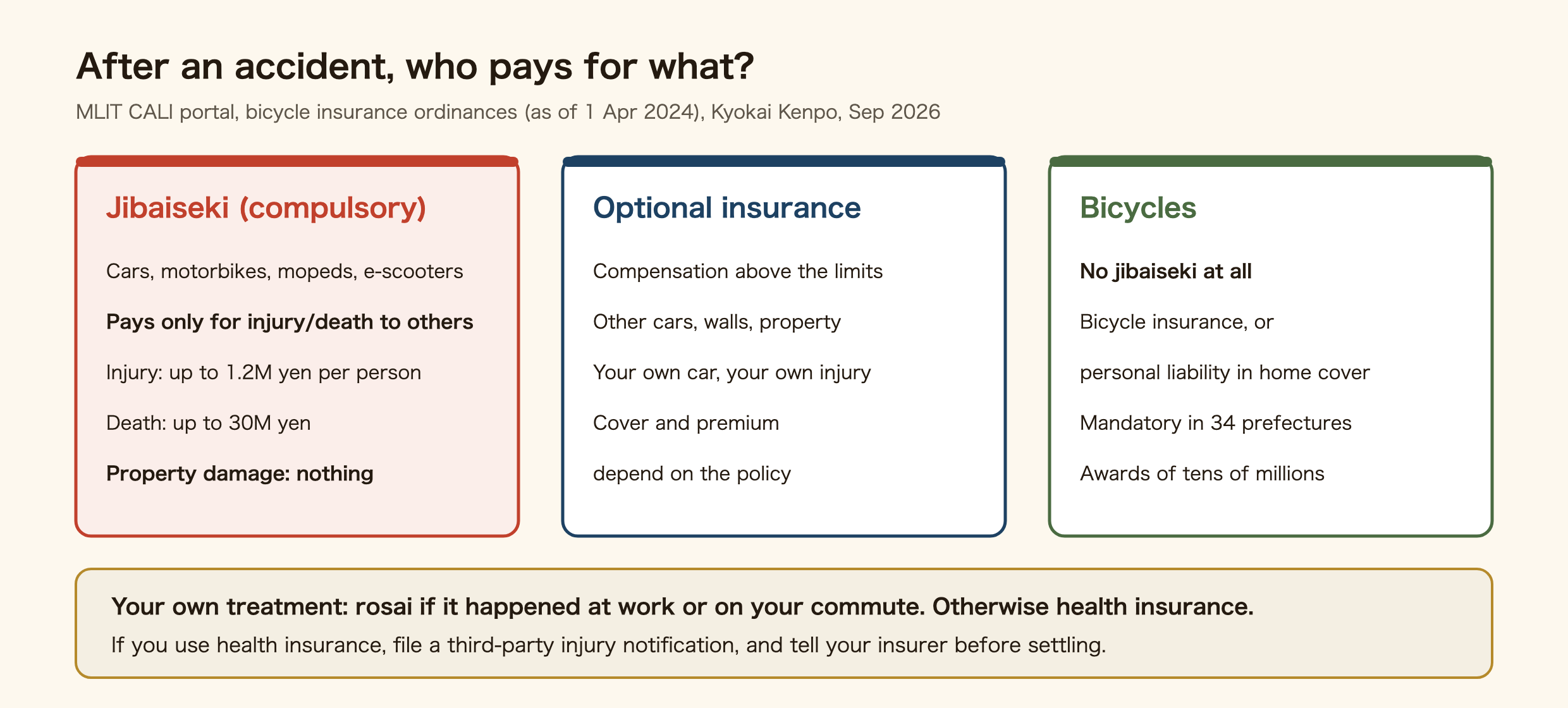
Compulsory automobile liability insurance — jibaiseki, called CALI in the ministry’s English pages — is the insurance every car, motorbike and moped must have by law. Electric kick scooters and mopeds with pedals (pedal-attached motorised bicycles) are included. Bicycles are not, and that includes electrically assisted bicycles that meet the legal standard. Driving without it carries up to one year’s imprisonment or a fine of up to 500,000 yen, plus six licence points.
But its cover is narrow. Jibaiseki only pays compensation to other people you injure or kill. The limits are per victim: 1.2 million yen for injury, 30 million yen for death, and 40 million down to 750,000 yen for lasting disability. The 1.2 million yen for injury has to cover treatment, lost earnings (normally 6,100 yen a day) and compensation for suffering (4,300 yen a day).
Damage to the other car or a shop wall, your own car, and your own injuries get nothing from jibaiseki. That is what optional insurance is for, and the premium and cover depend on the company and the policy. Why optional cover is not really optional is covered in converting your foreign driving licence. If you are about to get a Japanese licence from scratch, sort out insurance before your first drive.
If you are the injured one, you can claim directly from the other driver’s jibaiseki insurer. If you need money for treatment straight away, there is an advance payment of 50,000, 200,000 or 400,000 yen depending on the injury. If the driver fled and cannot be found, or had no jibaiseki, the government’s guarantee programme pays within the same limits. You claim at a non-life insurance company’s office.
Bicycle accidents in Japan: the same duties, but no jibaiseki
Under the Road Traffic Act, a bicycle is a vehicle (a “light vehicle”). So Article 72 applies exactly as it does to cars: stop, help, report.
Insurance is where it differs. There is no compulsory national insurance for bicycles like jibaiseki. The law’s definition of “automobile” does not include them. If you injure someone, you pay compensation from your own insurance, or your own pocket. Courts have ordered cyclists to pay tens of millions of yen (transport ministry).
That is why prefectures set the rule by ordinance. As of 1 April 2024, 34 prefectures made bicycle liability insurance mandatory, 10 asked residents to make an effort to have it, and three — Shimane, Nagasaki and Okinawa — had no ordinance. Tokyo, Osaka, Aichi, Fukuoka, Kanagawa, Saitama and Chiba are all mandatory.
Check what you already have before buying something new. If your renter’s insurance includes personal liability cover, it may pay when you injure someone on a bike. What that cover includes is in renters insurance in Japan. The rules and fines that help you avoid an accident in the first place are in Japan’s bicycle rules.
A bicycle is not an automobile, so criminal liability for injuring someone falls under the Penal Code: a fine of up to 300,000 yen for negligent injury, or up to five years or 1 million yen for gross negligence.
Can I use health insurance after a traffic accident? Yes — file the notification
You may have heard that health insurance does not cover traffic accidents. It does. The Ministry of Health, Labour and Welfare has told insurers that injuries from car accidents are covered like any other injury. An insurer cannot refuse because the other driver is unknown or hard to recover the money from.
Strictly, the other driver should pay for your treatment. When you use health insurance, the insurer pays first and then claims the money back from them. For that, you file a notification.
- Employee health insurance (such as Kyokai Kenpo): send a “third-party injury notification” (daisansha koi ni yoru shobyo todoke) to your insurer
- National Health Insurance: send the same notification to your city office
- Both need the traffic accident certificate. If you cannot send the form yet, phone them first
Two cautions. First, settlement. Kyokai Kenpo asks you to tell them before you settle with the other side, and never to hand over a blank power of attorney. Depending on what you agree, the insurer may lose the right to recover what it paid (Yokohama City). Second, if the other side has already paid your treatment costs, National Health Insurance cannot be used for them (Yokohama City).
If the accident happened at work or on your way to or from work, you use work injury insurance (rosai), not health insurance. Because someone else was involved, there is a “third-party accident report” to file as well; ask the Labour Standards Inspection Office if you are unsure. How the usual 30% share works is in health insurance in Japan.
How much does it cost?
| What | How much |
|---|---|
| Traffic accident certificate | 1,000 yen per copy (plus the post office transfer fee, or 143 yen online) |
| Treatment on health insurance | 30% for most people. The insurer pays the rest and claims it from the other side |
| Jibaiseki advance payment (to the injured person) | 50,000, 200,000 or 400,000 yen depending on the injury |
| Driving without jibaiseki | Up to one year’s imprisonment or 500,000 yen, plus six licence points |
| Lawyer consultation (JFBA Traffic Accident Consultation Center) | Free |
| Houterasu multilingual information service | Free (you pay the call charge) |
The expensive case is having no insurance. Compensation above jibaiseki limits, and all compensation for a bicycle accident, comes out of your own pocket if you are not covered. Checking your insurance is the one thing you can do before an accident.
Where can I get help after a traffic accident?
Settlement, who was at fault, dealing with the other side’s insurer — questions keep coming after an accident. These are the places the transport ministry lists.
- Traffic accident consultation offices: public offices run by prefectures and major cities, advising on settlement, compensation, fault ratios and insurance. For example, the Tokyo Metropolitan Traffic Accident Consultation Office is 03-5320-7733 (weekdays 9:00 to 17:00, for both victims and drivers who caused an accident). Saitama states that its consultations are free
- JFBA Traffic Accident Consultation Center: free consultations with a lawyer at 154 locations nationwide, phone 0120-078325 (weekdays 10:00 to 19:00, about 10 minutes per person). Free mediation if you cannot agree a settlement
- NASVA victims’ hotline: 0570-000738 (weekdays 10:00 to 12:00 and 13:00 to 16:00), which points you to the right service
- Japan Center for Settlement of Traffic Accident Disputes: when settlement talks with the other side’s insurer break down. Book an in-person consultation by phone
If Japanese is the problem, start with Houterasu’s Multilingual Information Service (0570-078377, weekdays 9:00 to 17:00). An interpreter answers and connects you to your nearest Houterasu office in a three-way call, and the staff tell you which system and which office fit your situation. The service is free; you pay only for the call. From an IP phone or a prepaid mobile, call 050-3754-5430. Other helplines in foreign languages are in help for foreigners in Japan.
Which one are you?
- You are at the scene right now — stop; if anyone is hurt, call 119, then 110. Note the other party’s name, contact, number plate and insurer, and take photos. Do not agree to settle on the spot. See a doctor today.
- You were injured (as a pedestrian, cyclist or passenger) — see a doctor today, get a medical certificate, and ask the police station for the accident area to register it as an injury accident. If you used health insurance, phone your insurer today to say a third-party notification is coming.
- You parted without calling the police — today, phone the police station that covers the place of the accident and tell them it happened. A certificate is only issued for reported accidents.
- It happened at work or on your commute — tell your employer and get treatment under rosai, not health insurance. Ask your employer today about the third-party accident report.
- You ride a bicycle — today, check whether you have bicycle insurance or personal liability cover in your renter’s insurance. If not, check your prefecture’s rule and get cover.
FAQ
Q. Do I have to report even a minor accident to the police in Japan?
Yes. Article 72 of the Road Traffic Act requires every driver involved in an accident to report it, including accidents with property damage only. Not reporting can mean up to three months’ imprisonment or a fine of up to 50,000 yen, and no traffic accident certificate.
Q. Where do I get a traffic accident certificate, and how much is it?
From the Japan Safe Driving Center, for 1,000 yen per copy. You can apply at a post office, at a center office or online. After five years for an injury accident, or three years for a property-only accident, it is normally no longer issued.
Q. Can I use health insurance for injuries from a traffic accident?
Yes. The health ministry has confirmed that car accident injuries are covered. If you use it, file a third-party injury notification with your insurer. Injuries at work or on your commute are covered by rosai instead.
Q. What is the difference between jibaiseki and optional car insurance?
Jibaiseki is compulsory and only pays compensation for injury or death caused to other people. The limit is 1.2 million yen per injured person and 30 million yen per death. Property damage, your own car, your own injuries and anything above the limits need optional insurance.
Q. What happens if I injure someone while cycling in Japan?
You have the same duties as a driver: stop, help and report to the police. Bicycles have no jibaiseki, so compensation comes from bicycle insurance or your own money. Thirty-four prefectures make bicycle insurance mandatory by ordinance.
Q. Where can I get help in English after a traffic accident?
Houterasu’s Multilingual Information Service (0570-078377, weekdays 9:00 to 17:00) connects you through an interpreter and tells you which system and office to use. The service is free; you pay the call charge. At the scene, 110 can also bring in an interpreter.
Summary
After a traffic accident, there are three things to do: stop, help, report to the police. They are legal duties for drivers and cyclists alike. Agreeing to “no police” can make you liable to a penalty, and it leaves you without a traffic accident certificate. Without that certificate, you are the one who struggles to claim.
The money splits like this: jibaiseki pays only for injuries to other people, optional insurance covers the rest, and bicycles need bicycle insurance. Your own injuries can be treated on health insurance, with a notification — or on rosai if it happened at work or on your commute. If things get complicated, go to a traffic accident consultation office or the JFBA center, and if Japanese is the barrier, to Houterasu’s multilingual line.
Official sources: e-Gov, Road Traffic Act / e-Gov, Compulsory Automobile Liability Security Act / e-Gov, Act on Punishment of Acts Causing Death or Injury by Driving / MLIT, CALI portal (English) / MLIT, What to do first after an accident / MLIT, If you are injured / MLIT, Where to get help / MLIT, Bicycle liability insurance / MHLW notice on insurance for injuries from crime and car accidents / Japan Safe Driving Center, Traffic accident certificate / Kyokai Kenpo, Third-party injury notification / Yokohama City, National Health Insurance after a traffic accident / Hyogo Prefectural Police Q&A / Tokyo Metropolitan Government, Traffic accident and foreign resident consultations / Houterasu, Multilingual Information Service. Checked on 25 September 2026. Office hours and bicycle insurance ordinances can change, so check your own prefecture’s page too.
Related reading
Found this useful? Share it
Send it to a friend who lives in Japan.
WHO WROTE THIS

mori
Japanese. I read the ministries’ own notices, orders and Q&As in the original, and I start from what my Nepalese and Sri Lankan friends in Japan actually ran into. I do not write about what I have not checked or been told.
What this site can and cannot do →Looking for something else?