Checked on 24 September 2026 against the Ministry of the Environment and the Ministry of Economy, Trade and Industry (METI) pages on appliance and computer recycling, the Waste Management Act on e-Gov, and the official rubbish guides of Shinjuku City (Tokyo), Osaka City and Yokohama City, including their foreign-language versions.
The short answer
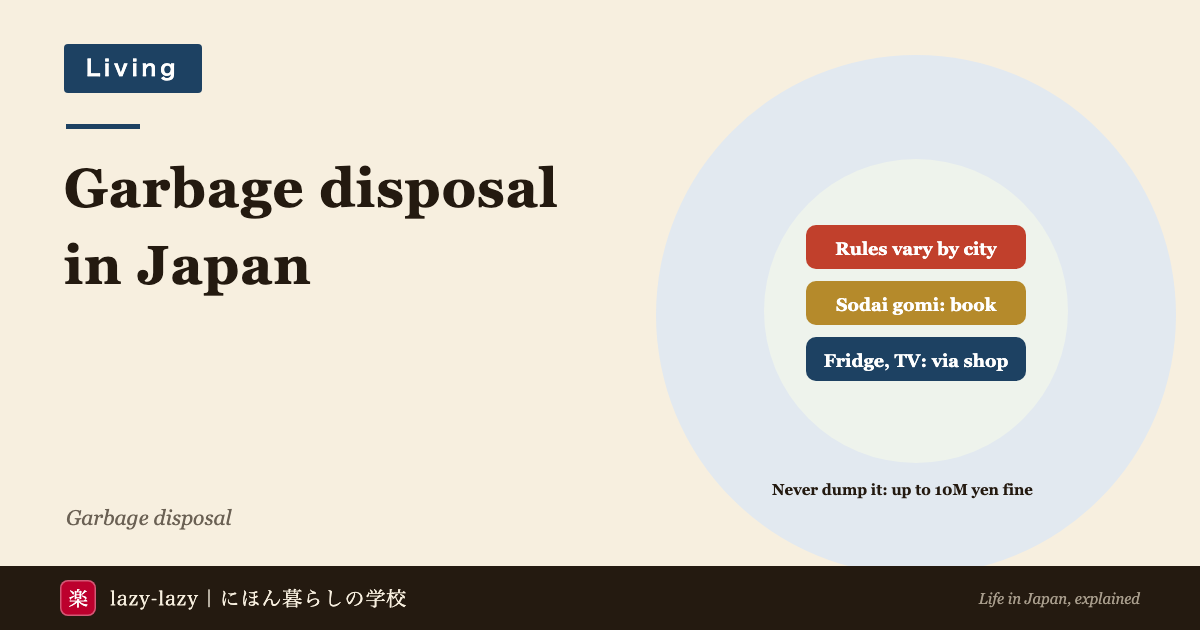
- Garbage rules in Japan are set by your city or ward, not the country. How to sort, which day, which bag and where to put it all change from one city to the next — sometimes from one street to the next.
- Look it up on your own city’s official site. Shinjuku has a sorting flyer in 10 languages, Osaka a guide in 5, Yokohama a leaflet in 10. Sorting apps exist too.
- Furniture, bikes and futons are “sodai gomi” (oversized rubbish). You book a pickup, buy a fee sticker, stick it on, and put the item out on the morning you were given. In Yokohama it takes about two weeks from booking to pickup.
- Air conditioners, TVs, fridges, washing machines and computers cannot go out as oversized rubbish. Appliances go back through a shop; computers go to the maker.
- Dumping rubbish on empty land or the street is a crime: up to five years in prison, a fine of up to 10 million yen, or both. Some “free pickup” collectors are unlicensed.
Knowing this, you can decide what goes where, and for how much, two or three weeks before a move or before you leave Japan — instead of flying out with a bed and a fridge still in the flat. If you have just arrived, you can get your local rules before your first bag goes out.
It is the weekend before you move. In the flat: a bed, a bicycle, and a fridge the last tenant left behind. You ask a Japanese friend how to get rid of them. “Oversized rubbish — buy a sticker, stick it on, done.” But your friend grew up in a different city from the one you live in, and the fridge cannot go out as oversized rubbish at all. For most Japanese people, rubbish rules are simply “how my town does it”. They do not know how yours does.
- How does garbage disposal work in Japan?
- Where can I find my city’s garbage sorting guide in English?
- What are the garbage sorting categories in Japan?
- How do I throw away large items (sodai gomi)?
- How much does oversized garbage cost?
- How big is “oversized”? 30 cm or 50 cm
- How do I dispose of a TV, fridge, washing machine or air conditioner?
- How do I throw away a computer, phone or batteries?
- Moving out or leaving Japan: what about a lot of rubbish at once?
- What happens if I dump garbage illegally?
- Which one are you?
- FAQ
- Summary
- Related reading
How does garbage disposal work in Japan?
Household rubbish is collected by the city (or, in Tokyo, the ward). So each one decides how to sort, which day each type goes out, and what bags to use. Official Japanese writes it ごみ (gomi); you will also see ゴミ.
The differences go further than city lines. In Shinjuku’s collection-day table, even within one neighbourhood — Ichigaya Yanagicho — the burnable-rubbish day depends on the block number.
Times are fixed as well. Shinjuku wants rubbish at the collection spot by 8 a.m. on collection day. Osaka sets a collection time slot for each area. Bags differ too: Osaka requires see-through bags (clear or semi-transparent), and bags you cannot see into — black ones, for example — get a warning sticker and are left behind. Osaka does not sell its own official bags at all.
If you live in an apartment block, check one more thing. Osaka notes that some blocks are collected by a licensed private company under contract with the owner, not by the city, and tells residents to ask the management company. The simplest move is to ask for the building’s rubbish rules when you sign the rental contract.
Where can I find my city’s garbage sorting guide in English?
Your city’s official website is the source that counts. Search “[your city] gomi bunbetsu” or “[your city] garbage”. Larger cities publish guides in other languages.
- Shinjuku (an example from Tokyo’s 23 wards): the “How to Separate and Dispose of Recyclable Resources / Garbage” flyer comes in English, Korean, Chinese, Vietnamese, Nepali, Myanmar, French, Tagalog, Thai and Arabic, as well as Japanese. It is handed out at ward facilities and available as a PDF
- Osaka: the “ABC of Waste Disposal Rules” guide in English, Chinese, Korean, Vietnamese and Nepali
- Yokohama: a booklet in 6 languages and a leaflet in 10 (including Nepali, Filipino and Thai). Its sorting dictionary, “Mictionary”, works in Japanese, English and Chinese
There are apps too. Shinjuku and Osaka both point residents to the sorting app “San-aru” (さんあ~る): type in an item and it tells you the category and the collection day. Yokohama has its own app in Japanese, English and Chinese.
For a paper copy, Shinjuku hands the flyer out at the ward office and its branch offices, and Yokohama at ward offices and its resource-circulation offices. Pick one up on the day you file your residence registration.
What are the garbage sorting categories in Japan?
The skeleton is similar in most places: everyday burnable rubbish, recyclables, things that do not burn, and oversized items. But the names and the lines between them move from city to city.
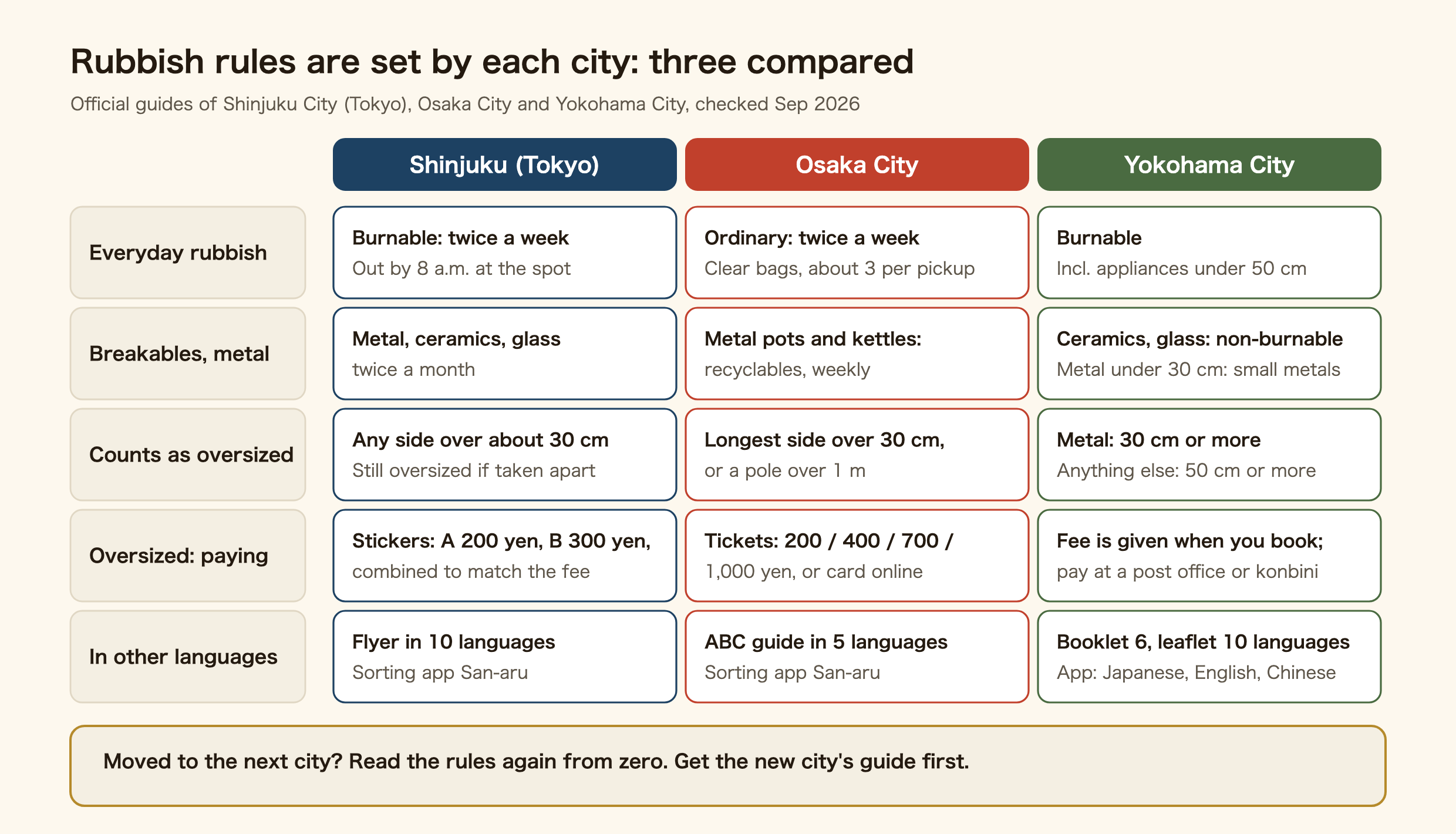
Shinjuku uses four groups: recyclables (weekly), burnable rubbish (twice a week), metal, ceramics and glass (twice a month), and oversized rubbish (booked, paid). Recyclables include paper, plastic packaging, bottles, cans, PET bottles, spray cans and dry batteries.
Osaka uses ordinary rubbish (twice a week), recyclables (weekly), plastic resources (weekly), and paper and clothing (weekly). Metal pots and kettles go with recyclables.
Yokohama splits things finer: burnable, non-burnable, spray cans, batteries, plastic resources, cans/bottles/PET bottles, small metals, paper, old cloth, and oversized. Small appliances under 50 cm go in burnable rubbish, and old cloth cannot go out on rainy days.
So the same frying pan is “metal, ceramics and glass” in Shinjuku, a recyclable in Osaka, and a small metal in Yokohama. The fastest way to avoid rubbish trouble is to drop your old city’s habits and learn the new city’s list.
How do I throw away large items (sodai gomi)?
Sodai gomi — oversized rubbish — is furniture, bedding, bicycles and other items too big for normal collection, picked up by appointment for a fee. The steps look the same in all three cities.
- Book: apply to your city’s oversized-rubbish reception centre by phone or online. Online booking runs 24 hours in Shinjuku and Osaka. Measure the items and count them first
- Pay: buy fee stickers (tickets) for the amount you are told, at a convenience store or other licensed shop. In Osaka and Yokohama you can also pay cashless if you book online
- Put it out: write your booking number or name and the collection date on the sticker and put one on each item. Out by 8 a.m. in Shinjuku and Yokohama, by 8:30 a.m. in Osaka
The place is not always your usual rubbish spot. Shinjuku asks for oversized items to go in front of the house, or near the ground-floor entrance of an apartment building — wherever was agreed when you booked.
Timing is the trap. Yokohama says pickup comes about two weeks after booking, and one booking covers up to nine items. Shinjuku lets you cancel or change an online booking until three days before collection. Book on the day your moving date is fixed, and a two-week wait still works.
How much does oversized garbage cost?
Everyday collection is, in principle, free in Shinjuku. What costs money is oversized rubbish and large amounts at once — and the same item costs different amounts in different cities.
| Item | Shinjuku | Osaka |
|---|---|---|
| Bicycle | 900 yen (16 inch or larger) | 400 yen |
| Single bed (without mattress) | 1,300 yen | 1,000 yen (bed frame) |
| Microwave | 900 yen | 400 yen |
| Suitcase | 400 yen | 200 yen |
| Futon | 400 yen (duvet or mattress futon) | 200 yen (up to 4 futons or blankets) |
The stickers differ too. Shinjuku sells A tickets at 200 yen and B tickets at 300 yen, which you combine to reach the fee. Osaka has four tickets — 200, 400, 700 and 1,000 yen — with no refunds. Osaka stopped selling them at post offices on 31 March 2025, so buy them at a licensed convenience store or supermarket. Yokohama tells you the fee when you book, and you pay at a designated bank, post office or convenience store.
Each city publishes a fee list by item. Add up the furniture you plan to throw out, and you know the total before you book.
How big is “oversized”? 30 cm or 50 cm
Where normal rubbish ends and oversized begins also depends on the city.
- Shinjuku: any side longer than about 30 cm. It stays oversized even if you take it apart
- Osaka: longest side or diameter over 30 cm, or over 1 m for something pole-shaped
- Yokohama: metal items 30 cm or longer; anything else (plastic, wood) 50 cm or longer
A 40 cm plastic storage box is oversized in Shinjuku and Osaka, but plastic resources in Yokohama. Fees are measured in their own way too: Osaka prices chests, bookshelves and shoe cabinets by width plus depth plus height, and under 2 metres in total costs 400 yen.
How do I dispose of a TV, fridge, washing machine or air conditioner?
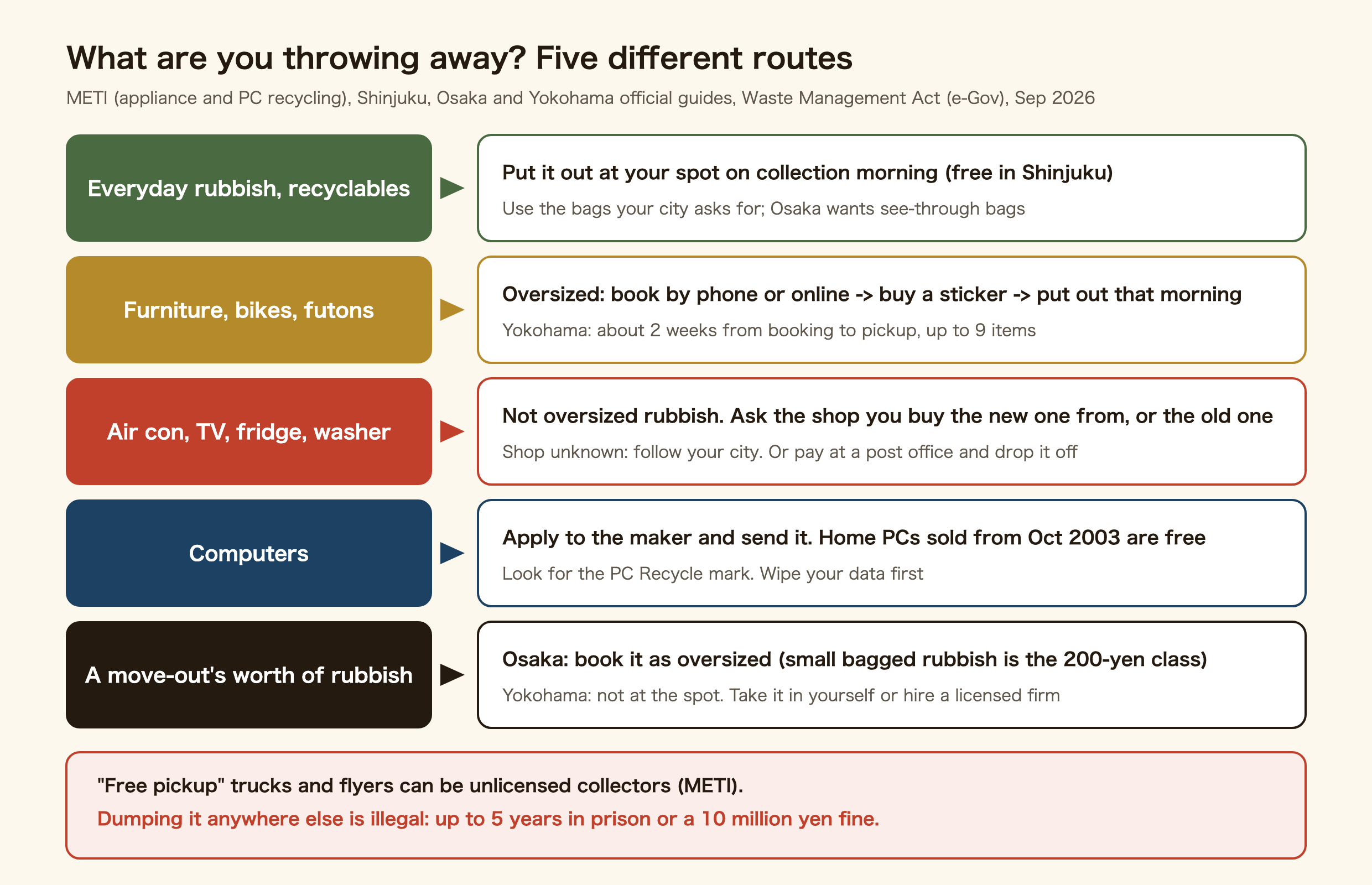
Household air conditioners, TVs, fridges and freezers, and washing machines and clothes dryers are the “four appliances” covered by Japan’s Home Appliance Recycling Law (Ministry of the Environment). They cannot go out as oversized rubbish. Osaka states plainly that it does not collect or take them back.
METI sets out the routes in this order.
- Replacing it with a new one of the same kind: ask the shop selling you the new one to take the old one
- Just getting rid of it: ask the shop where you bought it
- You do not know where it was bought: follow the method your city or ward gives
- Or: pay the recycling fee at a post office and take the appliance to a designated drop-off site yourself
You pay two charges: a recycling fee set by each manufacturer, and a collection and transport fee set by each shop. The recycling fee varies by item and maker, and TVs (15-inch and under, 16-inch and over) and fridges (170 L and under, 171 L and over) have two size bands. The Home Appliance Recycling Ticket Center (0120-319640, Japanese) lists fees by maker on its website.
A fridge inherited from the last tenant, or a second-hand washing machine, usually fails route 2 — you do not know the shop. Use route 3 or 4. Keep the copy of the recycling ticket you are handed; it lets you check later that the appliance was actually recycled.
How do I throw away a computer, phone or batteries?
Computers cannot go out as oversized rubbish either. Under the Act on the Promotion of Effective Utilization of Resources, manufacturers must collect and recycle them (METI). Shinjuku and Yokohama both say they do not collect computers.
For a home computer, apply to the maker’s collection service and send it in. Machines sold from October 2003 onwards are collected free, marked with a “PC Recycle” sticker. Even without the mark, a home-use machine may be free, so ask the maker. If the maker no longer exists, or you built the PC yourself, the PC 3R Promotion Association collects it for a fee. METI’s advice is to wipe your data yourself first. Tablets are not covered by this scheme.
Small electronics such as mobile phones and digital cameras are collected in drop-off boxes in some cities: Shinjuku takes nine kinds of item, including mobile phones, in boxes at the ward office and branch offices, and Osaka collects them in boxes at ward offices and other points. Keep lithium-ion batteries and power banks out of your rubbish. Osaka warns that they start fires in collection trucks and plants, and asks for them to go to its battery collection instead.
Moving out or leaving Japan: what about a lot of rubbish at once?
The weeks before a move produce far more rubbish than usual, and here the cities do opposite things.
- Osaka: large amounts from a move or a big clean-out can be booked as oversized rubbish. Small rubbish in bags falls into the 200-yen class
- Yokohama: a move-out’s worth of rubbish is not collected from the normal spot. Take burnable rubbish to an incineration plant yourself (book first; 13 yen per kg), take oversized items to a drop-off yard (book first; same fee as collection), or hire a firm licensed by the city
If your flight is close and the oversized-rubbish wait is too long, you have three ways out: take it to a city facility yourself, hire a company licensed by your city to collect household waste (both Osaka and Yokohama publish lists of licensed firms), and return appliances through a shop.
What to avoid is the truck driving past announcing “free pickup”. METI warns that some operators advertising free collection — trucks with loudspeakers, pickups on empty lots, flyers, online ads — are unlicensed, and that some have loaded everything up and then demanded a large payment because “not everything is free”. Before you hand anything over, check that the company holds a licence from your city.
The order of everything else before you go home is in the leaving-Japan checklist; how to fit oversized-rubbish booking around a domestic move is in the moving guide.
What happens if I dump garbage illegally?
The Waste Management Act says no one may throw away waste indiscriminately (Article 16). Dumping on empty land or the street is illegal dumping, punishable by up to five years’ imprisonment, a fine of up to 10 million yen, or both (Article 25). Attempting it is also punishable. Burning rubbish yourself, in a garden for example, is prohibited in principle, with the same penalty.
Rubbish put out on the wrong day or in the wrong category may simply be left behind. Osaka sticks a warning label on bags you cannot see into and does not collect them. Whatever is left is seen by every neighbour who uses the same spot. When in doubt, checking with your city or the app before you put it out is much faster. If phoning the city in Japanese feels hard, a multilingual help line for foreign residents can interpret for you.
Which one are you?
- You just arrived, or just moved to a new city — find your city’s official sorting guide in your language and the collection days for your address. Today, install the sorting app and check your next rubbish day.
- You are moving or leaving Japan and have furniture, a bike or futons to get rid of — count and measure what counts as oversized and total it from the fee list. Today, book with the reception centre to lock in a date.
- You have a fridge, washing machine, TV or air conditioner — check whether you know where it was bought. If not, open your city’s page on the four appliances today and look up the maker’s fee at the Recycling Ticket Center.
- You want to get rid of a computer — look for the PC Recycle mark and wipe your data. Today, apply to the maker’s collection service.
FAQ
Q. Are garbage rules the same everywhere in Japan?
No. Household rubbish is collected by each city or ward, so sorting, collection days, bags and times are set locally. Collection days can differ even within one neighbourhood, by block number.
Q. Where can I find garbage sorting rules in English?
Larger cities publish them. Shinjuku has a flyer in 10 languages, Osaka a guide in 5, Yokohama a leaflet in 10. Sorting apps (San-aru in Shinjuku and Osaka, the city’s own app in Yokohama) let you look up items one by one.
Q. Where do I buy a sodai gomi sticker?
At convenience stores, supermarkets and other shops licensed by your city. Stickers are specific to each city; Shinjuku tells residents to buy Shinjuku’s own tickets. Shinjuku’s come in 200 and 300 yen, Osaka’s in 200, 400, 700 and 1,000 yen. Osaka and Yokohama also take cashless payment for online bookings.
Q. Can I put a fridge or washing machine out as oversized rubbish?
No. Air conditioners, TVs, fridges, freezers, washing machines and clothes dryers fall under the Home Appliance Recycling Law. Ask the shop selling you the replacement or the shop you bought it from; if you do not know the shop, follow your city’s instructions. You pay a recycling fee and a collection fee.
Q. How do I dispose of a computer in Japan?
Apply to the maker and send it in. Home computers sold from October 2003 onwards are collected free and carry the PC Recycle mark. Wipe your data first.
Q. What happens if I dump rubbish on empty land?
It is illegal dumping under the Waste Management Act. The penalty is up to five years’ imprisonment, a fine of up to 10 million yen, or both, and attempts are punishable too.
Summary
Garbage disposal in Japan follows the rules of the city you live in. Put Shinjuku, Osaka and Yokohama side by side and the category names, the size that makes something oversized, and the sticker prices all differ. Your first step is to get your own city’s guide, in your language or through an app.
Book oversized items early — about two weeks in Yokohama. Fridges, washing machines, TVs and air conditioners go through a shop; computers go to the maker. A move-out’s worth of rubbish can be booked as oversized in some cities and must be taken in or collected by a licensed firm in others. The two things never to do: hand it to an unlicensed “free pickup” truck, or leave it on an empty lot.
Official sources: e-Gov, Waste Management and Public Cleansing Act / Ministry of the Environment, Home Appliance Recycling Law overview / METI, correct disposal of the four appliances / METI, PC recycling / Shinjuku City, sorting guides in other languages / Shinjuku City, oversized rubbish / Osaka City, how to put out rubbish / Osaka City, ABC of Waste Disposal Rules / Osaka City, oversized rubbish fees / Yokohama City, sorting and putting out rubbish / Yokohama City, oversized rubbish collection. Checked 24 September 2026. Always confirm the rules for your own address on your city’s site.
Related reading
Found this useful? Share it
Send it to a friend who lives in Japan.
WHO WROTE THIS

mori
Japanese. I read the ministries’ own notices, orders and Q&As in the original, and I start from what my Nepalese and Sri Lankan friends in Japan actually ran into. I do not write about what I have not checked or been told.
What this site can and cannot do →Looking for something else?