Checked on 24 September 2026 against the Local Tax Act, the National Tax Collection Act and the Immigration Control Act (e-Gov), the Ministry of Internal Affairs and Communications’ late-charge table, Setagaya and Chuo City’s tax and health insurance pages, the National Tax Agency, the Japan Pension Service, and the Immigration Services Agency’s renewal and permanent residence guidelines.
The short answer
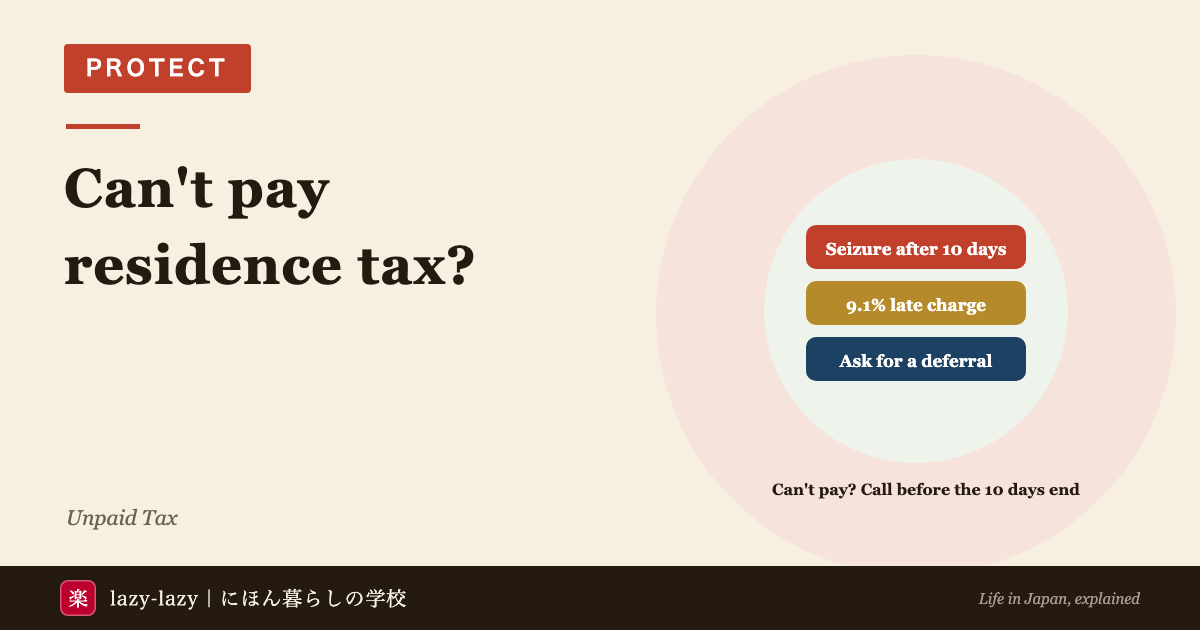
- If you miss the due date for residence tax, a demand letter follows within 20 days. Ten days after the letter is sent, the city can seize your wages or savings.
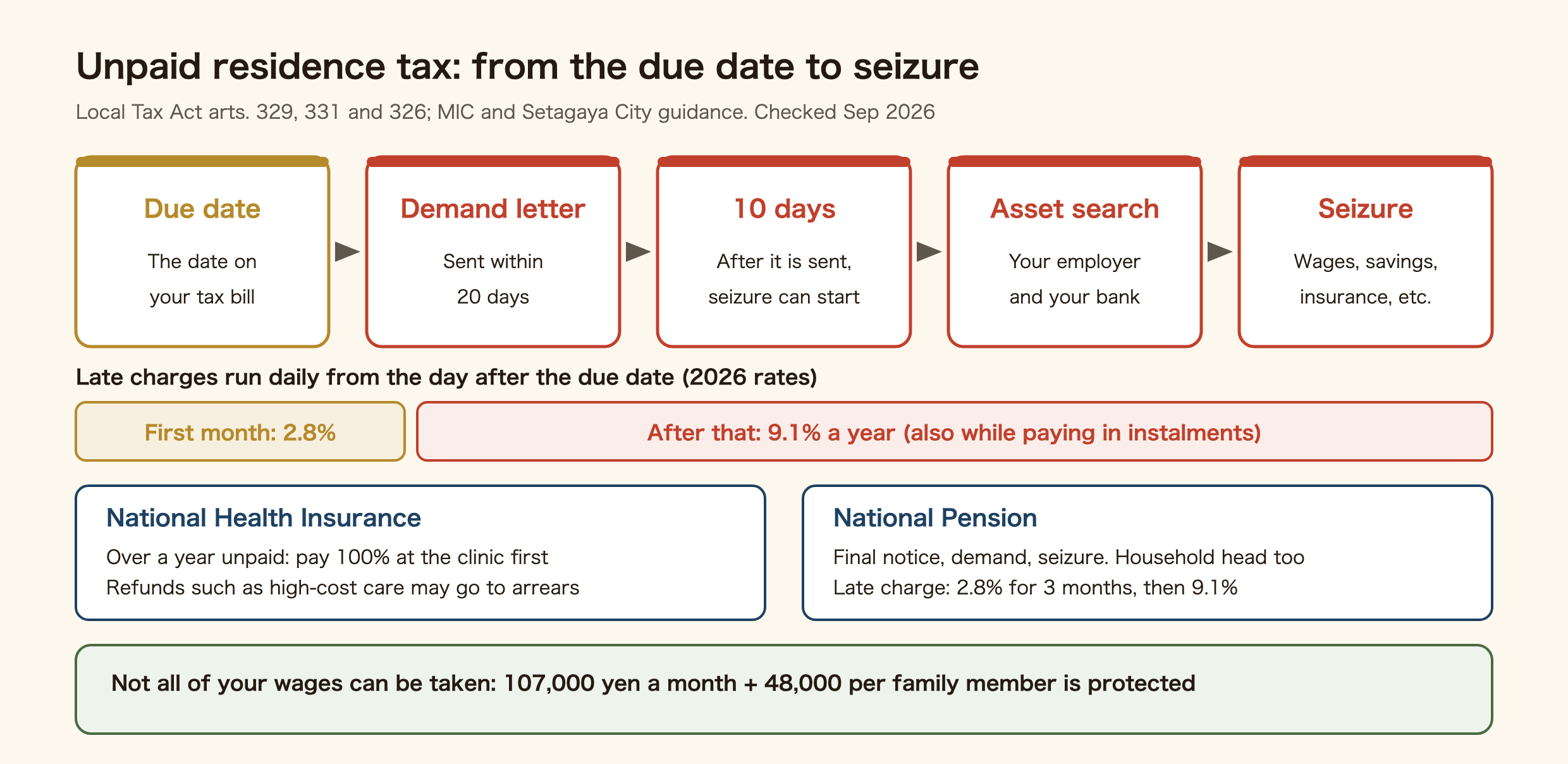
- Late charges run every day from the day after the due date. In 2026 the rate is 2.8% a year for the first month and 9.1% after that. Paying in instalments at the counter does not change the rate.
- If you cannot pay, call the city before those ten days run out. A formal deferral exists for illness or disaster, and another for when paying at once would wreck your living. If granted, the late charge is waived or drops to 1.3%.
- Visa renewal checks whether you have met your tax obligations. Permanent residence checks whether you paid on time. From April 2027, permanent residents who wilfully refuse to pay can have that status revoked.
- Unpaid tax is not, by itself, a ground for deportation. But if your renewal is refused, you cannot stay.
Knowing this, you can count from the date on your demand letter how many days you have before seizure, and ask for a deferral or instalments before then. You will also know what your next renewal or permanent residence application will look at.
Three months after leaving your job, three bills arrive in the same week: residence tax, National Health Insurance, National Pension. You cannot pay all of them. A Japanese colleague says, “I heard they seize things if you don’t pay.” When, and what? They are not sure. And how it affects your visa is something they have never had to think about.
- What happens if you don’t pay residence tax in Japan?
- How much are the late charges?
- Can’t pay residence tax, health insurance or pension? Four routes
- What do I need to ask for instalments or a deferral?
- Does unpaid tax affect my visa renewal?
- Unpaid tax and permanent residency
- Can I be deported for unpaid tax? What if I leave Japan?
- Where to ask for help
- Which one are you?
- FAQ
- Summary
- Related reading
What happens if you don’t pay residence tax in Japan?
For residence tax, the Local Tax Act sets the steps.
- Due date — the date on your tax bill. If you pay it yourself (futsu choshu), the law puts the instalments in June, August, October and January; Setagaya City sets them at the end of each of those months.
- Demand letter (tokusokujo) — if you miss the due date, the city must send one within 20 days (Local Tax Act art. 329).
- Ten days — if you have not paid ten days after the letter was sent, the law says the city “must seize” your property (art. 331).
- Asset search and seizure — Setagaya City says it will check with your employer and your bank and then seize: wages, savings, pensions, life insurance and so on.
Setagaya and Chuo City also send reminders by letter, phone or text after the demand letter. Those reminders do not mean you have been given more time. Legally, seizure is possible ten days after the demand letter.
National Health Insurance and the National Pension follow much the same path. For health insurance, demand letters and reminders come first, then seizure. Chuo City says that once a premium is more than a year overdue, you pay the full cost at the clinic and claim the insured part back later (tokubetsu ryoyohi). For the pension, a final notice and a demand letter come before seizure, and the household head and your spouse are legally liable to pay with you (Japan Pension Service).
Seizure does not mean losing your whole salary. Under the National Tax Collection Act art. 76 and its Order art. 34, from April 2026 an amount based on 107,000 yen a month, plus 48,000 yen for each family member you support, cannot be seized. Seizure for residence tax and health insurance follows the same national rules.
How much are the late charges?
The late charge (entaikin) is interest added for each day you are late. The rate in the law is 14.6% a year, but a lower special rate is set every year to follow market interest. The 2026 figures below come from the Ministry of Internal Affairs and Communications.
| Period | Residence tax and other local taxes | National Pension | Income tax and other national taxes |
|---|---|---|---|
| From the day after the due date | 2.8% for the first month | 2.8% for three months | 2.8% for two months |
| After that | 9.1% | 9.1% | 9.1% |
| While a formal deferral is granted | 1.3%, or waived | – | Reduced or waived |
Count from the day after the due date up to the day you pay. For residence tax, the tax is rounded down to the nearest 1,000 yen before calculating, and the charge is rounded down to the nearest 100 yen. If the total charge is under 1,000 yen, it is not collected (Local Tax Act art. 20-4-2).
An example. You owe 100,000 yen of residence tax due on 30 June and pay it on 31 December. The 31 days from 1 to 31 July at 2.8% come to about 238 yen. The 153 days from 1 August to 31 December at 9.1% come to about 3,815 yen. Together that is about 4,052 yen, so the late charge is 4,000 yen. Setagaya City gives its own example: 102,000 yen paid 61 days late costs 1,000 yen.
For National Health Insurance premiums, the late-charge rate is set by each city’s bylaw. Cities that collect it as a health insurance “tax” follow the same rules as residence tax. Check your own city’s page.
Can’t pay residence tax, health insurance or pension? Four routes
Most people’s first idea is to ask for instalments. But an instalment plan agreed at the counter (bunno) is not a legal deferral. Setagaya City says that while you pay in instalments, demand letters still arrive and late charges still run from the original due date. That means 9.1%.
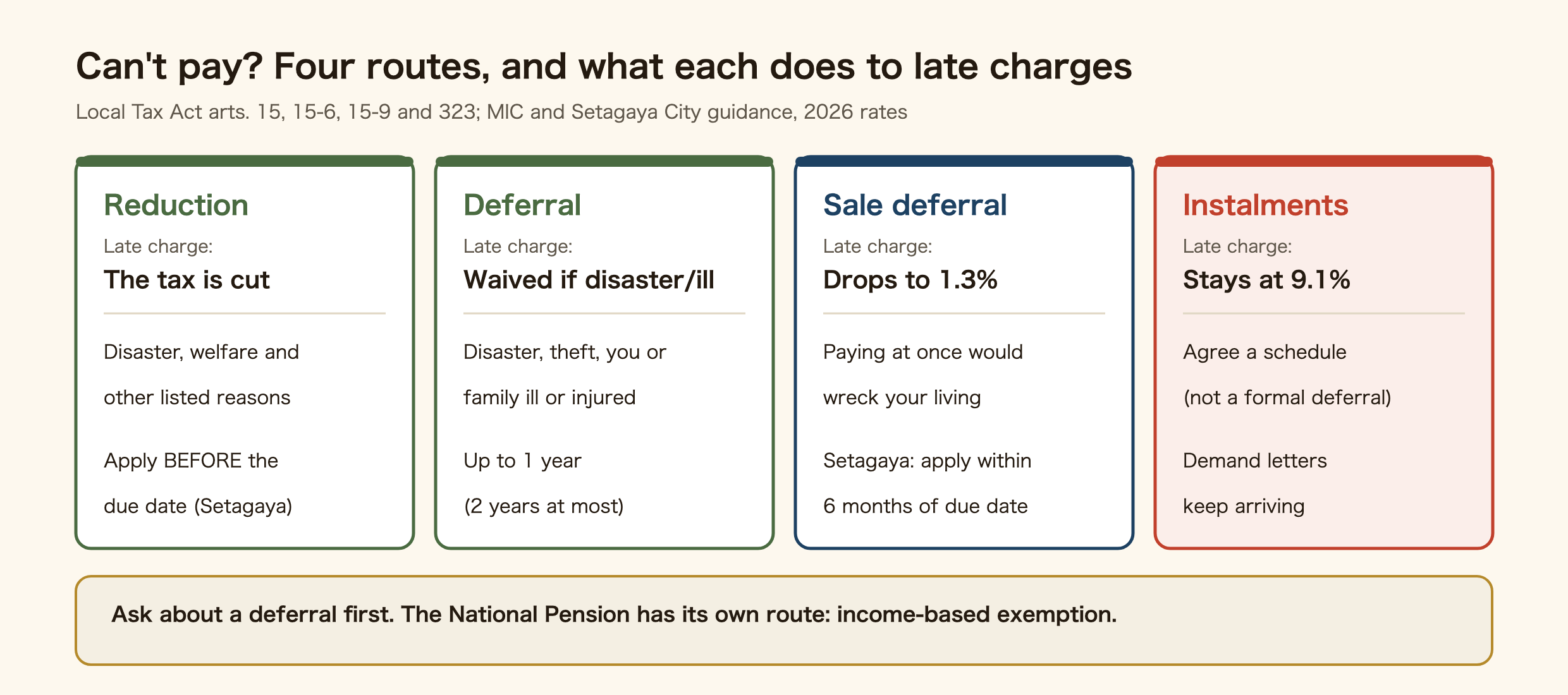
The Local Tax Act has three formal routes.
- Deferral of collection (choshu no yuyo, art. 15) — when you cannot pay at once because of a disaster or theft, illness or injury (yours or a family member’s in the same household), or closing or losing heavily on a business. Up to one year, and no more than two years with an extension. If the reason is disaster or illness, the late charge for that period is waived in full.
- Deferral of sale (kanka no yuyo, art. 15-6) — when paying all at once would make it impossible to keep your living going, whatever the reason, and you show you intend to pay. Each city’s bylaw sets the application window; in Setagaya it is six months from the due date, the same as for national tax. If granted, the late charge in 2026 is 1.3%.
- Reduction or exemption (genmen, art. 323) — for reasons set in the city’s bylaw, such as a disaster or receiving welfare. The tax itself goes down. Setagaya City says it applies only to tax whose due date has not yet passed.
So at the counter, before you say “instalments”, ask “Do I qualify for a deferral?” Paying back over the same year, 9.1% and 1.3% are very different. A deferral can require security; for national tax it is not needed if the amount is one million yen or less or the period is three months or less.
National Health Insurance premiums can also be reduced or deferred under each city’s bylaw (NHI Act art. 77). The 70%, 50% and 20% reductions for low-income households can be missed if you have not filed an income declaration; how that works is in the health insurance reduction you have to ask for.
The National Pension has a separate route: full, three-quarter, half or quarter exemption by income, a deferral for under-50s, and a special exemption after losing a job. You can apply for up to two years and one month back, so if you have unpaid months, start with a National Pension exemption.
What do I need to ask for instalments or a deferral?
For residence tax and health insurance, forms differ by city. There is no national list of documents. Call the tax office (or the health insurance section) whose number is on your bill or demand letter and ask: “I want to apply for a deferral. What should I bring?” Some cities, such as Setagaya, accept instalment requests online.
For national tax, the National Tax Agency lists the documents.
- An application for deferral of sale, or for deferral of payment
- A statement of assets, income and spending (over one million yen: an asset list and a detailed income statement)
- Documents for any security you provide
- For a deferral of payment, proof of the disaster, illness or other event
A city will want to know the same things: your income and spending, your savings, why you cannot pay, and when you can. Payslips, bank books, a doctor’s certificate if you are ill and your separation notice if you lost your job will speed things up.
Does unpaid tax affect my visa renewal?
Yes. The Immigration Services Agency’s guideline on changing status and renewing your period of stay lists, as item 7, “fulfilling tax obligations”.
- If you have not met them, it counts against you
- Even without a conviction, large or long-running arrears that are serious are treated the same way
- The same goes for payments required by law, such as National Health Insurance premiums
- Immigration may base its decision on payment information it receives from other agencies (added in the June 2026 revision)
No figure has been published for how much or how long unpaid tax leads to a refusal. The guideline says it is an overall judgement. Documents show it too: a spouse of a Japanese national renewing their visa submits a residence tax certificate and a tax payment certificate. The renewal steps and documents are in visa renewal in Japan.
Before you renew, get your own tax payment certificate from the city office. If it shows arrears, pay them or agree instalments or a deferral at the counter before you apply. “In arrears, but paying under an agreement” is not the same as doing nothing.
Unpaid tax and permanent residency
Permanent residence is judged more strictly than renewal. The Guidelines for Permission for Permanent Residence (revised 24 February 2026) list paying tax, pension and health insurance as public obligations, and state that even if you have paid by the time you apply, payment that was not made within the original deadline counts against you in principle.
The document list matches. Applicants on work visas or Dependent status submit bank book copies or receipts showing they paid residence tax on time for the last five years (three years for spouses). Periods when it was deducted from your salary do not need proof. For national tax you submit tax payment certificate “No. 3”, and for pension and health insurance, your payment record for the last two years.
For people who already have permanent residence, revocation arrives on 1 April 2027 (amended Immigration Act art. 22-4(1)(viii)). One ground is “wilfully failing to pay public taxes and dues”. The guideline on what that means was published as a draft on 4 August 2026, with public comments accepted until 3 September. As of 24 September, it is still a draft.
The draft says it does not cover “unavoidable circumstances such as illness, disaster or unemployment”, or people who “responded to demands, showed they intend to pay, and have been granted instalments or a deferral”. It does cover moving without notice so you cannot be found, ignoring demands without ever asking about payment, and repeatedly breaking an instalment agreement. Even where status is revoked, the Act switches the person to another status unless continued stay is inappropriate (art. 22-6). The full conditions are in can permanent residency be revoked in Japan.
Can I be deported for unpaid tax? What if I leave Japan?
Unpaid taxes or premiums are not listed among the grounds for deportation in art. 24 of the Immigration Control Act. Arrears alone are not a legal ground for removal.
But if unpaid tax leads to a refused renewal, you cannot stay beyond your current period of stay. What to do after a refusal is in visa renewal denied in Japan.
Leaving Japan does not cancel residence tax. It is charged by the city where you lived on 1 January, so even if you leave on 2 January or later, that year’s tax is still due (Setagaya City). Before you leave, pay it off or register someone in Japan as your tax representative.
The time limit on collecting residence tax is five years, but a demand letter restarts the count ten days after it is sent (Local Tax Act arts. 18 and 18-2). For health insurance and the pension the limit is two years, and a demand restarts that too. Waiting for it to expire does not work.
Where to ask for help
- Residence tax — your city’s tax office. The number is on your bill and demand letter
- National Health Insurance — your city’s health insurance section. Some, such as Chuo City, hold payment consultations on weekends
- National Pension — your pension office. For languages other than Japanese, call 0570-003-004 (interpreting is free)
- Income tax and other national taxes — the collection section of your local tax office
- If daily life itself is the problem — say so at the payment counter. Setagaya City explains that, with your consent, it will connect you with its living-support staff
If you are worried about Japanese, free helplines for foreigners lists who can answer in your language. If you cannot cover rent and food either, check whether your visa type can get welfare.
Which one are you?
- You have the bill but cannot pay it all by the due date — call the tax office before the date and ask whether you qualify for a reduction or deferral. A reduction is not possible after the due date, so call today.
- A demand letter has arrived — count ten days from its date. By then, pay or ask for a deferral of sale or instalments. Today, write that date in your calendar.
- Illness, injury, disaster or closing a business stopped you paying — you may qualify for a deferral of collection. Today, start collecting a doctor’s certificate or other proof.
- A renewal or permanent residence application is coming — get your tax payment certificate from the city and your payment record from the pension office, and check for arrears. Request them today.
FAQ
Q. When can my property be seized for unpaid tax in Japan?
For residence tax, ten days after the demand letter is sent. The demand letter goes out within 20 days of the due date. Reminders by letter or phone may come first, but legally seizure can begin after those ten days.
Q. How much is the late charge on residence tax?
In 2026, 2.8% a year for the first month after the due date and 9.1% after that. 100,000 yen due on 30 June and paid on 31 December costs 4,000 yen. A total under 1,000 yen is not collected.
Q. Can I pay residence tax or health insurance in instalments?
You can ask at the city office, and cities such as Setagaya accept instalment requests. But late charges still run at 9.1% while you pay. If illness or disaster is the reason, or paying at once would wreck your living, ask about a formal deferral first: the late charge is then waived or drops to 1.3%.
Q. Does unpaid tax affect visa renewal in Japan?
Yes. Immigration’s renewal guideline lists fulfilling tax obligations as a factor, and large or long-running arrears count against you. Unpaid health insurance is treated the same way. No threshold for refusal has been published.
Q. Can I be deported for unpaid taxes?
Unpaid tax is not itself a ground for deportation under the Immigration Control Act. But if it leads to a refused renewal, you cannot go on living in Japan.
Q. What happens if I leave Japan without paying residence tax?
It stays on record. Residence tax is charged by the city where you lived on 1 January, so leaving later does not cancel it. Pay it off before you leave or register someone in Japan as your tax representative.
Summary
For residence tax, seizure can start ten days after the demand letter is sent. In 2026 late charges are 2.8% a year for the first month and 9.1% after that. Health insurance and the pension follow the same pattern of demand and seizure.
If you cannot pay, silence is what hurts your visa and permanent residence. Before asking for instalments, ask whether you qualify for a deferral: it lowers the charge and puts on record that you intend to pay. Unpaid pension months can be stopped by applying for an exemption.
Official sources: Local Tax Act (e-Gov, Japanese) / National Tax Collection Act (e-Gov, Japanese) / MIC, late charges (Japanese) / Setagaya City, late charges (Japanese) / Setagaya City, payment consultation and enforcement (Japanese) / Setagaya City, demand letters (Japanese) / Chuo City, unpaid health insurance (Japanese) / NTA, when you cannot pay national tax on time (Japanese) / Japan Pension Service, enforced collection (Japanese) / ISA, renewal guideline (Japanese) / ISA, permanent residence guideline (Japanese) / e-Gov, draft PR revocation guideline (Japanese). Checked on 24 September 2026. Late-charge rates change every year and procedures differ by city, so always confirm with your own city office.
Related reading
Found this useful? Share it
Send it to a friend who lives in Japan.
WHO WROTE THIS

mori
Japanese. I read the ministries’ own notices, orders and Q&As in the original, and I start from what my Nepalese and Sri Lankan friends in Japan actually ran into. I do not write about what I have not checked or been told.
What this site can and cannot do →Looking for something else?