Checked on 30 September 2026 against the Civil Code on e-Gov, the Ministry of Justice’s materials on the 2020 Civil Code reform, the Ministry of Land, Infrastructure, Transport and Tourism (MLIT) restoration guideline and its housing guidebook for foreigners, the Tokyo Metropolitan Government’s guideline on rental disputes, Tokyo Waterworks, the National Consumer Affairs Center, and the Consumer Affairs Agency.
The short answer
- Under Japanese law, the landlord must repair what you need to live in the flat (Civil Code Art. 606). If the AC or water heater that came with the flat breaks from age, the landlord pays.
- If you broke it through carelessness or misuse, you pay. An AC left behind by the previous tenant and not listed in your contract may not be the landlord’s to fix.
- Your first move is to tell the management company (or the landlord), not to call a repairer. Take photos and keep a record of when you told them.
- For a water leak, close the stop valve first, then call. In an emergency, or if they don’t fix it within a reasonable time after you told them, you may repair it yourself and claim the landlord’s share back.
- If you lose your key, the lock change is on you. There is no official price guide. Call the management company before you call a locksmith from an online ad at night.
Knowing this, you will know who to call and who pays the night something breaks, and you will not pay for a repair that was never yours, or an inflated call-out fee. You will also be able to raise the rent for the days you could not use it.
It is an August night. You press the remote and the air conditioner blows nothing. The next morning there is no hot water. You ask a Japanese friend and get “tell your landlord?” and nothing more. Who pays? Can you call a repairer yourself? Do you still owe the full rent? Your friend doesn’t know, because nothing has broken in their flat. The answers are in the Civil Code, and in guidelines from the national government and Tokyo.
- Tenant rights in Japan: who pays when the AC or water heater breaks?
- Two things to check in your contract
- Who do I call? The management company, before any repairer
- What if water is leaking? Close the stop valve, then call
- What if maintenance won’t fix it? Two cases you may repair it yourself
- Do I pay full rent while it’s broken? Since April 2020, the rent is reduced
- Lost your key in Japan? The lock change is on you
- How much will it cost? It depends on why it broke
- What if I skip the rules?
- If it turns into a dispute: call 188
- Which one are you?
- FAQ
- Summary
- Related reading
Tenant rights in Japan: who pays when the AC or water heater breaks?
Something breaks, so you find a repairer and pay for it yourself. Where you come from, that may be normal. In Japan, the equipment that comes with a rented flat belongs to the landlord, and fixing it is the landlord’s job.
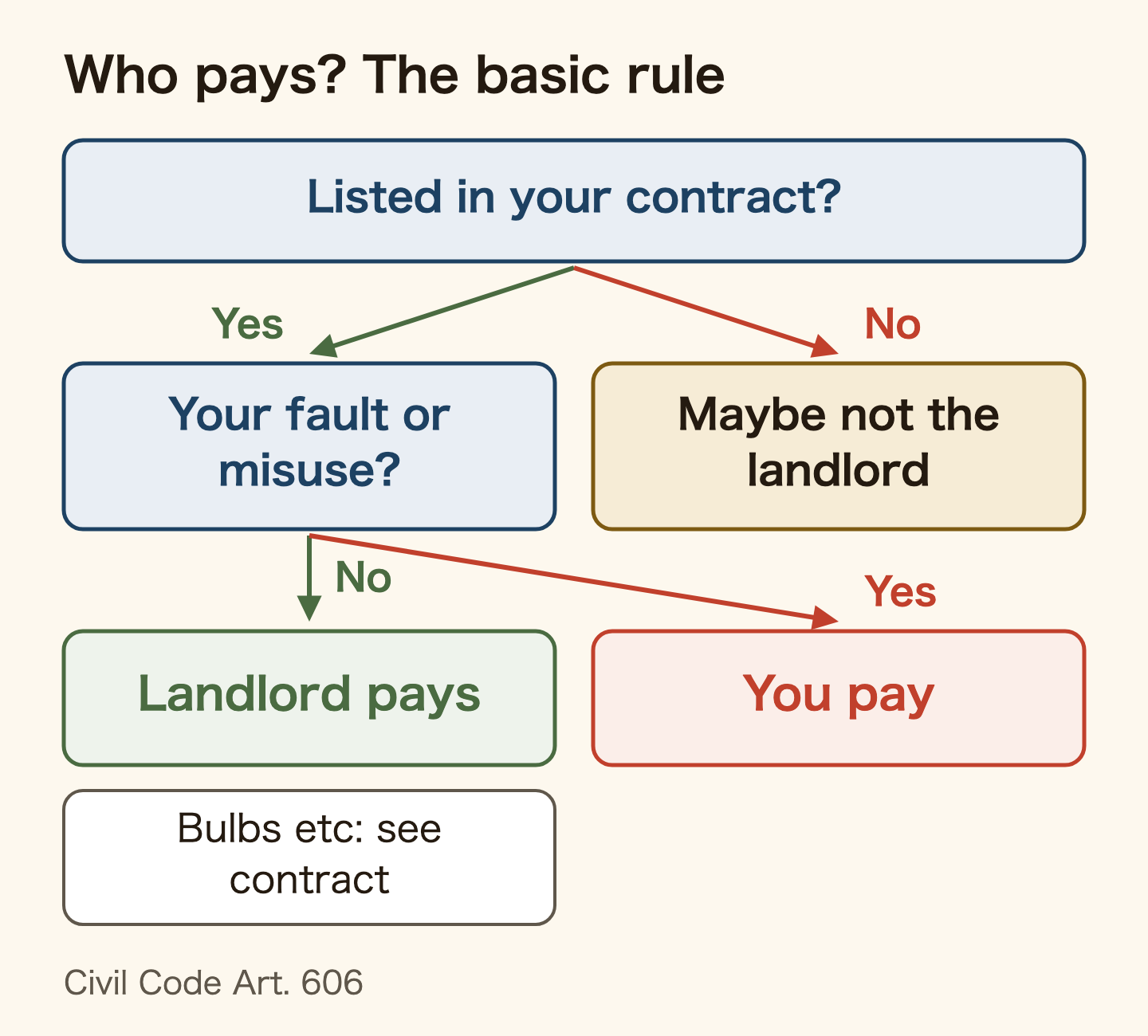
Article 606 of the Civil Code puts the duty to make the repairs needed to use the property on the lessor (Civil Code on e-Gov, in Japanese). The lessor is your landlord; the lessee is you.
The same article has an exception. If the repair became necessary because of something you are responsible for, the landlord does not have to make it. That sentence was added by the Civil Code reform that took effect on 1 April 2020.
The Tokyo Metropolitan Government’s guidelines for preventing tenant-landlord disputes give examples of each side:
- The landlord pays: the landlord’s AC, water heater or bath boiler breaking down with age; a leaking roof; doors and windows that stop working
- You pay: a window your child broke while playing; a bath boiler damaged by heating it with no water in it
Tokyo’s guideline also notes a rare exception: where the rent is very low and the repair very expensive, the landlord’s duty may be waived. For an ordinary flat’s AC or water heater, start from the rule that it is the landlord’s cost.
Two things to check in your contract
First, is the equipment listed in the contract? Tokyo’s guideline warns that equipment the previous tenant left behind, such as an AC, may not be the landlord’s responsibility if the contract does not list it. Look at the equipment section of your contract and the explanation of important matters (juyo jiko setsumeisho). If it says “one air conditioner”, it is the landlord’s.
Second, look for a small-repairs clause. A contract can let you replace light bulbs, fluorescent tubes and tap washers yourself, at your own cost. Tokyo’s guideline says this clause does not oblige you to make those repairs. The landlord also cannot charge you at move-out for small repairs you did not make.
If you cannot find your contract, ask the management company for a copy. How a Japanese lease is put together is in our guide to renting an apartment in Japan.
Who do I call? The management company, before any repairer
Article 615 says that when the flat needs repair, you must tell the landlord without delay, unless the landlord already knows.
For most tenants that means the management company. Many landlords hand the running of the building to one, and Tokyo’s ordinance requires the agent to tell you, before you sign, who to contact for repairs. It is in your explanation of important matters or the papers you got at move-in.
Tokyo’s guideline tells tenants to report problems early. The longer you wait, the harder it is to show whether something broke from age or from how it was used.
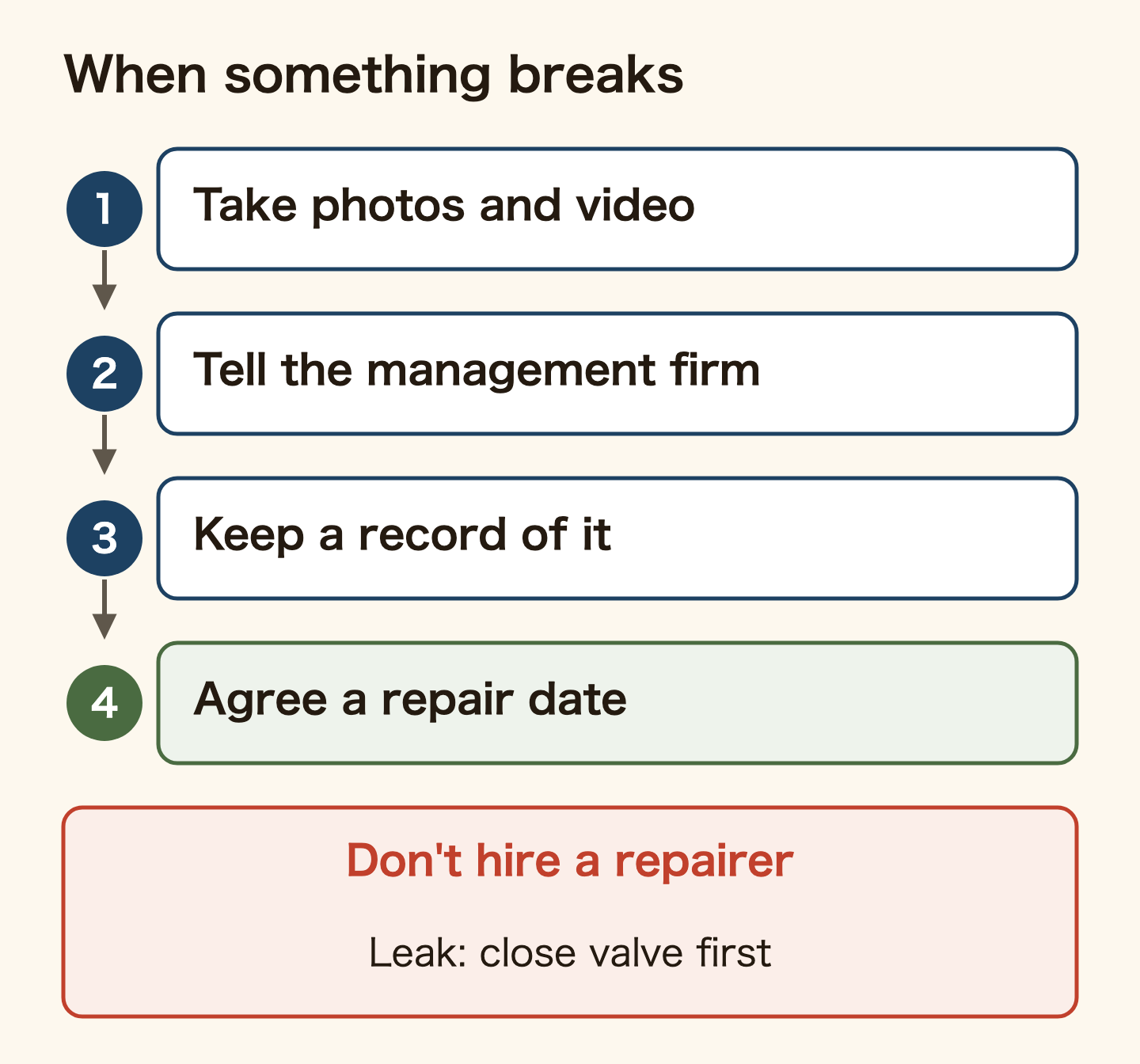
- Take photos and video, including any error code on the water heater or AC panel
- Tell the management company. If a phone call in Japanese is hard, email or their contact form is fine
- Keep a record: when, to whom, and what you said. For calls, note the date and the person’s name
- Agree a repair date, and ask whether you need to be home
Under Article 606(2), you cannot refuse to let the landlord in to carry out repairs needed to preserve the property. Agree the time together.
What if water is leaking? Close the stop valve, then call
A leak keeps spreading while you wait. Tokyo Waterworks says that if a toilet won’t stop running, close its stop valve; for a water heater, close its stop valve and the gas main valve, then ask for a repair. In the bureau’s diagram, the valve closes when you turn it clockwise.
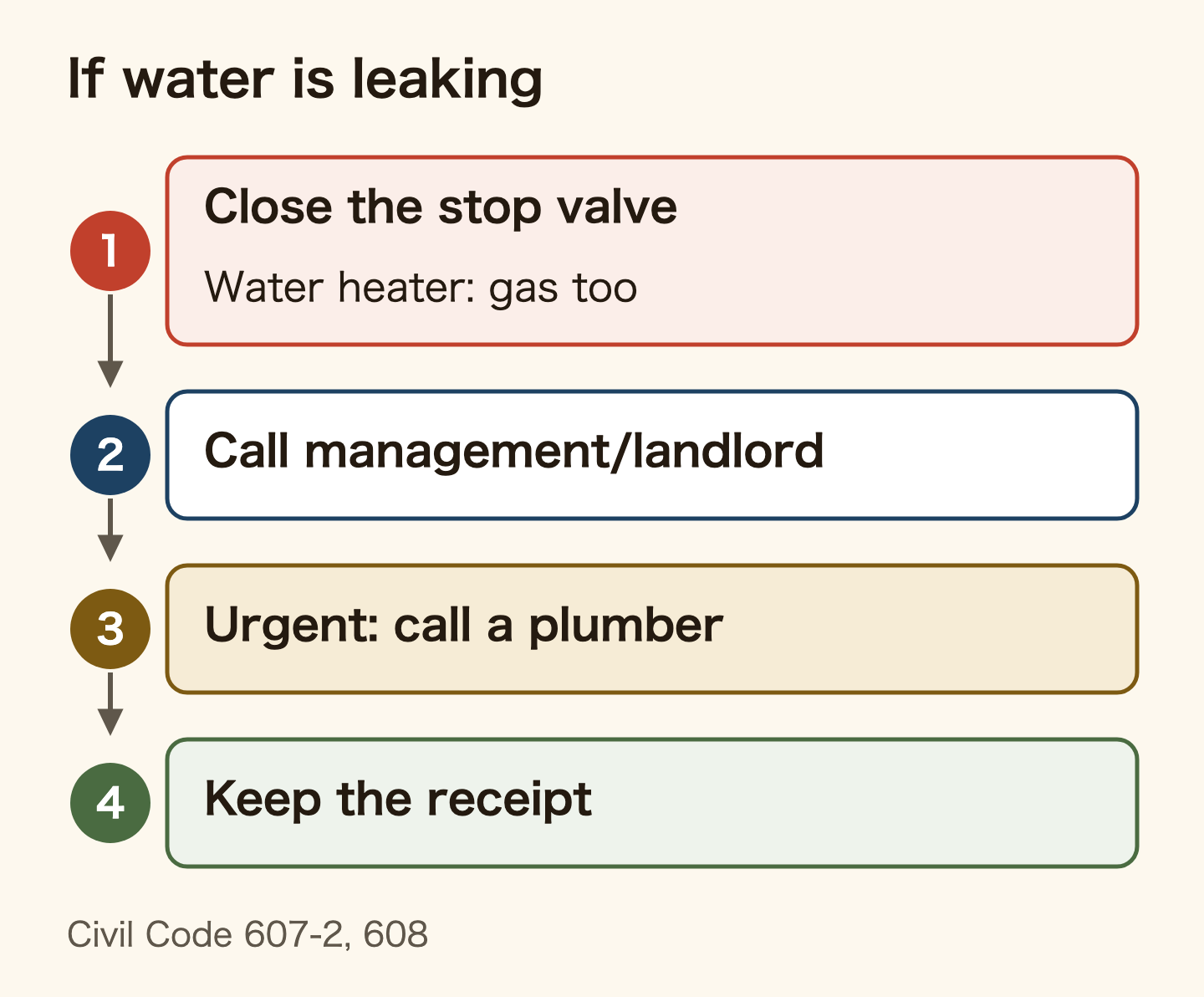
Then call the management company or the landlord. Tokyo Waterworks’ page on leak repairs also says people in apartment buildings should consult the building owner or management company.
If there is an emergency, you may call a plumber yourself (Article 607-2). The law does not define “emergency”; the Ministry of Justice’s example is a roof leaking after a typhoon, with the next typhoon on its way. Before the plumber starts, ask roughly what it will cost, and get a receipt. Tokyo Waterworks warns that a call-out fee is normally charged.
If the water reaches the flat below, it becomes a different question. If your carelessness caused it, you may owe the neighbour for the damage. Check what your renters insurance covers when water damages another flat.
What if maintenance won’t fix it? Two cases you may repair it yourself
You have asked again and again, and nobody comes. The Ministry of Justice’s own pamphlet uses exactly this example: a built-in air conditioner breaks, and the landlord keeps not fixing it. Before 2020, the Civil Code said nothing about when a tenant could do the repair.
Since 1 April 2020, Article 607-2 lets you repair it yourself in either of these cases (Ministry of Justice pamphlet on the new rental rules, in Japanese):
- You told the landlord a repair was needed (or the landlord knew), and the landlord did not make it within a reasonable time
- There is an emergency
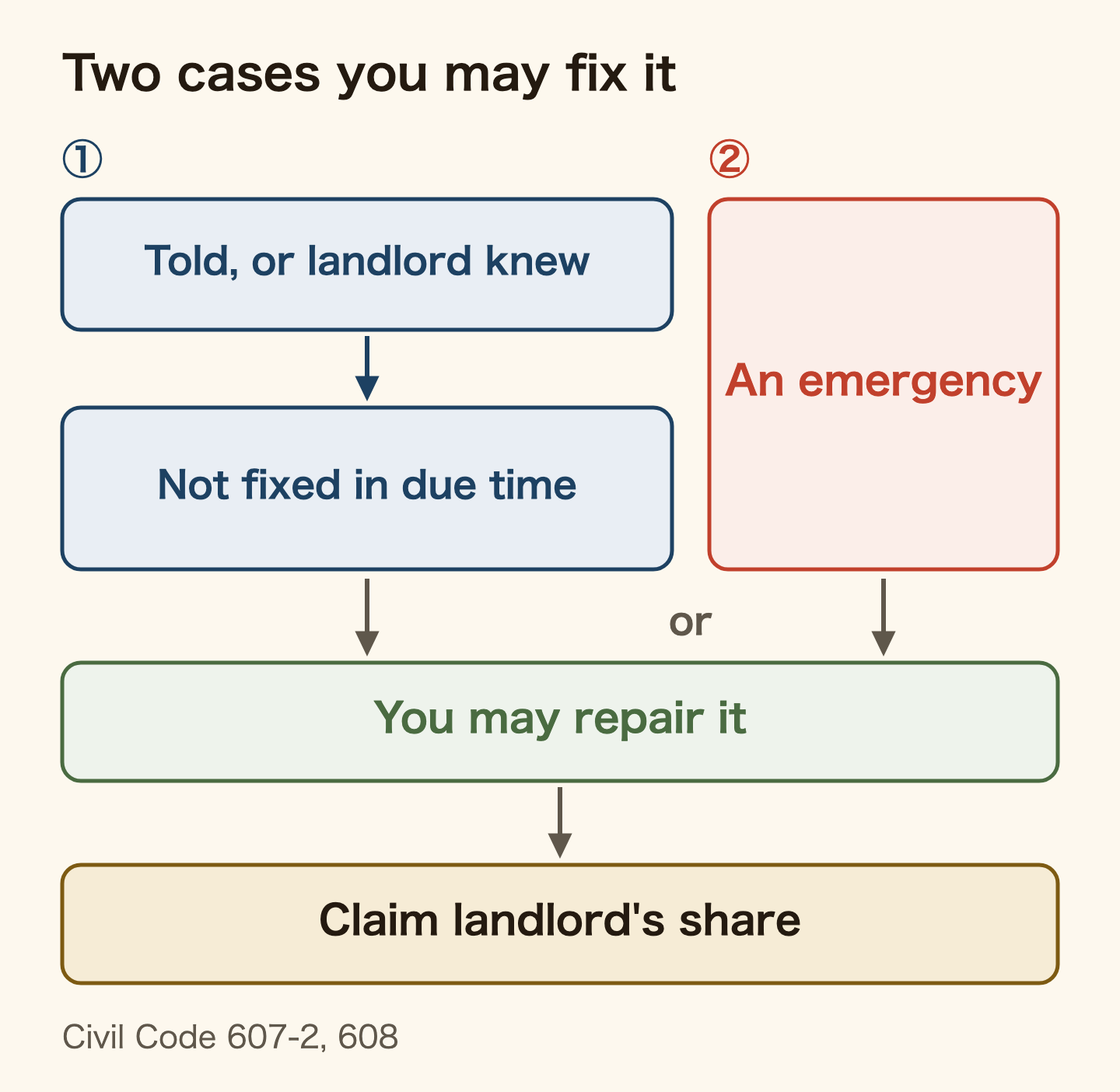
The Ministry explains that in these cases the landlord cannot hold you liable for making the repair. The law does not say how many days a “reasonable time” is.
Article 608 gets your money back. If you pay a necessary expense that the landlord should bear, you can claim it from the landlord immediately. To claim it, you need a record of your notice, plus the estimate and the receipt. That is why you report in writing, or keep notes.
Do I pay full rent while it’s broken? Since April 2020, the rent is reduced
Two weeks without hot water, and the same rent? Article 611 answers this.
If part of the flat becomes unusable and it is not your fault, the rent is reduced in proportion to the part you cannot use. Until March 2020 the article only said the tenant could demand a reduction (Ministry of Justice old/new comparison table, in Japanese). The new wording does not depend on you asking.
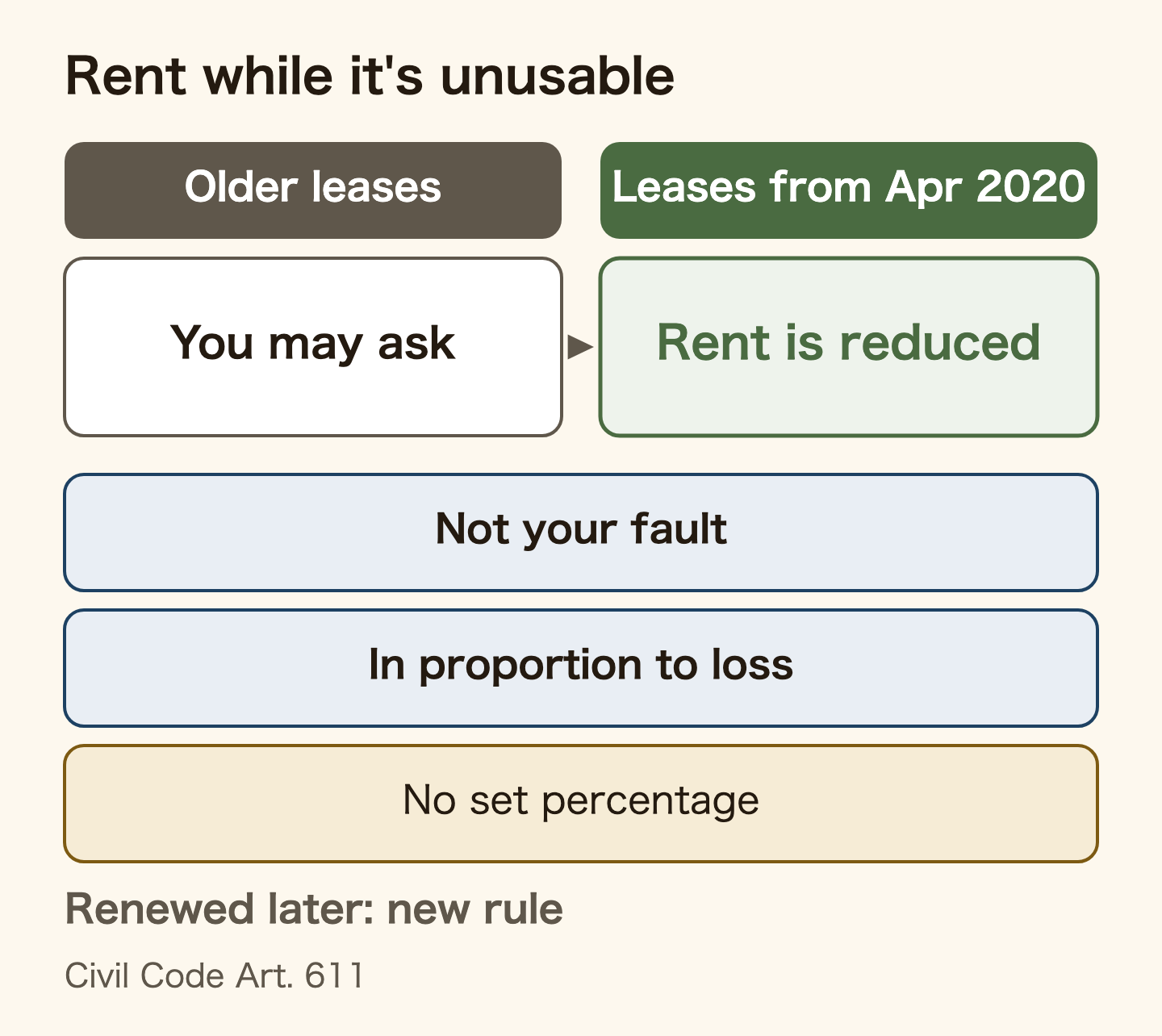
The law does not say by how much. In practice you show how long it was broken and what you could not use, and agree the amount with the management company. Your photos and records matter here too.
Check your contract date. Leases signed before 1 April 2020 fall under the old Civil Code. According to the Ministry’s pamphlet, if you renewed the lease by agreement after that date, the new rules apply.
Lost your key in Japan? The lock change is on you
MLIT’s restoration guideline splits lock changes in two:
- Changed because you lost or broke the key: the tenant pays the full cost, whatever the lock’s age, and the unit is the whole cylinder
- Changed with nothing lost or broken, for the next tenant: a management issue caused by tenants changing, so the landlord should pay
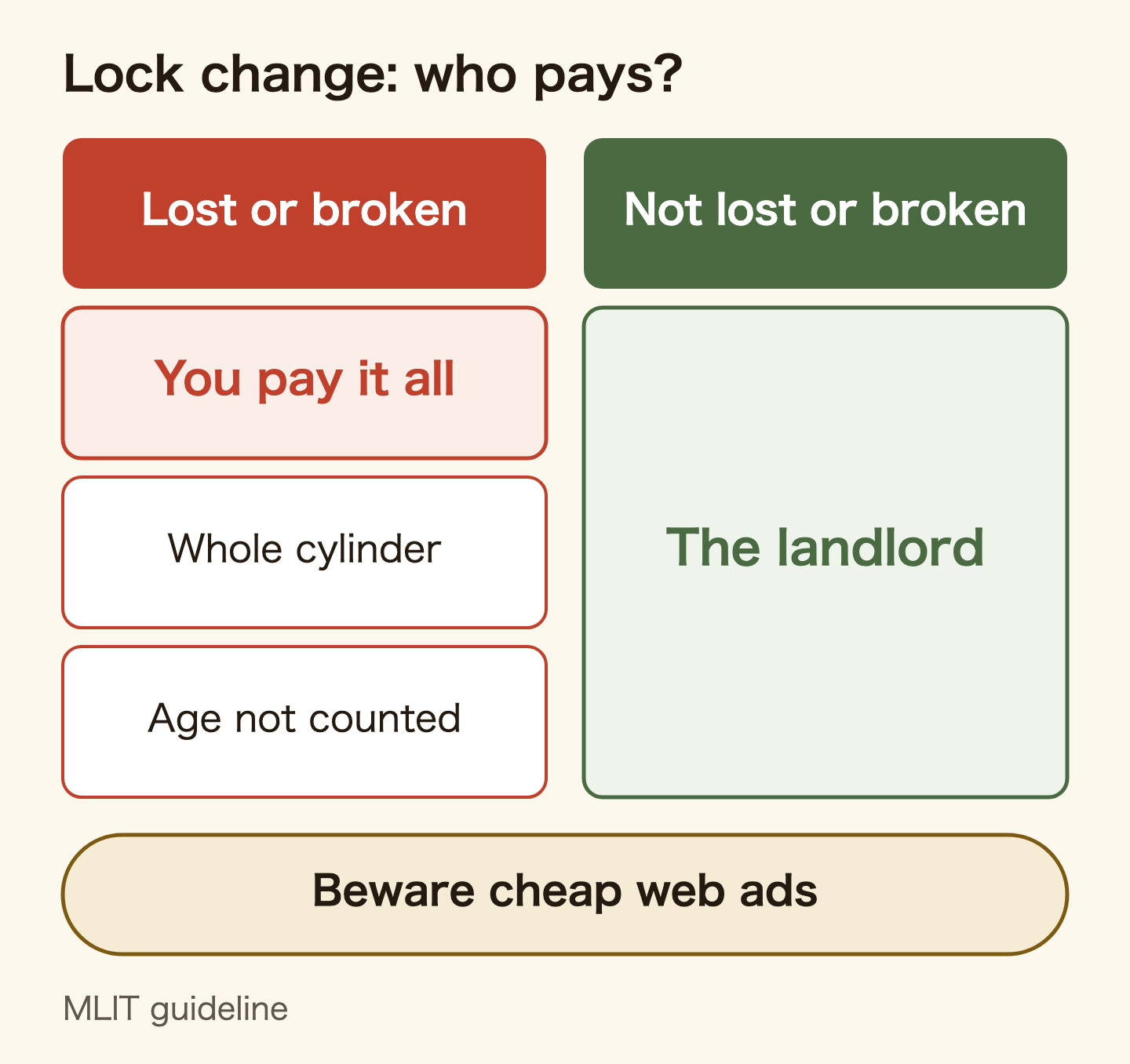
The guideline is about settling costs at move-out. If you lose a key while living there, it is still a change you made necessary, so expect to pay and talk to the management company first. There is no official price. The guideline’s unit-price table has only blank boxes for amounts.
The real danger is being locked out at night. The National Consumer Affairs Center reports a locksmith site advertising “unlocking from 2,000 yen” that charged about 100,000 yen after the job (received April 2024). In another case, the management company told a tenant to deal with it themselves; the tenant called an online locksmith and paid about 50,000 yen (received June 2024).
The Center’s advice comes down to three things. Don’t take “from X yen” ads at face value. If you are not satisfied with the price, don’t pay on the spot. If you rent, ask your landlord or management company in advance what they do when a key is lost. The best time to find the management company’s night-time number is now, before you lose anything.
The MLIT housing guidebook for foreigners reminds you that the key goes back to the landlord when you leave, so keep it safe.
How much will it cost? It depends on why it broke
| What happened | Who pays |
|---|---|
| The landlord’s AC or water heater broke from age | The landlord (you pay 0 yen) |
| You broke it through carelessness or misuse | You (the repair) |
| An AC left by the previous tenant, not in the contract | Not necessarily the landlord; ask the management company |
| Light bulbs, tap washers and other small repairs | With a small-repairs clause, you may do them yourself |
| You lost the key | You (full cost of a new cylinder) |
| The landlord would not fix it, so you paid | Claim it from the landlord (Art. 608) |
If the breakdown is the landlord’s to fix, you should not be paying for the repair. You only hire someone yourself in an emergency, or when the landlord will not act. Then, as Tokyo Waterworks advises, get more than one estimate if you can, and if there is no time, ask the price before work starts.
What if I skip the rules?
If you say nothing, you are not meeting the duty to notify in Article 615. As Tokyo’s guideline says, the longer you wait, the harder it is to show the item broke from age, and the more likely it is to be put on you.
If you hire a repairer without telling the landlord, you cannot count on getting the cost back unless one of the two cases in Article 607-2 applies. If you replace equipment or alter the flat without permission, you can be charged to put it back when you leave. How move-out charges are worked out is in our guide to move-out costs in Japan.
If it turns into a dispute: call 188
The management company won’t act, a repairer overcharged you, or you cannot agree on the rent. Dial the consumer hotline, 188, and you are put through to your local consumer affairs centre. The advice is free; you pay only the call charge. The National Consumer Affairs Center says that if you signed with a contractor on the spot after calling them for a quote, a cooling-off cancellation may be possible.
Tokyo runs a rental housing advice desk in its housing policy bureau. Its guideline also lists civil conciliation and small-claims suits at the summary court for disputes that talks cannot settle.
Which one are you?
- The AC or water heater suddenly stopped — take photos and video, and tell the management company today. Note the date and time.
- Water is leaking — close the stop valve, then call the management company. If you can’t reach anyone and the damage is spreading, ask a plumber for the price first, call them, and get a receipt.
- You have asked and nobody fixes it — gather your records, get an estimate, repair it yourself and claim the cost from the landlord. Send the management company your record of the days you could not use it and ask for the rent reduction.
- You lost your key — call the management company’s night number before any online locksmith. If you do call one, ask the price first and don’t pay on the spot if you are not satisfied.
FAQ
Q. Who pays if the air conditioner breaks in my rented apartment in Japan?
If it is the landlord’s AC listed in your contract and it broke from age, the landlord pays (Civil Code Art. 606). If you broke it through carelessness or misuse, you pay. An AC left by the previous tenant and not in the contract may not be the landlord’s responsibility.
Q. My water heater stopped working. Who do I contact?
The management company, or the landlord if there is none. The contact is in your explanation of important matters or your move-in papers. Contact them before calling a repairer.
Q. Can I fix it myself if the landlord won’t?
Yes, if you told them and it was not fixed within a reasonable time, or if there is an emergency (Art. 607-2). You can claim the landlord’s share of the cost (Art. 608).
Q. Is my rent reduced while something is broken?
If part of the flat is unusable and it is not your fault, the rent is reduced in proportion to what you cannot use (Art. 611). The law sets no percentage, so you agree the amount with the management company, showing how long and what was affected.
Q. I lost my apartment key in Japan. Who pays for the new lock?
You do. MLIT’s guideline puts the full cost of replacing the cylinder on the tenant when a key is lost, without counting the lock’s age. There is no official price guide.
Q. What should I do first if water is leaking?
Close the stop valve, then call the management company or landlord. If the leak is from the water heater, close the gas valve too.
Summary
When equipment in your rented flat wears out and breaks, the landlord fixes it and pays. You pay when you broke it through your own carelessness, and when you lose your key. Check your contract for two things: whether the item is listed, and whether there is a small-repairs clause.
Your first move is photos, a message to the management company, and a record of it. For a leak, the stop valve comes first. If the landlord won’t act, you may fix it and claim the cost, and the rent is reduced for what you couldn’t use. If you call anyone at night, ask the price first, and don’t pay on the spot if you are not satisfied.
Official sources: e-Gov, Civil Code (Arts. 606, 607-2, 608, 611, 615) / Ministry of Justice, Civil Code (law of obligations) reform / Ministry of Justice, pamphlet on the new rental rules / Ministry of Justice, old/new comparison table / MLIT, Guideline on restoration to original condition (revised), ch. 1 / MLIT, Housing guidebook for foreigners (English) / Tokyo Metropolitan Government, Guidelines for Preventing Tenant-Landlord Disputes / Tokyo Waterworks, when water won’t stop / Tokyo Waterworks, where to get a leak repaired / National Consumer Affairs Center, locksmith price trouble / National Consumer Affairs Center, emergency home repair trouble / Consumer Affairs Agency, consumer hotline 188 (all checked 30 September 2026). A special clause in your contract can change the answer, so read your own contract first.
Related reading
Found this useful? Share it
Send it to a friend who lives in Japan.
WHO WROTE THIS

mori
Japanese. I read the ministries’ own notices, orders and Q&As in the original, and I start from what my Nepalese and Sri Lankan friends in Japan actually ran into. I do not write about what I have not checked or been told.
What this site can and cannot do →Looking for something else?