This article was checked on 29 October 2026 against the Real Estate Brokerage Act and its Enforcement Regulations and the Civil Code (e-Gov), the Ministry of Land, Infrastructure, Transport and Tourism (MLIT) notice on brokerage fees, its apartment-hunting guidebook and its licensed-broker search, the Tokyo-area Real Estate Fair Trade Council’s advertising rules and enforcement cases, Saitama Prefectural Police’s fraud warning, and the Deposit Insurance Corporation of Japan’s page on the fraud relief law.
In short
- If someone asks you to transfer money before you have seen the room, or before the “important matters” explanation, do not pay. In Japan the order is viewing, application, screening, the important matters explanation, then signing the contract. The deposit, key money and agency fee are paid last.
- Rental scams and problems come in five types: bait listings, fake landlords or agents on social media, money taken up front, sublets from the current tenant, and unlicensed brokers.
- Check seven things before you pay. Have you seen the room? Does the agency’s licence number come up in MLIT’s search? Did a licensed real estate transaction specialist give you the important matters explanation? Does the payee match the other party to the contract? Will the application money come back? Is the agency fee within the cap? Does the other side have the landlord’s consent?
- The agency fee cap is one month’s rent plus consumption tax, counting what the agency takes from you and the landlord together (homes left empty for a long time have an exception on the landlord’s side). From you alone, it is half a month’s rent plus tax unless you agreed to more in advance.
- If you have already transferred money, call the receiving bank and the police right away. If the account is frozen, victims can be paid shares up to the balance at that time. For help, call #9110, 188 or Houterasu (0570-078377).
Once you know this, you can tell on the spot whether a request to “pay first” is one you should agree to, and walk away before any money leaves your account.
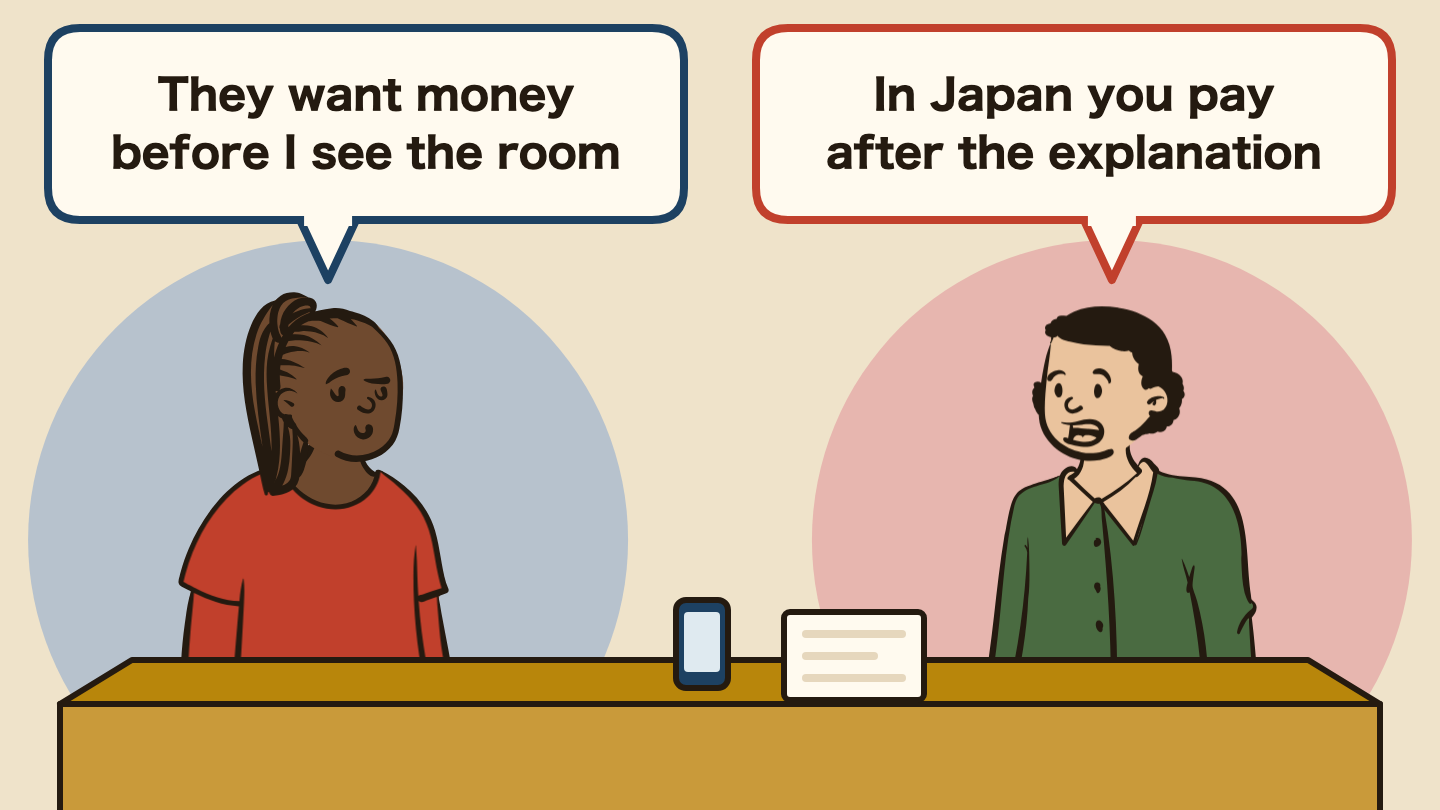
Three months after arriving in Japan, your dormitory move-out date is close. In a room-listing group on social media you find a room five minutes from the station for 40,000 yen a month. You send a message, and the reply says: “The landlord is overseas. It’s popular, so transfer the deposit and one month’s rent and I’ll hold it for you. The key will come by post.” The bank account is in a person’s name. You show it to a Japanese friend, who says, “In Japan you almost never send money straight to a landlord before you’ve even seen the room.”
- What types of rental scams and problems are there in Japan? Bait listings, fake landlords, pay-first, sublets, no licence
- How does renting normally work in Japan? You pay after the important matters explanation
- What should you check before you pay? Seven checks: licence, explanation, payee, refund
- How much can the agency fee be? One month’s rent plus tax at most
- What if you have already paid? Call the bank and the police at once
- How do you find a room safely? Start with licensed agencies and rooms that accept foreigners
- Where you stand: which one are you?
- Frequently asked questions
- Summary
- Related guides
What types of rental scams and problems are there in Japan? Bait listings, fake landlords, pay-first, sublets, no licence
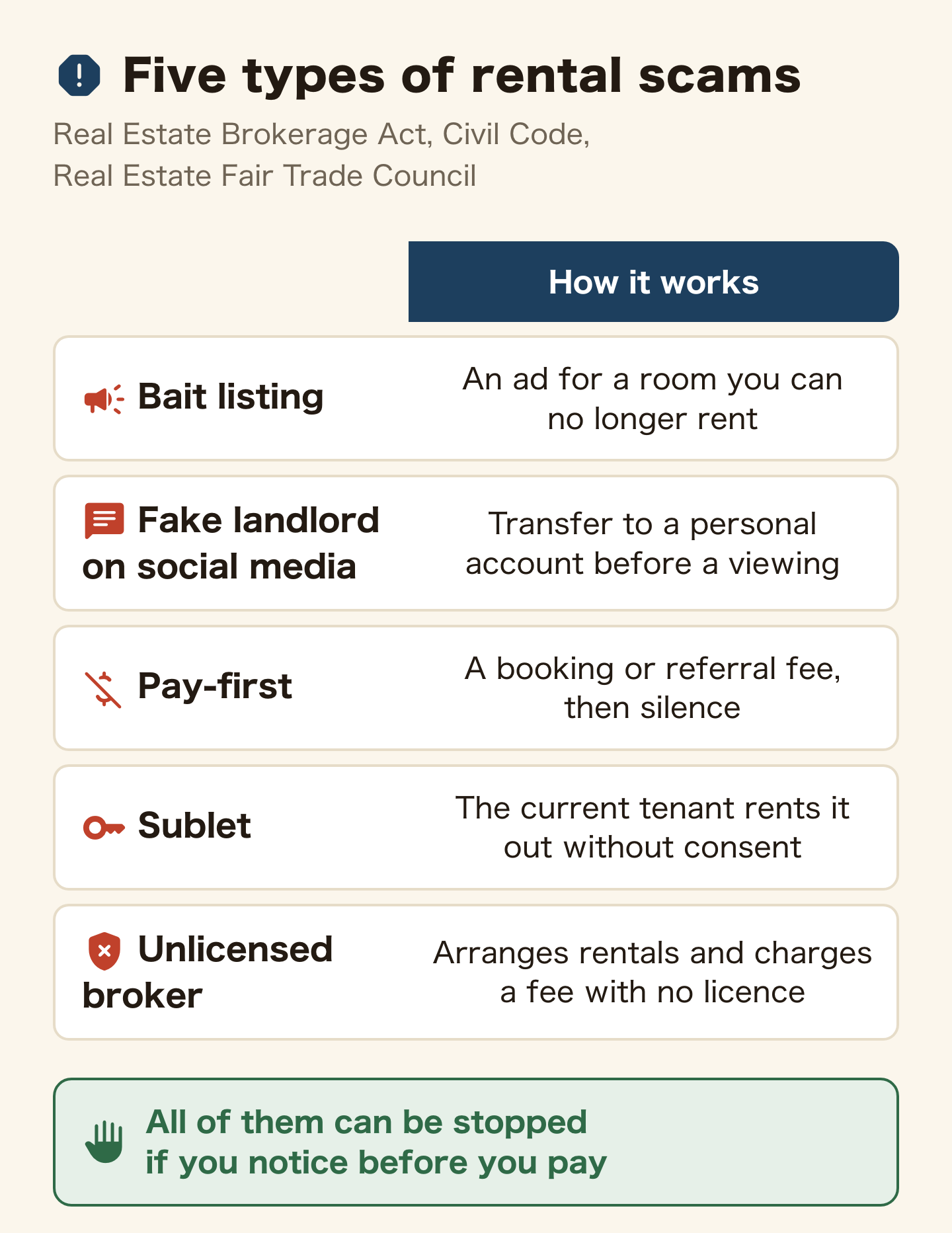
Some rental problems are fraud that takes your money. Others are ads or rentals that break the law. Either way, you can avoid them if you notice before you pay. There are five types to watch for.
- Bait listing (otori bukken): an ad for a room that can no longer be rented, or does not exist. When you ask, you hear “That one’s gone, but how about this one?”
- Fake landlord or agent on social media: someone on social media or a message board claims to be the landlord or an agent and gets you to transfer the deposit or rent to a personal account before showing you the room. That is the trick to watch for.
- Pay-first: you are asked to pay a “booking fee”, “referral fee” or “waiting-list fee” before any contract, and then the other side stops replying. That is the trick to watch for.
- Sublet: the person living there now rents the room to you without the landlord’s consent. “Take over my room, I’m going home” can be this.
- Unlicensed broker: someone arranges rentals and charges a fee without a real estate brokerage licence.
The industry council has made agencies pay a penalty for bait listings. The industry rules of the Tokyo-area Real Estate Fair Trade Council ban three kinds of bait advertising: a property that does not exist, one that exists but cannot be rented, and one the agency has no intention of renting out (Fair Competition Code for Real Estate Advertising, Article 21 (Japanese)). In September 2026 the council made one company pay a penalty under the industry rules over ads for eight rental flats. It kept them online for at least a month after they were contracted, the longest for over three months. It also kept others online for 24 days to over two months after tenants had moved in (Tokyo-area Real Estate Fair Trade Council, actions for September 2026 (Japanese)).
A sublet is risky for you too. The Civil Code says a tenant cannot rent the room to someone else without the landlord’s consent. If the landlord finds an unapproved sublet, they can cancel the original lease (Civil Code, Article 612 (e-Gov, Japanese)). You could then lose the room after paying for it.
Unlicensed brokering is illegal. The Real Estate Brokerage Act bans anyone without a licence from running a real estate brokerage, and from presenting or advertising themselves as one. Running a brokerage without a licence carries up to three years in prison or a fine of up to 3 million yen, or both. Presenting or advertising yourself as one carries a fine of up to 1 million yen on its own (Real Estate Brokerage Act, Articles 12, 79 and 82 (e-Gov, Japanese)).
How does renting normally work in Japan? You pay after the important matters explanation
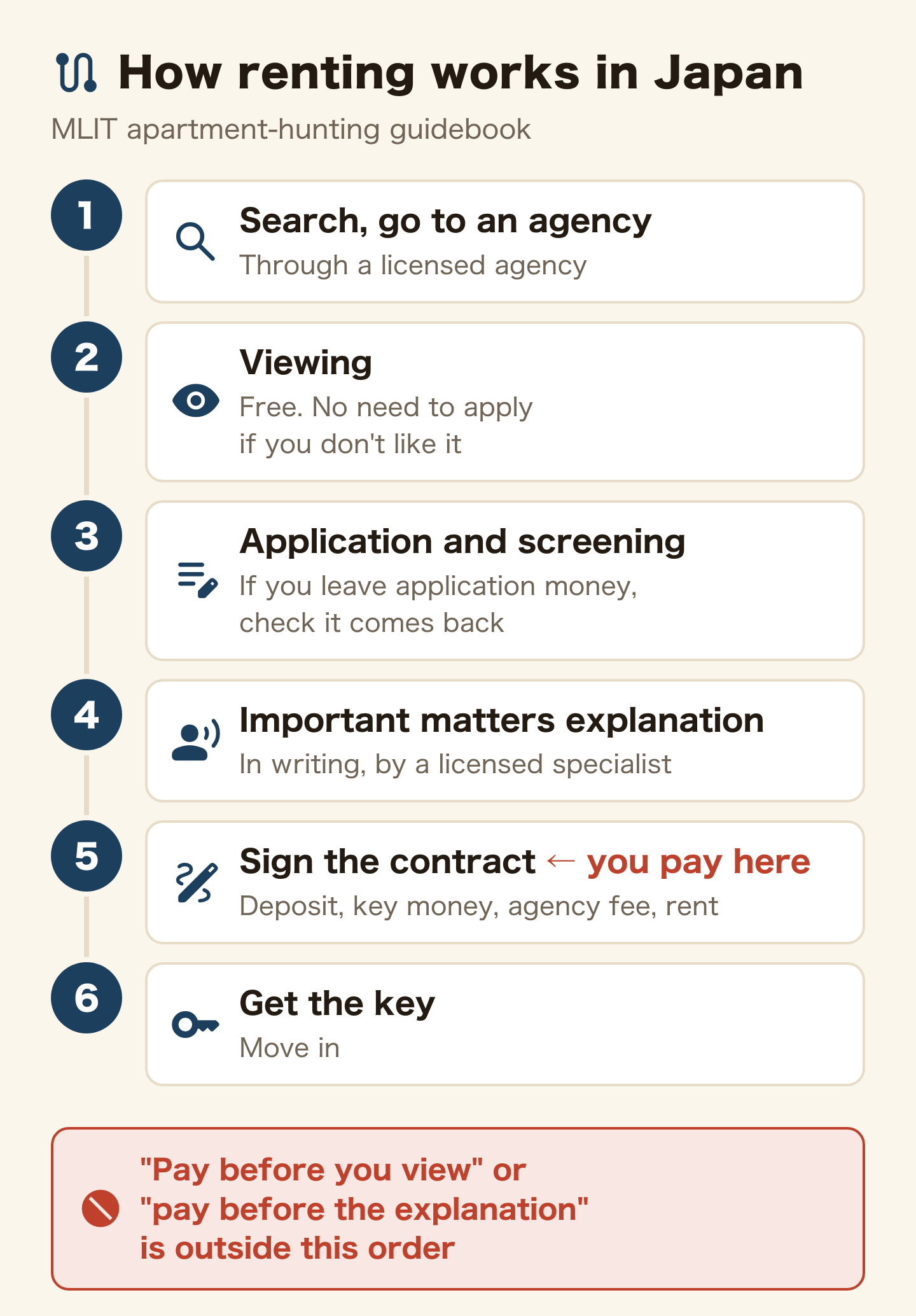
Hold a room by sending money to someone you have never met, without seeing it. In your country that might be normal. In Japan it is not how renting works.
MLIT’s apartment-hunting guidebook describes renting in Japan in this order (MLIT apartment-hunting guidebook (Japanese)):
- Search for rooms, for example on property websites
- Contact or visit a real estate agency
- View the room
- Fill in an application form
- Screening by the agency and the landlord
- Receive the important matters explanation (juyo jiko setsumei) of the contract
- Sign the contract and pay the deposit, key money, agency fee, insurance, rent, common service fee and so on
- Get the key and move in
The same guidebook says viewings are free. If you do not like the room, you do not have to apply. The contract money is paid when you sign, after the important matters explanation. If you are pushed to transfer the deposit or rent before you have seen the room, or before the explanation, that is outside this order.
You may be asked to leave application money (moshikomi-kin) with the agency when you apply. If so, check that it comes back if you do not sign. The guidebook also tells you to check whether application money will be returned. What each part of the move-in cost is for, including the deposit and key money, is in renting an apartment in Japan (move-in costs, documents and guarantors).
What should you check before you pay? Seven checks: licence, explanation, payee, refund
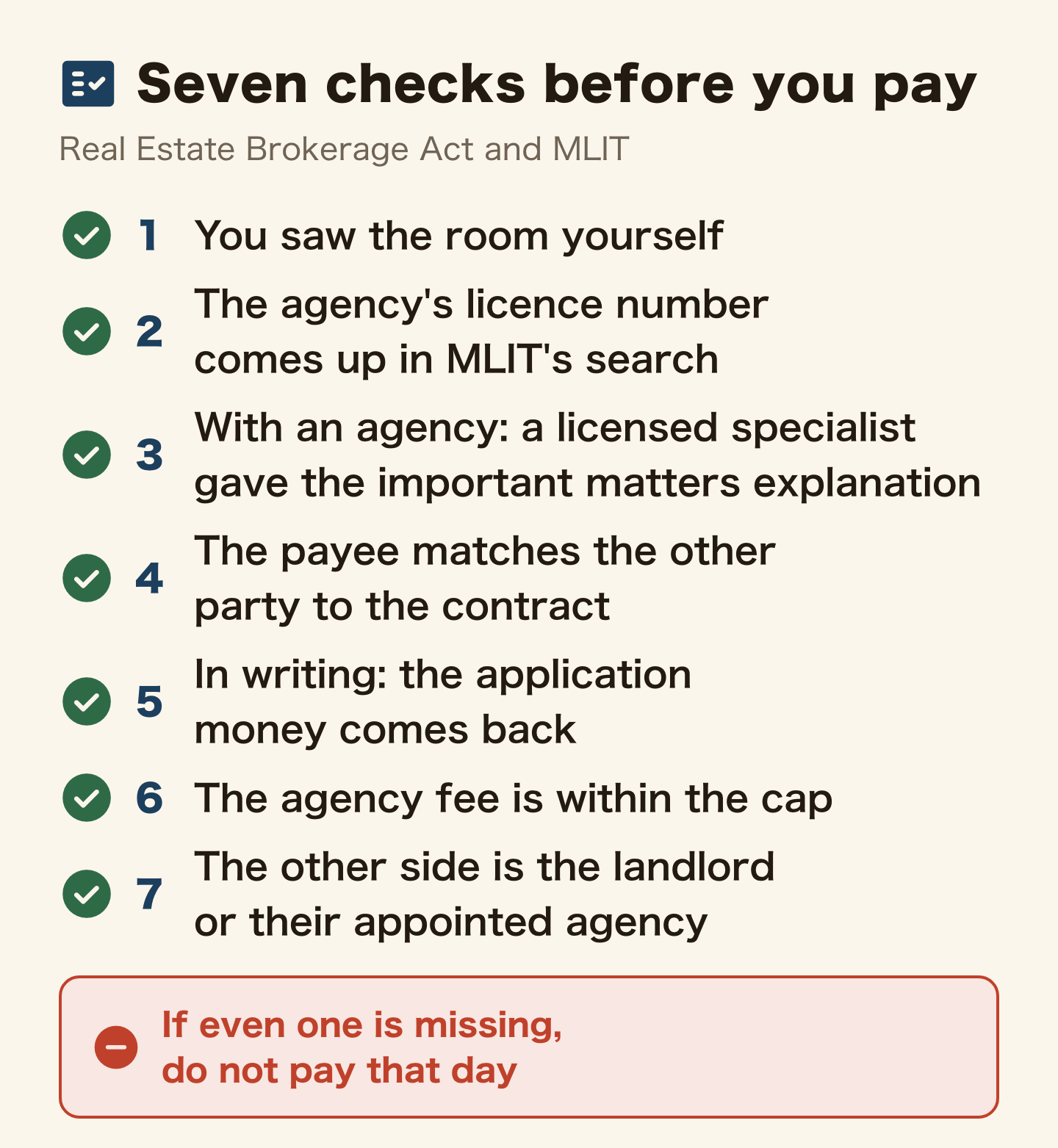
Before you pay, check these seven things. If you cannot check even one of them, do not pay that day.
- Have you seen the room yourself? Viewings are free. If it is too far, ask someone you know in Japan to see it, or ask for a video call showing the inside. If you hear “You can’t view it, but pay now and I’ll hold it”, stop there.
- Does the agency’s licence number come up in the government search? Companies that arrange rentals hold a real estate brokerage licence. Look up the licence number and company name from the ad or business card in MLIT’s licensed real estate broker search (Japanese). If the company does not come up, do not use it. A landlord renting out their own place does not need a licence (Real Estate Brokerage Act, Article 2). In that case, ask the management company or similar to confirm the person really is the landlord of that room.
- Did you get the important matters explanation? The Real Estate Brokerage Act requires a licensed real estate transaction specialist (takuchi tatemono torihikishi) to explain the important matters, with a written document, before the contract is made. When they explain, they must show their specialist ID card (Real Estate Brokerage Act, Article 35 (e-Gov, Japanese)). This is the rule when an agency is involved. “Just send the money first” with no explanation is not this order.
- Is the payee the same as the other party to the contract? Check that the account name matches the landlord or agency named in the contract. If it does not, ask why before you pay. On investment fraud, the police warn that if you are told to send money to a personal account, or the account changes every time, you should suspect fraud and contact them at once (Saitama Prefectural Police, warning on social media investment fraud (Japanese)).
- Will the application money come back if you do not sign? The Act’s Enforcement Regulations ban a licensed agency from refusing to return money it already holds when you withdraw your application (Enforcement Regulations, Article 16-11, item 2 (e-Gov, Japanese)). This rule does not reach someone without a licence. Before you hand it over, get it in writing or by email that it will be returned.
- Is the agency fee within the cap? The next section puts numbers on it.
- Is the other side the landlord, or an agency the landlord appointed? If the current tenant asks you to “take over” the room, contact the landlord or the management company directly and ask whether you can sign a new contract in your own name.
The seven checks are the same when a friend or someone from your country introduces the room. They may mean well, but that does not prove the person behind it is genuine. If there is anything you cannot confirm, not paying is the cheapest decision.
How much can the agency fee be? One month’s rent plus tax at most
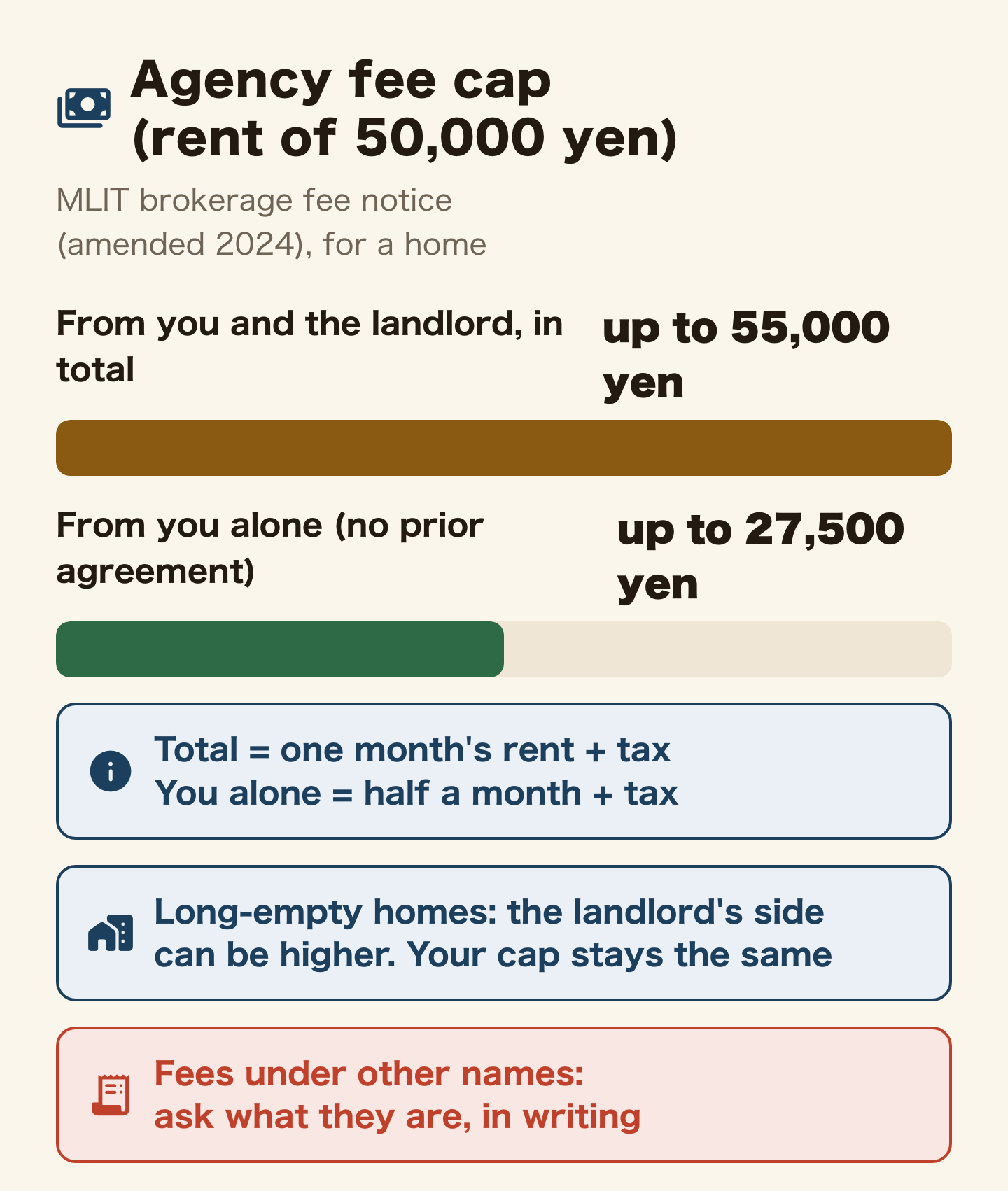
The cap on agency fees is set and published by the Minister of Land, Infrastructure, Transport and Tourism. Agencies cannot take more than that, and they must display the amounts in their offices (Real Estate Brokerage Act, Article 46).
- From you and the landlord together: up to 1.1 times one month’s rent (one month’s rent plus 10% consumption tax)
- From you alone, for a home: up to 0.55 times one month’s rent (half a month’s rent plus tax), unless you agreed in advance
For rent of 50,000 yen, the total cap is 55,000 yen. Unless you agreed in advance, the most you pay is 27,500 yen (text of the brokerage fee notice, published by Osaka Prefecture (Japanese)). If you are asked for one month’s rent as the agency fee, ask before you sign when you are supposed to have agreed to that.
There is an exception for homes that have stood empty for a long time (long-term vacant homes): the agency can take more from the landlord, up to two months’ rent plus tax in total. Even then, the cap on what you pay as the tenant does not change.
Fees can also be added under other names, such as a “referral fee”, “administration fee” or “paperwork fee”. Ask for a written note of what each payment is for and who receives it. Do not pay money nobody can explain.
What if you have already paid? Call the bank and the police at once
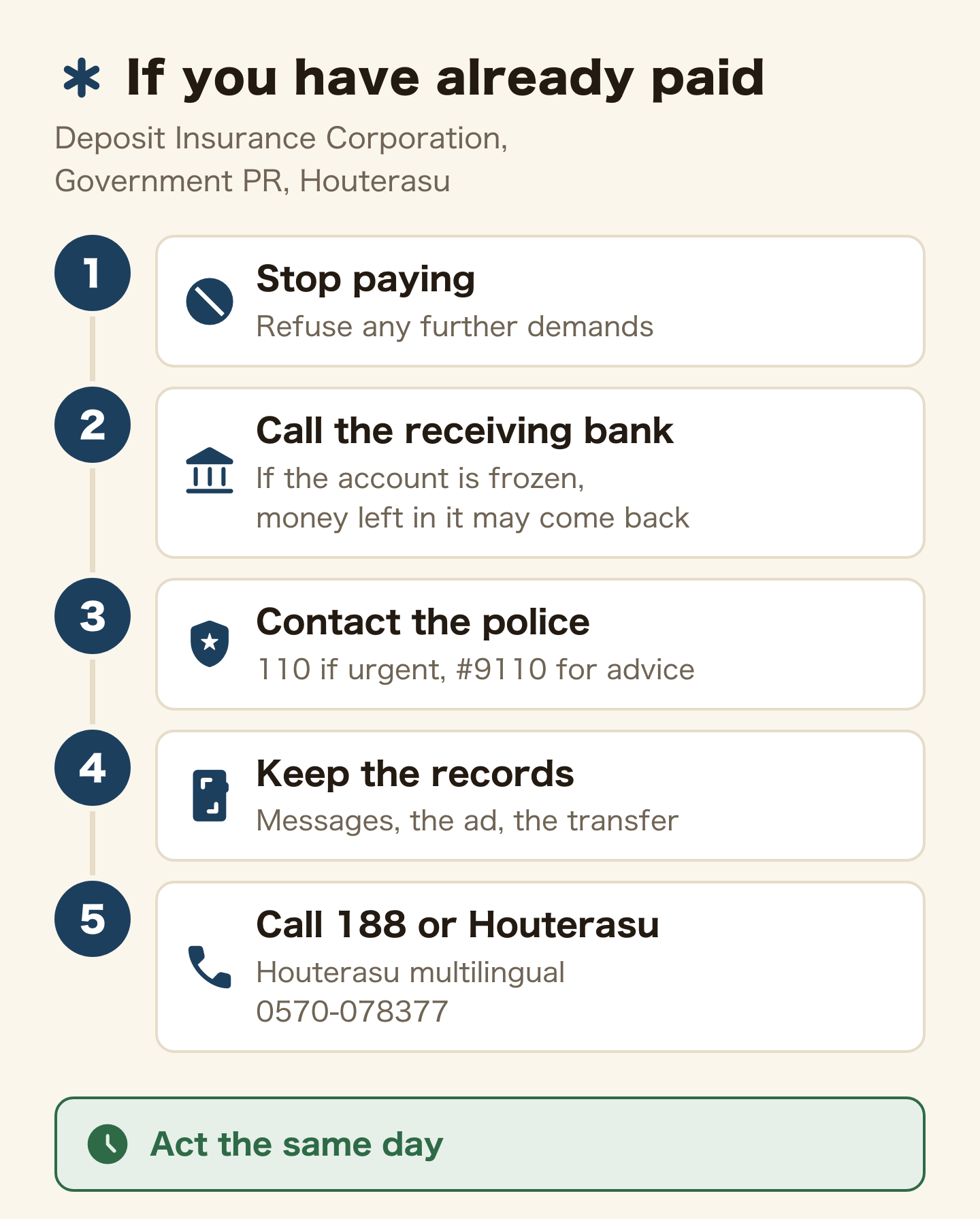
If you realise you have paid, do not be embarrassed. Act that same day.
- Stop paying. Do not pay any further demands, such as a “processing fee” or “postage for the key”.
- Call the receiving bank. If you paid by bank transfer, tell the bank that holds the account you sent money to that you may have been defrauded. The fraud relief law (furikome sagi kyusai ho) exists to recover losses from fraud and other crimes that used transfers to bank accounts. The Deposit Insurance Corporation of Japan says to contact the police and the receiving bank at once and ask for the account to be stopped (Deposit Insurance Corporation of Japan, fraud relief law notices (Japanese)). If the account is frozen, victims who apply are paid shares, up to the balance at the time it was frozen. You may not get it all back (Deposit Insurance Corporation of Japan, Q&A (Japanese)).
- Contact the police. Call 110 if money is being taken from you right now, or #9110 for advice. #9110 works nationwide and connects you to the police headquarters for the area you are calling from (Government of Japan public relations, help lines (Japanese)).
- Keep the records. Take screenshots of the messages, the ad, the other person’s account name and your transfer record, before they delete anything.
- Call a help line. Consumer hotline 188 connects you to your local consumer affairs centre (Consumer Affairs Agency, consumer hotline (Japanese)). If your Japanese is not strong enough, Houterasu’s multilingual information service (0570-078377, weekdays 9am-5pm) tells you where to go for help, through an interpreter (Houterasu, Multilingual Information Service).
How to call the police, and whether you can speak English, is in how to call the police in Japan (110 in English and #9110).
How do you find a room safely? Start with licensed agencies and rooms that accept foreigners
The surest way to avoid scams is to go through a licensed real estate agency from the start. MLIT’s guidebook suggests searching on property websites or at a local real estate agency. Rentals that accept foreign tenants can also be searched on the Safety Net Housing information system. If you are a student, ask your university’s student office whether it has housing information.
How to read Japanese property sites and the ways to search in English are in finding an apartment in Japan in English (SUUMO has none, three ways). If you have no guarantor and a stranger’s “no guarantor needed” offer is tempting, read renting in Japan without a guarantor (three routes that work) first.
Where you stand: which one are you?
- You are about to pay: run the seven checks. Today, look up the agency’s licence number in MLIT’s search and check that the payee matches the other party to the contract.
- You have been told “pay before the viewing and it’s yours”: do not pay. Today, stop replying to that person and search the same area through a licensed agency.
- The current tenant wants you to take over the room: ask the landlord. Today, contact the management company or landlord and ask whether you can sign in your own name.
- You paid application money and want to back out: ask for it back. Today, say by email that you are withdrawing the application and ask for the money to be returned, so it is in writing.
- You have already transferred money: act now. Today, call the receiving bank and the police (#9110), and save screenshots of everything.
You are done when all seven checks are complete before you pay, or when you have reported any money already sent to the bank and the police.
Frequently asked questions
Q. Is it safe to transfer the deposit or rent before I see the room?
Do not pay. In MLIT’s guidebook, viewings are free, and the deposit, key money and agency fee are paid when you sign the contract after the important matters explanation. If you are asked to transfer money to a personal account before a viewing, suspect fraud.
Q. What is a bait listing (otori bukken)?
An ad for a room you cannot actually rent. The real estate industry’s rules ban ads for properties that do not exist, that cannot be rented, or that the agency has no intention of renting out. In September 2026 the industry council made a company pay a penalty for keeping contracted rooms online for a month or more and occupied ones for 24 days or more.
Q. How can I check that a real estate agency is genuine?
Look up the licence number and company name from the ad or business card in MLIT’s licensed real estate broker search. The law also requires the specialist to show their ID card when giving the important matters explanation.
Q. How much can the agency fee be?
Up to one month’s rent plus consumption tax, from you and the landlord together (homes left empty for a long time have an exception on the landlord’s side). From you alone, for a home, it is half a month’s rent plus tax unless you agreed in advance. For rent of 50,000 yen, that is 27,500 yen.
Q. Can I take over a room from someone who is going home?
Only with the landlord’s or management company’s consent. The Civil Code bans sublets without consent, and if the landlord finds one, they can cancel the original lease. Contact the landlord and ask whether you can sign a new contract in your own name.
Q. If I was cheated, will I get the money back?
Not necessarily all of it. If you paid by transfer, call the receiving bank and the police at once. If the account is frozen, victims who apply are paid shares under the fraud relief law, up to the balance at the time it was frozen. For help, call #9110, 188 or Houterasu (0570-078377).
Summary
When renting in Japan, you view the room, apply, are screened and get the important matters explanation, and only then sign the contract and pay the deposit, key money and agency fee. If you are pushed to transfer money to a personal account before seeing the room or before the explanation, that is outside this order. Before you pay, check that you have seen the room, that the licence number comes up in the government search, that you got the important matters explanation, that the payee matches the other party to the contract, that the application money will come back, that the agency fee is within the cap, and that the other side has the landlord’s consent.
The agency fee cap is one month’s rent plus tax in total, and half a month plus tax from you alone unless you agreed in advance. If you have already transferred money, call the receiving bank and the police that same day, and keep a record of everything.
Official sources: Real Estate Brokerage Act, its Enforcement Regulations and the Civil Code (e-Gov) / MLIT apartment-hunting guidebook and licensed broker search / brokerage fee notice (Osaka Prefecture) / Tokyo-area Real Estate Fair Trade Council actions for September 2026 / Saitama Prefectural Police / Deposit Insurance Corporation of Japan / Government of Japan public relations / Consumer Affairs Agency / Houterasu (checked 29 October 2026)
Related guides
Found this useful? Share it
Send it to a friend who lives in Japan.
WHO WROTE THIS

mori
Japanese. I read the ministries’ own notices, orders and Q&As in the original, and I start from what my Nepalese and Sri Lankan friends in Japan actually ran into. I do not write about what I have not checked or been told.
What this site can and cannot do →Looking for something else?
You may use the figures in this article, including commercially, if you credit this site with a link. How to use our figures