Checked on 23 September 2026 against the Immigration Services Agency’s pages on notifications about your school, its official Q&A and the Student status document lists, the notice standards for Japanese-language schools and their interpretive guidelines, the Immigration Control Act on e-Gov, and official guidance for international students at Japanese universities.
The short answer
- You can change schools and keep your Student status. What Immigration’s Q&A asks for is not a new visa but notifications.
- Two notifications, each within 14 days: one for leaving your old school and one for joining the new one. You can file online at any hour. Not filing can mean a fine of up to 200,000 yen.
- Between leaving one school and entering the next, you cannot work part-time. Three months without studying also makes your status liable to cancellation.
- At your next renewal you submit attendance, grades and graduation (enrolment) certificates from your old school too. If your school has changed, you also need a “confirmation form” made by the new school.
- Get the new school’s admission letter before you withdraw from the old one. Check before you leave that the old school will still issue your certificates.
Knowing this, you can plan the gap, the money and the paperwork before you hand in a withdrawal form, so changing schools does not put your visa at risk. You can also prepare for what your next renewal will ask.
The classes are too easy, or too hard. The school is an hour away and you cannot fit your part-time job around it. A friend’s language school looks better. You tell a Japanese friend you want to switch, and they say, “Just transfer.” Then you ask what happens to your visa, and whether you have to tell Immigration. They do not know. For a Japanese student, changing schools is between the family and the school. For you, Immigration is part of it.
- Can I change schools on a student visa in Japan?
- How do I notify Immigration that I changed schools?
- What happens between leaving one school and starting the next?
- What does the visa renewal look at after a school change?
- Can I transfer from one Japanese language school to another?
- How much does changing schools cost?
- What if I forgot to notify within 14 days?
- What if my old school will not let me leave or will not issue certificates?
- What should I check before I change schools?
- Which one are you?
- FAQ
- Summary
- Related reading
Can I change schools on a student visa in Japan?
Yes. Language school, vocational school or university — the status of residence is the same Student status (ryugaku) at all of them.
The Immigration Services Agency’s Q&A has this exact question: “I have changed schools. Do I need to notify?” (Q39). The answer is two notifications within 14 days: one that you have left your previous school, and one that you are now enrolled at the new school. A new visa application does not appear in the answer.
But the change does not go unseen. It shows up in the documents for your next visa renewal (extension of period of stay), where the questions are why you changed schools and whether you were really studying at the old one.
How do I notify Immigration that I changed schools?
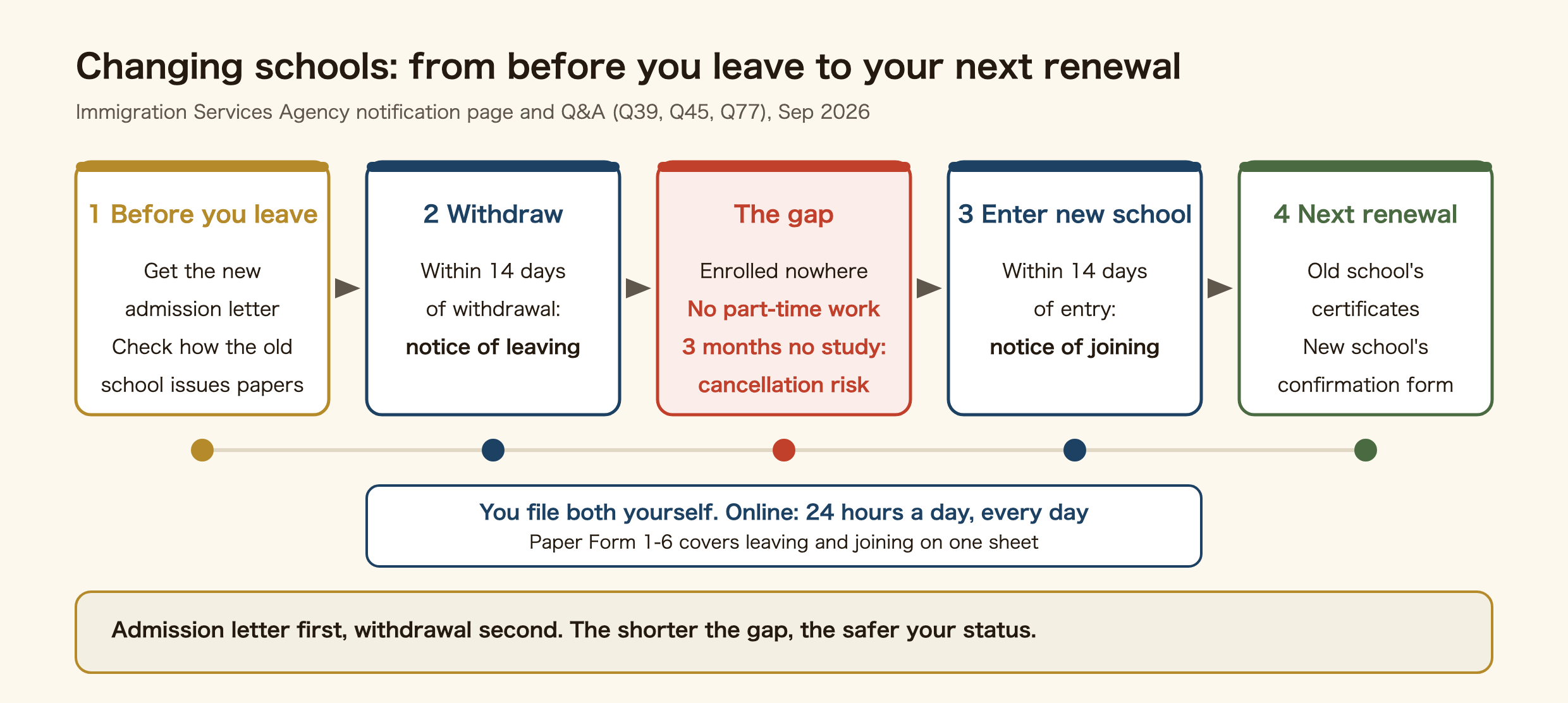
The official name is the “notification regarding the organisation of affiliation” (shozoku kikan ni kansuru todokede). It is required by Article 19-16 of the Immigration Control Act, and you file it yourself, not the school. Immigration’s page calls ending your activity at a school (graduation, withdrawal) “leaving”, and belonging to a new school (for example by going on to further study) “transfer”. Changing schools is both.
- Online: the ISA’s electronic notification system (denshi todokede shisutemu) accepts it 24 hours a day, every day. Register as a user the first time. No attachments are needed
- At a counter: at your regional immigration office, show your residence card and hand in the form
- By post: send the form and a copy of both sides of your residence card to the notification desk of the Tokyo Regional Immigration Services Bureau. No receipt is sent, so use a trackable service
On paper, leaving is Reference Form 1-2 and joining is Reference Form 1-3. Form 1-6 covers both on one sheet.
When does the 14 days start?
There are two separate start dates. The leaving notification runs from the day you left the old school (the withdrawal date). The joining notification runs from the day you became part of the new school (the entry date). If there is a gap between the two, you file the leaving notice first and the joining notice later.
Schools report too. A Japanese-language school on the Immigration notice list, for example, must report a student’s withdrawal by the end of the following month (notice standards, item 38). That does not replace yours. The law puts the duty to notify on you.
What happens between leaving one school and starting the next?
From the day you leave the old school to the day you enter the new one, you are nobody’s student. This is the risky part of changing schools.
First, no part-time work. The Immigration Q&A says the blanket work permission for students is “valid only while enrolled at an educational institution” (Q45). Even with the permission written on the back of your residence card, you cannot work while you are not enrolled. This is a separate condition from the 28-hour rule.
Second, the three-month rule. If you have not carried out Student activity (studying at a school) for three months or more in a row, your status can be cancelled unless there is a justifiable reason (Immigration Control Act, Article 22-4). An Immigration document for schools counts the three months “from the day after the last day the activity was confirmed”.
The Q&A’s examples of a justifiable reason include a student whose school closed and who is going through the procedure to enter another school, and a vocational school graduate who has been accepted by a Japanese university (Q77). Withdrawing by choice and then looking for a new school is not among the examples. Nothing official says “under three months is fine”, either. So get the new school’s admission letter before you file the withdrawal.
Once your status is cancelled, changing schools cannot fix it. The Q&A says that a student whose status was cancelled for not attending school cannot change or extend status even if they enter another school during the grace period before departure (Q76). They have to leave Japan and start again from a Certificate of Eligibility (COE).
What does the visa renewal look at after a school change?
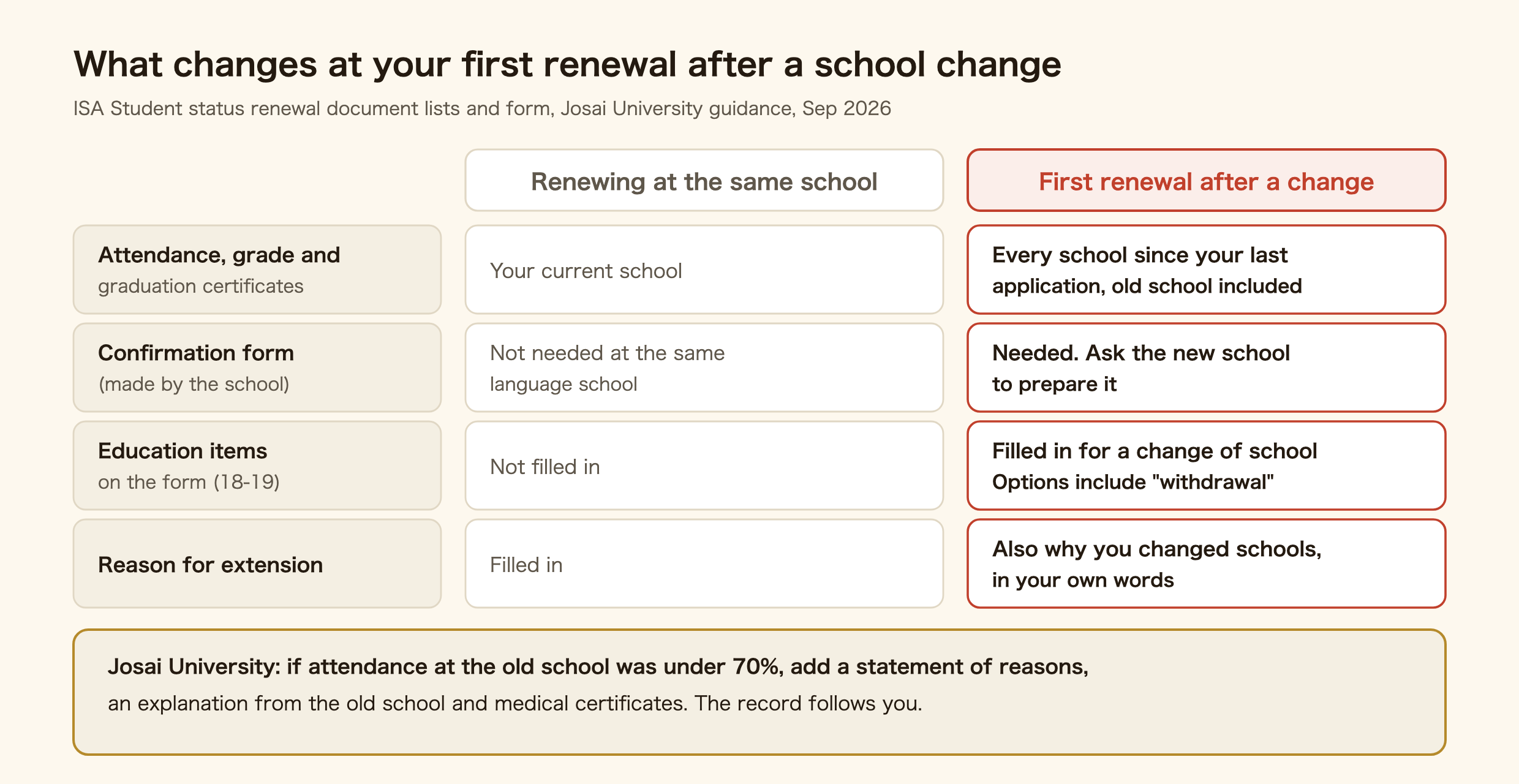
Your first renewal after a change asks for more than a renewal at the same school. The Student renewal document lists include these for language schools, vocational schools and universities alike:
- Attendance certificate, transcript and graduation certificate, for every school you have attended since your last application (for universities and vocational schools, the attendance certificate “if the school can issue one”)
- The “confirmation form” (kakushu kakuninsho), prepared by the school. The note on the list says it is not needed “when renewing at the same Japanese-language school”, which means it is needed after a change (except for people who never need it, such as vocational students studying subjects other than Japanese)
The application form has a section for you too. The Student renewal form says its education items are filled in “in case of going to a higher school or changing your school”, and the enrolment options include “withdrawal”. The reason for the change goes into the “reason for extension” box that every applicant fills in, in your own words.
University guidance is more concrete. The University of Tokyo asks students who entered from another school since their last renewal for the previous school’s graduation certificate and transcript at their first renewal. Josai University says that if attendance at the previous school was below 70 percent, you add a statement of reasons, an explanation written by the previous school, and supporting documents such as a medical certificate.
If you missed a lot of classes at the old school, the record follows you. How attendance is read is in attendance requirements for a student visa. If you were ill, keep the doctor’s note.
Can I transfer from one Japanese language school to another?
Yes. Immigration’s procedure is the same as for a university or vocational school: two notifications within 14 days, and the documents at your next renewal. Between language schools, watch three things.
- Whether the new school is recognised by the state — on the Immigration notice list, or a certified Japanese-language institution approved by the Minister of Education. Other schools cannot sponsor Student status. How to check is in how to choose a Japanese language school
- The confirmation form. If you move to a different language school, the new school prepares it for your next renewal. You cannot fill it in yourself, so ask the new school early
- Your attendance record. Language schools record attendance for every class hour and must give guidance to anyone below 80 percent in a month. Schools on the notice list report students below 50 percent to Immigration. None of this disappears when you move
How much does changing schools cost?
| Item | Cost |
|---|---|
| Notifications (leaving and joining) | No fee is listed on Immigration’s page |
| Certificates from the old school | Depends on the school |
| Entrance fee and tuition at the new school | Depends on the school |
| Refund of fees paid to the old school | Depends on the refund rules in its school regulations |
| Status renewal (when it is due) | From 1 October 2026, set by the length of stay granted |
The heavy part is tuition. Whether prepaid tuition comes back depends on the refund conditions in the old school’s regulations. Immigration’s interpretive guidelines for language schools note disputes over refunds after withdrawal and ask schools to write refund conditions into their regulations. Ask the office for that page before you file the withdrawal. For the renewal fee, the residence permit fee increase shows the amount for each length of stay.
What if I forgot to notify within 14 days?
Not filing within 14 days can bring a fine of up to 200,000 yen (Immigration Control Act, Article 71-5). A false notification can bring up to one year of imprisonment or a fine of up to 200,000 yen (Article 71-2).
It also matters at renewal. The Immigration Q&A lists “compliance with notification duties under the Immigration Control Act” first among the things generally considered when deciding the length of stay. If the 14 days have passed, file on the day you notice. The online system lets you do it today. For questions, the Immigration Services Agency’s information centre is on 0570-013904.
What if my old school will not let me leave or will not issue certificates?
“If you leave, we won’t give you certificates.” “We won’t accept your withdrawal.” If you hear this, know that the national standards treat it as the school’s problem. The interpretive guidelines for language schools warn schools that forcing a student out, and refusing to let a student withdraw, must not become human rights violations. The ISA and Education Ministry guideline for certified schools lists “obstructing a student’s choice of path, such as not issuing documents needed for further study or employment” as an example of a human rights violation.
If you still cannot get a certificate, Immigration’s notes for applicants say to explain why you cannot submit it and provide an alternative document. Keep your emails and messages with the school. For help, call the information centre or talk to the international student staff at your new school.
What should I check before I change schools?
- Do you have the new school’s admission letter? When is the entry date, and how many days after your withdrawal is it?
- Will the old school issue attendance, grade and enrolment certificates after you leave? Certificates for a renewal must be issued within the last three months
- How much of your prepaid tuition comes back? Have you read the refund rules?
- Does your period of stay end while you are at the new school? If so, you can apply to renew from three months before it ends
- If you are moving house, the address notification at your city office (within 14 days) and telling your part-time employer. This is a separate deadline from the Immigration notifications
Some students think about a leave of absence instead of switching. But during a leave you cannot work either, and the three-month rule applies the same way. Read what a leave of absence does to your visa before you decide.
Which one are you?
- Your next school is already decided — get the admission letter and check how the old school will issue your certificates. File the leaving and joining notifications within 14 days of the withdrawal and the entry. Today, register for the online notification system.
- You want to switch but have no new school yet — do not file a withdrawal yet. Find the new school and get an admission letter first. Today, read your school’s rules on withdrawal and refunds.
- You have already withdrawn and are looking for a school — stop part-time work. File the leaving notification within 14 days of withdrawal and secure a new school well before three months. Today, check whether you have filed the leaving notification.
- You decided to go home instead — hand in your residence card at the airport. Kobe University says that if you leave Japan straight after graduation and return the card at the airport, the notification is not needed; ask your school whether the same applies to a withdrawal. Today, go through the leaving-Japan checklist for your resident record, insurance and pension.
FAQ
Q. Do I need a new visa if I change schools in Japan?
No. What the Immigration Q&A asks for when you change schools is two notifications within 14 days: leaving the previous school and enrolling at the new one. The change will be looked at in the documents for your next renewal.
Q. Where and by when do I file the notifications?
You file them yourself with the Immigration Services Agency. Leaving is due within 14 days of leaving the old school, and joining within 14 days of entering the new one. The online notification system is open 24 hours a day.
Q. Can I work part-time between withdrawing and starting at the new school?
No. The work permission for students is valid only while you are enrolled at an educational institution. While you are enrolled nowhere, you cannot work.
Q. What happens to my status if there is a gap between schools?
Three months or more without studying makes your status liable to cancellation unless there is a justifiable reason. Withdrawing by choice and looking for another school is not among Immigration’s examples of a justifiable reason. Get the new school’s admission letter before you withdraw.
Q. Do I need documents from my old school at the next renewal?
Yes. Immigration’s document lists ask for attendance, grade and graduation certificates from every school you have attended since your last application. If your school has changed, you also submit a confirmation form prepared by the new school.
Q. Can I transfer from one Japanese language school to another?
Yes. The Immigration procedure is the same as for a university or vocational school. Check first that the new school is on the notice list or is a certified Japanese-language institution. Your attendance record at the old school stays with you.
Summary
You can change schools and keep your Student status. Immigration asks for two notifications within 14 days, not a new visa. But between leaving one school and entering the next you cannot work, and three months without studying makes your status liable to cancellation.
What happened before and after the change will be looked at in your next renewal: attendance and grades at the old school, and why you moved. So the order is admission letter first, withdrawal second. If you forgot the notifications, file them today.
Official sources: Immigration Services Agency, notification regarding the organisation of affiliation (Japanese) / ISA immigration and residence Q&A (Japanese) / ISA Student status: document lists and confirmation forms (Japanese) / ISA cancellation of status (Article 22-4) / ISA guidelines on accepting international students, including the language school notice standards (Japanese) / Immigration Control and Refugee Recognition Act (e-Gov) / Kobe University, notifications to Immigration / University of Tokyo, extension of period of stay / Josai University, status procedures. Checked on 23 September 2026. Always confirm with the international student staff at both your current and your new school before you file a withdrawal.
Related reading
Found this useful? Share it
Send it to a friend who lives in Japan.
WHO WROTE THIS

mori
Japanese. I read the ministries’ own notices, orders and Q&As in the original, and I start from what my Nepalese and Sri Lankan friends in Japan actually ran into. I do not write about what I have not checked or been told.
What this site can and cannot do →Looking for something else?