Figures, payment methods and conditions were checked against the Immigration Services Agency’s fee revision notice, its page on online fees and payment, and its official Q&A on 1 October 2026. They change – check the current terms yourself before you file anything.
Last updated: 1 October 2026
Summary
- The residence permit fee is what you pay when your permission is granted for a status change, a period-of-stay renewal, or permanent residence.
- It went up on 1 October 2026. The Cabinet Order behind it was promulgated on 28 August 2026.
- It used to be one flat amount. Now the amount depends on how long a period of stay you are granted.
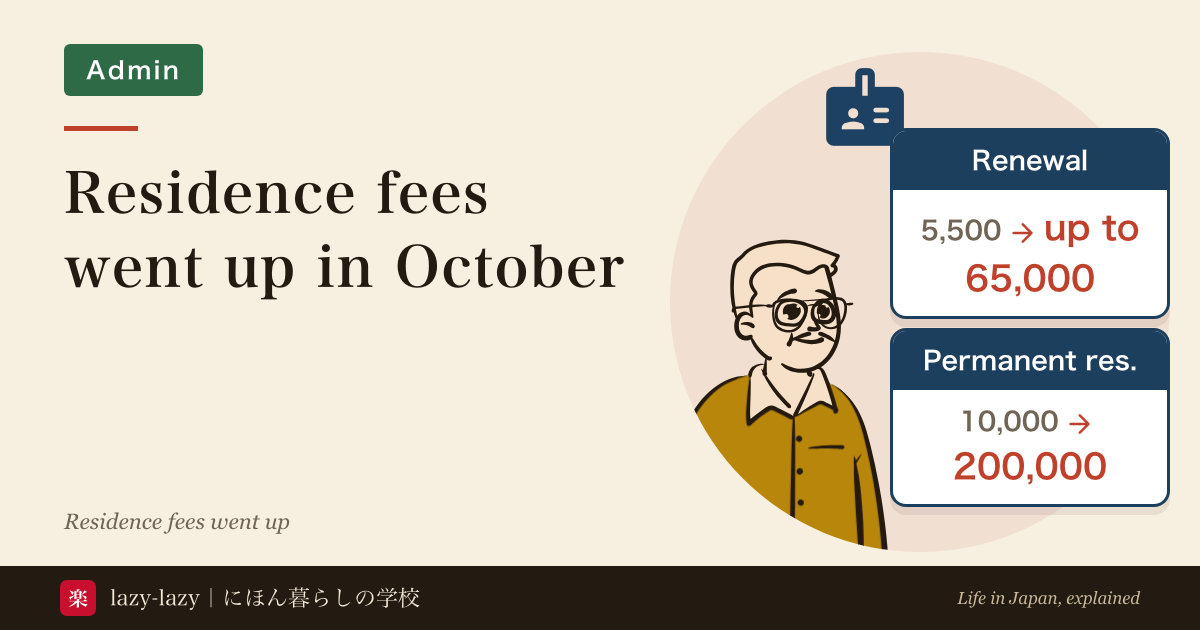
- A renewal granting 2 years went from 5,500 yen to 42,000 yen online, plus a 330 yen payment charge.
- Permanent residence went from 10,000 yen to 200,000 yen. A gap of 190,000 yen.
- But any application accepted by 30 September 2026 pays the old amount, even if the permission itself comes later.
- At the counter you pay with revenue stamps. Online applications accepted from 1 October are paid at a convenience store or by bank payment.
- A reduction and waiver scheme also started, but being short of money is not enough to qualify.
What changes: you know which fee band you will pay, and that applications accepted by 30 September still pay the old fee even if permission comes later.
If you have budgeted 6,000 yen every time you renew, this is not a small adjustment. In the labour ministry’s survey, people working part time on a student status earn 115,900 yen a month. For a 2-year permission filed online, one renewal now costs more than a third of that month’s pay.
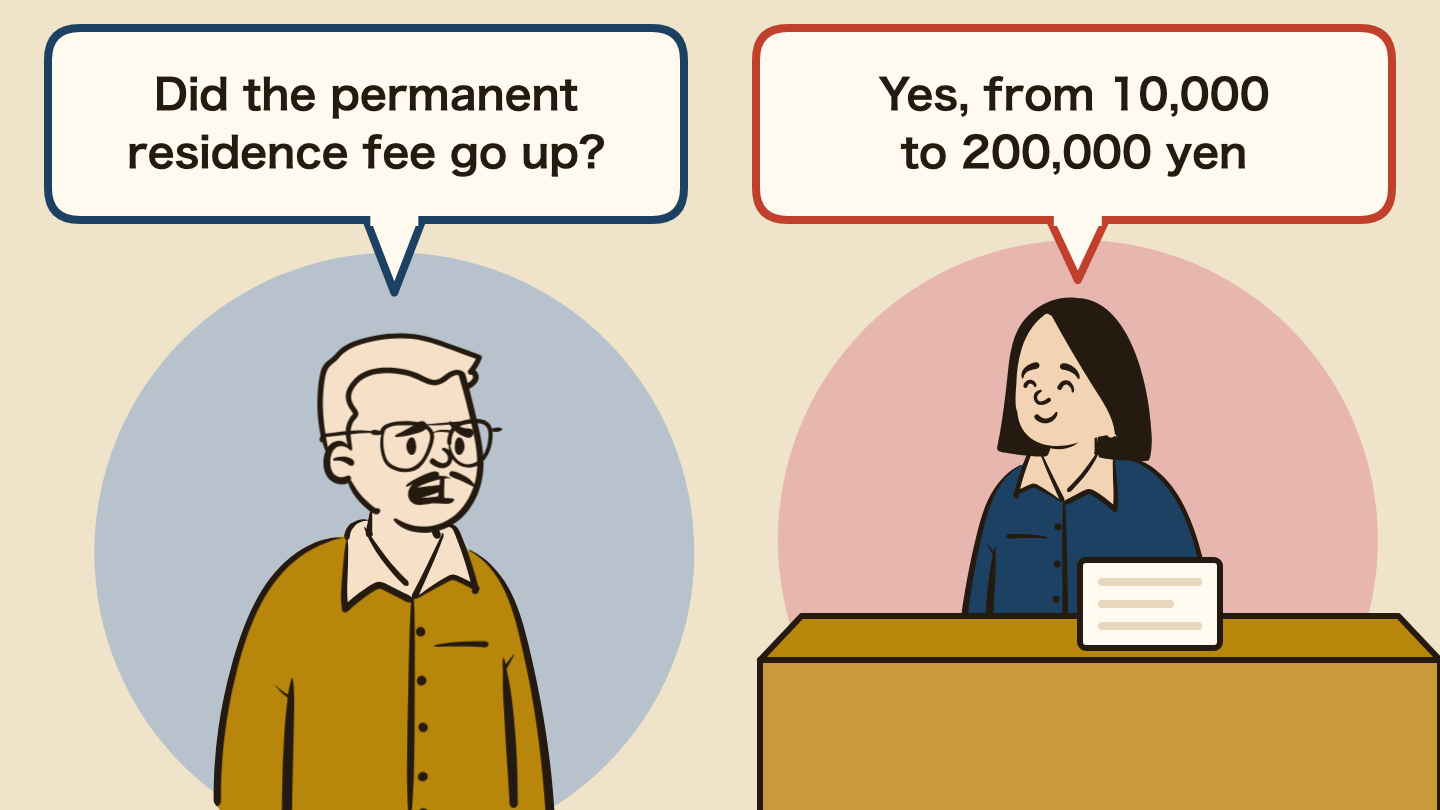
For anyone thinking about permanent residence it is heavier still: 10,000 yen became 200,000 yen (Immigration Services Agency).
Two things matter besides the amount. Applications accepted by 30 September still pay the old fee. And from 1 October, online applications are no longer paid with revenue stamps but at a convenience store or by bank payment.
- What the residence permit fee actually is
- How much is the Japan visa fee increase in 2026
- Permanent residence went from 10,000 to 200,000 yen
- When does the new fee start
- How much should you set aside if you file now
- Is there a Japan visa fee exemption
- What happens to revenue stamps
- Is this the same as the tourist visa fee
- What to do this week
- FAQ
- Summary
What the residence permit fee actually is
The residence permit fee is paid to the government when you receive permission for a change of status of residence, a renewal of your period of stay, or permanent residence. You do not pay it when you file. You pay it when the permission is granted, which means you pay nothing if you are refused.
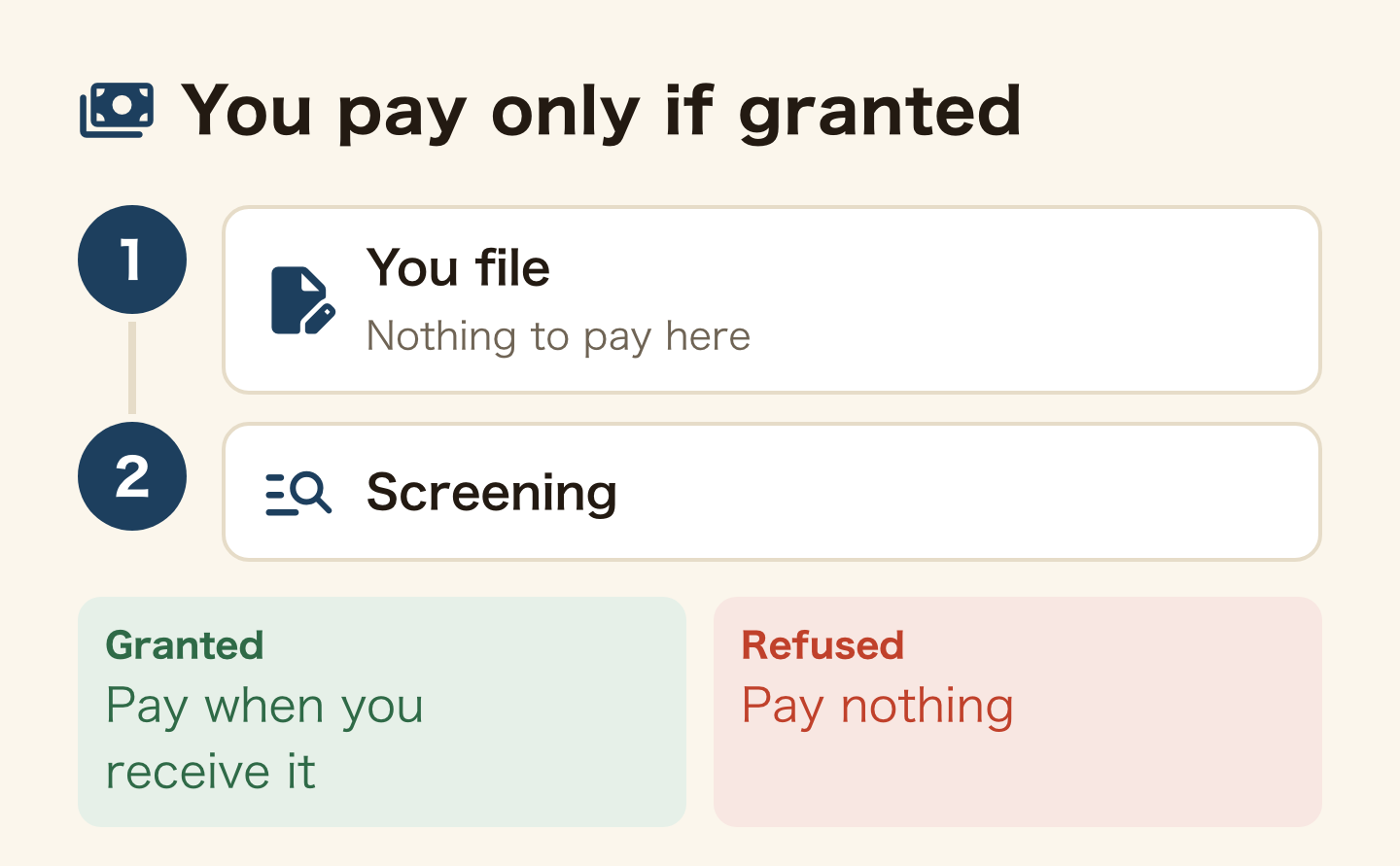
This is the fee people used to call “the 6,000 yen for a visa renewal”. At the counter you pay it with revenue stamps; online you pay it another way. The procedure itself is covered in our visa renewal article. This article is only about the amounts and how to pay.
The amounts are set in Article 25(1) of the amended enforcement order of the immigration law. The Cabinet Order was promulgated on 28 August 2026 and took effect on 1 October 2026 (Immigration Services Agency, revision of residence permit fees from 1 October 2026 (Japanese)).
How much is the Japan visa fee increase in 2026
The biggest change is not the number but how the number is decided. It used to depend only on which procedure you filed. Since 1 October, the longer the period of stay you are granted, the more you pay.
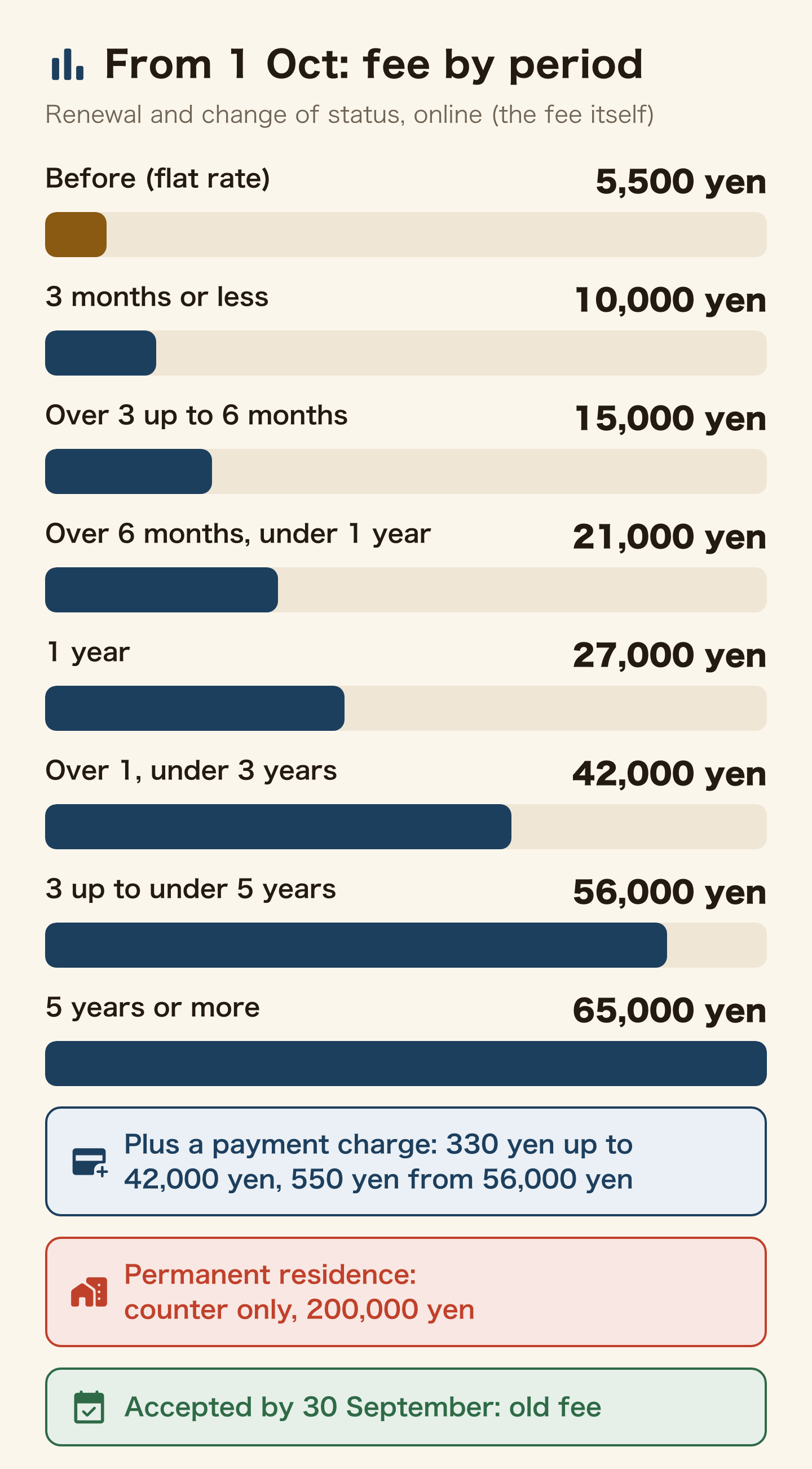
For a change of status and a renewal of period of stay (Immigration Services Agency, fee revision poster (Japanese)):
| Period granted | At the counter | Online | Online total paid (with charge) |
|---|---|---|---|
| (before, flat rate) | 6,000 yen | 5,500 yen | 5,500 yen |
| 3 months or less | 10,000 yen | 10,000 yen | 10,330 yen |
| Over 3 up to 6 months | 18,000 yen | 15,000 yen | 15,330 yen |
| Over 6 months, under 1 year | 25,000 yen | 21,000 yen | 21,330 yen |
| 1 year | 33,000 yen | 27,000 yen | 27,330 yen |
| Over 1 year, under 3 years | 48,000 yen | 42,000 yen | 42,330 yen |
| 3 years up to under 5 years | 64,000 yen | 56,000 yen | 56,550 yen |
| 5 years or more | 75,000 yen | 65,000 yen | 65,550 yen |
Student periods of stay are usually issued as 1 year 3 months or 2 years, and a first work status is normally 1 year or 3 years. So most readers land on the “1 year” or the “over 1 year, under 3 years” row: 27,330 or 42,330 yen online, payment charge included.
Online, a payment charge is added on top of the fee: 330 yen for bands up to 42,000 yen, and 550 yen for the 56,000 and 65,000 yen bands (Immigration Services Agency, online fees and payment (Japanese)). Every band above 3 months is still cheaper online than at the counter. Only for 3 months or less is online 330 yen dearer. What you need to apply online is in the guide to online visa renewal.
Permanent residence went from 10,000 to 200,000 yen
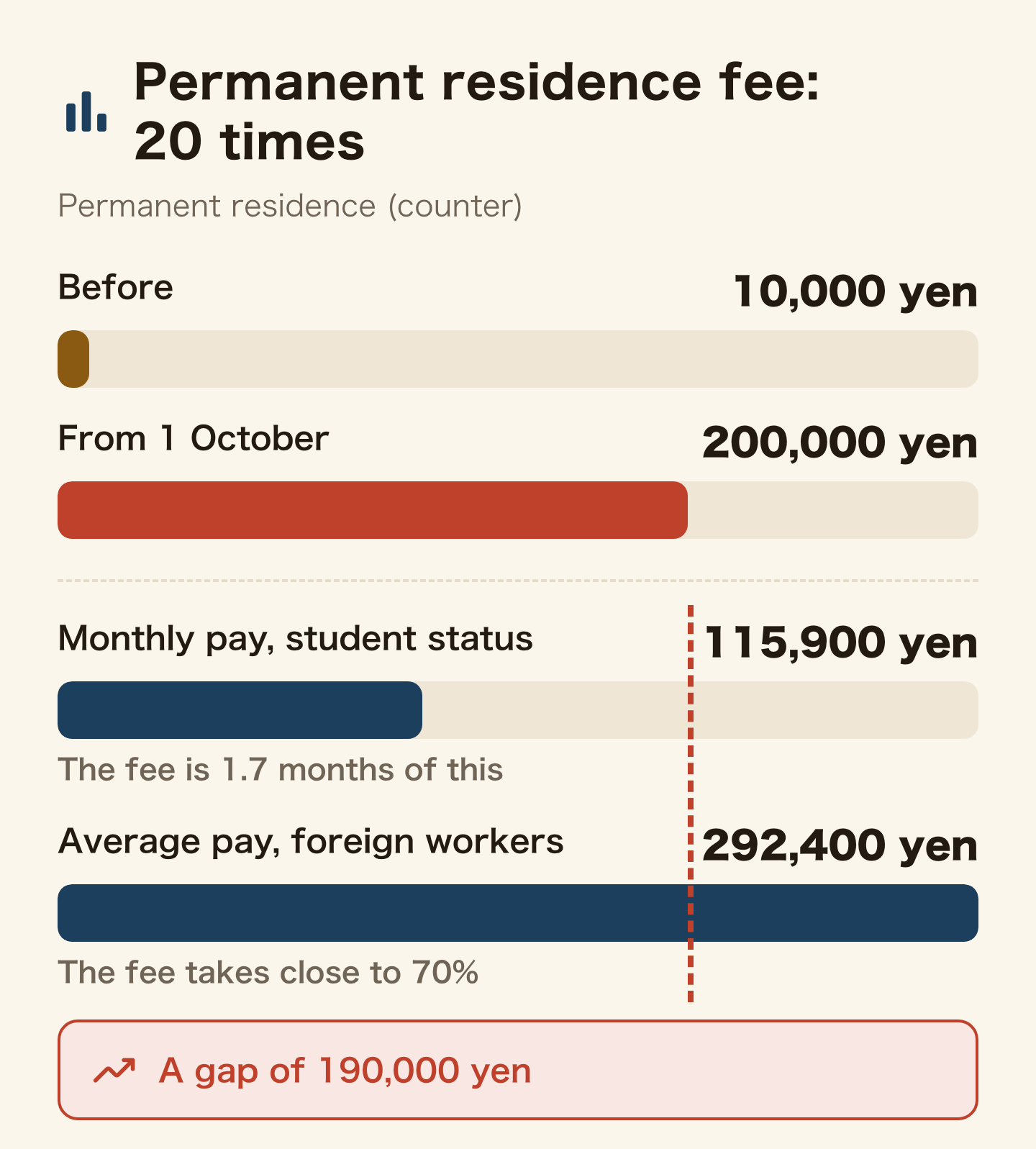
Permanent residence can only be filed at the counter, and its fee moved from 10,000 yen to 200,000 yen. Twenty times (Immigration Services Agency, permanent residence application (Japanese)).
Put that against real pay. Someone working part time on a student status earns 115,900 yen a month (MHLW survey), so the fee is about 1.7 months of income (200,000 / 115,900). Even for foreign workers overall, whose average monthly pay is 292,400 yen, it takes close to 70 percent of a month in one payment.
The requirements themselves, including the guideline revision adopted on 1 October 2026, are in our permanent residence article. The point here is narrow. A permanent residence application accepted by 30 September stays at 10,000 yen, however long screening takes. If you are filing now, plan for 200,000 yen.
When does the new fee start
The agency states that applications accepted by 30 September pay the old amount even when permission comes on or after 1 October (Immigration Services Agency, Q&A on the fee revision (Japanese)). Supplementary Provision Article 5 of the amending act (Act No. 32 of 2026) says the same: permission on an application made before 1 October follows the previous rules.
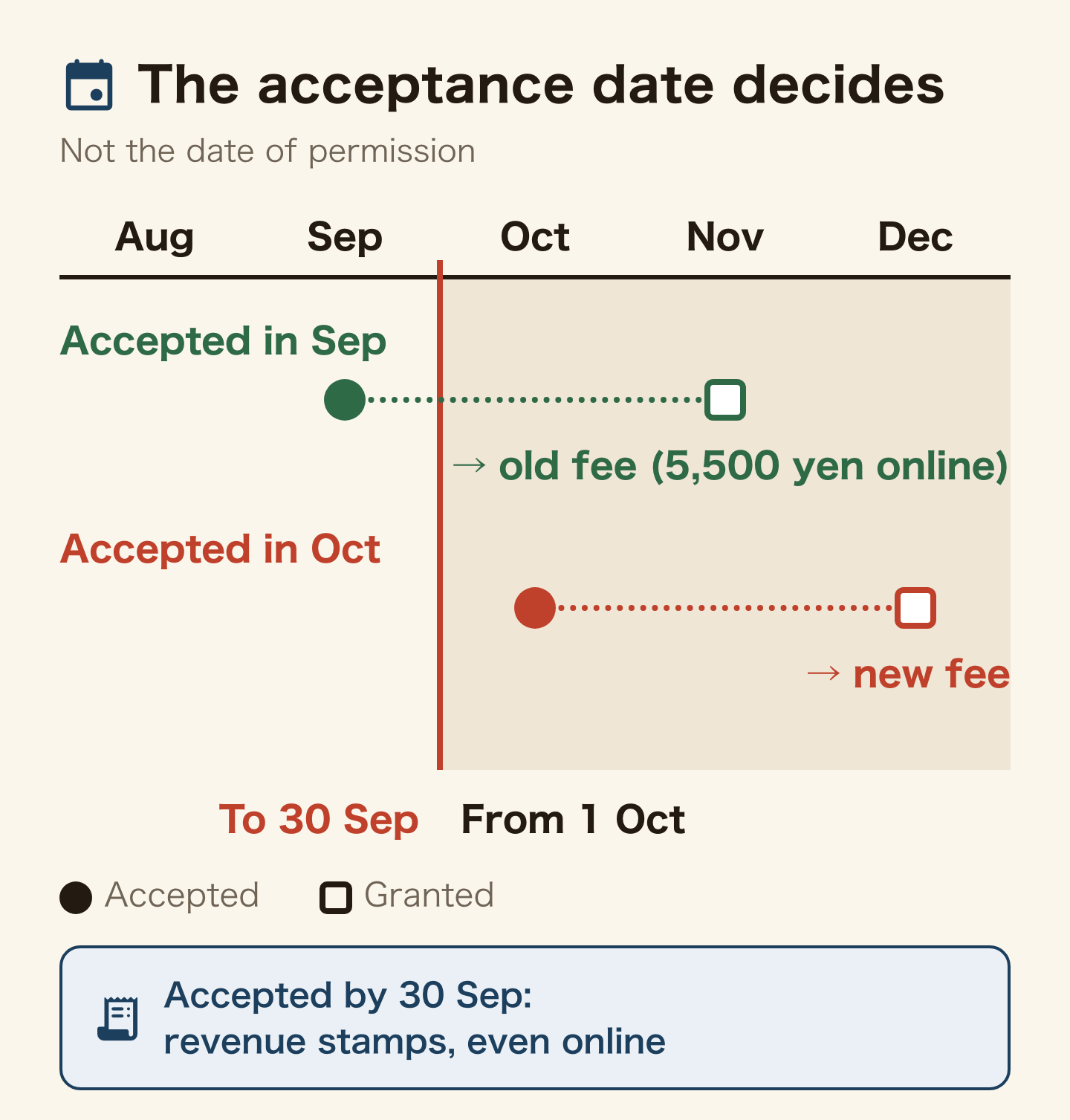
What matters is the date your application was accepted, not the date of the decision. If screening takes two months and the permission arrives in November, an application accepted by 30 September still pays the old fee (5,500 yen online).
The payment method stays the old one too. An online application accepted by 30 September is paid in revenue stamps, even if permission comes in October. Your acceptance date is in the email giving your provisional application number or your application number (the same agency, online fees and payment (Japanese)).
The dividing line is the acceptance date
Accepted by 30 September 2026 -> old amounts (6,000 yen at the counter, 5,500 yen online, 10,000 yen for permanent residence), paid in revenue stamps even online
Accepted on or after 1 October 2026 -> new amounts; online is paid at a convenience store or by bank payment
How much should you set aside if you file now
Every application accepted from 1 October pays the new fee. The band is set by the period you are granted, so the exact amount is fixed at permission. For counter applications it is written on the postcard sent after screening; online, it is in the email that follows the completion notice.
Renewal: 33,000 yen at the counter or 27,330 yen online for 1 year
A renewal can be filed on or before the day your period of stay expires, and for anyone holding a period of stay of 6 months or more, from 3 months before that expiry. Missing the pre-October fee is no reason to let the date slip: if it passes with nothing filed, you lose your status.
For 1 year you pay 33,000 yen at the counter or 27,330 yen online with the payment charge. For over 1 and under 3 years it is 48,000 or 42,330 yen (Immigration Services Agency, extension of period of stay (Japanese)). If you are married to a Japanese national, check the seven documents for a spouse visa renewal as well.
Change of status: the same table as a renewal
A change of status has no 3-month rule. You may file from the moment the reason for the change arises until your current period of stay expires. The fee follows the same table, set by the period granted (Immigration Services Agency, change of status of residence (Japanese)).
Student-to-work changes normally cluster between December and March. If the first permission is for 1 year, 33,000 yen at the counter or 27,330 yen online covers it. The procedure is in our student visa to work visa article.
If you are staying on a student status to continue studying, use the renewal rule above. If you are still deciding where to go after language school, you will need the school decision first.
Permanent residence: 200,000 yen at the counter
Permanent residence can be filed on or before the day your period of stay expires. There is no 3-month rule. The fee is 200,000 yen, paid at the counter on permission.
One warning. A refusal costs nothing, but filing again costs 200,000 yen once more when it is granted. Filing before your case is ready only loses you time. Check the years of residence, income, pension and tax first. The revocation rules also start in April 2027.
If you receive a specified residence card at the same time, its 1,900 yen fee may be added (Article 25(5) of the enforcement order; Immigration Services Agency, specified residence card (Japanese)).
Is there a Japan visa fee exemption
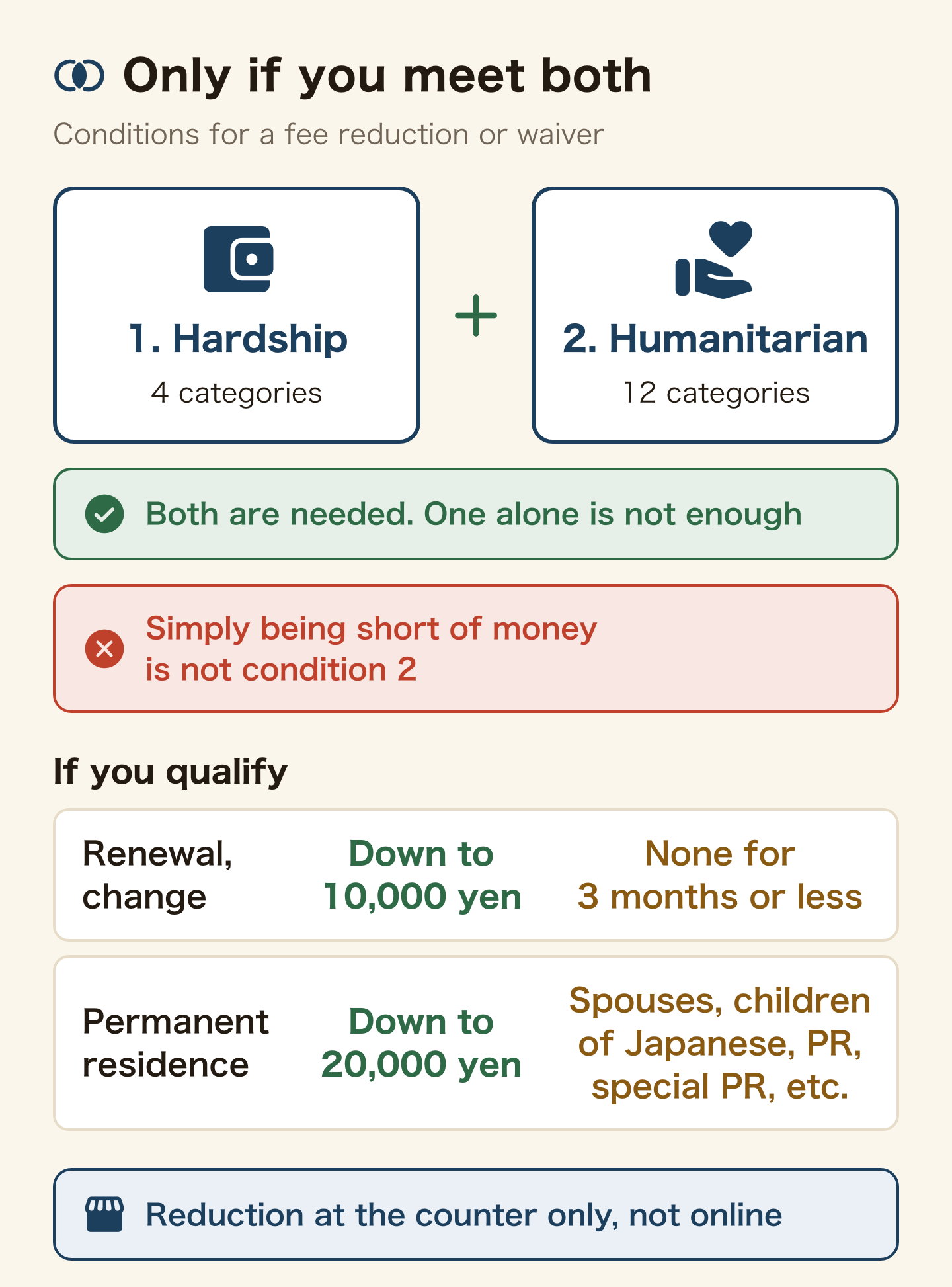
A reduction and waiver scheme started on 1 October 2026. Being short of money is not enough (Immigration Services Agency, reduction and waiver of residence permit fees (Japanese)).
The agency’s guideline requires both of two conditions.
- 1. Hardship comparable to a person requiring protection under the Public Assistance Act (four categories, such as receiving protection equivalent to public assistance, or receiving support payments as a refugee applicant)
- 2. A need for humanitarian consideration (twelve categories, such as recognised refugees, victims of human trafficking, foreign nationals in children’s homes, and patients with designated intractable diseases or children with disabilities and their carers)
Meeting one is not enough. And the twelve humanitarian categories do not include an ordinary student or worker who is simply struggling financially.
The agency explains why. In its view, someone who cannot afford the fee is generally judged unable to continue the activity their status is for, and so would normally not receive permission at all. It is a hard position, but it is the official one.
Where a reduction does apply, the amounts are fixed: down to 10,000 yen for a renewal or change, and down to 20,000 yen for permanent residence. The permanent residence reduction is limited to spouses and children of Japanese nationals, permanent residents and special permanent residents, and similar cases. The 3-months-or-less band is already 10,000 yen, so it has no reduction (Article 25(3) of the enforcement order).
The reduction is only available for counter applications; the online system does not support it. If you may qualify, file at the counter.
Building the money itself is a separate job: cutting your living costs, and claiming everything that shrinks when you apply, such as the health insurance reduction.
What happens to revenue stamps
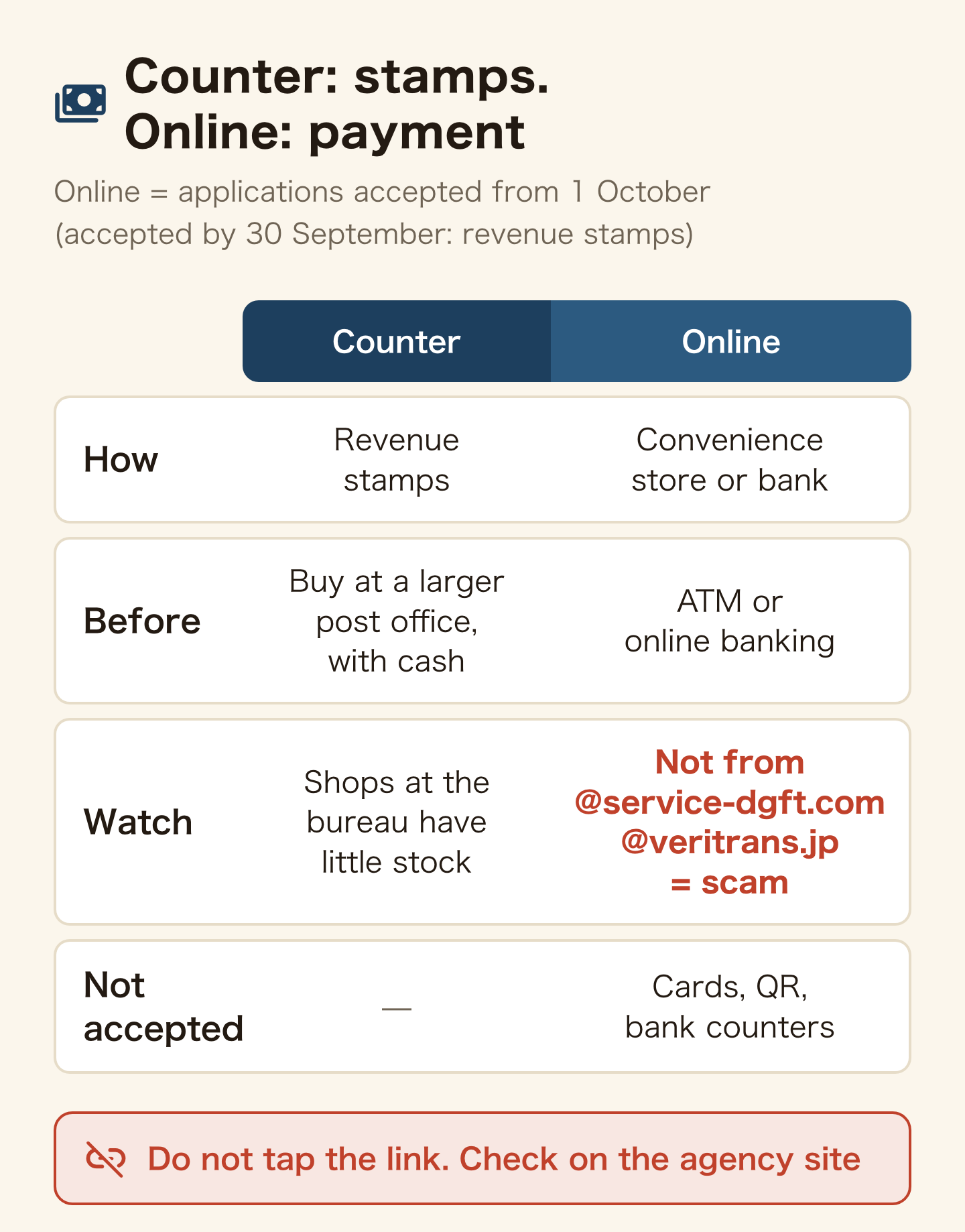
If you file at the counter, you still pay with revenue stamps. Because more denominations are now needed, the agency asks people to buy them in advance at a larger post office rather than at the shops inside the bureau, which hold limited stock. Revenue stamps can only be bought with cash. For the 75,000 yen band, for example, three stamps of 60,000, 10,000 and 5,000 yen will do (Immigration Services Agency, buying revenue stamps (Japanese)).
Online applications accepted from 1 October go the other way: revenue stamps cannot be used. You pay at a convenience store or by bank payment (Pay-easy) at an ATM or through online banking. Bank counters, credit cards and QR code payments are not accepted.
Here is how it works. After the screening completion email, a message with a payment link arrives from “@service-dgft.com”. No paper payment slip is sent. The deadline is the day before you collect your residence card. An agent filing for several people cannot pay for them in one go.
The convenience stores listed are Lawson and Ministop, FamilyMart, 7-Eleven, Daily Yamazaki and Seicomart (Immigration Services Agency, convenience store payment steps (Japanese)).
One caution. The payment application and completion emails come from “@veritrans.jp”. The agency states that any payment request from an address other than these two is a scam. Do not follow links you are unsure of; check on the agency’s own site. Other calls and emails that pose as Immigration or the police, and who to call if you already paid, are in scams in Japan that target foreigners.
Is this the same as the tourist visa fee
No, and the two are easy to confuse.
The fee charged by Japanese embassies and consulates abroad for a short-stay visa is a separate system. News and social media posts about “Japan raising visa fees” mix the two together. This article is about the fee that people already living in Japan pay to the immigration bureau in Japan.
What to do this week
- Take out your residence card and read the expiry date. A renewal can be filed from 3 months before it
- Find your band in the table above. For 1 year it is 33,000 yen at the counter or 27,330 yen online
- Filing at the counter? Buy revenue stamps with cash at a larger post office. Filing online? Make sure you can pay at a convenience store, an ATM or through online banking
- If you filed by 30 September, check your acceptance date in the application number email. You pay the old fee, in revenue stamps even online
- Ignore any payment request that does not come from “@service-dgft.com” or “@veritrans.jp”
Steps 1 and 4 take five minutes today. Once you have paid, keep the payment completion email until you have collected your residence card. That is the end of the money side of this procedure.
FAQ
Q. When did the Japan visa fee increase start?
On 1 October 2026, and it is now in force. Applications accepted by 30 September 2026 pay the old amount even if the permission is granted on or after 1 October. The Immigration Services Agency states this in its official Q&A.
Q. Why did the fees go up?
The agency says it needs residents to bear a corresponding share of the cost of strengthening and expanding immigration administration. It says the ceiling amounts were set by weighing the actual cost of screening, the cost of immigration control, comparable fees in other countries, and the ability to respond flexibly to future price rises.
Q. Is the permanent residence fee really 200,000 yen?
Yes. At the counter it went from 10,000 yen to 200,000 yen, and permanent residence cannot be filed online. An application accepted by 30 September 2026 pays 10,000 yen.
Q. Why does the same renewal cost different amounts for different people?
Because the amount is now set by the period of stay granted. The agency says it designed the scale so that people granted longer periods carry a lower cost per year. A 2-year permission falls in the “over 1 year, under 3 years” row, which is 42,000 yen online plus a 330 yen payment charge.
Q. I filed by 30 September. How much do I pay?
The old fee: 6,000 yen for a renewal or change (5,500 yen online) and 10,000 yen for permanent residence. Even online, you pay it in revenue stamps. Your acceptance date is in the email giving your provisional application number or application number.
Q. How do I pay the fee for an online application?
For applications accepted from 1 October 2026, at a convenience store or by bank payment at an ATM or through online banking. Credit cards, QR code payments and bank counters are not accepted. You pay through the link in the email from “@service-dgft.com” that follows screening, by the day before you collect your residence card. The payment charge is 330 or 550 yen.
Q. Is there an exemption from the fee?
There is a reduction and waiver scheme, but it requires both hardship comparable to a person requiring protection under the Public Assistance Act and a need for humanitarian consideration. The second is a list of twelve categories such as recognised refugees and victims of human trafficking, and it does not cover students or workers who are simply struggling financially. Where it applies, the fee drops to 10,000 yen for a renewal or change and 20,000 yen for permanent residence. The reduction is only available at the counter, not online.
Q. Do I get the fee back if I am refused?
You never pay it in the first place, because the fee is due when permission is granted. Any application accepted from 1 October 2026 pays the new amount.
Q. How do I know which revenue stamps to buy?
For counter applications, the amount is written on the postcard sent to you after screening. For online applications, it is in the payment email that follows the completion notice. You do not have to work it out in advance.
Summary
- The residence permit fee is paid when a renewal, change of status or permanent residence is granted, and it changed on 1 October 2026
- The flat rate was replaced by amounts based on the period of stay granted
- Renewals and changes: a 2-year permission went from 5,500 to 42,000 yen online, a 1-year one to 27,000 yen, plus a 330 or 550 yen payment charge online
- Permanent residence went from 10,000 to 200,000 yen at the counter, twenty times higher
- Applications accepted by 30 September 2026 pay the old amount even if permission comes later, in revenue stamps even online
- Counter: revenue stamps, bought with cash. Online from 1 October: convenience store or bank payment, no credit cards
- Reductions need both financial hardship and humanitarian grounds, and are only available at the counter
- Payment emails come only from “@service-dgft.com” and “@veritrans.jp”; anything else is a scam
Sources: Immigration Services Agency, “Revision of residence permit fees from 1 October 2026” / the same agency, fee revision poster / the same agency, online application fees and payment / the same agency, official Q&A / the same agency, reduction and waiver of residence permit fees / the same agency, buying revenue stamps / the same agency, convenience store payment steps / the same agency, application for extension of period of stay / the same agency, change of status of residence / the same agency, permanent residence / the same agency, specified residence card / Ministry of Health, Labour and Welfare, Survey on Employment of Foreign Workers 2025 (all checked 1 October 2026)
Found this useful? Share it
Send it to a friend who lives in Japan.
WHO WROTE THIS

mori
Japanese. I read the ministries’ own notices, orders and Q&As in the original, and I start from what my Nepalese and Sri Lankan friends in Japan actually ran into. I do not write about what I have not checked or been told.
What this site can and cannot do →Looking for something else?
You may use the figures in this article, including commercially, if you credit this site with a link. How to use our figures