Last updated: 8 October 2026
Summary
- Divorce or bereavement must be reported to immigration within 14 days. That duty is separate from anything happening to your status, and it applies to everyone.
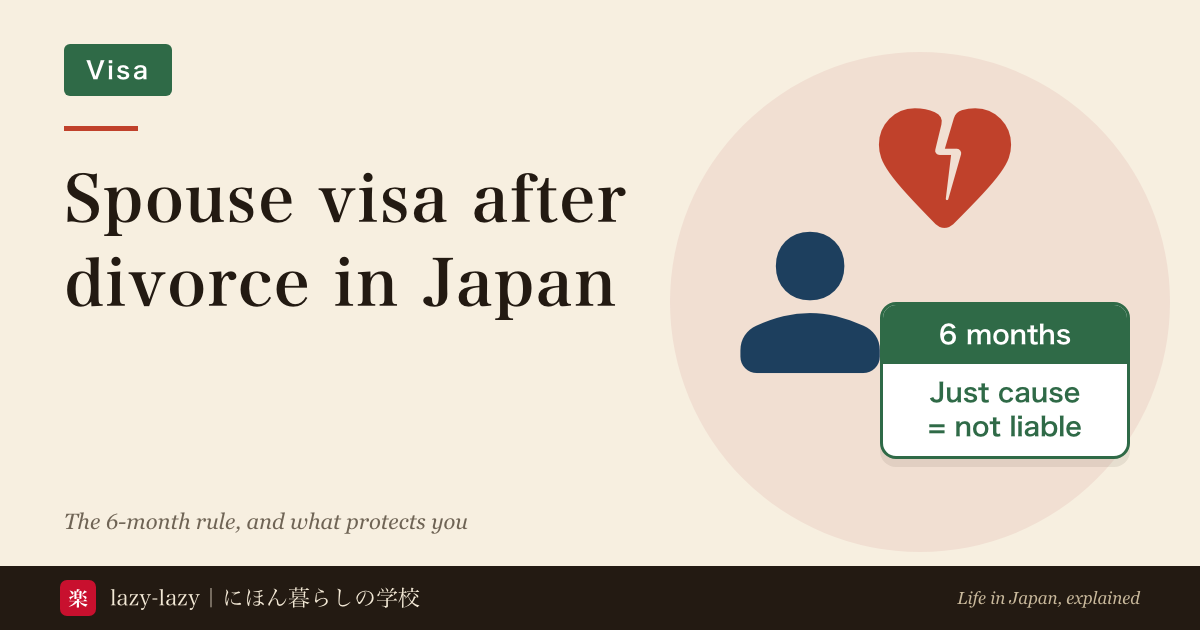
- Divorce does not end your status of residence on the spot. What triggers revocation is not carrying out activities as a spouse for six months or more.
- Even then, “just cause” protects you. Four examples are officially published, and two of them are “during divorce mediation or divorce litigation” and “taking refuge from a spouse’s violence.”
- Before revoking, immigration has a statutory duty to give you the chance to apply for a change of status or for permanent residence (Article 22-5).
- Even if your status is revoked, you are not deported that day. A departure period of up to 30 days is designated.
What changes: you know divorce does not end your status on the spot, and that there is a list of accepted reasons – so you neither flee the country nor sit silent past the 14-day report.
When a marriage is ending, the frightening thought is usually the same one: that you will lose the right to be in Japan tomorrow. That is not how it works. There is more time, and more procedure, than most people realise.
This guide sets out the reporting deadline, what the six-month figure actually measures, and the four situations officially published as just cause – based on the Immigration Control Act and material published by the Immigration Services Agency.
First: report within 14 days
The divorce is settled, and all your attention goes to rebuilding daily life. Where you are from, a divorce may be something settled between the two of you and your families, not something you report to an immigration office. In Japan, if you are here as a spouse, you have a duty to report it, and not filing is what counts against you later.
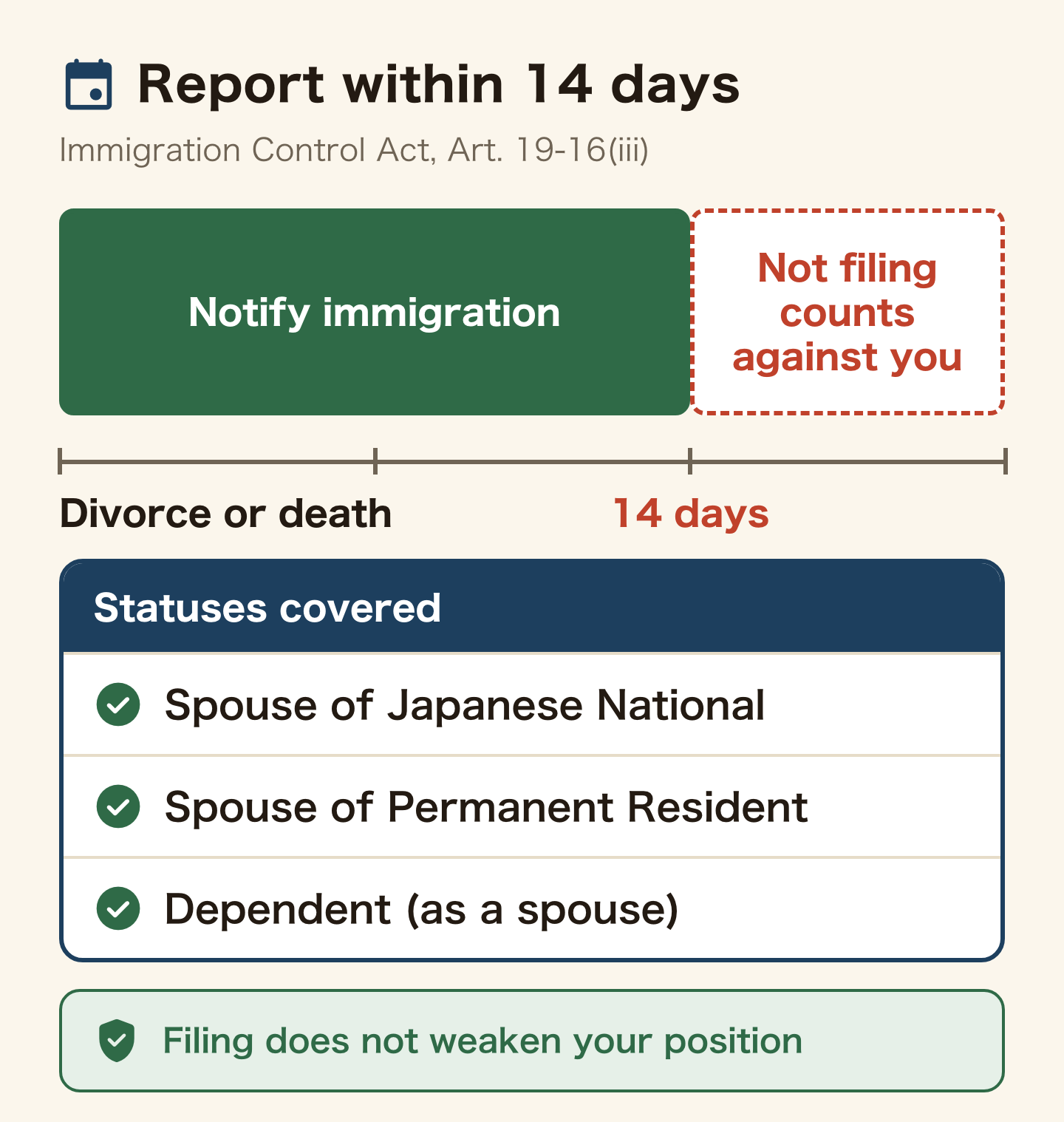
When you divorce or your spouse dies, you must notify the Immigration Services Agency within 14 days. That is Article 19-16(iii) of the Immigration Control Act.
It applies to Spouse or Child of Japanese National, Spouse or Child of Permanent Resident (the status for people married to a permanent resident), and Dependent (where you are here as a spouse). If you are on a dependent visa, the same provision covers you.
Reporting is not the same as being told to leave
People skip the report because they think it triggers revocation. The opposite is true. It is a notification of fact, and filing it does not weaken your position. Not filing it is what counts against you later.
Does divorce end your spouse visa immediately?
No. Read what the provision actually says:
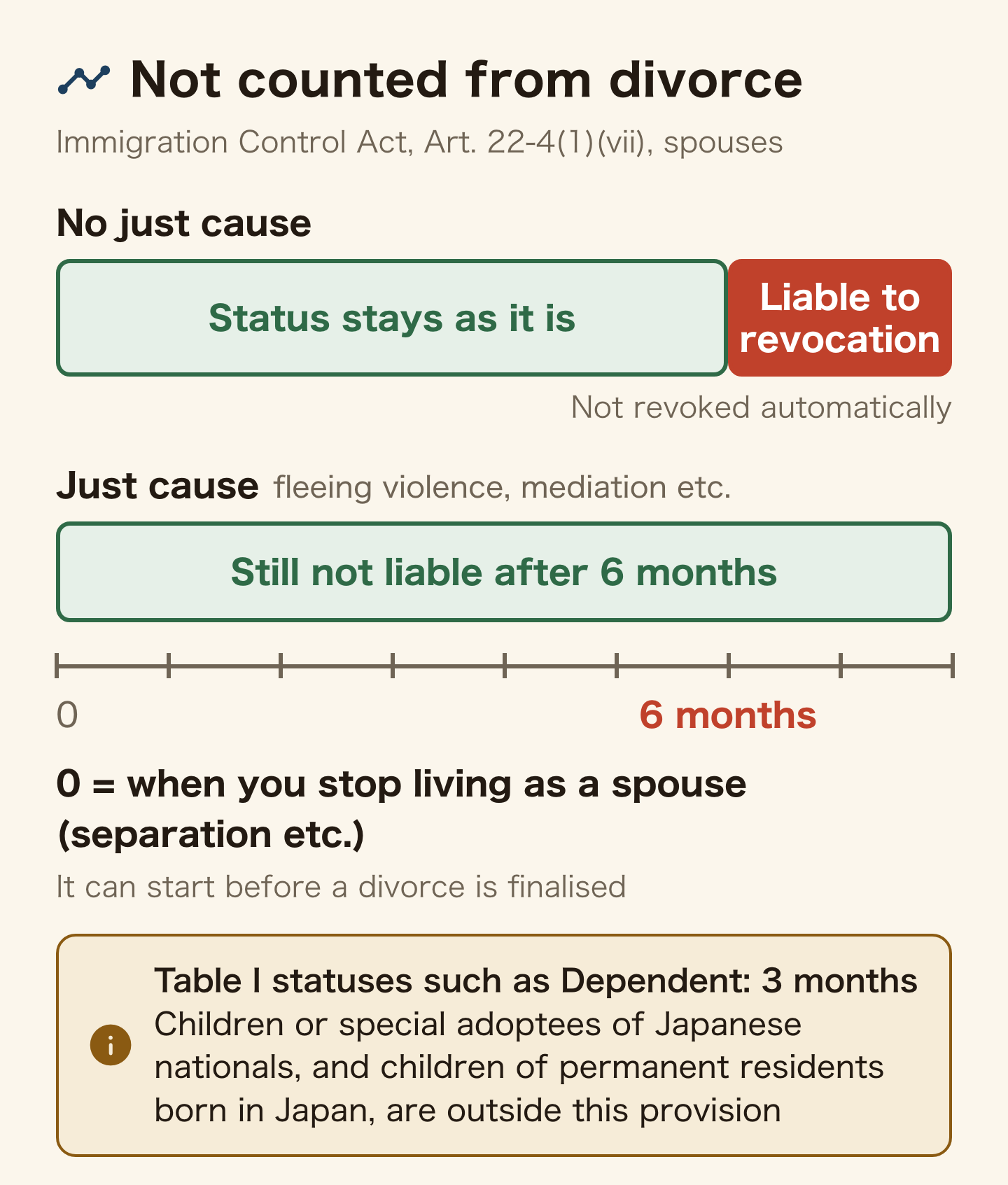
…has continued not to carry out activities as a spouse for six months or more while residing in Japan (except where there is just cause for not carrying out those activities)
Immigration Control Act, Article 22-4(1)(vii) – translated from the Japanese original
Three things are worth noticing.
One: it is not six months from the divorce. The clock measures a period of residing without carrying out activities as a spouse. It can start before a divorce is finalised, and it does not run at all where there is just cause.
Two: it makes your status liable to revocation, not revoked. The decision is made on the individual facts.
Three: people residing as the child or special adoptee of a Japanese national, and children of permanent residents who were born in Japan and have stayed since, are outside this provision. It reaches spouses.
The period also differs by status. Appended Table I statuses such as Dependent use three months; Spouse of a Japanese National and Spouse of a Permanent Resident use six. The statute makes one exception within Table I: Highly Skilled Professional (ii) also uses six months.
The four published examples of just cause
This is the part worth knowing. The Ministry of Justice publishes examples of when revocation will not be carried out.
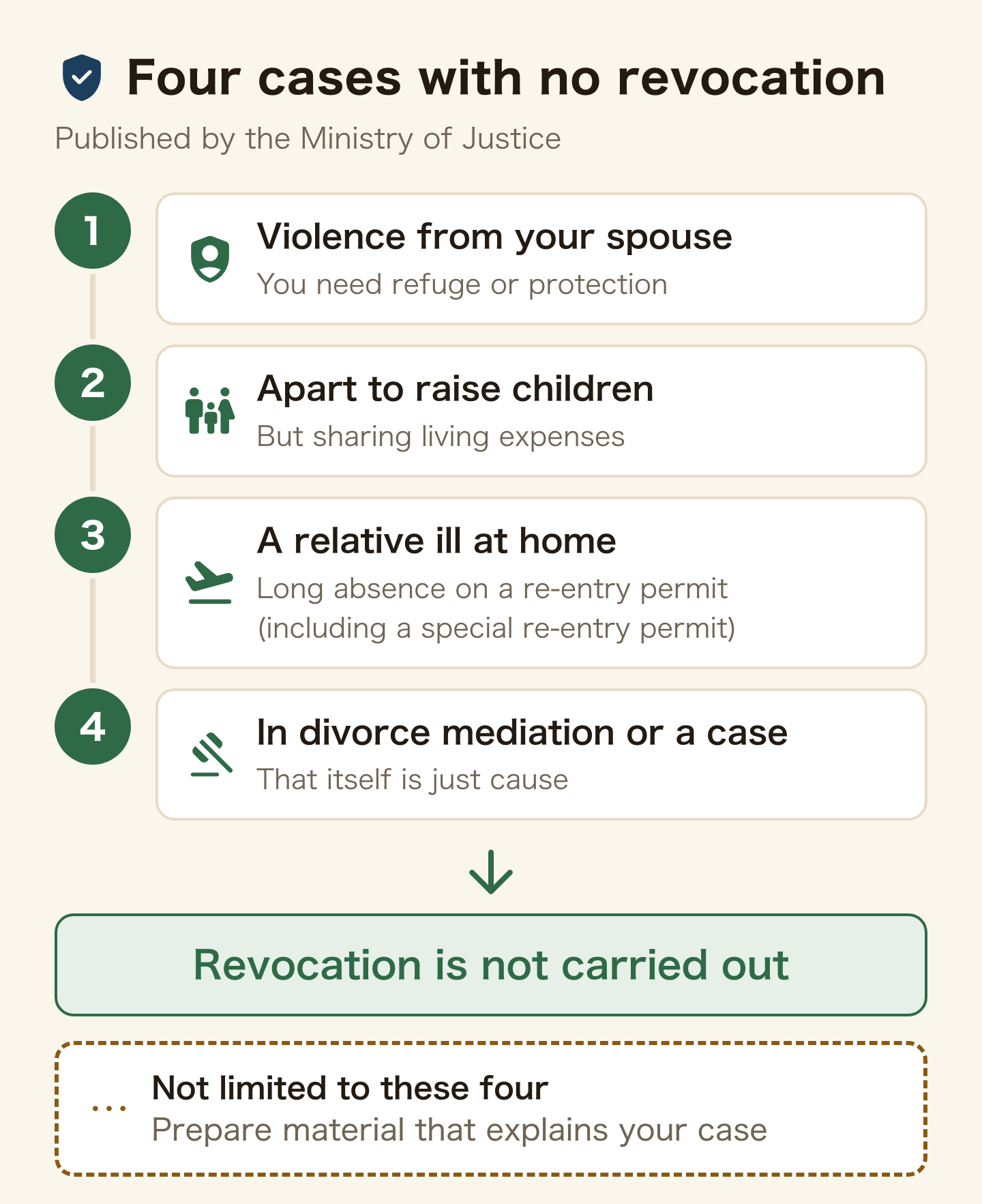
- Where you need temporary refuge or protection because of violence from your spouse (domestic violence)
- Where you live apart from your spouse for unavoidable reasons such as raising children, but you share living expenses
- Where you are outside Japan for a long period on a re-entry permit (including a special re-entry permit) because of illness or injury of a relative in your home country
- Where you are in divorce mediation or divorce litigation
Look at the fourth one. While the mediation or the case is running, that is itself just cause. You do not have to accept bad terms out of fear that your status will vanish if the process drags on. If your period of stay expires mid-mediation, you can still file the spouse visa renewal with a written explanation of the separation.
The first matters just as much. Leaving home to escape violence is not held against you – it is the first item on the official list.
The list is not exhaustive
The published document states that the examples are “not necessarily limited to those given below.” Decisions rest on individual circumstances. If your situation is not on the list, that is not a reason to stay silent – it is a reason to prepare material that explains it.
Immigration has a duty before it revokes
This is rarely mentioned, and it is in the statute:
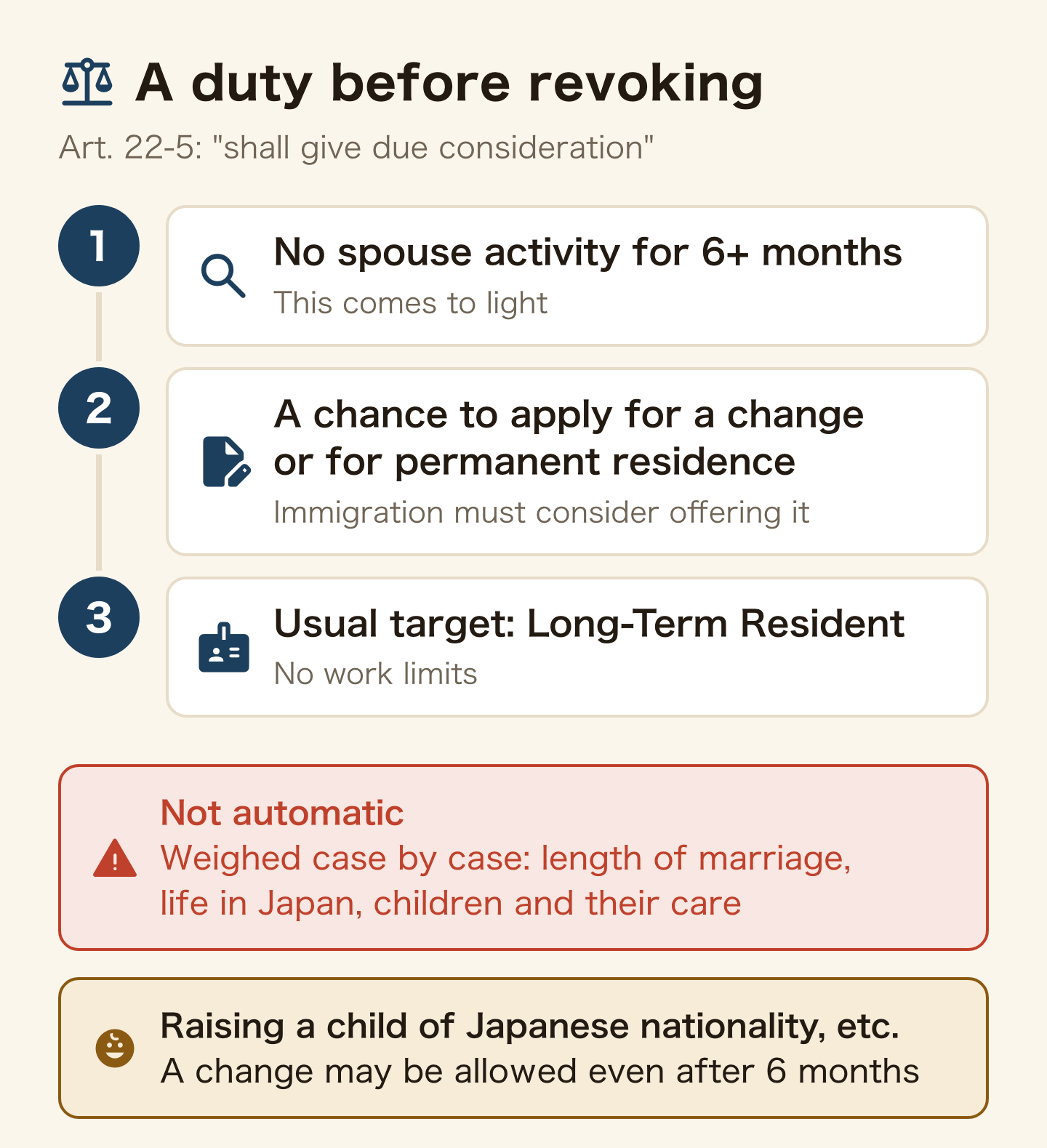
Where the Minister of Justice seeks to revoke the status of residence because the fact set out in item (vii) has come to light, the Minister shall give due consideration to affording the opportunity to apply for a change of status of residence or for permission for permanent residence.
Immigration Control Act, Article 22-5 – translated from the Japanese original
“Shall give due consideration” – it is written as a duty. The procedure is not designed to end with a revocation and nothing else.
The published material adds a note: even where the six months have passed, a change to another status of residence may be permitted where circumstances such as having custody of and raising a child of Japanese nationality exist.
The status people actually move to is Long-Term Resident. It has no work limits, and 5 years on it is enough to apply for permanent residency – what Long-Term Resident status is, and the cases where Immigration granted the change, will tell you what to explain when you ask. But it is not automatic. The length of the marriage, how your life in Japan has been established, whether you have children and how you are raising them – all of it is weighed individually. Anything telling you that divorce simply converts to Long-Term Resident is not accurate.
If it is revoked, do you leave that day?
No. The Immigration Services Agency explains the effect this way.
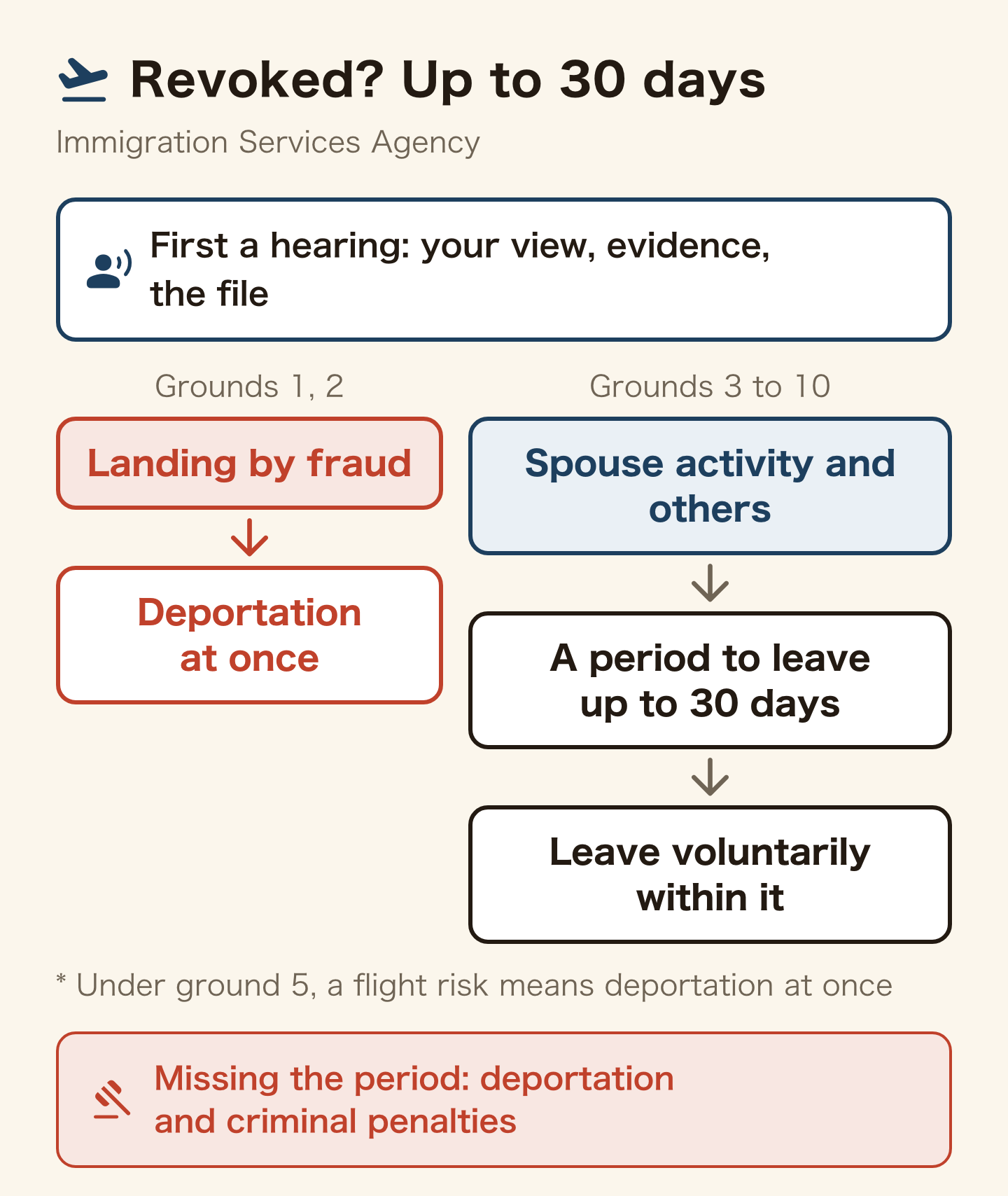
Where someone obtained landing permission by fraud (grounds 1 and 2), deportation follows immediately. But for grounds 3 to 10, which include the spouse-activity ground, a period necessary for departure is designated, up to a maximum of 30 days, and you leave voluntarily within it. The exception is ground 5: where there are reasonable grounds to suspect the person will abscond, deportation follows immediately.
There is also a hearing before any revocation. You may state your opinion, submit evidence, and request to inspect the material. It is not a process you wait out in silence.
One warning: failing to leave within the designated period makes you liable to deportation and to criminal penalties. Once a period is set, work within it.
The order to do things in
- Report within 14 days of the divorce or bereavement. It is a duty, and it does not weaken your position
- Check whether you fall within the four examples. Mediation or litigation in progress is itself just cause
- If you do not, ask about changing status before the six months run. Immigration has a duty to consider giving you that opportunity, and moving early leaves you more options than waiting
- If a hearing notice arrives, attend and explain. You are entitled to submit evidence
If you are escaping violence, contact a support service first – our list of help lines has the numbers. Securing your safety and handling your status can run in parallel.
When you reach the stage of rebuilding, look at changing to a work visa and at switching your health insurance.
Frequently asked questions
Q. What happens to my spouse visa in Japan after divorce?
Nothing immediately. Revocation applies where you have not carried out activities as a spouse for six months or more, and even then just cause takes you outside it. Report within 14 days, and ask about changing status before the six months run.
Q. My divorce mediation will run past six months. Will I lose my status?
Being in divorce mediation or divorce litigation is one of the four published examples of just cause. Keep documents showing the proceedings are under way.
Q. I left home to escape my spouse’s violence. Will my status be revoked?
Needing temporary refuge or protection because of a spouse’s violence is the first item on the published list. Leaving is not structured to count against you.
Q. Can I change to a Long-Term Resident visa after divorce?
Not automatically. It is an individual judgement on the length of the marriage, your established life in Japan, and the care of any children. Immigration does have a duty to consider giving you the opportunity to apply for a change of status or permanent residence (Article 22-5).
Q. Is bereavement treated the same as divorce?
The reporting duty is the same: within 14 days of the divorce or the death. The six-month provision applies in the same way, as a period of not carrying out activities as a spouse.
Q. If my status is revoked, must I leave Japan that day?
No. For this ground a departure period of up to 30 days is designated and you leave voluntarily within it. Failing to leave within that period makes you liable to deportation and criminal penalties.
Summary
- Report within 14 days of divorce or bereavement (Article 19-16(iii)). Dependent status is covered too
- Revocation attaches to not carrying out activities as a spouse for six months or more (Article 22-4(1)(vii)). Not six months from the divorce
- Four published examples of just cause: DV refuge / living apart while sharing expenses / long absence for a relative’s illness / divorce mediation or litigation. The list is expressly not exhaustive
- Before revoking, immigration must consider giving you the chance to apply for a change of status or permanent residence (Article 22-5)
- If revoked, a departure period of up to 30 days is designated, and there is a hearing where you can submit evidence
Official sources: Immigration Services Agency, “Revocation of status of residence (Article 22-4)” / Ministry of Justice, examples of when revocation is not carried out where there is just cause (PDF) / e-Gov, Immigration Control and Refugee Recognition Act
Provisions and published material were checked on 8 October 2026. Revocation decisions rest on individual circumstances. For your own case, consult a regional immigration bureau, an immigration lawyer or an attorney. If you are escaping violence, contact a spousal violence counselling and support centre or the police first.
Found this useful? Share it
Send it to a friend who lives in Japan.
WHO WROTE THIS

mori
Japanese. I read the ministries’ own notices, orders and Q&As in the original, and I start from what my Nepalese and Sri Lankan friends in Japan actually ran into. I do not write about what I have not checked or been told.
What this site can and cannot do →Looking for something else?
You may use the figures in this article, including commercially, if you credit this site with a link. How to use our figures