Checked on 23 September 2026 against the Ministry of Justice Q&A on international marriage and the family register, the Act on General Rules for Application of Laws, the Civil Code, the Family Register Act, the Penal Code and the Immigration Control Act (e-Gov), the Immigration Services Agency’s page on the Spouse of Japanese National status, and the family register guidance of Chuo, Osaka, Fukuoka and other city offices.
The short answer
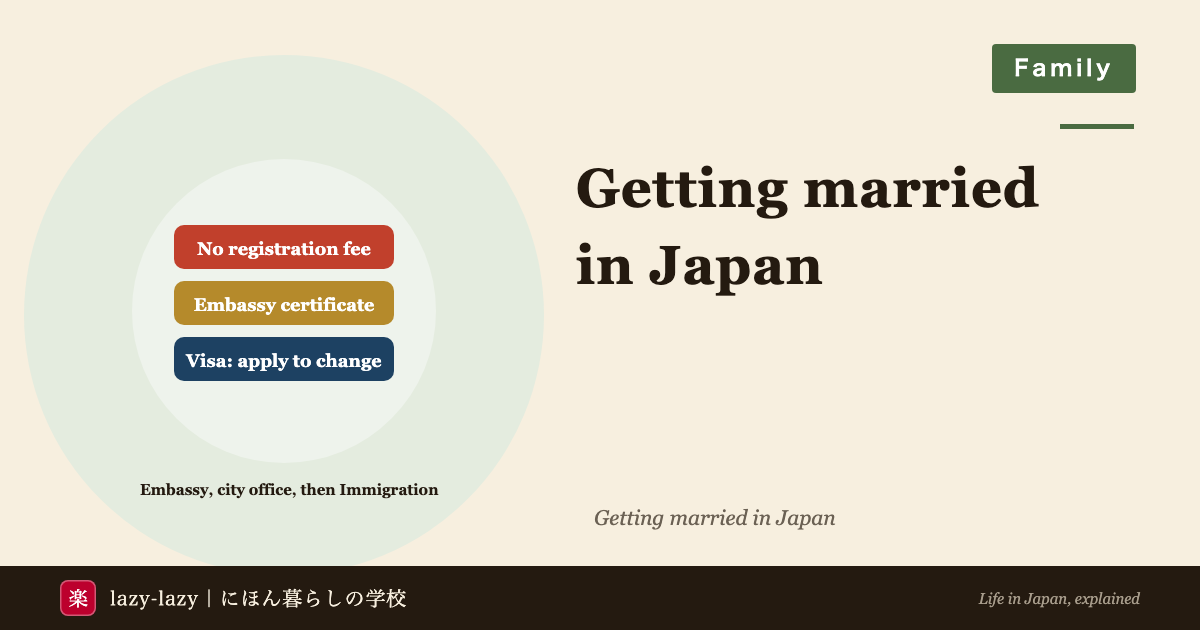
- To get married in Japan, you file a marriage registration at a city office, and the day it is accepted is your wedding day in law. There is no fee for the registration itself.
- The foreign partner needs a certificate of legal capacity to marry, with a Japanese translation. Your embassy issues it to show that your own country’s law lets you marry. If your country does not issue one, there are substitutes.
- Whether each of you can marry is decided by each person’s own national law (Act on General Rules for Application of Laws, Article 24). Japanese nationals can marry from 18. Two foreigners can also marry at a Japanese city office.
- Marriage does not change your visa (status of residence) by itself. To move to Spouse of Japanese National, you apply to Immigration for a change of status. It takes one to two months.
- The city office does not tell your home country. You report the marriage yourself. A sham marriage is a crime, and the status it brings is cancelled.
Knowing this, you can line up the embassy, the city office and Immigration in the right order, instead of collecting papers twice or filing at the last minute before your card expires.
You and your Japanese partner of three years have decided to marry. “Let’s just go and hand in the form,” they say. For two Japanese people, it is one sheet of paper and two witnesses. Then the counter asks for a certificate from your embassy and a Japanese translation of it. Your partner has never heard of that document. When does your visa change? What do you tell your own country? You ask Japanese friends, and nobody knows. For them, marriage is a procedure that begins and ends inside one country.
- How do you get married in Japan as a foreigner?
- Whose law applies: yours or Japan’s?
- What documents do you need? The certificate of legal capacity to marry
- Can two foreigners get married in Japan?
- Does marriage change my visa in Japan?
- How much does it cost?
- Do I need to report the marriage to my home country?
- What happens to surnames and the koseki?
- What if it is a sham marriage?
- What if I run out of time, or cannot get the papers?
- Which one are you?
- FAQ
- Summary
- Related reading
How do you get married in Japan as a foreigner?
The core is the same marriage registration (konin todoke) that Japanese couples use. The Ministry of Justice calls this “marriage in the Japanese form”. When the city office receives the form, confirms that both of you meet the conditions, and accepts it, you are married from that moment (Civil Code, Article 739). Chuo City puts it simply: the day of filing is the day of marriage.
You file at the city office of the Japanese partner’s registered domicile (honseki), or of the place where the person filing is (Family Register Act, Article 25). “Where you are” includes a temporary place of stay, not only your registered address (Matsuyama City). Two foreigners file where they are.
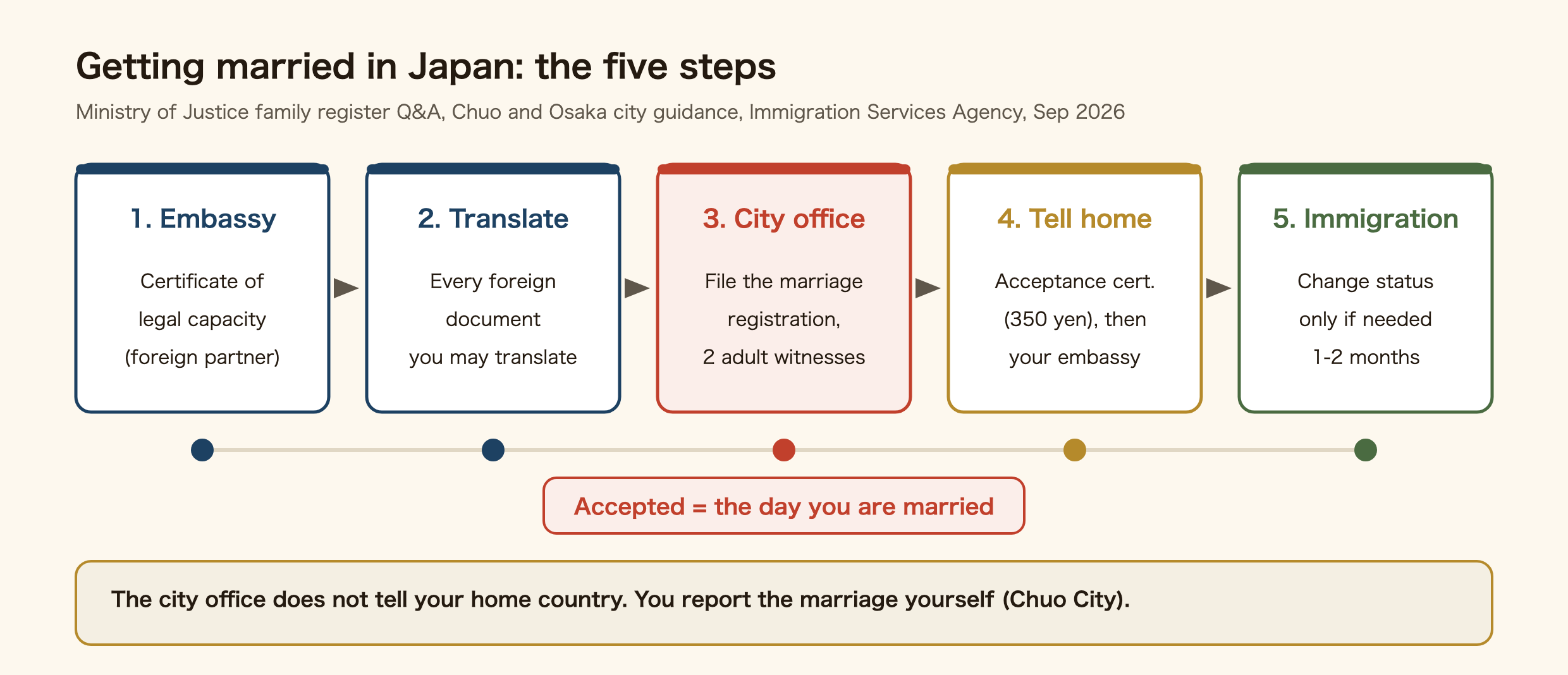
There are two other routes. One is to marry first in the other country, in that country’s form. The Japanese partner then submits the foreign marriage certificate to a Japanese embassy or to their home city office within three months of the marriage (Family Register Act, Article 41). The other route is only for two foreigners: marrying at your own country’s embassy in Japan, in your country’s form. In that case, nothing needs to be filed at a Japanese city office (MOJ Q&A).
Mixed couples need to watch one point. If one of you is Japanese and you marry inside Japan, the city office registration is the only way. A ceremony at a foreign embassy in Japan does not create a marriage under Japanese law.
Whose law applies: yours or Japan’s?
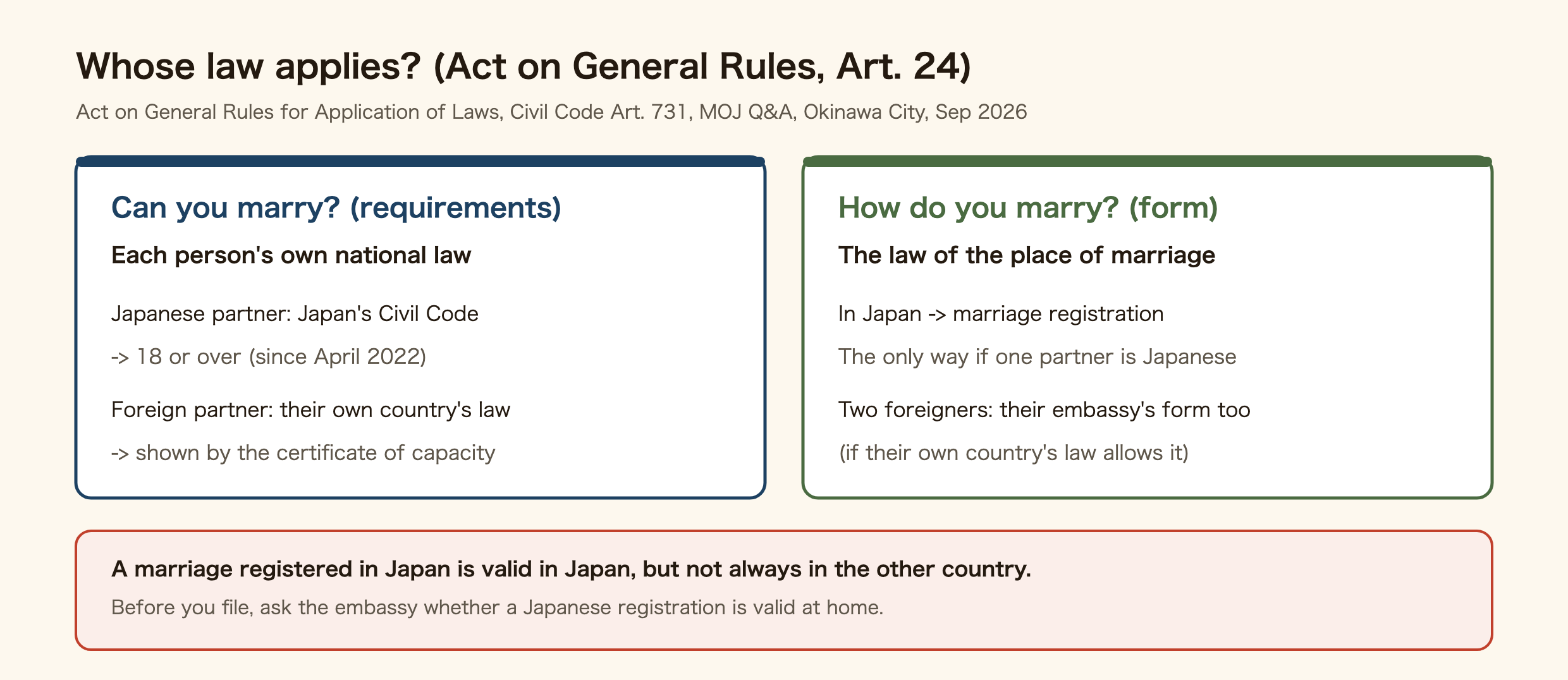
An international marriage touches two legal systems. Article 24 of the Act on General Rules for Application of Laws decides which one does what.
- Whether you can marry (age, being single and so on) is decided by each person’s own national law (paragraph 1)
- How you marry (the filing or ceremony) is decided by the law of the place where you marry (paragraph 2)
- A form that fits either partner’s national law is also valid, except when the marriage takes place in Japan and one partner is Japanese (paragraph 3)
Your Japanese partner must meet the conditions of the Japanese Civil Code. You must meet the conditions of your own country’s law. A Japanese city office cannot know every foreign law. So your embassy certifies that you can marry under your law. That document is the certificate of legal capacity to marry.
The marriage age works the same way. For Japanese nationals it has been 18 for both men and women since 1 April 2022 (Civil Code, Article 731). Before that, it was 16 for women. For the foreign partner, it is the age in their own law. The Japanese Civil Code also no longer has a waiting period before a woman can remarry (Article 733 was deleted). If your own country’s law has one, that still applies to you.
What documents do you need? The certificate of legal capacity to marry
A certificate of legal capacity to marry is a document in which your embassy or consul certifies that, under your own country’s law, you meet the conditions for marriage, such as age and being single. Chuo City gives its English name as “Certificate of Legal Capacity to Contract Marriage”. In Japanese it is konin yoken gubi shomeisho.
These are the typical documents on Chuo City’s list.
| Whose | Document | Note |
|---|---|---|
| Both | Marriage registration form | Signed by two adult witnesses |
| Foreign partner | Certificate of legal capacity to marry | With a Japanese translation |
| Foreign partner | Birth certificate | With a Japanese translation |
| Foreign partner | Certificate of nationality | A valid passport (original) can be used instead |
| Both | Photo ID | Residence card, passport, My Number Card and so on |
| Japanese partner | Family register (koseki) copy | Since 1 March 2024, normally no longer attached |
The exact list depends on your nationality. Chuo City asks you to contact the family register counter with your country’s name before filing. Fukuoka City also asks couples with a foreign partner to consult in advance.
Anyone may do the Japanese translation, including you. The translator writes their name at the end of the translation (MOJ Q&A, Chuo City).
The two witnesses must be adults, and they can be foreign nationals. Toyota City asks for witnesses who are registered as residents in Japan, and a foreign witness writes their nationality in the honseki box.
What if my country does not issue the certificate?
Some countries have no such certificate. You can still marry. The MOJ Q&A lists substitutes in two steps.
- A sworn statement made before your country’s consul in Japan, saying you have reached the legal age to marry and there is no legal obstacle, signed by the consul (with a Japanese translation)
- If that is not possible either: a copy of your country’s law (with its source and a translation), plus a passport, certificate of nationality, civil registry extract or birth certificate
So it is not “not needed”. The proof simply takes another shape. Some embassies take a long time to issue it, so ask your embassy how long it takes before you set a date.
Can two foreigners get married in Japan?
Yes. Two foreigners can file a marriage registration at the city office where they live, and once it is accepted, the marriage is valid under Japanese law (MOJ Q&A). Foreigners have no koseki, so the office keeps the form itself for 50 years. Your proof of marriage is the certificate of acceptance the office issues.
The question is whether your own country will recognise it. Okinawa City says plainly that a marriage registered in Japan is valid in Japan, but not always valid in your home country. If you share a nationality, you may be able to marry at your embassy in Japan instead. Ask the embassy which route works before you file.
If you do not live in Japan, for example if you came as tourists, expect delays. Chuo City says that registrations by two foreigners who do not live in the ward take about four months to review, or around six months with no precedent. A short visit may end before a decision.
Marrying another foreigner does not mean your spouse can live in Japan as your family. Whether they can get Dependent status depends on your own status. Check that your status is on the list of statuses that can bring a spouse to Japan first.
Does marriage change my visa in Japan?
No, not by itself. After the registration is accepted, your residence card stays the same. You keep your current status: Student, Engineer/Specialist in Humanities/International Services, or whatever you hold. To move to the Spouse or Child of Japanese National status, you apply to Immigration for a change of status of residence.
Whether to change depends on your situation. What Immigration clearly asks is that people who have stopped the activity of their old status apply promptly. That means someone who left their job or graduated from school, for example. Staying in Japan without doing your old activity can make your status liable to cancellation.
The Immigration Services Agency’s page lists these documents for the change.
- Change of status application form and one photo
- Your Japanese spouse’s koseki copy showing the marriage (if the marriage is not on it yet, the certificate of acceptance as well)
- A marriage certificate issued by an authority of your own country
- Proof of living costs (residence tax certificates of taxation and payment, and so on)
- Your Japanese spouse’s letter of guarantee, and the residence record (juminhyo) of the whole household
- The questionnaire (how you met and came to marry)
- Proof of your relationship: two or three snapshots of you together, and records of social media or calls
- Your passport and residence card, shown at the counter
Japanese certificates must be issued within the last three months, and any foreign-language document needs a Japanese translation. The standard processing time is one to two months. Spouse of Japanese National is granted for five years, three years, one year or six months, and after that you extend it through spouse visa renewal.
If your partner is a permanent resident rather than a Japanese national, the status is Spouse or Child of Permanent Resident. Marriage does not change your nationality, either. Japan’s Nationality Act has no route to citizenship through marriage. The route is naturalization, where spouses of Japanese nationals have shorter residence requirements (Article 7). The other way round, a Japanese national who takes a foreign nationality by their own choice loses Japanese nationality (Article 11).
How much does it cost?
| Item | Cost |
|---|---|
| Marriage registration | No fee (Fukuoka City) |
| Certificate of acceptance | 350 yen each; 1,400 yen for the decorative high-quality paper version (Osaka City) |
| Certificate of legal capacity to marry | Depends on your country and embassy |
| Japanese translation | Free if you do it yourself |
| Change of status (received by 30 September 2026) | 6,000 yen at the counter, 5,500 yen online |
| Change of status (applied on or after 1 October) | Set by the length granted: one year is 33,000 yen at the counter or 27,000 yen online; three years is 64,000 or 56,000 yen |
The Immigration fee is paid when the permission is granted, not when you apply. From 1 October 2026, it has seven levels depending on the length of stay granted. Applications received by 30 September pay the old amount, even if permission comes in October or later. Every level is in the October fee rise.
Do I need to report the marriage to my home country?
The Japanese city office has no system for telling your country about the marriage (Chuo City). If you want it on your home country’s civil register, you report it yourself to your embassy or consulate in Japan. For that, you use the certificate of acceptance, or a certified copy of the registration form, from the city office.
This matters for your visa too. Immigration’s list for the change of status includes “a marriage certificate issued by an authority of your own country”. If you put off reporting at home, that one paper is missing and your application is delayed. How to report and how long it takes differ by country, so ask your embassy before you file in Japan.
What happens to surnames and the koseki?
No koseki is created for the foreign partner. Your name, date of birth and nationality, and the fact of the marriage, are written in your Japanese partner’s koseki. If your partner was still in their parents’ koseki, a new one is created with them at the head (Family Register Act, Article 16).
Your Japanese partner’s surname does not change automatically. If they want to take your surname, they can do it by a simple notification at the city office within six months of the marriage (Family Register Act, Article 107). After six months, they need permission from the family court. The MOJ Q&A’s example is “Ayumi Suzuki” becoming “Ayumi Jordan”.
What if it is a sham marriage?
Filing a marriage for a visa, with no intention of being married, breaks several laws.
- The marriage is void. Under Civil Code Article 742, a marriage without an intention to marry is void
- Making officials record a false marriage in the family register is a crime under Penal Code Article 157: up to five years’ imprisonment or a fine of up to 500,000 yen, and attempts are also punished. Both partners file the registration, so the Japanese partner is one of the people who filed
- Status obtained by lies or improper means is liable to cancellation (Immigration Control Act, Article 22-4). When cancelled for improper means, you are given no period to leave and face deportation (Articles 22-4(7) and 24)
- Under Article 70, obtaining residence permission by improper means is also punished with up to three years’ imprisonment, a fine of up to 3 million yen, or both
That is why the change of status asks for a questionnaire, photos and social media records. For a real marriage, you do not need special preparation. Just keep your everyday photos and messages rather than deleting them.
A real marriage has a separate rule if you later stop living as a couple. A person on Spouse of Japanese National who has not lived as a spouse for six months or more can become liable to cancellation (Article 22-4(1)(vii)). The recognised reasons are in spouse visa and divorce.
What if I run out of time, or cannot get the papers?
Your card expires soon and the marriage papers are not ready. This is the most stressful moment. First, check whether you can renew your current status to buy time. If you are still working or studying, that route may be open.
If you apply for a change or renewal before your period of stay ends, you can remain in Japan until a decision is made, or for up to two months after the expiry date, whichever comes first (Immigration Control Act, Article 20(6); not for periods of 30 days or less). Letting the date pass without applying is the worst option.
If you came on a short-term visa, such as a tourist visa, and married here, a change of status is not granted unless there are unavoidable special circumstances (Article 20(3)). Talk to Immigration in that case.
If your country will not issue the certificate, if you cannot get papers because it is a remarriage, or if you have no status of residence, some offices such as Chuo City ask you to consult the family register counter first. You can drop off a marriage registration at night or on holidays, but it is only held; the office decides whether to accept it after review on a working day (Fukuoka City).
Which one are you?
- Marrying a Japanese national in Japan — today, ask your embassy what it needs for the certificate of legal capacity and how long it takes. Also call your city office’s family register counter, give your nationality, and ask for its list.
- Two foreigners marrying in Japan — today, ask your embassy two things: “Is a Japanese registration valid at home?” and “Can we marry at the embassy?” Choose the city office or the embassy after you hear the answer.
- Already married and unsure about changing your visa — today, get a certificate of acceptance and start reporting to your home country. Count back from the day you will leave your job or school, and set the date for the change of status.
- Your card expires within three months — today, check whether you can renew your current status. Do not let it expire while you wait for marriage papers.
FAQ
Q. Where do foreigners get married in Japan?
At a city office: the office of the Japanese partner’s registered domicile, or of the place where the person filing is. Two foreigners file where they are. The day the registration is accepted is the day you are married.
Q. What is a certificate of legal capacity to marry?
A document in which your embassy or consul certifies that you meet the conditions for marriage under your own country’s law. You submit it with a Japanese translation along with the marriage registration. If your country does not issue one, a sworn statement before your consul may be accepted instead.
Q. What does the Japanese partner need to bring?
The registration form and photo ID. Since 1 March 2024, a koseki copy normally no longer has to be attached, even when filing outside the registered domicile. The foreign partner brings the certificate of legal capacity, a birth certificate and proof of nationality (a passport can be used), each with a Japanese translation.
Q. Does my visa automatically become a spouse visa when I marry?
No. To move to Spouse of Japanese National, you apply to Immigration for a change of status. The standard processing time is one to two months. Immigration asks people who have stopped the activity of their old status to apply promptly.
Q. Can two foreigners get married in Japan?
Yes. File a marriage registration at the city office where you live; once accepted, it is valid in Japan. It is not always recognised in your home country, so check with your embassy before you file.
Q. Do I have to report the marriage to my home country?
The Japanese city office does not notify your country, so to register the marriage at home you report it yourself to your embassy or consulate. Immigration’s change of status requires a marriage certificate from your country, so start early.
Summary
Getting married in Japan centres on one form: the marriage registration at the city office. Each partner’s own law decides whether they can marry, so the foreign partner shows it with a certificate of legal capacity to marry. Japanese nationals can marry from 18. The registration itself costs nothing.
Marriage does not change your status of residence or your nationality by itself. Reporting to your home country and changing your status only happen if you start them. Put the embassy, the city office and Immigration in order, and count back from the date on your residence card.
Official sources: Ministry of Justice, Q&A on international marriage and the family register (Japanese) / MOJ, 2024 Family Register Act reform (Japanese) / MOJ, age of majority and marriage age (Japanese) / e-Gov, Act on General Rules for Application of Laws / Immigration Services Agency, Spouse of Japanese National / ISA, revision of residence permission fees / Chuo City, family register filings involving foreign nationals (Japanese) / Osaka City, certificate of acceptance (Japanese) / Fukuoka City, marriage registration (Japanese). Checked on 23 September 2026. Required documents differ by country and by office, so confirm with your city office’s family register counter and your embassy before you file.
Related reading
Found this useful? Share it
Send it to a friend who lives in Japan.
WHO WROTE THIS

mori
Japanese. I read the ministries’ own notices, orders and Q&As in the original, and I start from what my Nepalese and Sri Lankan friends in Japan actually ran into. I do not write about what I have not checked or been told.
What this site can and cannot do →Looking for something else?