Checked on 23 September 2026 against the Maternal and Child Health Act and the Child and Child-Rearing Support Act (e-Gov), the Children and Families Agency’s pages on prenatal checkups, its survey of checkup funding (April 2025), its leaflet and municipal Q&A on the pregnancy support payment, its handbook support site, and guidance from Shinjuku City, Osaka City and Edogawa City.
In short
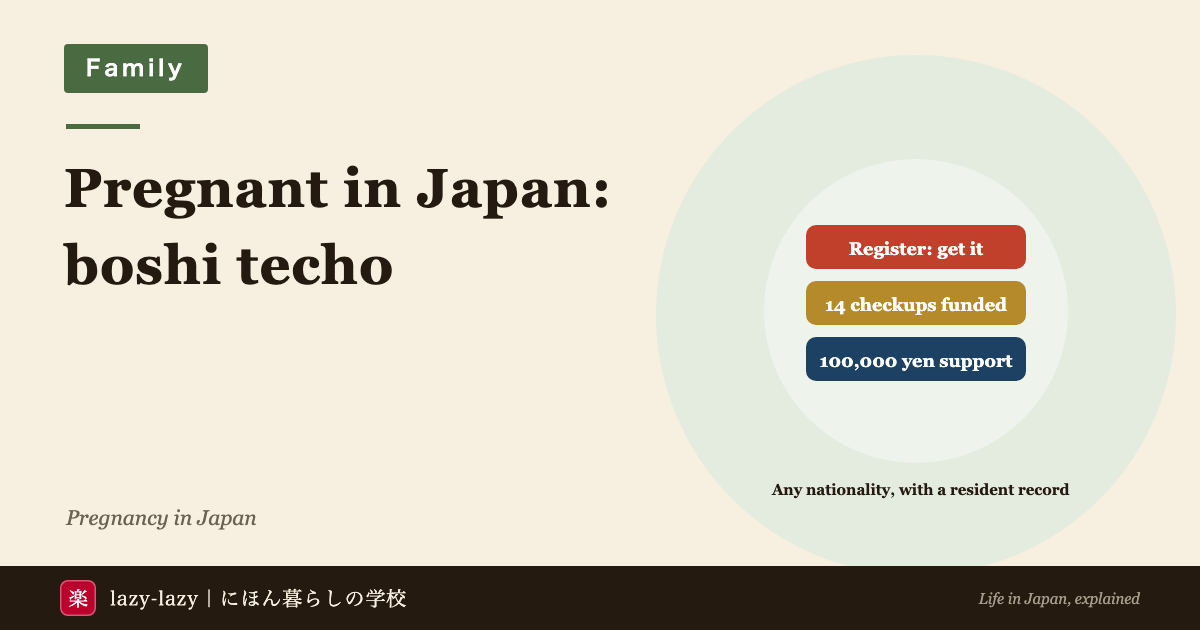
- Once a clinic confirms the pregnancy, register it at the city office where your resident record is. You get the Maternal and Child Health Handbook (boshi techo) on the spot, free.
- The boshi techo is one booklet that records your prenatal checkups, the birth, and your child’s growth and vaccinations. By law the city gives it to anyone who registers a pregnancy. Nationality is not a condition.
- Every one of Japan’s 1,741 municipalities funds at least 14 prenatal checkups. The average public funding is 113,647 yen per pregnancy. Tests beyond what the voucher covers can cost you extra.
- Since April 2025 there is a pregnancy support payment: 50,000 yen once the pregnancy is confirmed, then 50,000 yen per baby from eight weeks before the due date. 100,000 yen for one baby.
- The condition is a resident record in Japan. Nationality does not matter, and neither does whether you are on National Health Insurance or an employer’s plan. The handbook exists in 10 languages.
Knowing this, you can use vouchers from your very first checkup and claim the full 100,000 yen without missing a step. You will also know which counter to go to and what to ask before you set off.
The doctor says congratulations. On the way home you realise you have no idea what comes next. A Japanese friend tells you, “You go to the city office and get your boshi techo.” Then you ask: “Can a foreigner get one? Is there one in English? What about money?” And the answers stop. For people who grew up here it is so ordinary that nobody has ever had to think about it.
- Pregnant in Japan: where do you register the pregnancy?
- What is the boshi techo, and can foreigners get one?
- Is there a boshi techo in English?
- How many prenatal checkups, and what do they cost?
- What is the pregnancy support payment?
- National Health Insurance or employer insurance: does it change anything? What about my visa?
- Moving, or giving birth somewhere else
- What if you register late?
- Worried about money or language?
- Which one are you?
- FAQ
- Summary
- Related reading
Pregnant in Japan: where do you register the pregnancy?
At the city, ward, town or village office where your resident record is. In many places the counter is a public health centre rather than the main city hall. The Maternal and Child Health Act (Art. 15) says a pregnant person should notify the mayor “promptly”.
There is no fixed number of days. Osaka City says there is no deadline, but asks you to register as soon as you know. Shinjuku City asks for “by week 11 if possible”.
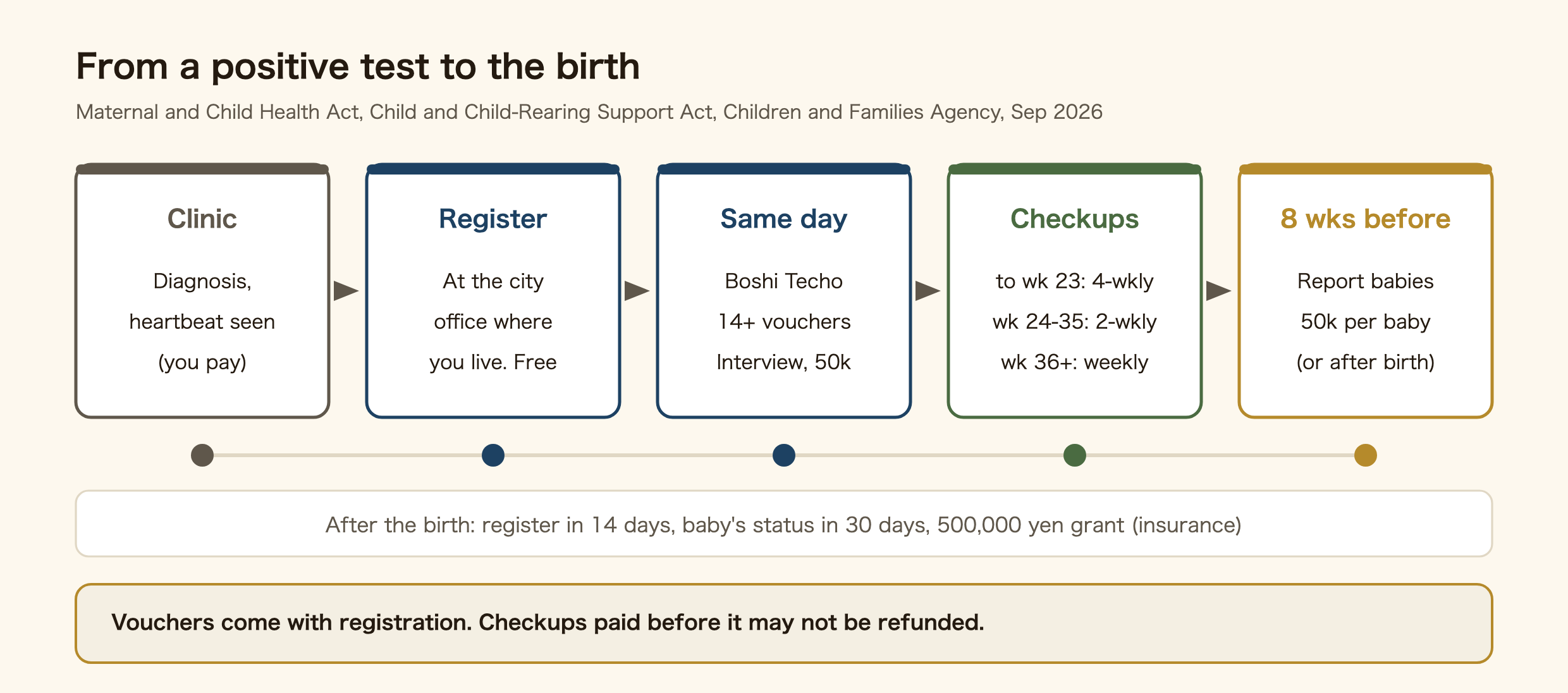
The clinic comes first. The Children and Families Agency describes the order as: see an obstetrician, then register the pregnancy at your local office and collect the handbook. That first clinic visit is paid out of pocket, because you do not have vouchers yet.
What to bring varies a little by city. Shinjuku City asks for three things.
- Something showing the pregnant person’s My Number: a My Number Card, the notification card, or a residence certificate that shows the number
- ID for the person filing (a residence card is fine)
- A letter of authorisation, only if someone outside your household files for you
If the clinic gave you a note with the weeks of pregnancy, the due date and the clinic’s name, bring it too. Some cities, Shinjuku among them, let you file the notification online through Mynaportal first. You still collect the handbook in person.
What is the boshi techo, and can foreigners get one?
The Maternal and Child Health Handbook (boshi kenko techo, usually shortened to boshi techo) holds your checkup results, the record of the birth, your child’s growth, health checks and vaccinations in one booklet. Article 16 of the Maternal and Child Health Act says the municipality “must issue” it to anyone who has registered a pregnancy. There is no nationality condition.
Doctors and midwives write in it at every checkup, so take it to every appointment. After the birth, you keep using it for your child’s checks and vaccinations.
Is there a boshi techo in English?
Yes. The Children and Families Agency publishes the handbook in 10 languages: English, Chinese, Korean, Vietnamese, Portuguese, Nepali, Tagalog, Indonesian, Spanish and Thai. Anyone can download the PDFs from the “For foreign residents” page of its handbook support site.
Whether the counter hands you a printed copy depends on the city. Shinjuku gives one foreign-language copy “as reference material” to a pregnant woman who is a foreign national and does not understand Japanese. If only the husband is foreign, it tells you to buy one yourself. The agency’s own advice is simply to ask whether a foreign-language handbook is available.
That is why people ask whether the boshi techo costs money. The Japanese handbook itself is free. Bilingual editions, with each page in Japanese and one of 10 languages side by side, are sold by the Maternal and Child Health Research Foundation, a public-interest foundation. If your city does not give you one, that is where it comes from. The copy your doctor writes in is the Japanese one.
How many prenatal checkups, and what do they cost?
The national standard for prenatal checkups sets about 14 visits. The Children and Families Agency gives these intervals.
- Early pregnancy to week 23: every four weeks
- Weeks 24 to 35: every two weeks
- Week 36 to the birth: every week
The cost is covered by vouchers (jushinhyo, sometimes called vouchers or tickets) that the city gives you when you register. In the agency’s survey as of 1 April 2025, all 1,741 municipalities funded at least 14 checkups. The average public funding was 113,647 yen per pregnancy.
Osaka City’s vouchers show what that looks like.
| Osaka City vouchers (fiscal 2025) | Paid by the city |
|---|---|
| No. 1 (around weeks 8-11, includes blood tests) | 24,940 yen |
| Nos. 2-11, standard checkup (each) | 3,780 yen |
| Nos. 12-14 (visits with more tests) | 8,560-17,380 yen |
| Ultrasound (4 times, each) | 4,780 yen |
| Total (one baby) | 122,020 yen |
What you pay yourself is anything above those amounts. Osaka and Edogawa both say you may pay extra depending on the tests. If you need treatment for an illness during pregnancy, that falls outside the vouchers and is billed to your health insurance (Edogawa City). If treatment bills get large, the high-cost medical expense benefit caps what you pay each month.
What is the pregnancy support payment?
It is a cash benefit from your city, introduced in April 2025 under the Child and Child-Rearing Support Act. It turned the earlier “childbirth and childcare support grant” into a scheme set by law (Children and Families Agency).
The amount is in the law: the number of babies plus one, times 50,000 yen (Art. 10-12). That is 100,000 yen for one baby and 150,000 yen for twins. It comes in two parts.
- First, 50,000 yen: apply to the city where your resident record is once a clinic has seen the baby’s heartbeat. Some cities let you apply on the pregnancy registration form itself (agency Q&A)
- Second, 50,000 yen per baby: report how many babies you are carrying from eight weeks before the due date. Reporting after the birth is also fine
The application comes with an interview with a public health nurse or similar (agency leaflet). The money goes into the pregnant woman’s own account. The agency’s Q&A says it cannot go to a child’s account, and it cannot be paid to anyone else either. If you have just arrived, open a bank account in your own name early. Some cities offer coupons instead of cash.
Miscarriage and stillbirth are covered. So is an abortion after the heartbeat was confirmed. The payment is not taxed (Art. 10-7).
National Health Insurance or employer insurance: does it change anything? What about my visa?
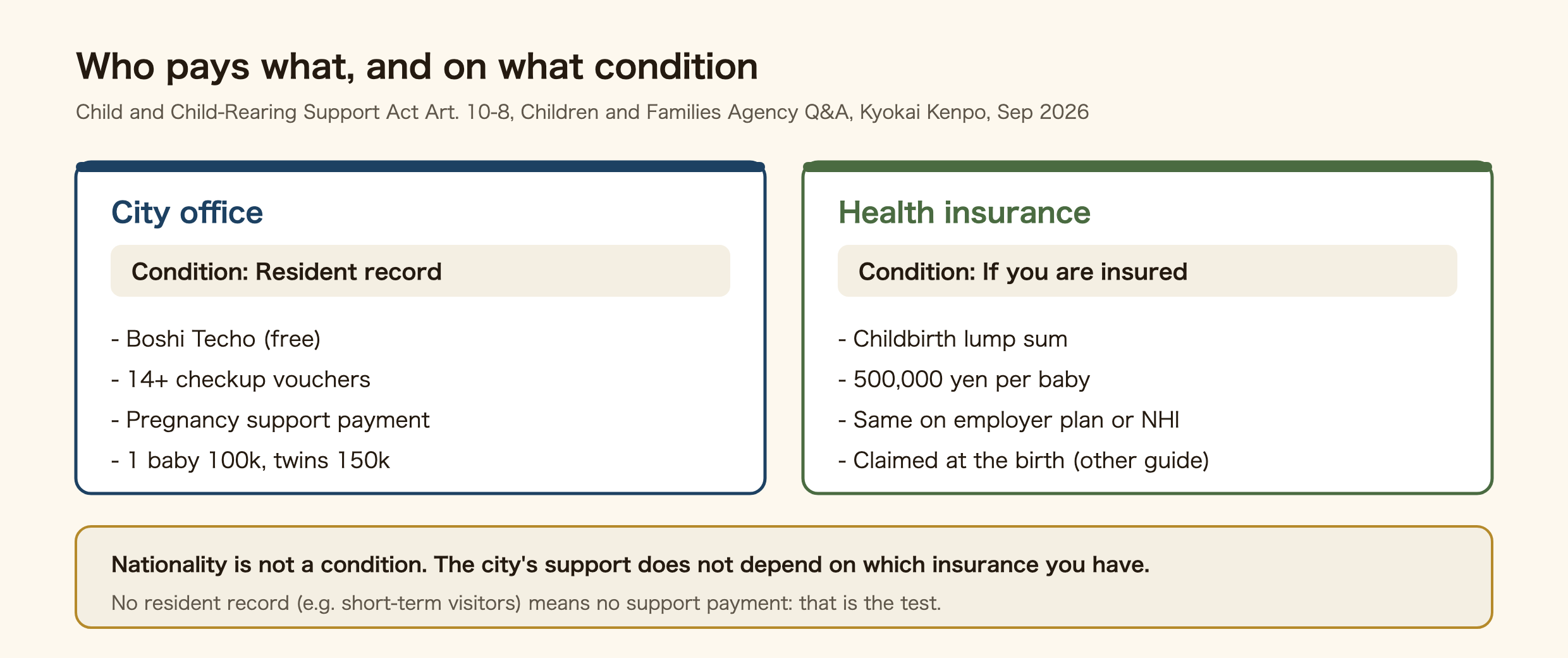
The condition for the support payment is one line of law: “a pregnant woman who has an address in Japan” (Art. 10-8). The agency’s Q&A says it applies whether or not the person has Japanese nationality.
Your status of residence is not a condition either. Asked about people on short-term statuses, the Q&A tells cities to “decide by whether there is a resident record”. So the dividing line is the resident record. If you live here on a status of more than three months and have registered your address, you qualify. A short-term visitor with no resident record does not.
Your health insurance does not matter. Pregnancy registration, the handbook, the vouchers and the support payment all belong to the city where your resident record is. National Health Insurance, an employer’s plan, or being covered as a dependant: it is the same.
What health insurance pays is the childbirth lump sum at the birth (500,000 yen per baby). That is an after-birth procedure, so check it in the guide to having a baby in Japan, together with the 14-day birth registration and the baby’s 30-day status application.
Moving, or giving birth somewhere else
Vouchers belong to the city that issued them. Osaka says its vouchers stop working once you move out, and you get new ones from your new city. The handbook stays the same. After the moving-house paperwork, go to the new city’s health centre as well.
The support payment works the same way. After moving, you apply again in the new city, and anything already paid is deducted (Art. 10-12, para. 3).
If you have checkups at a clinic outside your city, every municipality in Japan still offers some funding (agency survey). The usual method is to pay first and claim it back later. In Osaka the claim must be made within one year of the end of the pregnancy. Keep every receipt.
If you plan to go home to give birth, what you do with your resident record changes the support payment. Under the agency’s Q&A, if you keep your resident record in Japan you can apply and report even from abroad. If you move your record out before reporting the number of babies, you cannot make that second report. You can make it once you are back and have an address in Japan again, within the two-year limit. Before you leave, get the first payment done and ask the counter how to make the second report.
What if you register late?
The Maternal and Child Health Act has no penalty for not registering a pregnancy. Being late still costs you.
- Checkups before you receive the handbook may never be refunded. Shinjuku says plainly that checkups paid for yourself before the handbook was issued are not subsidised
- If you forget the voucher at a contracted clinic, that visit cannot be claimed back either (Osaka City)
- The support payment expires: two years from the time you could first claim it (agency Q&A)
Once the clinic has seen the heartbeat, aim to register that same week. If you have already paid for a few checkups yourself, register today and the vouchers cover the rest.
Worried about money or language?
The Maternal and Child Health Act (Art. 9-2) requires every municipality to offer advice on maternal and child health. The interview that comes with the support payment is the start of support that continues after the birth.
“I am worried about paying for checkups.” “I do not understand the explanations in Japanese.” “I have nobody nearby to help.” Say these things at the first interview, and the nurse can connect you to the services and interpreting that exist. Some municipalities have a “children and families centre” that handles pregnancy and child support in one place (Child Welfare Act Art. 10-2; setting one up is an obligation to try, not a must). After the birth, if your body or the baby is too much, there are postnatal care services with overnight stays, day visits or home visits (Maternal and Child Health Act Art. 17-2).
For life in Japan in general, the agency’s site also points to the Immigration Services Agency’s information centres for foreign residents. If you work, look at the money for your time off too: maternity and childcare leave benefits depend on your employment and health insurance, not your nationality.
Which one are you?
- The clinic has just confirmed the heartbeat — take your residence card and something showing your My Number to the health centre of the city where you live. Do the registration, handbook, vouchers and first support payment in one visit, today or this week.
- Worried you cannot read a Japanese handbook — ask at the counter, “Is there a foreign-language boshi techo?” If not, download your language’s version from the agency’s site today.
- Moving during pregnancy, or giving birth at a clinic in another city — get new vouchers and re-apply for the support payment at your new city’s health centre. Start a folder for refund receipts today.
- The due date is close — if you are past eight weeks before it, report the number of babies today for the second payment. Plan the 14-day birth registration and the 30-day status application too.
FAQ
Q. Can foreigners get a boshi techo in Japan?
Yes. Article 16 of the Maternal and Child Health Act says the municipality issues the handbook to anyone who registers a pregnancy, with no nationality condition. Register at the city office where your resident record is and you get it free, on the spot.
Q. Is there an English boshi techo?
Yes. The Children and Families Agency publishes the handbook in 10 languages including English, downloadable from its handbook support site. Whether your city hands out a printed foreign-language copy varies. The copy your doctor writes in is the Japanese one.
Q. How many prenatal checkup vouchers do you get in Japan?
Every municipality funds at least 14 checkups (Children and Families Agency, as of 1 April 2025). The average public funding is 113,647 yen per pregnancy, and tests beyond what a voucher covers can cost extra.
Q. How much is the pregnancy support payment, and can foreigners get it?
The number of babies plus one, times 50,000 yen: 100,000 yen for one baby. You get 50,000 yen once the pregnancy is confirmed and 50,000 yen per baby after reporting the number from eight weeks before the due date. The condition is an address in Japan, decided by whether you have a resident record. Nationality does not matter.
Q. When do I have to register my pregnancy?
The law says “promptly” and sets no number of days. But checkups you pay for before receiving the handbook may not be refunded, so register as soon as the clinic confirms the heartbeat.
Q. Does it matter whether I have National Health Insurance or employer insurance?
No. The handbook, vouchers and pregnancy support payment come from the city where your resident record is, and the type of health insurance is not a condition. What health insurance pays is the childbirth lump sum at the birth.
Summary
When you are pregnant in Japan, confirm the heartbeat at a clinic and register the pregnancy at the city office where your resident record is. You get the boshi techo and vouchers for at least 14 checkups the same day. Since April 2025, the pregnancy support payment adds 100,000 yen for one baby.
The condition is a resident record, not your nationality or your insurance. There is no deadline, but every week of delay adds checkups you pay for yourself. Tell the nurse at the first interview if language or money worries you.
Official sources: e-Gov, Maternal and Child Health Act (Japanese) / Child and Child-Rearing Support Act (Japanese) / Children and Families Agency, prenatal checkups (Japanese) / survey of checkup funding (Japanese) / pregnancy support payment (Japanese) / handbook support site, for foreign residents (10-language downloads) / Shinjuku City, pregnancy notification / Osaka City, prenatal checkups (Japanese). Checked on 23 September 2026. What to bring, voucher amounts and foreign-language copies vary by city, so confirm at your local health centre.
Related reading
Found this useful? Share it
Send it to a friend who lives in Japan.
WHO WROTE THIS

mori
Japanese. I read the ministries’ own notices, orders and Q&As in the original, and I start from what my Nepalese and Sri Lankan friends in Japan actually ran into. I do not write about what I have not checked or been told.
What this site can and cannot do →Looking for something else?