Checked on 25 September 2026 against the Ministry of Health, Labour and Welfare’s 2026 medical fee schedule and notices, its Navii medical search and #8000 table, the Fire and Disaster Management Agency’s #7119 page, and the official emergency care guidance of Nishinomiya City, Osaka Prefecture and Tokyo.
The short answer
- When it is not ambulance-level but cannot wait till morning, go to a holiday and night emergency clinic, or the duty doctor for that day. These clinics are run by cities for minor sudden illness at night and on holidays. No appointment is needed (Nishinomiya City).
- Find one that is open with the health ministry’s Navii search, under “Search urgently”. It works in English, Chinese and Korean. By phone, adults can call #7119 (41 areas) and children’s parents #8000 (all 47 prefectures) to ask whether to go and where is open.
- Night and holiday visits add a fee to the first-visit charge. For an adult it is 85 points out of hours, 250 on a holiday and 480 late at night. Paying 30%, that is 255, 750 and 1,440 yen more.
- Walking into a big hospital at night when it is not urgent can cost 7,000 yen or more without a referral, or an out-of-hours fee. Hospitals are not allowed to charge emergency patients the referral fee.
- A night clinic is first aid, not full treatment. You get a short supply of medicine and see your usual clinic the next day.
Knowing this, a fever on a Saturday night stops being a choice between calling an ambulance and suffering till Monday. You can find a place open tonight yourself, and you know in advance roughly what extra you will pay.
It is 10pm on a Saturday. Your temperature has hit 39°C and your throat is burning. Your usual clinic is closed, and this does not feel like an ambulance. You message a Japanese friend, who says, “Just go to the kyukan center.” Where is it? Your friend has no idea. They went as a child, when their parents looked it up. People who grew up here had someone find it for them. You have to find it yourself.
- Where do I go for urgent care in Japan at night or on a holiday?
- What is a holiday and night emergency clinic?
- What is a duty doctor (toban-i)?
- How do I find a clinic open now?
- How much does urgent care cost at night or on a holiday?
- What if I go straight to a big hospital at night?
- What should I bring to a night or holiday clinic?
- What if nobody speaks my language?
- What do I do the next day?
- Which one are you?
- FAQ
- Summary
- Related reading
Where do I go for urgent care in Japan at night or on a holiday?
Emergency care in Japan is organised in three levels by how serious the case is. Nishinomiya City describes them like this.
- Level 1: sudden illness mild enough for an outpatient visit. The holiday and night emergency clinic (in Nishinomiya, the “Oukyu Shinryojo”) and the duty doctors
- Level 2: serious cases that need admission or surgery. Hospitals take turns
- Level 3: life-threatening cases. The critical care centres
Level 1 is the one you walk into yourself. Levels 2 and 3 are for people referred from level 1 or brought in by ambulance. Osaka Prefecture says the same: level 1 is set up by each city, town or village.
So the place to look is your own city. Nishinomiya puts its night clinic and duty doctors on the city website. Search your city’s site for the words kyujitsu (holiday), yakan (night) and kyubyo (sudden illness).
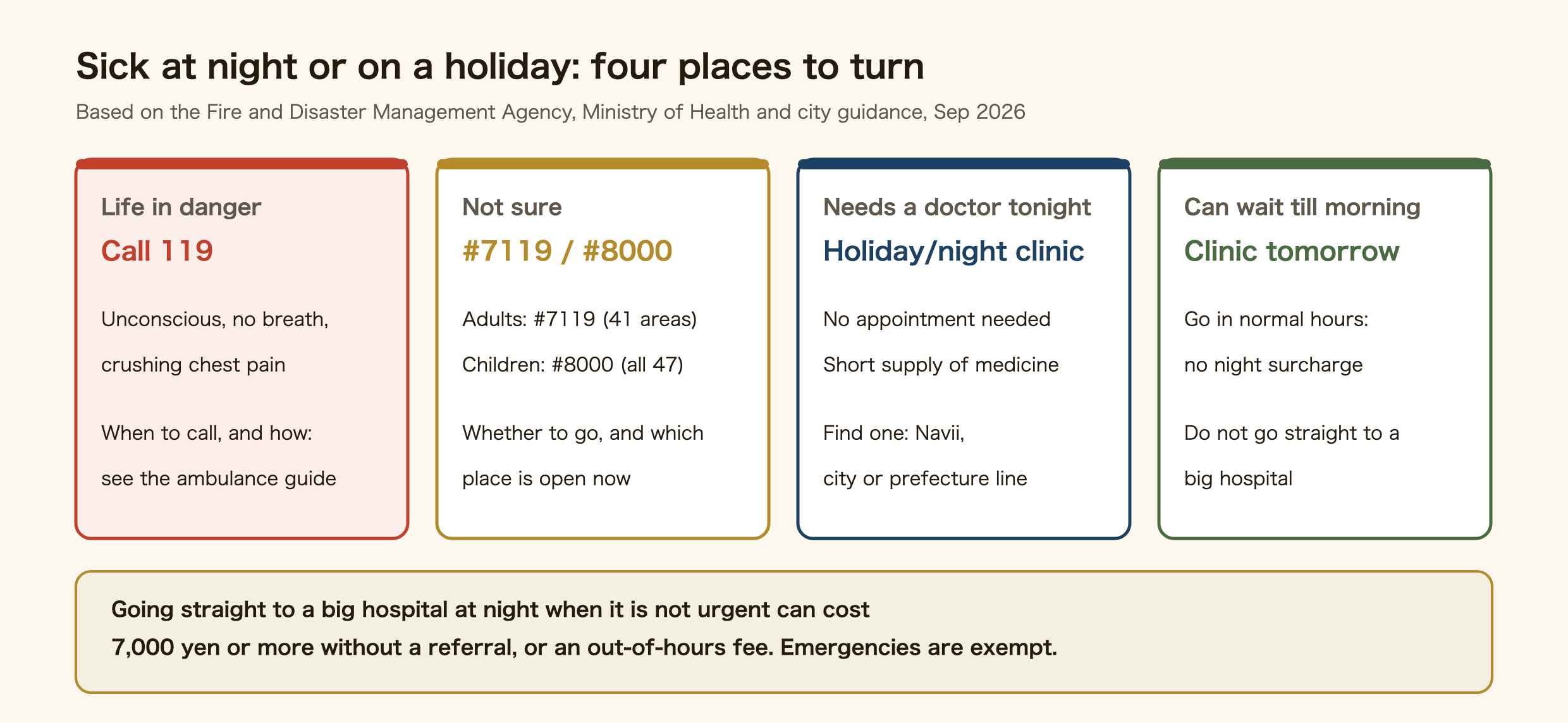
If a life is in danger right now, stop reading and call 119. Which symptoms mean an ambulance, and what to say on the phone, are in how to call an ambulance in Japan, and when to.
What is a holiday and night emergency clinic?
A holiday and night emergency clinic (kyujitsu yakan kyukan center) is a clinic run by a city or similar body to see minor sudden illness at night and on holidays. Names vary: kyubyo shinryojo, oukyu shinryojo and kyubyo center do the same job.
Take the Nishinomiya City night clinic as an example (city page updated 1 June 2026).
- No appointment needed. In flu season you may wait a long time
- Internal medicine and paediatrics only. No surgery or orthopaedics
- No X-ray or blood-test equipment
- Medicine is, as a rule, one day’s supply. For flu or long holidays the doctor decides
- Hours: weekdays 8:30pm to 11:30pm, Saturdays 5pm to 11:30pm. Sundays, public holidays and New Year: 9am to 2pm and 5pm to 11:30pm
The city describes the clinic’s purpose as “first-aid treatment to connect you to your regular doctor.” It is not there to cure you. It is there to get you through to the morning, or to the end of the long weekend.
Hours and departments differ a lot from city to city. In some areas, children go to a different centre after midnight. For Nishinomiya, that is the Hanshin-Kita children’s emergency centre in neighbouring Itami. Ears, eyes and teeth may be handled elsewhere too. Check your own city’s page for hours and departments before you go.
What is a duty doctor (toban-i)?
Duty doctors (toban-i) are local clinics that take turns opening on holidays and at night. Nishinomiya calls it the “at-home duty doctor system” and runs it for surgery, obstetrics and gynaecology, internal medicine and paediatrics.
The difference from the night clinic is that the place changes every day. In Nishinomiya, today’s duty doctors are listed on the city medical association’s website. Navii’s holiday and night search also shows them.
Nishinomiya tells people to use the duty doctor when the night clinic is closed or crowded. It is also how you find a department the night clinic does not have, such as a surgeon on duty for an injury.
How do I find a clinic open now?
If your city’s page does not help, use these three. All are public services.
1. Navii: “Search urgently”
Navii (Iryo Joho Net) is the Ministry of Health’s search for hospitals, clinics and pharmacies across Japan. From the top page, choose “Search urgently”, then “Medical institutions open on holidays and at night” or “Medical institutions currently open”. Set a place by address, map, station or your current location, and results appear nearest first.
The site switches to English, Simplified and Traditional Chinese, and Korean. You can also filter by the foreign languages a clinic speaks. The same “Search urgently” finds pharmacies open on a holiday.
2. Call #7119 (adults) or #8000 (children)
#7119 is the emergency advice line, where doctors, nurses and paramedics advise you by phone. The Fire and Disaster Management Agency says that besides advising whether to go, it will also tell you which medical institutions can see you if you ask where to go.
But #7119 runs in only 41 areas. Tokyo, Osaka and Hyogo take calls from all ages, 24 hours a day. Some areas outside the list run an advice line under a different number. For ages and hours in your area, see where #7119 works and what to call where it does not.
For children, call #8000. Every prefecture has it, but the hours differ.
- Tokyo: weekdays 6pm to 8am; holidays from 8am to 8am the next day
- Osaka: weekdays and holidays, 7pm to 8am
- Hyogo: weekdays 6pm to 8am; holidays from 8am to 8am the next day (Saturdays from 6pm)
In Osaka, #8000 does not answer on a Sunday afternoon. If you have children, look up your prefecture’s hours once (Ministry of Health, as of 22 May 2026). “Holidays” include the New Year break.
3. Call your prefecture’s medical information line
Some prefectures run a phone line that tells you which institutions are open now. It is a directory, not medical advice.
- Tokyo “Himawari”: 03-5272-0303 (24 hours, every day)
- Tokyo medical information service for foreign residents: 03-5285-8181 (English, Chinese, Korean, Thai and Spanish, every day 9am to 8pm)
- Osaka Prefecture Emergency Medical Information Center: 06-6693-1199 (24 hours, 365 days)
Wherever you find a place, phone it before you set out. Tokyo itself warns that listed details can change, and asks you to confirm by phone before going.
How much does urgent care cost at night or on a holiday?
A visit at night or on a holiday adds a fee on top of the usual charge. The amounts are set in the national fee schedule and are the same everywhere in Japan. One point is 10 yen.
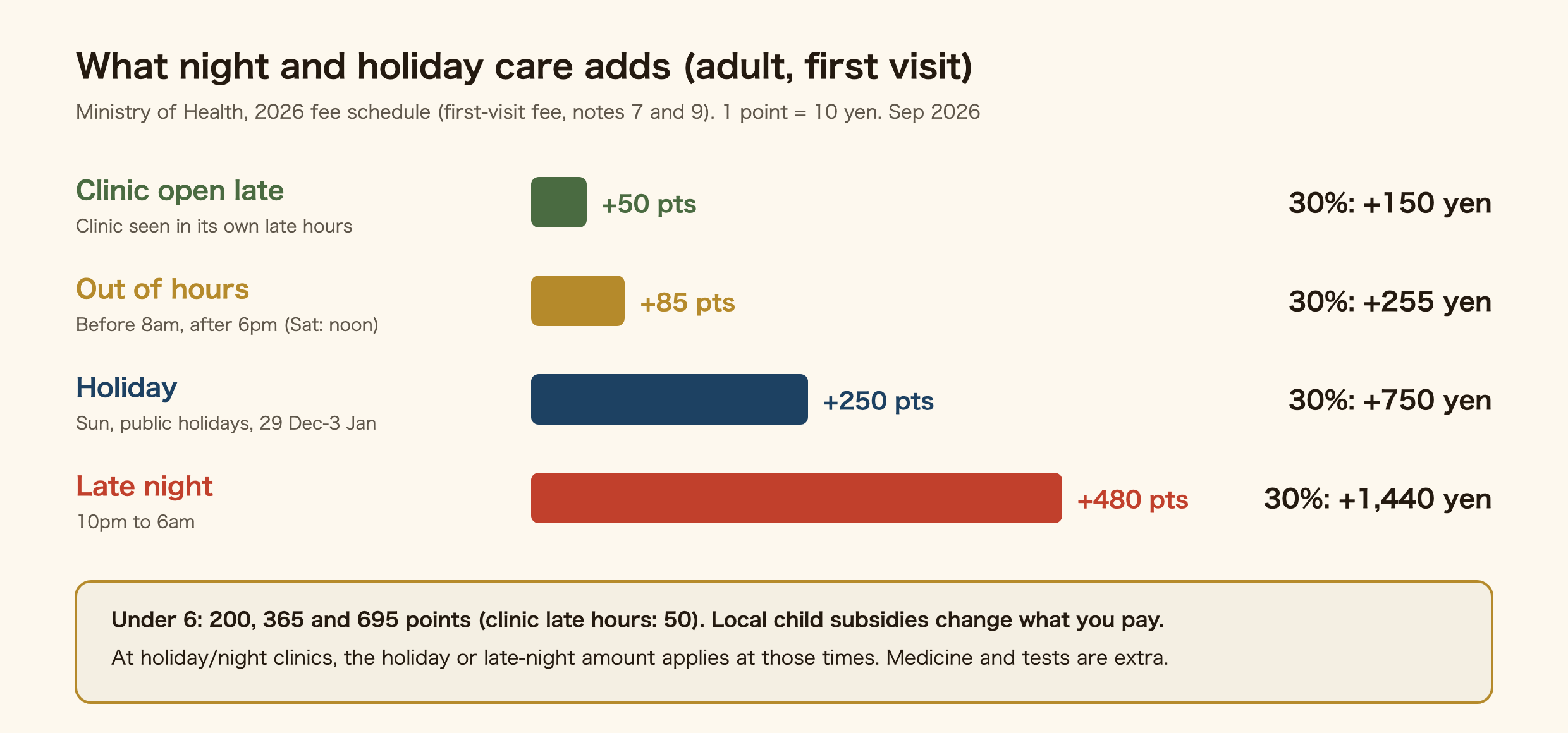
| When | First visit | At 30% | Return visit |
|---|---|---|---|
| Out of hours (roughly before 8am and after 6pm; Saturdays after noon) | 85 points | +255 yen | 65 points |
| Holiday (Sundays, public holidays, 29 Dec to 3 Jan) | 250 points | +750 yen | 190 points |
| Late night (10pm to 6am) | 480 points | +1,440 yen | 420 points |
| A clinic that opens late, seen within its own posted hours | 50 points | +150 yen | — |
Say an adult sees the night clinic for the first time on a Sunday afternoon. The first-visit fee of 291 points plus the 250-point holiday fee comes to 541 points. Paying 30%, that is about 1,620 yen, before medicine and tests. Night clinics and duty doctors are part of the local emergency care system, so a holiday or late-night visit there carries the holiday or late-night fee.
For children under 6, the fees are higher: 200 points out of hours, 365 on a holiday and 695 late at night. But what you actually pay for a child depends on your city’s subsidy. Check it in how children’s medical subsidies work city by city. The share you pay is 30% under age 70, and 20% for children before primary school.
How the time is counted
What counts as “out of hours” depends on the hours the clinic posts. The national guideline is roughly before 8am and after 6pm, or after noon on Saturdays. Holidays are Sundays, public holidays and 29 December to 3 January. Late night is 10pm to 6am in every season.
If the delay is the clinic’s fault, no fee is added. For example, you checked in before 6pm and the clinic only started seeing you after 6pm. For a clinic that opens late, the 50-point fee goes by the time you checked in, and cannot be charged just because crowding pushed you into the late slot.
What if I go straight to a big hospital at night?
Some people head for a university hospital’s night entrance, thinking a big hospital is safer. Two special fees can apply there. Neither is covered by insurance. You pay them in full.
The first is the no-referral fee. Going to an advanced treatment hospital, or a regional medical support hospital or referral-focused hospital with 200 or more general beds, without a referral costs 7,000 yen or more on the first visit. The 2026 revision left this amount unchanged.
But the ministry’s notice does not allow hospitals to charge it to emergency patients. For people seen at night or on a holiday under a local emergency care programme, the hospital may also choose not to charge. On the other hand, if it is not urgent and you went out of hours for your own convenience, the fee can be charged.
The second is the out-of-hours consultation fee. A hospital may charge it when there is no urgent need and the patient chooses to be seen outside its hours for their own convenience. The guideline amount is the same as the out-of-hours fee. A hospital that charges it must post a notice inside and, as a rule, on its website. If you are genuinely ill and it cannot wait, only the normal out-of-hours fee applies.
At night, big hospitals are also where ambulances bring the serious cases. For a minor sudden illness, go to the night clinic or a duty doctor. How to see a doctor in daytime, and which department to choose, is in seeing a doctor in Japan.
What should I bring to a night or holiday clinic?
Osaka Prefecture asks people to prepare the following before going to a clinic at night or on a holiday.
- Your health insurance (now a My Number health insurance card or an eligibility certificate)
- Money for the visit and the medicine
- The names of medicines you take (your medicine notebook)
- A doctor’s certificate or similar if you have an existing condition
- A jacket or blanket, so you do not get cold while you wait
Forgetting proof of insurance changes the bill a lot. At the Nishinomiya night clinic, a city by-law says that if your insurance cannot be confirmed, you pay the full cost worked out at 15 yen a point instead of 10. That is five times what you would pay at 30%.
Check what you should be showing now in the guide to My Number health insurance and the eligibility certificate. Keep it in your wallet so you are not searching for it at night.
What if nobody speaks my language?
Navii lets you filter by foreign language. If you live in Tokyo, 03-5285-8181 finds you institutions that can see you in English, Chinese, Korean, Thai or Spanish (every day, 9am to 8pm).
Neither the agency’s #7119 page nor the ministry’s #8000 page mentions support in other languages. If your Japanese is shaky, ask someone who speaks Japanese to make the call, or find the place on Navii instead. How to find a hospital in your language, and how interpreting works at the hospital, is in finding an English-speaking doctor and an interpreter.
What do I do the next day?
A night clinic gives you only a short supply of medicine. Some, like the one in Nishinomiya, cannot do X-rays or blood tests. The next day, or after the long weekend, go to your usual clinic. Take the medicine and any papers the night clinic gave you.
Going at night or on holidays again and again costs more because of the added fees. If a hospital stay or surgery makes the bill large, the monthly cap on what you pay under the high-cost medical expense benefit applies.
Which one are you?
- You feel ill now and need a doctor tonight — use Navii’s “Search urgently” or #7119 to find an open night clinic or duty doctor. Phone to confirm, then leave with your insurance and medicine notebook.
- Your child has a fever at night — call #8000. If your prefecture’s line is closed, search Navii for a paediatric duty doctor. Save #8000 and its hours in your phone today.
- It can probably wait till morning — drink water, rest, and see your usual clinic tomorrow morning. No night fee. If it gets worse in the night, call #7119.
- You are well right now — today, look up your city’s night clinic and its hours, and put Navii on your phone’s home screen.
FAQ
Q. What is a holiday and night emergency clinic in Japan?
It is a clinic run by a city or similar body for minor sudden illness at night and on holidays. No appointment is needed. It gives first-aid treatment, mainly internal medicine and paediatrics, until you can see your regular doctor. Hours and departments differ by city.
Q. How do I find a clinic open at night or on a holiday?
Use “Search urgently” on the Ministry of Health’s Navii site to find institutions open on holidays and at night, or open right now. #7119 and prefectural lines such as Tokyo’s Himawari or the Osaka Emergency Medical Information Center will also tell you where to go by phone.
Q. Does urgent care cost more at night or on a holiday in Japan?
Yes, a fee is added to the first-visit charge. For an adult it is 85 points out of hours, 250 on a holiday and 480 late at night: 255, 750 and 1,440 yen more if you pay 30%. For children under 6 it is 200, 365 and 695 points.
Q. What is a duty doctor (toban-i)?
Local clinics take turns opening on holidays and at night. The place changes every day, so check the city website, the medical association’s page or Navii for that day’s duty doctor.
Q. What time does #8000 open?
It depends on the prefecture. Tokyo answers from 6pm on weekdays and Osaka from 7pm every day, both until 8am. In all 47 prefectures it answers after midnight.
Q. Can I go straight to a big hospital’s emergency entrance at night?
If it is an emergency, you will not be charged the no-referral fee of 7,000 yen or more. If it is not urgent and you go for your own convenience, that fee or an out-of-hours fee may apply. For a minor sudden illness, go to a night clinic or duty doctor.
Summary
For sudden illness at night or on a holiday that is not an ambulance case, go to a holiday and night emergency clinic or the duty doctor. Find one through your city’s page, Navii’s “Search urgently”, #7119 or #8000, or your prefecture’s line. Phone before you set out to check it is open.
At night and on holidays, a first visit adds 85 to 480 points. Forgetting your insurance makes it much more expensive still. A night clinic is first aid, so see your usual clinic the next day. Going to a big hospital at night when it is not urgent can bring the no-referral fee.
Official sources: Ministry of Health, 2026 medical fee revision (fee schedule and notices, Japanese) / MHLW notice on selected care fees, 27 March 2024 (Japanese) / MHLW, how to use Navii (Japanese) / MHLW, children’s medical advice line #8000 (Japanese) / Fire and Disaster Management Agency, #7119 (Japanese) / Nishinomiya City night clinic (Japanese) / Osaka Prefecture, finding a medical institution (Japanese) / Tokyo, medical information service for foreign residents. Checked on 25 September 2026. Always check your own city’s page for the night clinic’s hours and departments before you go.
Related reading
Found this useful? Share it
Send it to a friend who lives in Japan.
WHO WROTE THIS

mori
Japanese. I read the ministries’ own notices, orders and Q&As in the original, and I start from what my Nepalese and Sri Lankan friends in Japan actually ran into. I do not write about what I have not checked or been told.
What this site can and cannot do →Looking for something else?