Figures, prices and terms were checked against the Immigration Services Agency pages on “Dependent”, “Specified Skilled Worker” and the COE, the Ministry of Foreign Affairs and the MHLW tuberculosis screening page on 3 September 2026. They change — check the current terms yourself before you sign up or file anything.
Last updated: 8 October 2026
Summary
- Bringing your family means getting them the Dependent status of residence.
- Only a spouse and children qualify. Parents are not in the law.
- SSW (i) cannot bring family. Neither can Technical Intern Training. Those statuses are not listed in the provision.
- SSW (ii) can. For your family, the gap between 1 and 2 is the whole story.
- Students can bring family too. Few people know this, but “Student” is on the list.
- A student proves support with a bank balance certificate. The immigration agency says so in writing.
- Nepalese family members need a TB clearance certificate, mandatory since 23 June 2025. Sri Lanka is not covered.
What changes: you know a student can bring family and a bank balance counts as proof of income – so the application you thought impossible is one you can file.
Years apart. You keep sending money home. It feels like time to bring them over.
Then you start reading, and the answers contradict each other. One site says you can, another says you cannot. Both can be right, because the answer depends on the status of residence you hold.
This article is built only from the text of the law and from the immigration agency, the foreign ministry and the health ministry.
- What “bringing your family” actually means
- Only a spouse and children qualify
- Can your status of residence bring family?
- Can SSW bring family to Japan?
- What order do the steps go in?
- Dependent visa documents: a student needs only a bank balance
- Nepalese family members need a TB certificate
- Can I bring my parents to Japan?
- After they arrive, can they work?
- What to do this week
- FAQ
- Summary
What “bringing your family” actually means
It means getting your family the Dependent status of residence. Your family’s permission hangs off the status you already hold in Japan.
The Immigration Control Act defines Dependent as daily activities as the spouse or child receiving support from a person holding one of a listed set of statuses.
Almost the whole answer lives in that sentence: “spouse or child” and “a listed set of statuses.”
Only a spouse and children qualify
To you, family includes your ageing parents. Where you come from, bringing your parents to live with you may be the most natural thing in the world. Japan’s Dependent status covers only a spouse and children, so plans built around bringing a parent stop right here.
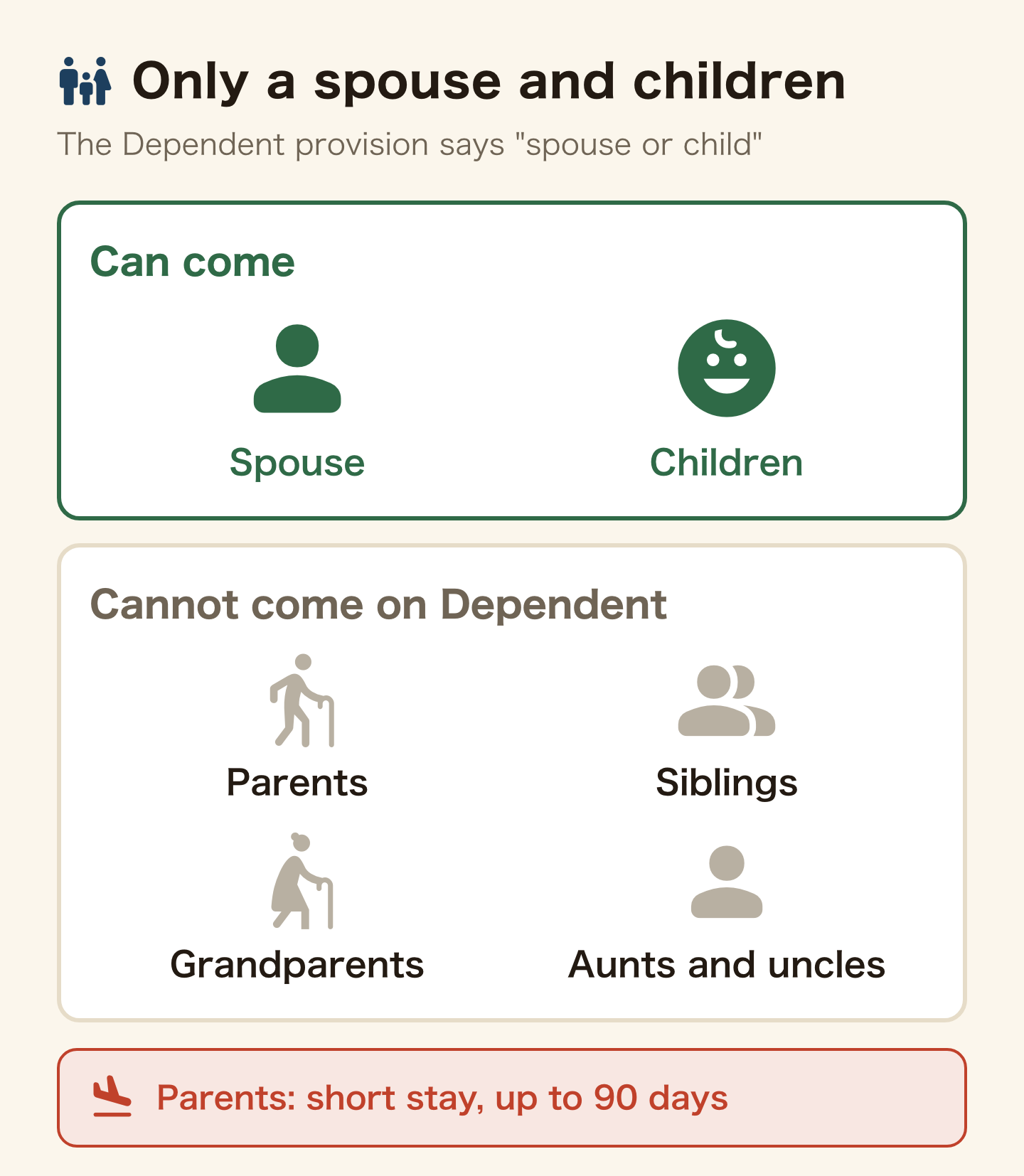
- Can come: your spouse, your children
- Cannot come on Dependent: parents, siblings, grandparents, aunts and uncles
Parents are where most people hit the wall. They are not covered. People keep searching, assuming there is a route they have not found yet. There is no route hidden in the law that the law does not mention. The alternative is further down.
Can your status of residence bring family?
Now the second half: the listed statuses. If yours is not named, even a spouse or child cannot come on Dependent.
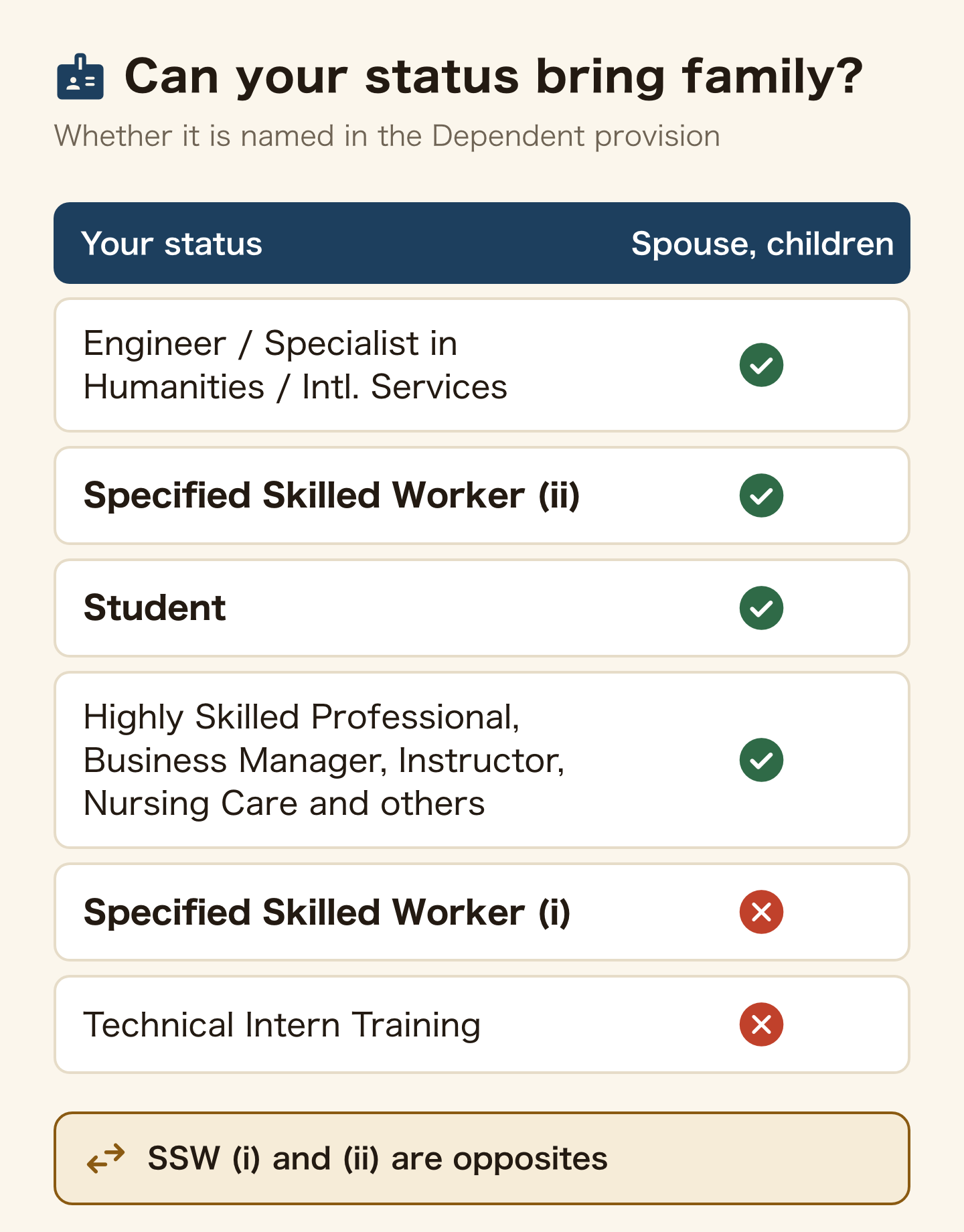
| Your status of residence | Can your spouse and children come? |
|---|---|
| Engineer / Specialist in Humanities / International Services | Yes |
| Highly Skilled Professional / Business Manager / Legal or Accounting Services / Medical Services / Researcher / Instructor / Intra-company Transferee / Nursing Care / Entertainer / Skilled Labor | Yes |
| Professor / Artist / Religious Activities / Journalist / Cultural Activities | Yes |
| Specified Skilled Worker (ii) | Yes |
| Student | Yes |
| Specified Skilled Worker (i) | No |
| Technical Intern Training | No |
The surprise for most readers is “Student”. Even while studying, you can bring a spouse and children. It is written into the provision.
Note that families of permanent residents and of Japanese nationals use different statuses, not Dependent. For example, a foreign spouse of a Japanese national can bring their own unmarried child under 18 from an earlier relationship as a Long-Term Resident. That is outside this article (for extending your own stay as the spouse of a Japanese national, see spouse visa renewal).
Can SSW bring family to Japan?
SSW (ii) can. SSW (i) cannot, for one plain reason: the Dependent provision names Specified Skilled Worker (ii) and does not name (i).
So moving from type 1 to type 2 is not only about pay. It is about whether your family can live with you. SSW (i) is also capped at five years of total stay, while type 2 has no such cap. Both things turn on the same step. Only 11 fields have type 2, so check the SSW type 1 vs type 2 differences and field list to see whether yours does.
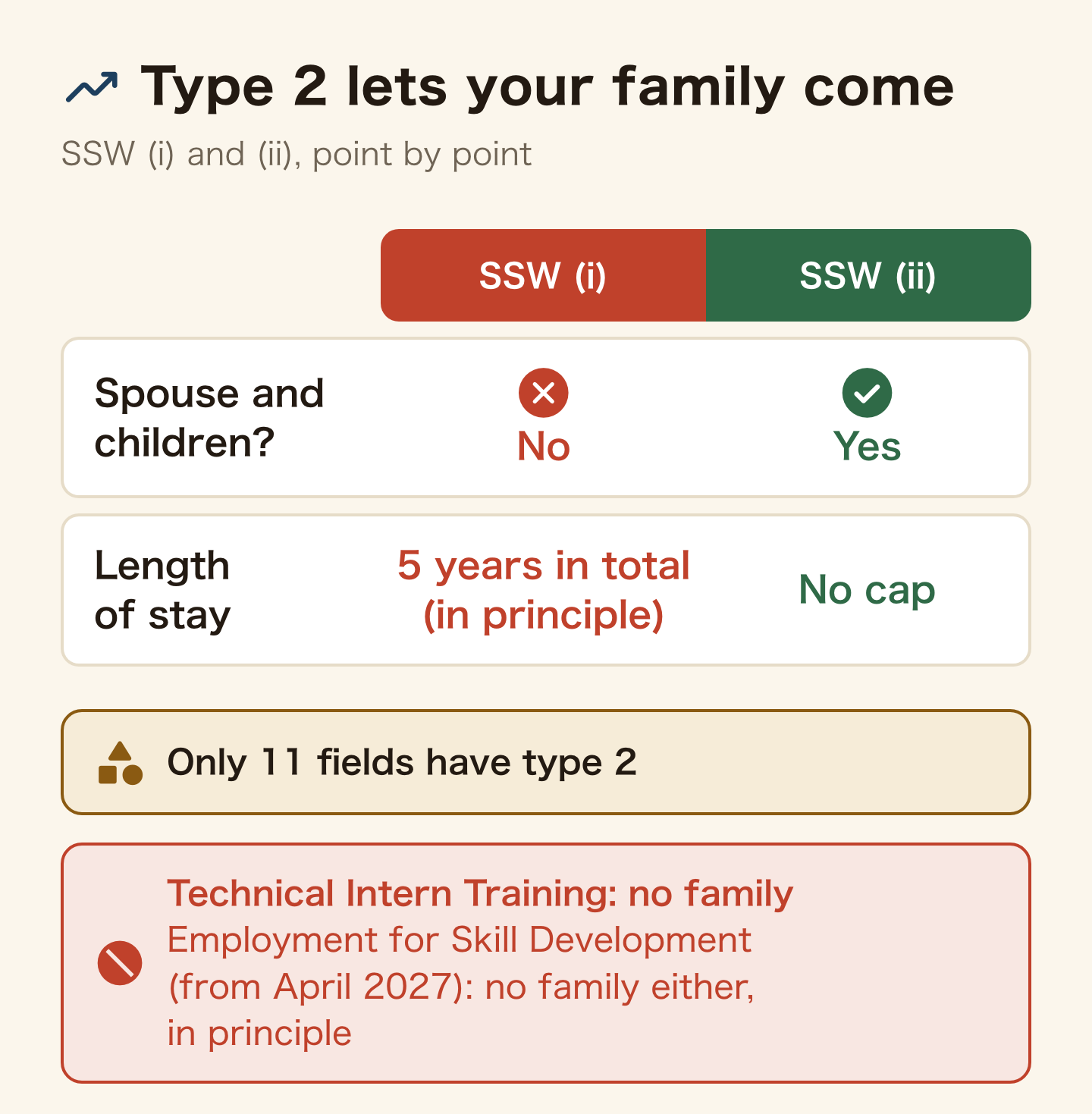
Technical Intern Training is excluded for the same reason, and Employment for Skill Development, which replaces it in April 2027, does not allow family either, in principle. Looking at pay by status of residence, the same divide shows up in money as well.
What order do the steps go in?
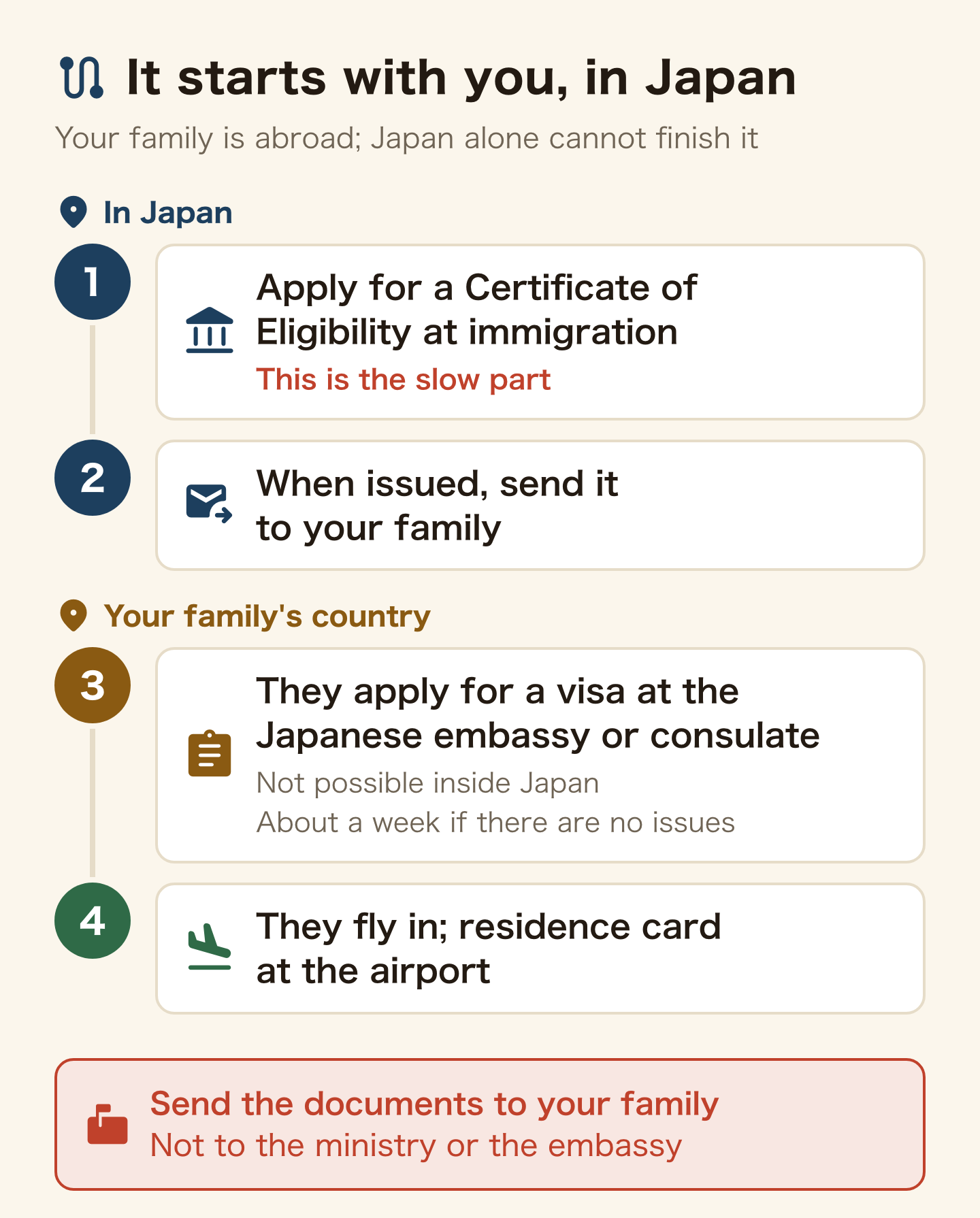
Your family is still abroad, and the process cannot be completed inside Japan. The order is:
- You apply in Japan for a Certificate of Eligibility (COE) at your regional immigration bureau, on your family’s behalf
- When it is issued, send the certificate to your family
- Your family applies for a visa at the Japanese embassy or consulate in their country. The foreign ministry states plainly that visa applications cannot be made inside Japan
- Visa granted, they fly. The Dependent residence card is issued at the airport
The foreign ministry says visa screening takes roughly one week from acceptance when there are no issues. The Certificate of Eligibility is the slow part, so start there early.
A common mistake
Do not post the documents to the ministry or the embassy. The foreign ministry instructs that the inviting person and the guarantor should send the completed documents to the visa applicant – that is, to your family.
Dependent visa documents: a student needs only a bank balance
The immigration agency lists what to file with the Certificate of Eligibility application. The main items:
- The application form and one photograph
- A self-addressed envelope with registered-mail postage
- Proof of the family relationship – a family register extract, a certificate of acceptance of a marriage registered in Japan, a copy of the marriage or birth certificate
- A copy of your residence card or passport
- Proof of your occupation and income
That last one is where people stall, and it splits by status.
How to prove you can support them
If you work (a working status)
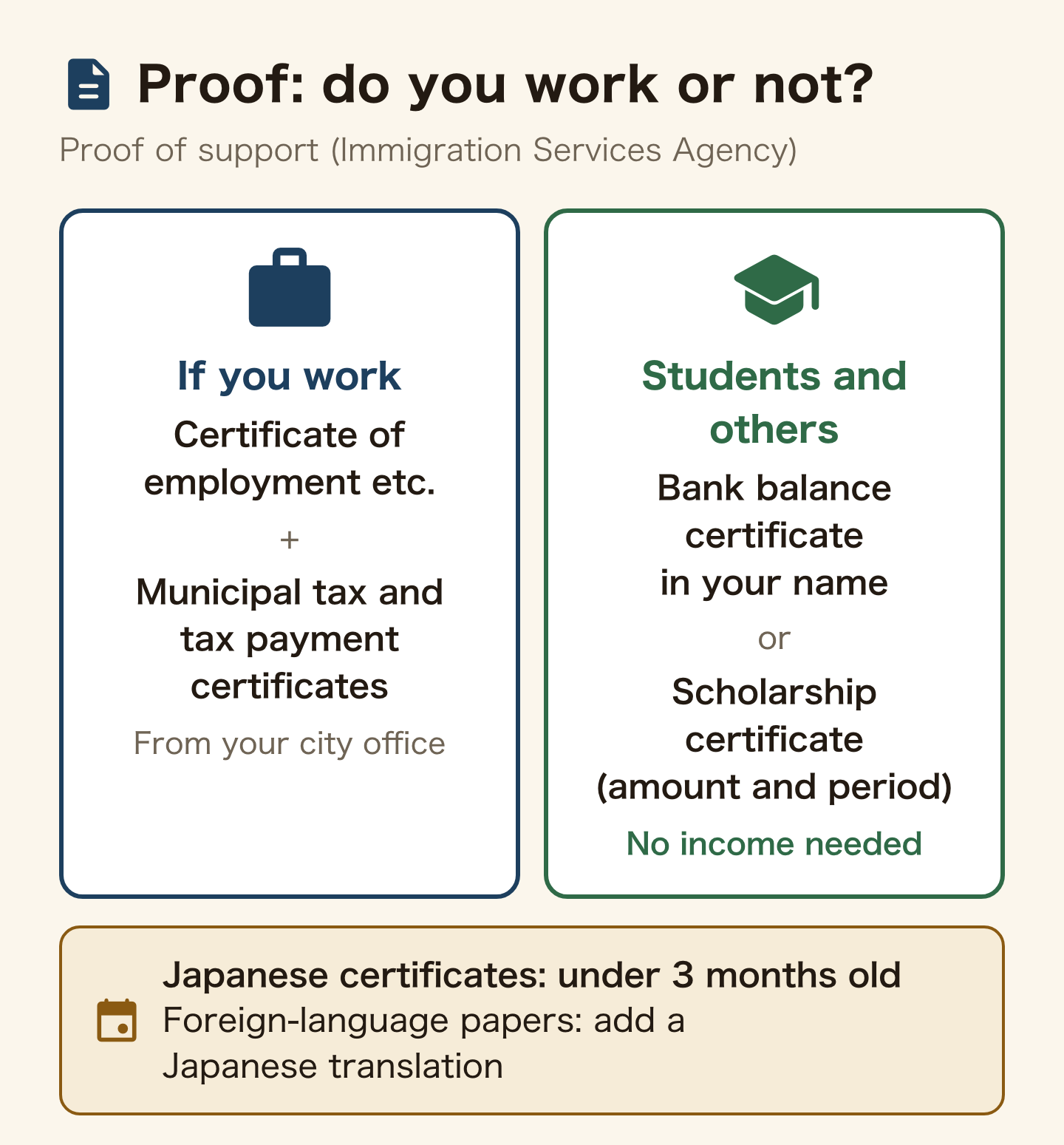
A certificate of employment, plus the municipal tax certificate (taxable or non-taxable) and tax payment certificate showing your annual income and payment record. Your city or ward office issues these.
If you do not (students and others)
A bank balance certificate in your name, or a certificate stating the amount and period of your scholarship. The immigration agency puts this in writing. You do not need an income; you need to show you can support them.
Two rules that are easy to miss. Certificates issued in Japan must be less than three months old, and any document in a foreign language needs a Japanese translation attached.
Nepalese family members need a TB certificate
This requirement is recent, and not knowing about it will stop your application.
Under the health ministry’s Japan Pre-Entry Tuberculosis Screening (JPETS), since 23 June 2025 applicants in the Philippines and Nepal must submit a TB clearance certificate when applying for a Certificate of Eligibility or a visa. Viet Nam followed on 1 September 2025.
Indonesia is set to follow for applications from 4 January 2027. The designated clinics start taking Indonesian applicants on 2 November 2026.
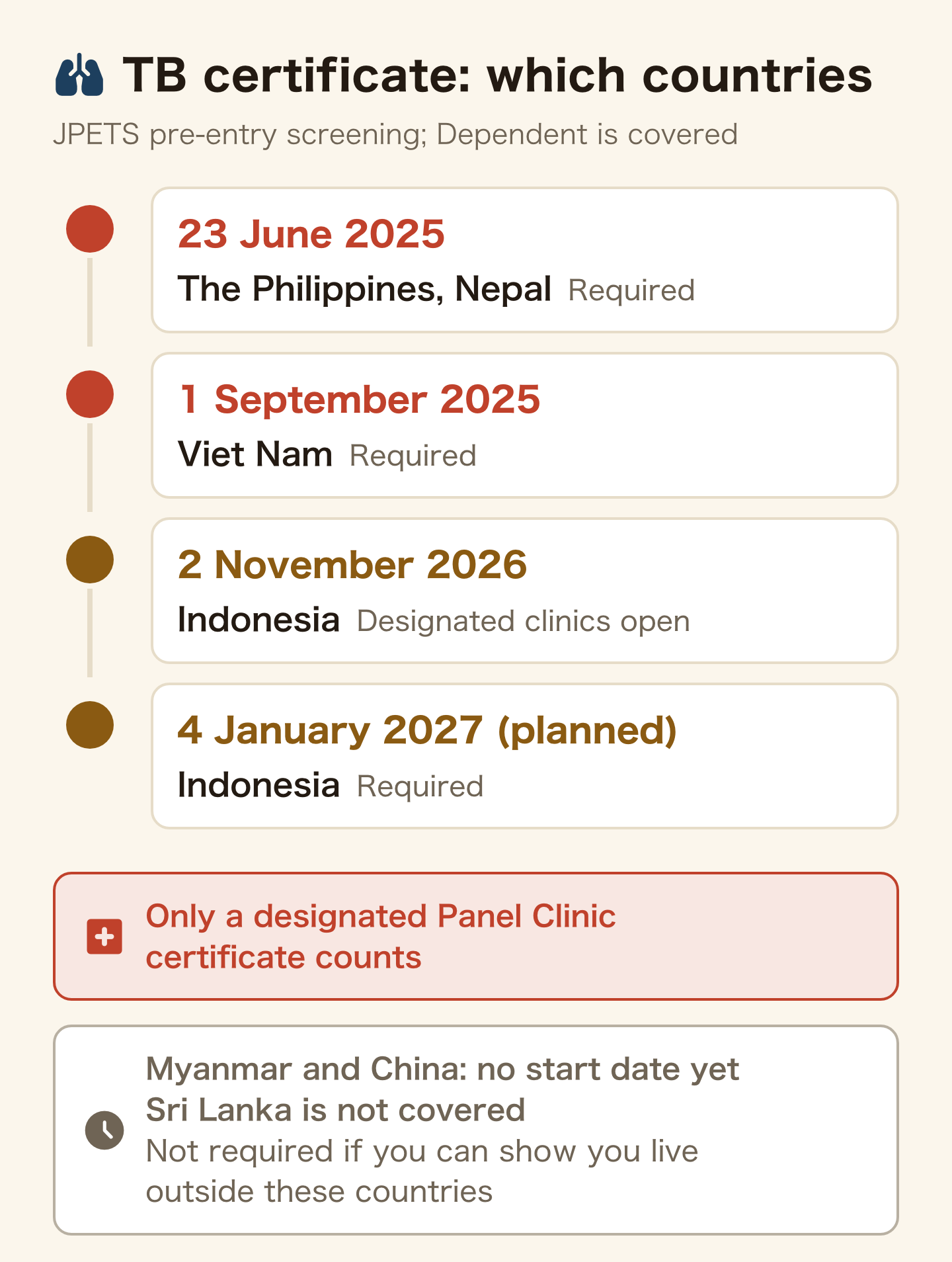
It applies to nationals of the Philippines, Viet Nam, Indonesia, Nepal, Myanmar and China who enter Japan as mid- to long-term residents. Dependent status is mid- to long-term, so it is covered. The exception is someone who lives outside these countries and can show it with a residence permit or similar.
Three things to remember
1. Only a designated Panel Clinic certificate counts. Your local hospital will not do
2. The ministry warns that falsifying a certificate may seriously affect the application
3. Sri Lanka is not a covered country. Indonesia is set to start on 4 January 2027; Myanmar and China have no start date yet
The designated clinics in Nepal are listed on the official JPETS site, which is also published in Nepali, so your family can read it directly. The examination takes time, so book it before you plan the filing dates.
Can I bring my parents to Japan?
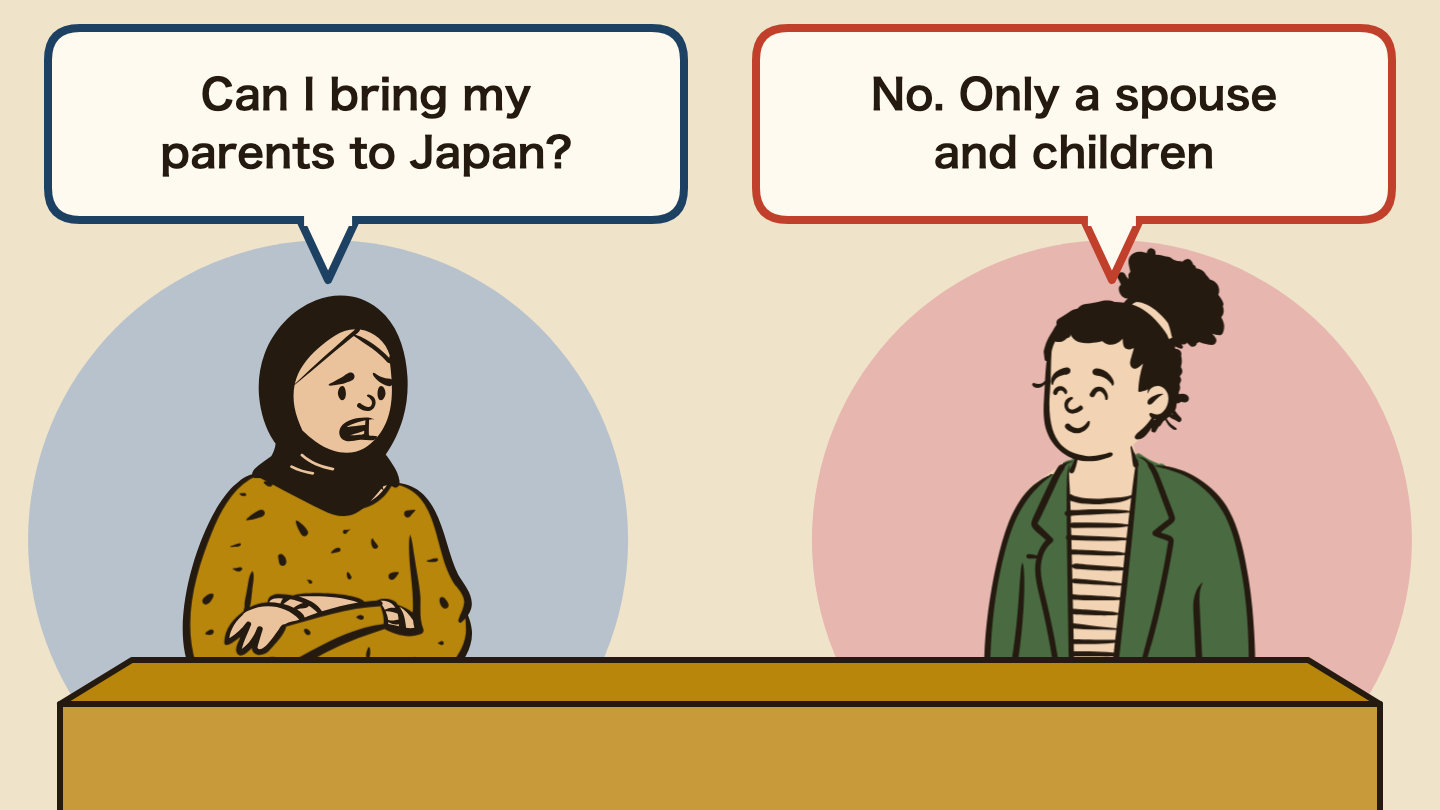
Not to live with you long term. This is the honest part: there is no status of residence for a parent.
What you can do is have them visit on a short-stay visa. The foreign ministry defines short stay as “tourism, business, visiting friends or relatives and similar, for up to 90 days.” Ninety days together is real.
But running a business for income or engaging in paid work is not permitted on a short stay. They cannot work.
For a short-stay visa, you in Japan are the inviting person. Download the letter of guarantee, the letter of reason for invitation and the schedule of stay from the foreign ministry site, fill them in and send them to your family. No personal seal is required. The exact document list varies by nationality and by embassy, so check the page of the Japanese embassy in their country. What to write in the invitation letter, which papers change when you pay for the trip, and whether the stay can be extended are covered in our family visit visa guide.
After they arrive, can they work?
Not automatically. Dependent status exists for daily life, not for work.
Working requires permission to engage in activity outside the status, and even then the limit is 28 hours a week. The counting differs from the student rule in ways that matter, and we set all of that out in working on a Dependent visa. Read it before they come. Budgets built on “they can just work once they arrive” tend to come up short.
What to do this week
- Read your own residence card. If it says Specified Skilled Worker, check whether it is (i) or (ii). The answer changes here
- If you qualify, ask your family to start collecting the relationship documents (marriage and birth certificates). These take time to obtain
- Get your proof of support ready: tax and payment certificates from the city office if you work, a bank balance certificate if you study
- If your family is Nepalese, find a designated JPETS clinic and book the screening
- If you want your parents to visit, download the short-stay forms from the foreign ministry site
Step 1 takes five minutes today. If it turns out you hold SSW (i), you can start planning the move to (ii) instead of waiting.
Two things for after they arrive: what a divorce does to the status is worth knowing before, not after, and a child born in Japan is not “brought” at all – the status must be applied for within 30 days of the birth. Once your children arrive and you apply at the city office, child allowance of 10,000 to 15,000 yen a month each (30,000 yen from the third child) is paid from the month after you apply; while they are abroad it is not. Children in the 3-to-5 classes also go to daycare or kindergarten free of charge, whatever their nationality. From age six, public elementary and junior high school is tuition-free too, but you have to apply to the board of education yourself.
FAQ
Q. Can SSW bring family to Japan?
SSW (ii) can. SSW (i) cannot. The Dependent provision lists Specified Skilled Worker (ii) among the qualifying statuses and does not list (i). Technical Intern Training is excluded for the same reason.
Q. Can I bring my parents to Japan permanently?
No. Dependent status covers only a spouse and children, and parents are not in the provision. There is no status of residence designed for a parent. They can visit on a short stay of up to 90 days, but cannot do paid work.
Q. Can a student bring family to Japan?
Yes. “Student” is one of the statuses named in the Dependent provision. Instead of an employment or tax certificate, you can prove support with a bank balance certificate in your name or a certificate of your scholarship.
Q. Where does the process start?
You, in Japan, apply to your regional immigration bureau for a Certificate of Eligibility. Once issued, send it to your family, who then apply for a visa at the Japanese embassy or consulate in their country. Visa applications cannot be made inside Japan.
Q. Who needs the TB clearance certificate?
Nationals of the Philippines, Viet Nam, Indonesia, Nepal, Myanmar and China entering Japan as mid- to long-term residents, unless they can show they live outside these countries. It became mandatory on 23 June 2025 for the Philippines and Nepal and on 1 September 2025 for Viet Nam. Indonesia is set to follow on 4 January 2027. Only certificates from designated Panel Clinics are accepted. Sri Lanka is not covered.
Q. Can my spouse work as soon as they arrive?
No. They need permission to engage in activity outside their status, and even with it the limit is generally 28 hours a week.
Q. Should I send the documents to the embassy?
No. The foreign ministry asks the inviting person and guarantor to send their documents to the visa applicant, not to the ministry or the embassy.
Summary
- Bringing family means getting them the Dependent status of residence
- Only a spouse and children qualify; parents and siblings are not in the provision
- Engineer/Specialist, SSW (ii), Student and others can bring dependents
- SSW (i) and Technical Intern Training cannot, so moving to type 2 is a family decision as well as a pay decision
- The order is: Certificate of Eligibility in Japan, send it home, visa at the embassy there
- Proof of support is tax certificates if you work, or a bank balance certificate if you study
- Certificates issued in Japan must be under three months old, and foreign-language documents need a Japanese translation
- Nepalese family members have needed a TB clearance certificate since 23 June 2025; Sri Lanka is not covered
- Parents can visit for up to 90 days on a short stay, with no paid work
- After arrival, working needs permission and is capped at 28 hours a week
Sources: Immigration Services Agency, status of residence “Dependent” / the same agency on “Specified Skilled Worker” / the same agency on the Certificate of Eligibility / Ministry of Foreign Affairs, visas / Ministry of Health, Labour and Welfare, Japan Pre-Entry Tuberculosis Screening / Immigration Services Agency, pre-entry TB screening (Japanese) (Indonesia schedule checked on 8 October 2026)
Found this useful? Share it
Send it to a friend who lives in Japan.
WHO WROTE THIS

mori
Japanese. I read the ministries’ own notices, orders and Q&As in the original, and I start from what my Nepalese and Sri Lankan friends in Japan actually ran into. I do not write about what I have not checked or been told.
What this site can and cannot do →Looking for something else?
You may use the figures in this article, including commercially, if you credit this site with a link. How to use our figures