Last updated: July 2026
Figures, prices and terms were checked against the Immigration Services Agency report on foreign students employed by Japanese companies (2024) on 6 August 2026. They change — check the current terms yourself before you sign up or file anything.
In short
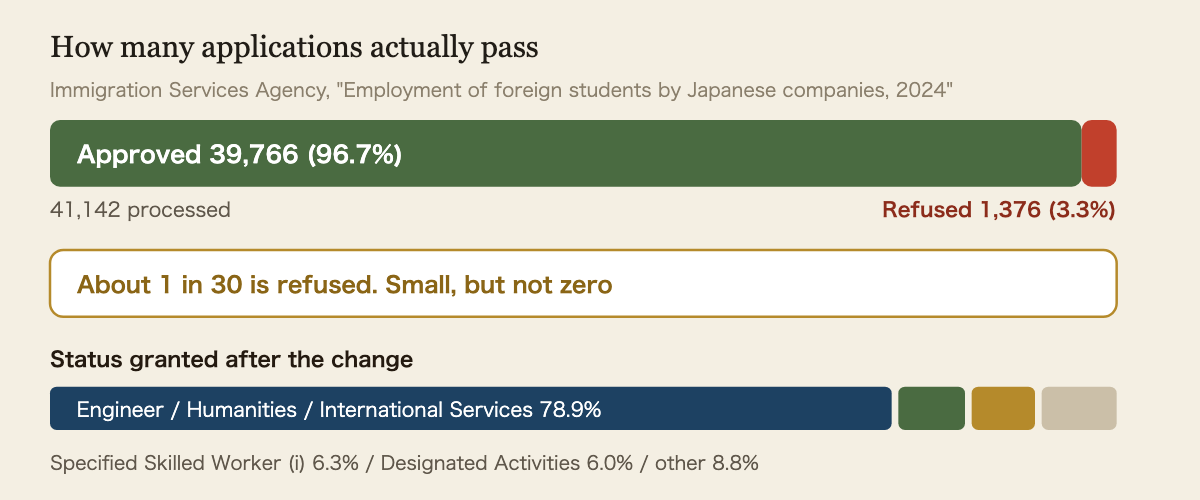
- 96.7% of applications get approved (2024, Immigration Services Agency) – but that still means about 1 in 30 does not. The outcome is decided long before you apply.
- The reasons that come up repeatedly include working over 28 hours a week during your studies – more than attendance, more than grades.
- How closely your major needs to match your job depends on your school: university graduates get more flexibility, vocational school (senmon gakko) graduates are judged more strictly.
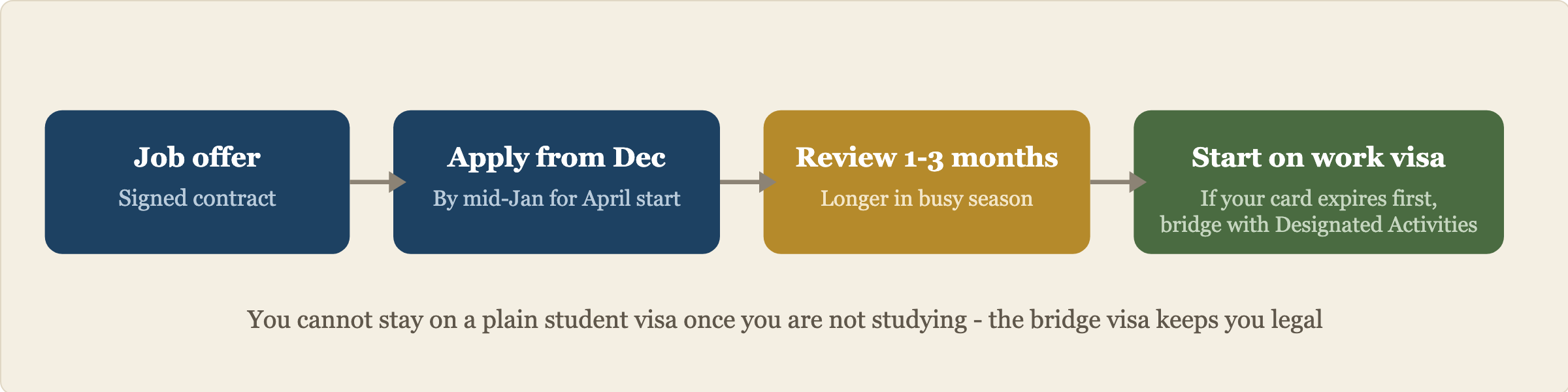
- You can apply as soon as you have a job offer – from December for an April start, and review takes 1 to 3 months (longer in the busy December-to-May season).
- If your student visa expires before results come back, you switch to a “Designated Activities” visa to bridge the gap – you do not become illegal.
Most guides on this topic are written by immigration lawyers for people who already have a job offer and need to file next week. This one is written for the stage before that – while you are still a student, because what you do in the next few months on your student visa can decide whether your work visa gets approved later.
- What actually decides approval or rejection?
- Does my major have to match the job?
- When do I apply, and how long does it take?
- What documents do you need?
- The December 2025 rule change – who it actually helps
- What if I get rejected?
- Frequently asked questions
- What is the actual approval rate for changing from a student visa to a work visa?
- What is the single biggest reason applications get rejected?
- Does my university major have to exactly match my new job?
- When should I apply, and how long does review take?
- What happens if my student visa expires before the review finishes?
- Summary
- Related guides
What actually decides approval or rejection?
Roughly 4 in 5 applications are approved, but rejections are not random – they trace back to specific, avoidable things you did as a student. Working over the legal hour limit is the single most common cause.
This is why the earlier guides on this site matter here: keeping to the 28-hour rule is not just about staying legal today – it is building the track record that gets your work visa approved later.
Does my major have to match the job?
It depends on your school. University graduates get meaningful flexibility – a business major working as a systems engineer has been approved before. Vocational school (senmon gakko) graduates are held to a stricter match between what they studied and what they will do.
- University / graduate school: immigration looks at the broader skill set you gained, not just the exact major title
- Vocational school: the connection needs to be closer. A real rejection case: an international business major (English-focused curriculum) applying for a real estate sales job was rejected for insufficient connection to the major
If you are at a vocational school, choose a job offer that clearly connects to what you studied, or be ready to explain the connection clearly in your application.
When do I apply, and how long does it take?
Apply as soon as you have a signed job offer – you can file from December. For an April start, aim to file by mid-January at the latest, since review usually takes 1 to 3 months and the December-to-May season is busiest for immigration.
What documents do you need?
You provide personal documents, and your future employer provides company documents proving the job is real and matches your qualifications.
| Who provides it | Documents |
|---|---|
| You | Application for change of status, photo, graduation certificate (or expected date), passport, residence card |
| Your employer | Employment contract or job offer letter stating duties, employment period, position and salary; company registration documents |
About 9 in 10 international students end up on the “Engineer / Specialist in Humanities / International Services” visa – the standard category covering office, technical and language-related roles.
The December 2025 rule change – who it actually helps
Since 1 December 2025, some applicants no longer need to submit documents like the employment contract or company registration certificate. But this only applies to a specific group, and the screening standard itself has not changed.
- You qualify for the simplified process if you fall into one of three groups: graduates (or soon-to-graduate) of a Japanese university or graduate school; graduates of a university ranked in the top 300 on at least two of the QS, THE or ARWU world rankings; or hires by a company that has already had a foreign student’s visa change approved and renewed at least once before
- Dispatch (temp agency) employment does not qualify
- Fewer documents does not mean an easier bar to clear – the same factors (28-hour rule, attendance, major-job connection) still decide the outcome
What if I get rejected?
You will usually be notified by letter rather than postcard. Reapplying is often possible, but it is harder the second time – address exactly why you were rejected, and consider professional help.
Official source: Immigration Services Agency of Japan
Once you hold a work visa, you can bring your spouse and children to Japan.
Frequently asked questions
What is the actual approval rate for changing from a student visa to a work visa?
In 2024, 41,142 applications were processed and 39,766 were approved – an approval rate of 96.7%. That leaves 1,376 refusals, about 1 in 30 (Immigration Services Agency, checked August 2026). Most people pass, but it has never reached 100 percent.
What is the single biggest reason applications get rejected?
Working more than the legal 28 hours a week during your studies is one common reason, along with weak attendance and a major that does not connect to the job. The Agency does not publish a ranking of refusal reasons, so treat any “number one cause” claim with care. It sits ahead of poor attendance, poor grades, or involvement in a crime.
Does my university major have to exactly match my new job?
University graduates get more flexibility – the connection is judged broadly. Vocational school (senmon gakko) graduates are held to a stricter, closer match between their studies and the job.
When should I apply, and how long does review take?
Apply as soon as you have a signed job offer, from December onward. Review usually takes 1 to 3 months, longer during the busy December-to-May season, so aim to apply by mid-January for an April start.
What happens if my student visa expires before the review finishes?
You switch to a “Designated Activities” visa to bridge the gap while you wait for a decision or continue job hunting. You do not become an illegal resident.
Summary
- About about 1 in 30 applications is refused – and working over 28 hours a week is the top cause
- University graduates get more flexibility on major-job match than vocational school graduates
- Apply from December, allow 1 to 3 months for review
- A visa gap before results arrive is bridged with a Designated Activities visa, not illegal status
Related guides
Found this useful? Share it
Send it to a friend who lives in Japan.
WHO WROTE THIS

mori
Japanese. I read the ministries’ own notices, orders and Q&As in the original, and I start from what my Nepalese and Sri Lankan friends in Japan actually ran into. I do not write about what I have not checked or been told.
What this site can and cannot do →Looking for something else?