This article contains affiliate links.
Last updated: October 2026
Summary
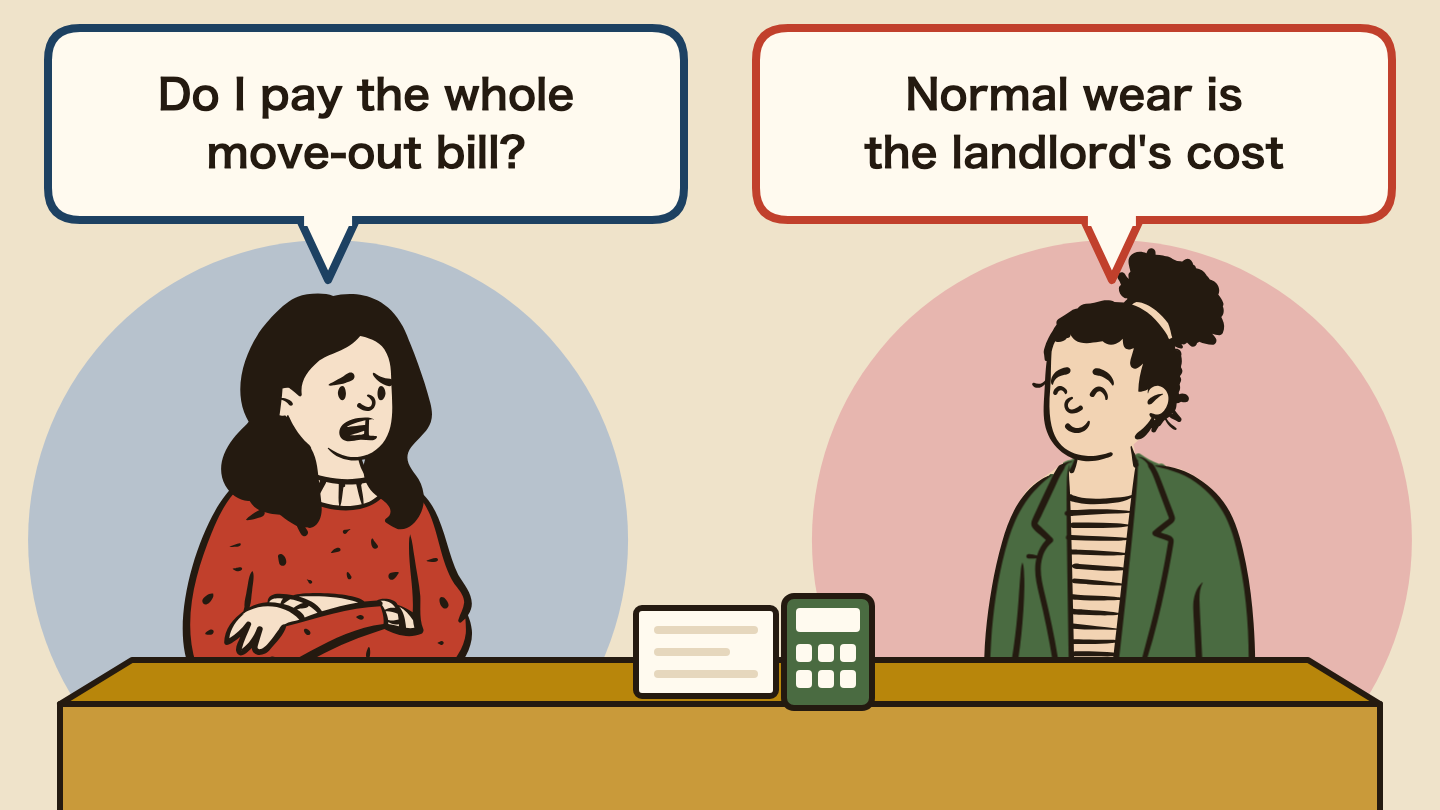
- The move-out fee (退去費用) is really a “restoration cost” (原状回復費用). Normal wear from ordinary living is the landlord’s cost; you pay only for damage you caused on purpose or through carelessness. You do not have to return the room to “like new.”
- Even for damage you caused, you do not pay the price of new. Wallpaper is worth about 1 yen after 6 years (depreciation).
- You repair only the part you damaged. “One mark, so we re-paper the whole room” is overcharging.
- Three ways to protect yourself: photos of the room before you leave / don’t sign on the spot / keep every exchange in writing.
- If the bill looks too high, say “please show me the basis (the estimate and photos).” You can decide whether to pay after you have seen it.
Knowing this, you can say “show me the basis for this” on the day you hand back the keys – and keep the part of the bill that was never yours to pay.
Move-out fees are easy to overpay if you don’t know the rules. This guide explains what you owe, what you don’t, and how to push back, following the government guideline.
- The move-out fee is really “restoration” – not money to make everything new
- Even if you broke it, you don’t pay for brand new (depreciation)
- You repair only the part you damaged – no full renovation
- Normal dirt can become your cost if you leave it (neglect)
- A “special clause” in the contract can still be invalid
- What is the average move-out cost?
- If it looks too high, or you cannot pay
- Five steps so you don’t lose money when you move out (your defence routine)
- What to do when the guarantor company or a contractor pushes you to pay
- Frequently asked questions
- Do I always have to pay move-out costs, and return the room to “like new”?
- Can they take my whole deposit?
- I smoked, and I was billed for the wallpaper in every room.
- I was asked to sign at the move-out walk-through.
- My contract has a cleaning-fee clause. Do I have to pay?
- I already paid too much. Can I get it back?
- Summary
- Related guides
The move-out fee is really “restoration” – not money to make everything new
The move-out fee is, properly speaking, the cost of restoration (原状回復, genjo kaifuku). Many people think it means “the money to make the room brand new again.” It does not. Article 621 of the Civil Code says the tenant restores only damage that appeared after moving in, and it excludes wear from ordinary use and ageing over time. The restoration guideline from the Ministry of Land, Infrastructure, Transport and Tourism (MLIT, Japanese) splits the costs the same way.
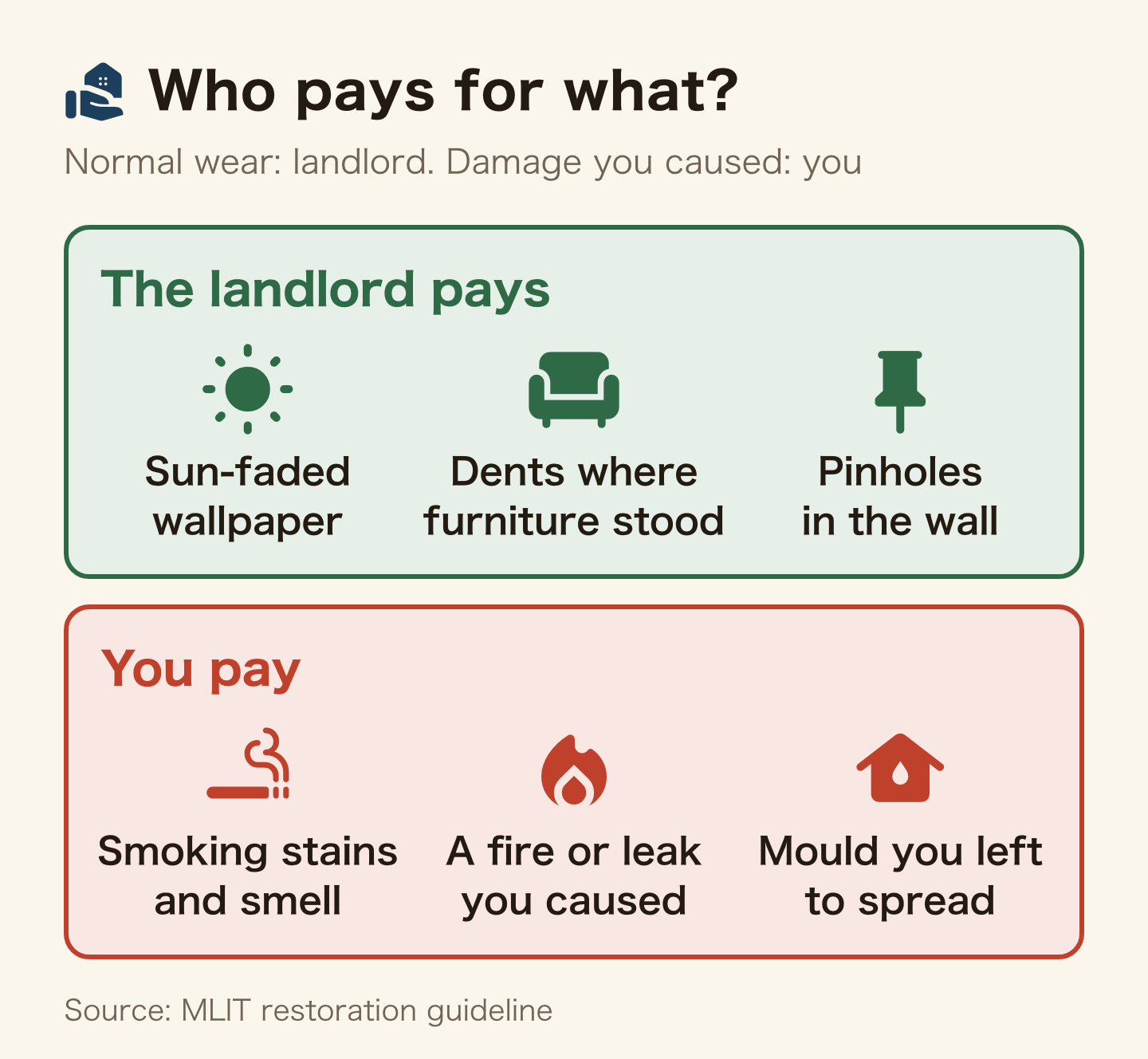
In short: normal living = free; things you damaged = you pay. Sun-faded wallpaper, dents where furniture stood, small pinholes – these are covered by the rent you paid, so they are not yours to pay for. The flip side: if a fire or a leak you caused damages the flat, you do owe the landlord. When equipment wears out and breaks, it is the other way round: the landlord pays for the repair while you live there. The tenant’s liability insurance you took out at move-in is there for that kind of bill.
Common examples (MLIT restoration guideline, Table 3, p.25 (Japanese PDF)):
| Situation | Who pays |
|---|---|
| Wallpaper faded from sunlight | Landlord |
| Dents in the floor from furniture | Landlord |
| Pinholes in the wall | Landlord |
| Equipment that stopped working because it reached the end of its life | Landlord |
| Wallpaper discoloured or smelling from smoking | You |
| A spilled drink that you did not clean up, leaving a stain or mould | You |
| Scratches made while moving furniture in or out | You |
| A door or fixture you broke on purpose or by misuse | You |
Even if you broke it, you don’t pay for brand new (depreciation)
This is where the money is. Even if you tear the wallpaper, you pay only for what that wallpaper is worth now. The MLIT guideline (p.12 and Table 3, p.26, Japanese PDF) treats wallpaper and carpet as losing value over 6 years, down to 1 yen, so the longer you have lived there, the smaller your share (depreciation).
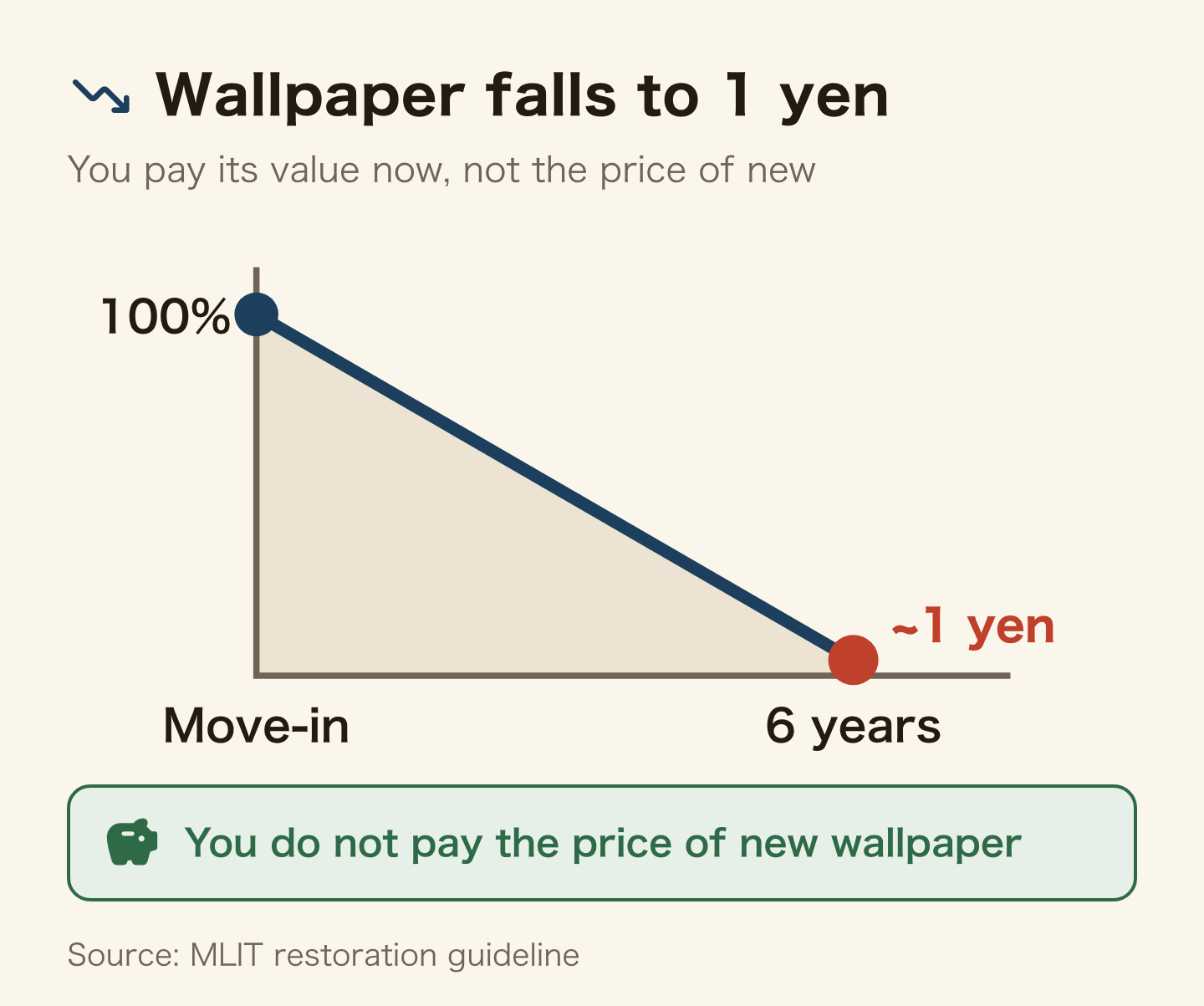
Example: if you tear wallpaper after 6 years, that wallpaper is worth about 1 yen. The guideline gives no basis for charging you the full price of new wallpaper.
Some things are not depreciated, though. Table 3 of the same guideline (p.26) says that for a partial repair of wooden flooring, the surface of tatami mats, fusuma and shoji paper, and a replacement lock after a lost key, the tenant who caused it pays the cost regardless of how long they lived there. Equipment such as an air conditioner loses value over its own service life.
And even after 6 years, the labour cost of removing graffiti you deliberately drew on the wallpaper can still be yours (guideline p.12). A value of 1 yen does not mean anything goes.
You repair only the part you damaged – no full renovation
A common problem: you mark one spot and are billed for re-papering everything. Table 3 of the guideline (p.26) sets the unit you pay for:
- Wallpaper: by the square metre as a rule; at most, the one wall that includes the damage (not the whole room)
- Wooden flooring: by the square metre as a rule; the whole room only if the damage is spread over many places
- Tatami: one mat at a time; if several are damaged, only that number
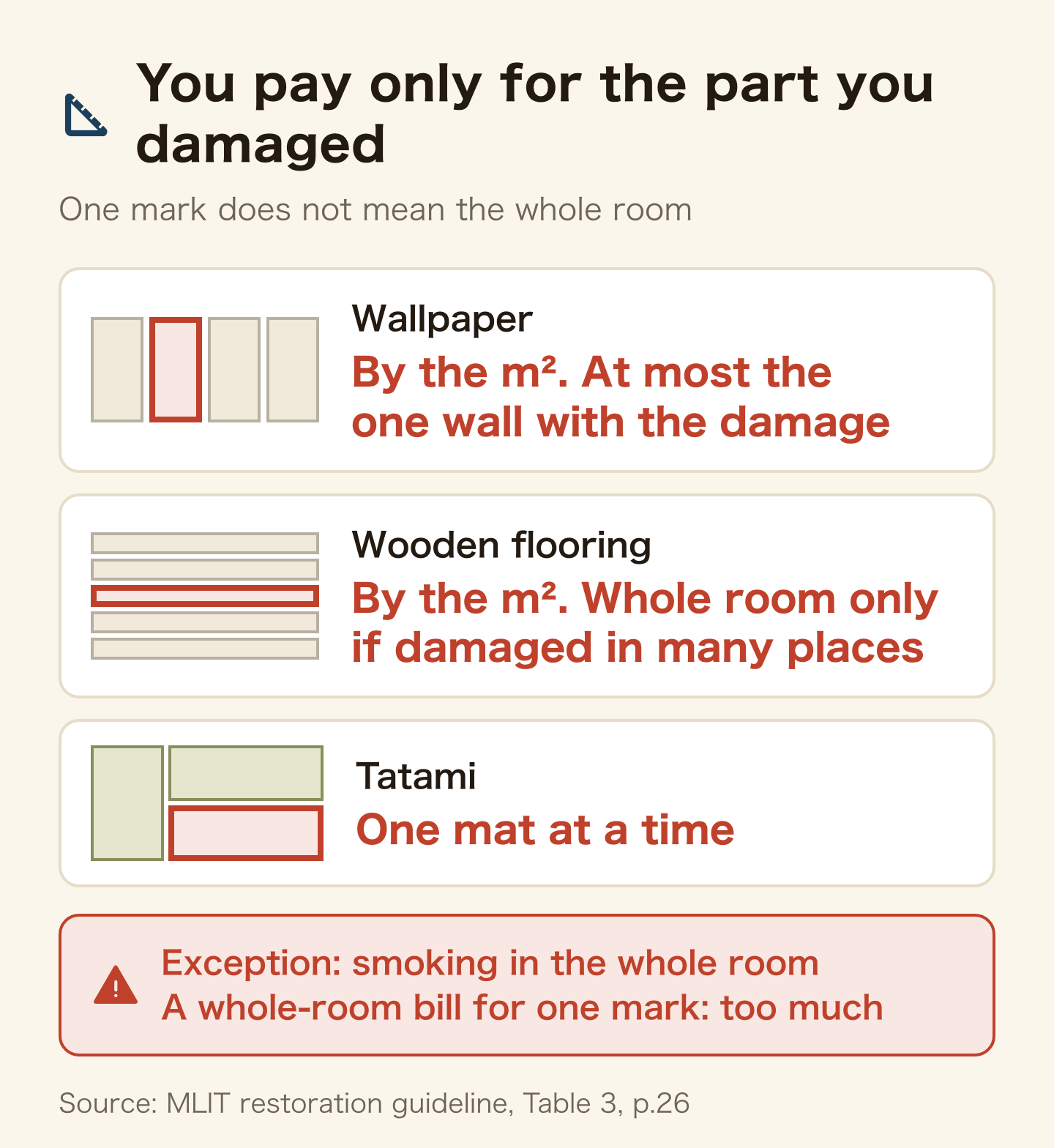
The exception is smoking. Only when tar or smell from smoking has discoloured or got into the wallpaper of the whole room does cleaning or re-papering that whole room become the tenant’s cost (same page, p.26). Even then, you pay the value after depreciation.
If one mark turns into a bill for “renovating the whole room,” that is a sign you are being overcharged.
Normal dirt can become your cost if you leave it (neglect)
On winter mornings the windows are covered in water. You never wipe it, and by spring the wall behind the curtain has turned black. This is where things change. Condensation itself usually comes from how the building is made, so it is not your fault. But the MLIT guideline (Table 3, p.25, Japanese PDF) puts mould and stains on you once you left them to spread, without telling the landlord and without wiping them, and the wall was damaged. The line is not the type of dirt; it is whether you cleaned and reported while you lived there.
In the same table, these are the tenant’s cost because of neglect:
- Mould and stains from condensation you left to spread (you did not tell the landlord and did not wipe it)
- Grease and soot in the kitchen, on the stove area and the kitchen fan (you did not clean normally)
- Limescale and mould in the bath, toilet and sink (you did not clean or look after them)
- A wall damaged by an air-conditioner leak that you left alone
- A floor stained by rust under the fridge that you left alone
- Changing the lock because you lost or broke a key
The same table also lists things that stay with the landlord: professional cleaning of a flat you kept normally clean, inside cleaning of an air conditioner with no smoke smell, and changing the lock when you did not lose or break a key. If your contract has a special clause, check it against the three conditions in the next section.
If you still live there, you can do two things. When you see condensation or a leak, wipe it and tell the landlord or management company straight away, by email or another way that leaves a record. And do not let the kitchen and bathroom build up. What can no longer be fixed on move-out day can be prevented while you live there.
A “special clause” in the contract can still be invalid
Your contract may include a special clause (特約, tokuyaku) such as “the tenant pays for professional cleaning at move-out.” A clause like this can make the tenant pay even for normal wear. But the MLIT guideline (p.7, Japanese PDF) says such a clause holds only when all three of these are met. If any is missing, the clause can be challenged:
- There is a real reason for the clause, and the amount is not excessive
- The tenant understood it meant a heavier burden than normal restoration
- The tenant clearly agreed to take on that burden (for example, by signing)
The Supreme Court ruling quoted on the same page requires that the range of normal wear the tenant will pay for is written concretely in the contract, or was explained in person and agreed. The guideline adds that stating roughly how much it will cost, such as unit prices, is essential to avoid disputes. Even when all three are met, a clause is not always valid. The same page also cites Article 10 of the Consumer Contract Act, which voids contract terms that one-sidedly harm the consumer.
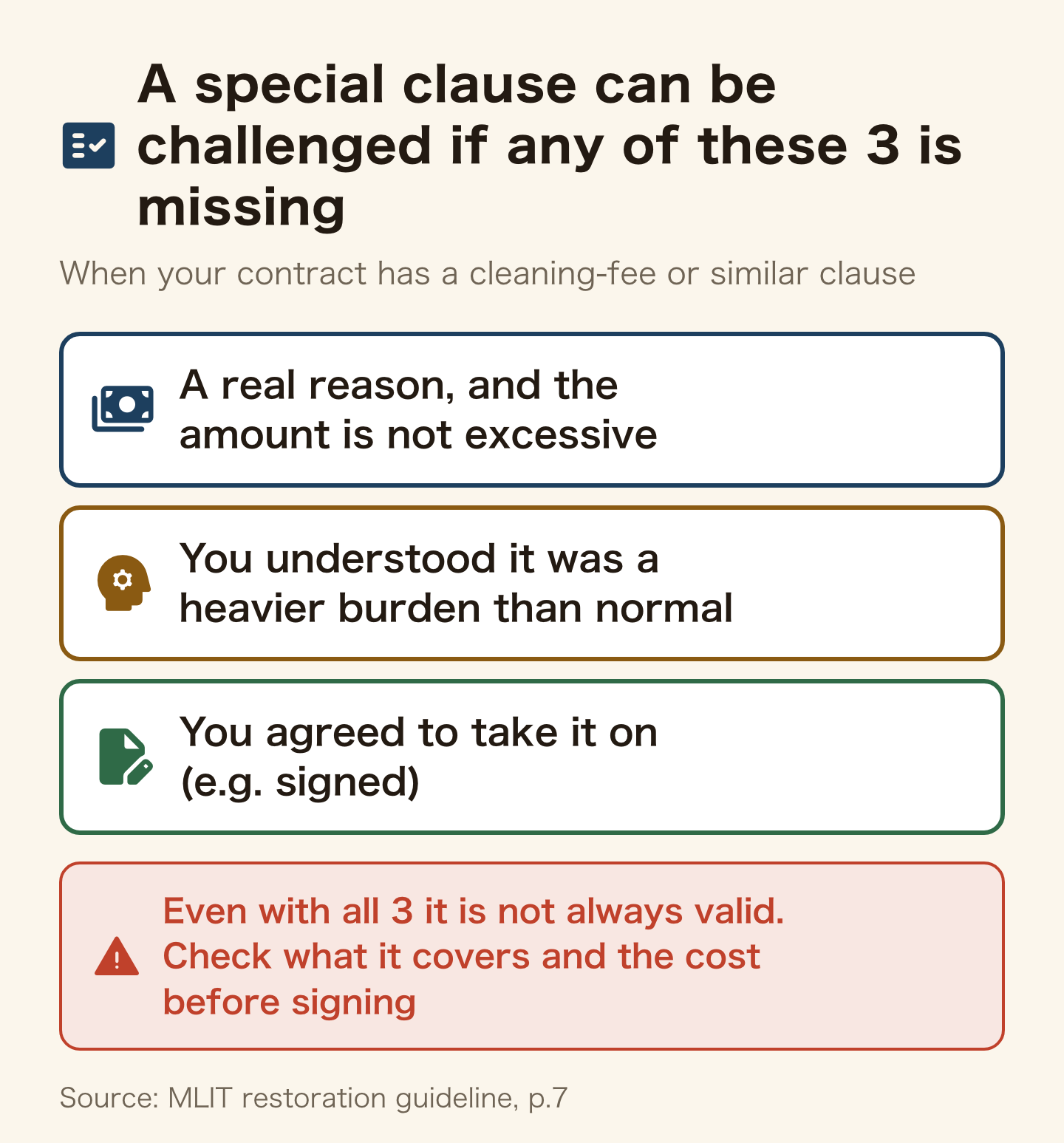
If the clause was just “somewhere in the contract,” or you cannot tell what it covers or how much it is, it may be invalid. Before you sign, check what it covers and how much it costs. For contract basics, see our guide to how renting works.
What is the average move-out cost?
There is no official average move-out cost published by the national or local government. The amount depends on the condition of the room and on how the MLIT restoration guideline (Japanese) splits each cost between you and the landlord.
You will find “average” figures online, but use them carefully. Cheap does not mean correct and expensive does not automatically mean unfair. The amount is not settled by an average. It is settled by one question.
Did you break it, or did time? The MLIT guideline says wear from ordinary living, and ageing, are not the tenant’s cost. Sun-faded wallpaper, dents where furniture stood, pinholes in the wall – those are not yours to pay for.
So when the bill arrives, read it line by line, not by the total. For each line, ask whether you broke it or whether it is ordinary wear and ageing. Even for damage you caused, you pay the value after depreciation.
Watch out especially for:
- One small mark, but a charge for re-papering or renovating the whole room
- Cleaning fees with no basis in your contract
- A single total with no itemised breakdown
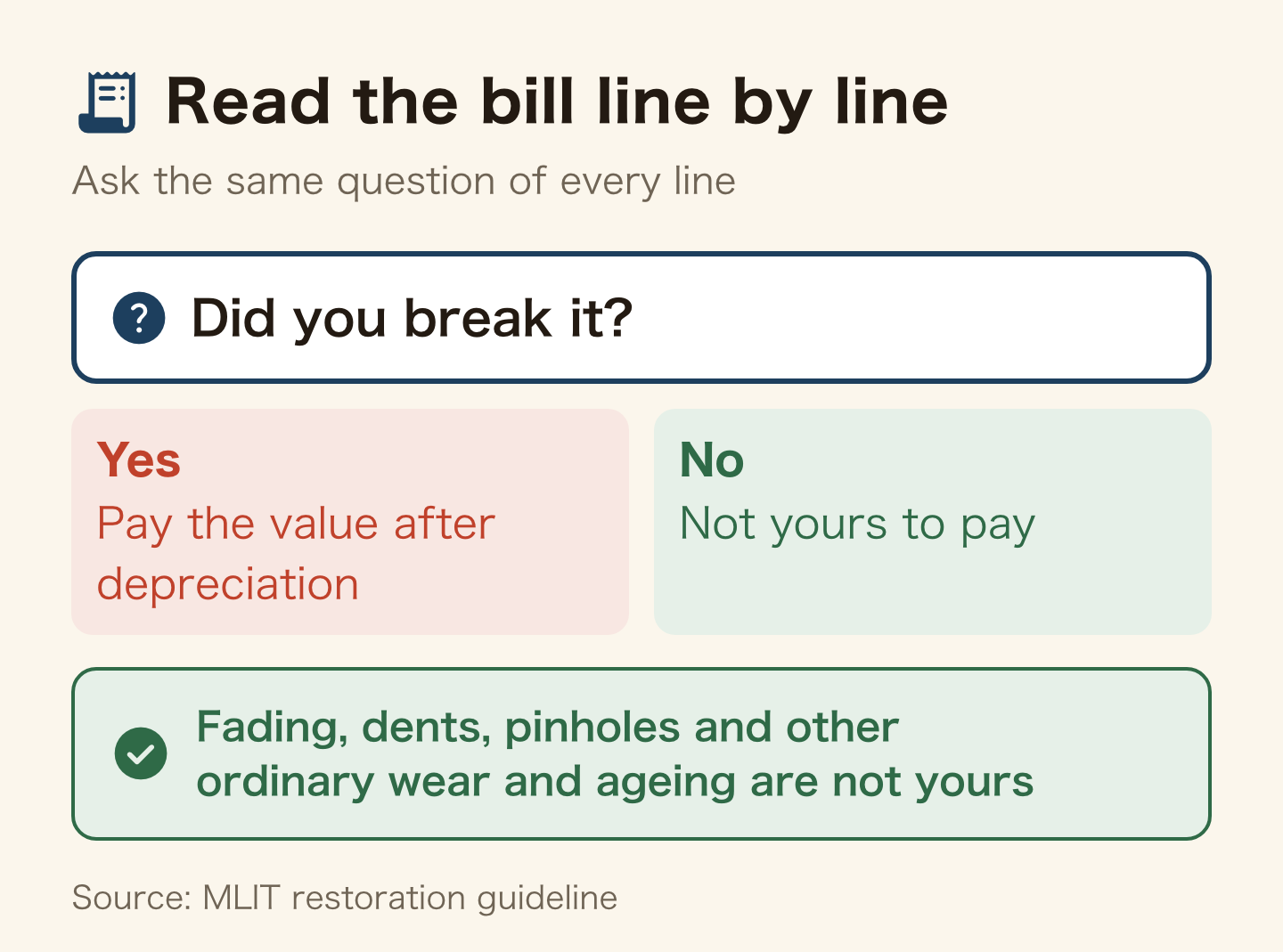
If your deposit does not come back, look in the same place. The deposit is money you handed over as security. Under Article 622-2 of the Civil Code, the landlord must return what is left after taking off what you owe, such as unpaid rent and restoration costs. If nothing came back, check whether the deductions include anything you did not break. If fading, dents and pinholes are on the list, those were never yours to pay.
If it looks too high, or you cannot pay
Sometimes the invoice arrives and you simply stop.
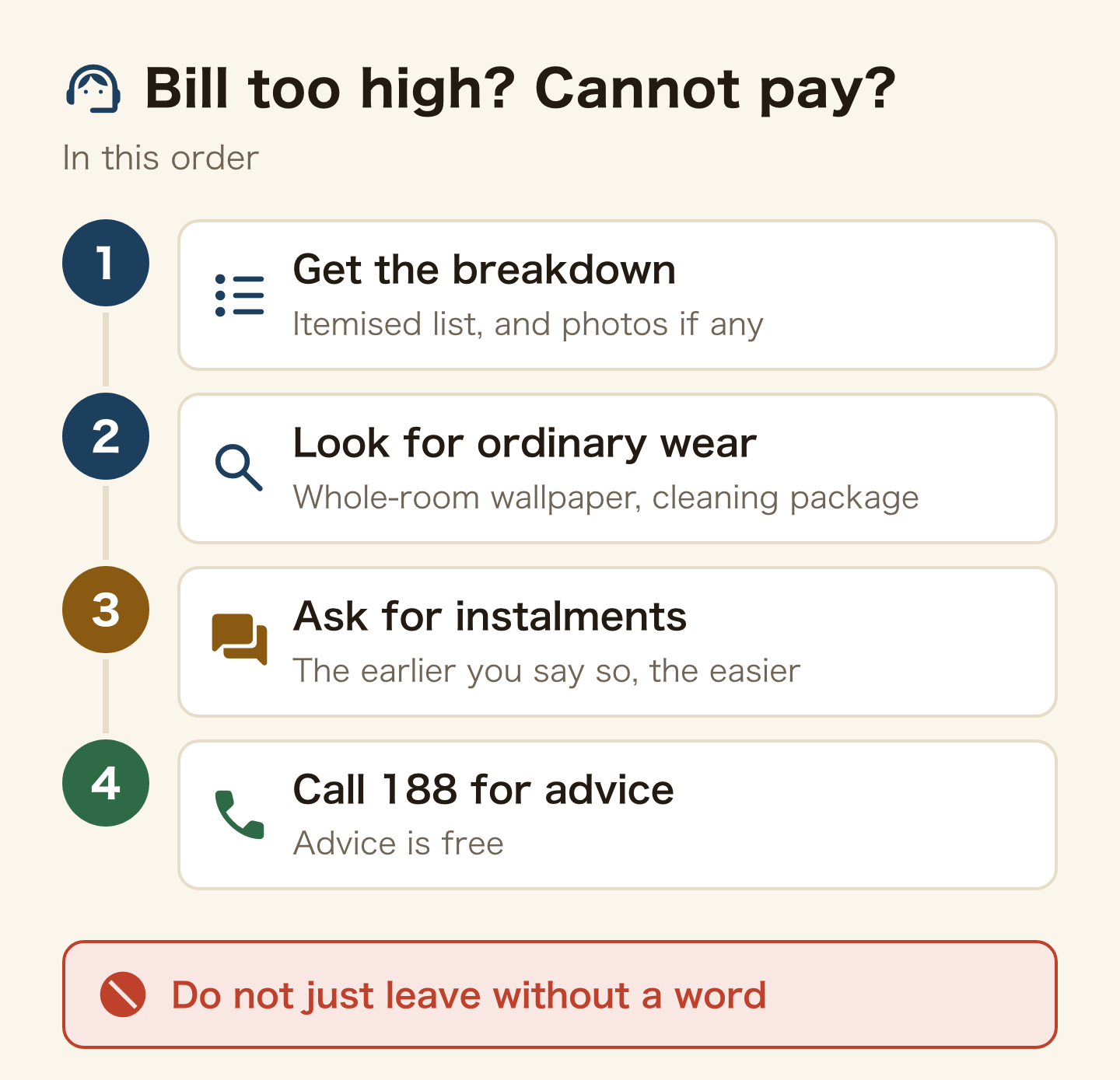
1. Ask for the breakdown. A bill that says only “restoration costs, one set” is reason enough to ask. What was repaired, where, and for how much – request the itemised list and photographs if they exist. Asking is not rude.
2. Look for ordinary wear inside it. Wallpaper replaced across the whole room, a full cleaning package, every tatami mat swapped. As this article has shown, those are not costs a tenant carries in full. This is where the number actually moves.
3. If you cannot pay it at once, say so. Some management companies will agree to instalments or give you time. Going quiet and letting it go unpaid is the worst available outcome, because being unreachable is what really causes them trouble. The earlier you speak, the easier the conversation.
4. If you still disagree, take it outside. Consumer affairs centres handle housing-money disputes like this one. The nationwide number is 188, which routes you to your local office, and advice is free.
If you cannot explain this in Japanese
Honestly: whether an interpreter joins the 188 call depends on your municipality. Nationwide multilingual coverage does not exist yet.
For Nepali, Sinhala, Vietnamese and others, there is the Immigration Information Centre on 0570-013904, weekdays 8:30 to 17:15. It works in Japanese, English, Chinese, Korean, Spanish, Portuguese, Vietnamese, Nepali, Thai, Burmese and Sinhala. But it is a line for immigration and residence questions. Its official page says it answers questions about entry and residence procedures, so it will not handle a move-out dispute. Our list of helplines for foreigners, by problem and language shows which number takes your problem in your language.
Whatever you do, do not simply leave without paying and without answering. An unpaid balance and an unreachable tenant end up on record with the guarantor company, and that follows you to the next flat – their screening looks at payment history.
Five steps so you don’t lose money when you move out (your defence routine)
Knowing the rules is not enough if you get the order wrong. Protect yourself in this order.
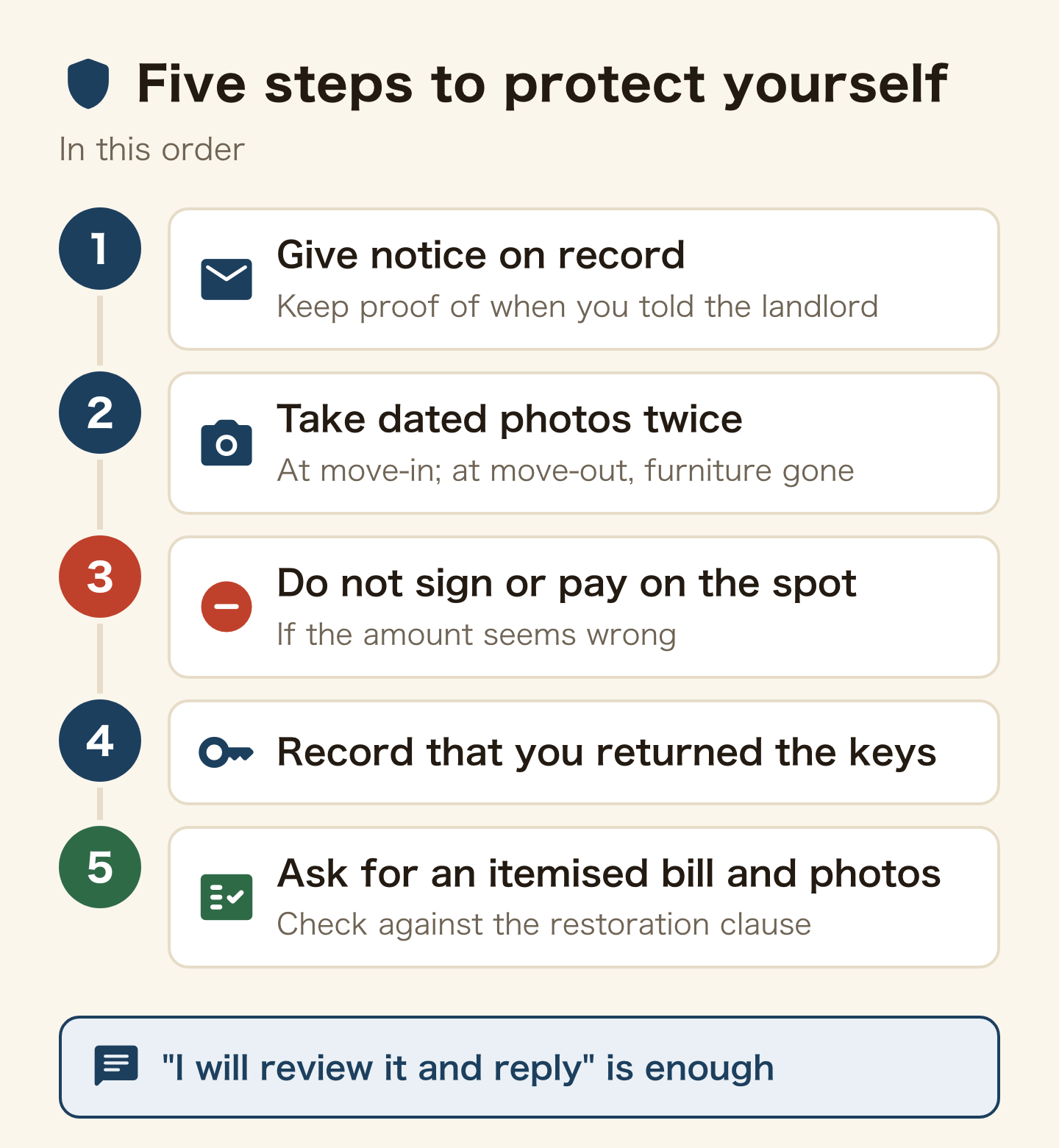
- Give notice in a way that leaves a record. Keep proof of when you told the landlord you are leaving.
- Photograph the room, with dates. Do it at move-in, and again at move-out once the furniture is out. Date-stamped photos prove what was already there.
- At the walk-through, don’t sign or pay on the spot.
- Keep a record that you returned the keys.
- When the bill comes, ask for an itemised breakdown and photos (“明細をください”, meisai o kudasai). Check each charge against the restoration (原状回復) and special-clause terms in your contract.
Step 3 matters most. Do go to the walk-through itself. The MLIT restoration guideline recommends that landlord and tenant check the room together. But in the same guideline’s process, the money is settled after the walk-through, when the bill arrives and you check it. You do not have to agree to an amount on the spot; “I’ll reply after I see the bill” is enough.
If you already signed a confirmation, don’t give up. The guideline’s Q&A (Q14, p.43) says that a signature only confirming that damage exists is not agreement to pay for it. Even if you signed agreeing to pay, without a special clause there is no reason to pay for damage that was not your fault.
What to do when the guarantor company or a contractor pushes you to pay
In Japan most tenants join a guarantor company, but it guarantees rent and other payments to the landlord – it is not on your side. A large bill can arrive even though you never signed anything. Remember this sentence.
One sentence to push back on an unfair bill
“Please show me the basis for this bill (the estimate, and photos from move-in and move-out). I would like to check the amount after depreciation and my share of the cost under the restoration guideline.”
– Send it in writing (email). Do not agree to a bill given only by word of mouth with no basis shown.
A contractor may say “the guideline isn’t the law.” That is true: the guideline itself is not a law. But the rule that a tenant does not restore normal wear and ageing is written in a law, Article 621 of the Civil Code. And the guideline explains at the start that it is a standard drawn from past court cases and real practice (guideline, “position of this guideline”).
Bring your contract and photos to any discussion. If you are stuck, don’t carry it alone: talk to your school’s international student office, or your city’s consumer affairs centre (消費生活センター, phone 188).
Official sources: MLIT restoration guideline (Japanese) (full revised edition, PDF: special-clause conditions p.7, 6 years to 1 yen p.12 and Table 3 p.26, graffiti p.12, who pays Table 3 p.25, repair units and items not depreciated Table 3 p.26, signed confirmations Q14 p.43) / e-Gov: Civil Code, Articles 621 and 622-2 (Japanese) / Consumer Affairs Agency: consumer hotline 188 (Japanese) / Immigration Services Agency: information centre (Japanese) / Japan Legal Support Center (Houterasu): multilingual information service / MLIT apartment-hunting guidebook (PDF, Japanese) (checked 18 October 2026)
Frequently asked questions
Do I always have to pay move-out costs, and return the room to “like new”?
No. You do not have to make it like new; you restore only damage you caused. If you simply lived there normally, the rule is that there is little or no restoration cost for you, and your deposit may come back. If your contract has a valid special clause, though, that part is charged.
Can they take my whole deposit?
They can take only what you owe: the fair cost of damage you caused, unpaid rent and similar. If that is less than the deposit, the rest must be returned (Civil Code Article 622-2). Ask for an itemised statement.
I smoked, and I was billed for the wallpaper in every room.
When tar or smell has got into the whole room, cleaning or re-papering that whole room is the tenant’s cost. But you pay the value after depreciation, and after 6 years or more the wallpaper is worth about 1 yen. Ask for the basis of any charge for rooms without tar stains, or at the price of new wallpaper.
I was asked to sign at the move-out walk-through.
You do not have to sign agreement to an amount on the spot. Go to the walk-through, check the room together and take photos. In the MLIT guideline‘s process, the money is settled after the walk-through, when you check the bill. Say “I’ll reply after I see the bill.” A signature that only confirms damage exists is not agreement to pay for it.
My contract has a cleaning-fee clause. Do I have to pay?
If there is no real reason, the amount is excessive, or you did not knowingly agree to a heavier burden, the clause can be challenged. Even when all three are met, it is not always valid. If it is unclear what it covers or how much it is, or nobody explained it, it may also be invalid. Without a valid clause, you do not pay for normal wear. Check your contract first.
I already paid too much. Can I get it back?
Depending on the situation, you may be able to ask for it back. Keep the bill, breakdown, receipt, photos and contract, and talk to the consumer affairs centre (phone 188). Houterasu’s line for foreign nationals (0570-078377, weekdays 9:00 to 17:00) also explains the legal system and where to get advice, free of charge.
Summary
- Move-out fee = restoration cost. Normal wear and ageing: landlord. Damage you caused on purpose or through carelessness: you
- Even if you damaged it, you don’t pay for new. Wallpaper is worth about 1 yen after 6 years (partial flooring repairs, tatami surfaces, fusuma paper and lost keys are not depreciated)
- You repair only the part you damaged. The whole room only in exceptions such as smoking
- A special clause can be challenged if a real reason, your understanding or your agreement is missing. Even with all three, it is not always valid
- Protect yourself: photos, no signing on the spot, everything in writing
- If it looks too high, say “please show me the basis.” If you are stuck, call the consumer affairs centre (188)
Related guides
Found this useful? Share it
Send it to a friend who lives in Japan.
WHO WROTE THIS

mori
Japanese. I read the ministries’ own notices, orders and Q&As in the original, and I start from what my Nepalese and Sri Lankan friends in Japan actually ran into. I do not write about what I have not checked or been told.
What this site can and cannot do →Looking for something else?
You may use the figures in this article, including commercially, if you credit this site with a link. How to use our figures