Checked on 25 September 2026 against the Ministry of Health, Labour and Welfare’s seasonal flu vaccine page and respiratory infection Q&A, the School Health and Safety Act Enforcement Regulations on e-Gov, and the 2026 (FY2026) guidance from Nagoya City, Shinagawa Ward and Chiyoda Ward. This explains the rules and is not medical advice.
The short answer
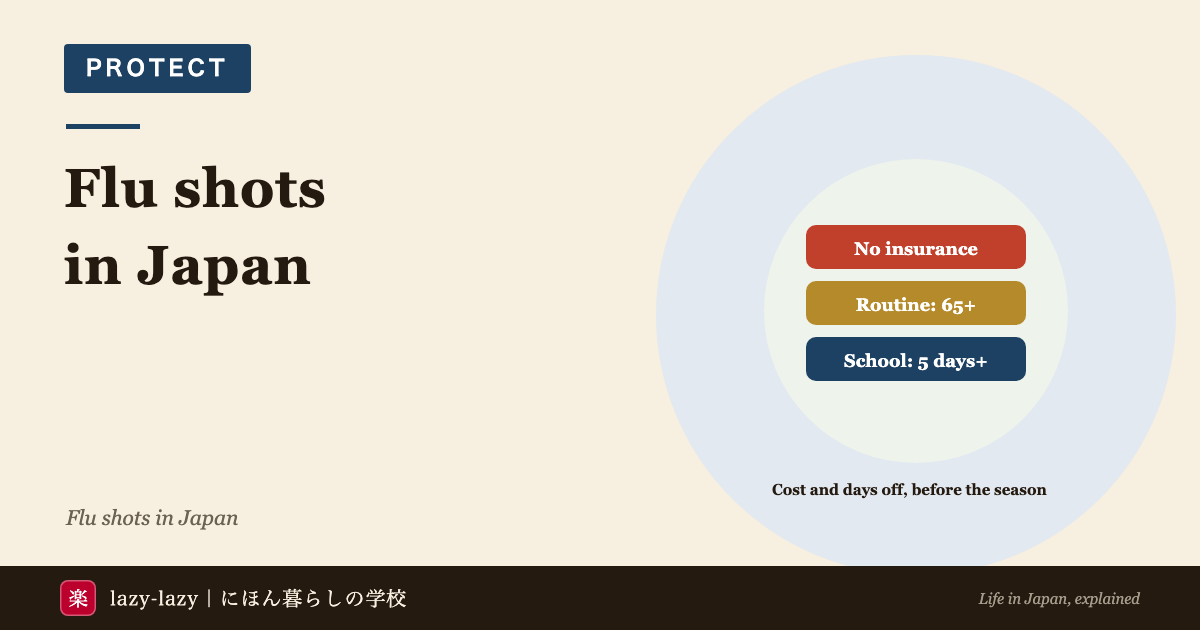
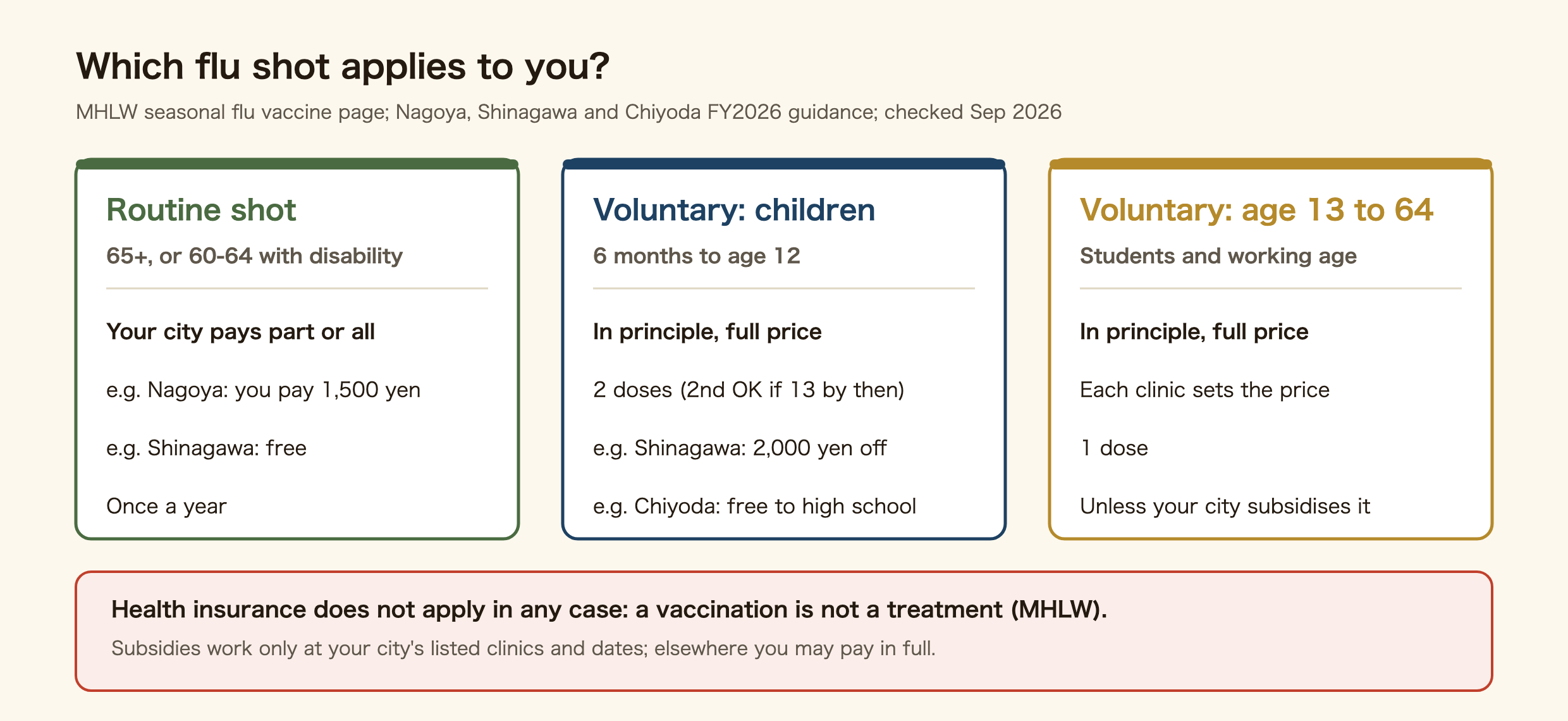
- Health insurance does not cover a flu shot in Japan. It is not a treatment. The price is set by each clinic and, in principle, you pay all of it. Nationality makes no difference.
- The routine (subsidised) flu shot is only for people aged 65 or over, and 60 to 64 with a severe disability. Everyone else gets a voluntary shot.
- Some cities also subsidise voluntary shots. In FY2026 Shinagawa pays 2,000 yen per child’s shot and Chiyoda makes it free up to high-school age. Check your own city’s page.
- If you catch it, school exclusion lasts until 5 days after onset and 2 days after the fever has gone. A normal temperature alone does not end it. At a Japanese language school, the period a doctor requires you to stay away is listed as an “unavoidable” absence.
- No law sets how many days you stay off work. If you are on your employer’s health insurance, sickness allowance can start from day 4 after three days off in a row.
Knowing this, you can check in October whether your shot is routine or voluntary and whether your city pays anything, and book before mid-December. If you do get ill, you will know that same day how many days to tell your school and your employer.
In October a sign goes up on the clinic door: “Flu shots — booking now”. How much is it? Do you need your insurance card? Can foreigners even get one? Your Japanese colleague shrugs: they get it at work every year and have never checked. Then you wake up with a fever. How many days can’t you go to school? Can you skip your part-time shift? Will you be paid? For Japanese people this is so ordinary that nobody explains it.
- Does health insurance cover a flu shot in Japan?
- Routine or voluntary: who gets the flu shot as a routine vaccination?
- How much does a flu shot cost in Japan?
- Where can I get a flu shot, and do I need to book?
- What should I do if I get the flu in Japan?
- How many days off school with the flu in Japan?
- Does it hurt my attendance rate as an international student?
- How many days off work with the flu in Japan, and will I be paid?
- Missed the dates, or can’t afford it?
- Which one are you?
- FAQ
- Summary
- Related reading
Does health insurance cover a flu shot in Japan?
No. The Ministry of Health, Labour and Welfare says it plainly: a flu vaccination is not a treatment for illness, so health insurance does not apply. In principle you pay the full price, and the price differs from clinic to clinic.
The familiar “you pay 30% at the counter” is for treating illness and injury. Vaccinations sit outside it. That is true for National Health Insurance and employer insurance, and for Japanese and foreign residents alike.
This also answers “do I need my insurance card?”. Since insurance is not used, showing the card does not change the price. For a city’s routine shot or subsidy, though, you need something that shows your address and age (Nagoya’s example: a driving licence or My Number Card).
The exception is when your city pays. The ministry notes that some cities cover part or all of the cost for people in the routine programme, and some run their own subsidies for people outside it.
Routine or voluntary: who gets the flu shot as a routine vaccination?
Under the Immunization Act, the routine flu vaccination covers (Ministry of Health, Labour and Welfare):
- People aged 65 or over
- People aged 60 to 64 whose heart, kidney or respiratory function is impaired so severely that everyday self-care is extremely limited (roughly disability grade 1)
- People aged 60 to 64 whose immune function is impaired by HIV so that daily life is almost impossible (also roughly grade 1)
A routine vaccination is one the city, town or ward where you live must provide under the Immunization Act. Nagoya’s guidance lists “registered as a resident of Nagoya” as a condition, and there is no nationality condition. A foreign resident with a resident record qualifies on the same terms. It is one shot per year.
Children, students and working-age adults are almost all in the voluntary category: a shot you choose to get outside the routine programme. The ministry itself notes that infants are not in the routine programme and are vaccinated voluntarily.
One change was planned for FY2026. In February 2026 the government’s vaccine council approved using a high-dose vaccine for people aged 75 or over in the routine programme. The manufacturer’s approval was then badly delayed, and council material dated 23 July says the plan is to postpone it from FY2026. This season’s routine shot is the same vaccine as before.
How much does a flu shot cost in Japan?
Each clinic sets its own price for a voluntary shot. There is no official “standard” price. Nagoya, for example, says voluntary shots are paid in full and that whether a clinic offers them, and at what price, differs by clinic.
Routine shots and subsidies vary a lot by city. Here are real FY2026 figures from official city pages.
| Who and where | FY2026 cost or subsidy |
|---|---|
| 65 or over (Nagoya) | You pay 1,500 yen. Free for households on welfare or exempt from resident tax, with a certificate |
| 65 or over (Shinagawa) | Free |
| Children (Shinagawa, 6 months to high-school age) | 2,000 yen off per injection (up to 2 for age 12 and under), or 4,000 yen off the nasal vaccine. The rest depends on the clinic |
| Children (Chiyoda, 6 months to high-school age) | Free (injection: 2 doses to age 12, 1 from 13; nasal: 1 dose) |
| Voluntary shot, age 13 to 64 (anywhere) | In principle full price, set by each clinic, unless your city runs its own subsidy |
To find your own city, search for its name with “influenza yobou sesshu josei” (インフルエンザ 予防接種 助成) and look for the official page. Some wards, like Chiyoda, ask you to bring the child’s medical expense certificate when you use the subsidy.
Subsidies only work at listed clinics and within set dates. Both Shinagawa and Chiyoda say a shot at a clinic in another ward is not subsidised (you pay in full).
Where can I get a flu shot, and do I need to book?
You get it at a local hospital or clinic (MHLW). For a voluntary shot, your address does not matter: any clinic that offers it will do. Shinagawa’s page says there are “no particular restrictions” on voluntary shots.
For a routine shot or a city subsidy, pick from your city’s list of designated or contracted clinics, usually a PDF on the city website. If you want a clinic where your language is spoken, see how to find an English-speaking doctor and get an interpreter.
You book with the clinic directly. Nagoya says “many clinics require a booking”; Shinagawa says “some clinics may not need one”. Chiyoda warns that clinics receive the vaccine at different times, so bookings can be hard to get. Call before you go.
- When it starts: in FY2026 Nagoya starts on 1 October and Shinagawa a week early on 24 September; both run to 31 January 2027. Tokyo’s infectious disease centre says shots usually start around October
- When to finish: flu season usually runs December to March and peaks from late January to early March. The ministry says it is best to be vaccinated by mid-December
- How many doses: one from age 13. Under 13, two (Chiyoda says 2 to 4 weeks apart). A child who is 12 at the first dose and 13 at the second still gets the second
- Nasal vaccine: a nasal spray vaccine is available for ages 2 to 18 (one dose). Not every clinic stocks it, so ask when booking
- What to bring: ID. For a routine shot, the city’s pre-vaccination form (Shinagawa mailed it on 18 September; Nagoya does not send one). For children, the Maternal and Child Health Handbook
Had one last year? Get one again. The vaccine is made each year from the viruses expected to circulate that season (MHLW).
What should I do if I get the flu in Japan?
Flu typically brings a fever of 38°C or more, headache, joint and muscle pain and exhaustion, fairly suddenly (MHLW). A sore throat, runny nose and cough come with it.
Call before you go. Tokyo’s infectious disease centre asks you to phone the clinic first and follow its instructions on when and how to come in, to avoid spreading the infection. Wear a mask. Which department to choose and what to say at reception are in our guide to seeing a doctor in Japan.
There is a reason not to wait. According to the ministry, antiviral flu medicine started within 48 hours of onset usually shortens the fever by one to two days. Started after 48 hours, you cannot expect much effect. The consultation and medicine are treatment, so your health insurance covers them. How prescriptions and over-the-counter medicine work in Japan is in our guide to medicine and pharmacies.
For adults, go straight away if you have difficulty breathing, chest pain that does not stop, a fever for three days or more, or you cannot keep fluids down (Tokyo infectious disease centre). For children, watch for seizures, slow responses, confused speech or blue lips. If it is night or a holiday and you are not sure, see how to call an ambulance on 119, and #7119 for when you are unsure. The ministry also asks families not to leave a child or teenager with flu alone for at least two days after treatment starts, because sudden abnormal behaviour such as running off can happen.
How many days off school with the flu in Japan?
Your fever breaks, you feel fine the next morning, and you head back to class. Where you come from, that may be completely normal. In Japan, schools keep you home for a fixed number of days set by law, even after the fever is gone. The same goes for parents with children in Japanese schools: a child sent in “because they are better now” may be sent home.
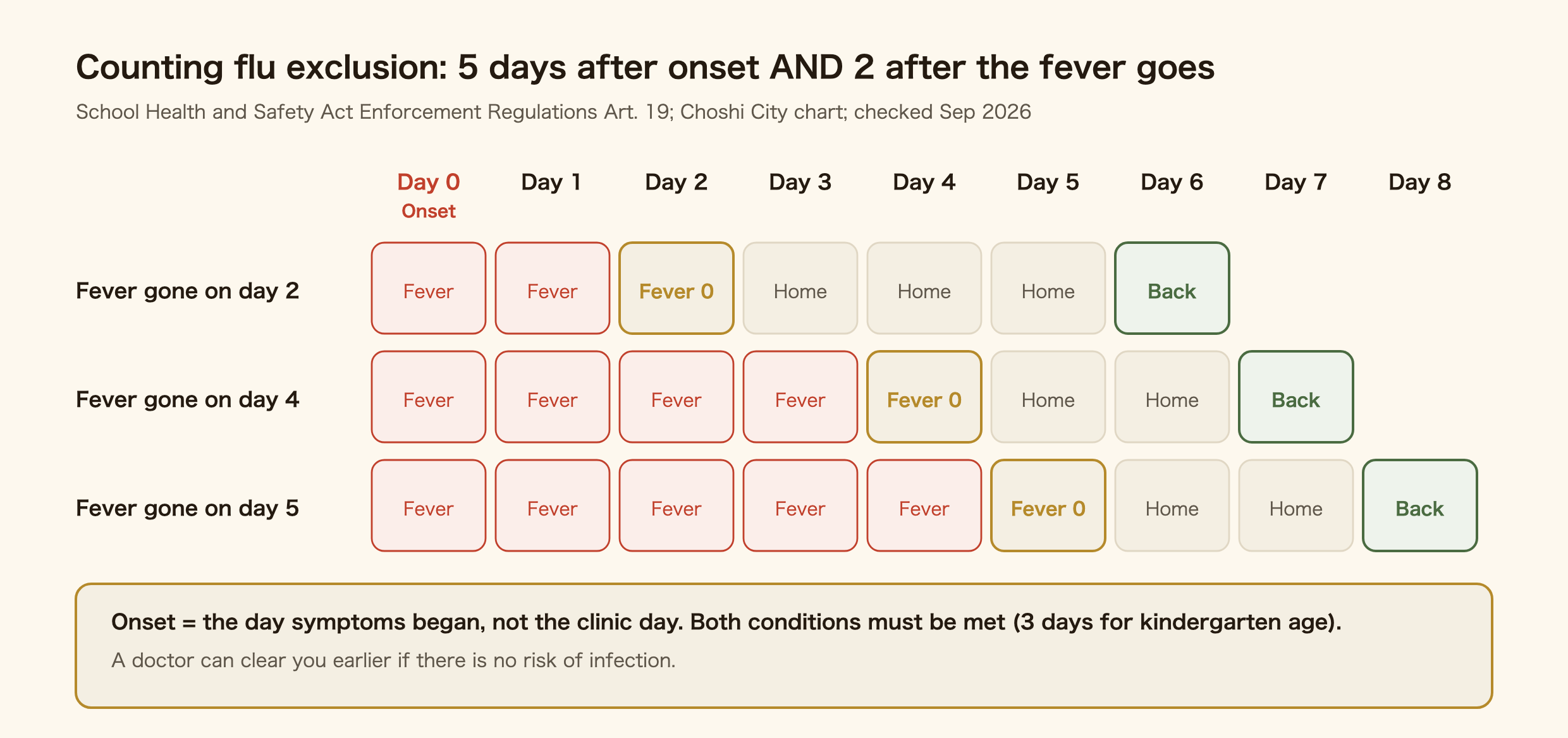
The School Health and Safety Act Enforcement Regulations list flu as a Category II disease and set the exclusion period as “until 5 days have passed after onset, and 2 days (3 for kindergarten-age children) have passed after the fever has gone” (Art. 19). Both conditions must be met. If a doctor judges there is no risk of infection, the rule does not apply.
A quick chart from the Choshi City Board of Education shows how to count.
- The day symptoms (fever) start is day 0 of onset. It is not the day you saw the doctor
- The day the fever goes is day 0 of recovery
- If the fever goes on day 1, 2 or 3, you can return on day 6. Day 4, return on day 7. Day 5, return on day 8
Fever starts on Monday evening: Monday is day 0. Even if the fever goes on Wednesday, the earliest you may attend is Sunday (day 6), which in practice means the following Monday.
The rule applies directly to schools under Article 1 of the School Education Act (elementary to high school, universities and colleges of technology), and also to vocational schools (senmon gakko) by extension. The principal orders the exclusion, and university and high-school students are told directly. A Japanese language school is not a “school” under this law unless it is licensed as a vocational school. In that case its own rules apply, so phone the school and ask how many days it wants you to stay home.
People often ask about “a family member has flu”. Article 19(4) says people living with a Category II patient stay off until a doctor judges there is no risk. There is no fixed number of days. Contact your school and follow its instructions.
You do not need a note saying you have recovered. The ministry says children and students do not need a recovery or negative test certificate to return.
Does it hurt my attendance rate as an international student?
At a Japanese language school, the national standards say a monthly attendance rate below 80% triggers guidance and below 50% is reported to Immigration. Absence for illness or other unavoidable reasons is excluded. Immigration’s interpretive guidelines give, as the first example, “an infectious disease, for the period a doctor’s diagnosis requires you to stay away”.
Your school does not know why you were absent unless you tell it. On the day you see the doctor, ask for a certificate or note for the school. What the school accepts varies, so check with the school first.
Do not do part-time work while excluded. The guidelines say that if a student is suspected of working while off sick, the school may ask for a medical certificate and question the student. How the 80% and 50% lines are counted is in Japan student visa attendance requirements. Universities and vocational schools have no published percentage, so each school decides how the absence is treated.
How many days off work with the flu in Japan, and will I be paid?
Do not judge work by what is normal at home either. Some Japanese employers have their own rule, such as a set number of days off after a flu diagnosis. Before you decide to go back because the fever is gone, check with your manager.
Workplaces have no legal number of days like schools do. Seasonal flu is a Category V disease under the Infectious Diseases Control Act. The “work restriction” a prefectural governor can impose applies to Categories I to III and pandemic-type flu, and seasonal flu is not among them (Art. 18).
Even so, the ministry asks people not to push themselves to go to school or work, because flu is generally shed from the day before onset until 3 to 7 days after. Tokyo’s infectious disease centre asks you to stay in, except to see a doctor, until at least 2 days after the fever has gone, and ideally until day 7 after onset. How many days you take is decided with your doctor’s advice and your employer’s rules.
Tell your employer early, once you have seen a doctor. When you go back, the ministry says a recovery or negative certificate is “not needed” and that workplaces “should not ask for one”. If you are asked, you can show them that.
For pay, it is one of these.
- Use paid leave: anyone who has worked six months and attended 80% of their days has it, part-timers included. Ask your employer whether you can use it for sick days. Work out how many days you have with our guide to paid leave in Japan
- Sickness allowance (on your employer’s health insurance): at Kyokai Kenpo, after 3 days off in a row (the waiting period, which can include paid leave and days off), it is paid for each unpaid day from day 4. The daily amount is two-thirds of your average standard monthly pay divided by 30
- On National Health Insurance: sickness allowance is optional for municipalities, paid only if their bylaws provide for it (National Health Insurance Act Art. 58(2)). Ask your city’s NHI counter
Check your employer’s work rules for how sick days are handled too.
Missed the dates, or can’t afford it?
Routine shots and subsidies have set dates. Shinagawa says that after the period you pay the full price. A second routine dose is also full price (Nagoya, Shinagawa). In FY2026 Nagoya, Shinagawa and Chiyoda all run to 31 January 2027. If mid-December has passed, you can still use the subsidy within the dates.
If you are 65 or over and cost is the worry, check for an exemption. In Nagoya, households on welfare or exempt from resident tax get the shot free by showing a certificate at the time. Bringing it afterwards gets no refund, so prepare it first.
If medical bills are the worry, know about the high-cost medical expense benefit, which caps what you pay at the counter. It matters if flu puts you in hospital.
Which one are you?
- You have a family member aged 65 or over (or you are 60 to 64 with a disability) — open your city’s “elderly influenza vaccination” page and check the dates, the cost and how the form arrives. Phone a designated clinic and book today.
- You have a child under 13 — two doses are needed, so get the first one in by November. Check your city’s child subsidy and phone a contracted clinic today.
- You are 13 to 64 and want the shot — call a nearby clinic about the price and booking, and fix a date before mid-December today. Glance at any notice from your employer or school too.
- You have a fever now — phone the clinic before going. If it is flu, count from the onset day as day 0 to find your return date, tell your school and employer today, and ask whether they need a certificate.
FAQ
Q. Does health insurance cover a flu shot in Japan?
No. A vaccination is not a treatment, so health insurance does not apply and in principle you pay the full price, which differs by clinic. Your cost goes down only with a routine shot (65 or over, for example) or your city’s own subsidy.
Q. Can foreigners get the routine shot or a city subsidy?
Yes, if you meet the conditions of the city where you are registered as a resident. Routine shots are provided by the city you live in, and cities such as Nagoya list resident registration as the condition. No nationality condition is given.
Q. When should I get a flu shot in Japan?
Cities such as Nagoya start on 1 October (Shinagawa started on 24 September in FY2026). Because flu peaks from late January to early March, the ministry says it is best to finish by mid-December.
Q. How many doses does a child need?
Two under age 13, one from 13. A child who is 12 at the first dose and 13 at the second still gets the second. A one-dose nasal vaccine is also available for ages 2 to 18.
Q. How many days off school with the flu in Japan?
Until 5 days have passed after onset and 2 days (3 for kindergarten age) after the fever has gone. The onset day and the day the fever goes are each counted as day 0. The earliest return is day 6, counting the onset day as day 0.
Q. Will I be paid if I miss work with the flu?
Use paid leave, or, if you are on your employer’s health insurance, you may get sickness allowance from day 4. It is paid for unpaid days after three days off in a row. Whether National Health Insurance pays it depends on your municipality.
Summary
A flu shot is not a treatment, so health insurance does not cover it. Each clinic sets the price, and you pay less only with a routine shot (65 or over, for example) or a city subsidy. Subsidies work only at your own city’s listed clinics and within its dates.
If you catch flu, phone before you go and get medicine within 48 hours. School exclusion lasts until 5 days after onset and 2 days after the fever has gone, and at a language school a doctor-required exclusion is an example of unavoidable absence. Work has no legal number of days, so agree it with your employer and protect your pay with paid leave or sickness allowance.
Sources (official): MHLW, Seasonal influenza vaccine / MHLW, Acute respiratory infection Q&A / MHLW vaccine council material (23 July 2026) / e-Gov, School Health and Safety Act Enforcement Regulations / Choshi City, flu exclusion chart / Immigration Services Agency, interpretive guidelines for Japanese language schools / Kyokai Kenpo, sickness allowance / Tokyo Metropolitan Infectious Disease Surveillance Center / Nagoya City / Shinagawa (elderly) / Shinagawa (children) / Chiyoda Ward (all in Japanese). Checked on 25 September 2026. Confirm prices and dates on your own city’s latest page. This is not medical advice; see a doctor if you are worried about your health.
Related reading
Found this useful? Share it
Send it to a friend who lives in Japan.
WHO WROTE THIS

mori
Japanese. I read the ministries’ own notices, orders and Q&As in the original, and I start from what my Nepalese and Sri Lankan friends in Japan actually ran into. I do not write about what I have not checked or been told.
What this site can and cannot do →Looking for something else?