Checked on 23 September 2026 against the Fire and Disaster Management Agency’s ambulance guide, interpretation data, #7119 and Q-suke pages, the Ministry of Health’s #8000 and referral-fee material, and official pages from the Tokyo Fire Department, Ibaraki Prefecture and Matsusaka City.
The short answer
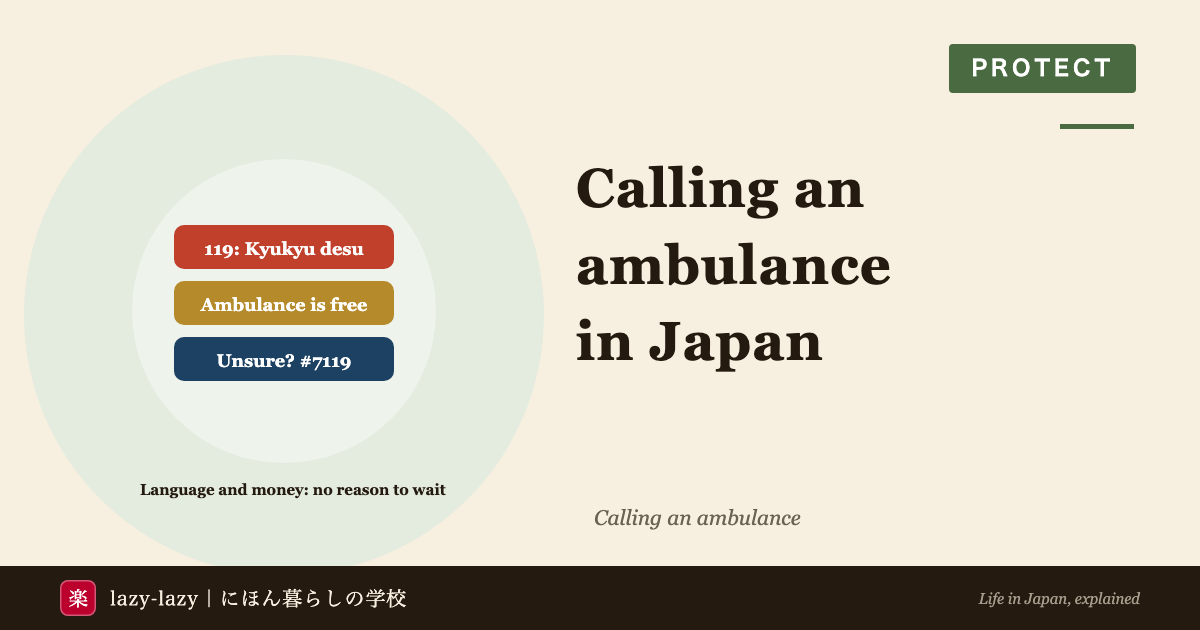
- Dial 119. When you hear “Kaji desu ka, kyukyu desu ka?” (fire or ambulance?), say “Kyukyu desu”. Then you are asked for the address, what happened, the patient’s age, and your name and number.
- You can call without Japanese. 673 of Japan’s 720 fire departments (93.5%) connect a phone interpreter, and every one of them covers English, Chinese and Korean.
- The ambulance itself is free, whatever your nationality or visa. The hospital bill is separate, and in places like Ibaraki a hospital may add a fee such as 7,700 yen if the call was not urgent.
- No address? Read out a nearby building, an intersection, or the address plate on a utility pole or vending machine.
- Not sure it is an emergency? Adults call #7119, children #8000. But #7119 only runs in 41 areas.
Knowing this, you will not hesitate over money or language on the night someone collapses. You can also save the right advice number in your phone today, before you need it.
It is late at night and your flatmate is doubled over, holding their chest. You know the number is 119. You do not know what they will ask, or what happens when fast Japanese comes down the line, or whether the ambulance costs money. You message a Japanese friend, and the reply is just “119”. They have never needed an interpreter on 119, and they have never had to find an address they could not read.
- How do I call an ambulance in Japan?
- Can I call 119 in English or my own language?
- What if I don’t know the address?
- Is the ambulance free in Japan for foreigners?
- Not sure whether to call 119? Use #7119 or #8000
- What should I bring in the ambulance?
- What if I call an ambulance for something minor?
- What if I cannot pay the hospital, or have no insurance?
- Which one are you?
- FAQ
- Summary
- Related reading
How do I call an ambulance in Japan?
Dial 119 from a mobile, a landline or a public phone. The first question is “Kaji desu ka, kyukyu desu ka?” — fire or ambulance? For an ambulance, say “Kyukyu desu.”
The dispatcher then asks what they need, in order. The Fire and Disaster Management Agency’s ambulance guide lists five things.
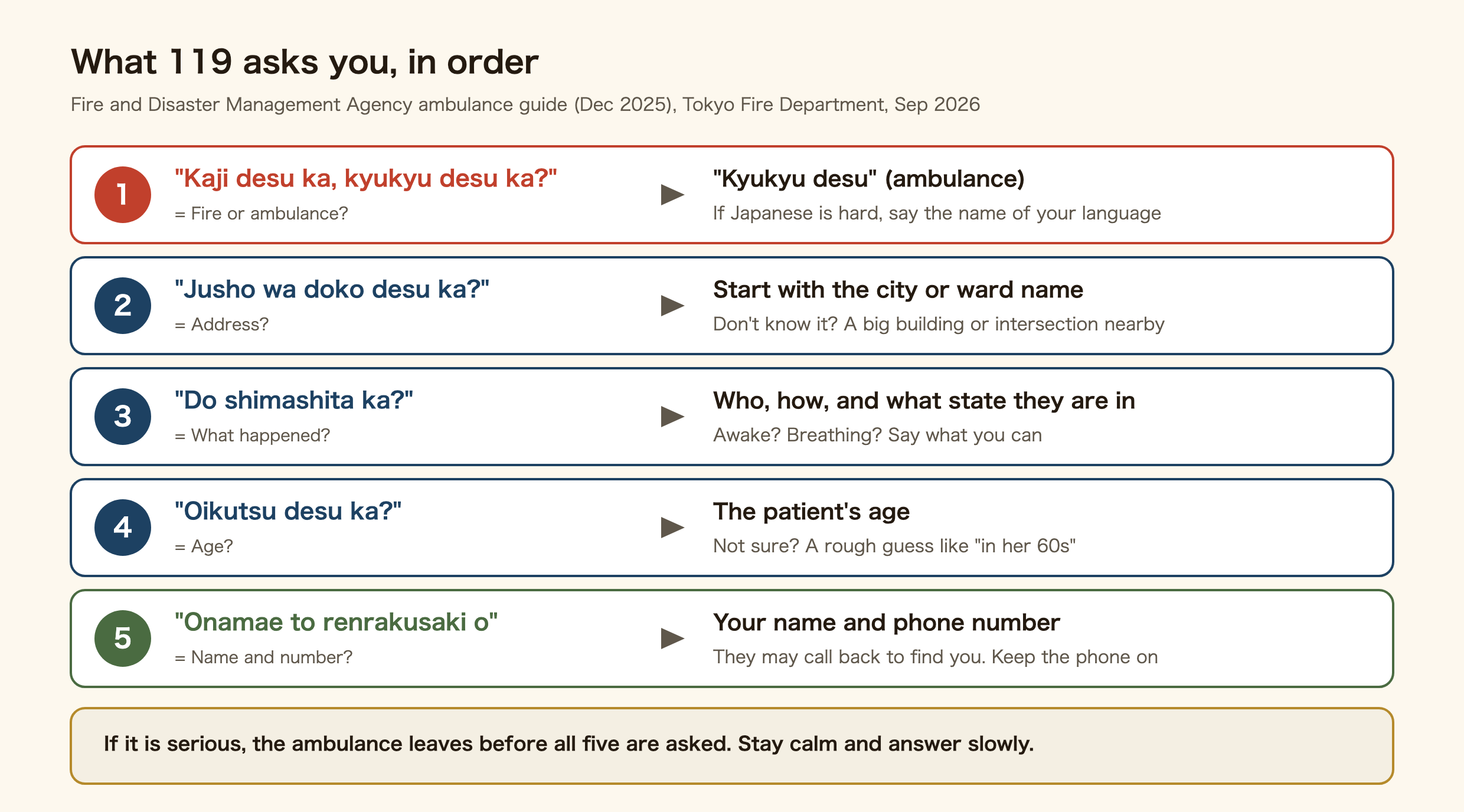
- That it is a medical emergency — “Kyukyu desu”
- The address where the ambulance should go — always starting from the city, ward or town
- What happened — who, how, and what state they are in now; whether they are conscious and breathing
- The patient’s age — a rough guess such as “in their 60s” is fine
- Your name, and a phone number that still works after the call
If the case sounds serious, the ambulance is sent before all five questions are done. Keep your phone switched on until the crew arrives: the Tokyo Fire Department says the crew may call you back if they cannot find the place.
The agency’s guide also shows “PA dispatch”, where a fire engine goes out together with the ambulance on urgent calls. So a fire engine arriving does not mean they misheard you.
Can I call 119 in English or my own language?
Yes. Most fire departments use “three-way interpretation”: when a call comes in a foreign language, the dispatcher patches in a phone interpretation centre and the three of you talk together. The system runs 24 hours a day, every day, in the main languages (Fire and Disaster Management Agency).
As of 1 January 2025, 673 of the 720 fire departments in Japan had it. All of them cover English, Chinese and Korean, and each department chooses its other languages. In 2024, the service was used 3,427 times on ambulance calls.
The Tokyo Fire Department always has English-speaking staff at its 119 centres. It uses the interpretation centre for English, Chinese, Korean, Portuguese and Spanish, and says interpreters will cover other languages as far as they can.
When the call connects, say the name of your language clearly: “English”, “Chinese”, “Nepali”. That gives the dispatcher what they need to bring in an interpreter. If someone nearby speaks Japanese, asking them to make the call also works; the agency’s guide for foreign visitors suggests exactly that.
Help with language continues after the ambulance arrives. 691 of the 720 fire departments carry “Kyukyu VoiceTra”, a translation app built for ambulance crews. It covers 15 languages, including Nepali, Vietnamese, Indonesian and Burmese as well as English, Chinese and Korean.
What if I don’t know the address?
If you are calling from home, your address is on your residence card: the Immigration Services Agency lists “place of residence” among the details printed on it. Put your address, in Japanese, into a note on your phone today. Then you only have to read it out.
If you find someone collapsed outside, not knowing the address is normal. The Tokyo Fire Department tells callers to look for these.
- The name of a large building or shop nearby (“in front of the XX Building in YY ward”, “near the ZZ post office”)
- The name of the road and of the intersection
- The station name and platform number, or the name of the bus stop
- The address plate on a utility pole, or the address sticker on a vending machine
- Asking at a convenience store or any open shop
Calls to 119 from mobile and IP phones send location information to the fire department (in use since 26 January 2007). Even so, the Tokyo Fire Department warns that finding a mobile caller can take time. Do not rely on it; give a landmark.
Start the address with the city or ward. In Tokyo alone, Itabashi ward and Hachioji city both have a district called Fujimi-cho. If 119 is slow to answer, stay on the line: hanging up can send you to the back of the queue (Tokyo Fire Department).
Is the ambulance free in Japan for foreigners?
Yes. You do not pay to be taken to hospital by ambulance. Owariasahi City’s fire department explains that emergency transport is a municipal service under the Fire Service Act, and there is no rule for charging for it. It adds that anyone in Japan can use the ambulance free, “regardless of nationality or residence status”. The cost is paid from taxes. The agency’s guide for foreign visitors puts it simply: the ambulance service is available for anyone in Japan.
Free stops at the ambulance door. What the hospital does — examination, tests, medicine — you pay for, the same as any other visit. The same visitor guide lists “cash or credit card, to pay at the hospital” among the things to bring.
| Item | Cost |
|---|---|
| Calling 119 and the ambulance ride | Free |
| Treatment, tests and medicine at the hospital | Your insurance share (30% for most people) |
| If you have no insurance card with you | The full amount at first |
| Extra fee when the call was not urgent (23 hospitals in Ibaraki, 3 in the Matsusaka area of Mie) | 2,200 to 13,200 yen (most often 7,700 yen) |
| Private ambulance (hospital transfers, going in or out) | Paid (Tokyo Fire Department) |
How the 30% share works, and how you get money back after a day without your card, is in health insurance in Japan. If you were hurt at work or on the way there, you use work injury insurance (rosai) instead, and treatment at a designated hospital is free.
Not sure whether to call 119? Use #7119 or #8000
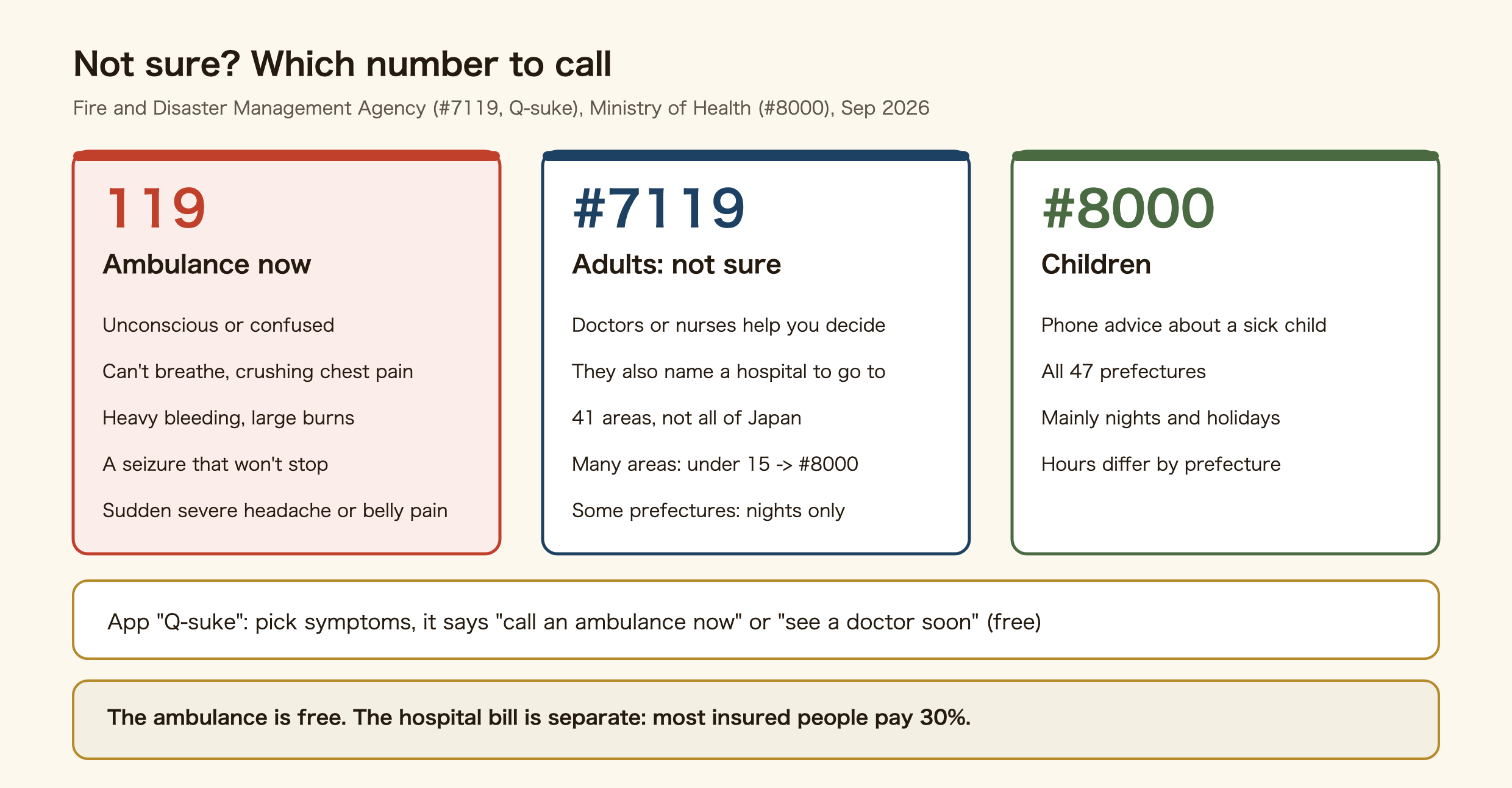
Unconscious. Struggling to breathe. A crushing pain in the middle of the chest that lasts two or three minutes. Heavy bleeding. A seizure that does not stop. For these, the agency asks you to call 119 without hesitating. The hard part is everything just short of that.
#7119 is the emergency advice line, officially the “Kyukyu Anshin Center” programme, promoted by the agency and run locally. Doctors, nurses and paramedics help you decide by phone whether you need an ambulance or should go to hospital now, and tell you which hospital can see you. If they judge it urgent, they pass you straight to 119.
It is not available everywhere. The agency’s table in September 2026 lists 41 areas.
- Whole prefecture: Aomori, Iwate, Miyagi, Yamagata, Fukushima, Ibaraki, Tochigi, Gunma, Saitama, Chiba, Tokyo, Kanagawa, Niigata, Toyama, Ishikawa, Fukui, Yamanashi, Nagano, Gifu, Shizuoka, Shiga, Kyoto, Osaka, Hyogo, Nara, Tottori, Okayama, Yamaguchi (with some exceptions), Tokushima, Kagawa, Ehime, Kochi, Fukuoka, Nagasaki, Kumamoto, Oita, Okinawa (with some exceptions)
- Part of a prefecture only: Sapporo and nearby towns, Nagoya city, Tanabe and nearby towns in Wakayama, and Hiroshima prefecture (except Osakikamijima) with Iwakuni and Waki in Yamaguchi
Akita, Mie, Shimane, Saga, Miyazaki and Kagoshima, among others, have no #7119 in the table. The agency notes that some areas run an emergency advice line under a different number, so check your prefecture’s website once.
Hours differ too. Tokyo, Osaka and Fukuoka answer 24 hours, while Yamagata and Kagawa answer only at night. Many areas take callers aged roughly 15 and over, and send younger children to #8000.
#8000 is the children’s medical advice line, a Ministry of Health programme with a line in every prefecture. All 47 answer mainly at night and on holidays, and all stay open past midnight, but the starting time varies by prefecture.
If you want a first answer before phoning anyone, the agency’s free app “Q-suke” helps. You pick symptoms on the screen, and it tells you something like “call an ambulance now” or “see a doctor as soon as possible”, then links to hospital and taxi searches. The agency’s page does not say which languages it supports, so if you cannot read Japanese, a phone call is the surer route.
What should I bring in the ambulance?
While you wait, the agency suggests getting these ready.
- Your My Number health insurance card, or your insurance eligibility certificate
- Your hospital patient card, if you have one
- Money (the visitor guide says cash or a credit card)
- Shoes
- The medicine you take, or your medicine notebook (okusuri techo)
- For a baby: the maternal and child health handbook, nappies, a feeding bottle and a towel
The less Japanese you have for explaining your conditions and medicines, the more the My Number health insurance card helps. Under “Myna-kyukyu”, which started nationwide on 1 October 2025, the ambulance crew reads the card and sees which hospitals you have used and what you have been prescribed. The card works even if you are unconscious. A card stored on a smartphone needs you to unlock it, so it does not work then. Carry the physical card.
If there are several of you, send one person outside to guide the ambulance in. It gets there faster (Fire and Disaster Management Agency).
What if I call an ambulance for something minor?
About half the people taken to hospital by ambulance turn out to have minor conditions that do not need admission (Fire and Disaster Management Agency). In Tokyo in 2024, ambulances went out 935,373 times, and 52.8% of patients carried were minor cases. The more minor calls there are, the later the ambulance reaches someone who needs it urgently.
That is why some areas now let hospitals charge an extra fee (sentei ryoyohi) when an ambulance patient’s call was not urgent.
- Ibaraki: since 2 December 2024, at 23 large hospitals, when the call was not urgent at the time it was made. 2,200 to 13,200 yen depending on the hospital, most often 7,700 yen
- Matsusaka area, Mie: since 1 June 2024, at 3 hospitals, 7,700 yen for minor cases that did not need admission. In the first year, 9.9% of ambulance patients paid it
This fee is really the charge for going to a big hospital without a referral letter. Since October 2022 the national standard for a first visit is 7,000 yen. But the Ministry of Health’s rules say it must not be charged “in an emergency or other unavoidable circumstances”. Ibaraki also says that heatstroke or a child’s febrile seizure counts as urgent when you call, even if it turns out mild at the hospital. If it is genuinely dangerous, this fee is no reason to wait.
Prank or false calls are another matter. Making a false report of a fire or of a sick or injured person without good reason is punishable by a fine of up to 300,000 yen or short detention under the Fire Service Act (Article 44). The Tokyo Fire Department says it may hang up on non-urgent calls before they finish.
What if I cannot pay the hospital, or have no insurance?
Some people avoid calling because they fear the hospital bill. If a life may be at stake, call first. Payment can be discussed afterwards.
If you arrive without your insurance card, the hospital may ask you to pay the full amount. Bring the card and the receipt later and everything except your share comes back. If the amount is more than you can pay, say so at the hospital desk that day. There is also a “free or low-cost medical care” programme for people in financial difficulty, open regardless of nationality or visa status. How it works, and how to find a hospital with interpreters, is in seeing a doctor in Japan.
If you have not joined national health insurance yet, that is the first thing to fix. The ambulance will come either way, but without insurance the hospital bill is the full amount.
Which one are you?
- Someone in front of you is in danger now — dial 119 and say “Kyukyu desu”. If the words will not come, say your language. Give the city first; if you do not know the address, read the utility pole or vending machine plate.
- You are an adult and not sure it is an emergency — check the agency’s table for #7119 in your area. If there is none, save your prefecture’s advice number in your phone today.
- You have children — save #8000 and your prefecture’s hours in your phone today.
- Nothing has happened yet — write your address in Japanese in your phone, put your My Number insurance card in your wallet, and check today that you are insured.
FAQ
Q. Is the ambulance free in Japan for foreigners?
Yes. Using the ambulance is free regardless of nationality or residence status. You pay the hospital separately for treatment, and in places such as Ibaraki and the Matsusaka area of Mie, a hospital may add a fee such as 7,700 yen if the call was not urgent.
Q. Can I call 119 in English?
Yes. 673 of Japan’s 720 fire departments use a phone interpretation centre for three-way calls, and all of them cover English, Chinese and Korean. Say the name of your language at the start of the call.
Q. What does 119 ask when I call for an ambulance?
After “fire or ambulance?”, you are asked for the address, what happened to the patient, their age, and your name and phone number. In a serious case the ambulance leaves before all the questions are finished.
Q. What if I don’t know the address?
Give the name of a large building or shop nearby, the intersection, or the station or bus stop. The address plate on a utility pole and the address sticker on a vending machine also work.
Q. Who do I call if I’m not sure I need an ambulance?
Adults call #7119 and children #8000. #7119 runs in 41 areas, so it is not available everywhere. #8000 is in all 47 prefectures and answers mainly at night and on holidays.
Q. What should I bring when the ambulance comes?
Your My Number health insurance card or eligibility certificate, money, shoes, and your medicines or medicine notebook. With Myna-kyukyu, the crew can read your medical history and prescriptions from the card.
Summary
The ambulance number is 119, and the first thing to say is “Kyukyu desu”. Even without Japanese, almost every fire department can bring in an interpreter. The ambulance itself is free for everyone; what costs money is the hospital.
Give the city first, and if you do not know the address, look at the utility pole and the vending machine. When you are unsure, adults call #7119 and children #8000. Some areas have no #7119, so save your prefecture’s number in your phone while everyone is still well.
Official sources: Fire and Disaster Management Agency, ambulance guide / FDMA, ambulance guide for foreign visitors (16 languages) / FDMA, three-way interpretation on 119 (Japanese) / FDMA, #7119 areas (Japanese) / FDMA, Q-suke app (Japanese) / FDMA, Myna-kyukyu (Japanese) / Ministry of Health, #8000 (Japanese) / Tokyo Fire Department, how 119 works (Japanese) / Owariasahi City fire department, ambulance cost (Japanese) / Ibaraki Prefecture, fee for non-urgent ambulance cases (Japanese) / Matsusaka City, fee at three core hospitals (Japanese). Checked on 23 September 2026.
Related reading
Found this useful? Share it
Send it to a friend who lives in Japan.
WHO WROTE THIS

mori
Japanese. I read the ministries’ own notices, orders and Q&As in the original, and I start from what my Nepalese and Sri Lankan friends in Japan actually ran into. I do not write about what I have not checked or been told.
What this site can and cannot do →Looking for something else?