Checked on 30 September 2026 against the Consumer Affairs Agency’s allergen labelling pages and handbook (April 2026 edition), Japan’s Food Labeling Standards on e-Gov, JNTO’s guides for Muslim and vegetarian travellers, the Japan Tourism Agency’s hospitality guide, and MEXT’s school guidebook and school-lunch guidelines.
The short answer
- Japan has no central agency for halal certification. What you avoid is your own decision. What Japan gives you is a way to check what is in the food.
- On packaged food, read the ingredient list (原材料名). Ingredients are listed from heaviest to lightest, and additives come after a “/” or in a separate 添加物 box. Pork appears as 豚肉, ポーク or 豚脂; alcohol as 酒精, 洋酒 or みりん.
- Only 9 allergens must be labelled. Pork, gelatin, beef and chicken are among the 20 “recommended” items, so they can be in a product even when the allergen note does not mention them.
- Restaurants and food made and sold in-store have no ingredient label. You have to ask, and JNTO’s bilingual inquiry sheet is the quickest way.
- For school lunch, talk to your child’s class teacher, whether the reason is religion or allergy. Allergy arrangements need a form written by a doctor.
Knowing this, you can work out from a Japanese label, or a staff member’s answer, whether you can eat something. If you have children, you will also know what to tell the school before they start.
You pick up a bread roll at a convenience store. The back of the bag is covered in tiny characters: ショートニング, 乳化剤, 酒精. Is there pork in it? You ask a Japanese friend, and they shrug. Your friend has never had to read a label looking for pork or alcohol.
- How do I find halal food in Japan?
- How to read Japanese food labels: three places to look
- How are pork, gelatin and alcohol written in Japanese ingredient lists?
- When does the label not tell you? Four cases
- Japan’s allergen labels: the 9 mandatory items, with cashew added in April 2026
- Vegetarian and vegan in Japan: watch the dashi
- How do I ask at a restaurant? Japanese phrases and JNTO’s inquiry sheet
- School lunch in Japan: tell the teacher about religion or allergies
- How much does it cost?
- What if I eat something by mistake?
- Which one are you?
- FAQ
- Summary
- Related reading
How do I find halal food in Japan?
Start with this: Japan has no central halal certification body. JNTO, the national tourism organisation, says so plainly in its guide for Muslim travellers (JNTO, Muslim Travelers in Japan). Certification is done by private organisations.
According to the same guide, halal-certified products in Japan are mostly ingredients such as frozen meat and spices, not ready meals. The average supermarket does not stock halal products, though some “ethnic” grocery stores sell halal curries and similar meals.
How strict to be varies from person to person. The Japan Tourism Agency’s guide notes that the interpretation and practice of Islam differ by school, country, region, culture and individual, and that there is no single worldwide standard (Japan Tourism Agency, hospitality guide for vegetarian, vegan and Muslim travellers, Japanese). This article does not judge what is halal. It shows how to check what is in food in Japan. If you are vegetarian or have a food allergy, the tools are the same.
How to read Japanese food labels: three places to look
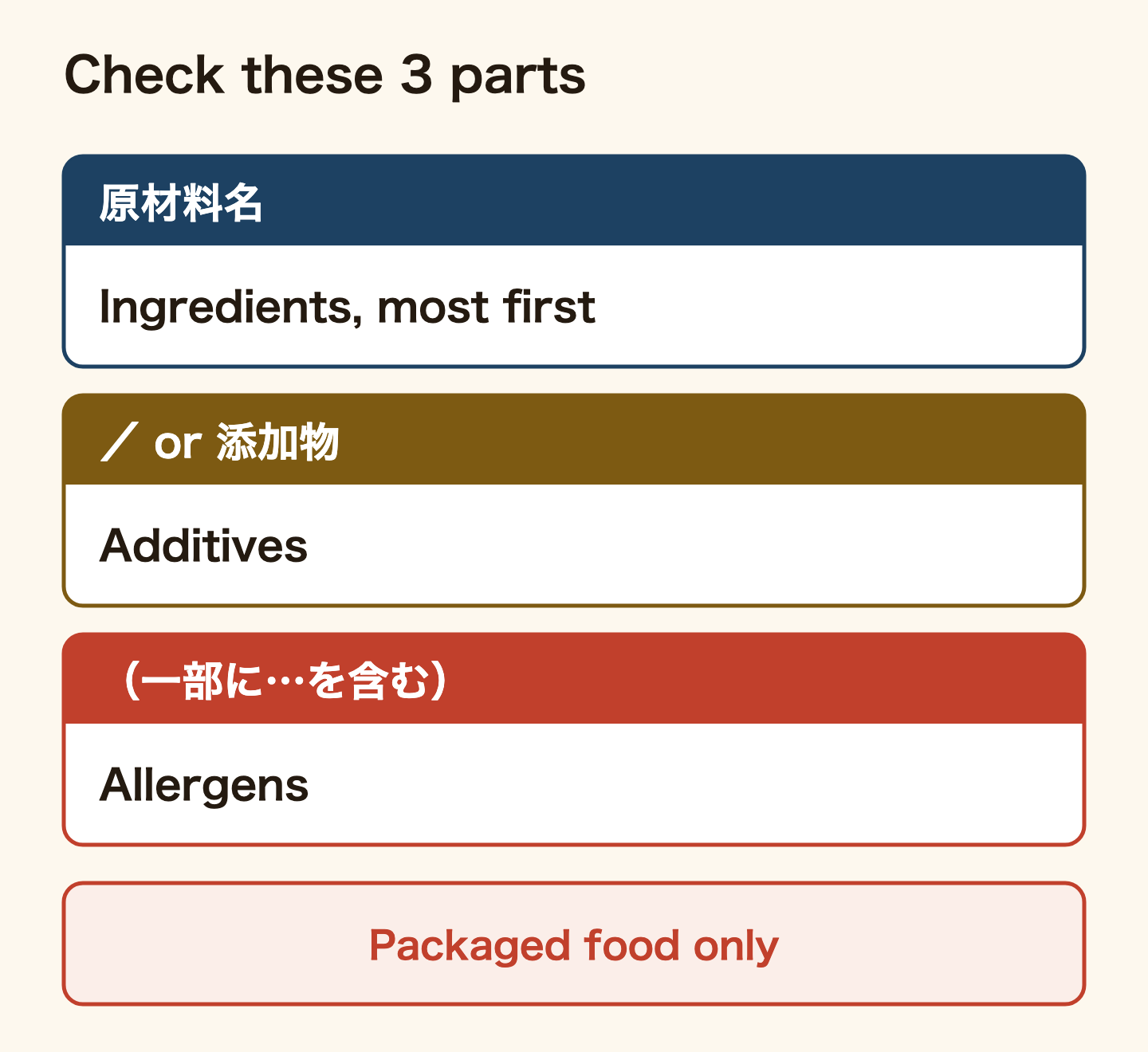
Packaged processed food carries a label box on the back. Look at three parts.
- 原材料名 (ingredients): listed in order of weight, heaviest first (Food Labeling Standards, Art. 3, Japanese). An ingredient made of several things, such as margarine, has its own contents in brackets after it.
- 添加物 (additives): after a “/” that ends the ingredient list, or in a separate 添加物 box.
- Allergens: either after each ingredient, such as (卵を含む) “contains egg”, or at the end as (一部に小麦・卵・豚肉を含む) “partly contains wheat, egg, pork”.
A vague “may contain” is not allowed as an allergen label (Consumer Affairs Agency, food allergen labelling, Japanese). Where a factory also handles an allergen, a warning such as “this factory also makes products containing ○○” is recommended.
How are pork, gelatin and alcohol written in Japanese ingredient lists?
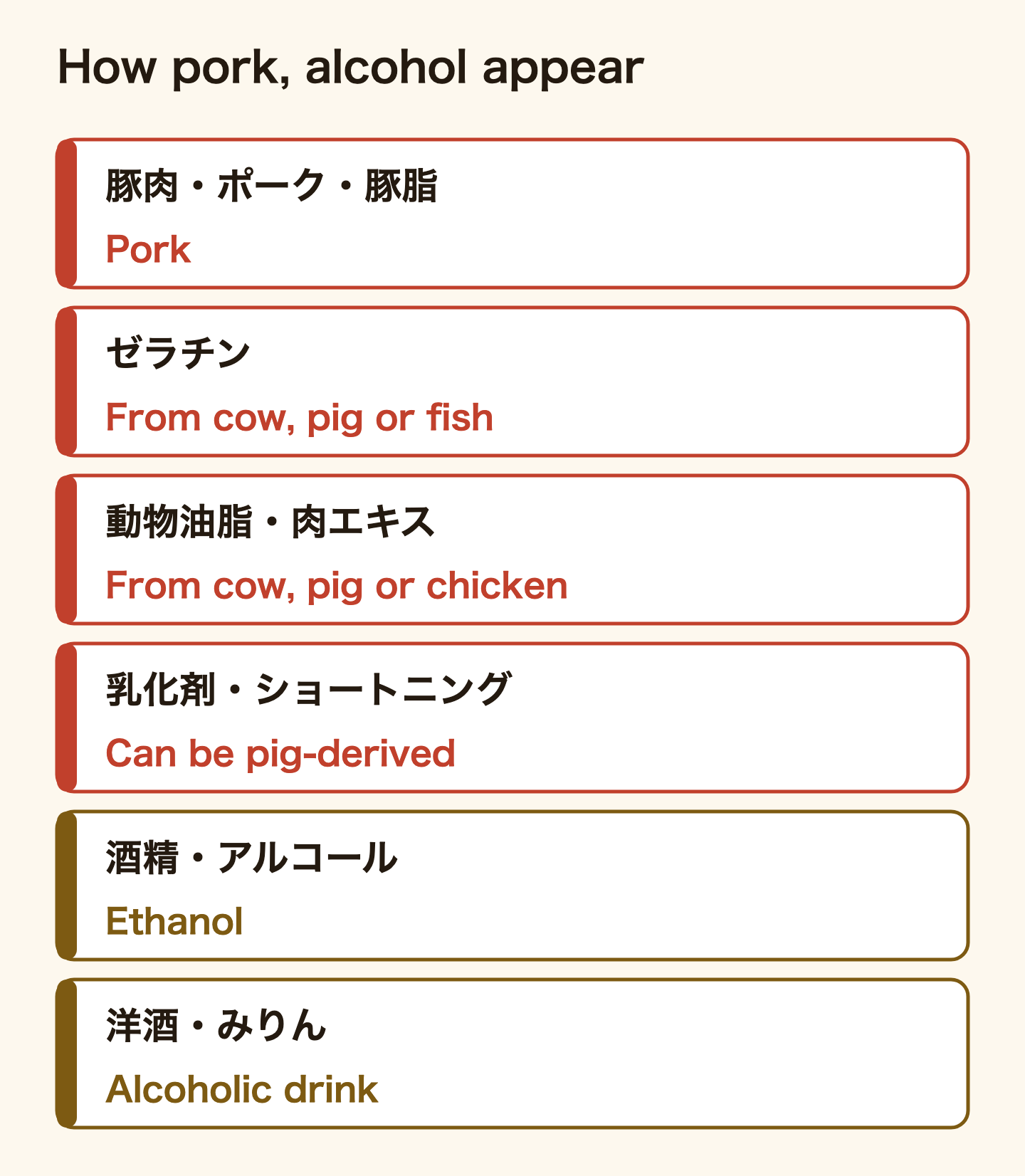
Pork is not always written 豚肉 (butaniku). The Consumer Affairs Agency’s handbook lists ぶたにく, 豚 (buta) and ポーク (pōku) as accepted equivalents, and names like ポークウインナー (pork sausage), 豚ミンチ (minced pork) and 豚脂 (pork fat) also count. Lard falls within the scope of pork (CAA allergen labelling handbook, April 2026, Japanese).
Some names hide their source. The same handbook says gelatin (ゼラチン) is often made from cattle or pigs, and sometimes from fish. 動物油脂 (animal fat) and 肉エキス (meat extract) are made from cattle, pigs or chickens. Lumping allergens together as “meat” or “animal ○○” is not allowed in the allergen label.
The Japan Tourism Agency’s guide gives emulsifier, shortening, gelatin and collagen as examples of ingredients that can be pig-derived. An emulsifier can be listed simply as 乳化剤, by its function, without naming its source (Food Labeling Standards, Appended Table 7). When a label only says 乳化剤, the label cannot tell you where it came from. If it matters to you, ask the manufacturer.
Alcohol used as an additive is written 酒精 (shusei), アルコール or エチルアルコール. All three are names for ethanol (CAA additive list). As an ingredient it appears as 洋酒 (Western liquor) or みりん (mirin). JNTO notes that cooking sake and mirin go into many Japanese dishes, and that some miso contains alcohol unless it is additive-free and labelled 無添加.
When does the label not tell you? Four cases
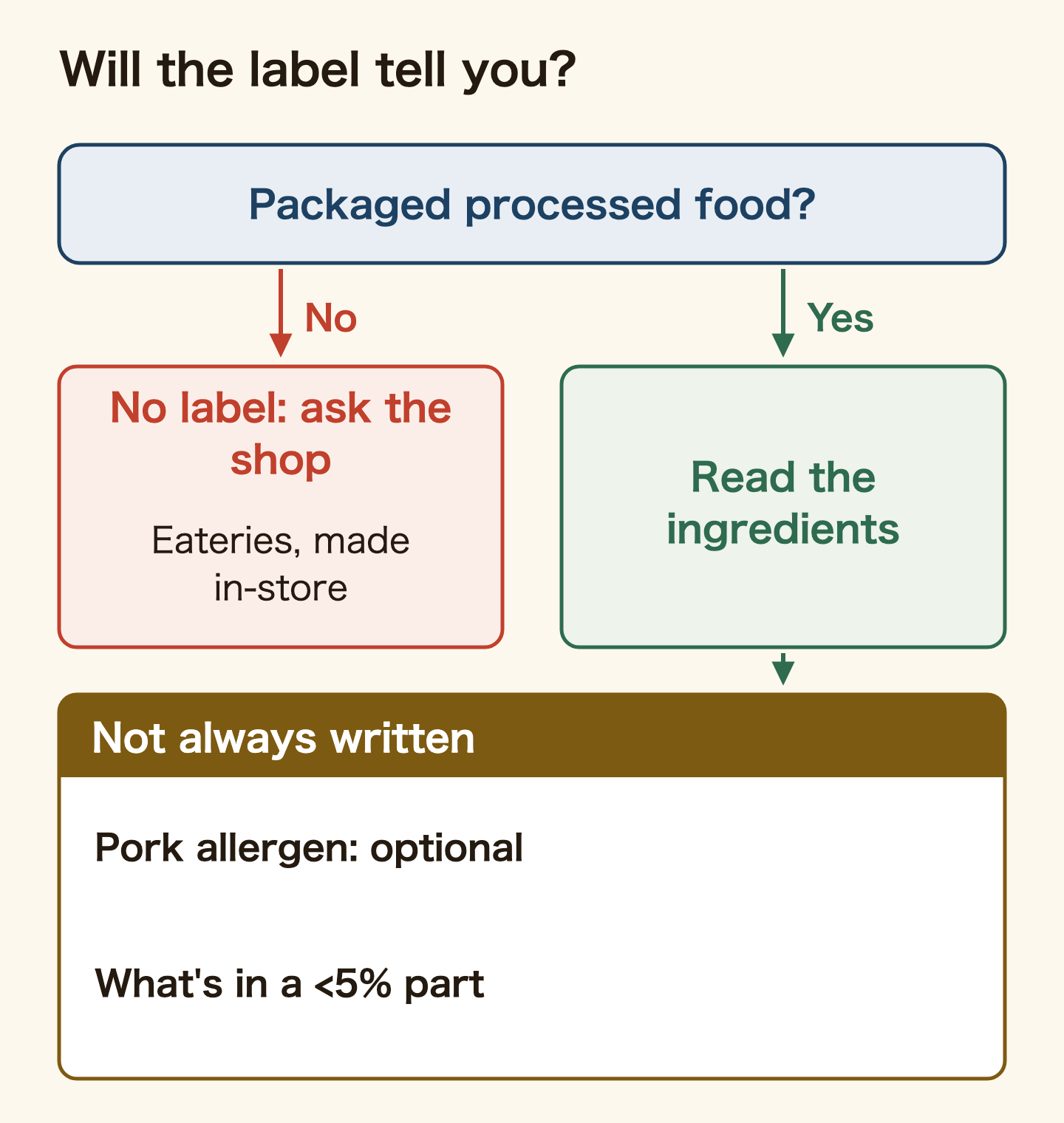
A label does not always tell you everything. Within what we could confirm, these are the four cases where something can go unwritten.
- Restaurant food: the Food Labeling Standards do not apply to food served to eat on the premises (Art. 1). Delivery food is also outside allergen labelling.
- Food made and sold in the same place: bread baked in the shop, for example, does not need an ingredient list (Art. 5). Loose food sold by weight or by the piece is also outside allergen labelling.
- Small ingredients: if a compound ingredient is under 5% of the product, its contents can be left out (Art. 3). Inside a compound ingredient, items ranked third or lower and under 5% can be grouped as その他 (“other”).
- Additives listed by function: 乳化剤 (emulsifier), 香料 (flavouring) and others can be listed without naming the source. An additive carried in with an ingredient at too small an amount to have an effect (carry-over) does not have to be listed.
The allergen note has one more trap. Labelling pork and gelatin is only recommended, so a missing 豚肉 in the allergen brackets does not prove there is no pork. If a product says この食品は29品目のアレルゲンを対象範囲としています (“this food covers 29 allergens”), the maker has checked the recommended items too.
Japan’s allergen labels: the 9 mandatory items, with cashew added in April 2026
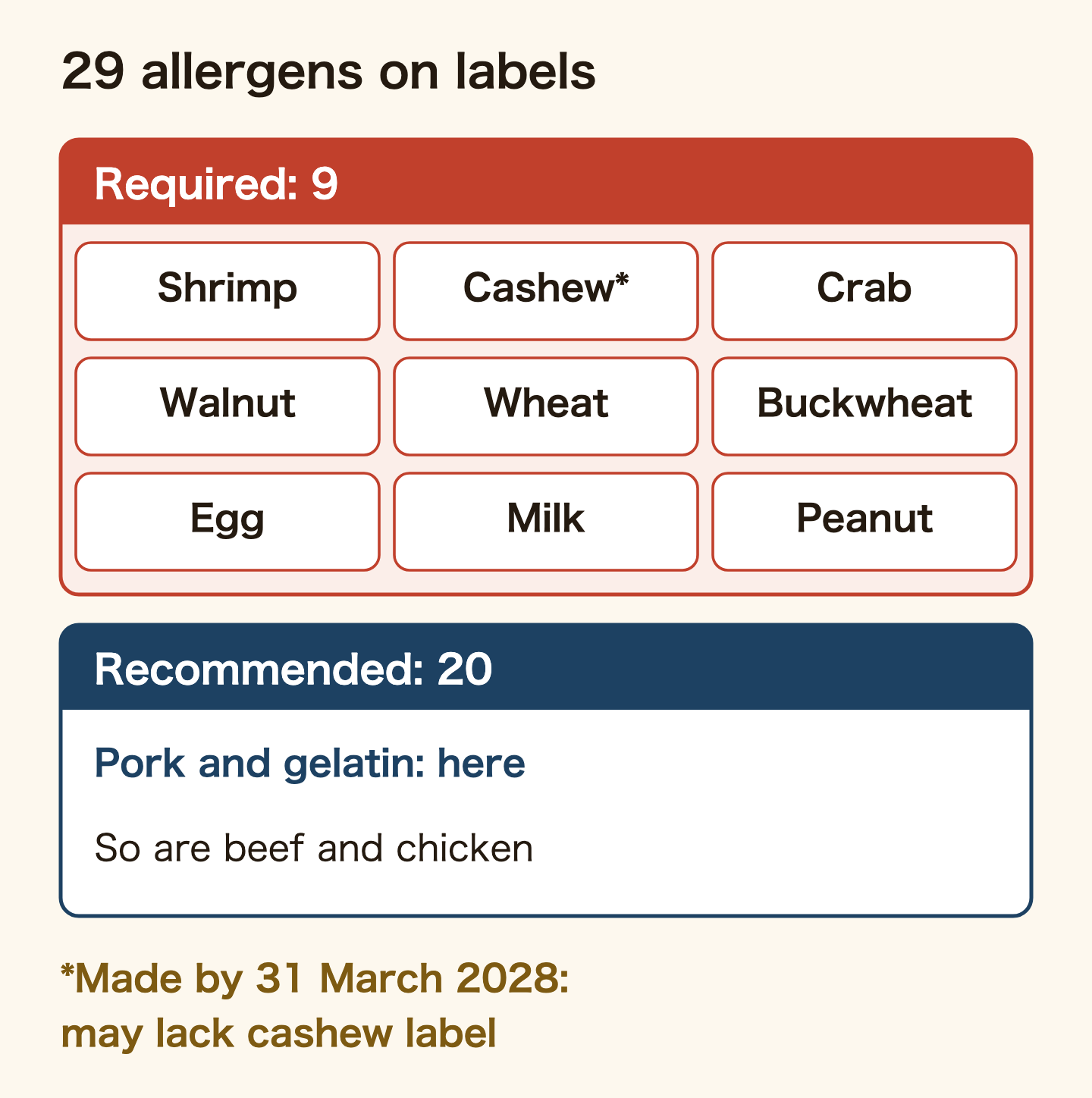
Nine items must be labelled by law as of 30 September 2026: shrimp (えび), cashew (カシューナッツ), crab (かに), walnut (くるみ), wheat (小麦), buckwheat (そば), egg (卵), milk (乳) and peanut (落花生).
Cashew was added on 1 April 2026 (CAA notice of 1 April 2026, Japanese). There is a two-year transition: products made by 31 March 2028 may still follow the old rule and leave cashew off the label (Food Labeling Standards, supplementary provisions). If you are allergic to cashews, do not rely on the label alone during this period.
The other 20 items are recommended, not required: almond, abalone, squid, salmon roe, orange, kiwi fruit, beef, sesame, salmon, mackerel, soybean, chicken, banana, pistachio, pork, macadamia nut, peach, yam, apple and gelatin. Pistachio was added in April 2026.
Equivalent spellings are allowed: egg can appear as 卵, 玉子 or たまご. Learn how your own allergen can be written and you will miss it less often.
Vegetarian and vegan in Japan: watch the dashi
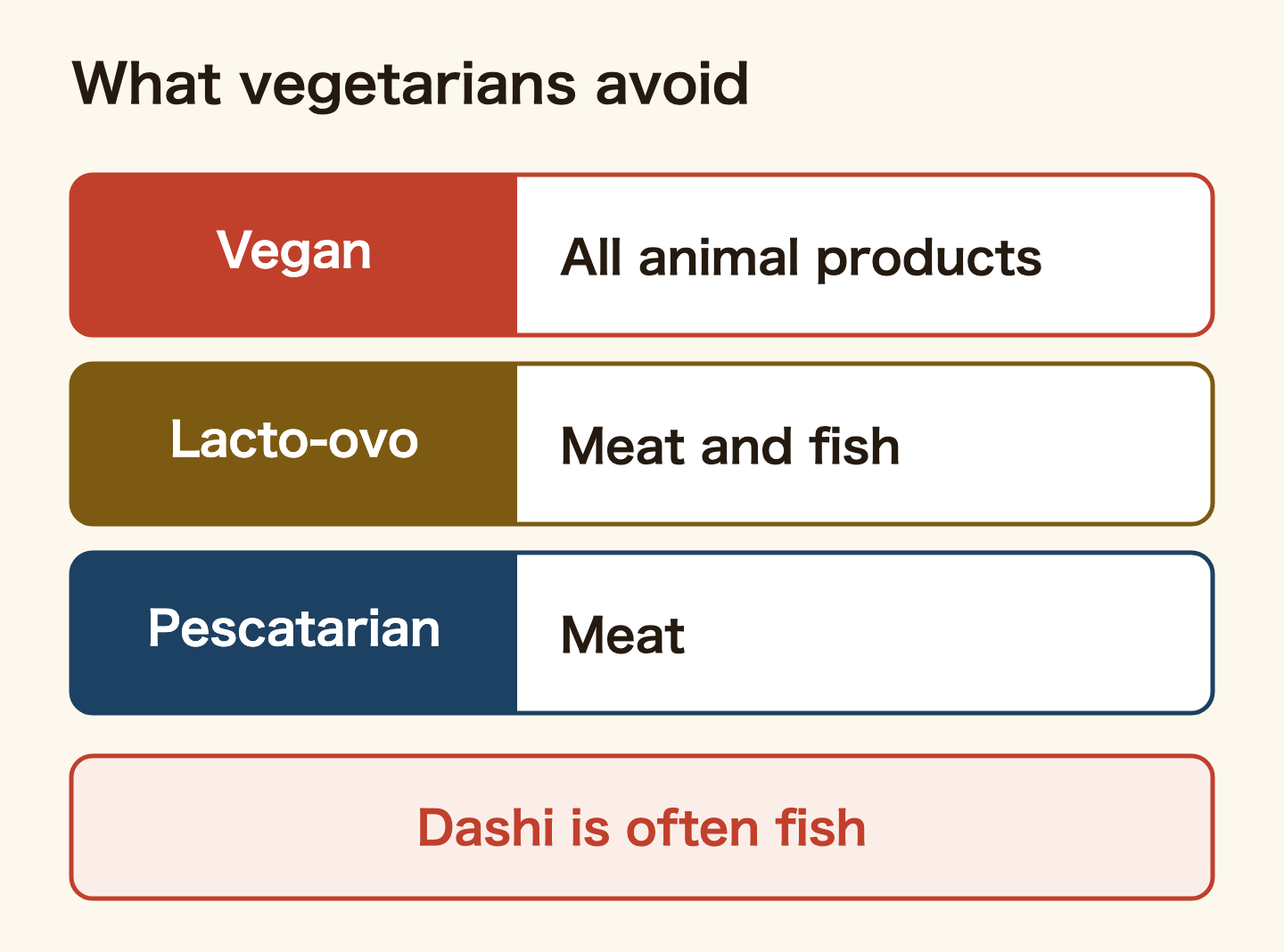
A dish can look like vegetables only and still taste of fish. JNTO’s vegetarian guide warns that the sauce packed with natto is often dashi, a fish stock (JNTO, Vegetarian and Vegan Guide).
Words matter as well. JNTO points out that “vegetarian” can be understood more loosely in Japan than in English, and advises saying exactly what you cannot eat: meat, fish, dashi and stocks. The Japan Tourism Agency’s guide describes vegans as avoiding all animal-derived products, including honey and gelatin.
How do I ask at a restaurant? Japanese phrases and JNTO’s inquiry sheet
You expect the menu to list what is in each dish. Where you come from, that may be normal. In Japan, food served in a restaurant does not have to be labelled at all. Nothing is being hidden; there is simply no rule to write it down. So you ask.
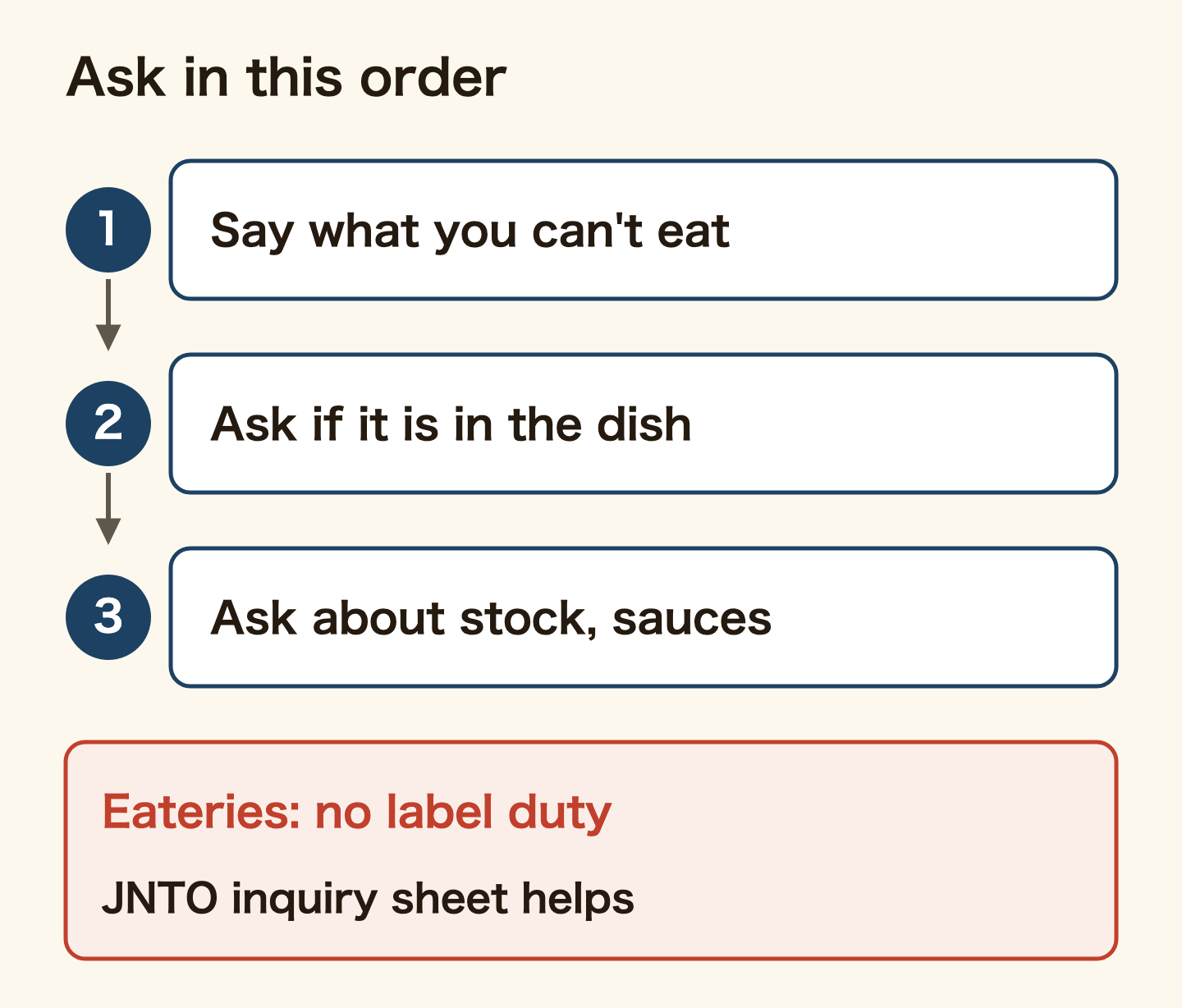
Ask in three steps. Say what you cannot eat, ask whether it is in the dish, then ask about the stock and seasonings.
| What you want to say | Japanese |
|---|---|
| I cannot eat pork. | 豚肉が食べられません。 Butaniku ga taberaremasen. |
| I cannot have alcohol or mirin either. | お酒とみりんも、食べられません。 Osake to mirin mo, taberaremasen. |
| Is there pork or alcohol in this? | この料理に、豚肉やお酒は入っていますか。 Kono ryōri ni, butaniku ya osake wa haitte imasu ka. |
| What about the stock and seasonings? | だしや調味料にも、入っていませんか。 Dashi ya chōmiryō ni mo, haitte imasen ka. |
| I eat no meat, no fish, no dashi. | 肉も魚も、だしも食べません。 Niku mo sakana mo, dashi mo tabemasen. |
| I have an egg allergy. Even a little is a problem. | 卵のアレルギーがあります。少しでも入っていたら食べられません。 Tamago no arerugī ga arimasu. Sukoshi demo haitte itara taberaremasen. |
If speaking feels risky, paper works better. JNTO publishes a bilingual Muslim Services Inquiry Sheet that you show to restaurant, hotel or shop staff, who tick “yes” or “no”. It asks whether there is a menu with no pork-derived ingredients and no alcohol, whether dishes can be made without sake or mirin, whether utensils and dishes are kept separate, and whether alcohol is served to other customers. There are also questions for shops about a specific product.
JNTO also notes that a restaurant calling itself halal-friendly may not cook in a separate halal-only kitchen. How far things need to be kept apart is, again, yours to decide and to ask about.
School lunch in Japan: tell the teacher about religion or allergies
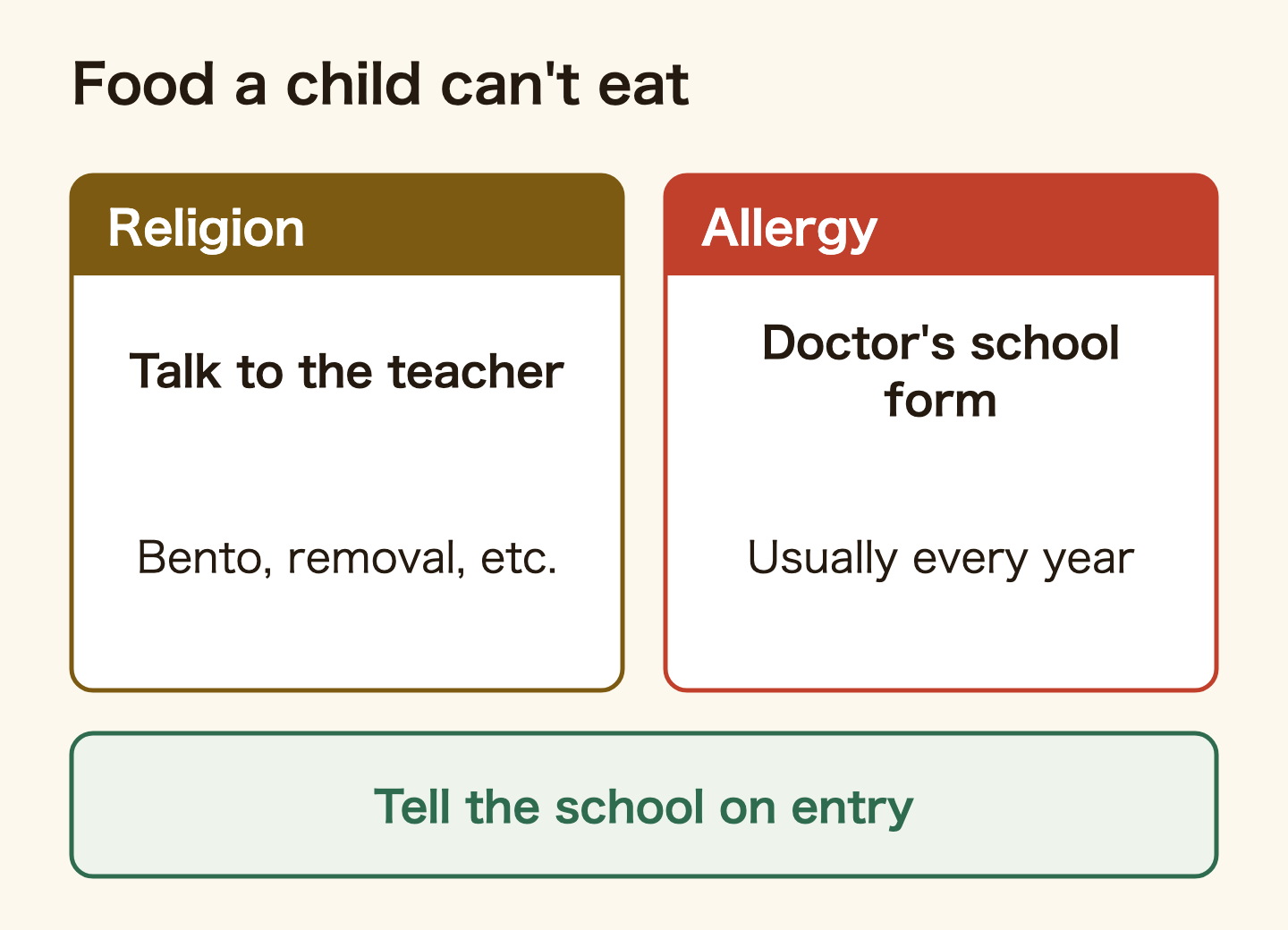
Most Japanese public elementary and junior high schools serve lunch. MEXT’s guidebook for foreign parents says that if there is food your child cannot eat for health or religious reasons, you should consult the class teacher (MEXT school guidebook for foreign parents).
There is guidance for schools too. MEXT’s handbook on accepting foreign children says children from Islamic backgrounds need consideration at lunch, and that schools should basically respect the parents’ religious judgement. It adds that what is forbidden differs by country, region and school of thought, so the decision rests first with the parents (MEXT, handbook on accepting foreign children, Japanese).
What schools actually do varies. In a 2017 survey of 20 city boards of education by the Ministry of Internal Affairs’ Chubu regional office, 14 said schools allowed packed lunches, 8 said schools removed pork and other foods the child could not eat, and 3 said schools gave parents information on lunch ingredients such as whether pork was used (MIC Chubu survey on religious accommodation, Japanese). These are what the boards reported, not national figures.
Allergies follow a set procedure. Under MEXT’s guideline, parents who want allergy arrangements must submit a 学校生活管理指導表, a school form based on a doctor’s diagnosis. The rule is complete removal: the food is either served or not. When it cannot be served safely, the child brings a packed lunch. If the arrangement continues, the form is usually resubmitted every year (MEXT, food allergies in school lunch, Japanese). The enrolment steps are in how to put your child in a Japanese public school and what it costs.
How much does it cost?
Reading labels and using JNTO’s sheet cost nothing. Money comes in with school lunch.
MEXT’s survey found that parents paid 35,774 yen a year for school lunch at public elementary school and 35,671 yen at public junior high (FY2023 survey of children’s learning expenses). Since April 2026, the government has paid local authorities toward the food cost of public elementary school lunch, with a benchmark of 5,200 yen per child per month. Parents do not need to apply (MEXT school lunch cost relief, Japanese).
The same page says some local authorities support children who cannot eat school lunch, for example because of a severe allergy, and that this support needs its own application. We found no national rule on whether you pay for lunch on days your child brings a packed lunch. Ask about money when you talk to the teacher.
What if I eat something by mistake?
For allergies, the CAA handbook lists losing consciousness and a drop in blood pressure leading to shock among the severe symptoms. If that happens, call 119 at once. What to say on the phone is in how to call an ambulance in Japan, and how to find a hospital that speaks your language is in finding an English-speaking doctor.
If a wrong label caused it, contact the shop and the manufacturer. What to do from a religious point of view is not something this article covers. Follow your own community’s practice.
Which one are you?
- You avoid pork and alcohol — scan ingredient lists for 豚・ポーク・豚脂・ラード・ゼラチン・動物油脂・肉エキス・乳化剤・ショートニング・酒精・洋酒・みりん. Save JNTO’s inquiry sheet on your phone for eating out.
- You are vegetarian or vegan — learn to say 肉も魚も、だしも食べません. Mention it when you book.
- You have a food allergy — check whether your allergen is one of the 9 mandatory items or the 20 recommended ones. If it is recommended, ask the shop or maker even when the label says nothing.
- Your child is starting school — tell the class teacher at the entry or transfer interview what your child cannot eat. For an allergy, book a doctor’s appointment to get the school form written.
FAQ
Q. Is there an official halal mark in Japan?
There is no single national certification body. JNTO says Japan has no central agency for halal accreditation. Certification is done by private organisations.
Q. If the allergen note does not mention pork, is the food pork-free?
Not necessarily. Allergen labelling for pork and gelatin is only recommended, not required. Read the ingredient list itself, and ask the maker about items such as 乳化剤 whose source is not given.
Q. What does 酒精 mean on a Japanese label?
It means ethanol (alcohol). As an additive it can be written 酒精, アルコール or エチルアルコール.
Q. How many allergens must be labelled in Japan?
Nine, as of 30 September 2026. Shrimp, cashew, crab, walnut, wheat, buckwheat, egg, milk and peanut. Cashew was added on 1 April 2026, with a transition for products made by 31 March 2028.
Q. Do restaurant dishes in Japan have ingredient labels?
They do not have to. The Food Labeling Standards do not apply to food served to eat on the premises. Ask the staff, or show JNTO’s inquiry sheet.
Q. What if my child cannot eat school lunch for religious reasons?
Talk to the class teacher. MEXT’s handbook asks schools to basically respect parents’ religious judgement. Arrangements such as packed lunches or removing foods vary by school and city.
Summary
Japan has no national halal certification body, and what you avoid is your decision. Your tools are the label and your questions. On packaged food, read 原材料名: pork shows up as 豚, ポーク or 豚脂, alcohol as 酒精, 洋酒 or みりん.
But pork and gelatin are optional in the allergen note, and restaurants and in-store food carry no label. Where nothing is written, ask. For school lunch, religion or allergy, it starts with telling the class teacher when your child joins.
Official sources: Consumer Affairs Agency, food allergen labelling (Japanese) / CAA allergen labelling handbook, April 2026 (PDF, Japanese) / CAA notice of 1 April 2026 (PDF, Japanese) / CAA additive list (PDF, Japanese) / Food Labeling Standards on e-Gov (Japanese) / JNTO, Muslim Travelers in Japan / JNTO, Muslim Services Inquiry Sheet / JNTO, Vegetarian and Vegan Guide / Japan Tourism Agency hospitality guide, April 2024 (PDF, Japanese) / MEXT school guidebook for foreign parents / MEXT handbook on accepting foreign children (Japanese) / MEXT, food allergies in school lunch (Japanese) / MEXT school lunch cost relief (Japanese) / MIC Chubu survey on religious accommodation (PDF, Japanese). All checked on 30 September 2026.
Related reading
Found this useful? Share it
Send it to a friend who lives in Japan.
WHO WROTE THIS

mori
Japanese. I read the ministries’ own notices, orders and Q&As in the original, and I start from what my Nepalese and Sri Lankan friends in Japan actually ran into. I do not write about what I have not checked or been told.
What this site can and cannot do →Looking for something else?