Checked on 23 September 2026 against the Labour Standards Act, Labour Contract Act, Employment Insurance Act and Immigration Control Act (e-Gov), the Ministry of Health, Labour and Welfare’s guidance and standard on dismissal and non-renewal, Hello Work, and the Immigration Services Agency.
The short answer
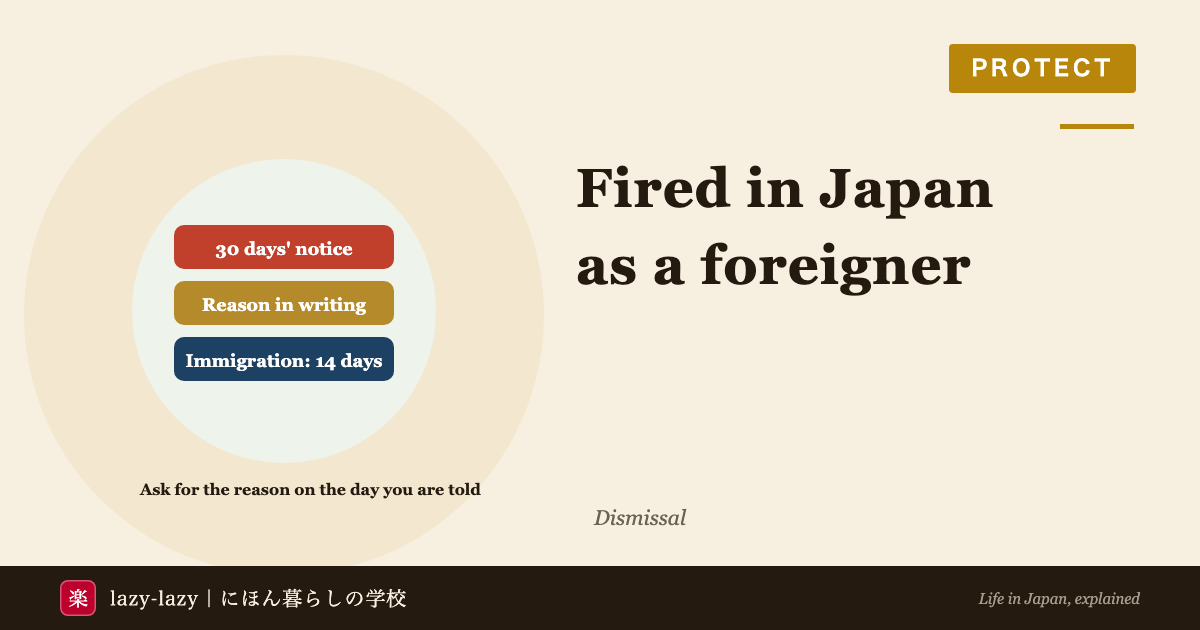
- Yes, you can be fired in Japan, but not freely. A dismissal without an objectively reasonable cause that is not appropriate by social norms is void (Labour Contract Act, Article 16). Treating you differently because of your nationality is banned.
- The employer must give 30 days’ notice, or pay your average wage for every day of notice it did not give. “Don’t come in tomorrow” means 30 days’ pay. Part-timers are covered too.
- You can demand the reason in writing. Once you ask, the employer must issue a certificate without delay (Labour Standards Act, Article 22).
- Non-renewal of a fixed-term contract has rules too. After three or more renewals, or more than a year of work, you get 30 days’ notice. Where renewal was reasonably expected, a non-renewal without good reason does not stand.
- On a work status, notify Immigration within 14 days. Three months without working makes your status liable to cancellation, but an active job search is one of Immigration’s examples of a justifiable reason. Unemployment benefit after dismissal starts after a seven-day wait.
Knowing this, you can ask for notice pay and a written reason on the day you are told to go, and you know which of the 14-day and three-month clocks to deal with first.
After closing, the manager calls you over. “You don’t need to come in from tomorrow.” You ask why. “It’s the company’s decision.” Your Japanese co-workers say it is unfair, but nobody mentions notice pay, and nobody mentions your visa. For them, losing a job is only about the job. For you, it is also about your residence status.
- Can you get fired in Japan? Only with a real reason
- Notice of dismissal in Japan: 30 days, or 30 days’ pay
- Can I get the reason for dismissal in writing?
- Contract not renewed? Fixed-term workers get notice and reasons too
- Can I be fired during probation in Japan?
- Off work with a work injury or on maternity leave? You cannot be dismissed
- Asked to resign? That is not a dismissal
- What happens to my visa if I get fired in Japan?
- Unemployment benefit after being fired: it starts after seven days
- How much can I get, and does help cost anything?
- What if the employer breaks the rules?
- Which one are you?
- FAQ
- Summary
- Related reading
Can you get fired in Japan? Only with a real reason
Dismissal means the employer ends the employment contract on its own. It is different from quitting, and from leaving by mutual agreement.
Article 16 of the Labour Contract Act makes a dismissal void if it “lacks objectively reasonable grounds and is not considered appropriate in general social terms”. The Ministry of Health, Labour and Welfare (MHLW) explains that a single mistake does not normally justify dismissal. How serious the fault was, the damage to the company and any unavoidable circumstances are all weighed, and in the end a court decides. Cutting staff because business is bad is judged even more strictly, because the reason lies with the company.
Being a foreigner changes none of this. Article 3 of the Labour Standards Act bans discrimination in working conditions on the grounds of nationality. The law also bans dismissal because you reported the employer to the Labour Standards Inspection Office, because of pregnancy, childbirth or maternity leave, because you asked for childcare leave, because you reported power harassment, or because you joined a union (MHLW summary).
Employers must list the grounds for dismissal in their work rules. Find out which ground they say applies to you. That is the first step, whether you fight it or accept it.
Notice of dismissal in Japan: 30 days, or 30 days’ pay
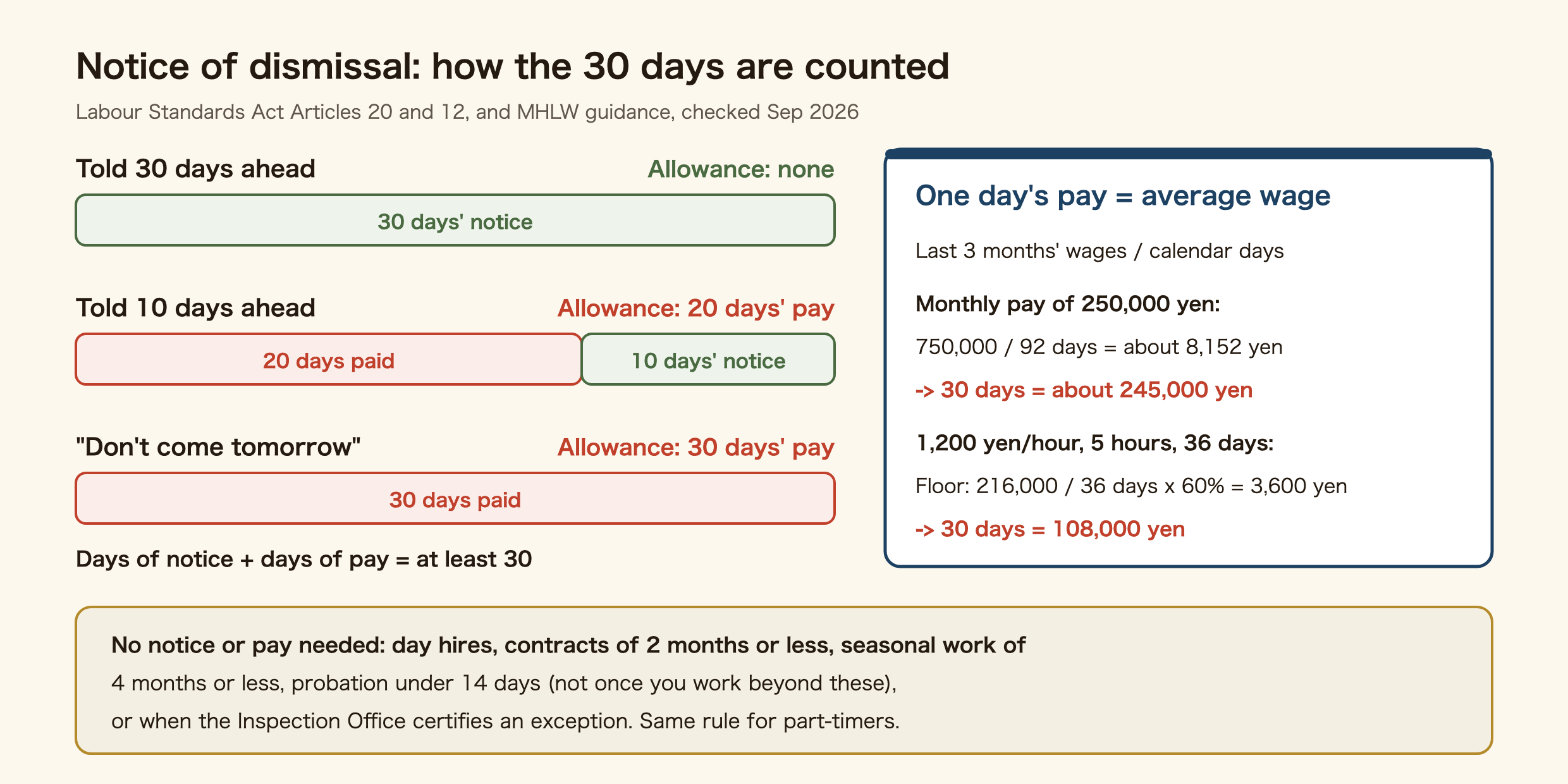
Even with a valid reason, the employer must announce a dismissal at least 30 days in advance (Labour Standards Act, Article 20). If it does not, it must pay at least 30 days of your average wage. This is the dismissal notice allowance (kaiko yokoku teate). Notice and pay add up: told 10 days ahead, you are owed the other 20 days’ pay (MHLW’s example).
One day of “average wage” is your wages for the last three months divided by the calendar days in those months, weekends included (Article 12). If your pay has a cut-off date, count back from the last one. Bonuses are left out.
On 250,000 yen a month, that is 750,000 ÷ 92 days, about 8,152 yen a day, so 30 days comes to about 245,000 yen. Hourly and daily workers also have a floor: the total divided by the days actually worked, times 60%. At 1,200 yen an hour, five hours a day and 36 days in three months, that is 216,000 ÷ 36 × 60% = 3,600 yen, so 30 days is 108,000 yen.
The exceptions are fixed by law (Article 21): day hires, contracts of two months or less, seasonal contracts of four months or less, and people on probation. But notice is required once a day hire works past one month, someone on probation past 14 days, and the others past the agreed period.
A disaster that makes the business impossible to continue, or a dismissal for the worker’s own fault, is also an exception, but only with certification from the head of the Labour Standards Inspection Office (Article 20). Without it, “it was your mistake” does not remove the notice or the pay.
Can I get the reason for dismissal in writing?
Yes. If you ask between the day you are given notice and your last day, the employer must issue a certificate stating the reason without delay (Labour Standards Act, Article 22-2). After you leave, you can still ask for a certificate of employment that states the reason for leaving, including the reason for a dismissal (22-1). An employer that refuses faces a fine of up to 300,000 yen (Article 120).
Ask by email or another method that leaves a record. What you want in writing is which ground in the work rules they rely on, and the facts behind it. MHLW notes that this helps if you challenge the dismissal.
Keep these with the certificate.
- A note of the date you were told, and the exact words used
- The dismissal notice and the certificate of reasons
- Your written working conditions or employment contract (it shows the contract period and whether it can be renewed)
- The page of the work rules listing grounds for dismissal
- Your last three months of payslips (to calculate notice pay)
Contract not renewed? Fixed-term workers get notice and reasons too
Non-renewal (yatoidome) is when the employer does not renew a fixed-term contract at the end of its term. A contract normally ends with its term, but these rules apply.
- 30 days’ notice — if the contract has been renewed three or more times, or you have worked there continuously for more than a year, the employer must tell you at least 30 days before the end. This does not apply if non-renewal was made clear from the start (MHLW standard on fixed-term contracts, Article 2).
- Written reasons — if you ask, the employer must give you a certificate of the reason without delay, also after the contract has ended (Article 3).
- When a reason is required — if repeated renewals have made the contract no different from a permanent one, or you had reasonable grounds to expect renewal, a non-renewal without good reason does not stand. The contract is treated as renewed on the same terms (Labour Contract Act, Article 19).
- Mid-term dismissal — only for an unavoidable reason (Labour Contract Act, Article 17).
Article 19 works only when you ask for renewal. The law requires you to apply before the term ends, or without delay after it. Send “I would like to renew my contract” by email so there is a record.
Since April 2024, an employer that adds or lowers a cap such as “renewals up to X times” partway through must explain why in advance (Article 1 of the standard).
Can I be fired during probation in Japan?
After 14 days, even on probation, you are owed 30 days’ notice or notice pay (Labour Standards Act, Article 21).
A reason is still needed. Based on court cases, MHLW explains that ending a contract during probation is allowed more widely than an ordinary dismissal, but only with an objectively reasonable cause that is appropriate by social norms. A typical case is a fact the employer could not have known when hiring that comes to light during probation (Central Labour Relations Commission casebook). “You’re on probation” is not a reason on its own.
Off work with a work injury or on maternity leave? You cannot be dismissed
While you are off work to recover from a work injury or work-related illness, and for 30 days after. While you are on maternity leave before and after birth, and for 30 days after. During these periods the employer cannot dismiss you (Labour Standards Act, Article 19). The only exceptions are a final compensation payment when treatment has not ended after three years (Article 81), and a disaster that makes the business impossible to continue, certified by the Inspection Office.
Treatment and lost pay after a work injury are covered by rosai insurance. For the money during maternity leave, see maternity and childcare leave pay.
Asked to resign? That is not a dismissal
When the employer says “Would you leave?”, that is a request to resign (taishoku kanshō), not a dismissal. Whether to agree is your decision. MHLW says a request that interferes with your free decision can be an unlawful infringement of your rights.
If you agree and leave, it does not count as leaving for personal reasons (MHLW). Hello Work treats you like a dismissed worker, as a “specified qualified recipient”. Watch the separation notice. You are supposed to check the reason written on it before you leave, so if it says “personal reasons”, say so on the spot. Even later, Hello Work will look into the facts and decide the reason if you object.
What happens to my visa if I get fired in Japan?
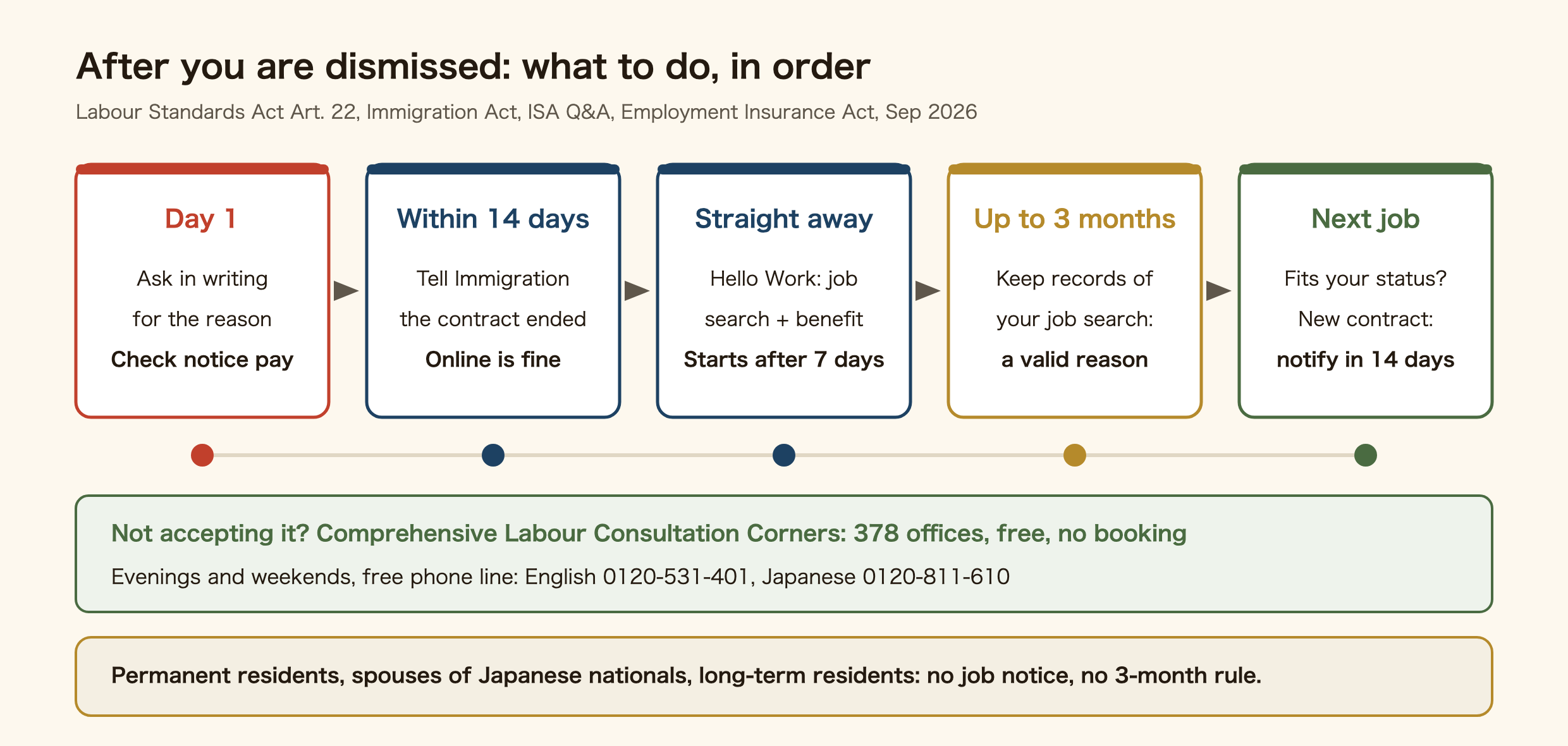
Your visa (residence status) does not end on the day you are fired. But if you hold a work status, two clocks start.
The first is 14 days. Holders of Engineer/Specialist in Humanities/International Services, Specified Skilled Worker, Skilled Labor, Nursing Care and similar statuses must file a “notification regarding the contracting organisation” within 14 days of the contract ending. Business Manager, Intra-company Transferee, Technical Intern Training and similar statuses file a “notification regarding the activity organisation” (Immigration Control Act, Article 19-16). You can file online. Not filing can mean a fine of up to 200,000 yen.
The second is three months. If you have not carried out the activity of your status for three months or more in a row, your status becomes liable to cancellation (Article 22-4), unless there is a justifiable reason. Immigration’s Q&A gives as an example a person who, after leaving a job, is actively looking for the next one, visiting companies and so on. Keep your Hello Work slip, the companies and dates you applied to, and interview records, starting today. How cancellation works is in what really gets a visa cancelled in Japan.
Permanent residents, spouses of Japanese nationals, spouses of permanent residents and long-term residents have neither the notification nor the three-month rule, because work is not the activity their status is based on. A student who loses a part-time job does not notify Immigration either: the activity of Student status is studying.
If you lost the job through bankruptcy, downsizing and similar reasons and have found nothing after three months, there is another route. If you are aiming for Specified Skilled Worker, you may be able to change to “Designated Activities (employment continuation support)” (Immigration Services Agency). The steps are in changing jobs on a Specified Skilled Worker visa. When you find the next job, check it fits your status, and notify the new contract within 14 days.
Unemployment benefit after being fired: it starts after seven days
A dismissed worker is a “specified qualified recipient” at Hello Work. You need six months of employment insurance in the year before leaving (people who quit need 12 months in two years). There is no benefit restriction period like the one for people who quit: payment is due once the seven-day waiting period after registering is over (Employment Insurance Act, Articles 21 and 33). You get 90 to 330 days depending on age and years insured.
Non-renewal is treated similarly. If you were renewed into three or more years of work, or were told the contract would be renewed, you are a specified qualified recipient. If you wanted renewal but no agreement was reached, you are a “specified-reason leaver”. The exception is a dismissal for serious fault of your own: then a restriction of one to three months applies (Article 33).
Amounts and steps are in unemployment benefits for foreigners. Health insurance and pension from the next day work the same as for someone who quit. Leaving a job in Japan gives the order of the three offices to visit.
How much can I get, and does help cost anything?
| Item | Amount |
|---|---|
| Dismissal notice allowance | Average wage × (30 days − days of notice given) |
| Wages still owed after you leave | Must be paid within 7 days of your request (Labour Standards Act, Article 23) |
| A dismissal found void as unlawful | Right to wages from the dismissal date |
| Consultation at a Consultation Corner or Inspection Office | Free |
| Labour Bureau advice and guidance, or mediation | Free |
| Working Conditions Hotline (phone) | Free |
Severance pay is not guaranteed by law. It exists only if the company has a scheme, which is then set out in its work rules (Labour Standards Act, Article 89).
What if the employer breaks the rules?
Dismissal with no notice and no notice pay, or dismissal of someone off work with a work injury or on maternity leave, breaks the Labour Standards Act. The penalty is up to six months’ imprisonment or a fine of up to 300,000 yen (Article 119). You can report it to the Labour Standards Inspection Office for your workplace. Dismissing you because you reported it is also banned (Article 104).
“I don’t accept the reason” or “this dismissal should be void” is a civil dispute. The place to take it is the Comprehensive Labour Consultation Corner of the prefectural Labour Bureau.
- Comprehensive Labour Consultation Corners — 378 offices nationwide. Free, no booking, and they cover dismissal and non-renewal. They take consultations from foreign workers in a range of languages. Closed at weekends, on public holidays and over New Year. You can also apply there for advice and guidance from the Labour Bureau, or for mediation by an expert (free and private).
- Working Conditions Hotline — a free phone line run for MHLW. Weekdays 5-10 pm, weekends and holidays 9 am-9 pm. English 0120-531-401, Chinese 0120-531-402 and Japanese 0120-811-610 every day. Vietnamese 0120-531-406 on Tuesday, Wednesday and Friday to Sunday; Nepali 0120-531-408 on Wednesday and Sunday.
Which one are you?
- Told “don’t come in tomorrow” — email your employer today asking for a certificate of the reason and for the notice allowance. Work out the amount from your last three months of payslips.
- Told your contract will not be renewed — count the renewals and total time in your contracts. If you want to stay, email “I would like to renew my contract” before the term ends.
- Asked to resign — do not sign a resignation letter on the spot. If you decide to agree, check that the separation notice does not say “personal reasons”.
- Already dismissed and staying in Japan on a work status — file with Immigration within 14 days from today. Register at Hello Work and start keeping records of every application and interview.
FAQ
Q. Do foreigners get the dismissal notice allowance in Japan?
Yes. Discrimination by nationality is banned, and part-timers are covered too. The exceptions are day hires, contracts of two months or less, probation under 14 days and similar (not once you work beyond these), and cases certified by the Inspection Office.
Q. How much is the dismissal notice allowance?
Your average wage times the days of notice you did not get, out of 30. Fired on the spot on 250,000 yen a month, that is about 245,000 yen.
Q. My employer will not tell me why I was fired.
Ask for a certificate of the reason for dismissal. The employer must issue it without delay (Labour Standards Act, Article 22), or face a fine of up to 300,000 yen.
Q. Do I get notice if my fixed-term contract is not renewed?
Yes, 30 days before the end, if the contract has been renewed three or more times or you have worked there for more than a year. It does not apply if non-renewal was made clear from the start.
Q. What happens to my visa if I get fired in Japan?
It does not end right away. On a work status, notify Immigration within 14 days. Three months without your status activity makes it liable to cancellation, but an active job search is an example of a justifiable reason.
Q. Can I get unemployment benefit straight away after being fired?
Payment is due after a seven-day waiting period from registering at Hello Work. There is no restriction period, except after a dismissal for serious fault of your own.
Summary
An employer in Japan cannot fire you at will. Without a real reason the dismissal is void, and even with one you are owed 30 days’ notice or pay for the missing days. You can demand the reason in writing. Fixed-term workers are also owed notice, and sometimes a reason, when a contract is not renewed.
On a work status, dismissal starts a 14-day clock and a three-month clock. File with Immigration, go to Hello Work, and keep a record of your job search. A dismissal you do not accept can go to a free Consultation Corner. Start by asking for the reason in writing on the day you are told.
Official sources: Labour Standards Act, Articles 3, 12, 19-23, 81, 89, 104, 119, 120 (e-Gov, Japanese) / Labour Contract Act, Articles 16-19 (e-Gov, Japanese) / MHLW standard on fixed-term contracts and non-renewal (Japanese) / MHLW rules on ending employment contracts (Japanese) / MHLW Check Your Working Conditions: resignation, dismissal, non-renewal (Japanese) / Hello Work, specified qualified recipients (Japanese) / Immigration Services Agency, cancellation of status / ISA immigration and residence Q&A / MHLW Comprehensive Labour Consultation Corners / MHLW consultation for foreign workers. Checked on 23 September 2026. Whether a particular dismissal is valid is ultimately for a court to decide.
Related reading
Found this useful? Share it
Send it to a friend who lives in Japan.
WHO WROTE THIS

mori
Japanese. I read the ministries’ own notices, orders and Q&As in the original, and I start from what my Nepalese and Sri Lankan friends in Japan actually ran into. I do not write about what I have not checked or been told.
What this site can and cannot do →Looking for something else?