Checked on 23 September 2026 against the Prime Minister’s Office preparedness pages, the Japan Meteorological Agency, the Cabinet Office (Disaster Management), the Immigration Services Agency’s Living and Working Guidebook, the Japan Tourism Agency, NHK and NTT East, and the text of the Disaster Countermeasures Basic Act.
The short answer
- When the earthquake alert sounds, protect your head and get under a sturdy table. Do not run outside. Do the same if you feel the shaking first.
- An evacuation site is where you run first; an evacuation shelter is where you stay if you cannot go home. Foreign residents can use both. Look up the ones near your home on the hazard map now.
- To get alerts in your language, install “Safety tips”, a free app supervised by the Japan Tourism Agency (15 languages). Nepali is included.
- Store at least 3 litres of drinking water per person per day for three days — 9 litres each. For a large disaster, a week’s supply is recommended.
- To reach family, use 171 (voice) and web171 (text). Family abroad can read web171. You can practise on the 1st and 15th of every month.
Knowing this, you can settle where to shelter, where to go and how to reach your family before anything happens, in your own language, instead of guessing in a panic on the day.
In the middle of the night your phone makes a sound you have never heard. The screen is in Japanese. A few seconds later the room starts to shake. When it stops, you do not know whether to go outside or where you would even go. You ask a Japanese friend the next day what you are supposed to do. “Just get under the table,” they say. They have practised since primary school, so the rest feels too obvious to explain. If you grew up somewhere without earthquakes, the obvious part is exactly what you are missing.
- What to do in an earthquake in Japan: when the alert sounds, protect your head
- What to do after an earthquake in Japan: fire first, then decide whether to leave
- Evacuation site or evacuation shelter? Foreign residents can use both
- How to read a hazard map in Japan: enter your address, then check each disaster type
- Japan earthquake apps in English and other languages: Safety tips, NHK and the Meteorological Agency
- Earthquake preparedness kit for Japan: how much water and food
- Can’t reach your family after an earthquake? Use 171 and web171
- Lost your residence card or passport in a disaster? Card: Immigration within 14 days
- What is a Nankai Trough “megaquake advisory”, and what do you do?
- How much does it cost?
- Which one are you?
- FAQ
- Summary
- Related reading
What to do in an earthquake in Japan: when the alert sounds, protect your head
The Earthquake Early Warning is the Japan Meteorological Agency’s alert that estimates, right after a quake starts, how strong the shaking will be and when it will reach each area — and tells you before the strong shaking arrives. When shaking of intensity 5-lower or more is expected, a warning goes out on TV, radio, mobile phones and the local outdoor loudspeakers. On a phone, the major carriers use a shared, dedicated buzzer sound.
Between the alert and the strong shaking you have a few seconds, at most a few tens of seconds. Putting the Prime Minister’s Office and the Meteorological Agency guidance together, this is what to do.
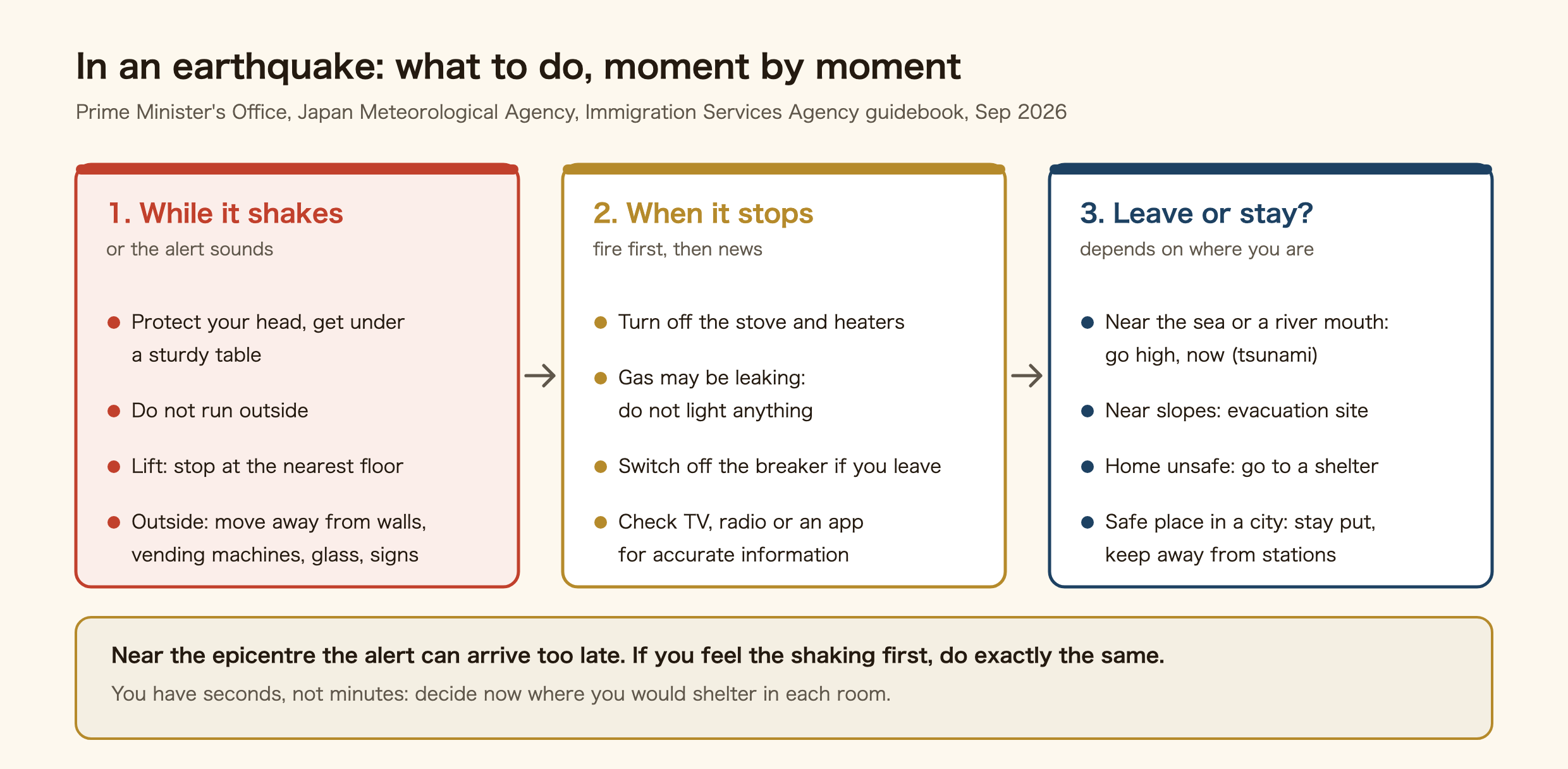
- At home: protect your head, move away from large furniture, and get under a sturdy table
- Do not rush outside
- Cooking: turn off the flame if you can do it where you are. If you are away from it, do not go back to put it out
- Open a door so you have a way out
- In a lift: stop at the nearest floor and get out
- Outside: move away from block walls, vending machines, signs and windows that could break
- In a large shop or other crowded building: follow the staff, and do not rush for the exits or stairs
Close to the epicentre, the alert can arrive after the shaking has started. The Meteorological Agency says that if you feel the shaking first, you do exactly the same. Do not wait for the alert to move.
The “shindo” (seismic intensity) you hear on the news is how strongly the ground shakes where you are. Japan uses 10 levels: 0, 1, 2, 3, 4, 5-lower, 5-upper, 6-lower, 6-upper and 7. Magnitude is a different number: the size of the earthquake itself.
What to do after an earthquake in Japan: fire first, then decide whether to leave
Once the shaking stops, deal with fire. The Immigration Services Agency’s guidebook says to turn off the kitchen and heaters when the shaking stops, and not to light anything because gas may be leaking. If you leave home, switch off the breaker first. When the power comes back, electrical fires can start.
Then decide whether to go. The answer depends on where you are.
- Near the sea or a river mouth: if you feel strong shaking, or weak but long, slow shaking, go to high ground or a tsunami evacuation building without waiting for a warning. Stay away from the coast until warnings are lifted
- Near hills or slopes: once the shaking stops, go to the evacuation site your city designates
- Your home is damaged or unsafe: go to an evacuation shelter
- In a safe place in a city: do not move around unnecessarily. Keep away from stations, where crowds can fall on each other
The Prime Minister’s Office warns that after a big quake in a large city, the first three days or so are chaotic, with fires and rescues taking priority. If your home or workplace is safe, staying there is also a way of keeping safe. Get your information from TV, radio or a multilingual app.
Evacuation site or evacuation shelter? Foreign residents can use both
The names sound alike, but the jobs are different. In the Great East Japan Earthquake of 2011 the two were not clearly separated, and that was one reason the damage spread. In 2013 the law was changed so that cities designate them separately (Cabinet Office White Paper on Disaster Management 2021).
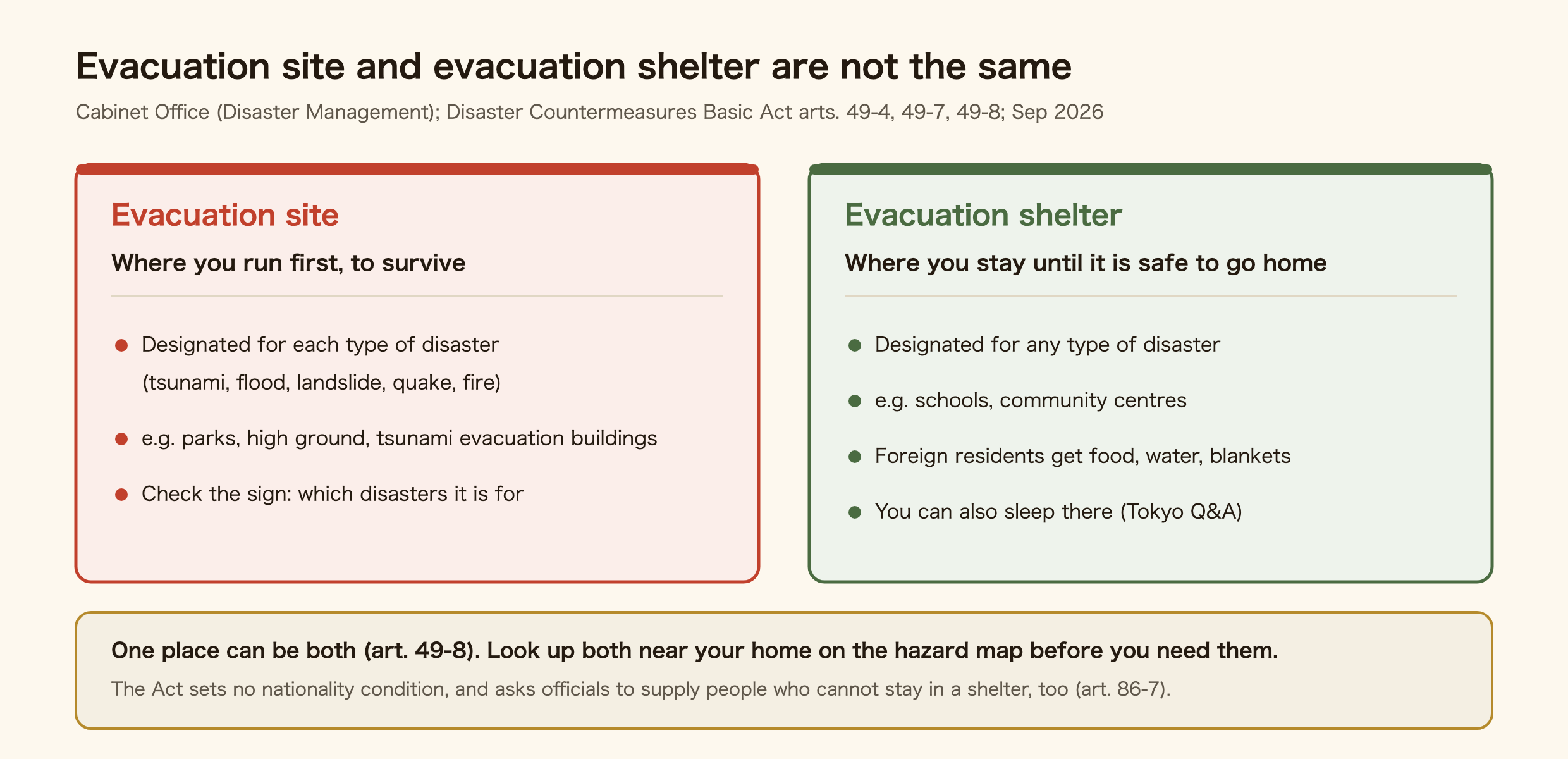
A designated emergency evacuation site (hinan basho) is a place you run to urgently to save your life. According to the Cabinet Office, sites are designated separately for each type of disaster: flood, landslide, earthquake, tsunami, large fire and so on. A site that is safe in a tsunami is not necessarily safe in a flood. The sign at the site shows which disasters it is for.
A designated evacuation shelter (hinanjo) is a building where people stay until the danger has passed, or while they cannot go home. They are often schools or community centres, and they are designated regardless of the type of disaster. One building can be both (Disaster Countermeasures Basic Act, Article 49-8).
Foreign residents can use shelters. A disaster Q&A for foreign residents written by Tokyo, and published on the Cabinet Office’s disaster site, says that at a shelter foreigners too receive food, drinking water, blankets and daily necessities, and can sleep there. For special spaces such as somewhere to pray, it says to ask the staff. A Niigata Prefecture guide tells staff to explain shelters as a place where “nationality does not matter”. The articles of the law that set up shelters contain no nationality condition either.
Some people cannot stay in a shelter. Article 86-7 of the Act asks officials to keep track of disaster victims who, for unavoidable reasons, cannot stay in a shelter, and to try to get supplies and information to them too. If you stay at home, ask at the nearest shelter how to receive food and information.
How to read a hazard map in Japan: enter your address, then check each disaster type
A hazard map shows which places are likely to become dangerous in a disaster, and where the evacuation sites are. The Ministry of Land, Infrastructure, Transport and Tourism runs a Hazard Map Portal that covers the whole country.
- Open the overlay map (“Kasaneru hazard map”) and enter your home address, or use your current location
- Under disaster types, display flood and inland flooding, landslides, storm surge and tsunami one at a time
- If your home is coloured, check the legend to see what that colour means
- Find the nearest evacuation site and shelter. Since 13 July 2026 the overlay map can also show designated shelters
- From the “Wagamachi hazard map” link, open the map your own city has published
The Prime Minister’s Office points out that the safe place to go differs by type of disaster: heavy rain, tsunami, eruption. If a tsunami could follow an earthquake where you live, pick a site that is designated for tsunami. Once you have chosen, walk the route from home once.
When you move house, do it again for the new address. Doing it together with your address registration means you will not forget.
Japan earthquake apps in English and other languages: Safety tips, NHK and the Meteorological Agency
Before the next quake, install something that gives you alerts in a language you can read. These three are confirmed on official pages.
| Name | From | Languages | What it sends |
|---|---|---|---|
| Safety tips (app) | Supervised by the Japan Tourism Agency, since October 2014 | 15: Japanese, English, Chinese (simplified and traditional), Korean, Spanish, Portuguese, Vietnamese, Thai, Indonesian, Tagalog, Nepali, Khmer, Burmese, Mongolian | Earthquake Early Warnings, tsunami warnings, emergency weather warnings, eruption alerts, typhoons, heatstroke. Also an action flowchart and communication cards to show people around you |
| NHK WORLD-JAPAN (app) | NHK | Alerts in 11: English, Chinese, French, Hindi, Indonesian, Korean, Portuguese, Russian, Spanish, Thai, Vietnamese. News in 19 | Earthquake and tsunami alerts, and emergency weather warnings |
| Meteorological Agency multilingual pages (web) | Japan Meteorological Agency | The same 15 as Safety tips | Weather, heavy rain and heat, earthquakes, tsunami, volcanoes |
Safety tips was built for visitors, but its official page says it is useful for residents too, and the Immigration Services Agency’s guidebook lists it as a free app. For Nepali speakers, Safety tips and the Meteorological Agency pages are the two options here. We found no Sinhala in any of them (as of 23 September 2026). In that case, set English or Japanese, and look at the communication cards before you need them.
The Cabinet Office publishes a leaflet listing these apps and sites in 15 languages. It suggests sticking it somewhere you can see it straight away. A printed copy still works when your phone battery is dead.
Earthquake preparedness kit for Japan: how much water and food
The Prime Minister’s Office guideline for households is three days of drinking water at 3 litres per person per day, and three days of emergency food. For a large-scale disaster, a week’s supply is recommended. The sum is 3 litres × people × days.
| People | Water for 3 days (minimum) | Water for 1 week |
|---|---|---|
| 1 | 9 litres | 21 litres |
| 2 | 18 litres | 42 litres |
| 4 | 36 litres | 84 litres |
That is drinking water only. You need separate water to flush the toilet. The Prime Minister’s Office suggests keeping a plastic tank of tap water, or leaving the bath full.
You do not need special emergency food. The Prime Minister’s Office recommends stocking the food you already eat. Buy extra of what keeps, eat it, and replace it. Keep doing that and there are always three days of food at home.
Keep a grab bag near the door as well. The Prime Minister’s Office checklist includes water, food, a torch, a portable radio, spare batteries and a charger, and first-aid supplies. Its list of valuables includes your passport, next to bankbooks and cash. Your residence card can stay in your wallet, since you are required to carry it anyway.
Inside, fix furniture to the wall, and keep furniture out of the room you sleep in as far as you can. In the Great Hanshin-Awaji Earthquake and others, many people were killed or badly hurt by falling furniture (Prime Minister’s Office). Keep a torch, slippers and a whistle within reach of where you sleep.
Can’t reach your family after an earthquake? Use 171 and web171
After a big quake, calls pile up and phone lines jam. That is when NTT switches on the Disaster Emergency Message Dial (171) and the Disaster Message Board (web171).
- 171 (voice): call 171, press 1 to record or 2 to play back, then enter the phone number of the person in the disaster area, including the area code. Each message can be up to 30 seconds
- web171 (text): on the web171 site, enter a phone number and leave a message of up to 100 characters. The site can be switched to English, Korean or Chinese
- Mobile carriers’ message boards: docomo, au, SoftBank / Y!mobile and Rakuten Mobile have their own
If your family is abroad, this is the part that matters: web171 can be read from overseas. NTT East says messages can be checked by phone number from anywhere in Japan or abroad, and more messages can be added. You can register up to 10 email addresses to be notified when a message is left. Voice notifications cannot be sent to international numbers.
Agree with your family now: “I will leave messages on web171 under my mobile number.” Without an agreed number, the person searching cannot find you. You can try it out on the 1st and 15th of every month, 1–3 January, 15–21 January and 30 August–5 September. Leave one message yourself and have your family read it, so the real thing is not the first time.
Lost your residence card or passport in a disaster? Card: Immigration within 14 days
If your residence card is lost because your home collapsed or burned, your status of residence does not disappear. You still have to apply for a replacement card, within 14 days of learning it is gone.
The Immigration Services Agency says that for a disaster, you submit a disaster certificate (risai shomeisho) or similar instead of the police-report statement. If you cannot get one, you may be asked for a written explanation. If your passport is gone too and you cannot show it, a written reason is accepted. There is no fee, and the new card is normally issued the same day.
Never applying is an offence: up to one year of imprisonment or a fine of up to 200,000 yen (Immigration Control Act, Article 71-2). You can still apply after 14 days, but you will need an extra written reason. The full list of what to bring is in what to do when you lose your residence card. Your passport is issued by your own government, so ask your country’s embassy or consulate about replacing it.
If you are hurt in the quake or on the way out, how to see a doctor in Japan and when to call 119 will help.
What is a Nankai Trough “megaquake advisory”, and what do you do?
The Nankai Trough Earthquake Extra Information is issued by the Meteorological Agency when, among other things, the chance of a major quake along the Nankai Trough is judged higher than usual. Nankai Trough earthquakes are large quakes that have struck roughly every 100 to 150 years, in a zone from Suruga Bay to off Hyuganada (Prime Minister’s Office).
It comes with one of four keywords. The Cabinet Office’s English leaflet calls them “Under Analysis”, “Megathrust Earthquake Alert”, “Megathrust Earthquake Attention” and “Analysis Complete”. News in English usually calls the third one a “megaquake advisory”.
- Under Analysis: an unusual event is being assessed. The result comes in about two hours at the earliest
- Megathrust Earthquake Alert: residents who could not evacuate in time after a quake evacuate in advance for one week. Everyone else stays ready to leave at once. A further week of the “Attention” response follows
- Megathrust Earthquake Attention (the “megaquake advisory”): review your preparations, stay ready to leave at once, and carry your emergency items with you. Evacuate on your own if needed
- Analysis Complete: back to normal life, though the chance of a big quake has not gone away
“Megathrust Earthquake Attention” was issued once, at 19:15 on 8 August 2024. On 13 January 2025 “Under Analysis” was issued and closed as “Analysis Complete” the same night (Meteorological Agency issuance history).
This is not a prediction. The Meteorological Agency says current science cannot pinpoint when or where the quake will happen, and it can strike with no advance information at all. The special responses are called for in the designated Nankai Trough promotion areas, based on places expecting tsunami of 3 metres or more or shaking of 6-lower or more. For the Japan and Chishima Trenches off Hokkaido and Sanriku in the north, a similar advisory is issued after an M7-class quake.
How much does it cost?
| Item | Cost |
|---|---|
| Safety tips | Free |
| NHK WORLD-JAPAN app | No charge (data charges apply) |
| Recording or playing a 171 message | Free from NTT East and West phones. From a mobile, check with your carrier. No charge for storing messages |
| Disaster public phones set up at shelters | Free |
| web171 | Free (internet charges apply) |
| Replacing your residence card | No fee |
| Water and food stock | Your normal groceries, bought a little ahead |
The only real spending is on your stock and grab bag. You do not have to buy it all at once. Start with 9 litres of water per person, then three days of the tins and pouches you already eat. Building it up step by step is enough.
Which one are you?
- Just arrived and have done nothing yet — install Safety tips and set your language. Put your address into the hazard map and write down one evacuation site and one shelter near home. Do it today.
- Your family is abroad — send them: “I will leave messages on web171 under my mobile number.” On the next 1st or 15th, leave a practice message. Today, just send the number.
- No water or food at home — buy 9 litres of water per person on today’s shopping trip. Put a torch and charger in a grab bag, and decide where your passport lives.
- You live near the sea or in a Nankai Trough promotion area — walk the route to a tsunami evacuation site or high ground once, today. Put the bag you would carry during a “megaquake advisory” by the door.
FAQ
Q. Can foreigners use evacuation shelters in Japan?
Yes. Tokyo’s disaster Q&A for foreign residents, published on the Cabinet Office site, says foreigners too receive food, water and blankets at shelters and can sleep there. The articles of the law that set up shelters contain no nationality condition.
Q. What should I do when the earthquake alert goes off?
Protect your head and get under a sturdy table. Do not run outside. In a lift, get off at the nearest floor; outside, move away from block walls and vending machines. Do the same if you feel the shaking first.
Q. Is there an earthquake app in English or Nepali?
Safety tips, supervised by the Japan Tourism Agency, works in 15 languages including English and Nepali. It sends Earthquake Early Warnings and tsunami warnings. The NHK WORLD-JAPAN app sends alerts in 11 languages, and the Meteorological Agency’s web pages come in 15.
Q. How much water and food should I store?
The Prime Minister’s Office guideline is 3 litres of drinking water per person per day for three days, plus three days of food. That is 9 litres for one person. A week’s supply is recommended for a large disaster. Toilet water is extra.
Q. How do I contact my family after an earthquake?
Use NTT’s Disaster Emergency Message Dial 171 or the web171 message board. Messages on web171 can be read from abroad. Practise on the 1st or 15th of a month.
Q. What happens if I lose my residence card in an earthquake?
Your status stays valid, but apply for a replacement at Immigration within 14 days of learning it is lost. For a disaster, submit a disaster certificate or similar instead of the police statement. There is no fee.
Summary
An earthquake is easier to handle when you split it by time. While it shakes, protect your head under a table. When it stops, deal with fire and decide whether to leave based on where you are. An evacuation site is where you run first; a shelter is where you stay. Foreign residents can use both.
Three things can be done before the next quake. Install Safety tips in your language. Look up the site and shelter near your home on the hazard map, and walk there once. Store 9 litres of water per person, and agree with your family which number you will use on web171. All of it can start today, at almost no cost.
Official sources: Prime Minister’s Office, preparing before a disaster (Japanese) / Prime Minister’s Office, earthquakes (Japanese) / JMA, when you see or hear an Earthquake Early Warning (Japanese) / JMA, Nankai Trough earthquake information (Japanese) / JMA multilingual disaster information / Cabinet Office, evacuation sites (Japanese) / Cabinet Office, helpful apps and websites in a disaster / Immigration Services Agency, Living and Working Guidebook / Japan Tourism Agency, Safety tips / MLIT Hazard Map Portal (Japanese) / NTT East, web171. Checked on 23 September 2026. Always confirm your evacuation site and shelter on your own city’s official pages.
Related reading
Found this useful? Share it
Send it to a friend who lives in Japan.
WHO WROTE THIS

mori
Japanese. I read the ministries’ own notices, orders and Q&As in the original, and I start from what my Nepalese and Sri Lankan friends in Japan actually ran into. I do not write about what I have not checked or been told.
What this site can and cannot do →Looking for something else?